


need help adjusting dwell on m/c solenoid
 01-27-2009, 04:36 PM
#1
Junior Member
Thread Starter

Join Date: Jul 2006
Location: DE
Posts: 50
Likes: 0
Received 0 Likes
on
0 Posts
Car: 84 z28
Engine: 305 vin H
Transmission: auto
need help adjusting dwell on m/c solenoid
84 z28 305H carb#17084201 Rochester quadrajet. Just got done rebuilding my first quadrajet put on car and fired right up! I set tps to .5v at curb idle was .6v and goes up to 4.2 wot. Tested m/c solenoid across terminals and had 20 ohms and is clicking when key is turned on. I set the lean mixture solenoid screw using a 1.304 tube spacer that I made, lean screw is out 3-5/8 turns. I adjusted rich solenoid screw to get 1/8" travel. I then used a gauge that I made from 5/32 rod and bent into candy cane shape gauge that measures 1.756" from tip to tip to set iab valve which was 4-1/2 turns out from shut. Also set float level to 11/32". Soaked in carb dip prior to rebuild. Didn't bother to remove factory plugs from idle mixture screws. I thought the factory setting was good enough and that I would just adjust the iab to get proper dwell. Ran car at high idle for awhile to get up to normal temp. Hooked up dwell meter to diagnostic wire. At low idle, dwell reads 54 on 6cyl scale. Tried opening up iab to seven turns and needle did not move at all. At 2000-25000 rpms, it reads between 30-35 at seven turns out, up in the 40's when iab is set back to initial 4-1/2 turns. Do I need to remove carb and drill out idle mixture plugs and screw in further?  Car does seem to load up at idle after a while. I replaced o2 sensor two years ago. Could it be acting up? Also need to add that the charcoal canister was unplugged from carb and carb inlet tube was capped.
Car does seem to load up at idle after a while. I replaced o2 sensor two years ago. Could it be acting up? Also need to add that the charcoal canister was unplugged from carb and carb inlet tube was capped. Last edited by dirtpoor1; 01-27-2009 at 05:18 PM.
 01-27-2009, 07:29 PM
#2
Supreme Member


Re: need help adjusting dwell on m/c solenoid
Where are you attaching the leads to measure dwell? We've had "issues" with how people have measured dwell on this board before. Stuff that's had a few of us beating our heads against a wall before we figured out the problem wasn't the carb, it was how the dwell meter was hooked up.
Always drive the car for a while before you adjust the mixture screws or IAB. You need to be CERTAIN you are in closed loop and I'm not absolutely sure you are guaranteed to get in closed loop just idling in the driveway for a while.
Your initial bench adjustments on everything are definitely within the realm of sanity. Don't see anything that says "whoah, he's way off the edge of the map on that one!"
Always drive the car for a while before you adjust the mixture screws or IAB. You need to be CERTAIN you are in closed loop and I'm not absolutely sure you are guaranteed to get in closed loop just idling in the driveway for a while.
Your initial bench adjustments on everything are definitely within the realm of sanity. Don't see anything that says "whoah, he's way off the edge of the map on that one!"
01-27-2009, 07:33 PM
#3
Junior Member
Thread Starter
Join Date: Jul 2006
Location: DE
Posts: 50
Likes: 0
Received 0 Likes
on
0 Posts
Car: 84 z28
Engine: 305 vin H
Transmission: auto
Re: need help adjusting dwell on m/c solenoid
had green lead of dwell meter hooked to the diagnostic wire back by the blower motor, had black lead of dwell meter hooked to neg terminal of battery. What exactly is open and closed loop? thank you.
01-28-2009, 07:19 AM
#4
Supreme Member
Re: need help adjusting dwell on m/c solenoid
You're hooking up the dwell meter properly, so that's not it.
Closed loop is when the ECM is using the O2 sensor to provide feedback on how to trim the mixture by adjusting the duty cycle of the mixture control solenoid. Engine temp is only one of the factors that the ECM uses to determine if it's time to go into closed loop.
If it's not looking at the O2 yet (i.e. it's still in open loop) it's running off a pre-programmed duty cycle table programmed into the ECM. Your adjustments at the carb won't make any difference in the duty cycle you are reading. That's why it's important to be certain you're driven around enough that you're in closed loop before making any carb adjustments based on duty cycle.
Closed loop is when the ECM is using the O2 sensor to provide feedback on how to trim the mixture by adjusting the duty cycle of the mixture control solenoid. Engine temp is only one of the factors that the ECM uses to determine if it's time to go into closed loop.
If it's not looking at the O2 yet (i.e. it's still in open loop) it's running off a pre-programmed duty cycle table programmed into the ECM. Your adjustments at the carb won't make any difference in the duty cycle you are reading. That's why it's important to be certain you're driven around enough that you're in closed loop before making any carb adjustments based on duty cycle.
01-28-2009, 07:50 AM
#5
Supreme Member
iTrader: (7)

Join Date: May 2004
Location: Lexington, SC
Posts: 5,291
Likes: 0
Received 58 Likes
on
52 Posts
Car: 1987 SC/1985 TA
Engine: 350/vortec/fitech
Transmission: T56
Axle/Gears: 3.27 9-bolt
Re: need help adjusting dwell on m/c solenoid
You'll know its in closed loop when choking the airhorn with a rag causes a change in dwell reading. Dwell should increase as it attempts to lean the mixture. Sounds like your motor's not quite fully warmed up.
01-28-2009, 08:48 AM
#6
Junior Member
Thread Starter
Join Date: Jul 2006
Location: DE
Posts: 50
Likes: 0
Received 0 Likes
on
0 Posts
Car: 84 z28
Engine: 305 vin H
Transmission: auto
Re: need help adjusting dwell on m/c solenoid
OK, I'll try driving it around for a while and see what happens then. It seemed a little odd that it would go to 54 on the 6cyl dwell scale and just sit there like a rock. Is 7 turns out on the iab too much to be in the accepted adjusting range?
01-28-2009, 09:27 AM
#7
Supreme Member
iTrader: (7)
Join Date: May 2004
Location: Lexington, SC
Posts: 5,291
Likes: 0
Received 58 Likes
on
52 Posts
Car: 1987 SC/1985 TA
Engine: 350/vortec/fitech
Transmission: T56
Axle/Gears: 3.27 9-bolt
Re: need help adjusting dwell on m/c solenoid
If its stuck on 54 either the O2 isn't sending good data yet or the ECM is trying to lean out a rich mixture. If opening a vacuum source lowers your dwell reading you''ll know you're in feedback mode and if you can bring it near 50% by adjusting IAB, you're there. I wouldn't go much more than 7 turns out though.
If you're not in closed loop try setting the IAB at 2 turns out and give it about a minute for the dwell to respond. If no response add half a turn out. Keep going til you get to 7. You'll know its good when the dwell meter begins wavering back and forth +/- 10 degrees or so.
Trending Topics
01-28-2009, 09:44 AM
#8
Junior Member
Thread Starter
Join Date: Jul 2006
Location: DE
Posts: 50
Likes: 0
Received 0 Likes
on
0 Posts
Car: 84 z28
Engine: 305 vin H
Transmission: auto
Re: need help adjusting dwell on m/c solenoid
question: does car need to be in drive at idle to check dwell? thanks.
01-28-2009, 10:07 AM
#9
Supreme Member
iTrader: (7)
Join Date: May 2004
Location: Lexington, SC
Posts: 5,291
Likes: 0
Received 58 Likes
on
52 Posts
Car: 1987 SC/1985 TA
Engine: 350/vortec/fitech
Transmission: T56
Axle/Gears: 3.27 9-bolt
Re: need help adjusting dwell on m/c solenoid
I usually set mine in park. I've set them in drive before and didn't have an appreciable difference between the dwell in park or drive.
01-28-2009, 02:01 PM
#10
Moderator
iTrader: (14)

Join Date: Mar 2000
Location: Littleton, CO USA
Posts: 43,169
Likes: 0
Received 35 Likes
on
34 Posts
Car: 82 Berlinetta/57 Bel Air
Engine: LS1/LQ4
Transmission: 4L60E/4L80E
Axle/Gears: 12B-3.73/9"-3.89
The factory instructions (sticky above) says to have it in Drive, but I don't recall which way I set mine, or checking it in Drive vs. Park.
01-28-2009, 04:37 PM
#11
Senior Member

Join Date: Jul 2004
Location: Brooklyn, N.Y.
Posts: 515
Likes: 0
Received 0 Likes
on
0 Posts
Car: '83 Firebird S/E
Engine: The Chevy 305. with carburator
Transmission: 700R-4
Re: need help adjusting dwell on m/c solenoid
Had the same exact issues.
I was never able to get the darn thing to work properly until all the vacuum leaks were found and plugged.
Then it happened again. No closed-loop, or so I thought.
This time there was a major vacuum leak in this 4-nippled thing near the alternator top-bracket.
What I am trying to say is that when you think that the car is not in closed-loop, it may simply already have such a bad air leak, that when you purposely try to make that dwell meter move, it doesn't.
Seth
I was never able to get the darn thing to work properly until all the vacuum leaks were found and plugged.
Then it happened again. No closed-loop, or so I thought.
This time there was a major vacuum leak in this 4-nippled thing near the alternator top-bracket.
What I am trying to say is that when you think that the car is not in closed-loop, it may simply already have such a bad air leak, that when you purposely try to make that dwell meter move, it doesn't.
Seth
01-28-2009, 08:09 PM
#12
Supreme Member
iTrader: (7)
Join Date: May 2004
Location: Lexington, SC
Posts: 5,291
Likes: 0
Received 58 Likes
on
52 Posts
Car: 1987 SC/1985 TA
Engine: 350/vortec/fitech
Transmission: T56
Axle/Gears: 3.27 9-bolt
Re: need help adjusting dwell on m/c solenoid
Had the same exact issues.
I was never able to get the darn thing to work properly until all the vacuum leaks were found and plugged.
Then it happened again. No closed-loop, or so I thought.
This time there was a major vacuum leak in this 4-nippled thing near the alternator top-bracket.
What I am trying to say is that when you think that the car is not in closed-loop, it may simply already have such a bad air leak, that when you purposely try to make that dwell meter move, it doesn't.
Seth
I was never able to get the darn thing to work properly until all the vacuum leaks were found and plugged.
Then it happened again. No closed-loop, or so I thought.
This time there was a major vacuum leak in this 4-nippled thing near the alternator top-bracket.
What I am trying to say is that when you think that the car is not in closed-loop, it may simply already have such a bad air leak, that when you purposely try to make that dwell meter move, it doesn't.
Seth
06-21-2017, 05:12 PM
#13
Junior Member

Join Date: Jun 2017
Posts: 10
Likes: 0
Received 0 Likes
on
0 Posts
Re: need help adjusting dwell on m/c solenoid
I'm trying to adjust using dwell on my 85 IROC. Could u please be more specific on how to hook up dwell meter?
06-21-2017, 06:32 PM
#14
Junior Member
Join Date: Jun 2017
Posts: 10
Likes: 0
Received 0 Likes
on
0 Posts
06-21-2017, 08:11 PM
#15
Senior Member
Join Date: Jul 2004
Location: Brooklyn, N.Y.
Posts: 515
Likes: 0
Received 0 Likes
on
0 Posts
Car: '83 Firebird S/E
Engine: The Chevy 305. with carburator
Transmission: 700R-4
Re: need help adjusting dwell on m/c solenoid
A thread brought back from the dead. I have had two cars since. First was a stunning 2004 GTO that drowned in the hurricane. Present car is a red one.
It is great that some of these older Firebirds are still on the road.
It is great that some of these older Firebirds are still on the road.
06-22-2017, 07:17 AM
#16
Supreme Member
iTrader: (7)
Join Date: May 2004
Location: Lexington, SC
Posts: 5,291
Likes: 0
Received 58 Likes
on
52 Posts
Car: 1987 SC/1985 TA
Engine: 350/vortec/fitech
Transmission: T56
Axle/Gears: 3.27 9-bolt
Re: need help adjusting dwell on m/c solenoid
You're still around? I've been driving my 85 nearly every day but have begun looking for something newer to take its place in the winter and during inclement weather. +300K miles on the body (assuming it only had +100K when I got it in '05). Takes some effort to keep it semi-nice.
for the dwell you'll need to look for a single wire green lead near the HVAC blower motor. it comes out of the ECM harness that passes through the passenger fender. you'll connect it to the dwell meter lead. If you have a non-powered dwell meter it will come with two leads-one to the green diagnostic lead and one to a convenient ground.
with the motor fully warmed up and the dwell meter connected, an ideal dwell reading should hover around 30 degrees (or 50%) swinging slightly back and forth as the dwell adjusts to O2 readings. choking the carb some with a rag should richen the mixture and cause the dwell to respond by leaning the mixture - higher dwell.
the dwell is a measure of the amount of time the rods stay down in the jets-restricting fuel flow. the MCS cycles 10 times per second but the hang time down is dwell. because the rods must come up/down the ecm cannot command 100% or 1% percent dwell.
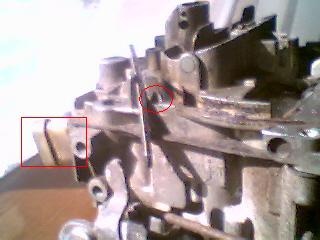
with all other settings on the carb correct and all other components functioning the dwell is adjusted to the center position (30 degrees/50%) by turning the Idle Air Bleed (IAB) screw in the center of the air horn. moving the IAB up (counter clockwise) allows more air into the mixture, leaning it. there may be a tamper proof cover over the IAB.
hook it up and tell us what you see. if you have a scan tool it may be more helpful because it will show other ECM parameters that can help confirm their proper operation or troubleshoot their non-functionality.
if you need to, you can start a new thread.
for the dwell you'll need to look for a single wire green lead near the HVAC blower motor. it comes out of the ECM harness that passes through the passenger fender. you'll connect it to the dwell meter lead. If you have a non-powered dwell meter it will come with two leads-one to the green diagnostic lead and one to a convenient ground.
with the motor fully warmed up and the dwell meter connected, an ideal dwell reading should hover around 30 degrees (or 50%) swinging slightly back and forth as the dwell adjusts to O2 readings. choking the carb some with a rag should richen the mixture and cause the dwell to respond by leaning the mixture - higher dwell.
the dwell is a measure of the amount of time the rods stay down in the jets-restricting fuel flow. the MCS cycles 10 times per second but the hang time down is dwell. because the rods must come up/down the ecm cannot command 100% or 1% percent dwell.
with all other settings on the carb correct and all other components functioning the dwell is adjusted to the center position (30 degrees/50%) by turning the Idle Air Bleed (IAB) screw in the center of the air horn. moving the IAB up (counter clockwise) allows more air into the mixture, leaning it. there may be a tamper proof cover over the IAB.
hook it up and tell us what you see. if you have a scan tool it may be more helpful because it will show other ECM parameters that can help confirm their proper operation or troubleshoot their non-functionality.
if you need to, you can start a new thread.
06-22-2017, 09:44 AM
#17
Junior Member
Join Date: Jun 2017
Posts: 10
Likes: 0
Received 0 Likes
on
0 Posts
Re: need help adjusting dwell on m/c solenoid
Thanks for the info. I'll check it out in the next couple days. Seems to be running rich as I've melted 2 converters down! Had carb rebuilt and runs great. No check engine light. So I'm guessing mixture is off a little or excessive fuels pressure causing a rich mixture. So we'll see.
06-22-2017, 12:48 PM
#18
Senior Member
Join Date: Jul 2004
Location: Brooklyn, N.Y.
Posts: 515
Likes: 0
Received 0 Likes
on
0 Posts
Car: '83 Firebird S/E
Engine: The Chevy 305. with carburator
Transmission: 700R-4
Re: need help adjusting dwell on m/c solenoid
Even before my '83 had its unfortunate incident, the body began suffering with the dreaded 'GM Thin Metal Syndrome'. First, the rear shocks broke off the body, then both sail panels cracked. I hate unit-body, especially when it is poorly done. Chrysler began using it in the mid-60's, but those cars weighed 2 1/2 tons.
06-30-2017, 09:53 AM
#19
Junior Member
Join Date: Jun 2017
Posts: 10
Likes: 0
Received 0 Likes
on
0 Posts
Re: need help adjusting dwell on m/c solenoid
You're still around? I've been driving my 85 nearly every day but have begun looking for something newer to take its place in the winter and during inclement weather. +300K miles on the body (assuming it only had +100K when I got it in '05). Takes some effort to keep it semi-nice.
for the dwell you'll need to look for a single wire green lead near the HVAC blower motor. it comes out of the ECM harness that passes through the passenger fender. you'll connect it to the dwell meter lead. If you have a non-powered dwell meter it will come with two leads-one to the green diagnostic lead and one to a convenient ground.
with the motor fully warmed up and the dwell meter connected, an ideal dwell reading should hover around 30 degrees (or 50%) swinging slightly back and forth as the dwell adjusts to O2 readings. choking the carb some with a rag should richen the mixture and cause the dwell to respond by leaning the mixture - higher dwell.
the dwell is a measure of the amount of time the rods stay down in the jets-restricting fuel flow. the MCS cycles 10 times per second but the hang time down is dwell. because the rods must come up/down the ecm cannot command 100% or 1% percent dwell.
with all other settings on the carb correct and all other components functioning the dwell is adjusted to the center position (30 degrees/50%) by turning the Idle Air Bleed (IAB) screw in the center of the air horn. moving the IAB up (counter clockwise) allows more air into the mixture, leaning it. there may be a tamper proof cover over the IAB.
hook it up and tell us what you see. if you have a scan tool it may be more helpful because it will show other ECM parameters that can help confirm their proper operation or troubleshoot their non-functionality.
if you need to, you can start a new thread.
for the dwell you'll need to look for a single wire green lead near the HVAC blower motor. it comes out of the ECM harness that passes through the passenger fender. you'll connect it to the dwell meter lead. If you have a non-powered dwell meter it will come with two leads-one to the green diagnostic lead and one to a convenient ground.
with the motor fully warmed up and the dwell meter connected, an ideal dwell reading should hover around 30 degrees (or 50%) swinging slightly back and forth as the dwell adjusts to O2 readings. choking the carb some with a rag should richen the mixture and cause the dwell to respond by leaning the mixture - higher dwell.
the dwell is a measure of the amount of time the rods stay down in the jets-restricting fuel flow. the MCS cycles 10 times per second but the hang time down is dwell. because the rods must come up/down the ecm cannot command 100% or 1% percent dwell.
with all other settings on the carb correct and all other components functioning the dwell is adjusted to the center position (30 degrees/50%) by turning the Idle Air Bleed (IAB) screw in the center of the air horn. moving the IAB up (counter clockwise) allows more air into the mixture, leaning it. there may be a tamper proof cover over the IAB.
hook it up and tell us what you see. if you have a scan tool it may be more helpful because it will show other ECM parameters that can help confirm their proper operation or troubleshoot their non-functionality.
if you need to, you can start a new thread.
06-30-2017, 07:59 PM
#20
 07-01-2017, 11:19 AM
#21
Junior Member
Join Date: Jun 2017
Posts: 10
Likes: 0
Received 0 Likes
on
0 Posts
Re: need help adjusting dwell on m/c solenoid
 07-02-2017, 06:47 PM
#22
Supreme Member
iTrader: (1)

Join Date: Feb 2017
Location: Meriden, CT 06450
Posts: 4,030
Received 511 Likes
on
428 Posts
Car: 84 TA orig. 305 LG4 "H" E4ME
Engine: 334 SBC - stroked 305 M4ME Q-Jet
Transmission: upgraded 700R4 3200 stall
Axle/Gears: 10bolt 4.10 Posi w Lakewood TA Bars
Re: need help adjusting dwell on m/c solenoid
Sometimes you can find that "socket" in a jewelers screwdriver set. I have an old set from Radio Shack that has it.

Thread
Thread Starter
Forum
Replies
Last Post
LT1Formula
Engine/Drivetrain/Suspension Parts for Sale
7
10-08-2015 08:34 PM
