


90-92 Tachometer fix....
 05-16-2009, 01:43 PM
#201
Junior Member

Join Date: Feb 2009
Location: Florence,KY
Posts: 4
Likes: 0
Received 0 Likes
on
0 Posts
Car: 1990 Camaro RS
Engine: L03
Transmission: Auto
Re: 90-92 Tachometer fix....
I will give that a shot when I get back home, it is time for new tires and alignment now.
 06-06-2009, 07:18 PM
#202
Junior Member
iTrader: (1)

Join Date: May 2009
Location: Charlotte, NC
Posts: 46
Likes: 0
Received 0 Likes
on
0 Posts
Car: 1991 Camaro RS
Engine: 305 TPI
Transmission: T5
Axle/Gears: 3.42 Std
Re: 90-92 Tachometer fix....
Add one more fixed tach to the list! 
THANK YOU SO MUCH to all those that put their time and effort not only into researching the issue, but in posting it for the rest to see. Your efforts are greatly appreciated!

THANK YOU SO MUCH to all those that put their time and effort not only into researching the issue, but in posting it for the rest to see. Your efforts are greatly appreciated!
06-22-2009, 10:29 AM
#203
Member

Join Date: Apr 2009
Location: San Antonio
Posts: 162
Likes: 0
Received 0 Likes
on
0 Posts
Car: 1990 RS
Engine: 305 TBI
Transmission: T-5
Axle/Gears: 3.08
Re: 90-92 Tachometer fix....
Okay tried it and failed. tach was reading super high and pegging out(originally). I clipped the #4 pin and solder'd 2 100k 1/2w ohm in parallel. started car, tach just pegged out. took it apart and solder'd them in series. Tach still pegs out. What the hell did I do wrong?
06-22-2009, 11:15 AM
#204
Junior Member

Join Date: Oct 2007
Location: Houston, TX
Posts: 36
Likes: 0
Received 0 Likes
on
0 Posts
Car: 89 IROC 5.7
Engine: 357
Transmission: T-56
Axle/Gears: 3.73
Re: 90-92 Tachometer fix....
Okay tried it and failed. tach was reading super high and pegging out(originally). I clipped the #4 pin and solder'd 2 100k 1/2w ohm in parallel. started car, tach just pegged out. took it apart and solder'd them in series. Tach still pegs out. What the hell did I do wrong?
For anyone still viewing this helpful thread, i have successfully repaired my tach (89 Iroc) by clipping pins 4 and 10 off, and soldering two 100k Ohm resistors in a series to bring me to 197.1k Ohms. Soldered them onto the board and tested it against my autometer tach. 99% accurate, revved in 200 rpm increments to 4000 rpm and it's dead on.
Resistors used were Radioshack
100 Piece
Carbon-Film Resistor Assortment
1/2 watt - 5% tolerance
Thanks TGO!
Resistors used were Radioshack
100 Piece
Carbon-Film Resistor Assortment
1/2 watt - 5% tolerance
Thanks TGO!
06-22-2009, 11:38 AM
#205
Member
Join Date: Apr 2009
Location: San Antonio
Posts: 162
Likes: 0
Received 0 Likes
on
0 Posts
Car: 1990 RS
Engine: 305 TBI
Transmission: T-5
Axle/Gears: 3.08
Re: 90-92 Tachometer fix....
07-20-2009, 09:53 AM
#206
Junior Member

Join Date: Jul 2009
Location: Trenton, OH
Posts: 5
Likes: 0
Received 0 Likes
on
0 Posts
Car: 1992 RS Camaro
Engine: Crate 350, XE CompCam
Transmission: WC T5
Axle/Gears: 4 Wheel Disc, 3.42 Gears
Re: 90-92 Tachometer fix....
My 1992 RS has this problem but it seems a little more harsh than others. My idle is at 3,000 RPMs... which I know is waaay off. Do you think this mod will help still or do you think
that I would need a lower/higher resistor value?
I just had the dash out on Saturday too. (Dang Engine Warning Light, well it's out now).. should have searched harder for this thread.
-AJ
that I would need a lower/higher resistor value?
I just had the dash out on Saturday too. (Dang Engine Warning Light, well it's out now).. should have searched harder for this thread.
-AJ
07-20-2009, 09:55 AM
#207
Junior Member
Join Date: Jul 2009
Location: Trenton, OH
Posts: 5
Likes: 0
Received 0 Likes
on
0 Posts
Car: 1992 RS Camaro
Engine: Crate 350, XE CompCam
Transmission: WC T5
Axle/Gears: 4 Wheel Disc, 3.42 Gears
Re: 90-92 Tachometer fix....
My 1992 RS has this problem but it seems worse than any of your problems. I'm 350 carb swapped and my idle on the inside gauge reads 2,250- 3,000 RPM (depending on cold start or when engine temp is up). I know that this is off. Do you think I would need a differant resistor value?
07-20-2009, 10:54 AM
#208
Junior Member
iTrader: (1)
Join Date: May 2009
Location: Charlotte, NC
Posts: 46
Likes: 0
Received 0 Likes
on
0 Posts
Car: 1991 Camaro RS
Engine: 305 TPI
Transmission: T5
Axle/Gears: 3.42 Std
Re: 90-92 Tachometer fix....
The resistor value is a constant. What happens is that the resistor pack can fail by either going to a complete open state (infinite resistance) where your tach will just peg or it can partially fail and you just end up with a higher resistance. Mine was around 3k at idle as well and I found that these pins on the resistor pack were reading around 500k.
Regardless of how far off the resistor pack is, the fix remains the same. Just remember to check the resistance of the resistors with an Ohm meter as they do vary by +/- %5 or so (usually -). With 2 100k resistors, you should be pretty close to 193k.
Regardless of how far off the resistor pack is, the fix remains the same. Just remember to check the resistance of the resistors with an Ohm meter as they do vary by +/- %5 or so (usually -). With 2 100k resistors, you should be pretty close to 193k.
07-20-2009, 11:31 AM
#209
Member


Re: 90-92 Tachometer fix....

Just be sure you clip the factory resistor so that it is completely out of the circuit. This fix should work for any car with a failed resistor.
Best of Luck
07-31-2009, 01:41 PM
#210
Junior Member

Join Date: Jul 2009
Location: SC
Posts: 10
Likes: 0
Received 0 Likes
on
0 Posts
Car: '90 Iroc
Engine: 350TPI
Transmission: 700R4
Axle/Gears: 3.23
Re: 90-92 Tachometer fix....
I performed the fix on mine yesterday and had the tach working well with several shutdowns and re-starts over the course of a few hrs. I went back out to the car after it sat for awhile yesterday evening and it had quit altogether. I just pulled the cluster back out and don't see anything wrong or burnt. I don't get it. What now?
07-31-2009, 02:00 PM
#211
Member
Re: 90-92 Tachometer fix....
Short story, Make sure everything is plugged in well, remeasure the resistance on your fix (check for short), check for voltage and ground on the plug to the cluster.
Given the scenario, my best bet would be a short / bad connection in the cluster or a bad solder connection / resistor. Solder off the resistors, ensure the pins are not contacting anything they shouldn't (i.e. other pins, solder areas) and solder on a new one.
You may try soldering a wire with a connector in each pin location so that you can plug in a POT, set the resistance to match the gauge to the actual measured RPM (using a timing light with readout, etc), unplug the POT, measure its resistance and plug in the appropriate resistor.
Given the scenario, my best bet would be a short / bad connection in the cluster or a bad solder connection / resistor. Solder off the resistors, ensure the pins are not contacting anything they shouldn't (i.e. other pins, solder areas) and solder on a new one.
You may try soldering a wire with a connector in each pin location so that you can plug in a POT, set the resistance to match the gauge to the actual measured RPM (using a timing light with readout, etc), unplug the POT, measure its resistance and plug in the appropriate resistor.
08-18-2009, 12:23 AM
#212

Re: 90-92 Tachometer fix....
Just did this on my 90 rs v6 and so far it seems to work. I used two 100k ohm resistors in series sodered to the back of the board and the pins clipped on the front. My reading before the fix was over 1M ohm resistance.
10-02-2009, 07:23 PM
#213
Junior Member

Join Date: Sep 2008
Posts: 1
Likes: 0
Received 0 Likes
on
0 Posts
Re: 90-92 Tachometer fix....
My tach showed the car idling at 3000rpm and when I was driving at 70mph, the tach was pinned.
I pulled the instrument panel out of my '90 vette and at first couldn't find the small circuit board that had the chips on it. A little closer look and I determined it was built directly into the main circuit board of the cluster! Strange. Anyway, I measured across 4 and 10 and didn't get a reading so I clipped pin 10 and soldered 2 100k resistors in series to pins 4 and 10. When I tested it out, she was sitting idling at 500rpm. I hooked up the computer and ran the diagnostic software and it showed 925 rpm. So, I pulled the cluster again, took off the resistors and measured them. 194k total. so I took another 100k resistor (all I bought) and threw it in the mix to get 298k and threw the cluster back in again. This time it sat idling at about 700 rpm and the computer showed 750 rpm. I brought it up to 3000 rpm and the computer showed 2800 rpm. Well, close enough to my liking!
Strange how the chips were part of the main circuit board, compared to pictures of others I found here. Also, that it took 298k instead of the 196k everyone else reports. Anyhow, I'm happy it's fixed!
I pulled the instrument panel out of my '90 vette and at first couldn't find the small circuit board that had the chips on it. A little closer look and I determined it was built directly into the main circuit board of the cluster! Strange. Anyway, I measured across 4 and 10 and didn't get a reading so I clipped pin 10 and soldered 2 100k resistors in series to pins 4 and 10. When I tested it out, she was sitting idling at 500rpm. I hooked up the computer and ran the diagnostic software and it showed 925 rpm. So, I pulled the cluster again, took off the resistors and measured them. 194k total. so I took another 100k resistor (all I bought) and threw it in the mix to get 298k and threw the cluster back in again. This time it sat idling at about 700 rpm and the computer showed 750 rpm. I brought it up to 3000 rpm and the computer showed 2800 rpm. Well, close enough to my liking!
Strange how the chips were part of the main circuit board, compared to pictures of others I found here. Also, that it took 298k instead of the 196k everyone else reports. Anyhow, I'm happy it's fixed!
10-20-2009, 11:04 PM
#214
Junior Member

Join Date: Oct 2009
Location: Trinity, NC
Posts: 11
Likes: 0
Received 0 Likes
on
0 Posts
Car: 91 Z28 Vert
Engine: 305 TPI
Transmission: 5-speed
Axle/Gears: Richmond 3.42
Re: 90-92 Tachometer fix....
WoooHooo!!! add one more fixed tach to list. My tach has been getting steadily worse since i bought it 7 years ago. Started about 500 off then it was about 4000 off. Idled over 4500 rpm, pegged if you rev it. Just never knew how to fix it and didnt want to change the cluster cause its got low miles. Thank you all for figuring out this fix. I'm so happy now.
11-15-2009, 10:09 PM
#215
Member

Join Date: Mar 2009
Location: Stonewall, LA
Posts: 166
Likes: 0
Received 1 Like
on
1 Post
Car: 1988 IROC Z
Engine: 350 5.7L Carb'd
Transmission: 700r4
Axle/Gears: Disc 2.77
Re: 90-92 Tachometer fix....
im gonna go ahead and do this resistor replacement, even though my cars an 88 not a 90-92, but i measured the resistor on the tach board and got nothing back, i figured i should get something so it lead me to believe the resistor chip is bad, instead of getting resistors i was gonna go with the potentiometer, i pulled one from an old busted up guitar, took out my multimeter and turned the **** until i got about 192k ohms, is it ok to use this?
also just incase im not reading the multimeter right(im a multimeter newb, finally went and bought one not to long ago), i have a picture
*edit* now when i test it with the multimeter, it says .192m ohm, is that the same as 192k ohm?
i know the reading of the multimeter is probably obvious, but still.. gimme a break, lol
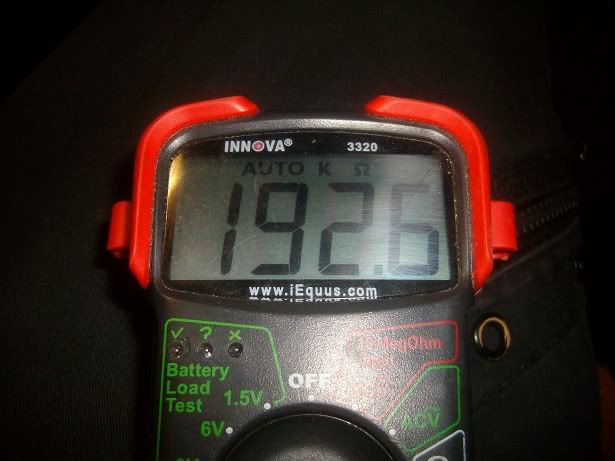
also just incase im not reading the multimeter right(im a multimeter newb, finally went and bought one not to long ago), i have a picture
*edit* now when i test it with the multimeter, it says .192m ohm, is that the same as 192k ohm?
i know the reading of the multimeter is probably obvious, but still.. gimme a break, lol
Last edited by wwwyzzerdd; 11-15-2009 at 10:39 PM.
11-16-2009, 05:14 PM
#216
Member
Join Date: Mar 2009
Location: Stonewall, LA
Posts: 166
Likes: 0
Received 1 Like
on
1 Post
Car: 1988 IROC Z
Engine: 350 5.7L Carb'd
Transmission: 700r4
Axle/Gears: Disc 2.77
Re: 90-92 Tachometer fix....
well i went ahead and did it, and it worked!... sort of, said i was idling at 500, i think im gonna have to use another 100k ohm resistor along with my pot, or i might just get 3 100k ohm resistors and solder them in
anyway this worked, my tach did have a faulty resistor, i avoided this thread for so long because my car isnt a 90-92, shouldve just tried it out a long time ago
anyway this worked, my tach did have a faulty resistor, i avoided this thread for so long because my car isnt a 90-92, shouldve just tried it out a long time ago
12-01-2009, 09:41 PM
#217
Junior Member

Join Date: Nov 2009
Location: Owasso, OK
Posts: 19
Likes: 0
Received 0 Likes
on
0 Posts
Re: 90-92 Tachometer fix....
Kudos and thanks to all who have put in the work to figure this out. I just did this on my 91 Camaro Z28, and it worked like a charm! I fully expected it to not work, but wound up pleasantly surprised. I measured the resistance from the 4-10 and it was initially 184K ohm. My tach was reading about twice what it should have been. I figured it wouldn't work only being about 10K ohm off. I put together a 100K, (2) 47K, and (1) 2.2K resistors. It was a pretty big set, but that was all I could get at Radio Shack. After soldering them together I got 194.8K ohm. I figured that would be close enough. Popped it in and it worked great! I guess practicing my soldering on XBOX mods finally payed off! Thanks again!
12-02-2009, 07:31 PM
#218
Member
Join Date: Mar 2009
Location: Stonewall, LA
Posts: 166
Likes: 0
Received 1 Like
on
1 Post
Car: 1988 IROC Z
Engine: 350 5.7L Carb'd
Transmission: 700r4
Axle/Gears: Disc 2.77
Re: 90-92 Tachometer fix....
Kudos and thanks to all who have put in the work to figure this out. I just did this on my 91 Camaro Z28, and it worked like a charm! I fully expected it to not work, but wound up pleasantly surprised. I measured the resistance from the 4-10 and it was initially 184K ohm. My tach was reading about twice what it should have been. I figured it wouldn't work only being about 10K ohm off. I put together a 100K, (2) 47K, and (1) 2.2K resistors. It was a pretty big set, but that was all I could get at Radio Shack. After soldering them together I got 194.8K ohm. I figured that would be close enough. Popped it in and it worked great! I guess practicing my soldering on XBOX mods finally payed off! Thanks again!
12-13-2009, 04:18 PM
#219
Member

Join Date: Nov 2009
Location: Hokesbluff, Al
Posts: 112
Likes: 0
Received 0 Likes
on
0 Posts
Car: iroc z
Re: 90-92 Tachometer fix....
i done two clusters today. one is spot on and the other one is about 3-400 rpm low. oh well, a tach that works at all is better than one pegged out all the time. good thread and if anybody needs a working cluster, let me know. i now have a spare and the spare is spot on.
 12-30-2009, 07:56 PM
#221
Senior Member
iTrader: (1)

Join Date: Mar 2000
Location: Charlotte NC
Posts: 609
Likes: 0
Received 0 Likes
on
0 Posts
Car: 92 Z28 Z03
Engine: 350
Transmission: 700-R4
Axle/Gears: 2.73 G80
Re: 90-92 Tachometer fix....
add another one to the list.....
I bought my car a month ago and the tach was always pegged at 7k rpm.
I removed the chip bought a solder and resistors and without any soldering experience before I was able to mount the resistors and get it to work. It wasn't clean but it did the job. (If I can do it anyone can)
I would like to thank everyone who took the time and effort to figure this out.. I would also like to thank TGO for this great website and the internet for making it possible to share this information.
I bought my car a month ago and the tach was always pegged at 7k rpm.
I removed the chip bought a solder and resistors and without any soldering experience before I was able to mount the resistors and get it to work. It wasn't clean but it did the job. (If I can do it anyone can)
I would like to thank everyone who took the time and effort to figure this out.
. I would also like to thank TGO for this great website and the internet for making it possible to share this information.
02-15-2010, 01:54 PM
#222
Senior Member
iTrader: (2)

Join Date: Oct 2001
Location: Sedalia, MO
Posts: 646
Likes: 0
Received 1 Like
on
1 Post
Car: 1991 Z28 vert, 1988 GTA
Engine: 305 TPI, 305 Carb-finally runs!
Transmission: TH-700R4/BW WC T-5
Axle/Gears: 3.73 posi 4th gen 10-bolt/BW 9 bolt
Re: 90-92 Tachometer fix....
I'm royally pissed right now. I just tried BOTH repair methods, the original one and marry's, and neither worked. Now I have two ruined boards. I have one more board left, so I guess I better not f*ck this one up, but I probably will because for some reason, it just is not meant for me to have a working tach. Oh wait, I did! The tach in the car was fine before I did this, just read high. So I though "well, let me try this repair, lots of folks have done it and had luck." Well I guess I'm not lucky. I'd like to know how in the f*ck all these people were succesful and I was not. I guess its just not meant for me to have an accurate tach. Guess I'll be stuck with one that just pegs itself out now every time I start it.
The last board I have before I am royally screwed, I have no idea if it came out of a 6 or 8 car, most likely an 8 car, I had it in my garage. I set my voltmeter to 2ook ohms and get nothing. I set it to 2M ohms and get .212 ohms. So what does that mean? Which repair method do I need to attempt and hopefully succeed but probably fail at?
The last board I have before I am royally screwed, I have no idea if it came out of a 6 or 8 car, most likely an 8 car, I had it in my garage. I set my voltmeter to 2ook ohms and get nothing. I set it to 2M ohms and get .212 ohms. So what does that mean? Which repair method do I need to attempt and hopefully succeed but probably fail at?
02-15-2010, 03:03 PM
#223
Member
iTrader: (1)

Join Date: Nov 2008
Location: Lynchburg, VA
Posts: 109
Likes: 0
Received 0 Likes
on
0 Posts
Car: 92 RS
Engine: 305 TBI
Transmission: T-5
Axle/Gears: 4th Gen/3.23/Posi
Re: 90-92 Tachometer fix....
Well how about you snap some pictures of your attempts at it so we could maybe see what went wrong. Seeing as there's tons of people who have done this with perfect success, either something was done wrong, or there is something wrong with either your car or the clusters you're using.
02-15-2010, 06:57 PM
#224
Senior Member
iTrader: (2)
Join Date: Oct 2001
Location: Sedalia, MO
Posts: 646
Likes: 0
Received 1 Like
on
1 Post
Car: 1991 Z28 vert, 1988 GTA
Engine: 305 TPI, 305 Carb-finally runs!
Transmission: TH-700R4/BW WC T-5
Axle/Gears: 3.73 posi 4th gen 10-bolt/BW 9 bolt
Re: 90-92 Tachometer fix....
I took the resistors off one of my failed attempts to reuse them on my new attempt, and i also took the 1M ohm pot off my first failed attempt in case i decided to reuse it. Before I even start, I'm gonna take my last board out and try it, see what happens. If the tach pegs out with that board, i'm going to poke around and see if something happened under the hood or to my tach to make it screwy.
If it matters, this tach worked perfectly before I started this, never pegged, always had smooth movement throughout the gauge, just read high.
If it matters, this tach worked perfectly before I started this, never pegged, always had smooth movement throughout the gauge, just read high.
02-15-2010, 11:49 PM
#226
Senior Member
iTrader: (2)
Join Date: Oct 2001
Location: Sedalia, MO
Posts: 646
Likes: 0
Received 1 Like
on
1 Post
Car: 1991 Z28 vert, 1988 GTA
Engine: 305 TPI, 305 Carb-finally runs!
Transmission: TH-700R4/BW WC T-5
Axle/Gears: 3.73 posi 4th gen 10-bolt/BW 9 bolt
Re: 90-92 Tachometer fix....
I used 196k total resistance, i used the pot like others on here to dial it in, but when it didnt work, i went to the resistors instead. but i just tried my third circuit board, and i don't know what happened, but it is within 25-50 RPMs of what my snap on mt2500 shows. so i left it like that. but now, somehow, my passenger side low beam headlight stays on even when the highbeams are turned on, and the high beams do work fine, the low just won't shut off on that side...grrrrr seems like i'm starting to get hit with all these little b*tch problems at once!
02-18-2010, 12:52 AM
#227
Senior Member

Join Date: May 2003
Location: Runnin' from the Reaper
Posts: 663
Likes: 0
Received 1 Like
on
1 Post
Car: 91 B4C/91 RS 305
Engine: L98 and L03
Transmission: 2xTH700R4
Axle/Gears: 3.23 LSD/2.73 Open
Re: 90-92 Tachometer fix....
great info. I was wondering if this should fix my dead tach as well and if anybody had a good link that explained how to get into the gauge cluster (tried a long time ago and couldn't find a screw or 2 so I never got in)
02-18-2010, 12:59 AM
#228
Senior Member
iTrader: (2)
Join Date: Oct 2001
Location: Sedalia, MO
Posts: 646
Likes: 0
Received 1 Like
on
1 Post
Car: 1991 Z28 vert, 1988 GTA
Engine: 305 TPI, 305 Carb-finally runs!
Transmission: TH-700R4/BW WC T-5
Axle/Gears: 3.73 posi 4th gen 10-bolt/BW 9 bolt
Re: 90-92 Tachometer fix....
if you are referring to your 91, its easy as pie. you don't have to remove the whole cluster from the car. remove the two torx screws holding the under dash panel to the dash. those are sort of in the middle of the panel, may or may not have little "buttons" covering the holes. there may be one or two screws towards the bottom of the panel as well. once all the screws are out, you can remove the panel. there are two small screws holding the gauge panel trim on, one is on the left and one on the right, the underdash panel covers them so you should see them now. pull them. next, reach up behind the dash under the headlight **** and feel on the headlight switch for a little button. turn on your lights and push that button to remove the ****. (disconnect battery or pull the lights fuse to not drain your battery). the trim just pops off, make ure to disconnect any wires for the cigar lighter and foglight switch (if you have foglights.) after the trim is off, you'll see some little tiny silver screws holding the lens and grey face trim on. remove them, and BAM there is your cluster, all exposed. follow instructions in this thread to repair. put it back together the opposite way it came apart.
02-21-2010, 05:22 PM
#229
Member

Join Date: Dec 2009
Location: Granite Falls, NC
Posts: 338
Likes: 0
Received 0 Likes
on
0 Posts
Car: 1992 Camaro RS
Engine: 305 TBI
Transmission: T5
Re: 90-92 Tachometer fix....
It fixed mine too. My speedometer was not working and I bought another cluster. The tach was not working on it too. I did this trick and now it reads perfect, THANK YOU!!!!!
03-06-2010, 10:38 PM
#230

Re: 90-92 Tachometer fix....
Tons of good info here but I cant seem to find a post that is similar to mine. A little guidance would help guyz. Here is my tach issue. I took my 86 IROC Z to a shop. The mech hooked up a Snap On computer in the ALDL port and I read the Idle RPM's at 1,000 on the computer. I looked at the Tach and it read 3,300 RPM's. I couldn't ask the mech to floor it so that I can record at what RPM's the tach would max out at because he too busy. So what approach should I take guyz?
Bump
Bump
Last edited by Chevy86 IROC-Z; 03-10-2010 at 12:12 PM.
03-29-2010, 04:07 PM
#232
Member

Join Date: Oct 2003
Location: Malta
Posts: 240
Likes: 0
Received 0 Likes
on
0 Posts
Car: 89 RS Camaro
Engine: 350 ci
Transmission: T5
Axle/Gears: 3:42
Re: 90-92 Tachometer fix....
does this way fix my problem?
the needle on the tacho reads good but the needle is not stable!! always jumping!!
any help? v8 tacho
the needle on the tacho reads good but the needle is not stable!! always jumping!!
any help? v8 tacho
04-15-2010, 10:07 AM
#233
Junior Member

Join Date: Apr 2010
Posts: 3
Likes: 0
Received 0 Likes
on
0 Posts
Re: 90-92 Tachometer fix....
Hi guys...
Somebody told me a couple of years ago about this fix, but never got to it...the car had a bad miss and since I had to fix that first, I did not bother with the Tach problem...reading through these posts has really fired me up to try the fix...now, is it the same board for the speedo? because mine pegs at start up too...('92 RS Convertible)
Jd
Somebody told me a couple of years ago about this fix, but never got to it...the car had a bad miss and since I had to fix that first, I did not bother with the Tach problem...reading through these posts has really fired me up to try the fix...now, is it the same board for the speedo? because mine pegs at start up too...('92 RS Convertible)
Jd
04-15-2010, 11:19 AM
#234
Re: 90-92 Tachometer fix....
Hi guys...
Somebody told me a couple of years ago about this fix, but never got to it...the car had a bad miss and since I had to fix that first, I did not bother with the Tach problem...reading through these posts has really fired me up to try the fix...now, is it the same board for the speedo? because mine pegs at start up too...('92 RS Convertible)
Jd
Somebody told me a couple of years ago about this fix, but never got to it...the car had a bad miss and since I had to fix that first, I did not bother with the Tach problem...reading through these posts has really fired me up to try the fix...now, is it the same board for the speedo? because mine pegs at start up too...('92 RS Convertible)
Jd
04-15-2010, 11:53 AM
#236
Member
iTrader: (1)
Join Date: Nov 2008
Location: Lynchburg, VA
Posts: 109
Likes: 0
Received 0 Likes
on
0 Posts
Car: 92 RS
Engine: 305 TBI
Transmission: T-5
Axle/Gears: 4th Gen/3.23/Posi
Re: 90-92 Tachometer fix....
Seeing as his signed off of his post saying he has a 92 Vert, I'm going to say it's safe to assume he hasn't converted back to a mechanical speedo... and he's running electrical.
Yes, the signal paths come in through the same board... but the fix to the tach is exclusive to the tach and won't fix any issues with the speedo. Search around and see if ya can't find anyone else who has had similar issues, and if ya come up dry then fire up a new thread on your speedo issue with some more info as to when it happens, what you've checked so far, etc...
Good luck
Yes, the signal paths come in through the same board... but the fix to the tach is exclusive to the tach and won't fix any issues with the speedo. Search around and see if ya can't find anyone else who has had similar issues, and if ya come up dry then fire up a new thread on your speedo issue with some more info as to when it happens, what you've checked so far, etc...
Good luck
04-15-2010, 01:33 PM
#238
Junior Member
Join Date: Apr 2010
Posts: 3
Likes: 0
Received 0 Likes
on
0 Posts
Re: 90-92 Tachometer fix....
Thanks for your responses...It is electrical...I've done some searching and looks like a possible bad VSS sensor...just wanted to make sure in case the signals went through the same resistor chip...Car is a '92 convertible, 25th Anniversary, white/red RS w/305 TBI...Fully stock; only exhaust pipes have been enlarged (2 1/4")...will post pics soon...Thanks again for your input!
Jd
Jd
04-15-2010, 04:19 PM
#240

Re: 90-92 Tachometer fix....
Could be a faulty ignition module in your dizzy sending strange signals (= maybe going bad).
You can hook up an scanning tool or a laptop with datamaster and scan and see the RPM value the ECM sees and see if thats stable or if that wiggles to, if its stable in the computer its your gauge thats failing doing its job. But if its unstable on the computer to it might be a bad connection bad grounds, low voltage or a bad igntion module on your dizzy..
And also the Speedometers are not electrical, they are mechanical. Atleast on 89 cause you have the speedometer wire going to it. or is that just for the odometer ?
04-15-2010, 04:23 PM
#241
Re: 90-92 Tachometer fix....
Could be a bad connection behind the RPM gauge (make sure the connections to the gauge is clean and not oxidized.
Could be a faulty ignition module in your dizzy sending strange signals (= maybe going bad).
You can hook up an scanning tool or a laptop with datamaster and scan and see the RPM value the ECM sees and see if thats stable or if that wiggles to, if its stable in the computer its your gauge thats failing doing its job. But if its unstable on the computer to it might be a bad connection bad grounds, low voltage or a bad igntion module on your dizzy..
And also the Speedometers are not electrical, they are mechanical. Atleast on 89 cause you have the speedometer wire going to it. or is that just for the odometer ?
Could be a faulty ignition module in your dizzy sending strange signals (= maybe going bad).
You can hook up an scanning tool or a laptop with datamaster and scan and see the RPM value the ECM sees and see if thats stable or if that wiggles to, if its stable in the computer its your gauge thats failing doing its job. But if its unstable on the computer to it might be a bad connection bad grounds, low voltage or a bad igntion module on your dizzy..
And also the Speedometers are not electrical, they are mechanical. Atleast on 89 cause you have the speedometer wire going to it. or is that just for the odometer ?
04-15-2010, 07:36 PM
#243
Junior Member
Join Date: Apr 2010
Posts: 3
Likes: 0
Received 0 Likes
on
0 Posts
Re: 90-92 Tachometer fix....
That's what I thought until I looked for a speedo cable on mine! Nowhere to be found...and since the "typical" schematics only show a mechanical, I was lost! Thanks for all the great stuff here!
Jd
 04-28-2010, 08:44 PM
#245
Junior Member

Join Date: Jan 2009
Location: New Zealand
Posts: 9
Likes: 0
Received 0 Likes
on
0 Posts
Car: 86 IROC
Engine: 305
Transmission: Auto
Re: 90-92 Tachometer fix....
I note that everyone appears to be fully removing the instrument cluster. In the pre 1990 type it is possible to remove the facia, then the metal surround and simply unplug (pull forward) the Tacho. A caution is that you must remember to protect the needles at all times.
I followed the early thread of Morley and Needaz and replaced the 0.086MF capacitor (approx behind 3240rpm). In my case that did not work. Tested old capacitor when out and it was close enough on my meter to its rating.
Next step, as previously stated by others, needle deflection is controlled by a resister/capacitor circuit. I have proven (in my case) that the capacitor is ok thus I must now deal to the resistor. I will follow the procedure used for 90-92 cars of clipping pins 4 & 10 and retrofitting a 196k ohm 1/2 watt 5%tolerance resistor. That is once I get my hands on one. Will post my result for all you pre 90 owners.
IMG_0389.JPG
Cheers John
I followed the early thread of Morley and Needaz and replaced the 0.086MF capacitor (approx behind 3240rpm). In my case that did not work. Tested old capacitor when out and it was close enough on my meter to its rating.
Next step, as previously stated by others, needle deflection is controlled by a resister/capacitor circuit. I have proven (in my case) that the capacitor is ok thus I must now deal to the resistor. I will follow the procedure used for 90-92 cars of clipping pins 4 & 10 and retrofitting a 196k ohm 1/2 watt 5%tolerance resistor. That is once I get my hands on one. Will post my result for all you pre 90 owners.
IMG_0389.JPG
Cheers John
Last edited by Haz; 04-28-2010 at 09:37 PM. Reason: add pic

 04-29-2010, 07:40 PM
#249
Junior Member
Join Date: Jan 2009
Location: New Zealand
Posts: 9
Likes: 0
Received 0 Likes
on
0 Posts
Car: 86 IROC
Engine: 305
Transmission: Auto
Re: 90-92 Tachometer fix....
Not sure if this helps you. My 86 IROC was showing double rpm so followed the pre 90 solution of replacing the 0.068MF capacitor in the needle deflection circuit. In my instance this made no change (old capacitor when tested was ok).
I then followed this thread with relation to the resistance across pins 4 & 10. I measured existing resistance and found 396k ohm (double correct resistance which correlates to my double rpm?) I note that some members found that this measured up to 500+k ohms for tachos that were pegging out.
Cut out pin 4 & 10, soldered in 196k ohm resistor. plugged tacho back in. Eureka!! a working tacho indicating approc650rpm @ idle.
Thank you to the people who put so much effort into this solution.
I then followed this thread with relation to the resistance across pins 4 & 10. I measured existing resistance and found 396k ohm (double correct resistance which correlates to my double rpm?) I note that some members found that this measured up to 500+k ohms for tachos that were pegging out.
Cut out pin 4 & 10, soldered in 196k ohm resistor. plugged tacho back in. Eureka!! a working tacho indicating approc650rpm @ idle.
Thank you to the people who put so much effort into this solution.
04-30-2010, 04:11 PM
#250
Re: 90-92 Tachometer fix....
Wow. I'm determined to fix my wacko tacho. Time will only tell because I've got another month and a half to finish the Spring semester in to community college that Im attending. Too much school gots me buzzy as hell.