


305 or 350?
 07-25-2009, 08:17 AM
#1
Supreme Member

Thread Starter

305 or 350?
Hi,
I posted this in my other thread, but I think it's getting lost and I'm going to look at the car tomorrow, so need to know.
Here is the problem,
I'm looking for a donor car, for the engine and tranny. I found an 87 Iroc in my area. The owner says it was originally a 305, but it now has a 350.
How can I tell if he's telling the truth or not?
I saw this thread
https://www.thirdgen.org/forums/faq-...305-350-a.html
and it appears, I can look up the casting number on the block?
Where is this number at? Is it something I can easily find?
Is there a website, I can go and type in the number and find out?
I'm going to look at the car tomorrow morning, so I hope someone knows.
I posted this in my other thread, but I think it's getting lost and I'm going to look at the car tomorrow, so need to know.
Here is the problem,
I'm looking for a donor car, for the engine and tranny. I found an 87 Iroc in my area. The owner says it was originally a 305, but it now has a 350.
How can I tell if he's telling the truth or not?
I saw this thread
https://www.thirdgen.org/forums/faq-...305-350-a.html
and it appears, I can look up the casting number on the block?
Where is this number at? Is it something I can easily find?
Is there a website, I can go and type in the number and find out?
I'm going to look at the car tomorrow morning, so I hope someone knows.
 07-25-2009, 11:41 AM
#2
Supreme Member
Thread Starter
Re: 305 or 350?
Well it turns out the car was a 305, when I asked for the casting numbers he then responded that it's most likely a 305 that's been bored out.
But for future reference, where is the casting number on the engine?
I found a site that lets you enter in the number to find out what it is.
But for future reference, where is the casting number on the engine?
I found a site that lets you enter in the number to find out what it is.
07-25-2009, 11:46 AM
#3
Supreme Member
iTrader: (3)

Join Date: Sep 2006
Location: sunny so cal.
Posts: 1,531
Likes: 0
Received 1 Like
on
1 Post
Car: 1990
Engine: 305
Transmission: 700r4
Axle/Gears: stock
Re: 305 or 350?
try here and save it for future use its a good reference site.
http://www.mortec.com/
hope it helps.
and in the sales section on this board there is an add on someone selling a 305 and trans. but the entire car would be nice for spairs.
but you can also hold out for a 350 - but remember not all 305's or 350's are the same.
http://www.mortec.com/
hope it helps.
and in the sales section on this board there is an add on someone selling a 305 and trans. but the entire car would be nice for spairs.
but you can also hold out for a 350 - but remember not all 305's or 350's are the same.
07-26-2009, 09:25 AM
#4
Supreme Member
Thread Starter
Re: 305 or 350?
try here and save it for future use its a good reference site.
http://www.mortec.com/
hope it helps.
and in the sales section on this board there is an add on someone selling a 305 and trans. but the entire car would be nice for spairs.
but you can also hold out for a 350 - but remember not all 305's or 350's are the same.
http://www.mortec.com/
hope it helps.
and in the sales section on this board there is an add on someone selling a 305 and trans. but the entire car would be nice for spairs.
but you can also hold out for a 350 - but remember not all 305's or 350's are the same.
Ya, I'm going to need the whole car. I'm doing a v6-v8 swap in my 84 and I really want a 87+TPI 350 car, and I'm going to need everything.. But good grief, they seem like all of a sudden they are impossible to find or any condition 4k+ now. Figures that I'm at the point where I have my car ready to go.
Last edited by cdoyle; 07-26-2009 at 09:50 AM.
07-26-2009, 08:19 PM
#5
Supreme Member

Join Date: Sep 2002
Location: Cary, North Carolina
Posts: 9,192
Likes: 0
Received 16 Likes
on
16 Posts
Car: 1992 RS
Engine: Carbed 350
Transmission: 700R4
Axle/Gears: 3.42 posi
Re: 305 or 350?
The casting numbers are on the top of the block, driver side. But even then, you don't always get the full story. If you notice on Mortec, alot of casting numbers are the same for different motors. Take a 1969 V8 block - the same number exists for a 302, 327, and 350 - even if you count main cap bolts you STILL are not sure, as the 302 and the 350 can have 4, and the 327 and the 350 can have 2. Often, you have to get block ID, crank ID, and count and count cap bolts to know exactly what you have.
For example - I have a 1969 block - it's casting number says one of the 3, bolt count says 327, but crank ID says 350 - thus, I have a 327. BUT .... it's a large journal 327 - which means that it can accept 350 internals - so somewhere in the last 40 years, it was rebuilt with a 350 crank, rods, pistons - so for all intensive purposes it's a 350 NOW. This all comes from "back in the day", when engineers actually were worth their pay, and designed things for the present and the future - as opposed to today's built it, use it, throw it away and get something else society (where the "engineers" just design to satisfy today's need, knowing that they have to change it tomorrow or they won't have anything else to do and they'll lose their job ).
).
Not meaning to scare you, but just an FYI - can't always believe what you see, and nothing is ever as it appears.
For example - I have a 1969 block - it's casting number says one of the 3, bolt count says 327, but crank ID says 350 - thus, I have a 327. BUT .... it's a large journal 327 - which means that it can accept 350 internals - so somewhere in the last 40 years, it was rebuilt with a 350 crank, rods, pistons - so for all intensive purposes it's a 350 NOW. This all comes from "back in the day", when engineers actually were worth their pay, and designed things for the present and the future - as opposed to today's built it, use it, throw it away and get something else society (where the "engineers" just design to satisfy today's need, knowing that they have to change it tomorrow or they won't have anything else to do and they'll lose their job
).Not meaning to scare you, but just an FYI - can't always believe what you see, and nothing is ever as it appears.
07-26-2009, 10:29 PM
#6
Supreme Member
Thread Starter
Re: 305 or 350?
The casting numbers are on the top of the block, driver side. But even then, you don't always get the full story. If you notice on Mortec, alot of casting numbers are the same for different motors. Take a 1969 V8 block - the same number exists for a 302, 327, and 350 - even if you count main cap bolts you STILL are not sure, as the 302 and the 350 can have 4, and the 327 and the 350 can have 2. Often, you have to get block ID, crank ID, and count and count cap bolts to know exactly what you have.
For example - I have a 1969 block - it's casting number says one of the 3, bolt count says 327, but crank ID says 350 - thus, I have a 327. BUT .... it's a large journal 327 - which means that it can accept 350 internals - so somewhere in the last 40 years, it was rebuilt with a 350 crank, rods, pistons - so for all intensive purposes it's a 350 NOW. This all comes from "back in the day", when engineers actually were worth their pay, and designed things for the present and the future - as opposed to today's built it, use it, throw it away and get something else society (where the "engineers" just design to satisfy today's need, knowing that they have to change it tomorrow or they won't have anything else to do and they'll lose their job ).
Not meaning to scare you, but just an FYI - can't always believe what you see, and nothing is ever as it appears.
For example - I have a 1969 block - it's casting number says one of the 3, bolt count says 327, but crank ID says 350 - thus, I have a 327. BUT .... it's a large journal 327 - which means that it can accept 350 internals - so somewhere in the last 40 years, it was rebuilt with a 350 crank, rods, pistons - so for all intensive purposes it's a 350 NOW. This all comes from "back in the day", when engineers actually were worth their pay, and designed things for the present and the future - as opposed to today's built it, use it, throw it away and get something else society (where the "engineers" just design to satisfy today's need, knowing that they have to change it tomorrow or they won't have anything else to do and they'll lose their job
).Not meaning to scare you, but just an FYI - can't always believe what you see, and nothing is ever as it appears.
I think to be safe, since I just want to get this darn car on the road again. Is find an 87ztpi car that came originally with the 350. I'm hoping that most likely nobody replaced it with a 305 lol.
07-26-2009, 11:43 PM
#7
TGO Supporter

Join Date: Oct 2002
Location: Saskatoon, SK, Canada
Posts: 9,067
Likes: 0
Received 1 Like
on
1 Post
Car: '83 Z28, '07 Charger SRT8
Engine: 454ci, 6.1 Hemi
Transmission: TH350, A5
Axle/Gears: 2.73 posi, 3.06 posi
Re: 305 or 350?
This is a Pontiac block, not a Chevy, but look at where the casting number is in the pic. Its in the same spot on the opposite side (on the drivers side) on a Chevy block.
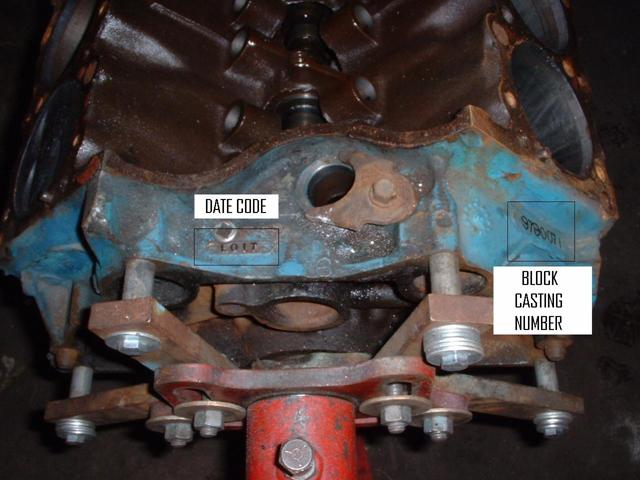
Casting number doesn't tell you everything about an engine, but it will tell you what size block it is (the bore size). The 350 uses a block with a 4" bore, which is shared with the 302 and 327 (if its an 010 block, which is the most common one). While there is a chance it could be a 302 or 327 - 99% of those blocks were assembled as 350ci, so the odds would be good at it being a 350. The 302 is a rare and prized animal, and the 327 was only built for one year with that block, as was the 302. The 350 was built for 10 years with that block.
Get the last 3 digits of the casting number on the block and report back or just look it up on Google. It won't tell you anything specific about the engine (HP, compression, what car it came from, etc) but it will tell you if its a 350 block or a 305 block, or something else.
Casting number doesn't tell you everything about an engine, but it will tell you what size block it is (the bore size). The 350 uses a block with a 4" bore, which is shared with the 302 and 327 (if its an 010 block, which is the most common one). While there is a chance it could be a 302 or 327 - 99% of those blocks were assembled as 350ci, so the odds would be good at it being a 350. The 302 is a rare and prized animal, and the 327 was only built for one year with that block, as was the 302. The 350 was built for 10 years with that block.
Get the last 3 digits of the casting number on the block and report back or just look it up on Google. It won't tell you anything specific about the engine (HP, compression, what car it came from, etc) but it will tell you if its a 350 block or a 305 block, or something else.

Thread
Thread Starter
Forum
Replies
Last Post


