


HOW TO: INSTALLING A TURBO


 09-24-2007, 11:12 AM
#102
Junior Member

Join Date: Jun 2007
Posts: 10
Likes: 0
Received 0 Likes
on
0 Posts
Re: HOW TO: INSTALLING A TURBO
so i recived my turbo sat. and yes it is a bit small.. but im ok with it considering this is my first turbo install i've ever done, so its a learning process for me.. does it matter which bov and wastegate ill be using?
Last edited by whitechevy; 09-24-2007 at 11:16 AM.
09-25-2007, 11:19 PM
#103
Junior Member
Join Date: Jun 2007
Posts: 10
Likes: 0
Received 0 Likes
on
0 Posts
Re: HOW TO: INSTALLING A TURBO
alright.. i noticed u have a sensor near the turbo.. is that just something you have to have for your car but i dont need it for mine? or in other words is is just for your computer? but mine, i dont need the sensor?
Last edited by whitechevy; 09-25-2007 at 11:49 PM.
10-03-2007, 08:51 PM
#104
Junior Member

Join Date: Sep 2007
Location: adirondack moutains NY
Posts: 92
Likes: 0
Received 0 Likes
on
0 Posts
Car: bandit II Firebird
Engine: 3.1
Transmission: auto
Axle/Gears: 3.42
Re: HOW TO: INSTALLING A TURBO
10-03-2007, 09:21 PM
#105
Re: HOW TO: INSTALLING A TURBO
White, that is the o2 sensor. If using the stock sensor, keep it between the turbo and exhaust manifolds, preferably after the two merege.
tank, 3.1/2.8/3.4 RWD's are almost identical engines, so yes.
I can't stress enough that tuning is the key here guys. I rebuilt my motor twice due to detonation and bad tuning. If these are your daily drivers, please be aware of getting enough fuel supplied.
tank, 3.1/2.8/3.4 RWD's are almost identical engines, so yes.
I can't stress enough that tuning is the key here guys. I rebuilt my motor twice due to detonation and bad tuning. If these are your daily drivers, please be aware of getting enough fuel supplied.
10-03-2007, 11:58 PM
#107
Re: HOW TO: INSTALLING A TURBO
Yeah, that's how my car is when it's running 
You might not be happy with that m24 (t25 class turbo), it's going to run out of steam real early, but it will help a little. You might see 200hp. A pair would be better served on the 3.1, Nissan uses two on their 3.0L's. Mfgr's are known for using turbos that are on the small side for an engine (3.1 turbo Pontiac for example).
You might not be happy with that m24 (t25 class turbo), it's going to run out of steam real early, but it will help a little. You might see 200hp. A pair would be better served on the 3.1, Nissan uses two on their 3.0L's. Mfgr's are known for using turbos that are on the small side for an engine (3.1 turbo Pontiac for example).
10-04-2007, 01:15 AM
#108
Junior Member
Join Date: Jun 2007
Posts: 10
Likes: 0
Received 0 Likes
on
0 Posts
Re: HOW TO: INSTALLING A TURBO
ya i understand.. but this is what i wanted to start with, since it will be my first turbo instal and im definatly in a learning process as i go.. once i learn more i will upgrade more.. this is work for now though 
11-03-2007, 11:05 AM
#109
Supreme Member

Join Date: Nov 2007
Location: IL
Posts: 1,092
Likes: 0
Received 1 Like
on
1 Post
Car: 88 IROC, 76 Malibu Classic
Engine: 350 TPI, 350
Transmission: 700R4, 4-speed
Axle/Gears: 10 bolt ????
Re: HOW TO: INSTALLING A TURBO
Yeah, that's how my car is when it's running
You might not be happy with that m24 (t25 class turbo), it's going to run out of steam real early, but it will help a little. You might see 200hp. A pair would be better served on the 3.1, Nissan uses two on their 3.0L's. Mfgr's are known for using turbos that are on the small side for an engine (3.1 turbo Pontiac for example).
You might not be happy with that m24 (t25 class turbo), it's going to run out of steam real early, but it will help a little. You might see 200hp. A pair would be better served on the 3.1, Nissan uses two on their 3.0L's. Mfgr's are known for using turbos that are on the small side for an engine (3.1 turbo Pontiac for example).
03-23-2008, 12:46 AM
#110
Member

Join Date: Feb 2008
Location: Cumming, GA
Posts: 249
Likes: 0
Received 0 Likes
on
0 Posts
Car: 1988 Firebird
Engine: soon to be 3.4/3400
Re: HOW TO: INSTALLING A TURBO
You stress how important it is to get it tuned right... do you mean like putting bigger injectors, bigger fuel pump/ or do you mean electically like telling the computer to feed more gas into the motor with stock injectors????
03-23-2008, 10:35 AM
#112
Member
Join Date: Feb 2008
Location: Cumming, GA
Posts: 249
Likes: 0
Received 0 Likes
on
0 Posts
Car: 1988 Firebird
Engine: soon to be 3.4/3400
Re: HOW TO: INSTALLING A TURBO
So would this do the trick???
http://www.autocarparts.com/part/1462/0/
http://www.autocarparts.com/part/1462/0/
03-23-2008, 11:57 AM
#113
Re: HOW TO: INSTALLING A TURBO
That's a little much for a mild turbo, lol. I have the A1000, it's good for 800hp under boost (1000hp N/A).
A simple Walbro 255gph in tank is enough for a few hundred hp.
You really need to start with tuning equipment and learn to tweak your N/A first, then install the turbo. I did it the other way around anfd it cost me a spun bearing (twice) from detonation.
A simple Walbro 255gph in tank is enough for a few hundred hp.
You really need to start with tuning equipment and learn to tweak your N/A first, then install the turbo. I did it the other way around anfd it cost me a spun bearing (twice) from detonation.
03-23-2008, 12:12 PM
#114
Member
Join Date: Feb 2008
Location: Cumming, GA
Posts: 249
Likes: 0
Received 0 Likes
on
0 Posts
Car: 1988 Firebird
Engine: soon to be 3.4/3400
Re: HOW TO: INSTALLING A TURBO
Ok thanks for the advice, a friend of mine has a thing to tune with maybe ill borrow it and play around with the numbers 
04-02-2008, 10:35 PM
#115
Member

Join Date: Mar 2008
Posts: 147
Likes: 0
Received 0 Likes
on
0 Posts
Re: HOW TO: INSTALLING A TURBO
You inspired me. I have a 85 2.8l with a 5spd. And i love it, it handle like its on rails, hooks up great. I have mastered the launch. And The best part, is that i can get 29 mpg on the hwy.
This weekend it gets a 9bolt. Next weekend.... Some turbo action.
I am going to use some of your ideas. Same turbo, same intercooler similar intake routing. Idk i graduated from the a-team school of engineering. So i multitask the engineering process with the building process. haha
Ill take some pics when its done.
This weekend it gets a 9bolt. Next weekend.... Some turbo action.
I am going to use some of your ideas. Same turbo, same intercooler similar intake routing. Idk i graduated from the a-team school of engineering. So i multitask the engineering process with the building process. haha
Ill take some pics when its done.
04-05-2008, 06:57 AM
#116
Junior Member

Join Date: Apr 2008
Posts: 1
Likes: 0
Received 0 Likes
on
0 Posts
Re: HOW TO: INSTALLING A TURBO
hey, hope its not too diverse, but I have an older 3800 v6, and this setup seems like it will be pretty universal, but what type of injectors might i need for just a 5-7 lb boost range, and what specs on the turbo and BOV should i change if any? this will be my first NA-non mod so far. thanks for the great information and pictures.
04-07-2008, 10:22 AM
#117
Member


Join Date: Nov 2006
Location: Wyoming
Posts: 405
Likes: 0
Received 0 Likes
on
0 Posts
Car: 92 Chevrolet Camaro RS
Engine: 3.1L V6
Transmission: T-5
Axle/Gears: 3.42
Re: HOW TO: INSTALLING A TURBO
hey, hope its not too diverse, but I have an older 3800 v6, and this setup seems like it will be pretty universal, but what type of injectors might i need for just a 5-7 lb boost range, and what specs on the turbo and BOV should i change if any? this will be my first NA-non mod so far. thanks for the great information and pictures.
 04-12-2008, 05:13 PM
#120
Supreme Member
iTrader: (1)

Join Date: Mar 2005
Location: Western PA
Posts: 1,089
Likes: 0
Received 0 Likes
on
0 Posts
Car: 91 Camaro
Engine: 3.1/3100 in progress...Turbo Soon
Transmission: 700r4
Re: HOW TO: INSTALLING A TURBO
You already know what turbo you need...Just plug it into Ebay, a search engine, or look around a JY.
04-28-2008, 10:48 PM
#121
Member
Join Date: Mar 2008
Posts: 147
Likes: 0
Received 0 Likes
on
0 Posts
Re: HOW TO: INSTALLING A TURBO
Man i am so pissed. I won a t04e turbo with internal waste gate off ebay. When i got it today i opend the box and see that its not the .50 comp .63 turbine that i orderd. Its a .60compressor .63 turbine 

04-28-2008, 11:02 PM
#122
Supreme Member
iTrader: (1)

Join Date: Apr 2008
Location: Utah
Posts: 10,401
Likes: 0
Received 2 Likes
on
2 Posts
Car: 89 RS 89 iroc 87 firebird
Engine: 3.1 Turbo/ 355 twin turbo
Transmission: a4 w/ 4500 stall/ a4 / t5
Axle/Gears: strange s60 /w 3:42's
Re: HOW TO: INSTALLING A TURBO
picture? im sure its the same exact turbo
04-29-2008, 05:58 PM
#123
Member
Join Date: Mar 2008
Posts: 147
Likes: 0
Received 0 Likes
on
0 Posts
Re: HOW TO: INSTALLING A TURBO
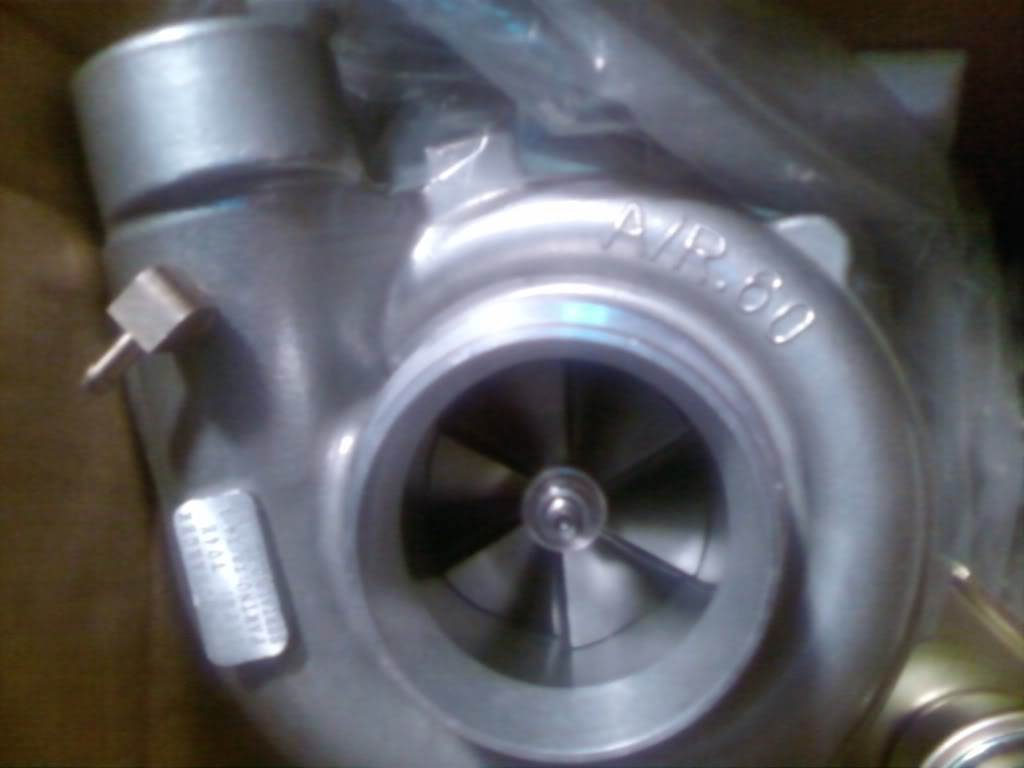
It looks like the out side dimensions are similar, but look how there is no step on the inlet like on the .50 .63 turbo. Not only is there no step, but the clamping area is thiner. I would say that the inlet i.d. is in fact bigger.
04-29-2008, 06:04 PM
#124
Supreme Member
iTrader: (1)
Join Date: Apr 2008
Location: Utah
Posts: 10,401
Likes: 0
Received 2 Likes
on
2 Posts
Car: 89 RS 89 iroc 87 firebird
Engine: 3.1 Turbo/ 355 twin turbo
Transmission: a4 w/ 4500 stall/ a4 / t5
Axle/Gears: strange s60 /w 3:42's
Re: HOW TO: INSTALLING A TURBO
it has the same wheel see how urs is machines from the end of th inlet in thats why it has no step whats the od of the inlet 2.75 or 3 inch?
04-29-2008, 07:02 PM
#125
Member
Join Date: Mar 2008
Posts: 147
Likes: 0
Received 0 Likes
on
0 Posts
04-29-2008, 07:08 PM
#126
Supreme Member
iTrader: (1)
Join Date: Apr 2008
Location: Utah
Posts: 10,401
Likes: 0
Received 2 Likes
on
2 Posts
Car: 89 RS 89 iroc 87 firebird
Engine: 3.1 Turbo/ 355 twin turbo
Transmission: a4 w/ 4500 stall/ a4 / t5
Axle/Gears: strange s60 /w 3:42's
Re: HOW TO: INSTALLING A TURBO
its the same exact turbo diff inlet housing,the inlet on mine was 3 inch thats why it has the larger step, urs is 1/4 in les sin diamiter start with so it only has a small taper to the inlet
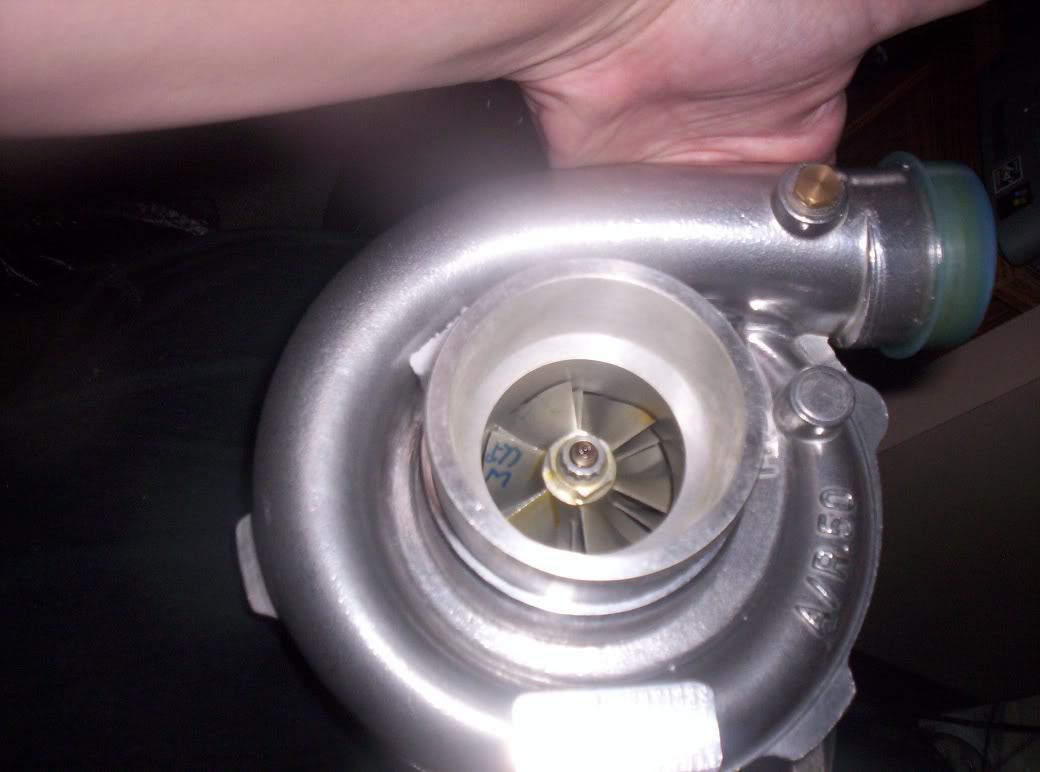
hmm 2 5/16's id ?? feel llike poping off the inlet covet and taking a caliper to the inducer if the wheel?
hmm 2 5/16's id ?? feel llike poping off the inlet covet and taking a caliper to the inducer if the wheel?
Last edited by project89; 04-29-2008 at 07:12 PM.
04-29-2008, 07:32 PM
#127
Member
Join Date: Mar 2008
Posts: 147
Likes: 0
Received 0 Likes
on
0 Posts
Re: HOW TO: INSTALLING A TURBO
its the same exact turbo diff inlet housing,the inlet on mine was 3 inch thats why it has the larger step, urs is 1/4 in les sin diamiter start with so it only has a small taper to the inlet
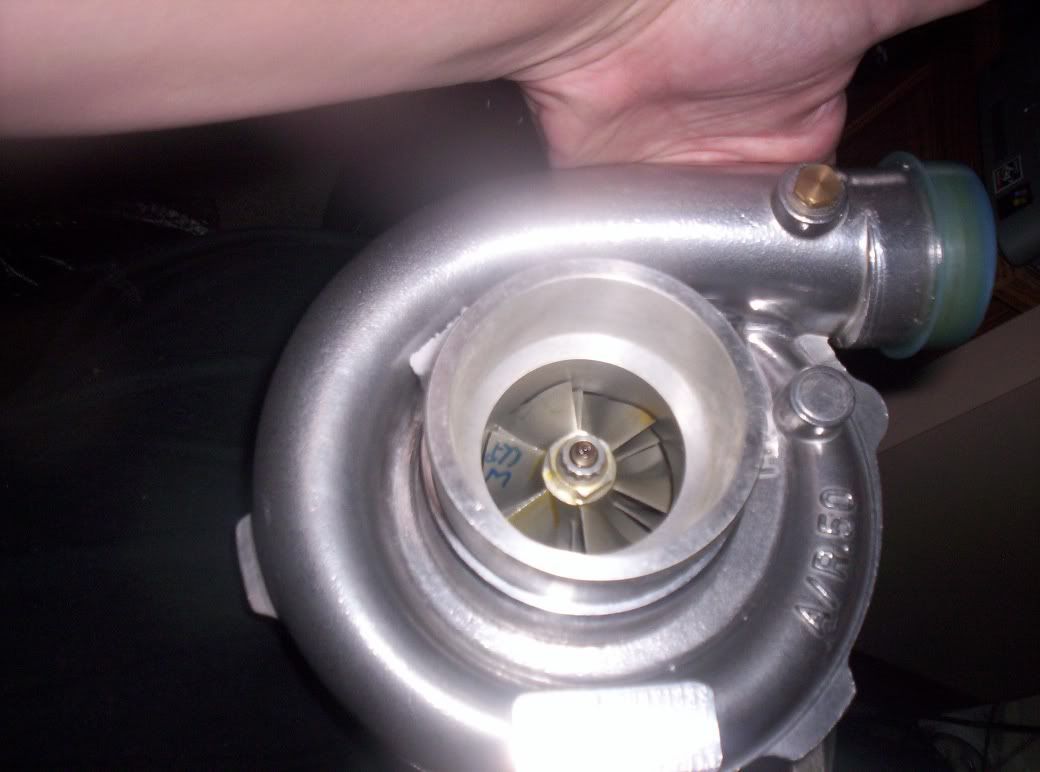
hmm 2 5/16's id ?? feel llike poping off the inlet covet and taking a caliper to the inducer if the wheel?
hmm 2 5/16's id ?? feel llike poping off the inlet covet and taking a caliper to the inducer if the wheel?
the od is 2.831 (a little bigger then 2 13/16) and the minimum id is 2.344 ( alittle bigger then 2 21/64)
04-29-2008, 09:43 PM
#128
Supreme Member
iTrader: (1)
Join Date: Apr 2008
Location: Utah
Posts: 10,401
Likes: 0
Received 2 Likes
on
2 Posts
Car: 89 RS 89 iroc 87 firebird
Engine: 3.1 Turbo/ 355 twin turbo
Transmission: a4 w/ 4500 stall/ a4 / t5
Axle/Gears: strange s60 /w 3:42's
Re: HOW TO: INSTALLING A TURBO
u may have a 50 trim ud have to take the cover off to mesure it corectly,but eitherway its the right turbo
05-29-2008, 09:56 PM
#129
Member
Join Date: Mar 2008
Posts: 147
Likes: 0
Received 0 Likes
on
0 Posts
Re: HOW TO: INSTALLING A TURBO
wtf is up with every one using an fittings? The fitting on the turbo is 1/4 npt, so a 1/4npt to 3/16 flare adapter is a 1.19 from the hardware store, and the 3/16 is cheep too 20 feet for 15 bucks. So why does every one go out of there way to use an fittings and line?
05-29-2008, 10:02 PM
#130
Supreme Member
iTrader: (1)
Join Date: Apr 2008
Location: Utah
Posts: 10,401
Likes: 0
Received 2 Likes
on
2 Posts
Car: 89 RS 89 iroc 87 firebird
Engine: 3.1 Turbo/ 355 twin turbo
Transmission: a4 w/ 4500 stall/ a4 / t5
Axle/Gears: strange s60 /w 3:42's
Re: HOW TO: INSTALLING A TURBO
vibration resistance, and wear resistance.not to mention the flexability.
the turbo oil inlet shoudl be 1/8 pipe thread, mine has a 1/8th to -3 an adapter screwed into it
the turbo oil inlet shoudl be 1/8 pipe thread, mine has a 1/8th to -3 an adapter screwed into it
06-06-2008, 02:45 AM
#131
Junior Member

Join Date: Mar 2008
Posts: 40
Likes: 0
Received 0 Likes
on
0 Posts
Car: !985 Chevy Camaro
Engine: 2.8L
Transmission: T5
Re: HOW TO: INSTALLING A TURBO
i'm kinda new to the world of turbos... i was going to read every post to see if this was asked... but thats a lot of posts. so i'm just going to ask it.
does your car have to have fuel injectors? or can you do this to a carbed engine.
I have a 1985 Camaro, V6 (2.8L) and i wanted to add power without swapping my engine for a V8. so ya... info would be welcomed thanks in advance.
does your car have to have fuel injectors? or can you do this to a carbed engine.
I have a 1985 Camaro, V6 (2.8L) and i wanted to add power without swapping my engine for a V8. so ya... info would be welcomed
thanks in advance.
07-11-2008, 04:38 PM
#132
Senior Member
iTrader: (5)

Join Date: Nov 2006
Location: Tallahassee, FL
Posts: 1,517
Likes: 0
Received 0 Likes
on
0 Posts
Car: 89 V6 Camaro
Engine: 2.8
Transmission: 700R4
Axle/Gears: 3.42 open diff
Re: HOW TO: INSTALLING A TURBO
I recently made up my mind to turbo my 6. I've started to start planning things out have have talked to a few guys. I decided to use stock manifolds with a forward facing downpipes. I'm only going to run 5 psi to keep it safe for a stock internal motor. What should I use for tuning. Can I get away with just an fmu? I figured to do that pcm swap also for a better tune. I'll have questions later on as I get into the build more.
07-12-2008, 08:26 PM
#133
Supreme Member
iTrader: (1)
Join Date: Apr 2008
Location: Utah
Posts: 10,401
Likes: 0
Received 2 Likes
on
2 Posts
Car: 89 RS 89 iroc 87 firebird
Engine: 3.1 Turbo/ 355 twin turbo
Transmission: a4 w/ 4500 stall/ a4 / t5
Axle/Gears: strange s60 /w 3:42's
Re: HOW TO: INSTALLING A TURBO
af ur maf based, only thing u need is a set of 19# injectors
I recently made up my mind to turbo my 6. I've started to start planning things out have have talked to a few guys. I decided to use stock manifolds with a forward facing downpipes. I'm only going to run 5 psi to keep it safe for a stock internal motor. What should I use for tuning. Can I get away with just an fmu? I figured to do that pcm swap also for a better tune. I'll have questions later on as I get into the build more.
07-13-2008, 06:15 AM
#134

Re: HOW TO: INSTALLING A TURBO
Place the O2 sensor AFTER the turbine. The increased pre-turbine pressure will skew the readings. Also with the increased restriction pre-turbine there will be a false rich reading that will usually have the ECM command smaller injector pulse widths and lean out the mixture that causes even more problems.The increased heat can also shorten the life of the O2 sensor. Post turbine O2 placement gives a slightly more accurate reading due to the lower pressure. The turbine itself causes a change in the AFR of the exhaust gases, usually leaner, due to the turbine heat burning off some of the remaing fuel and also the turbine using the excess fuel in the exhaust gasses to spool and keep the turbine wheel spooled. This last part is getting fairly deep into turbine theory though, and it's just easier to understand that the readings pre-turbine and post turbine of the O2 sensor will be different.
It is better to use the O2 in a post turbine install for accuracy due to pressure, or less pressure post turbine, that will provide a more accurate reading.
I haven't seen a WBO2 manufacturer that recommends installing thier sensors pre-turbine, for both accuracy and increased heat reasons. This would also make tuning the car/ECM easier to have both O2 sensors post turbine. If you are using the simulated NBO2 output of the WBO2 sensor this goes without saying.
I can't stress enough that tuning is the key here guys. I rebuilt my motor twice due to detonation and bad tuning. If these are your daily drivers, please be aware of getting enough fuel supplied.
07-16-2008, 02:54 PM
#135
Re: HOW TO: INSTALLING A TURBO
Hmm. All the 3800's are doing this with the twin o2 sensors without problems.
A heated o2 will be needed to install so far down stream, unless the sensor reaches correct temps.
Perhaps it's not the IDEAL thing to do, but neither is a NB on a turbo car either
A heated o2 will be needed to install so far down stream, unless the sensor reaches correct temps.
Perhaps it's not the IDEAL thing to do, but neither is a NB on a turbo car either
07-18-2008, 09:40 PM
#136
Re: HOW TO: INSTALLING A TURBO
A heated o2 will be needed to install so far down stream, unless the sensor reaches correct temps.
Perhaps it's not the IDEAL thing to do, but neither is a NB on a turbo car either
The early GM ECM is not set-up to use a WBO2 sensor to control fueling, and unless you create a hack and patch or use a bin file that can use a WBO2 sensor for fueling control, then you would still be running on a NBO2 sensor.
Even though I will be installing a WBO2 sensor in my Datsun, I'm still of the camp that it's not absolutly nessisary to use a WBO2 sensor. You can get very close on tune with use of a NBO2 sensor, if you know how to look at everything else the engine is doing and what it's telling you.
07-19-2008, 09:38 AM
#137
Supreme Member
iTrader: (1)
Join Date: Apr 2008
Location: Utah
Posts: 10,401
Likes: 0
Received 2 Likes
on
2 Posts
Car: 89 RS 89 iroc 87 firebird
Engine: 3.1 Turbo/ 355 twin turbo
Transmission: a4 w/ 4500 stall/ a4 / t5
Axle/Gears: strange s60 /w 3:42's
Re: HOW TO: INSTALLING A TURBO
lol im still tunning mine off a nb02, i throw in the wideband every now and then to check on things,but i just shoot for .800V from the narrow band.even the grand national guys do the same.like six says u jut shave to pay attention to the motor and car and what its doing
07-19-2008, 02:36 PM
#138
Re: HOW TO: INSTALLING A TURBO
The early GM ECM is not set-up to use a WBO2 sensor to control fueling, and unless you create a hack and patch or use a bin file that can use a WBO2 sensor for fueling control, then you would still be running on a NBO2 sensor.
Even though I will be installing a WBO2 sensor in my Datsun, I'm still of the camp that it's not absolutly nessisary to use a WBO2 sensor. You can get very close on tune with use of a NBO2 sensor, if you know how to look at everything else the engine is doing and what it's telling you.
It may just work to put the stock NB (non-heated) downstream of the turbine, but if it doesn't reach a minimum temp, it it will mis-read just as bad as if it were placed upstream of the turbine, right?
I tried my o2's in a few different configurations, and even had the WB feeding the ECM a simulated signal, and found I was most happy with the ECM reading the stock o2 that was pre-turbine and the WB only for checking the AFR and feeding the gauge. I'm sure there was some more variables involved, even the grounding location of the WB can change the reading.
07-20-2008, 08:52 AM
#139
Re: HOW TO: INSTALLING A TURBO
 " after what I wrote.
Well remember in this configuration, even the turbo itself is quite a ways away from the heads. The hot pipes are going around the back of the engine, then under the k member and back up in front. It took about a quite a bit of pipe to get that far on mine.
My turbo was about 8" worth of pipe from one of the heads, about 3' of pipe from the other, NBO2 sensor mounted in the stock (turbocoupe) downpipe elbow O2 bung, woked absolutly great.
In another set-up there was about 12" between the closest head and the turbo, with the O2 in the down pipe, about 6" away from the turbo, it worked great, once again.
Well if you are going to argue the fact that OEM's are correct, wasn't it you who told me that some OEM's have the NB before the turbine?
I'm not saying that I disagree with you totally. The stock ECM may not have been designed for a WBo2, but the engines in questions were not designed for boost either.
It may just work to put the stock NB (non-heated) downstream of the turbine, but if it doesn't reach a minimum temp, it it will mis-read just as bad as if it were placed upstream of the turbine, right?
I tried my o2's in a few different configurations, and even had the WB feeding the ECM a simulated signal, and found I was most happy with the ECM reading the stock o2 that was pre-turbine and the WB only for checking the AFR and feeding the gauge. I'm sure there was some more variables involved, even the grounding location of the WB can change the reading.
07-20-2008, 10:53 AM
#140
Re: HOW TO: INSTALLING A TURBO
Perhaps if you said "burned up" I would have gotten it
Not really. I thought this thread was based on an under k installation, I used this same method.
Yeah, Loner's worked great as well. Both his sensors were mounted about 6" away from the turbine, near the turn down. They were mounted in line IIRC, much like you asked in the PROM forum bout yours. Works good.
So it does work, then. Was there known issues with them as far as longevity of the sensors?
Yes and no. OEM turbo apps tend to have lower compression, some even went as far as forged pistons etc, but those are really just "safety nets" and don't affect the function of an engine, so I guess you got me there
I agree a heated sensor is an easy solution, but I used my stock sensor becasue it worked and I had it right there. Kind of like using the Gen2 push rods in your Franken 60? :P
Again, I thought this thread was basing the subject off the install, one that so many v6 Fbodies have used (under k). Yes, each install has to have lots of little issues addressed according to all the variables, tooling, availability of parts at the time, the ability of the fabricator, and not to mention all the variations on tuning and parts selection.
Too blanket of a statement, when custom turbocharging is involved, there are many configurations or pathes that the piping couold take, some long like you had, some short. Maybe in a long distance, like a rear mount set-up the O2 being preturbine would likely work better than all the way at the back, because the temp of the exhaust will definatly drop by that point, and the pressure would not be as high as with a conventional mount due to the cooled exhaust even pre-turbine.
My turbo was about 8" worth of pipe from one of the heads, about 3' of pipe from the other, NBO2 sensor mounted in the stock (turbocoupe) downpipe elbow O2 bung, woked absolutly great
In another set-up there was about 12" between the closest head and the turbo, with the O2 in the down pipe, about 6" away from the turbo, it worked great, once again.
In another set-up there was about 12" between the closest head and the turbo, with the O2 in the down pipe, about 6" away from the turbo, it worked great, once again.
Nope, didn't say some, I said one that I know of, the '89/'90 Grand Prix TGP, and no one seems to know why that was done that way, other than possibly space since the downpipe was installed in a way that would make it difficult to install an O2 sensor. All other OEM turbo applications I've looked at have the O2 sensor in the downpipe.
Moot point, engines are engines, regardless of aspiration. There is very little difference if any in the actual design between an N/A engine and a turbo engine when you actually break it down. On conventional engines, they all use a block, a crank, pistons and connecting rods, a cam or a few, rockers or followers, heads, etc, the design is the same, in some cases the parts might be altered a bit to get more from area or another.
Again, this is something that should be addressed in each install, because your install had so much pipe between the heads and the turbo, the exhaust was likely cooling down too much by the time it even hit the turbo, let alone out the down pipe. A heated O2 would have been a more advisable option here.
07-21-2008, 04:31 AM
#141

Re: HOW TO: INSTALLING A TURBO
As far as O2 sensor location, as far as what I’ve seen, only WB O2’s are really pressure sensitive (and also work in a much narrower band of temperatures) as compared to a NBO2.
As far as tuning issues… GM basically knew what tune the parts needed when the car left the factory, and as far as serious running was concerned the O2 wasn’t involved. It was only used under cruise conditions and as a rich/lean indicator, not as an indicator of exact A/F ratio.
07-21-2008, 10:17 AM
#142
Senior Member

Join Date: Mar 2008
Location: Harrisburg PA
Posts: 512
Likes: 0
Received 0 Likes
on
0 Posts
Car: 04 Jetta
Engine: 1.8t AWP
Transmission: 5spd
Re: HOW TO: INSTALLING A TURBO
This is jsut a stupid comment im posting but what the hell. If your going with non recirculated BOV and want a really loud sound buy a turbo XS RFL(really ****ing loud) sounds nasty get looks every time it goes off. Sounds like a f***in whip. We had one on a 92 AWD turbo eclipse was the best BOV i ever heard.
08-13-2008, 06:33 PM
#143
Member

Join Date: Jul 2008
Posts: 177
Likes: 0
Received 0 Likes
on
0 Posts
Re: HOW TO: INSTALLING A TURBO
I have a few questions about this as well:
1) Where/How do you mount all of the boost guage and sensor stuff?
2) How do you exactly mount the "Turbo manual boost controller?" I was looking at this one: http://cgi.ebay.com/ebaymotors/_Car-...3756.m14.l1318
3) Would this BOV work? I was going to get the whole kit and get seperate Silicone adaptors at a later time: http://cgi.ebay.com/ebaymotors/ws/eB...MEWA:IT&ih=022
4) Finally, could I get a little more detail on how to mount the FMU? Like what plugs into each port. I was looking at this one: http://cgi.ebay.com/ebaymotors/_Car-...3756.m14.l1318
I am going to do this setup to an 89 camaro that had a "slight" engine fire when I get back from deployment. This thread seems to help a lot. Any final suggestions?
1) Where/How do you mount all of the boost guage and sensor stuff?
2) How do you exactly mount the "Turbo manual boost controller?" I was looking at this one: http://cgi.ebay.com/ebaymotors/_Car-...3756.m14.l1318
3) Would this BOV work? I was going to get the whole kit and get seperate Silicone adaptors at a later time: http://cgi.ebay.com/ebaymotors/ws/eB...MEWA:IT&ih=022
4) Finally, could I get a little more detail on how to mount the FMU? Like what plugs into each port. I was looking at this one: http://cgi.ebay.com/ebaymotors/_Car-...3756.m14.l1318
I am going to do this setup to an 89 camaro that had a "slight" engine fire when I get back from deployment. This thread seems to help a lot. Any final suggestions?
08-20-2008, 08:09 AM
#145
Junior Member
Join Date: Mar 2008
Posts: 40
Likes: 0
Received 0 Likes
on
0 Posts
Car: !985 Chevy Camaro
Engine: 2.8L
Transmission: T5
Re: HOW TO: INSTALLING A TURBO
If i were to salvage a turbo from a bone yard, what would i be looking for? from what kind of cars should i take it from?
04-11-2009, 11:47 PM
#146
Junior Member

Join Date: Apr 2009
Posts: 1
Likes: 0
Received 0 Likes
on
0 Posts
Re: HOW TO: INSTALLING A TURBO
is installing a turbo good for just racing or is it good for commuting? it sounds cool to say i have a turbo but if you put in in your truck is it necessarily useful if your not using it to race with? idk... any input would be great.
05-03-2009, 01:13 AM
#147
Junior Member
iTrader: (3)

Join Date: Feb 2009
Location: Oklahoma City, Oklahoma
Posts: 52
Likes: 0
Received 0 Likes
on
0 Posts
Car: 1986 Firebird Project
Engine: 3.1L
Transmission: t5
Re: HOW TO: INSTALLING A TURBO
Ok another newb question... How does your vacuum equipment work on a boosted setup. (ie...brake booster,cruise....)??? Thanks guys I enjoy the reading!
05-08-2009, 10:21 AM
#148
Supreme Member
iTrader: (1)
Join Date: Apr 2008
Location: Utah
Posts: 10,401
Likes: 0
Received 2 Likes
on
2 Posts
Car: 89 RS 89 iroc 87 firebird
Engine: 3.1 Turbo/ 355 twin turbo
Transmission: a4 w/ 4500 stall/ a4 / t5
Axle/Gears: strange s60 /w 3:42's
Re: HOW TO: INSTALLING A TURBO
the brakes hold vacum while under boost, it has a one way check valve, though u wont be on the brakes while ur boosting, the only one mod i had to do was install a check valve on the heater control valve line, the line that controls the vents, without on it would pop the hoses off, its like a 79 cent part form the auto parts store
 06-26-2009, 11:55 AM
#150
Senior Member

Join Date: Nov 2008
Location: Batavia Area, NY
Posts: 467
Likes: 0
Received 0 Likes
on
0 Posts
Car: 91 Firebird, 06 Dodge Ram 1500 SLT
Engine: 3.1L, 4.7L
Transmission: 700r4, 45RFE
Axle/Gears: 3.23 open, 3.55?
Re: HOW TO: INSTALLING A TURBO
No....you will be running new piping to the throttle body. If your talking about the stock intake runners and manifold, then yes...but it would be a good idea to do AT LEAST some port matching.