


Can 187 heads work on a L69? If so, what needs to be changed?


Thread Starter
Senior Member
Joined: May 2012
Posts: 582
Likes: 2
From: Woodstock, IL
Car: 1984 Trans Am Recaro Edition
Engine: 355 L98 Vortec 226/234 custom cam
Transmission: TKO-600
Axle/Gears: On borrowed time...
Can 187 heads work on a L69? If so, what needs to be changed?
Found some 187 heads that may be priced well enough to buy...I have a stock L69 engine with the q-jet and original intake manifold. What would I need to do/get to make the 187 heads work?
Thanks
Chuck
Thanks
Chuck
Thread Starter
Senior Member
Joined: May 2012
Posts: 582
Likes: 2
From: Woodstock, IL
Car: 1984 Trans Am Recaro Edition
Engine: 355 L98 Vortec 226/234 custom cam
Transmission: TKO-600
Axle/Gears: On borrowed time...
Re: Can 187 heads work on a L69? If so, what needs to be changed?
Can someone also speak from experience of they had the same thing done to their engine? Here are some things that appear to be positive reasons for this head.
1.94-1.5
58CC combustion
Heads are thoroughly cleaned and inspected
Pressure tested to ensure no cracks or leaks
3 angle Valve job / performed on Serdi or Sunnen machine
CBN milled to ensure straightness within .0015" and correct finish
All machine work performed on the latest state of the art equipment
Heads are assembled with 1.94 Stainless Steel one piece intake valves
Heads are assembled with 1.50 Stainless Steel one piece exhaust valves
Heads are assembled with hardened valve keepers
Heads are assembled with new valve seals
Heads are assembled with new .550 lift valve springs
Heads are complete and ready to install
1.94-1.5
58CC combustion
Heads are thoroughly cleaned and inspected
Pressure tested to ensure no cracks or leaks
3 angle Valve job / performed on Serdi or Sunnen machine
CBN milled to ensure straightness within .0015" and correct finish
All machine work performed on the latest state of the art equipment
Heads are assembled with 1.94 Stainless Steel one piece intake valves
Heads are assembled with 1.50 Stainless Steel one piece exhaust valves
Heads are assembled with hardened valve keepers
Heads are assembled with new valve seals
Heads are assembled with new .550 lift valve springs
Heads are complete and ready to install
Thread Starter
Senior Member
Joined: May 2012
Posts: 582
Likes: 2
From: Woodstock, IL
Car: 1984 Trans Am Recaro Edition
Engine: 355 L98 Vortec 226/234 custom cam
Transmission: TKO-600
Axle/Gears: On borrowed time...
Re: Can 187 heads work on a L69? If so, what needs to be changed?
So, where is the catch with these heads?


Joined: Sep 2005
Posts: 28,022
Likes: 2,496
Car: Yes
Engine: Usually
Transmission: Sometimes
Axle/Gears: Behind me somewhere
Re: Can 187 heads work on a L69? If so, what needs to be changed?
How would it be "A Good Idea" to strangle a perfectly good motor (well, it's a 305, but still) with THAT garbage? Tired of having too much power? 


Joined: Jan 2005
Posts: 10,450
Likes: 509
From: Hurst, Texas
Car: 1983 G20 Chevy
Engine: 305 TPI
Transmission: 4L60
Axle/Gears: 14 bolt with 3.07 gears
Re: Can 187 heads work on a L69? If so, what needs to be changed?
Thread Starter
Senior Member
Joined: May 2012
Posts: 582
Likes: 2
From: Woodstock, IL
Car: 1984 Trans Am Recaro Edition
Engine: 355 L98 Vortec 226/234 custom cam
Transmission: TKO-600
Axle/Gears: On borrowed time...
Re: Can 187 heads work on a L69? If so, what needs to be changed?
I will disagree with you! The swirl ports easily match the 416s in HP and make more torque. This was a heavy long bed 1980 C10 truck with 3.08 gears and a TH350. The engine here is a .040" over flat top piston 305, with 810 casting 350 swirl port heads and a touch more cam than the L69. It had an edelbrock rpm intake and in this video the q-jet had the seconaries locked out. We were fuel tuning the primaries. The bog on the 1-2 shift was from hitting the 5,500 rpm rev limiter in the Accel 300+ box.
Interesting
Thread Starter
Senior Member
Joined: May 2012
Posts: 582
Likes: 2
From: Woodstock, IL
Car: 1984 Trans Am Recaro Edition
Engine: 355 L98 Vortec 226/234 custom cam
Transmission: TKO-600
Axle/Gears: On borrowed time...
Re: Can 187 heads work on a L69? If so, what needs to be changed?


I knew I'd get a rise out of you about this ....!!!!
Just throwing that idea out there, fascinated with the results that Fast355 got.
Trending Topics
Joined: Sep 2005
Posts: 28,022
Likes: 2,496
Car: Yes
Engine: Usually
Transmission: Sometimes
Axle/Gears: Behind me somewhere
Re: Can 187 heads work on a L69? If so, what needs to be changed?
The swirl ports easily match the 416s in HP and make more torque.
We all know that any head with a giant lump obstruction right square in the path of all the flow, right on the roof of the bowl where it is well and widely known that the path to power is smoothing and removing turbulence, is BOUND to make more HP than a head WITHOUT such an obstruction, no?
There's EXACTLY ONE person on the whole Internet making claims like these, that I know of. For EVERYBODY ELSE, things seem to work differently. While I am certainly not calling anybody a liar or anything like that, I tend to take ONE person's claims as weighed against THE REST OF THE UNIVERSE, with a grain of salt.
Thread Starter
Senior Member
Joined: May 2012
Posts: 582
Likes: 2
From: Woodstock, IL
Car: 1984 Trans Am Recaro Edition
Engine: 355 L98 Vortec 226/234 custom cam
Transmission: TKO-600
Axle/Gears: On borrowed time...
Re: Can 187 heads work on a L69? If so, what needs to be changed?
So to help my further understanding of cylinder heads...
1- intake/exhaust (1.84 vs 1.94 vs 2.02, etc..) must be closely optimized with respect to the engines ability to compress the fuel and air efficiently enough to make the crankshaft crank hard enough to produce torque/power.
2- swirl properties of the head (still foggy on this) determine the velocity and flow of the air going to the engine 4 cycle stroke process intake,compress,power,exhaust.
1- intake/exhaust (1.84 vs 1.94 vs 2.02, etc..) must be closely optimized with respect to the engines ability to compress the fuel and air efficiently enough to make the crankshaft crank hard enough to produce torque/power.
2- swirl properties of the head (still foggy on this) determine the velocity and flow of the air going to the engine 4 cycle stroke process intake,compress,power,exhaust.
Thread Starter
Senior Member
Joined: May 2012
Posts: 582
Likes: 2
From: Woodstock, IL
Car: 1984 Trans Am Recaro Edition
Engine: 355 L98 Vortec 226/234 custom cam
Transmission: TKO-600
Axle/Gears: On borrowed time...
Re: Can 187 heads work on a L69? If so, what needs to be changed?
Is this a fair conclusion ?
With respect to the 305-
Too little air (1.74 or 1.84), less power.. Too much air not enough compression (larger than 1.94) therefore power is reduced due to lowered compression.
With respect to the 305-
Too little air (1.74 or 1.84), less power.. Too much air not enough compression (larger than 1.94) therefore power is reduced due to lowered compression.
Joined: Sep 2005
Posts: 28,022
Likes: 2,496
Car: Yes
Engine: Usually
Transmission: Sometimes
Axle/Gears: Behind me somewhere
Re: Can 187 heads work on a L69? If so, what needs to be changed?
Compression is the measure of the change in volume between when the piston is at the top of the cyl, vs when it's at the bottom. No difference there between a 305 and any other motor.
Since an engine works by converting the heat energy (released by combustion) into mechanical energy (pushing the crank around), and does this by allowing the heated gases to expand which extracts the heat (the gases cool as they expand from pushing on the piston), the most important impact of "compression" isn't "compression" at all. Rather, it's EXPANSION. The greater the ratio of uncompressed volume to compressed volume, the more heat is converted. Same for a 305 as any other ICE.
Torque is the measure of how hard the piston is being pushed down in the cyl, times the lever arm of the crank. The force on the piston is equal to cyl psi times piston area. Note how therefore, torque (at any given RPM) is some function of cyl psi, times displacement; and note also that there is NO DIFFERENCE in the brand of cast iron, the bore/stroke ratio, rod length, or ANYTHING ELSE, in that equation. Cyl pressure (a function of heat, which is in turn a function of how much fuel was burned and how completely) and displacement. Torque therefore is a measure of energy aka work as you'll recall from your high school physics class.
Power, measured in HP or kW, is the time rate of expenditure of energy. Note also that NOWHERE in the torque equation, was RPM mentioned; any properly tuned engine of a given displacement will make basically the same amount of torque as any other properly tuned engine of the same displacement developing the same cyl pressure. However, not all engines make that same torque at the same RPM; usually when people refer to a "high torque" engine, they mean, all the torque is at low RPMs, whereas a high-power engine, makes that same torque except at higher RPMs. Again, as you will recall from high school physics, one HP = 33,000 lbs raised 1 foot in 1 minute; to get from ft of lift to ft-lbs of torque, the conversion is 2 * pi, since a wheel with a raius of 1 ft has a circumference of 2pi ft, which is to say, 1 rev of such a wheel = 2pi linear feet; and since HP is conveniently meausured in units of feet, pounds, and minutes, then all we have to do to convert from torque and RPM to HP, is to divide by 33,000 and multiply by 2pi. 33,000 ÷ 2pi = 5252.11. Which is why, we customarily describe it as, HP = torque × RPM ÷ 5252.
This stuff is all so simple, at its core; it's all just numbers.
Not too hard to see then, that in the end, the max HP that any given combo is capable of, is a direct function of FLOW: x number of fuel molecules each containing a certain amount of energy, per unit time. If you burn more fuel (completely, remember; not, just richen the mixture) per unit time, you get more power. But to do that, you need oxygen. Which is usually obtained from air.
LOOK at a valve. It has a head with a diameter of, say, 1.84". It has a stem which in a 305 has a diameter of 11/32" (.344" give or take). This stem is obstructing part of the valve's port. The valve is in a guide which has a diameter of about .565" or thereabouts, ALSO obstructing the port. Not hard to see that even though the difference between 1.72" and 1.84" isn't all that much, the increase is ALL out at the edge, where it can do some good; the net effect is then (1.84 - .565) / (1.72 - .565), or about 1.275 / 1.165, or nearly 11% increase in useable flow cross-sectional area. Meaning, about 11% MORE STUFF can get past the valve in the same length of time, meaning the engine can make 11% MORE power.
Valve size is not related to compression in any manner way shape or form.
Here's a set of 081 heads (the ones people get more power by throwing the "swirlies" in the trash and replacing them with) that have 1.94" intakes installed in them.
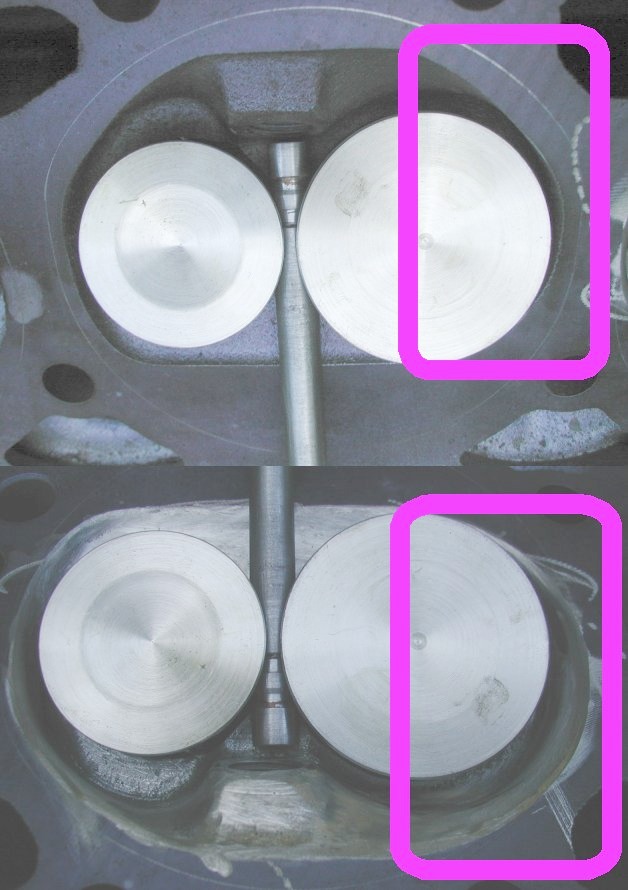
Observe in the upper head, how close the margin of the valve is, to the "vertical" "wall" of the chamber. Now... do you suppose it REALLY MATTERS how big you make the valve, if all the material coming through it has to squeeze through that little crack? THAT'S why 305s don't respond well to larger valves; not anything to do with compression. Furthermore, the bore, which is inside those scribe marks I made with a head gasket, is ALSO right up against the edge of the valve; in fact, depending on the tolerances in the machine work and whatnot, a 2.02" valve will sometimes HIT THE TOP OF THE DECK because it's not even fully inside the cyl. In case it fits though, it's RIGHT UP AGAINST the cyl wall, which means there's not even a crack left for material to flow through.
Turbulence in the port is BAD for power. Good for "torque" at VERY LOW RPMs; but destructive to power. What it does, is limit the amount of material that can flow through the port. Maximum flow occurs when there is smooth, laminar, constant-velocity flow; any departure from those conditions lessens the flow. Less flow = less power, ceteris paribus. It's just not that hard.
Since an engine works by converting the heat energy (released by combustion) into mechanical energy (pushing the crank around), and does this by allowing the heated gases to expand which extracts the heat (the gases cool as they expand from pushing on the piston), the most important impact of "compression" isn't "compression" at all. Rather, it's EXPANSION. The greater the ratio of uncompressed volume to compressed volume, the more heat is converted. Same for a 305 as any other ICE.
Torque is the measure of how hard the piston is being pushed down in the cyl, times the lever arm of the crank. The force on the piston is equal to cyl psi times piston area. Note how therefore, torque (at any given RPM) is some function of cyl psi, times displacement; and note also that there is NO DIFFERENCE in the brand of cast iron, the bore/stroke ratio, rod length, or ANYTHING ELSE, in that equation. Cyl pressure (a function of heat, which is in turn a function of how much fuel was burned and how completely) and displacement. Torque therefore is a measure of energy aka work as you'll recall from your high school physics class.
Power, measured in HP or kW, is the time rate of expenditure of energy. Note also that NOWHERE in the torque equation, was RPM mentioned; any properly tuned engine of a given displacement will make basically the same amount of torque as any other properly tuned engine of the same displacement developing the same cyl pressure. However, not all engines make that same torque at the same RPM; usually when people refer to a "high torque" engine, they mean, all the torque is at low RPMs, whereas a high-power engine, makes that same torque except at higher RPMs. Again, as you will recall from high school physics, one HP = 33,000 lbs raised 1 foot in 1 minute; to get from ft of lift to ft-lbs of torque, the conversion is 2 * pi, since a wheel with a raius of 1 ft has a circumference of 2pi ft, which is to say, 1 rev of such a wheel = 2pi linear feet; and since HP is conveniently meausured in units of feet, pounds, and minutes, then all we have to do to convert from torque and RPM to HP, is to divide by 33,000 and multiply by 2pi. 33,000 ÷ 2pi = 5252.11. Which is why, we customarily describe it as, HP = torque × RPM ÷ 5252.
This stuff is all so simple, at its core; it's all just numbers.
Not too hard to see then, that in the end, the max HP that any given combo is capable of, is a direct function of FLOW: x number of fuel molecules each containing a certain amount of energy, per unit time. If you burn more fuel (completely, remember; not, just richen the mixture) per unit time, you get more power. But to do that, you need oxygen. Which is usually obtained from air.
LOOK at a valve. It has a head with a diameter of, say, 1.84". It has a stem which in a 305 has a diameter of 11/32" (.344" give or take). This stem is obstructing part of the valve's port. The valve is in a guide which has a diameter of about .565" or thereabouts, ALSO obstructing the port. Not hard to see that even though the difference between 1.72" and 1.84" isn't all that much, the increase is ALL out at the edge, where it can do some good; the net effect is then (1.84 - .565) / (1.72 - .565), or about 1.275 / 1.165, or nearly 11% increase in useable flow cross-sectional area. Meaning, about 11% MORE STUFF can get past the valve in the same length of time, meaning the engine can make 11% MORE power.
Valve size is not related to compression in any manner way shape or form.
Here's a set of 081 heads (the ones people get more power by throwing the "swirlies" in the trash and replacing them with) that have 1.94" intakes installed in them.
Observe in the upper head, how close the margin of the valve is, to the "vertical" "wall" of the chamber. Now... do you suppose it REALLY MATTERS how big you make the valve, if all the material coming through it has to squeeze through that little crack? THAT'S why 305s don't respond well to larger valves; not anything to do with compression. Furthermore, the bore, which is inside those scribe marks I made with a head gasket, is ALSO right up against the edge of the valve; in fact, depending on the tolerances in the machine work and whatnot, a 2.02" valve will sometimes HIT THE TOP OF THE DECK because it's not even fully inside the cyl. In case it fits though, it's RIGHT UP AGAINST the cyl wall, which means there's not even a crack left for material to flow through.
Turbulence in the port is BAD for power. Good for "torque" at VERY LOW RPMs; but destructive to power. What it does, is limit the amount of material that can flow through the port. Maximum flow occurs when there is smooth, laminar, constant-velocity flow; any departure from those conditions lessens the flow. Less flow = less power, ceteris paribus. It's just not that hard.
Thread Starter
Senior Member
Joined: May 2012
Posts: 582
Likes: 2
From: Woodstock, IL
Car: 1984 Trans Am Recaro Edition
Engine: 355 L98 Vortec 226/234 custom cam
Transmission: TKO-600
Axle/Gears: On borrowed time...
Re: Can 187 heads work on a L69? If so, what needs to be changed?
This is good. thanks for the explanation !
Chuck
Chuck
Joined: Jan 2005
Posts: 10,450
Likes: 509
From: Hurst, Texas
Car: 1983 G20 Chevy
Engine: 305 TPI
Transmission: 4L60
Axle/Gears: 14 bolt with 3.07 gears
Re: Can 187 heads work on a L69? If so, what needs to be changed?
On Dewey316s cammed 305 tbi with headers and a single plane intake a pair of ported 416s did not equal the stock 187s until until 4,300 rpm and did not see signifigant gains until 5,000+ rpm. Stock 416s would have had even worse results. The swirlports run very well when cammed properly and offer improved low-midrange torque and better mileage.

Thread
Thread Starter
Forum
Replies
Last Post
Terrell351
Engine/Drivetrain/Suspension Parts for Sale
5
Jun 13, 2021 01:13 PM