


Piston Ring "Clocking" - Any Advice How To Do It Right ???


Thread Starter
Junior Member
Joined: Sep 2005
Posts: 39
Likes: 0
Piston Ring "Clocking" - Any Advice How To Do It Right ???
Going to be installing the pistons in my 305 this weekend. Ring package box only has minimal instruction about the oil ring. Rings are Hastings with a moly top ring.
Do you have a prefered method of clocking the rings, putting the gaps of certain rings in certain positions ? How much does it matter ?
Thanks
Do you have a prefered method of clocking the rings, putting the gaps of certain rings in certain positions ? How much does it matter ?
Thanks

Supreme Member
iTrader: (8)
Joined: Jul 2001
Posts: 3,204
Likes: 7
From: New Boston, IL, USA
Car: '90 Formula 350
Engine: 383 SBC
Transmission: ProBuilt S/S 700-R4 & ACT 9" Stall
Axle/Gears: 10 bolt 3.23
I do 180* offsets on the compression land rings. I've heard if you do 0* offset you can have excessive blowby. I also did 180* on the oil rings, because I planned on 75 psi pressure. I've also heard 90* on oil rings is good.

Supreme Member
iTrader: (1)
Joined: Jul 2004
Posts: 10,763
Likes: 4
From: Calgary, AB, Canada
Car: 1982 Trans-Am
Engine: 355 w/ ported 416s
Transmission: T10, hurst shifter
Axle/Gears: 10 bolt, true-trac, 3.73
I think clocking them is kinda a waste of time. I suppose offsetting the gaps is a good idea, but I never really worried about it much.
getting the oil ring on was kinda tricky, unless you put the lower backup ring on, then put the wavy ring on 90* offset, then the top backup ring on 90* offset again. otherwise it just keeps popping out. dip the pistons in a coffee can of oil before installing in the block (IMHO).
getting the oil ring on was kinda tricky, unless you put the lower backup ring on, then put the wavy ring on 90* offset, then the top backup ring on 90* offset again. otherwise it just keeps popping out. dip the pistons in a coffee can of oil before installing in the block (IMHO).

TGO Supporter
Joined: Aug 1999
Posts: 14,811
Likes: 1
From: Jackson County
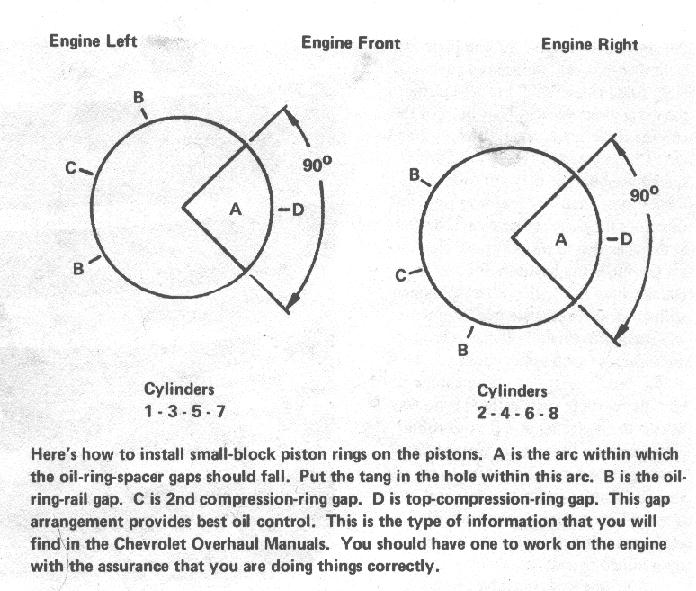
several manuals have the diagram of what ring goes where. off the top of my head i don't remember but i'm thinking it's something like the gaps at 10, 2, 5, and 7 o'clock positions. you don't want a gap over the wrist pin

Supreme Member
Joined: Jul 2005
Posts: 1,675
Likes: 3
From: Arab, Alabama
Car: 1988 Trans Am GTA
Engine: 350 4BBL
Transmission: 700R4
Axle/Gears: 3.27
I believe this is very important especially for forged pistons since the clearance at the top of the piston when cold can be as big as .040". The ring gaps are positioned differently for pistons on each side (bank) because when the engine is under load the piston is against the thrust side of the cylinder wall. This leaves the gap at the top of the piston predictably on the opposite side of the cylinder. Oil consumption and blowby are controlled best when the gaps are both: A. totally inside the piston groove under load and, B. spaced away from the corresponding "next" ring.
Click this picture.
(and it costs nothing to do this)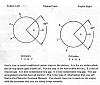
Click this picture.
(and it costs nothing to do this)

Thread
Thread Starter
Forum
Replies
Last Post
UltRoadWarrior9
Transmissions and Drivetrain
3
Sep 2, 2015 08:24 PM
