


Repainting the Hood Tomorrow


Thread Starter
Supreme Member
iTrader: (1)
Joined: Mar 2001
Posts: 4,226
Likes: 6
From: Chesterfield, Indiana
Car: 1991 Z28 Camaro
Engine: 5.7
Transmission: Jasper 700R4 Stage II
Axle/Gears: 3.23 For Now
Repainting the Hood Tomorrow
Back in 2003, a gravel truck happen to toss some gravel on my hood....so..I was left with a some scratches:

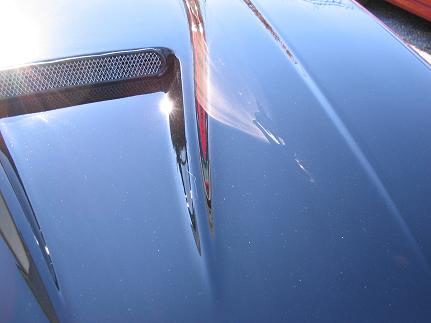
I've since then buffed the hood....but you could still see the scratches. Also, a few hairline cracks have appeared...probably because of the lacquer primer I used. So, tomorrow is the big day, I'm going to bring it to work and give it a new paint job. I'll post pictures when I get it done!
I've since then buffed the hood....but you could still see the scratches. Also, a few hairline cracks have appeared...probably because of the lacquer primer I used. So, tomorrow is the big day, I'm going to bring it to work and give it a new paint job. I'll post pictures when I get it done!
Thread Starter
Supreme Member
iTrader: (1)
Joined: Mar 2001
Posts: 4,226
Likes: 6
From: Chesterfield, Indiana
Car: 1991 Z28 Camaro
Engine: 5.7
Transmission: Jasper 700R4 Stage II
Axle/Gears: 3.23 For Now
Originally posted by KEVIN G.
Hey Shawn... Are you gonna strip that old lacquer primer off?
Hey Shawn... Are you gonna strip that old lacquer primer off?
The painter said I wouldn't have to. He said he could seal it and paint it. I DA'd the hood, to feather some of the fisheyes out...which worked well. Then, I wetsanded the area that looked like was "cracking". It wasn't the primer....the actualy first layer of fiberglass has some small hairline cracks in it. So, I repaired them. Do you think I should strip the whole hood and restart?

Senior Member
Joined: Jun 2004
Posts: 692
Likes: 12
From: North Carolina
Car: 1984 TRANS AM AERO (PAINT SO DEEP
Engine: 305 CARBED
Transmission: 700 R-4/Vette Servo mod
Well, lacquer products are a thermoplastic which means heat and solvents can break them down...
All 2k products are thermoset...once they're hard nothing can break them down. The molecules are crosslinked.
That primer will keep moving under your thermoset clearcoat...Especially on a black car in the hot summer..Which causes shrinkage, swelling and eventually, failure.
If you repaired some areas, you may see "hotspots" under the paint where the repair is. That will be the edge of the lacquer reacting to the new product.
All 2k products are thermoset...once they're hard nothing can break them down. The molecules are crosslinked.
That primer will keep moving under your thermoset clearcoat...Especially on a black car in the hot summer..Which causes shrinkage, swelling and eventually, failure.
If you repaired some areas, you may see "hotspots" under the paint where the repair is. That will be the edge of the lacquer reacting to the new product.
Thread Starter
Supreme Member
iTrader: (1)
Joined: Mar 2001
Posts: 4,226
Likes: 6
From: Chesterfield, Indiana
Car: 1991 Z28 Camaro
Engine: 5.7
Transmission: Jasper 700R4 Stage II
Axle/Gears: 3.23 For Now
thanks for the heads up, I'll definently keep that in mind. You really seem to break everything down which is awesome. 

Thread
Thread Starter
Forum
Replies
Last Post
91TTOPZ
Exterior Parts for Sale
5
Sep 20, 2016 12:42 PM