


Bad computer Symptom?


Thread Starter
Junior Member
Joined: Sep 2004
Posts: 17
Likes: 0
From: Enola, PA, USA, Earth
Car: 1988 Chevy Camaro -
Engine: Gas... for now.
Transmission: Automatic
Bad computer Symptom?
Well, I've decided to try and learn the beast instead of taking it to the garage everytime she burps.
The symptom is the check engine light comes on, and I lose power... like about 3/4 of the engine's power is GONE! With petal to the metal, it takes forever to get up to speed, and I never get above 2500rpm.
It seems to happen if I try to push the engine hard during a tight turn, or if I open the throttle all the way (or close to it) nearly right after I start up.
I noticed the issue with the turns because of driving home to NY last weekend for my cousin's HS graduation, more then once, I'd go to merge, hit the petal to get some power, and the light would come on, and the engine would sulk.
Solution seems to be to pull over and shut the car off. I mean, just urn the ignition off, and wait a moment. I've gotten to about 10 seconds, then I fire back up, and she runs fine.
However, NOT all 'power-turns' result in the issue appearing.
If anyone can help me identify the cause of the symptoms, it would be greately appreciated!
(Car Rookie) - J.D.
The symptom is the check engine light comes on, and I lose power... like about 3/4 of the engine's power is GONE! With petal to the metal, it takes forever to get up to speed, and I never get above 2500rpm.
It seems to happen if I try to push the engine hard during a tight turn, or if I open the throttle all the way (or close to it) nearly right after I start up.
I noticed the issue with the turns because of driving home to NY last weekend for my cousin's HS graduation, more then once, I'd go to merge, hit the petal to get some power, and the light would come on, and the engine would sulk.
Solution seems to be to pull over and shut the car off. I mean, just urn the ignition off, and wait a moment. I've gotten to about 10 seconds, then I fire back up, and she runs fine.
However, NOT all 'power-turns' result in the issue appearing.
If anyone can help me identify the cause of the symptoms, it would be greately appreciated!
(Car Rookie) - J.D.
Last edited by jgallaway81; Jul 2, 2005 at 08:13 PM.

Moderator


Joined: Jan 2000
Posts: 19,686
Likes: 318
O.K. I have a little time today. You can probably find a lot of what you are seeking just by searching the board archives, but here goes:
The Electronic Control Module (ECM) is the device that controls most fuel and ignition functions for the engine, as well as emissions systems, torque converter clutch operation, and several other items. IT receives input signals from various engine and transmission sensors, computes the necessary fuel and ignition functions, and operates the fuel and ignition systems accordingly. Sensor inputs that are out of an acceptable range, or outputs that are damaged or disconnected will generate errors in the ECM processing, and will set an internal trouble code, which is stored in ECM short term memory (RAM).
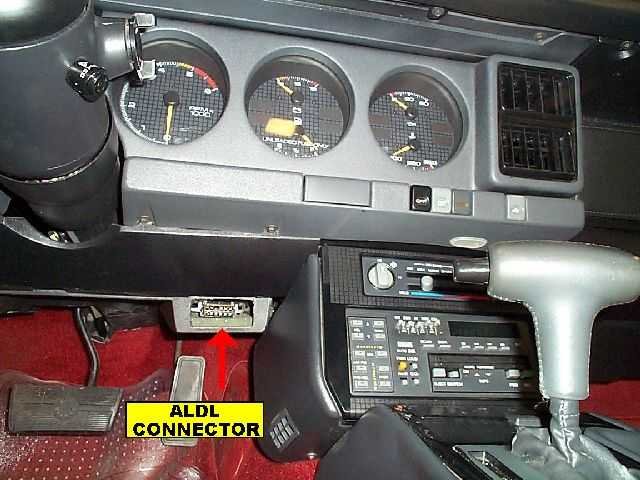
The ECM is also connected to a socket in the vehicle passenger compartment, to the right of the steering wheel on Pontiacs and left of the steering wheel on Chevrolets. This socket is called the Assembly Line Diagnostic Link, or "ALDL" connector, for short. You can connect several devices to this socket to receive data from the ECM and perform various diagnostic functions. There are data logging scanners that communicate with the ECM through this port, and Code Scanners that can trigger a diagnostic mode in the ECM and display stored error codes. Some of these code scanners are commercially available for about $30-45. Most TGO members have used the GM OBD I ECM Diagnostic Trouble Code Retrieval Tool" with great success. This device is also known as a "paper clip" to TGO members. Form this paper clip (or any piece of wire) into a ‘U’ shape.
With the engine and ignition turned off, locate the ALDL connector under the dash There should be a small rectangular cover over the access hole in the lower dash trim, or at least it was when the car was delivered.
Insert a tool as described above (paper clip) into the 'A' and 'B' terminals on the ALDL connector:
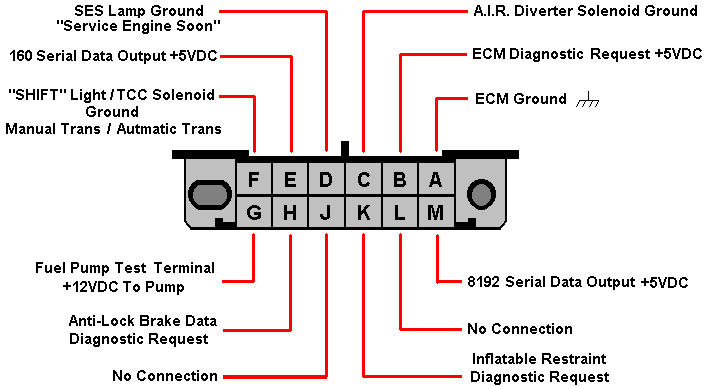
WITHOUT STARTING the engine, turn the ignition to the "RUN" position. Watch the Malfunction Indicator Lamp (MIL) - it will begin to flash. This is also commonly called the "Service Engine Soon" or "SES" lamp. The first code will flash three times, and will usually be a code '12'. This is encoded by one flash of the lamp, a brief pause, then two successive flashes of the lamp. Each code will repeat three times, so you should see a "Code 12" flash three times. Any other error codes will follow in numerical order, and each code should flash three times. After all codes have been displayed three times, the "Code 12" will again flash three times, then all other codes will follow as described earlier. This cycle will continue until the jumper is removed or the ignition is turned off.
After you have made a note of all error codes, turn off the ignition and remove the jumper immediately. If you forget to remove the jumper and attempt to start the engine with it in place, you could damage the ECM. For this reason you should remove it immediately.
Once you have a note of all error codes, check this file for the decoding:
GM Error Codes.pdf.
You'll need Adobe Acrobat Reader to open/print the file.
The Electronic Control Module (ECM) is the device that controls most fuel and ignition functions for the engine, as well as emissions systems, torque converter clutch operation, and several other items. IT receives input signals from various engine and transmission sensors, computes the necessary fuel and ignition functions, and operates the fuel and ignition systems accordingly. Sensor inputs that are out of an acceptable range, or outputs that are damaged or disconnected will generate errors in the ECM processing, and will set an internal trouble code, which is stored in ECM short term memory (RAM).
The ECM is also connected to a socket in the vehicle passenger compartment, to the right of the steering wheel on Pontiacs and left of the steering wheel on Chevrolets. This socket is called the Assembly Line Diagnostic Link, or "ALDL" connector, for short. You can connect several devices to this socket to receive data from the ECM and perform various diagnostic functions. There are data logging scanners that communicate with the ECM through this port, and Code Scanners that can trigger a diagnostic mode in the ECM and display stored error codes. Some of these code scanners are commercially available for about $30-45. Most TGO members have used the GM OBD I ECM Diagnostic Trouble Code Retrieval Tool" with great success. This device is also known as a "paper clip" to TGO members. Form this paper clip (or any piece of wire) into a ‘U’ shape.
With the engine and ignition turned off, locate the ALDL connector under the dash There should be a small rectangular cover over the access hole in the lower dash trim, or at least it was when the car was delivered.
Insert a tool as described above (paper clip) into the 'A' and 'B' terminals on the ALDL connector:
WITHOUT STARTING the engine, turn the ignition to the "RUN" position. Watch the Malfunction Indicator Lamp (MIL) - it will begin to flash. This is also commonly called the "Service Engine Soon" or "SES" lamp. The first code will flash three times, and will usually be a code '12'. This is encoded by one flash of the lamp, a brief pause, then two successive flashes of the lamp. Each code will repeat three times, so you should see a "Code 12" flash three times. Any other error codes will follow in numerical order, and each code should flash three times. After all codes have been displayed three times, the "Code 12" will again flash three times, then all other codes will follow as described earlier. This cycle will continue until the jumper is removed or the ignition is turned off.
After you have made a note of all error codes, turn off the ignition and remove the jumper immediately. If you forget to remove the jumper and attempt to start the engine with it in place, you could damage the ECM. For this reason you should remove it immediately.
Once you have a note of all error codes, check this file for the decoding:
GM Error Codes.pdf.
You'll need Adobe Acrobat Reader to open/print the file.
Last edited by Vader; Mar 31, 2018 at 10:56 AM. Reason: Updated links

Member
Joined: Dec 2001
Posts: 456
Likes: 4
From: Concordia, MO, USA
Car: 89 Formula, WS6
Engine: LB9/peanut cam :(
Transmission: 700R4

If anybody wants to start a betting pool, I'm in for codes 33,34, and 36.
It sounds like you're having problems with your mass airflow sensor (MAF sensor).
Vader's dead on-target though. Pulling codes is the best place to start. It narrows the field quite a bit.

Thread
Thread Starter
Forum
Replies
Last Post
MikkoV
TPI
2
Sep 9, 2015 04:25 PM
