When you click on links to various merchants on this site and make a purchase, this can result in this site earning a commission. Affiliate programs and affiliations include, but are not limited to, the eBay Partner Network.
Engine SwapEverything about swapping an engine into your Third Gen.....be it V6, V8, LTX/LSX, crate engine, etc. Pictures, questions, answers, and work logs.
You are risking a huge investment to just keep the 255. Everything I see online says that pump will be at its absolute limit with your power numbers, some sources say you are well above (500hp limit). You really want to be operating with headroom to spare, not at the limits of a particular component.
You are risking a huge investment to just keep the 255. Everything I see online says that pump will be at its absolute limit with your power numbers, some sources say you are well above (500hp limit). You really want to be operating with headroom to spare, not at the limits of a particular component.
agreed. Time to jump ship. Reorganize. Where’s QwkTrip lol
Well I’ve been prowling around. Looking for a solution. I found a nice aeromotive set up but it has AN fittings and LINES.
looks like a solid piece. But it’s costly and I can’t keep my stock lines. Where the happy medium?
the name of the game is utilize my gas gauge and my harness relay.
they also offer a pro kit. You can control the flow. But it’s expensive! This is getting out of control
The advertised ratings that these pump manufacturers publish are just at one condition, typically 13.5V and 40 psi (they'll say in the tech specs). And the "Horsepower ratings" are just ballpark guesses based on assumption of 10 gal/hr fuel flow per 100 Hp. The pump flow curve will give you better idea how it will perform in your application.
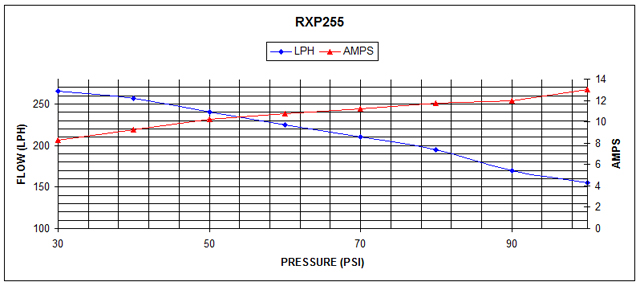
Below is the flow curve for a Racetronix RXP255 at 13.5V operating voltage (typical alternator charging voltage), Link Here
LS engine operates at 58 psi. This is about 225 L/hr on the curve (about 595 Hp by the rule of thumb). But you want some headroom on that because the real world isn't perfect. You have no head room at all, probably at a deficit actually. This is why it would smart to get a larger pump.
Although too much pump is a problem too because a lot of excess fuel constantly goes back to the tank, heating it up a lot. Temperatures can get so high that it causes drivability problems. A 340 L/hr pump has lots of headroom for your engine and there is no need to go larger. Although I don't know the options out there for 3rd gen fuel tanks. Sometimes you gotta do what you gotta do to have a quality product, and if that is a larger pump then that's kind of the way it is.
According to testing at Lingenfelter, the stock 4th gen fuel filter and C5 Corvette fuel filter are good for about 270 L/hr before pressure drop becomes excessive. I would guess stock 3rd gen filter is about the same? Keep this in mind if you want to balance capabilities through the fuel system.
Personally I just live with it because I'm too lazy to change it, but I will say my filter has to be suuuuper clean or it will show up as a problem in fuel pressure data logs.
I'm finding that wiring a 4th gen tank is a lot easier than a 3rd gen tank. This 3rd gen tank is making me think a lot harder. Started up a new thread about the stock wiring bulkhead in the tank, https://www.thirdgen.org/forums/elec...ead-stock.html
Lack of upsized bulkhead offerings is making me try to figure out whether the stock bulkhead can or cannot support a 340 pump.
Turns out the Speartech pump circuit was too small so that ditched my ideas. The OP ended up using the whole Racetronix 340 kit with heavy-duty tank harness plus Hotwire kit.
1LELS7, thanks for letting me learn this with you. I learned a lot about the 3rd gen tank setup. Very different from what I thought coming into this thread!


 lol
lol