


Something I dont understand about wheel hop


Joined: Sep 2005
Posts: 27,893
Likes: 2,436
Car: Yes
Engine: Usually
Transmission: Sometimes
Axle/Gears: Behind me somewhere
Re: Something I dont understand about wheel hop
But I am going to come back with quote after quote from qualified people talking about dampers when they talk about wheel hop
Just like, I could post quotes on here from knowledgeable people about carburetor tuning or ignition system setup as answers to questions about a diesel motor; sure, they'd be accurate, truthful and all that, but would they ACTUALLY ADDRESS THE PROBLEM? "See, says right here, this guy with 5 degrees and 3 Indy 500 championships says the spark should occur at 35° BTDC..."
the first things brought up, are worn bushings
And I will continue to post, when people ask about wheel hop, the SOLUTION to the CAUSE of the problem. Even though I seem to get attacked by people whose areas of specialization and preference lie elsewhere besides the matter at hand. Feel free to post whatever you like whenever you like, even if it's only about a COVER-UP to the SYMPTOM of the problem; that's what this place is about. It's a discussion board, not supposed to be some one or another point of view "dominating" others.
I fail to see how you can be unconvinced by simple geometry and physics. The "science" is SO SIMPLE, you make me smile every time I see someone try to ignore it. You might as well argue that water flows uphill, and then claim that those who try to show that no it flows downhill haven't "proven" their case, and start talking about buying and installing pumps for draining people's yards when it rains and talking all about what the best pumps are when all they really need to do is dig a ditch. That's OK too, most of the people who visit this board won't have much trouble figuring out the pretend techno BS from the glaringly obvious.
And I totally agree with you in some ways, namely the importance of good shocks and struts in general; and their benefit to the wheel-hop situation just like their benefit in controlling ANY suspension motion. The difference lies in the FACT of what CREATES the wheel hop in the first place. And the FACT is, it is not CREATED by anything to do with the shocks, even if it might be POSSIBLE to CONTROL it with them; it is CREATED by the LCA geometry as its FIRST CAUSE, and therefore, like anything else, it should be addressed at its SOURCE as the FIRST approach to a cure, after any worn or defective parts are replaced as they always should be before modifying ANYTHING.

Supreme Member
Joined: Mar 2001
Posts: 6,577
Likes: 0
From: Portland, OR www.cascadecrew.org
Car: 1990 Camaro RS
Engine: Juiced 5.0 TBI - 300rwhp
Transmission: T5
Axle/Gears: 3.42 Eaton Posi, 10 Bolt
Re: Something I dont understand about wheel hop
Where is the science. That is all I am asking. If it was so simple, I am sure you can show me the equation for it. You haven't shown anything that what you THINK must be the cause, you have shown no proof. Again, you posting a paint drawing doesn't count as science, Look in the Milliken's book, or find a IEEE or SAE article on wheel hop, and show me.
Joined: Sep 2005
Posts: 27,893
Likes: 2,436
Car: Yes
Engine: Usually
Transmission: Sometimes
Axle/Gears: Behind me somewhere
Re: Something I dont understand about wheel hop
Where is the science.
 I'm sure I could use a CAD program or something and dressed it up prettier, and show the force vectors produced in the horizontal and vertical directions. I'm positive I can calculate the value of the part trying to raise the rear end up, as a function of the angle of the LCA misalignment; and equally positive I can calculate the frequency at which the rear end will try to hop up and down as a function of its mass and the spring rates, as well as tire properties (since the whole systematic defect is driven by a cycle of alternating presence and absence of traction, in addition to the resonance in the suspension motion itself). And people's eyes here would glaze over, and the point of the whole exercise would not be one iota better demonstrated than by simply doing the thought experiment that the drawing encourages. You should try it.
Show us a "book" where someone has discussed the specific details of THESE CARS, and how they fail. Taking general statements about suspension theory out of their context, and attempting to apply them to a specific situation where the BASIC REQUIREMENTS of a properly working suspension are not met, isn't helpful to anyone.

Supreme Member
iTrader: (1)
Joined: Jul 2004
Posts: 10,763
Likes: 4
From: Calgary, AB, Canada
Car: 1982 Trans-Am
Engine: 355 w/ ported 416s
Transmission: T10, hurst shifter
Axle/Gears: 10 bolt, true-trac, 3.73
Re: Something I dont understand about wheel hop
Since my sketching skills are far superior to sofakingdoms (or my imagery-thefting skills are good...), I'll post up this pic, with MOVING MSpaint lines. If needed, I can add some red (or even BLUE) circles to help draw attention to parts?
I think we *could*, OVER-shock a car to control the wheelhop, but that's almost like setting the LCA angle much too far... It induces other problems, ie the car becomes undriveable on anything other than a perfectly flat race track.
I think looking at the angle of the LCA and seeing how the force of the rear end moves the car, kinda makes it easy to see that it's going cause wheelhop (if setup poorly). Might as well set it up level, (or slightly lower in the back), then look at shock rates and whatnot. Obviously worn out parts should be replaced first.

I think we *could*, OVER-shock a car to control the wheelhop, but that's almost like setting the LCA angle much too far... It induces other problems, ie the car becomes undriveable on anything other than a perfectly flat race track.
I think looking at the angle of the LCA and seeing how the force of the rear end moves the car, kinda makes it easy to see that it's going cause wheelhop (if setup poorly). Might as well set it up level, (or slightly lower in the back), then look at shock rates and whatnot. Obviously worn out parts should be replaced first.

Banned
Joined: Sep 2007
Posts: 140
Likes: 0
Re: Something I dont understand about wheel hop
{NOTE: THis following post of mine is based on a response to Sofakingdom & Sonix models or scketches. It does not reflect the original posters question, it reflects the continual posting of bad tech info.}
Even Sonix just listed in his slide show that quote" Improper angle occurs from springs settling over time or lowering".
I discussed how lowering needs them to recorrect the geometry- I even stated Ihave them on my car.
However, his other reason stated "it occurs from spring settling"- bingo, worn parts. You model scketch just showed exactly what I stated above. People put themon as a baidaid fix to other problems because people like you guys are preaching this is the cure they need "IF they have worn springs"
It is not and you are promoting bad tech info.
Sonix, This is not an attack against you. Please understand I do not post things against people to make them look bad, I post things about false ino that can cause people reading these posts to buy the wrong parts wasting their hard earned dollars when they could have spent the money correctly on the proper fix. Your tech is wrong, but this does not make you a bad person. Please correct it so the unknowing person that does not understand things goes out and buys the wrong part to fix his/her problem. If the springs are worn, replace the springs.
Here's what I think some are not understanding. I think possibly you guys think that well the spring has sagged and I like the existing height- SO.....I will keep the springs and buy LCARB's Right? Wrong!!!!!!!
The spring even though sitting at the height you like are old a fatigued. The rate has dropped, they are weak. The proper fix is to buy new factory springs and cut the height off them about 1/4 to 1/2 based on the spring design and its # of free coils. This can get the car at the same fatigued spring height WITHOUT the fatigued spring rate.
THis is the most important statement I can make here-
Now the wheel hop does not come into play at static height. It comes into play at dynamic height when forces are applied and the fatigued spings compress more than the new springs- EVEN THOUGH they both started out supporting the car at the exact SAME STATIC HEIGHT.
Are we getting this now? I hope so SOFA. Becaue I have been very patient coming back intothis dead beaten hiorse of a post trting to get you to realize that you are wrong even though you still think you are not with your above posts.
Now with all this said, Take my senerio I listed above and instead of a spring change, you could also simply put a higher damper rate shock like a koni yellow on there adn it too would fix the lower rate shock, keep the same ride height, and actually improve the sfaety and handling of the vehicle at all realms of driving. Its what we do with our cars, drive them- be safe.
The higher bump rate (jounce, compression, etc- I call it bump) of a very good performance shock INCREASES the bump resistance just as a higher rate spring would- However- it does differently and better by slowing down the compression rate which wheelhop derives from. If the spring can not compress as fast due to a higher damper rate shock, its geometry will not go astry as quickly and the frquency causing whellhop will deminish. Every actrion has a reaction- SO... The rebound rate being higher also limits the recoil of the wheel hop frequency.
BUT, Yes this is a big BUTTTTTT... those of yoiu buying chaeapo budget valved shocks like KYB's are not getting the quality of valving in the shock. THey are more like a hard 4x4 shock when the adjustment is inncreased, and when decreased theytend not to have sufficiant compression valving which even if the rebound is very good, the weak bump valing still allowed the car to quat and the high rebound is now preventing it from returning to non-wheelhop angles.
Spring rates AND shock valving combined as a marriage is the whole key to good performance. THis is why GOOD shcoks can make just about anything more safe and just far better all around handling. The adition of LCARB's in place of this senerio with no other fix in this senerio would create a cr that is dangerous at freeway speeds with roll induced oversteer when the car swings sideway and first compresses to parallel- THEN due to bad damper rates releases while in lateral trasition in colision avoidance and now promotes roll oversteer- You spin out of control and die because someone gave you bad tech.
Even Sonix just listed in his slide show that quote" Improper angle occurs from springs settling over time or lowering".
I discussed how lowering needs them to recorrect the geometry- I even stated Ihave them on my car.
However, his other reason stated "it occurs from spring settling"- bingo, worn parts. You model scketch just showed exactly what I stated above. People put themon as a baidaid fix to other problems because people like you guys are preaching this is the cure they need "IF they have worn springs"
It is not and you are promoting bad tech info.
Sonix, This is not an attack against you. Please understand I do not post things against people to make them look bad, I post things about false ino that can cause people reading these posts to buy the wrong parts wasting their hard earned dollars when they could have spent the money correctly on the proper fix. Your tech is wrong, but this does not make you a bad person. Please correct it so the unknowing person that does not understand things goes out and buys the wrong part to fix his/her problem. If the springs are worn, replace the springs.
Here's what I think some are not understanding. I think possibly you guys think that well the spring has sagged and I like the existing height- SO.....I will keep the springs and buy LCARB's Right? Wrong!!!!!!!
The spring even though sitting at the height you like are old a fatigued. The rate has dropped, they are weak. The proper fix is to buy new factory springs and cut the height off them about 1/4 to 1/2 based on the spring design and its # of free coils. This can get the car at the same fatigued spring height WITHOUT the fatigued spring rate.
THis is the most important statement I can make here-
Now the wheel hop does not come into play at static height. It comes into play at dynamic height when forces are applied and the fatigued spings compress more than the new springs- EVEN THOUGH they both started out supporting the car at the exact SAME STATIC HEIGHT.
Are we getting this now? I hope so SOFA. Becaue I have been very patient coming back intothis dead beaten hiorse of a post trting to get you to realize that you are wrong even though you still think you are not with your above posts.
Now with all this said, Take my senerio I listed above and instead of a spring change, you could also simply put a higher damper rate shock like a koni yellow on there adn it too would fix the lower rate shock, keep the same ride height, and actually improve the sfaety and handling of the vehicle at all realms of driving. Its what we do with our cars, drive them- be safe.
The higher bump rate (jounce, compression, etc- I call it bump) of a very good performance shock INCREASES the bump resistance just as a higher rate spring would- However- it does differently and better by slowing down the compression rate which wheelhop derives from. If the spring can not compress as fast due to a higher damper rate shock, its geometry will not go astry as quickly and the frquency causing whellhop will deminish. Every actrion has a reaction- SO... The rebound rate being higher also limits the recoil of the wheel hop frequency.
BUT, Yes this is a big BUTTTTTT... those of yoiu buying chaeapo budget valved shocks like KYB's are not getting the quality of valving in the shock. THey are more like a hard 4x4 shock when the adjustment is inncreased, and when decreased theytend not to have sufficiant compression valving which even if the rebound is very good, the weak bump valing still allowed the car to quat and the high rebound is now preventing it from returning to non-wheelhop angles.
Spring rates AND shock valving combined as a marriage is the whole key to good performance. THis is why GOOD shcoks can make just about anything more safe and just far better all around handling. The adition of LCARB's in place of this senerio with no other fix in this senerio would create a cr that is dangerous at freeway speeds with roll induced oversteer when the car swings sideway and first compresses to parallel- THEN due to bad damper rates releases while in lateral trasition in colision avoidance and now promotes roll oversteer- You spin out of control and die because someone gave you bad tech.
Last edited by Duracell Bunny; Sep 30, 2007 at 11:55 AM.

Senior Member
Joined: Jan 2004
Posts: 678
Likes: 0
From: Connecticut
Car: '89 Firebird Formula
Engine: 305 TBI
Transmission: T5
Re: Something I dont understand about wheel hop
Well as far as worn out factory parts, my car has the following parts involving the rear end:
Subframe connectors
Koni red shocks on high
Brand new Moog IROC springs (stock height)
Brand new UMI tubular panhard bar (w/ poly)
Brand new UMI tubular LCAs (w/ poly)
Poly sway bar endlinks and bushings
Cheap Kumho tires (AST 245/50/16)
Subframe connectors
Koni red shocks on high
Brand new Moog IROC springs (stock height)
Brand new UMI tubular panhard bar (w/ poly)
Brand new UMI tubular LCAs (w/ poly)
Poly sway bar endlinks and bushings
Cheap Kumho tires (AST 245/50/16)

Banned
Joined: Sep 2007
Posts: 140
Likes: 0
Re: Something I dont understand about wheel hop
In a post way up above I explained that
1)the car did this from the factory new.
2)Koni reds are better than the factory shock- BUT
3) tire grip is also better now days compared to 20 year ago tire technology
so Conclusion in above post was the better shocks but also better tire grip puts him back in the same boat with wheelhop.
Grip and HP is an enemy. The more of both, the higher the spring rate AND shock damper valving needed to comtrol it. HP gets so hightha tthe car becomes a strickly sraight line vehicle in order to safely handle that HP(we are refering tothings getting extreme like doorslammers to top fuel)
Darkshot does not need relocation brackets at stock heght. If he insists on having that suspension choice Baiscally doing burnouts on a factory suspension, he will have to live wth wheelhop. Otherwise, he sould upgrade his shocks and spring rates and keep the same static ride height- but thois changes the dynamic ride height and eliminates his wheelhop.
Last edited by Duracell Bunny; Sep 30, 2007 at 11:49 AM.
Senior Member
Joined: Jan 2004
Posts: 678
Likes: 0
From: Connecticut
Car: '89 Firebird Formula
Engine: 305 TBI
Transmission: T5
Re: Something I dont understand about wheel hop
We'll since we are all applying science, theory, ms paint diagrams, and animated gifs, I for one would really like an animation of this "quick lane change to your grave" scenario.. seriously interested in learning about the problem.
If I had lcarb's I would have went out to an empty parking lot and been my own test dummy already
If I had lcarb's I would have went out to an empty parking lot and been my own test dummy already
Guest
Posts: n/a
Re: Something I dont understand about wheel hop
There are different factors in play with wheel hop, as mentioned above its a resonance thing. Whenever dealing with resonance, the first thing to do is avoid it if at all possible. Thats why you correct your geometry first, if its wrong. Check it, fix it. Having adequate pressure via the spring to control the axle and body is also necessary. Then you have to have the right amount of damping to control any motion presented. Thats what a damper is for. If you dont believe me, look at the graph posted on the previous page and the quote from the author himself. Dampers are not to prevent resonance, they are to control it. Here's what he said
"At wheel hop resonant frequency, increasing damping reduces wheel displacement and increases phase angle"
Reduces displacement. Thats typical of behavior of a damper. An overdamped suspension will only reduce the motion, not prevent it. I'll agree stock these suspensions left much to be desired, not only the LCA angle but the springs and the shocks. Combine all that, some power, some grip, some uneven surface (doesnt have to be that uneven either) and there you have it. Wheelhop.
Most of whats posted is right. HP and grip are your enemy. So are the suspension geometry, the springs, the shocks... minimize is the key.
Some background, expanding on what was posted before regarding resonance, damping, phase angle, etc (from my library. structures but same principles apply):
Chapter 3 of 25: Response of One-Degree of Freedom System to Harmonic Loading
3.3: Evaluation of Damping at Resonance
Structural Dynamics, 4th Ed
Mario Paz
ISBN 0-412-07461-3
(the funny looking E is damping, the D (dyn. magnification factor) is a factor of a formula to determine displacement or motion)
"At wheel hop resonant frequency, increasing damping reduces wheel displacement and increases phase angle"
Reduces displacement. Thats typical of behavior of a damper. An overdamped suspension will only reduce the motion, not prevent it. I'll agree stock these suspensions left much to be desired, not only the LCA angle but the springs and the shocks. Combine all that, some power, some grip, some uneven surface (doesnt have to be that uneven either) and there you have it. Wheelhop.
Most of whats posted is right. HP and grip are your enemy. So are the suspension geometry, the springs, the shocks... minimize is the key.
Some background, expanding on what was posted before regarding resonance, damping, phase angle, etc (from my library. structures but same principles apply):
Chapter 3 of 25: Response of One-Degree of Freedom System to Harmonic Loading
3.3: Evaluation of Damping at Resonance
Structural Dynamics, 4th Ed
Mario Paz
ISBN 0-412-07461-3
(the funny looking E is damping, the D (dyn. magnification factor) is a factor of a formula to determine displacement or motion)

Supreme Member
iTrader: (1)
Joined: Feb 2000
Posts: 7,964
Likes: 4
From: Norfolk, VA. USA
Car: 86 Trans Am, 88 Formula
Engine: 95LT4, 305TPI
Transmission: T56, T5
Re: Something I dont understand about wheel hop
I had LCARB's on my car in this video
http://youtube.com/watch?v=yEb8eRJRc...elated&search=
http://youtube.com/watch?v=yEb8eRJRc...elated&search=
Banned
Joined: Sep 2007
Posts: 140
Likes: 0
Re: Something I dont understand about wheel hop
We'll since we are all applying science, theory, ms paint diagrams, and animated gifs, I for one would really like an animation of this "quick lane change to your grave" scenario.. seriously interested in learning about the problem.
If I had lcarb's I would have went out to an empty parking lot and been my own test dummy already
If I had lcarb's I would have went out to an empty parking lot and been my own test dummy already
But I will try to be short and to the point.Roll oversteer/roll understeer, big swaysbars, mild rate springs and shocks what does this all mean and how does it affect things?
Lets start with the rear axle at stagnant position and LCA angles(the car is just sitting there not moving). If the lca's are parallel or close to parallel to the ground, then when the chassis leans to lets ay the right (you are in a left turn) The outside of the car will squat with lateral loading and the LCA angle will change to an upward angle in the rear. As this angle extends upward, the distance from the chassis mount and the axle mount in an imaginary parallel distance shortens. This shortening geometry causes the outside wheel section of the axle to move forward while the inside wheel section of the axle remains near aprox parallel- THUS it steers the axle inward towards the corner you are heading. If the car rolls enough and lets say the inside drops out, the outer distance from mount to mount in a parallel imaginary line also shortens and the axle still remains neutral steer or steers inward. THis is roll understeer to nuetral settings- This is good, It holds the rear end from tracking outward away from the direction you going and helps maintain a neutral balance of slip angle of both front and rear tread contact patches- More uniform loss of traction- more favorable for a predictable 4 wheel drift when car is pressed hard.
Now, Lower both rear LCA mounts into lower holes of the LCARB's and create a downward angle towards the rear of the LCA's( At stagnant height again). As the car rolls in the same senerio as above, The outside wheel of the corner will squat as the chassis rolls. Back to that imaginary parallel distance between LCA mounts and the right hand side (the outside LCA) distance just LENGTHENED on that side while the inside either stayed the same or dropped further out in suspension travel and caused that LCA distance to close even more- The axle now is steering outward away from the corner. There is less slip angle and the rear of the car is heading straight with lots of grip fast as the front of the car continues to turn. The rear of the car steers away from the corner and the car goes very uncontrolably into a snap oversteer and comes around- Just like you saw in Zephers video. His car is very loose through and out of the corners.
There are times in Zephers video where he starts to get out of shape (meaning the tail is coming out through trasitions) then suddenly it does bite and he quickly gains grip and cornering momentum exiting the turn- WHY?
As hes stabs the thottle (he does have very good power) he does extend that LCA back downward on the outdside even though the car is leaned. That combined with the rear posi or locker will regain rear bite and nose lightens, the car steers out more balanced. This is the only way he saves the car corner after corner is stabbing the throttle to re shorten that outer LCA distance and steer the rear axle back to nuetral. Lifting the throttle is down right suicide for him if he is in a corner deep and hard.
So back to the lane change.
If you are traveling down the freeway at lets say aprox 60-80mph in a thridgen with relocators on the car and the LCA's pointing downward in the rear- AND- you deside you have to crank the wheel over to phase warp a few lanes over to avoid a car changing lanes into you path (or whatever you trouble is- you just had to panic steer in a rapid direction over from the forward path you were traveling) Your chassis leans quickly and the rear axle steers outward and snaps into roll oversteer - And as you lift the throttle because you have to brake for cars ahead of you , you are a goner just like you saw Zepher spin in his first run. Even at that speed, If you could still get hard on the thottle it is too late because the polar weight of these cars will keep your tail end heading in the spin.
Keep your geometry safe and correct. Keep your LCA's close to paralell to the ground.
Last edited by Duracell Bunny; Sep 30, 2007 at 11:45 PM.
Banned
Joined: Sep 2007
Posts: 140
Likes: 0
Re: Something I dont understand about wheel hop
I am trying to decide if I feel like typing more, Here goes nothing.
Subject- My car
And how it pulls 1.07 g's on street tires. that figure for those of you that do not know is remarkable and probably a world record for a 3100 lb thrid gen with full interior weight and creature comforts (A/C, etc) and most importantly- ON STREET TIRES 280 treadwear.
I have alot going on back there while the car sits into a corner but can tackle bumps through those hard corners. How the car brakes into corners, how the car accelerates into corners.
Myt spring choice and rate (I run progressive rear springs), COMBINED with my car weight bias, My roll couple (front and rear roll centers), my chassis strength and it multiple lateral braces and such, my unique swaybar choice (thanks to the lighter nose I can get away with a massive 25mm solid rear chromemoly bar- also thanks to my progressive rate springs), combined with my rebound settings and fixed bump setting (which by the way I am stuck with but wish the rear compression valving was just a tad less), Cmbined with my TQarm lentgh and mounts, my unsprung weight, and my brake setup (size and bias- a few tricks here to that can take a little novel) all work in sequence with heights and geomerty levels as the car leans and squats in all diffenrrent senerios. I had a problem with the rears going lower than I wanted to I further increased the progressive sping rate increase with the addition of hidden Koni shaftstyle bumpstops tha progressively increase spring rate after 7/8" of travel squat. I have also reduced the distance of mky LCA lentghs to further promote my roll understeer effect.
Everything took me about 2 years to perfect, but tinkering here, trying this-nope, puit it back and try that instead- I taylored it into a setup that is extremely unique and unlike anyone elses setup on these boards. My agilty and corner speed has everything to do with both 1) my lightweight V6 nose and its supesion travel geometry, and the use of progressive rear coils and my talyors roll induced understeer.
You could take change any one setting onm my car, or even remove something such as leaving my STB but removing my 3pt firewall links- and not tell me and I could drive it and tell you what was changed- My car is that sensitive to small changes.
There is alot that can be done to those rear setting- Its not only what parts you bolt or weld on, its more importantly how you set them.
I get so much grip off of street tires I actually wasted an Auburn Pro diff in 2 years with a V6. I corner that hard. (not a stardard Auburn, an Auburn Pro)
Autox run. Note that this is on street tires and a standard everyday alignment on tires that had 25,000 miles on them already. Note the car towards the end of the video when they zoom in at it coming back at you. It does not look very fast heading away bacause it is smooth and basically gutless (its the wifes minivan so to speak- my family car). But once it gets back near you you can tell just how hard it is carrying its speed and going through the corners. The next closest 3rd gen in our local group was 3.9 seconds behind me- even with this pathetic V6 power you see ******* off the line.Chris here (Madmax) was one of those competitors that day and his car is no slouch with a few modifications as most all the others were. Don't let this car fool you. As one of its victums has said," the license plate should be your first warning" It reads ON A RAIL.
http://www.zippyvideos.com/8464669705208156/d3/
Subject- My car
And how it pulls 1.07 g's on street tires. that figure for those of you that do not know is remarkable and probably a world record for a 3100 lb thrid gen with full interior weight and creature comforts (A/C, etc) and most importantly- ON STREET TIRES 280 treadwear.
I have alot going on back there while the car sits into a corner but can tackle bumps through those hard corners. How the car brakes into corners, how the car accelerates into corners.
Myt spring choice and rate (I run progressive rear springs), COMBINED with my car weight bias, My roll couple (front and rear roll centers), my chassis strength and it multiple lateral braces and such, my unique swaybar choice (thanks to the lighter nose I can get away with a massive 25mm solid rear chromemoly bar- also thanks to my progressive rate springs), combined with my rebound settings and fixed bump setting (which by the way I am stuck with but wish the rear compression valving was just a tad less), Cmbined with my TQarm lentgh and mounts, my unsprung weight, and my brake setup (size and bias- a few tricks here to that can take a little novel) all work in sequence with heights and geomerty levels as the car leans and squats in all diffenrrent senerios. I had a problem with the rears going lower than I wanted to I further increased the progressive sping rate increase with the addition of hidden Koni shaftstyle bumpstops tha progressively increase spring rate after 7/8" of travel squat. I have also reduced the distance of mky LCA lentghs to further promote my roll understeer effect.
Everything took me about 2 years to perfect, but tinkering here, trying this-nope, puit it back and try that instead- I taylored it into a setup that is extremely unique and unlike anyone elses setup on these boards. My agilty and corner speed has everything to do with both 1) my lightweight V6 nose and its supesion travel geometry, and the use of progressive rear coils and my talyors roll induced understeer.
You could take change any one setting onm my car, or even remove something such as leaving my STB but removing my 3pt firewall links- and not tell me and I could drive it and tell you what was changed- My car is that sensitive to small changes.
There is alot that can be done to those rear setting- Its not only what parts you bolt or weld on, its more importantly how you set them.
I get so much grip off of street tires I actually wasted an Auburn Pro diff in 2 years with a V6. I corner that hard. (not a stardard Auburn, an Auburn Pro)
Autox run. Note that this is on street tires and a standard everyday alignment on tires that had 25,000 miles on them already. Note the car towards the end of the video when they zoom in at it coming back at you. It does not look very fast heading away bacause it is smooth and basically gutless (its the wifes minivan so to speak- my family car). But once it gets back near you you can tell just how hard it is carrying its speed and going through the corners. The next closest 3rd gen in our local group was 3.9 seconds behind me- even with this pathetic V6 power you see ******* off the line.Chris here (Madmax) was one of those competitors that day and his car is no slouch with a few modifications as most all the others were. Don't let this car fool you. As one of its victums has said," the license plate should be your first warning" It reads ON A RAIL.
http://www.zippyvideos.com/8464669705208156/d3/
Last edited by Duracell Bunny; Oct 1, 2007 at 12:27 AM.

Supreme Member
Joined: Jul 2005
Posts: 2,123
Likes: 0
From: North Central Mass.
Car: 1985 Berlinetta
Engine: Megasquirted TPI
Transmission: Transgo 700R4
Axle/Gears: 3.42

Senior Member
Joined: Jan 2004
Posts: 678
Likes: 0
From: Connecticut
Car: '89 Firebird Formula
Engine: 305 TBI
Transmission: T5
Re: Something I dont understand about wheel hop
Is this kind of what your trying to say? obviously theres more to it then that, and perhaps would not even look like that because of it, just trying to get a grasp 
i should have put more arrows, view this bottom to top :P

i should have put more arrows, view this bottom to top :P
Last edited by dr1; Oct 1, 2007 at 01:37 AM.
Joined: Sep 2005
Posts: 27,893
Likes: 2,436
Car: Yes
Engine: Usually
Transmission: Sometimes
Axle/Gears: Behind me somewhere
Re: Something I dont understand about wheel hop
Not exactly...
1. (your top pic) Rear end of of LCA higher than "frame" end = BAD, creates wheel hop under acceleration
2. (middle pic) Rear end end of LCA level with "frame" end UNDER POWER = ideal
3. (bottom pic) Rear end end of LCA lower than "frame" end beyond just far enough to meet the "level UNDER POWER" requirement = bad also, creates weird steering geometry and wheel hop under hard braking
Stock, LCA is about level, at rest. But the back end of the car "squats" somewhat under power, which puts the system into condition 1 by lowering the "frame" with respect to the rear end. That's why they had wheel hop disease THE DAY THEY ROLLED OFF THE SHOWROOM FLOOR, with NEW springs, NEW shocks, NEW bushings, and NEW everything else: the geometry wasn't designed properly (like so many other things, this is why we "modify" our cars: they aren't "perfect" in our opinion as they came from the factory). Lowering the car, either deliberately or just as an effect of the typical old worn-out stock springs under most of these cars (including ALL of them that haven't had them replaced), makes it worse. Lowering the rear end end of the LCA with the extension bracket does 2 things: it reduces the tendency of the car to "squat" in the first place; and when it DOES "squat", it restores the CORRECT geometry, namely, LCA level. It is possible to lower it so far that the rear end of the car actually RAISES UP under power, instead of "squatting"; but that's TOO much, for anything other than a single-purpose strip-only drag car. The correct ballpark for street use is to set the LCA angle at rest such that the car still squats slightly, and at that time, the LCA is about level.
1. (your top pic) Rear end of of LCA higher than "frame" end = BAD, creates wheel hop under acceleration
2. (middle pic) Rear end end of LCA level with "frame" end UNDER POWER = ideal
3. (bottom pic) Rear end end of LCA lower than "frame" end beyond just far enough to meet the "level UNDER POWER" requirement = bad also, creates weird steering geometry and wheel hop under hard braking
Stock, LCA is about level, at rest. But the back end of the car "squats" somewhat under power, which puts the system into condition 1 by lowering the "frame" with respect to the rear end. That's why they had wheel hop disease THE DAY THEY ROLLED OFF THE SHOWROOM FLOOR, with NEW springs, NEW shocks, NEW bushings, and NEW everything else: the geometry wasn't designed properly (like so many other things, this is why we "modify" our cars: they aren't "perfect" in our opinion as they came from the factory). Lowering the car, either deliberately or just as an effect of the typical old worn-out stock springs under most of these cars (including ALL of them that haven't had them replaced), makes it worse. Lowering the rear end end of the LCA with the extension bracket does 2 things: it reduces the tendency of the car to "squat" in the first place; and when it DOES "squat", it restores the CORRECT geometry, namely, LCA level. It is possible to lower it so far that the rear end of the car actually RAISES UP under power, instead of "squatting"; but that's TOO much, for anything other than a single-purpose strip-only drag car. The correct ballpark for street use is to set the LCA angle at rest such that the car still squats slightly, and at that time, the LCA is about level.
Banned
Joined: Sep 2007
Posts: 140
Likes: 0
Re: Something I dont understand about wheel hop
Your drawing shows good the articulation and how the wheel moves forward off the vertical line at the top and bottom of the arch of articulation. The center one is lengthened from left to right, the top and bottom ones shorten from left to right due to articulation arch. Good accurate drawing.
As for useful range and stagnant height? This will vary slightly due to different spring rates and overall suspension travel. Start at the bottom of your graph (the bottom of the "bad range" you have listed and label that 2.
Label the center one(the paralell one) a 5, label the top one an 8. on a 0-10 scale.
Normal range of operation show be maintained where the LCA is close to parallel so little changes effects occur as possible. This range depends on suspension travel. a softer spring suspension may travel 5" total height, a firmer one like my setup will not go farther than 2 1/8" travel at most in "compression" from stagnant height with me in it. Driver weight can also vary startng ride height (you merely sit into the car and it can bump travel 1" on some peoples cases.)
With this said, normal articulation FOR THE MOST PART on "any" suspension articulation should range normal useage the same up and down distance from 5 (5 is center). This keeps the geomerty closest from changing. This pertains to control arms, A-arms, as well as tierods also. This is keeping things neutral in a perfect world. BUT (here's the but) street use suspnsions are softer for comfort thus they have alot of travel and geometry goes out of wack easier. As things wear, this gets even worse. SO if your LCA goes as low as 3, you need to go as high as an 8 travel (3-8 range) to keep a centered articulation. 0-5 would be bad, 5-10 would be bad, even 4-9 bad, or 2-7 bad. BUt he 0-5 of course is dratically worse on a progressive scale than a 2-7 range.
NOW, Travel range does not necessarily predict "stagnant" angle. Above I talked about compression travel. THe car may start at a 4 to 5 range stagnant. THis is ideal. Then compression travel puts the 4 to an 8 and drop out travel may let it out to a 3 in a corner inside release of just in road imperfections following road conture. So again, travel range is 3-8 with the starting stagnant height technically at about a 4 1/2. Drops to 3, but increases to 8. Compression side always has a deeper range than release side- until you jack the car off the ground that is.
My car. I run mine starting at about a 6 with me in it. My arms are about 1" shorter so they gain just a slight bit quicker in angle because my overall travel is reduced. My articulation goes from 5-8 and thats it. I have it set that it will not go heigher than an 8 due to recording shoock travel (Via a zip tie on the shock shaft to record max travel. (Reset it down each time by hand and retest.) This ziptie technique is how I discovered my compresion travel and limited it further with the Koni Shaft style progressive rate bumpstops. IT was going to a 10 and sucking down the other side to a 7 with the massive rear swaybar. on very hard corners. I was traveling too much and then bounceing into tration loss over bumps in corners (bouncing off the factory hard bumpstop which I had trimmed and reshaped much smaller- I was still hitting it.
I gotta go. More on this later. Sorry I cant finish right now.
As for useful range and stagnant height? This will vary slightly due to different spring rates and overall suspension travel. Start at the bottom of your graph (the bottom of the "bad range" you have listed and label that 2.
Label the center one(the paralell one) a 5, label the top one an 8. on a 0-10 scale.
Normal range of operation show be maintained where the LCA is close to parallel so little changes effects occur as possible. This range depends on suspension travel. a softer spring suspension may travel 5" total height, a firmer one like my setup will not go farther than 2 1/8" travel at most in "compression" from stagnant height with me in it. Driver weight can also vary startng ride height (you merely sit into the car and it can bump travel 1" on some peoples cases.)
With this said, normal articulation FOR THE MOST PART on "any" suspension articulation should range normal useage the same up and down distance from 5 (5 is center). This keeps the geomerty closest from changing. This pertains to control arms, A-arms, as well as tierods also. This is keeping things neutral in a perfect world. BUT (here's the but) street use suspnsions are softer for comfort thus they have alot of travel and geometry goes out of wack easier. As things wear, this gets even worse. SO if your LCA goes as low as 3, you need to go as high as an 8 travel (3-8 range) to keep a centered articulation. 0-5 would be bad, 5-10 would be bad, even 4-9 bad, or 2-7 bad. BUt he 0-5 of course is dratically worse on a progressive scale than a 2-7 range.
NOW, Travel range does not necessarily predict "stagnant" angle. Above I talked about compression travel. THe car may start at a 4 to 5 range stagnant. THis is ideal. Then compression travel puts the 4 to an 8 and drop out travel may let it out to a 3 in a corner inside release of just in road imperfections following road conture. So again, travel range is 3-8 with the starting stagnant height technically at about a 4 1/2. Drops to 3, but increases to 8. Compression side always has a deeper range than release side- until you jack the car off the ground that is
.My car. I run mine starting at about a 6 with me in it. My arms are about 1" shorter so they gain just a slight bit quicker in angle because my overall travel is reduced. My articulation goes from 5-8 and thats it. I have it set that it will not go heigher than an 8 due to recording shoock travel (Via a zip tie on the shock shaft to record max travel. (Reset it down each time by hand and retest.) This ziptie technique is how I discovered my compresion travel and limited it further with the Koni Shaft style progressive rate bumpstops. IT was going to a 10 and sucking down the other side to a 7 with the massive rear swaybar. on very hard corners. I was traveling too much and then bounceing into tration loss over bumps in corners (bouncing off the factory hard bumpstop which I had trimmed and reshaped much smaller- I was still hitting it.
I gotta go. More on this later. Sorry I cant finish right now.
Senior Member
Joined: Jan 2004
Posts: 678
Likes: 0
From: Connecticut
Car: '89 Firebird Formula
Engine: 305 TBI
Transmission: T5
Re: Something I dont understand about wheel hop
I get that part, I can picture how angle will effect wheelhop. But this is how I take what Dean is saying, and maybe I misunderstand but..
Supposing your starting angle is too severe.. when your cars body rolls completely to one side, the rear axle can now move in the complete opposite direction it used to move in.. and just one side is doing it with the car leaned like that, so hence the steering effect??
I would imagine in reality the whole motion for most peoples cars is somewhere convering the entire range of that picture though, and probably has no noticeable effect on handling?? I dont know.. and thats probably more of the argument, then whether or not the angle can possibly effect handling, is whether or not it has any relevance to most peoples cars who use the brackets.
It is still a bit funny arguing about it though, this is one of the best handling peices of american muscle riding around out there regardless.. the number of street/strip cars riding around out there, on the highway next to you, is quite high. And then the shitty factory stuff that didnt even have a team to design the suspension it would seem :P If you had to switch over 4 lanes of highway, lets hope your the only one involved otherwise your probably f*cked anyways..
damn, how did you sneak in a reply above me? I take too long to post
Supposing your starting angle is too severe.. when your cars body rolls completely to one side, the rear axle can now move in the complete opposite direction it used to move in.. and just one side is doing it with the car leaned like that, so hence the steering effect??
I would imagine in reality the whole motion for most peoples cars is somewhere convering the entire range of that picture though, and probably has no noticeable effect on handling?? I dont know.. and thats probably more of the argument, then whether or not the angle can possibly effect handling, is whether or not it has any relevance to most peoples cars who use the brackets.
It is still a bit funny arguing about it though, this is one of the best handling peices of american muscle riding around out there regardless.. the number of street/strip cars riding around out there, on the highway next to you, is quite high. And then the shitty factory stuff that didnt even have a team to design the suspension it would seem :P If you had to switch over 4 lanes of highway, lets hope your the only one involved otherwise your probably f*cked anyways..
damn, how did you sneak in a reply above me? I take too long to post
Joined: Sep 2005
Posts: 27,893
Likes: 2,436
Car: Yes
Engine: Usually
Transmission: Sometimes
Axle/Gears: Behind me somewhere
Re: Something I dont understand about wheel hop
Yes you (and Dean) are absolutely correct in that analysis of the rear end unintentionally becoming a steering element. That's what I was referring to up there.
The wheelbase on each side of the car is determined by where in its arc the LCA is. So with the LCA perfectly level, the wheelbase is at its LONGEST; and it SHORTENS as the LCA swings IN EITHER DIRECTION away from level, in its arc. So, in a turn where the LCAs are pointed severely downward, the outer wheel will deflect upward, into the chassis, levelling the LCA over at least some part of the suspension travel; thereby increasing the WB on THAT SIDE of the car. All the while, the opposite thing is happening on the other side of the car: the WB is getting shorter, because the LCA is swinging farther away from level. In other words, the rear end is NO LONGER perpendicular to the car's axis; instead, it's now actively moving around and steering the car. Specifically, it's ADDING to the already-existing steering, in a "positive-feedback" kind of way: you steer hard, the rear end steers some more, which makes the car steer harder, which makes the rear steer some more, etc. Obviously there's limits to how far that whole process can go (namely, traction), but it isn't hard to see that it's a bad thing. IIRC that was one of the factors in the famous Corvair "roll-over" situation of years gone by.
So yeah, if you:
1. Fail to control body roll, such that the 2 sides of the suspension are MASSIVELY different in their deflection (i.e., not enough spring, sway bar, shock, or some combo of all); and
2. Overdose on LCA lowering (probably to the point in fact, where it has a DETRIMENTAL effect on straight-line acceleration, but from other reasons besides wheel hop); and
3. Attempt an extreme handling maneuver;
then unexpected and tragic things can happen.
All true.
Keep in mind also, that's THREE STUPID THINGS it takes there, to create the disaster. Too much LCA lowering, not enough car prep, too violent of a steering input.
IN NO WAY do I advocate lowering the LCAs to that point. That possibility is one of the things I get beat over the head with every time I post this, and somebody (usually Dean) comes in here with that argument. IT DOES NOT APPLY when the brackets are set up properly.
It also doesn't mean that LCA brackets aren't the way to eliminate wheel hop at it source. What it DOES mean is that they need to be used properly and not indiscriminately set all the way to "kill" without understanding ALL of the effects that they can have, and thinking about what can happen.
The wheelbase on each side of the car is determined by where in its arc the LCA is. So with the LCA perfectly level, the wheelbase is at its LONGEST; and it SHORTENS as the LCA swings IN EITHER DIRECTION away from level, in its arc. So, in a turn where the LCAs are pointed severely downward, the outer wheel will deflect upward, into the chassis, levelling the LCA over at least some part of the suspension travel; thereby increasing the WB on THAT SIDE of the car. All the while, the opposite thing is happening on the other side of the car: the WB is getting shorter, because the LCA is swinging farther away from level. In other words, the rear end is NO LONGER perpendicular to the car's axis; instead, it's now actively moving around and steering the car. Specifically, it's ADDING to the already-existing steering, in a "positive-feedback" kind of way: you steer hard, the rear end steers some more, which makes the car steer harder, which makes the rear steer some more, etc. Obviously there's limits to how far that whole process can go (namely, traction), but it isn't hard to see that it's a bad thing. IIRC that was one of the factors in the famous Corvair "roll-over" situation of years gone by.
So yeah, if you:
1. Fail to control body roll, such that the 2 sides of the suspension are MASSIVELY different in their deflection (i.e., not enough spring, sway bar, shock, or some combo of all); and
2. Overdose on LCA lowering (probably to the point in fact, where it has a DETRIMENTAL effect on straight-line acceleration, but from other reasons besides wheel hop); and
3. Attempt an extreme handling maneuver;
then unexpected and tragic things can happen.
All true.
Keep in mind also, that's THREE STUPID THINGS it takes there, to create the disaster. Too much LCA lowering, not enough car prep, too violent of a steering input.
IN NO WAY do I advocate lowering the LCAs to that point. That possibility is one of the things I get beat over the head with every time I post this, and somebody (usually Dean) comes in here with that argument. IT DOES NOT APPLY when the brackets are set up properly.
It also doesn't mean that LCA brackets aren't the way to eliminate wheel hop at it source. What it DOES mean is that they need to be used properly and not indiscriminately set all the way to "kill" without understanding ALL of the effects that they can have, and thinking about what can happen.
Last edited by sofakingdom; Oct 1, 2007 at 11:51 AM.

Supreme Member
iTrader: (1)
Joined: Feb 2000
Posts: 7,964
Likes: 4
From: Norfolk, VA. USA
Car: 86 Trans Am, 88 Formula
Engine: 95LT4, 305TPI
Transmission: T56, T5
Re: Something I dont understand about wheel hop
Oh, and here is a video without LCARB's.
http://youtube.com/watch?v=BQ54A0NY2l0
I ended up tearing apart my Eaton/Moser/4.10 rear end and swapping in a stock 01 SS 3.42 rear.
http://youtube.com/watch?v=BQ54A0NY2l0
I ended up tearing apart my Eaton/Moser/4.10 rear end and swapping in a stock 01 SS 3.42 rear.
Supreme Member
Joined: Mar 2001
Posts: 6,577
Likes: 0
From: Portland, OR www.cascadecrew.org
Car: 1990 Camaro RS
Engine: Juiced 5.0 TBI - 300rwhp
Transmission: T5
Axle/Gears: 3.42 Eaton Posi, 10 Bolt
Re: Something I dont understand about wheel hop
Madmax.
Here is the thing, you can't avoid the resonance, you adjust your LCA's, and raise the IC, you change the spring rate, and so on. I am absolutly not saying that LCA's aren't needed at times (as BOTH Dean and I have pointed out, we both run them). BUT, I don't consider it the "cause" of wheel hop, as sofaking likes to point out so much, IMHO, shocks are the key to this. When you set everything up, if you are having wheel hop, you are under dampened. You see, if you drop the LCA, the IC is moved, thus more wieght transfer, thus you need stiffer springs, and what does this do to you whole concept of trying to avoid the resonance frequency by the suspension adjustments. Yeah, it would be great to be able to avoid it, but real world, it won't happen. You have to properly dampen the system, knowing that there is going to be a point when you have to control the resonance.
--John
Here is the thing, you can't avoid the resonance, you adjust your LCA's, and raise the IC, you change the spring rate, and so on. I am absolutly not saying that LCA's aren't needed at times (as BOTH Dean and I have pointed out, we both run them). BUT, I don't consider it the "cause" of wheel hop, as sofaking likes to point out so much, IMHO, shocks are the key to this. When you set everything up, if you are having wheel hop, you are under dampened. You see, if you drop the LCA, the IC is moved, thus more wieght transfer, thus you need stiffer springs, and what does this do to you whole concept of trying to avoid the resonance frequency by the suspension adjustments. Yeah, it would be great to be able to avoid it, but real world, it won't happen. You have to properly dampen the system, knowing that there is going to be a point when you have to control the resonance.
--John
Joined: Sep 2005
Posts: 27,893
Likes: 2,436
Car: Yes
Engine: Usually
Transmission: Sometimes
Axle/Gears: Behind me somewhere
Re: Something I dont understand about wheel hop
Dewey,
If you can AVOID exciting the resonsnace in the first place by applying the forces in the right direction, then you won't have ANYTHING that needs to be damped.
Since you've got all those chassis books that you like to quote shock stuff out of, go open one up; and flip back a few chapters, to where they talk about chassis member design. Don't start right in the middle of the book; get all that stuff that comes BEFORE THAT right first.
If you can AVOID exciting the resonsnace in the first place by applying the forces in the right direction, then you won't have ANYTHING that needs to be damped.
Since you've got all those chassis books that you like to quote shock stuff out of, go open one up; and flip back a few chapters, to where they talk about chassis member design. Don't start right in the middle of the book; get all that stuff that comes BEFORE THAT right first.
Supreme Member
Joined: Mar 2001
Posts: 6,577
Likes: 0
From: Portland, OR www.cascadecrew.org
Car: 1990 Camaro RS
Engine: Juiced 5.0 TBI - 300rwhp
Transmission: T5
Axle/Gears: 3.42 Eaton Posi, 10 Bolt
Re: Something I dont understand about wheel hop
Which brought me to the example above, it is not that easy.
You raise your IC to get your A/S higher. Because of this, you have more weight transfer, so you end up with higher spring rates, which means you still excite the frequency because the sprung frequency has changed.
Let me ask you this, what is the magic ammount of anti-squat or the magic IC location, to keep wheel hop from happening? How high or low does my sprung resanance frequency have to to avoid wheel hop? and what else am I screwing up by trying to get to that point.
Again. IF EVERYTHING IS BALANCED in that, you your LCA's close to level (he said, stock replacement springs, I BET his LCA's are level or the axle side is just slightly down), and you have wheel hop issues, it is because you are under dampened. Dialing in a huge amount of A/S is not the solution the problem.
You raise your IC to get your A/S higher. Because of this, you have more weight transfer, so you end up with higher spring rates, which means you still excite the frequency because the sprung frequency has changed.
Let me ask you this, what is the magic ammount of anti-squat or the magic IC location, to keep wheel hop from happening? How high or low does my sprung resanance frequency have to to avoid wheel hop? and what else am I screwing up by trying to get to that point.
Again. IF EVERYTHING IS BALANCED in that, you your LCA's close to level (he said, stock replacement springs, I BET his LCA's are level or the axle side is just slightly down), and you have wheel hop issues, it is because you are under dampened. Dialing in a huge amount of A/S is not the solution the problem.

Supreme Member
Joined: Jun 2005
Posts: 1,440
Likes: 2
From: huntsville, al
Car: 89 IROC
Engine: 6.8 HSR N2O
Transmission: TKO 600
Axle/Gears: 9" Moser 3.50 True trac
Re: Something I dont understand about wheel hop
Hey Darkshot- you gettin all this? I haven't seen you post since the "experts" got to arguing about the theory behind why your car may be hopping so bad. Did you get the LCARB's? Did it help? I'm interested cause your case seems to be a severe one. Good luck if you're even still out there.

Thread Starter

Joined: Nov 2005
Posts: 1,946
Likes: 0
From: Sacramento
Car: 91 RS
Engine: 350 TBI
Transmission: WC T5
Axle/Gears: 3.42 Posi
Re: Something I dont understand about wheel hop
Actually I was involved in a car accident less than 12 hours after making this post so I need to catch up with the responses. I do plan on getting the relocation brackets however.
Supreme Member
iTrader: (1)
Joined: Jul 2004
Posts: 10,763
Likes: 4
From: Calgary, AB, Canada
Car: 1982 Trans-Am
Engine: 355 w/ ported 416s
Transmission: T10, hurst shifter
Axle/Gears: 10 bolt, true-trac, 3.73
Re: Something I dont understand about wheel hop
Hmm, well you had the accident *without* the relocation brackets, so it looks like Dean's full of crap then 
Guest
Posts: n/a
Re: Something I dont understand about wheel hop
My condolences.
Dewey, I never said the shocks werent needed, but its not the solution. The shock should be matched to the car and provide proper damping for the suspension rather than overdamping it. If overdamping was the way, then everyone would just run the stiffest shocks known to man and adjustables would be a total waste. More to the point its the rest that is set to control it as much as feasible and the shocks are chosen to match.
Dewey, I never said the shocks werent needed, but its not the solution. The shock should be matched to the car and provide proper damping for the suspension rather than overdamping it. If overdamping was the way, then everyone would just run the stiffest shocks known to man and adjustables would be a total waste. More to the point its the rest that is set to control it as much as feasible and the shocks are chosen to match.
Banned
Joined: Sep 2007
Posts: 140
Likes: 0
Re: Something I dont understand about wheel hop
We'll see what caused his accident partner. Brakes maybe, of maybe someone rearended him? Funny you think its a joke at both my and Darkshots expense.
Darkshot, Hope all works out.
Supreme Member
iTrader: (1)
Joined: Jul 2004
Posts: 10,763
Likes: 4
From: Calgary, AB, Canada
Car: 1982 Trans-Am
Engine: 355 w/ ported 416s
Transmission: T10, hurst shifter
Axle/Gears: 10 bolt, true-trac, 3.73
Re: Something I dont understand about wheel hop
I do have a sense of humor, which was apparently lost on you....

Joined: May 2004
Posts: 5,338
Likes: 72
From: Lexington, SC
Car: 1987 SC/1985 TA
Engine: 350/vortec/fitech
Transmission: T56
Axle/Gears: 3.27 9-bolt
Supreme Member
Joined: Mar 2001
Posts: 6,577
Likes: 0
From: Portland, OR www.cascadecrew.org
Car: 1990 Camaro RS
Engine: Juiced 5.0 TBI - 300rwhp
Transmission: T5
Axle/Gears: 3.42 Eaton Posi, 10 Bolt
Re: Something I dont understand about wheel hop
One thing I can tell you, is that UNDER-Dampening isn't the way either.
--John
Guest
Posts: n/a
Re: Something I dont understand about wheel hop
Well thats for sure. Underdamped sucks anyway. I dont like bounce with my ride... in a car anyway.
I posted above before "minimize is the key".
FYI on another car at home (not a F-body) we installed some brackets on it mostly because of traction issues. At the factory holes the geometry was a little off anyway. With the brackets at the 'middle' hole its about right, and the handling is good and traction is fair (better than the factory geometry). With the LCA's moved down to the bottom the traction is on kill (as far as its concerned anyway, still sucks) but the rear is stiff as hell (feels like bind) and the ride and handling sucks. What Dean mentioned about roll oversteer. Its not uncontrollable by any means, but I wouldnt go autocrossing the car set up in that fashion.
I posted above before "minimize is the key".
FYI on another car at home (not a F-body) we installed some brackets on it mostly because of traction issues. At the factory holes the geometry was a little off anyway. With the brackets at the 'middle' hole its about right, and the handling is good and traction is fair (better than the factory geometry). With the LCA's moved down to the bottom the traction is on kill (as far as its concerned anyway, still sucks) but the rear is stiff as hell (feels like bind) and the ride and handling sucks. What Dean mentioned about roll oversteer. Its not uncontrollable by any means, but I wouldnt go autocrossing the car set up in that fashion.
Supreme Member
Joined: Mar 2001
Posts: 6,577
Likes: 0
From: Portland, OR www.cascadecrew.org
Car: 1990 Camaro RS
Engine: Juiced 5.0 TBI - 300rwhp
Transmission: T5
Axle/Gears: 3.42 Eaton Posi, 10 Bolt
Re: Something I dont understand about wheel hop
See, notice, one small change of one suspension pick-up point, and you have all sorts of diffrent effects. My orginal point still stands, and especialy as it deals with the person posting. I would BET money that his axle side mount is slightly lower than his axle side. He just put new springs on, that are higher rate (and thus the sprung mass' resonsance frequency increases), and now he is hopping, because he is under dampened.
I guess I don't see why this is even an argument.
--John
I guess I don't see why this is even an argument.
--John
Banned
Joined: Sep 2007
Posts: 140
Likes: 0
Re: Something I dont understand about wheel hop
Autoxing is low speed and not as critical. it would be far worse at freeway speeds.
THose of you that do not think 1/4" of axle steer is a big have never experienced what the difference feels like. 1/8" thrust to the left in a left hand turn feels MAJOR difference then 1/8" thrust to the right in a left hander. Rear steer is about 3 times more squirrely than front steer.
Take that same 1/8" to one side going straight down the road and you are doglegging bigtime and will major feel it in the steering.
Try toeing in and out your FRONTS 1/8" and see how that affects the way a car turns into a corner (and remember, the front toe setting is not to the left, or to the right, its both tires acting in on eachother or acting out on eachother going straight, not both turns the same direction- yet it has a major difference in feel when turned with that 1/4" overall difference. NOW REMEMBER, the rear is about 3x as sensitive. Sofa, your kidding yourself to think this has no effect, and you are even kidding yourself thinking if it does have effect it is only minor- no, its major.
------
More on that above post I did yesterday on the 0-10 scale with 5 being parallel. My cars' inside rear LCA stays at a 5 for the most part on even surface hard cornering. I acheived this through Video footage of my car on a skidpad and estimating the gap in my inner wheelwells in hard turning. SLower speed corner entrances are resttricted from roll rate as much due to the high rebound rate I run. Once set into steady state for a second or two the car proceeds to roll and set and the taill end tightends up in corner. THis gives me a radically fast turnin and then progresses into neutralizing the balance as the roll continues. THis is good for low speed tighter turns. Higher speed turns the car takes longer entering the turn and this the rebound can achieve the roll desored to induce roll understeer needed to keep the tail tight on high speed turn ins before steadystate is reached. SO no, autox is not a critical as road course speeds.
High speed braking: my rear does not jack as quickly from the inverted angle due 1) in part of the high rebound slowing it, but 2) mainly the progressive rate spings not inducing high recoil rates and causing rear jacking like linear springs do in the same situation. My slightly shorter TQarm helps with squat to counteract. My rear brakes are smaller compared to my fronts but my rear bias is slightly higher. THis combined with some different pad coiefficients front and rear allow the rear to come on first and hard to keep out any tail yaw but the higher front coefficient comes in to overpower the rears and balance it out a few seconds on eliminating rear wheel hop under extremely hard high speed braking. My low front roll center is counter acted in the couple with my lowered rear roll center and the increased leverage gets the roll I desire to induce the roll understeer and quat load the outside tires without lifting load on the insides.
My lightweiight V6 alllows me to run a very low front roll center due to the cars' overall lower center of gravity. WIth the 800lbs fronts, but greatly reduced unsprung weight- I still pull off a remarkably smooth straightline ride for the wife to wenjkoy this car daily.
Its all how you set it.
I am nicknaming Sofakingdom to SofakingOutOfYourLeague.
THose of you that do not think 1/4" of axle steer is a big have never experienced what the difference feels like. 1/8" thrust to the left in a left hand turn feels MAJOR difference then 1/8" thrust to the right in a left hander. Rear steer is about 3 times more squirrely than front steer.
Take that same 1/8" to one side going straight down the road and you are doglegging bigtime and will major feel it in the steering.
Try toeing in and out your FRONTS 1/8" and see how that affects the way a car turns into a corner (and remember, the front toe setting is not to the left, or to the right, its both tires acting in on eachother or acting out on eachother going straight, not both turns the same direction- yet it has a major difference in feel when turned with that 1/4" overall difference. NOW REMEMBER, the rear is about 3x as sensitive. Sofa, your kidding yourself to think this has no effect, and you are even kidding yourself thinking if it does have effect it is only minor- no, its major.
------
More on that above post I did yesterday on the 0-10 scale with 5 being parallel. My cars' inside rear LCA stays at a 5 for the most part on even surface hard cornering. I acheived this through Video footage of my car on a skidpad and estimating the gap in my inner wheelwells in hard turning. SLower speed corner entrances are resttricted from roll rate as much due to the high rebound rate I run. Once set into steady state for a second or two the car proceeds to roll and set and the taill end tightends up in corner. THis gives me a radically fast turnin and then progresses into neutralizing the balance as the roll continues. THis is good for low speed tighter turns. Higher speed turns the car takes longer entering the turn and this the rebound can achieve the roll desored to induce roll understeer needed to keep the tail tight on high speed turn ins before steadystate is reached. SO no, autox is not a critical as road course speeds.
High speed braking: my rear does not jack as quickly from the inverted angle due 1) in part of the high rebound slowing it, but 2) mainly the progressive rate spings not inducing high recoil rates and causing rear jacking like linear springs do in the same situation. My slightly shorter TQarm helps with squat to counteract. My rear brakes are smaller compared to my fronts but my rear bias is slightly higher. THis combined with some different pad coiefficients front and rear allow the rear to come on first and hard to keep out any tail yaw but the higher front coefficient comes in to overpower the rears and balance it out a few seconds on eliminating rear wheel hop under extremely hard high speed braking. My low front roll center is counter acted in the couple with my lowered rear roll center and the increased leverage gets the roll I desire to induce the roll understeer and quat load the outside tires without lifting load on the insides.
My lightweiight V6 alllows me to run a very low front roll center due to the cars' overall lower center of gravity. WIth the 800lbs fronts, but greatly reduced unsprung weight- I still pull off a remarkably smooth straightline ride for the wife to wenjkoy this car daily.
Its all how you set it.
I am nicknaming Sofakingdom to SofakingOutOfYourLeague.
Last edited by Duracell Bunny; Oct 3, 2007 at 07:22 PM.
Joined: Sep 2005
Posts: 27,893
Likes: 2,436
Car: Yes
Engine: Usually
Transmission: Sometimes
Axle/Gears: Behind me somewhere
Re: Something I dont understand about wheel hop
My cars'
I did
my rear
I acheived
I run
gives me
My low
I desire
I still

Yes we're all impressed. Honestly.
First person experience is definitely something to be sought after; but it looks like there's a pattern here that has very little, AT MOST, to do with wheel hop. I'm feeling a little too much of something not related to that.
I think I'll come up with a nickname for Dean too. It'll involve a gender-specific activity usually performed .... uhhhh, solo.
None of which seems to have a whole lot to do with, how you fix the wheel hop problem that these cars are born with, and that gets worse with age, wear & tear, and typical mods. Which is, re-align the suspension member geometry that wasn't really right from the factory, and that all of those other things make worse. We've all seen, heard, been through, and got tired of, what happens when you do TOO MUCH of it though. Can we please move on now?

Joined: Sep 2005
Posts: 27,893
Likes: 2,436
Car: Yes
Engine: Usually
Transmission: Sometimes
Axle/Gears: Behind me somewhere
Re: Something I dont understand about wheel hop
interesting and educational merit
Like that whole last post. Not ONE WORD about how somebody can improve their own car, but a whole page about how great Dean thinks his car is.And still, not too much from you about the CAUSES or CURES of wheel hop IN THESE CARS. All I see is lots of stuff about, take any random old worn-out car with suspension members pointing Lord only knows where, and jam $1000 worth of shocks on it and it instantly reaches handling Nirvana; and of course, endless drivel about Dean's car. Not too much practical advice on how to deal with the geometry design flaw that THESE CARS have, as they come from the factory, and aggravated by wear; namely, the instant center being located too low and too far forward, or even somewhere BEHIND the car altogether like it usually is, instead of being located somewhere roughly near the CG, where it belongs, which of course is another method of analyzing and describing what LCARBs do (look at the various "centers" of the car & suspension). This is all the same sort of thing as the various suspension adjustments on a 4-link might do, or the various alterations of the same general sort (in terms of effect) that are known to work on various other chassis designs such as the A & G bodies that have a somewhat similar design issue that produces a somewhat similar symptom (wheel hop), and so on. Well known to the world at large.
I'm terribly sorry if you feel irrelevant and useless (easy to see how you would get that feeling, looking at how easy it is to see that you're just running off at the mouth without helping anybody), but beating this whole thing to death about how terrific your car is won't make that drivel any more USEFUL to people looking for the CAUSES and CURES for WHEEL HOP in THESE SPECIFIC CARS.
Have a WONDERFUL day Dean! Nice to see you back again, at least temporarily.


Joined: Feb 2005
Posts: 4,500
Likes: 90
From: West Warwick RI, postal code: 02893
Car: Building LS3, T56 Z28
Engine: LS3
Transmission: T-56
Axle/Gears: Moser/ 4.11
Re: Something I dont understand about wheel hop

WOW! You guys are really something.
Dean seems to have some great experience under his belt. Why not just do a FULL tech write up that can become a sticky with all that knowledge in your head Dean?
As for sofakingdom:You seems to be trying to ground the thread and stay on track but are really getting distracted by Dean.
I think everyone should focus on the thread at hand.
What is the most 100% fix to wheel hop. Not just hack jobing it, but acctually fixing it. Granted most of us don't need to pull over 1 lateral G, and don't have the $ to make our cars do so, lets stick to practical fixes.
I for one don't even have wheel hop. I run stock IROC springs in my 91, with KYB AGX shocks set to 6 of 8 (pretty hard). and the fronts set to 1, softest. Then I don't run LCARBs but I do have tube trailing arms with poly ends.
I have 4.11s and a T-56 with 340 Lbs of TQ on hand to beat the crap outta my car and mashing the gas, I still get no "hop". Dunno why not, but try and copy me, I don't have a lot of $ in these springs or shocks really.
Thats all I got to say about this, later.
Joined: Sep 2005
Posts: 27,893
Likes: 2,436
Car: Yes
Engine: Usually
Transmission: Sometimes
Axle/Gears: Behind me somewhere
Re: Something I dont understand about wheel hop
Thank you.
Yes indeed, Dean is highly distracting. I apologize for letting him bait me, maybe I should just ignore him. He definitely knows his stuff about handling and many other things, and has plenty of BTDT; but it seems like this is one floor of his building that his elevator just refuses to stop on. Oh well. That would be LCARBs.
Some cars get lucky and don't hop; some are a great deal worse. There's other factors besides just this one that affect it. But in general, if a car has it, this is the way to nuke it.
Mine had it so bad that it could put down 2 dashed lines on the pavement for as long as I felt like staying in the gas, until something broke (usually the trans mount). Additionally, the left & right sides didn't always resonate exactly in sync (even after changing springs & shocks); the car would get this funky "skipping" sort of motion, from side to side. Very unnerving.
LCARBs totally squished it.
The car was at roughly stock height at the time of their installation. It had had this problem since I first got it, which was not quite brand new, but it was less than 2 years old and had less than 40k miles on it. I test drove LOTS of new ones in later years, especially from about 87 to 89; nearly all seemed to have it. I lost interest in buying a newer one after that.
Others have had similar experiences.
Yes indeed, Dean is highly distracting. I apologize for letting him bait me, maybe I should just ignore him. He definitely knows his stuff about handling and many other things, and has plenty of BTDT; but it seems like this is one floor of his building that his elevator just refuses to stop on. Oh well.
the most 100% fix to wheel hop
Some cars get lucky and don't hop; some are a great deal worse. There's other factors besides just this one that affect it. But in general, if a car has it, this is the way to nuke it.
Mine had it so bad that it could put down 2 dashed lines on the pavement for as long as I felt like staying in the gas, until something broke (usually the trans mount). Additionally, the left & right sides didn't always resonate exactly in sync (even after changing springs & shocks); the car would get this funky "skipping" sort of motion, from side to side. Very unnerving.
LCARBs totally squished it.
The car was at roughly stock height at the time of their installation. It had had this problem since I first got it, which was not quite brand new, but it was less than 2 years old and had less than 40k miles on it. I test drove LOTS of new ones in later years, especially from about 87 to 89; nearly all seemed to have it. I lost interest in buying a newer one after that.
Others have had similar experiences.
Banned
Joined: Sep 2007
Posts: 140
Likes: 0
Re: Something I dont understand about wheel hop
{Quote:
the most 100% fix to wheel hop
That would be LCARBs.}
No it is not- THis is bad tech.
You could have solved your problem the correct way by SIMPLY adding higher rate springs and shocks and maintaining correct geometry.
You just are not getting it and keep listing bad tech.
The ONLY time someone needs relocation brackets IS IF THEY LOWER THEIR RIDE HEIGHT.
the most 100% fix to wheel hop
That would be LCARBs.}
No it is not- THis is bad tech.
You could have solved your problem the correct way by SIMPLY adding higher rate springs and shocks and maintaining correct geometry.
You just are not getting it and keep listing bad tech.
The ONLY time someone needs relocation brackets IS IF THEY LOWER THEIR RIDE HEIGHT.
Supreme Member
iTrader: (1)
Joined: Jul 2004
Posts: 10,763
Likes: 4
From: Calgary, AB, Canada
Car: 1982 Trans-Am
Engine: 355 w/ ported 416s
Transmission: T10, hurst shifter
Axle/Gears: 10 bolt, true-trac, 3.73
Re: Something I dont understand about wheel hop
You guys can just agree to disagree eh?
I think that's the part that sofakingdom (Rob?) wants to argue. If you already have the correct geometry, then sure, fine, go on to other things, like stiffer springs and shocks.
But if you DON'T (either from it being lowered via lowering springs, different height tires or wheels, etc etc etc), then you need to get to the correct geometry first.
Dean, do you agree that you want to get to correct geometry before you look at springs/shocks? If so, I think you guys are in complete agreement, it's just a matter of semantics right?
maintaining correct geometry.
But if you DON'T (either from it being lowered via lowering springs, different height tires or wheels, etc etc etc), then you need to get to the correct geometry first.
Dean, do you agree that you want to get to correct geometry before you look at springs/shocks? If so, I think you guys are in complete agreement, it's just a matter of semantics right?
Banned
Joined: Sep 2007
Posts: 140
Likes: 0
Re: Something I dont understand about wheel hop
If the springs are too light a rate for the application, THey can start at the correct geometry on the stagnant side of articulation.
HOWEVER, they can motion too far compression in the other realm of articulation for the HP and GRIP being exerted.
NOW, addition of LCARB"S will provide the end of the articulation swing to correct but now puts the stangant end of the articulation swing at risk of roll oversteer.
So no, LCARB's are NOT the way to go. Stiffer rate springs and shocks to limit the far end of articulation due to increased grip and HP is the CORRECT way to go.
Everything has to be married togher. If you put a buetter than stock motor in there, you need to now increase the suspension to handle the greater forces exerted so the chassis is controled, you had also better increase the braking capacity, etc.... the cars' componants have to be married to what you are throwing it also..
I build cars extreme I know in most peoples eyes. I do not think so BECAUSE (I always try and give a reason with my opininon and try to base it on fact)
I can hammer my cars day in and day out and they still keep ticking. I do not build my cars then go drive them, I build my cars to handle what I throw at them and make them as reliable as humanly possible so they are still running as good 10 years from now. I never put a motor in a car with massive HP without the rest of the car being built to suit it first. My drivetrains and suspensions will easily handle my motors with 'daily abuse for years'. I have the correct parts, I have the correct geometry- they last and perform exceptional.
My slowest car is my 77 ElCamino SS. That car if I drove it hard would suffer from wheelhop. It is a cruiser and is sprung stock . It can not handle burnouts etc.-SO, here is the real kicker, I DO NOT BURN OUT IN IT.
If I wanted to build it(which I do not) I would NOT be putting relocation brackets on it to increase the suspension geometry to prevent wheelhop, I would do as desribed above and put heavier rate springs in it (the only mod this car has is slightly better than factory shocks- its stock and its a cruiser- so I drive it that way.
HOWEVER, they can motion too far compression in the other realm of articulation for the HP and GRIP being exerted.
NOW, addition of LCARB"S will provide the end of the articulation swing to correct but now puts the stangant end of the articulation swing at risk of roll oversteer.
So no, LCARB's are NOT the way to go. Stiffer rate springs and shocks to limit the far end of articulation due to increased grip and HP is the CORRECT way to go.
Everything has to be married togher. If you put a buetter than stock motor in there, you need to now increase the suspension to handle the greater forces exerted so the chassis is controled, you had also better increase the braking capacity, etc.... the cars' componants have to be married to what you are throwing it also..
I build cars extreme I know in most peoples eyes. I do not think so BECAUSE (I always try and give a reason with my opininon and try to base it on fact)
I can hammer my cars day in and day out and they still keep ticking. I do not build my cars then go drive them, I build my cars to handle what I throw at them and make them as reliable as humanly possible so they are still running as good 10 years from now. I never put a motor in a car with massive HP without the rest of the car being built to suit it first. My drivetrains and suspensions will easily handle my motors with 'daily abuse for years'. I have the correct parts, I have the correct geometry- they last and perform exceptional.
My slowest car is my 77 ElCamino SS. That car if I drove it hard would suffer from wheelhop. It is a cruiser and is sprung stock . It can not handle burnouts etc.-SO, here is the real kicker, I DO NOT BURN OUT IN IT.
If I wanted to build it(which I do not) I would NOT be putting relocation brackets on it to increase the suspension geometry to prevent wheelhop, I would do as desribed above and put heavier rate springs in it (the only mod this car has is slightly better than factory shocks- its stock and its a cruiser- so I drive it that way.
Last edited by Duracell Bunny; Oct 4, 2007 at 11:21 AM.
Joined: Sep 2005
Posts: 27,893
Likes: 2,436
Car: Yes
Engine: Usually
Transmission: Sometimes
Axle/Gears: Behind me somewhere
Re: Something I dont understand about wheel hop
You could have solved your problem the correct way by SIMPLY adding higher rate springs and shocks and maintaining correct geometry.
The problem isn't just "maintaining" correct geometry; it's ESTABLISHING it in the first place.
These cars were BORN WITH this problem. They did it the day they rolled off the showroom floor. Lowering, wear, weakened springs, and ineffective shocks make it worse, for sure; but the root cause is a design issue, of poor geometry. The cars simply weren't designed with this feature optimized. Knowing how the factory is, there was probably a GOOD reason (to them) why they left it imperfect as they did, because of some other compromise they felt it necessary to make; could have been any number of things; the correct-length brackets might have been so low that with some arbitrarily small tire size they thought they might drag the ground if the car had a flat tire, long enough brackets could have made completed rear ends too expensive to ship to the vehicle assembly plant, could have been any number of things; I don't know, and it doesn't really matter. The fact of the matter is, it's the fact.
So yes Sonix, you are right: at its core, the problem is geometry. Tires don't really affect it, since they don't change the angle the LCA makes with respect to the "frame"; since shocks don't alter the suspension member geometry, so they can't fix it, all they can do is control it and cover it up; and lower-than-stock ride height makes it worse.
Guest
Posts: n/a
Re: Something I dont understand about wheel hop
Stock springs and Koni red sounds overdamped to me... or at least a LOT more in that direction than stock. I dont see how a Koni Yellow is going to help at this point.
Check geometry, it may or may not be fine. This is so easy to do, there shouldnt be so much discussion about it.
Get some brackets to fix it, if need be.
Get the poly out, or tighten the bushings with the car on the ground.
Forget shocks and springs, for now. Do the above, get the car repaired (sorry about the accident) and see if it still hops.
Check geometry, it may or may not be fine. This is so easy to do, there shouldnt be so much discussion about it.
Get some brackets to fix it, if need be.
Get the poly out, or tighten the bushings with the car on the ground.
Forget shocks and springs, for now. Do the above, get the car repaired (sorry about the accident) and see if it still hops.

Senior Member
iTrader: (4)
Joined: Feb 2003
Posts: 872
Likes: 1
From: Weedsport, NY
Car: 1986 Camaro SC
Engine: Bolt-on/cam 305
Transmission: 700R4 w/ 2500stall
Axle/Gears: 3.73 10bolt Posi
Re: Something I dont understand about wheel hop
Maybe you guys need to try baby steps to try and get on the same page. Lets see what common ground we can find. The LCA angle can contribute to, or lessen (I wouldn't say 100% eliminate in a rear world applicate - there are always bumps in the road.) wheel hop. Fair statement? After all, wheelhop is induced by the axle moving away from the road, which is a direct function of the suspension geometry. Can we also agree that several factors, such as shock dampening, spring rate, etc are factors that contribute to the control of the rearends motion, but do not determine the way the physical gemoetry will want to move things. Of course how much movement the rear can move will depend on the dampening, etc. If those two statements are correct, I think its fair to say the LCARB's are important (maybe not if your lucky enough to have good geometry stock - not likely) to provide the ideal LCA angle, while appropriate spring rates and shocks are required to control this motion effectively. That all seems pretty accurate to me, you can nit-pick little things within that, but thats generally right. If thats correct, you guys are trying to make just about the same point, but tend to grasp for points of contention instead of points of common ground.
Supreme Member
Joined: Mar 2001
Posts: 6,577
Likes: 0
From: Portland, OR www.cascadecrew.org
Car: 1990 Camaro RS
Engine: Juiced 5.0 TBI - 300rwhp
Transmission: T5
Axle/Gears: 3.42 Eaton Posi, 10 Bolt
Re: Something I dont understand about wheel hop
Case in point people. I'm with Dean now. Sofakingoutofhisleague.
See, Madmax is at least carrying on a real discussion, I am very much enjoying my dialog with him. But Sofa, you have no idea what you are talking about. Please stop posting.
Joined: Sep 2005
Posts: 27,893
Likes: 2,436
Car: Yes
Engine: Usually
Transmission: Sometimes
Axle/Gears: Behind me somewhere
Re: Something I dont understand about wheel hop
Car to show me how the IC is going to be behind the car?
Since the IC in this design of suspension is more or less at the point where a line drawn through the LCA pivots intersects a line drawn through the torque arm WHEN UNDER POWER, then if the LCAs are angled upwards from the frame to the rear end, the IC is behind the car since the torque arm is just about level, only a couple of degrees upward from the rear end to the trans. Pretty obvious.
With the arms angled very slightly downward, aka factory at rest, the IC will be out toward the front of the car, or even in front of the car someplace. If the arms are exactly parallel to the torque arm, the IC is all the way out at infinity. But since the car will squat with the factory settings (i.e. the frame end of the LCAs goes toward the ground, down, making the angle UPWARDS), then with that setting, the IC moves way out front of the car, or even to infinity and beyond as the arms pass through parallel, and ends up BEHIND the car.
Ideally, for traction, you want the IC somewhere more or less along a line from the tire contact patch, to the car's CG. The closer to the CG it is when along that line, the less anti-squat (i.e. the more neutral it will be); of course if it's in front of the CG, and especially if it's below the CG, the car will squat (rotate). Using the trusty old rule of thumb that the CG is at the shifter ****, it's not too hard to mentally "rough in" where you want the LCAs for "ideal" traction. Now granted that setting is TOO MUCH angle for street use; among other problems, it will cause wheel hop under braking. Braking does the EXACT SAME THING as forward acceleration, as far as suspension link behavior, just in reverse... so if the instant center is too far behind the CG, then under braking, the rear wheels will act under braking like they do under power when the IC is forward of the CG; where the rear squats under power, it will lift under braking, and the LCA angle being pointed too severely downward will make the horizontal force applied to the LCA resolve into a component trying to rotate it up off the ground just like the bad scenario under acceleration.
A quick glance under the car will reveal that with the LCAs about ½ - ¾" down in the rear, their imaginary line meets the torque arm's imaginary line somewhere near the transmission tail; which is a reasonable compromise among anti-squat, locating the IC directly on the CG for neutral front-rear handling, and so forth.
Supreme Member
Joined: Mar 2001
Posts: 6,577
Likes: 0
From: Portland, OR www.cascadecrew.org
Car: 1990 Camaro RS
Engine: Juiced 5.0 TBI - 300rwhp
Transmission: T5
Axle/Gears: 3.42 Eaton Posi, 10 Bolt
Re: Something I dont understand about wheel hop
WRONG.
We don't have a 3-link. We have a slider mount, so the IC location is always in line with the sliding link.
Per the Milliken's Book. Our IC is always determined by the LENGTH of the torque arm. The IC will always fall in the plane of the sliding link, its vertical position is the only thing the LCA inclination determines.
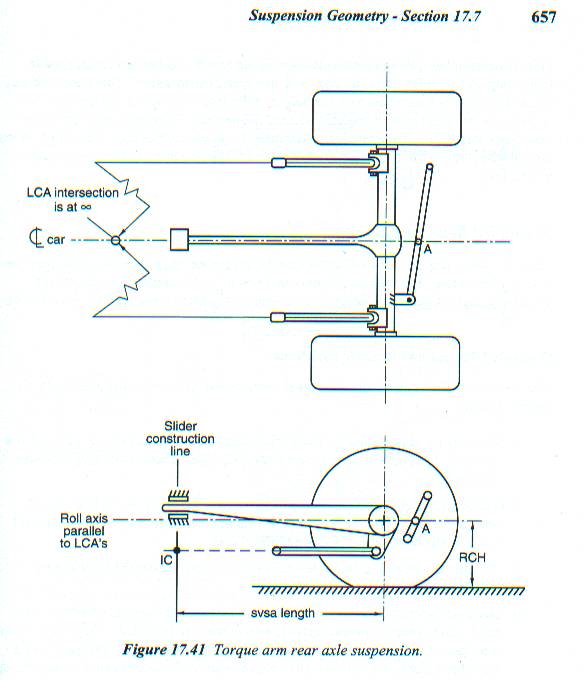
Please, stop posting.
We don't have a 3-link. We have a slider mount, so the IC location is always in line with the sliding link.
Per the Milliken's Book. Our IC is always determined by the LENGTH of the torque arm. The IC will always fall in the plane of the sliding link, its vertical position is the only thing the LCA inclination determines.
Please, stop posting.
Supreme Member
iTrader: (1)
Joined: Jul 2004
Posts: 10,763
Likes: 4
From: Calgary, AB, Canada
Car: 1982 Trans-Am
Engine: 355 w/ ported 416s
Transmission: T10, hurst shifter
Axle/Gears: 10 bolt, true-trac, 3.73
Re: Something I dont understand about wheel hop
I thought that what you just mentioned Dewey, is only accurate if the LCA and torque arm are both parallel, therefore they "intersect" at infinity, so the IC is directly below the torque arm mount. But if they are not parallel, then the IC is where they intersect. I thought that is discussed in text the page before this....
I'm not sure if I read that part in the milliken book, or the one by Carol Smith though.... I'll have to grab the book when I get home this evening, now you've got my hamster a runnin' on the wheel...
I'm not sure if I read that part in the milliken book, or the one by Carol Smith though.... I'll have to grab the book when I get home this evening, now you've got my hamster a runnin' on the wheel...