


Lubricating Idle Air Control Valve?


Thread Starter
Junior Member
Joined: Oct 2004
Posts: 25
Likes: 0
From: Baltimore, Maryland USA
Car: 1990 Trans Am GTA
Engine: 5.7 liter, 350 V8
Transmission: 4 speed auto.
Lubricating Idle Air Control Valve?
I was gathering some information on the "Idle Air Control Valve". I suspect that there may be a problem with mine, on my 1990 Trans Am GTA.
I was reading an article that said that you should "lubricate the idle air control valve", to make sure the spring and the pintle, move back and forth properly.
Is this true? Do you have to lubricate the idle air control valve?
If so, what do you use to lubricate it?
Has anyone heard this before?
Thanks in advance!
I was reading an article that said that you should "lubricate the idle air control valve", to make sure the spring and the pintle, move back and forth properly.
Is this true? Do you have to lubricate the idle air control valve?
If so, what do you use to lubricate it?
Has anyone heard this before?
Thanks in advance!
Last edited by adreed24; May 3, 2007 at 11:19 PM.

Supreme Member
Joined: Jul 2005
Posts: 1,675
Likes: 3
From: Arab, Alabama
Car: 1988 Trans Am GTA
Engine: 350 4BBL
Transmission: 700R4
Axle/Gears: 3.27
Re: Lubricating Idle Air Control Valve?
If you haven't cleaned the throttle body I would suggest that before replacing the IAC.

Moderator


Joined: Jan 2000
Posts: 19,664
Likes: 313
Re: Lubricating Idle Air Control Valve?
If you suspect the IAC is sluggish, it can be cleaned and lubricated. Don't bother to try to lubricate it unless it is disassembled for cleaning. A factory new IAC will have a light coating of white lithium grease on the pintle rack gears. Cleaning will remove that grease and the dirt it has attracted, so it should be lubricated again before assembly.
Remove the electrical connector from the IAC. Unscrew the IAC unit from the throttle body.
Rock the pintle back and forth and allow the spring to extend it until it comes apart in your hands. Clean everything with lint-free cloths and a mild solvent. Harsh solvents can affect the insulation of the stepper motor coils. It's generally the dirt and buildup on this worm shaft that causes sluggish IAC operation.
When the worm gear on the pintle shaft is clean and dry, apply one drop of clean light oil to the shaft and work the pintle back into the rack gears of the motor by the same rocking motion. It takes a while to get the pintle back into the worm gears, but you'll get it. It is important to get the pintle fully retracted into the housing so that the pintle is not forced against the rack gears when reinstalling the IAC unit in the throttle body.
While the IAC is out, clean the air passages in the throttle body. The orifice in the TB where the IAC resides is the seat that the IAC valve closes against, and it can accumulate a lot of carbon, dirt, and debris. The easy way to do this is with carburetor cleaner and a small stiff brush.
When everything is clean and dry, replace the gasket if it is damaged, apply a little anti-seize to the threads, and torque the IAC to the proper specs. (13 ft/lb for '85-'89 , 30 in/lb for 1990-on.) Proceed with setting the TPS and minimum air position.
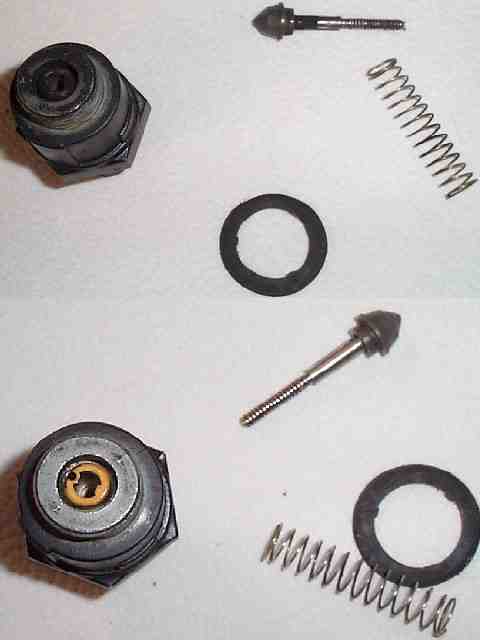
A dirty IAC can act slowly, and it doesn't take a lot of contamination to slow the stepper motor. The top example is completely "dead" while the same IAC in the lower photo works perfectly:
Remove the electrical connector from the IAC. Unscrew the IAC unit from the throttle body.
Rock the pintle back and forth and allow the spring to extend it until it comes apart in your hands. Clean everything with lint-free cloths and a mild solvent. Harsh solvents can affect the insulation of the stepper motor coils. It's generally the dirt and buildup on this worm shaft that causes sluggish IAC operation.
When the worm gear on the pintle shaft is clean and dry, apply one drop of clean light oil to the shaft and work the pintle back into the rack gears of the motor by the same rocking motion. It takes a while to get the pintle back into the worm gears, but you'll get it. It is important to get the pintle fully retracted into the housing so that the pintle is not forced against the rack gears when reinstalling the IAC unit in the throttle body.
While the IAC is out, clean the air passages in the throttle body. The orifice in the TB where the IAC resides is the seat that the IAC valve closes against, and it can accumulate a lot of carbon, dirt, and debris. The easy way to do this is with carburetor cleaner and a small stiff brush.
When everything is clean and dry, replace the gasket if it is damaged, apply a little anti-seize to the threads, and torque the IAC to the proper specs. (13 ft/lb for '85-'89 , 30 in/lb for 1990-on.) Proceed with setting the TPS and minimum air position.
A dirty IAC can act slowly, and it doesn't take a lot of contamination to slow the stepper motor. The top example is completely "dead" while the same IAC in the lower photo works perfectly:
Last edited by Vader; Mar 31, 2018 at 10:19 PM. Reason: Updated links
Moderator
Joined: Jan 2000
Posts: 19,664
Likes: 313
Re: Lubricating Idle Air Control Valve?
The IAC is not strictly an electrical device, but is an electromechanical device. It's the "mechanical" part of that which requires lubrication. Linear (non-vacuum) EGR valves and later design (non-vacuum) cruise conrtol servoes operate the same way. If you want an overview of how a linear stepper motor works:
http://www.intellidrives.com/AppNote...epperWorks.htm
http://www.intellidrives.com/AppNote...epperWorks.htm

Thread
Thread Starter
Forum
Replies
Last Post
eightsixseven
Tech / General Engine
2
Dec 16, 2024 01:50 PM
