When you click on links to various merchants on this site and make a purchase, this can result in this site earning a commission. Affiliate programs and affiliations include, but are not limited to, the eBay Partner Network.
Tech / General EngineIs your car making a strange sound or won't start? Thinking of adding power with a new combination? Need other technical information or engine specific advice? Don't see another board for your problem? Post it here!
I've just torn down the chevy 350 that usually occupies the engine bay in my '85 camaro. The idea is a re-ring, new bearings, and new aluminium heads, as the pistons, block, crank, rods and so forth are in excellent order.
But in order to select a new set of heads, i need to get some data on the pistons i have. And i cannot seem to be able to dig out anything at all on these things.
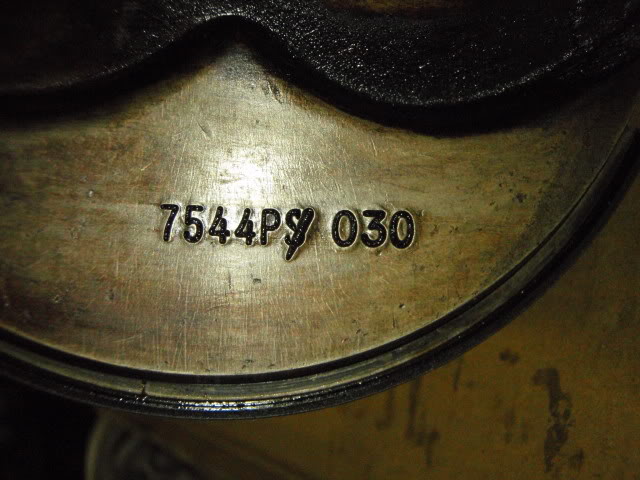
The only markings on them are 7544PS/030
As far as i gather, that means the block has been bored .030" over, fair enough, but i need more info. Anyone out there who recognize these?
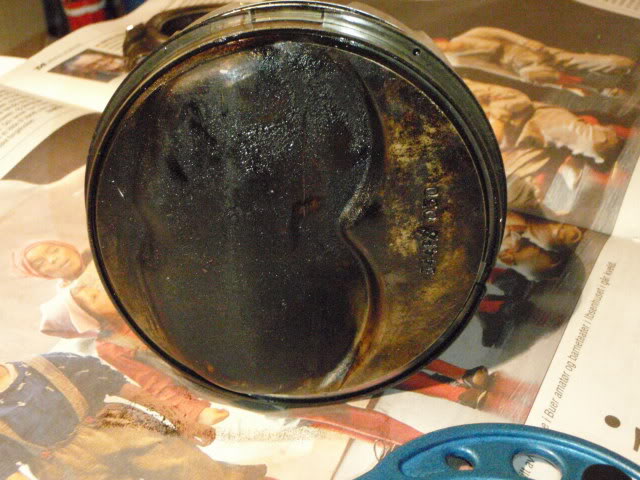
Whoa, pop up pistons! I can't say the 7544 piston is a familiar part number to me..
you could measure the compression height, and dome/dish size and then you're done though...
Yeah. it's a pop up. I guess there's a connection between that and the 74 cc (cast #333882) heads that were on this engine. But in general my shortblock is in very good shape, so i want to keep it, but my heads are done for. (valve guides have already been coiled once, and that's worn out again).. so there's not much to gain there.
But to select a new set of heads properly, it would help to know the data on the pistons
I would highly recommend using neither of them,...
Decent flat top pistons are barely over $100 nowadays, and if you've already got to buy new pistons then you're paying shipping on those anyway...
Those are very unusual pistons. I'm guessing it's actually a 383 since the rings are bunched up toward the top of the piston because of the pin location.
Can you measure the diameter at the skirt or maybe post a picture of the underside of the piston?
Or if you have a micrometer, the distance from the pin bore to the top of the piston?
Something is very strange about the top ring being bigger than the second ring...
i'll post a pic, just got to get up to my garage one day and take it, i guess tomorrow.
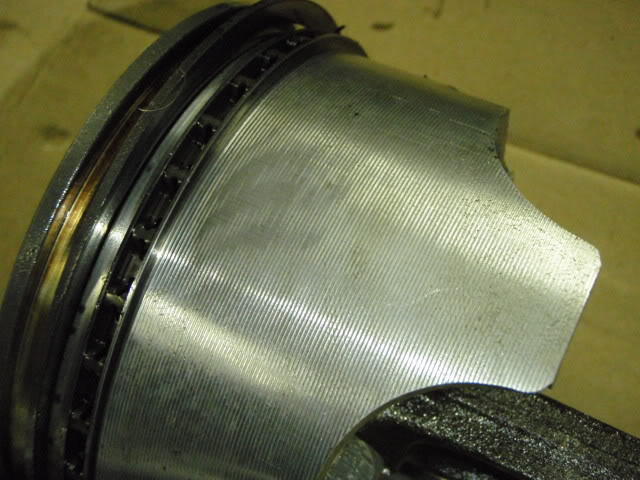
But the top ring is not straight. It is L shaped, with the stem of the L going into the groove, facing upwards. I was a bit surprised with this as well.
It is possible that this engine has a stroker crank ,i never actually measured the crank (and this being the first time i'm tearing down a CSB, i dont know what to look for either.
I'll see if i can get the measurements you asked for when i'm up there.
For a domed-piston 383, I would bring to your attention that AFR offers their newest "Eliminator" heads in 75cc, with your choice of 180 or 195cc intake ports. Both emissions-legal. Theri 210s aren't legal. Dart offers their Pro 1 Platinums in 200cc, and 215cc, with a 72cc, but not legal. Brodix offers their all-not-legal heads with chambers up to 76 cc, in 180, 200 and on up.
Thanks for the suggestions, Atilla, i will look them over in detail when i manage to figure out what i actually have here.
Firstly, closeup of the odd top ring, as asked by Supervisor42:
The distance from the pin bore to the top of the piston is a little difficult to get a proper reading of, as the only place i can place the micrometer hits the domed area. but a good approximation is 1.11".
I have no idea how to properly measure rod lengt, but if i were to estimate center-center, it would be 5 3/4 ". (measured with a ruler, as i said, an approximation.)
There are a couple of marks in the underside of the piston, i can make out an F, and a.. blob..
If the measurements are close, they're 350 pistons (not 383).
Definitely forged.
I'm trying to remember which manufacturer used the gas loaded top ring. It was years ago...
The idea was to use compression pressure to seal the rings allowing a low tension ring that had low friction.
Did you notice the piston in the second pictures is a .060 oversize?
Hope you remember which holes which piston came out of.
Getting rings for those pistons is going to be a struggle especially if you have to buy two different sizes.
This is getting interesting.
I bet that engine is a racing "retiree"...
So, tell us about the cam. Nice smooth idle?
ok. thanks for the info, that clears things up some more.
Hmmm. .060? i think you read that wrong, the piston i took pictures of is clearly marked .030.. not too visible in the picture tho.
Quite possible this is an old race engine, the bottom end seems to have had quite some work done on it at some point. Includes a forged crank, and apparently the assembly has been balanced. That is one of the reasons i want to keep the rotating assembly as-is. Block looks very good, still clearly visible honing marks, no top ridge. pistons came right out.
Yep, i've marked both rods and caps.
idle on this thing was pretty rough. it refused to idle smoothly unless i brought it up to 1000 rpm. Tho, this may also have been caused by my inexperience with adjusting carbs. Carb is a carter, 750cfm. i also had poor vacuum at idle (never measured, but after a while at idle, i had no brake booster anymore). The thing worked damn well at high rpm's tho. at about 3500 stuff started happening.
plans for the rebuild includes a slightly smaller carb (650), as i partially blame the idle problems on a too large carb. Any hints there?
It's not the carb, it's the cam....
Check for a part number stamped on the front.
This is indeed an old racing engine. Do you have plans to mix your own race gas for this thing? Pop up pistons like that give a very high CR... Still don't know the dome on those...
The rods could be 5.7". They're either that, or 6", so i'm guessing 5.7".
1.1" compression height is strange. 1.56 is pretty normal...
Some guys on another forum suggested that these were a set of TRW LT1 11:1 pistons, but so far, the pictures i have managed to find of those pistons do not match. And neither does the number on top.
I'm gonna take a second look at the cam next time i'm up there, see if i can find any numbers.
i was planning on running it on pump gas (98 octane RON, equivalent to 94 octane if you measure it in the US system. So i guess i should go for a CR of about 10:1, maybe 10.5:1 with aluminium heads.
Tried measuring the amount of water displaced by the dome, but ended up making a mess. A rough approximation, using a ruler, is 13 cc's. that does not take into consideration the reliefs for the valves.. Is there any common volumes for piston domes?
It's not the carb, it's the cam....
Check for a part number stamped on the front.
This is indeed an old racing engine. Do you have plans to mix your own race gas for this thing? Pop up pistons like that give a very high CR... Still don't know the dome on those...
The rods could be 5.7". They're either that, or 6", so i'm guessing 5.7".
1.1" compression height is strange. 1.56 is pretty normal...
Need the dome size on those pistons...
I had him measure to the edge of the bore not the center of the pin.
Pin=.972 divide by 2 (to get center) +1.11=1.573 compression height.
Originally Posted by Camarogeddon
Some guys on another forum suggested that these were a set of TRW LT1 11:1 pistons, but so far, the pictures i have managed to find of those pistons do not match. And neither does the number on top.
I'm gonna take a second look at the cam next time i'm up there, see if i can find any numbers.
i was planning on running it on pump gas (98 octane RON, equivalent to 94 octane if you measure it in the US system. So i guess i should go for a CR of about 10:1, maybe 10.5:1 with aluminium heads.
Tried measuring the amount of water displaced by the dome, but ended up making a mess. A rough approximation, using a ruler, is 13 cc's. that does not take into consideration the reliefs for the valves.. Is there any common volumes for piston domes?
My engine has the TRW 11:1 slugs in it and it ain't them.
There aren't many dome sizes between 11:1 and 12.5:1.
They look like 12.5:1 "Speed-Pro" pistons to me (before Speed-Pro and TRW got married). This would explain why I can't find the number anywhere.
The unique top ring seems to be endurance/HP and not drag/rpm design because it is heavy. Like a circle track engine.
I can post info with pictures on how you can CC them if you want. You'll need vaseline, micrometer, piece of window glass, vetinary syringes, patience and a calculator.
EDIT:
FOUND IT!!! I was right! 7544P/S .030 ...gotta fire up the scanner.
Last edited by Supervisor42; Oct 28, 2008 at 07:07 PM.
See the scans below. The rings are called "head land rings".
The 7544P/S 030 is a semi-finished piston. Racers like to do their own special thing for the top ring.
Since they have changed the numbering system to TRW's after Speed-Pro and TRW got married, it's going to be hard to tell what TRW number is equivelent.
Yea, the cam should be every bit as interesting. It will explain why he hasn't been able to keep valve guides in it. That must have been a hell of an engine before they put stock heads on it and put it out to pasture.
The valve train geometry would have been awful...
Edit: If Norway wasn't so far away, I would put a degree wheel and dial indicator on it, and read the numbers. It ain't gonna want to idle below 1000 with any carb...
Last edited by Supervisor42; Oct 28, 2008 at 11:09 PM.
As far as i can tell, the RPM range listed matches my experiences with the current setup pretty well, (which was a huge source of irritation, as i felt that the angine had a lot more to give, but the tranny insisted on shifting at 3750, at wot. But that's another tech discussion entirely.)
Secondly, now that i have an idea about the pistons, i'm still looking for that dome volume.. guess it'll soon be time to go to a store and buy some putty, and make an imprint, fill it, and measure, IF i can find some new rings for these slugs.
That was a great cam in it's day.I would look at the XE line of Comp Cams,much more modern grinds,same behavior of cam will make a good deal more power,especially when complimented with a good set of heads.
sorry to disappoint you there, but that's what i found . I'm debating on keeping the cam, as i don't want anything wilder, (i want this to be streetable), but i still love that rough idle...
I actually suspect that this engine does have it's original setup, as the heads and intake have been ported. if they just slapped some stock heads on there to send it off, they wouldn't have bothered.
Just measuring the pistons using some clay, water and a digital scale. The dome i measured as 21cc's, and the valve reliefs came out as 3 cc's. That gives a total of 18 cc's from the pistons.
Is this a reasonable value?
According to tech support at summit, they suggested using normal rings in these pistons. Would that be a problem, or will the pistons work fine with normal rings. ?
Last edited by Camarogeddon; Oct 31, 2008 at 03:35 PM.
Umm, the 18cc is too high.
There weren't that many different forged piston configurations back then. The forged TRW domed pistons started life as the same forging and had more of the dome machined off for the lower C/Rs.
Here's the 3 domed TRW's available back then for example:
Bore:4.001, stroke:3.48, deck:.025, steel shim gasket: .020 compressed, gasket dia: 4.125, head:64cc.
Part#___dome height__piston volume_C/R___Fuel
L2304F___.1"________-2.4cc_______11:1__100 octane
L2252F___.22"_______-11.0cc______12:5__120 octane racing gas
L2505F___.35"_______-14.3cc______13.1:1_alcohol
The forged flat-top piston had a C/R of about 10:1
The speed-pro pistons should be similar. Yours should measure in the -10cc to -12cc range. They look almost identical to the 12.5:1 TRW's. Can you measure the dome height? I can post more TRW pics if you want.
I'm planning on running it on what's called 98 octane here (highest quality available at the pumps here), which would be equivalent to 94 octane in the US system
Another reason for me keeping the pop-up pistons is that it is easier to lower the CR with a dished piston later, if i want to experiment with forced induction at a later stage..
Trust me I know this is 16 years later but that's the beauty of the internet... Lol someone somewhere at some point in time may end up here scratching their head saying okay so what became of the pistons?
So today I'm going through a book The Chevrolet Racing Engine by Bill Jenkins and on page 52 he gives a part number it's very close to the pistons that he uses in his race engines. I get on Google to check the part number and voila here we are on the Thirdgen site talking about your pistons. The book is by SA Design and copyright dated 1976.
The headland ring I believe also used to be called a dykes ring and which was followed by the napier. I would say the rings wouldn't be so much of a problem as would getting another piston. Even if you could you'd have to finish it yourself. 😫
Originally Posted by Camarogeddon
I'm planning on running it on what's called 98 octane here (highest quality available at the pumps here), which would be equivalent to 94 octane in the US system
Another reason for me keeping the pop-up pistons is that it is easier to lower the CR with a dished piston later, if i want to experiment with forced induction at a later stage..







 . That must have been a hell of an engine before they put stock heads on it and put it out to pasture.


 . I was hoping for something like a Duntov 30-30.


