When you click on links to various merchants on this site and make a purchase, this can result in this site earning a commission. Affiliate programs and affiliations include, but are not limited to, the eBay Partner Network.
CarburetorsCarb discussion and questions. Upgrading your Third Gen's carburetor, swapping TBI to carburetor, or TPI to carburetor? Need LG4 or H.O. info? Post it here.
Yes.
Some carb brands work better with different fuel pressures than other brands.
I've seen cases where a "high performance" fuel pump required a regulator to work with the carb in question.
"Stock type" is a little subjective. What's advertised as stock replacement in one online shopping catalog is described as something else someplace else.
Sometimes a difference of a couple of PSI creates a go/no go situation.
Yes.
Some carb brands work better with different fuel pressures than other brands.
I've seen cases where a "high performance" fuel pump required a regulator to work with the carb in question.
"Stock type" is a little subjective. What's advertised as stock replacement in one online shopping catalog is described as something else someplace else.
Sometimes a difference of a couple of PSI creates a go/no go situation.
Thanks for the reply. The fuel pump in question is just a replacement from one of the popular auto parts stores (Advance or O'reilly). I have a suspicion that it may be over-powering the needle/seat in my non-CCC Q-JET (which has been replaced even though the previous needle/seat were new). I've had two Q-jets on this motor, one re-man and one new, and both idle rough & rich no matter what I do. Even jetted down the new carb 2 sizes. Exhaust stinks and burns eyes. Ignition timing is 16° initial and 34° total. Vacuum is only 11" in neutral @800 RPM. I'm at 6,000 feet, so it'll never be 15" to 20", but should probably be at least 13" with the mild cam (212°/218° @ 050, 110 LSA). The power piston is down like it should be, so that's not it. Frustrating to say the least...
As mentioned, there "are" aftermarket mech. pumps that put out more pressure than stock replacements, but don't think adv, or autozone would be selling them as "stock".
You mentioned using the Qjet carb. I'm assuming it's the "modern" version, (107 series, compared to the earlier 70 series), which are usually 800 cfm carbs. You describe it as running rich. (Lean can smell also). So we're assuming your choke is fully open, and operating correctly. 11": of vacuum kinda sucks, unless tuned for it. You mentioned the power piston is closed. How did you prove that? On the newer carbs, there's no bowl vent to access it while running. Are you getting any nozzle drip? Is your float set correctly?
As mentioned, there "are" aftermarket mech. pumps that put out more pressure than stock replacements, but don't think adv, or autozone would be selling them as "stock".
You mentioned using the Qjet carb. I'm assuming it's the "modern" version, (107 series, compared to the earlier 70 series), which are usually 800 cfm carbs. You describe it as running rich. (Lean can smell also). So we're assuming your choke is fully open, and operating correctly. 11": of vacuum kinda sucks, unless tuned for it. You mentioned the power piston is closed. How did you prove that? On the newer carbs, there's no bowl vent to access it while running. Are you getting any nozzle drip? Is your float set correctly?
It's a 750 and has a bowl vent. Choke is wide open and float is definitely set correctly. I haven't really checked for nozzle drip (should have done that)...
Also; can someone explain to me how the return works on the mechanical pump/carb system? Is it possible that my problem could be related to that?...
Any mechanical pump I've used with a return line obviously has the third fitting for the return. In that fitting is a restrictor, sized much like a carb jet.
I adapted mine to the formerly EFI'd chassis so the lines were there already.
One thing I discovered, although this is more related to what was needed as the GPH requirements went up, was that the return line has to be sized correctly. The 5/16ths that was originally part of the EFI wasn't enough to prevent some oddball issues with fuel delivery. I ended up having to upsize the line to 3/8ths.
Yours being more of a stock type deal probably doesn't have that problem.
Ultimately, I ended up with a carb specific fuel regulator to help with proper pressure not only at idle but up to and including WOT.
Last edited by skinny z; Apr 21, 2022 at 09:47 AM.
Q-Jet, AFB, and many older stock Carburetors will require slightly lower Fuel Pressure than a comparable 4150/ Holley Carb.
Sometimes the difference between 5.00 Psi and 7.00 Psi, is enough to flood (surpass Float/ Needle+Seat) an AFB for example.
After many years of using a multitude of different Carburetors, Mechanical Fuel Injection, and Electronic Fuel Injection...
Every single Fuel System that I build uses a Fuel Pressure Regulator.
Every single one.
Pairing Different Model fuel pumps with different types of Carburetors, create far too many different results.
Just use a Regulator, and don't worry so much about the variables.
Q-Jet, AFB, and many older stock Carburetors will require slightly lower Fuel Pressure than a comparable 4150/ Holley Carb.
Sometimes the difference between 5.00 Psi and 7.00 Psi, is enough to flood (surpass Float/ Needle+Seat) an AFB for example.
After many years of using a multitude of different Carburetors, Mechanical Fuel Injection, and Electronic Fuel Injection...
Every single Fuel System that I build uses a Fuel Pressure Regulator.
Every single one.
Pairing Different Model fuel pumps with different types of Carburetors, create far too many different results.
Just use a Regulator, and don't worry so much about the variables.
There really isn't any place to put a regulator. And while I see the benefit, the factory didn't use them on carbed cars, and they ran fine, so I feel like I shouldn't have to. It has a new metal line between the pump & carb -- runs between the waterpump & timing cover...
As long as the Pump you are using, is not producing more pressure than the original Pump...
You would be fine.
I rarely come across a Fuel System that is essentially Stock.
The Fuel Pressure Regulator brings back a level of control, when using upgraded/ non-Stock Fuel System Parts.
On my old Camaro I put on a pump spec'd for a Z28 with a Holley carb and it put out right at 15 psi. Way too much for a Q-jet. I put on a Holley pressure regulator (non-bypass) and it has worked fine for years running at about 4 psi. You'd need to get a pressure gauge hooked up and see what you really have to figure out how to go with this problem.
I'll be interested in what you find.
I've had stock systems to high capacity electric setups and most everything in between. Sometimes it's a total mystery what's screwed things up when before all seemed ok.
Mine really started to become a pain at the dragstrip when I had a stock arrangement fuel system. Mechanical pump, OEM lines for a returnless system and stock pump. Waiting between rounds and the heat soak would boil the fuel in the lines and kill the fuel delivery half way down the track.
It was a pain to resolve.
Cautionary tale for you regarding mechanical pumps in general.
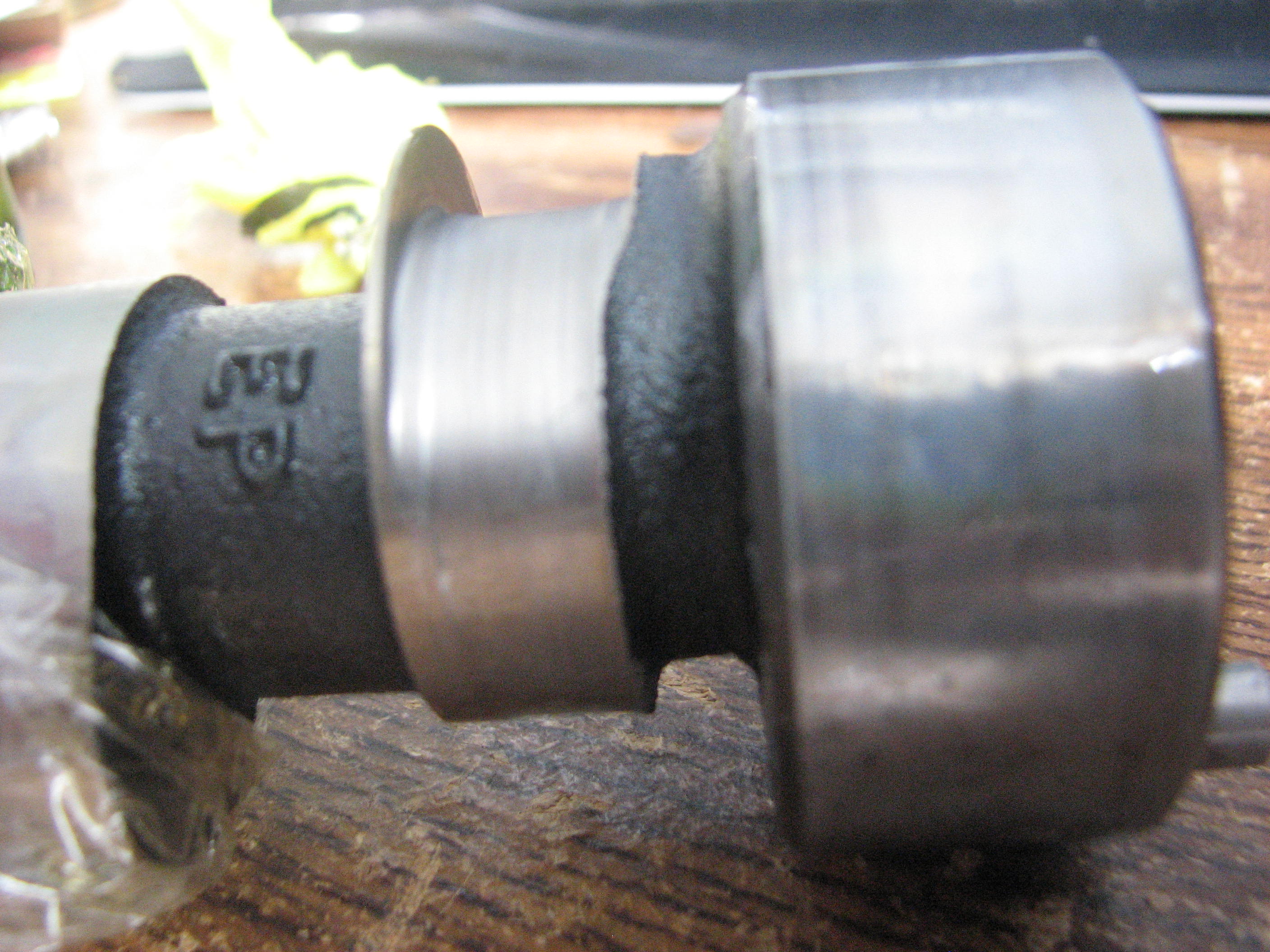
The pump pushrod to cam eccentric is a sliding contact as you know. Just like a flat tappet lifter, without the proper attention, the pushrod can carve a groove in the cam to the point where there's nothing left. I found that out the hard way and that's what ultimately forced me into an electric arrangement. It's compounded when making a move to a higher volume pump than stock.
I've got a great picture of a destroyed cam somewhere in my archives.
Yes sir I have that roller tipped pushrod.
The intention was to use with my Edelbrock high volume pump but I split the housing on the inlet fitting, said, "That's it! I'm going electric."
Never went back.
Extreme case of cam wear with the stock rod and high load fuel pump.
That's my cam. That's the result of using an unsuitable oil and a high volume pump with excessive spring pressure. That little escapade filled that engine with a lot of metal. It never recovered from that.
I've one for sale if you're interested. New in the box.
You have to ensure that the bolt hole boss that intersects the pushrod channel is drilled and tapped. All the old school blocks are. Some of the newer blocks may not be.
Story goes is that the hole was a carry over from when the SBC had engine mounts across the front rather than the sides.
These days, it's a handy place to spin in a bolt to hold the pump pushrod up against the cam when installing the fuel pump.
Last edited by skinny z; Apr 28, 2022 at 09:01 PM.