


1986 LG4 Bogging & Hesitation


Thread Starter
Junior Member
Joined: Dec 2024
Posts: 26
Likes: 5
From: Decatur IL
Car: 1986 IROC Z (& 1979 Trans Am)
Engine: LG4 305
Transmission: 700R Auto
Axle/Gears: GU2 2.73
1986 LG4 Bogging & Hesitation
Hello, I have a 1986 IROC with the LG4, all stock and original but with a recurring drivability problem. It starts and idles and runs smoothly around town but when accelerating to 40-50 mph it will bog and hesitate, sometimes badly, almost as if it is gasping for fuel or air until I let off the gas and it "catches it's breath." Then it can usually (but not always) be eased up to 60-70. Happens intermittently and can be either cold or warm, anybody else have this problem with a carbureted car?
I purchased the car from long term storage and the owner was reassuring about how he drained the tank and cleaned the carburetor before startup. I immediately removed the fuel tank to inspect and clean (not too bad) blew out the lines and replaced the sending unit. Upon experiencing my drivability problem I assumed it was the fuel filter or the (original mechanical) fuel pump so I replaced both (Delphi pump), along with all associated (original) rubber hoses and even the tank vent. I bought manuals and tools (including an OBDI diagnostic scanner) and after research on the CCC system I rebuilt the carb myself to make sure everything was clean and adjusted to spec. The float is new and set correctly (within 1/64"), the MCS is the original and correctly adjusted with 4/32" travel. We have new O rings on the Air Bleed Valve, mixture screws at the original 3 1/2 turns, new TPS adjusted to .51 volts with engine off and reading 4.0 at WOT. The carb is the correct original with all plugs in place (until I came along). I carefully inspected all the vacuum and PCV hoses and even the (perfectly working) cruise control, no obvious leaks but I replaced any that were marginal. I tested the air diverter valve per the service manual and it tested correctly. Replaced intake manifold gaskets and tested the Thermac, the barometric pressure and vacuum sensors. The drivability problem remains.
When I first checked it the timing was the original 0 degrees BTC, after reading here I advanced it to 5 degrees BTC, I think the car runs slightly better but the problem recurrs. The dwell reads 25-30 at cold idle in open loop, when it warms up into closed loop it usually seems to move to 40-45 in moderate driving, when decelerating it may swing to 15-20. The bogging and hesitating happens at both ends of the dwell scale. EGR and EFE test good, new delphi O2 sensor and new stock-style exhaust including catalytic converter (original Y pipe remains). Would welcome advice, maybe sofakingdom can weigh in? Thanks in advance, Todd C
I purchased the car from long term storage and the owner was reassuring about how he drained the tank and cleaned the carburetor before startup. I immediately removed the fuel tank to inspect and clean (not too bad) blew out the lines and replaced the sending unit. Upon experiencing my drivability problem I assumed it was the fuel filter or the (original mechanical) fuel pump so I replaced both (Delphi pump), along with all associated (original) rubber hoses and even the tank vent. I bought manuals and tools (including an OBDI diagnostic scanner) and after research on the CCC system I rebuilt the carb myself to make sure everything was clean and adjusted to spec. The float is new and set correctly (within 1/64"), the MCS is the original and correctly adjusted with 4/32" travel. We have new O rings on the Air Bleed Valve, mixture screws at the original 3 1/2 turns, new TPS adjusted to .51 volts with engine off and reading 4.0 at WOT. The carb is the correct original with all plugs in place (until I came along). I carefully inspected all the vacuum and PCV hoses and even the (perfectly working) cruise control, no obvious leaks but I replaced any that were marginal. I tested the air diverter valve per the service manual and it tested correctly. Replaced intake manifold gaskets and tested the Thermac, the barometric pressure and vacuum sensors. The drivability problem remains.
When I first checked it the timing was the original 0 degrees BTC, after reading here I advanced it to 5 degrees BTC, I think the car runs slightly better but the problem recurrs. The dwell reads 25-30 at cold idle in open loop, when it warms up into closed loop it usually seems to move to 40-45 in moderate driving, when decelerating it may swing to 15-20. The bogging and hesitating happens at both ends of the dwell scale. EGR and EFE test good, new delphi O2 sensor and new stock-style exhaust including catalytic converter (original Y pipe remains). Would welcome advice, maybe sofakingdom can weigh in? Thanks in advance, Todd C


Joined: Sep 2005
Posts: 27,819
Likes: 2,406
Car: Yes
Engine: Usually
Transmission: Sometimes
Axle/Gears: Behind me somewhere
Re: 1986 LG4 Bogging & Hesitation
anybody else have this problem with a carbureted car?
I don't see the fuel filter mentioned in your Journey. You DID replace that, right? Making sure to have it turned the right direction with the spring on the correct side?
maybe sofakingdom can weigh in?

even the (perfectly working) cruise control

Thread Starter
Junior Member
Joined: Dec 2024
Posts: 26
Likes: 5
From: Decatur IL
Car: 1986 IROC Z (& 1979 Trans Am)
Engine: LG4 305
Transmission: 700R Auto
Axle/Gears: GU2 2.73
Re: 1986 LG4 Bogging & Hesitation
I don't see the fuel filter mentioned in your Journey. You DID replace that, right? Making sure to have it turned the right direction with the spring on the correct side?
Twice, but It has been a few months, I guess it wouldn't hurt to check again. If I recall I think I installed it with the hole facing outward and the spring inside the carb pushing against the flat side of the filter?
Don't let anyone know where you are. Not even what country you're in. That's probably the last one. Who knows what depths of depravity some yutz that wants to drive down the freeway with his/her foot off the gas, might descend to. Oh I see it's already too late.[/QUOTE]
Yes, I know, not very high performance but most of the time I like a relaxed cruise and was delighted it worked.
Twice, but It has been a few months, I guess it wouldn't hurt to check again. If I recall I think I installed it with the hole facing outward and the spring inside the carb pushing against the flat side of the filter?
Don't let anyone know where you are. Not even what country you're in. That's probably the last one. Who knows what depths of depravity some yutz that wants to drive down the freeway with his/her foot off the gas, might descend to. Oh I see it's already too late.
[/QUOTE]Yes, I know, not very high performance but most of the time I like a relaxed cruise and was delighted it worked.
Joined: Sep 2005
Posts: 27,819
Likes: 2,406
Car: Yes
Engine: Usually
Transmission: Sometimes
Axle/Gears: Behind me somewhere
Re: 1986 LG4 Bogging & Hesitation
the hole facing outward and the spring inside the carb pushing against the flat side of the filter
Another strange and insidious thing that can cause poor fuel delivery, is interference with the fuel pump drive rod.
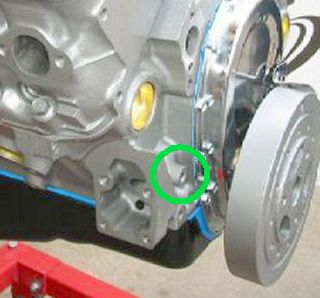
This bolt hole goes directly into the drive rod passage. If a too-long bolt is installed here, it will hit the rod, bind it up, and prevent the pump from working. In fact you even can use this to your advantage when changing out the pump: you can have your assistant bump the motor over with the starter while you feel the rod with your finger, and when it's fully retracted, put a long bolt in that hole FINGER TIGHT ONLY to hold the rod up while you change the pump. The pump is STUUUUUUPID SIMPLE: just a back-and-forth floppy diaphragm with a spring below it, about like an aquarium air pump. The cam eccentric pushes the drive rod down which pushes the diaphragm down against the spring, which allows the chamber to fill with fuel; then when the cam eccentric allows the rod to return, the spring in the pump pushes the diaphragm AND ROD back up. If the rod can't slide freely, no pumping happens. In fact one of the tricks for long years now has been to use a lightweight drive rod such as https://www.summitracing.com/parts/sum-250025 to lighten the parasitic load on the spring, of the spring having to return the rod back up into the block as well as moving fuel. The reason I posted this pic originally was because the most annoying mystery oil leeeeeeeek in a SBC is to leave that bolt hole with no bolt in it (originally, it held on the motor mount, before that was a pad on the side of the block), as often happens when hacking the smog pump off. If you take out that bolt and the FP rod, in some blocks you can actually SEE the crankshaft. Alternatively, putting even the stock smog pump bracket bolt back in without some sort of spacer (stack of washers etc.) can allow the tip of the bolt to hit the drive rod.
In any case, you have a fuel delivery problem. BTW what kind of condition was the little "sock" filter in the bottom of the tank, would have looked something like this https://www.rockauto.com/en/moreinfo...jOTbwwAXdxo%3D, in? Yeah I know; a $3 part, $1000 or a life-changing ordeal to replace; butt that's life. Sitting up often results in those things getting all crudded up with the tarry funk which clogs them completely.
Thread Starter
Junior Member
Joined: Dec 2024
Posts: 26
Likes: 5
From: Decatur IL
Car: 1986 IROC Z (& 1979 Trans Am)
Engine: LG4 305
Transmission: 700R Auto
Axle/Gears: GU2 2.73
Re: 1986 LG4 Bogging & Hesitation
I replaced the sock in the fuel tank while I was in there so that should not be the problem (and I pray that I don't have to THAT job again!). I will check that pushrod interference idea though, the fuel pump install with that pushrod was a bit fiddly for me. My AIR pump is as original and should not have been altered or removed but who knows? This problem acts fuel related to me too but I am running out of ideas. I have chased vacuum leaks but found nothing apparent and my power brake hose at idle reads about 20 lbs of vacuum as I think it should, as does the hose to the vacuum sensor. Also, given the 40 mph I thought maybe it could be the Torque Converter Clutch but it does the same thing if set in 3rd gear
Thread Starter
Junior Member
Joined: Dec 2024
Posts: 26
Likes: 5
From: Decatur IL
Car: 1986 IROC Z (& 1979 Trans Am)
Engine: LG4 305
Transmission: 700R Auto
Axle/Gears: GU2 2.73
Re: 1986 LG4 Bogging & Hesitation
So sofakingdom, what should I think about my dwell readings? Am I correct that if I am seeing 40-45 degrees the ECM is reading a rich mixture and sending a lean command to correct it (and vice versa at 15 degrees?) If so any thoughts what might be causing the overly rich mixture and how might I correct it?
Joined: Sep 2005
Posts: 27,819
Likes: 2,406
Car: Yes
Engine: Usually
Transmission: Sometimes
Axle/Gears: Behind me somewhere
Re: 1986 LG4 Bogging & Hesitation
Yes, if the dwell reading is high (ECM is pulling the rods down into the jets and opening the IAB valve) it thinks it's rich, and vice-versa for readings that are low.
Does the IAB adjustment have any "authority" at all on the reading at idle? Running it down should lower the dwell reading, backing it out should increase it.
Did you epoxy over the plugs at the bottom of the metering wells under the primary jets? If not, that would be the very first thing to try. Wire-brush them down to clean metal, sterilize them with lacquer thinner or acetone or MEK (NOT "paint thinner", NOT "brake cleaner", NOT turpentine) and slather them over thoroughly with the steel-filled JB Weld. You don't have to tear the carb down for that, only remove the throttle plate. These are the small, inconspicuous ones on the 2 little "towers" on the primary side, not the big obvious ones that are near the size of a dime, on the secondary side. There are 2 on each "tower", 4 total.
Can you tell independently whether it's really rich or not? (at least, at idle) If the ECM can't bring the mixture within tolerance at cruise, it will eventually set a code.
The mixture control solenoid of course operates both the IAB and the metering rods. If the solenoid isn't set within the right range, then the rods and/or IAB may not travel properly, or may not track with each other. If the ECM is constantly thinking the mixture is rich, then it will have high dwell trying to hold the rods down and/or the IAB open, but if they can't go down far enough, then you'll end up with high dwell and it'll still be rich anyway. Try screwing the lean stop (the adjustment in the round feature outside the air cleaner flange) downwards (clockwise). This should affect the dwell at both idle and cruise. Similarly, if the rich stop is set too high, then whenever the ECM lets the solenoid return to rest, the mixture will go richer, faster, than it's expecting, and again you'll end up with high dwell.

I've always seemed to find that these things run better with the lean stop set low and the rich stop (the one just inside the air cleaner flange) high, such that the solenoid's range of motion is wider. All by itself, that gives the ECM more control over the mixture, and better ability to reliably reach the end of its range in both directions, than if the range is narrower. If the anti-tamper plugs are out, then you can adjust these at any time; all you need is a tool that looks like a straight-blade screw head. You can make one from a piece of about 3/16" brass or steel rod, or whatever size it is that will go down in the holes, with a slot cut in the end.
Does the IAB adjustment have any "authority" at all on the reading at idle? Running it down should lower the dwell reading, backing it out should increase it.
Did you epoxy over the plugs at the bottom of the metering wells under the primary jets? If not, that would be the very first thing to try. Wire-brush them down to clean metal, sterilize them with lacquer thinner or acetone or MEK (NOT "paint thinner", NOT "brake cleaner", NOT turpentine) and slather them over thoroughly with the steel-filled JB Weld. You don't have to tear the carb down for that, only remove the throttle plate. These are the small, inconspicuous ones on the 2 little "towers" on the primary side, not the big obvious ones that are near the size of a dime, on the secondary side. There are 2 on each "tower", 4 total.
Can you tell independently whether it's really rich or not? (at least, at idle) If the ECM can't bring the mixture within tolerance at cruise, it will eventually set a code.
The mixture control solenoid of course operates both the IAB and the metering rods. If the solenoid isn't set within the right range, then the rods and/or IAB may not travel properly, or may not track with each other. If the ECM is constantly thinking the mixture is rich, then it will have high dwell trying to hold the rods down and/or the IAB open, but if they can't go down far enough, then you'll end up with high dwell and it'll still be rich anyway. Try screwing the lean stop (the adjustment in the round feature outside the air cleaner flange) downwards (clockwise). This should affect the dwell at both idle and cruise. Similarly, if the rich stop is set too high, then whenever the ECM lets the solenoid return to rest, the mixture will go richer, faster, than it's expecting, and again you'll end up with high dwell.
I've always seemed to find that these things run better with the lean stop set low and the rich stop (the one just inside the air cleaner flange) high, such that the solenoid's range of motion is wider. All by itself, that gives the ECM more control over the mixture, and better ability to reliably reach the end of its range in both directions, than if the range is narrower. If the anti-tamper plugs are out, then you can adjust these at any time; all you need is a tool that looks like a straight-blade screw head. You can make one from a piece of about 3/16" brass or steel rod, or whatever size it is that will go down in the holes, with a slot cut in the end.
Trending Topics
Thread Starter
Junior Member
Joined: Dec 2024
Posts: 26
Likes: 5
From: Decatur IL
Car: 1986 IROC Z (& 1979 Trans Am)
Engine: LG4 305
Transmission: 700R Auto
Axle/Gears: GU2 2.73
Re: 1986 LG4 Bogging & Hesitation
Yes, if the dwell reading is high (ECM is pulling the rods down into the jets and opening the IAB valve) it thinks it's rich, and vice-versa for readings that are low.
The mixture control solenoid of course operates both the IAB and the metering rods. If the solenoid isn't set within the right range, then the rods and/or IAB may not travel properly, or may not track with each other. If the ECM is constantly thinking the mixture is rich, then it will have high dwell trying to hold the rods down and/or the IAB open, but if they can't go down far enough, then you'll end up with high dwell and it'll still be rich anyway. Try screwing the lean stop (the adjustment in the round feature outside the air cleaner flange) downwards (clockwise). This should affect the dwell at both idle and cruise. Similarly, if the rich stop is set too high, then whenever the ECM lets the solenoid return to rest, the mixture will go richer, faster, than it's expecting, and again you'll end up with high dwell.
The mixture control solenoid of course operates both the IAB and the metering rods. If the solenoid isn't set within the right range, then the rods and/or IAB may not travel properly, or may not track with each other. If the ECM is constantly thinking the mixture is rich, then it will have high dwell trying to hold the rods down and/or the IAB open, but if they can't go down far enough, then you'll end up with high dwell and it'll still be rich anyway. Try screwing the lean stop (the adjustment in the round feature outside the air cleaner flange) downwards (clockwise). This should affect the dwell at both idle and cruise. Similarly, if the rich stop is set too high, then whenever the ECM lets the solenoid return to rest, the mixture will go richer, faster, than it's expecting, and again you'll end up with high dwell.

Thread
Thread Starter
Forum
Replies
Last Post
6spdSteve
Tech / General Engine
3
Jun 3, 2009 09:27 AM
thegeezer
Carburetors
3
Sep 8, 2004 04:03 PM