


Suspension question


Thread Starter
Supreme Member
iTrader: (1)
Joined: Oct 2005
Posts: 1,050
Likes: 0
From: Glen Park, NY
Car: 1987 IROC-Z
Engine: TPIS II Supercharged w/Nitrous
Transmission: 700R4 Probuilt
Axle/Gears: 3:73 Richmond 12 Bolt
Suspension question
I have completely dropped my entire suspension system from Front and Back of my 87 IROC-Z. I have installed the BRM K-Frame with Tubular A-arms. I am getting ready to put BMR strut and Lower springs in the front end. Are there spring pads in the front suspension also, or just on the back? I kinda remember that there was something in the old K-Frame but I don't remember what it was.
Here is the only link I have found the spring pads unless someone has something better..
http://www.classicindustries.com/camaro/parts/rl8d.html
Here is the only link I have found the spring pads unless someone has something better..
http://www.classicindustries.com/camaro/parts/rl8d.html


Joined: Sep 2005
Posts: 28,036
Likes: 2,502
Car: Yes
Engine: Usually
Transmission: Sometimes
Axle/Gears: Behind me somewhere
Re: Suspension question
Yup, those are the "isolators".
You could just put a coupla thicknesses of heater hose on the end of the springs.
You could just put a coupla thicknesses of heater hose on the end of the springs.
Thread Starter
Supreme Member
iTrader: (1)
Joined: Oct 2005
Posts: 1,050
Likes: 0
From: Glen Park, NY
Car: 1987 IROC-Z
Engine: TPIS II Supercharged w/Nitrous
Transmission: 700R4 Probuilt
Axle/Gears: 3:73 Richmond 12 Bolt
Re: Suspension question
I am not going cheap on this project, so the hose option won't work. But, I wasn't sure about the front suspension.. So I will use the same isolators on the front springs that I used on the back suspension?


Joined: Aug 1999
Posts: 19,282
Likes: 103
From: Lawrence, KS
Car: Met. Silver 85 IROC/Sold
Engine: 350 HO Deluxe (350ci/330hp)
Transmission: T-5 (Non-WC)
Axle/Gears: Limited Slip 3.23's
Re: Suspension question
http://www.spohn.net/shop/1982-1992-...Isolators.html
BTW, the rears are in the link you provide.
JamesC
Last edited by JamesC; Jan 26, 2013 at 03:56 PM. Reason: Additional Info
Thread Starter
Supreme Member
iTrader: (1)
Joined: Oct 2005
Posts: 1,050
Likes: 0
From: Glen Park, NY
Car: 1987 IROC-Z
Engine: TPIS II Supercharged w/Nitrous
Transmission: 700R4 Probuilt
Axle/Gears: 3:73 Richmond 12 Bolt
Re: Suspension question
Thank you very much..
No, the fronts and rears are completely different. Here's link to the fronts:
http://www.spohn.net/shop/1982-1992-...Isolators.html
BTW, the rears are in the link you provide.
JamesC
http://www.spohn.net/shop/1982-1992-...Isolators.html
BTW, the rears are in the link you provide.
JamesC
Thread Starter
Supreme Member
iTrader: (1)
Joined: Oct 2005
Posts: 1,050
Likes: 0
From: Glen Park, NY
Car: 1987 IROC-Z
Engine: TPIS II Supercharged w/Nitrous
Transmission: 700R4 Probuilt
Axle/Gears: 3:73 Richmond 12 Bolt
Re: Suspension question
This is great because I was looking at Spohn earlier and am ordering my roll cage from them. I was trying to get everything else but wasn't exactly sure of the combination to get? What are some opinions.
EIB-3-Pro Eibach Pro Performance Lowering Springs - 1982-1992 GM F-Body: Camaro & Firebird
FSI-8292F Front Upper Spring Isolators 2 ea
WIL-140-11012-D Wilwood Dynalite Pro Series Front Disc Brake Kit - 1982-1992 GM F-Body: Camaro & Firebird w/Drilled Rotors
A-SRK-REAR-8288F Extreme Performance Drilled & Slotted Rear Rotors - Pair - 1982-1988 GM F-Body: Camaro & Firebird
E-FRTKIT-8292-1 Spohn Precision Front End Rebuild Kit - 1982-1992 GM F-Body: Camaro & Firebird
I am upgrading the brakes and since the front entire suspension is being replace, I am thinking of ordering everthing above. Has anyone had any knowledge on the E-FRTKIT-8292-1 from Spohn?? It looks like the entire steering setup.
EIB-3-Pro Eibach Pro Performance Lowering Springs - 1982-1992 GM F-Body: Camaro & Firebird
FSI-8292F Front Upper Spring Isolators 2 ea
WIL-140-11012-D Wilwood Dynalite Pro Series Front Disc Brake Kit - 1982-1992 GM F-Body: Camaro & Firebird w/Drilled Rotors
A-SRK-REAR-8288F Extreme Performance Drilled & Slotted Rear Rotors - Pair - 1982-1988 GM F-Body: Camaro & Firebird
E-FRTKIT-8292-1 Spohn Precision Front End Rebuild Kit - 1982-1992 GM F-Body: Camaro & Firebird
I am upgrading the brakes and since the front entire suspension is being replace, I am thinking of ordering everthing above. Has anyone had any knowledge on the E-FRTKIT-8292-1 from Spohn?? It looks like the entire steering setup.

Trending Topics

Supreme Member
iTrader: (2)
Joined: Sep 2006
Posts: 2,118
Likes: 15
From: Houston, TX
Car: 1989 GTA
Engine: SuperRam 350
Transmission: Pro Built S/S TH700R4
Axle/Gears: 3.27
Re: Suspension question
Actually I'm going to be going for this setup here.
https://www.thirdgen.org/forums/brak...rformance.html

Supreme Member
iTrader: (2)
Joined: May 2002
Posts: 4,449
Likes: 8
From: Everett, WA
Car: 87' IROC
Engine: L98
Transmission: T56
Re: Suspension question
The Dynalite is a small caliper with a small pad. Smaller than stock. On top of they they use a tiny tiny 11x0.81" rotor with less thermal mass than stock.
What do you plan to use the car for?
Thread Starter
Supreme Member
iTrader: (1)
Joined: Oct 2005
Posts: 1,050
Likes: 0
From: Glen Park, NY
Car: 1987 IROC-Z
Engine: TPIS II Supercharged w/Nitrous
Transmission: 700R4 Probuilt
Axle/Gears: 3:73 Richmond 12 Bolt
Re: Suspension question
Yikes. Please do your research on this kit before you buy. I would rather run OEM brakes.
The Dynalite is a small caliper with a small pad. Smaller than stock. On top of they they use a tiny tiny 11x0.81" rotor with less thermal mass than stock.
What do you plan to use the car for?
The Dynalite is a small caliper with a small pad. Smaller than stock. On top of they they use a tiny tiny 11x0.81" rotor with less thermal mass than stock.
What do you plan to use the car for?

On Probation
Joined: Apr 2012
Posts: 1,435
Likes: 18
Re: Suspension question
I don't plan on 1/4 mile runs but once or twice. I drive in once in a while, mainly to car shows and to play out on the streets.. I would like upgraded brakes as the 1 piston calipers aren't going to have the stopping power that I would perfer to feel safe with.. Do anyone have any recommendations for 4 wheel disc calipers, rotors?
Don;t use those hubs for street use and turning, and don;t use those lightweight rotors, you will burn them up and hotspot the rotor in a heart beat causing fade and possible failure. They are made for drag rae cars that make one stop and then sit awhile.
Also- I never use spring isolators. They are simply for creature comfort not to transmit vibration noise into the chassis/cockpit so they do serve a purpose. I never ran them on my daily driver and I had that car like that for the better of 15 years. I would just electrical tape about 1" of the top wire end and then grease the heck out of the spring top and the upper can with red synthetic wheel bearing grease- never ever had issues.

Re: Suspension question
I don't plan on 1/4 mile runs but once or twice. I drive in once in a while, mainly to car shows and to play out on the streets.. I would like upgraded brakes as the 1 piston calipers aren't going to have the stopping power that I would perfer to feel safe with.. Do anyone have any recommendations for 4 wheel disc calipers, rotors?
Once you are able to lock your wheels, there is nothing "more stopping power" is going to do for you. Stock brakes will lock the wheels without any problem.
Bigger brakes are mostly about heat capacity. If you stop a bunch of times at full tilt (think roadcourse) and the brakes get hot you start to run into fade issues. Bigger brakes are like a bigger heat sink. Since you have admitted you don't plan on using the car for road courses and such, you do not need bigger brakes.
I know you are thinking, "who is this dipshyt trying to tell me stock brakes are fine when everyone is all about big brakes"
Well I may be just some dipshyt off the internet but I run my car very hard in time attack on small road courses, in fact, that is all I do with it. It's registered to run on the street but I don't.
I have completely stock brakes with only an adjustable prop valve in it and I've never had brake fade. I've overheated the car before I've overheated the brakes. And not that I could ever prove it, but I'd bet it stops in a shorter distance than 99.99% of the thirdgens with big brake kits out there. Adj. prop valve, big sticky tires, and composed suspension movement help.
Long story short, you don't need big brakes and most people don't. Especially for drag racing and just cruising around. If you want to get them for bling, that's a whole other story and I'm not here to tell you there's anything wrong with that if that is your thing
Supreme Member
iTrader: (2)
Joined: May 2002
Posts: 4,449
Likes: 8
From: Everett, WA
Car: 87' IROC
Engine: L98
Transmission: T56
Re: Suspension question
Year ago a was at Global West talking with Doug about machining me those G-body aluminum hubs he made me that where strong enough for a 4000lb g-eody road race car. Long and short of it is- he had one of those WIlwood aluminum hubs there that was cracked in half and showed it to me. I was not suppose to ever say anything about it but that was years ago now. Wilwood contacted Doug at that time to engineer a hub for the car that broke that hub- that was the CAD file he duplicated for me and it fit on my F-body hub with the same bearings and offset hub face. I got lucky and got the only other set of hubs ever made- right place at the right time.
Don;t use those hubs for street use and turning, and don;t use those lightweight rotors, you will burn them up and hotspot the rotor in a heart beat causing fade and possible failure. They are made for drag rae cars that make one stop and then sit awhile.
Don;t use those hubs for street use and turning, and don;t use those lightweight rotors, you will burn them up and hotspot the rotor in a heart beat causing fade and possible failure. They are made for drag rae cars that make one stop and then sit awhile.
They can be had in either normal 6061 or higher strength 7075 aluminum and with the larger 1LE outer bearing. They also offer the option of stock M12 or 1/2" studs. Really nice product. These are what I put in kits that I put together.


Joined: Jun 2000
Posts: 5,364
Likes: 51
From: Enschede, Netherlands
Car: 82 TA 87 IZ L98 88 IZ LB9 88 IZ L98
Engine: 5.7TBI 5,7TPI 5.0TPI, 5,7TPI
Transmission: T5, 700R4, T5, 700R4
Axle/Gears: 3.08, 3.27, 3.45, 3.27
Re: Suspension question
how much for just the hubs?
Supreme Member
iTrader: (2)
Joined: May 2002
Posts: 4,449
Likes: 8
From: Everett, WA
Car: 87' IROC
Engine: L98
Transmission: T56
Re: Suspension question
Stock brakes have more stopping power than you can use, and with an adjustable prop valve, you wont be able to make the pre fade stopping distance any shorter by getting larger brakes.
Once you are able to lock your wheels, there is nothing "more stopping power" is going to do for you. Stock brakes will lock the wheels without any problem.
Bigger brakes are mostly about heat capacity. If you stop a bunch of times at full tilt (think roadcourse) and the brakes get hot you start to run into fade issues. Bigger brakes are like a bigger heat sink. Since you have admitted you don't plan on using the car for road courses and such, you do not need bigger brakes.
Once you are able to lock your wheels, there is nothing "more stopping power" is going to do for you. Stock brakes will lock the wheels without any problem.
Bigger brakes are mostly about heat capacity. If you stop a bunch of times at full tilt (think roadcourse) and the brakes get hot you start to run into fade issues. Bigger brakes are like a bigger heat sink. Since you have admitted you don't plan on using the car for road courses and such, you do not need bigger brakes.
1LE
C4
C4HD
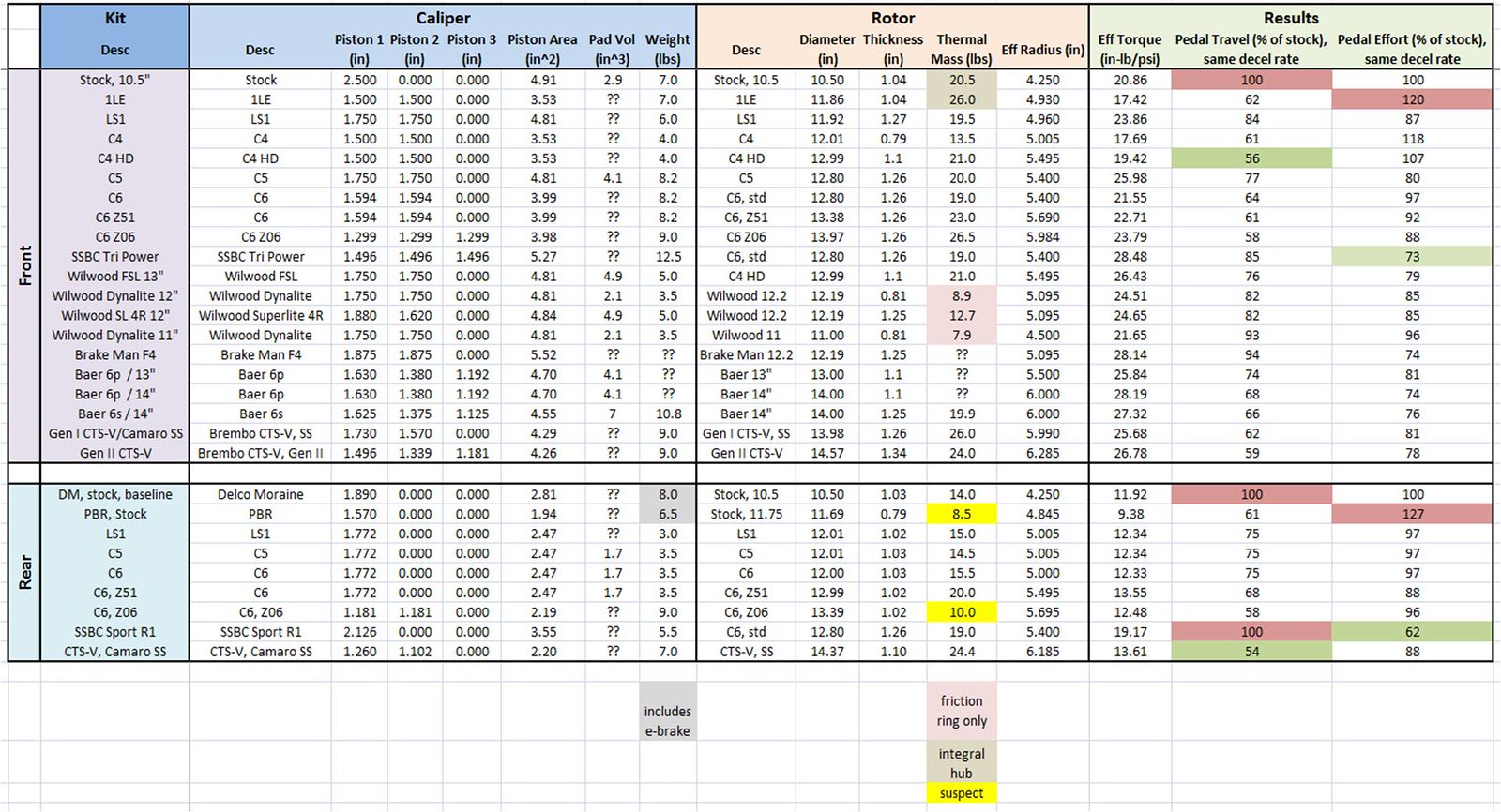
However I think the one thing people always forget to talk about with regard to brakes is the pedal feel. To me, and I'm sure others, this is a huge consideration, people just don't normally think about it. To me feel consists primarily of pedal effort and pedal travel.
To me the OEM pedal is way to long to be comfortable, even for the street. I grew up with modern cars with shorter pedals and that is what I like. In fact my benchmark was my daily driver, a Acura CL Type S. This car doesn't have fancy brakes, just your plain 12" rotor, two piston sliding caliper. I think people really need to think about what they like about good brakes.
When I put the Wilwood FSL calipers on 13" rotors on my car, it was like driving a whole new car, the pedal feel was magic, even on the street. And of course they allowed me to get out onto road courses without worry.
Here is a chart I put together. Pay particular attention to the last two columns.
right click - view image for a larger version
Supreme Member
iTrader: (2)
Joined: May 2002
Posts: 4,449
Likes: 8
From: Everett, WA
Car: 87' IROC
Engine: L98
Transmission: T56
Re: Suspension question
They are in the neighborhood of $330 for the standard 6061 AL with normal SET34 sized outer bearing and choice of M12 or 1/2" studs. "Billet" dust caps are +$35
The 7075 "road race" hubs are in the neighborhood of $500 and are a GOOD bit stronger. They also have the larger SET 3 outer bearing and again choice of M12 or 1/2" studs. "Billet" dust caps are included.
I also have a few "custom" versions that are 6061 and have dual bolt pattern, 5x4.75" and 5x120mm for the BMW wheel crowd. These also have the larger SET3 outer bearing and are priced nicely in between. "Billet" dust caps are +$35. These are for M12 studs only.
All prices include Timken bearings and seals. They can be ordered bare for a few bucks less.
The 7075 "road race" hubs are in the neighborhood of $500 and are a GOOD bit stronger. They also have the larger SET 3 outer bearing and again choice of M12 or 1/2" studs. "Billet" dust caps are included.
I also have a few "custom" versions that are 6061 and have dual bolt pattern, 5x4.75" and 5x120mm for the BMW wheel crowd. These also have the larger SET3 outer bearing and are priced nicely in between. "Billet" dust caps are +$35. These are for M12 studs only.
All prices include Timken bearings and seals. They can be ordered bare for a few bucks less.
Supreme Member
iTrader: (2)
Joined: Sep 2006
Posts: 2,118
Likes: 15
From: Houston, TX
Car: 1989 GTA
Engine: SuperRam 350
Transmission: Pro Built S/S TH700R4
Axle/Gears: 3.27
Re: Suspension question
Stock brakes have more stopping power than you can use, and with an adjustable prop valve, you wont be able to make the pre fade stopping distance any shorter by getting larger brakes.
Once you are able to lock your wheels, there is nothing "more stopping power" is going to do for you. Stock brakes will lock the wheels without any problem.
Bigger brakes are mostly about heat capacity. If you stop a bunch of times at full tilt (think roadcourse) and the brakes get hot you start to run into fade issues. Bigger brakes are like a bigger heat sink. Since you have admitted you don't plan on using the car for road courses and such, you do not need bigger brakes.
I know you are thinking, "who is this dipshyt trying to tell me stock brakes are fine when everyone is all about big brakes"
Well I may be just some dipshyt off the internet but I run my car very hard in time attack on small road courses, in fact, that is all I do with it. It's registered to run on the street but I don't.
I have completely stock brakes with only an adjustable prop valve in it and I've never had brake fade. I've overheated the car before I've overheated the brakes. And not that I could ever prove it, but I'd bet it stops in a shorter distance than 99.99% of the thirdgens with big brake kits out there. Adj. prop valve, big sticky tires, and composed suspension movement help.
Long story short, you don't need big brakes and most people don't. Especially for drag racing and just cruising around. If you want to get them for bling, that's a whole other story and I'm not here to tell you there's anything wrong with that if that is your thing
Once you are able to lock your wheels, there is nothing "more stopping power" is going to do for you. Stock brakes will lock the wheels without any problem.
Bigger brakes are mostly about heat capacity. If you stop a bunch of times at full tilt (think roadcourse) and the brakes get hot you start to run into fade issues. Bigger brakes are like a bigger heat sink. Since you have admitted you don't plan on using the car for road courses and such, you do not need bigger brakes.
I know you are thinking, "who is this dipshyt trying to tell me stock brakes are fine when everyone is all about big brakes"
Well I may be just some dipshyt off the internet but I run my car very hard in time attack on small road courses, in fact, that is all I do with it. It's registered to run on the street but I don't.
I have completely stock brakes with only an adjustable prop valve in it and I've never had brake fade. I've overheated the car before I've overheated the brakes. And not that I could ever prove it, but I'd bet it stops in a shorter distance than 99.99% of the thirdgens with big brake kits out there. Adj. prop valve, big sticky tires, and composed suspension movement help.
Long story short, you don't need big brakes and most people don't. Especially for drag racing and just cruising around. If you want to get them for bling, that's a whole other story and I'm not here to tell you there's anything wrong with that if that is your thing
Supreme Member
iTrader: (2)
Joined: May 2002
Posts: 4,449
Likes: 8
From: Everett, WA
Car: 87' IROC
Engine: L98
Transmission: T56
Re: Suspension question
Lets look at the brakes job.
1. must stop the car with minimum dust and minimum noise and no drama.
2. must absorb and reject the heat of friction
3. must last a long time and be relatively maintenance free
4. must be as small, cheap, and light as possible
5. must look good (for some)
6. must feel good
1. must stop the car with minimum dust and minimum noise and no drama
Pretty much any brake kit does this under normal conditions with a good pad choice
2. must absorb and reject the heat of friction
This is the biggie. From a purely technical point of view brakes are a compromise of brake performance (thermal performance) and weight.
You need mass to absorb the heat of friction. But how much mass? Well that really depends on how fast you plan to go and how much your car weights.
more speed : more mass needed
more weight : more mass needed
So you want the right amount of thermal mass (rotor size/weight) without too much. Too much will just hinder the other aspects of vehicle performance like handling, acceleration, and efficiency.
Once you have absorbed the heat you need a way to reject it back to the air. That is the job of the cooling vanes in the rotor. Basically the more surface area of the vanes the better the cooling. So a rotor with more vanes will cool better than a rotor with less. Vane geometry also plays a part but much less than pure vane count. So its also important to realize that a large rotor inherently has a larger van surface area. Double whammy to the smaller rotor, it can't absorb as much heat as a big rotor and can't reject it as fast either. This becomes important when you are on a road course and have consecutive hard breaking sections.
Heat also makes its way into the pads and the caliper and then into the fluid. As long as you keep the temperature in a good range for the pad you have nothing to worry about. Basically pick a pad compound for the job. A smaller pad (volume wise) will heat up faster and run hotter. This means there is a higher likelihood you need to run a "performance" or "racing" pad depending on how you are using the car. Heat in the brake fluid is of limited worry unless you exceed the boiling point of the fluid. I would only be concerned if you have a small brake kit (like stock) and run it quite hard. I always recommend using quality fluid to resist boiling.
3. must last a long time and be relatively maintenance free
Basically this is talking about pad life. The larger the pad (volume wise) the longer they will last. In an ideal world, rotors basically last "forever".
Also with very hard use and certain caliper designs, you can have pad taper. This comes in two forms. Leading edge taper is where the leading edge of the pad is more worn than the trailing. This occurs with VERY heavy use on calipers that have all the pistons the same size. I am simplifying things here. But with a properly designed 4 or 6 piston caliper you use a smaller leading edge piston to negate this effect. On the street you have nothing to worry about. The other form of taper is from caliper flex. This shows up as the pad being more worn on the top (radially) than the top. This comes down to the stiffness of the caliper. More meat and smart design in the bridge are helps prevent this. Again, nothing to worry about on the street.
4. must be as small, cheap, and light as possible
Small (light) brakes make the rest of the car work better (suspension, steering, acceleration, efficiency). Also small brakes are easy to package inside wheels.
Cheap brakes are good b/c who wants to spend more than they have to.
5. must look good (for some)
Purely subjective, I won't go there.
6. must feel good
Again to me this is hugely important. This is how you interact with the brakes. It should feel good. See my previous response for more details.
Brakes like anything else on the car are a compromise. Its up to you to figure out your requirements.
If I was street, drag, or auto-x only:
Any kit will stop the car in any situation. I would spend my time thinking about how I want the brakes to feel, how much money I have to spend, and maybe some looks.
If I was doing some open track events or racing:
I would think about the thermal mass I need for my brakes to survive. Then I would think about brake feel. The other considerations come after that.
It also comes down to how tolerant you are of swapping pads. I am not a big fan of swapping pads at the track so I run an oversized brake kit that allows me to use a street pad on the track. Wilwood calipers on the other hand make pad swaps a breeze, so no big deal there.
John
Last edited by 87350IROC; Jan 29, 2013 at 06:25 PM.
Supreme Member
iTrader: (2)
Joined: May 2002
Posts: 4,449
Likes: 8
From: Everett, WA
Car: 87' IROC
Engine: L98
Transmission: T56
Re: Suspension question
Most of the issues stem from the padlets. If go to the solid pad, things are better.
My biggest gripe aside from the padlets is that pads are quite expensive.
I am also not the biggest fan of drilled rotors which the Z06 brakes come with by default.
Thread Starter
Supreme Member
iTrader: (1)
Joined: Oct 2005
Posts: 1,050
Likes: 0
From: Glen Park, NY
Car: 1987 IROC-Z
Engine: TPIS II Supercharged w/Nitrous
Transmission: 700R4 Probuilt
Axle/Gears: 3:73 Richmond 12 Bolt
Re: Suspension question
I realized I never qualified my statement that the Z06 setup is not that great. And I say that from a complete package point of view, not strictly performance.
Most of the issues stem from the padlets. If go to the solid pad, things are better.
My biggest gripe aside from the padlets is that pads are quite expensive.
I am also not the biggest fan of drilled rotors which the Z06 brakes come with by default.
Most of the issues stem from the padlets. If go to the solid pad, things are better.
My biggest gripe aside from the padlets is that pads are quite expensive.
I am also not the biggest fan of drilled rotors which the Z06 brakes come with by default.
Supreme Member
iTrader: (2)
Joined: May 2002
Posts: 4,449
Likes: 8
From: Everett, WA
Car: 87' IROC
Engine: L98
Transmission: T56
Re: Suspension question
Drilled rotors showed up in the old days as a way to expel gasses away from where the pad meets the rotor. Old formulation pads out gassed significantly when heated. This true of many compounds both natural and man made. So, you would in essence "float" the pad on a layer of gas if the temperature get high enough. The holes provide a path for the gas to escape so the pad can stay in full contact with the rotor. I suspect drilled rotors started grass roots style as everyone has a drill press. Slotting requires more expensive machinery. I suspect this is why drilling was generally more popular than slotting.
Slots really serve the same purpose.
Now a side effect of the holes or slots is they can actually increase the friction between the pad and rotor at high temps. At high temps, the pad softens a small amount. When it softens a tiny bit of the pad can get pushed below the level of the hole or slot creating an extra hook point for the pad to grab onto the rotor. Generally this creates a feel of more instant pad engagement or "initial bite". This is a secondary effect of the holes or slots and is minor. This effect also causes the pads to wear more quickly than with plain rotors. The SAE has determined this to be between 25-50% faster at temperature.
A third and even more minor effect is that by drilling or slotting the rotor is that you are both dropping mass (weight) from the rotor and providing slightly more surface area for cooling. I argue these effects are negligible but others would disagree. I am open to an honest discussion.
Finally, rotor integrity. Both the holes and the slots locally increase the stress on the rotor. Particularly drilled rotor, as it provides a full through the thickness initiation point for cracks while also increasing the local stress by 3 times.
So in conclusion I never recommend drilled rotors. Again, there are other opinions out there. It is up to the consumer to evaluate the information and make an informed decision.
I typically recommend plain rotors as they last forever and are inexpensive.
I personally like the look of slotted rotors and use them on my vehicle with success. That combined with the fact that I am willing to live with the increased pad wear and slots have fewer negative side effects than drilled holes, I do recommend slotted rotors for people who like the look. I would not be afraid to run slotted rotors on a road coarse, and I do.
John
Re: Suspension question
John (87350Iroc) knocked it out of the park. I don't have much to add except for a few bits
First, about z06 brakes, and I am not so eloquent but bear with me.
The brakes are not what is stopping the car, what is stopping the car are your tires, and that is important to remember. You can only stop as fast as your tires will allow and that is the point where static friction drops off and sliding friction begins. As I understand it there is a slight amount of sliding that is going on at the tread before actual deceleration drops off like a cliff and you are just skidding.
Why is this important to know? Well, a car like the Z06 is very good about evenly distributing the braking load to all four tires (which happen to be relatively large and sticky). And that is why it has very good braking numbers.
Part of this is done through managing the movement of weight and what the static weights look like. Think about a car pitching forward a lot. This unloads the rear tires and creates a lot more work for the front. Or a car that is very nose heavy vs one that is closer to 50/50.
Another part of this is that the car is relatively light, less mass moving means less energy needs to be scrubbed off.
Yet another part of this is ABS. They have engineered the brakes to keep each tire very close to that knee point where static friction turns to sliding friction where your stopping power is greatest. No human can achieve that unless you have four brake pedals, four legs, and the brainpower to sense the tractive effort of each tire individually. It's extremely hard to hit peak braking power with just one pedal and no ABS. You can't beat four channel abs on pavement.
So the entire system is what counts, brakes are but one part of this system. If you want to decrease stopping distances you need to look at it as a system designed to use up every last ounce of traction from all four tires.
Stock thirdgen brakes and indeed most stock brakes from this era are extremely front biased. This was a way that engineers made the car safe for just about every condition they imagined the car would be driven in, from ice to death valley in the summer time. If at any point the rears locked up before the fronts it would be dangerous to most drivers, so the solution was to overbias them to the front to account for all conditions plus a generous safety factor just to be sure.
This is why I really recommend an adjustable prop valve if you are in search of shorter stopping distances. But the system includes shocks, springs, and tires.
First, about z06 brakes, and I am not so eloquent but bear with me.
The brakes are not what is stopping the car, what is stopping the car are your tires, and that is important to remember. You can only stop as fast as your tires will allow and that is the point where static friction drops off and sliding friction begins. As I understand it there is a slight amount of sliding that is going on at the tread before actual deceleration drops off like a cliff and you are just skidding.
Why is this important to know? Well, a car like the Z06 is very good about evenly distributing the braking load to all four tires (which happen to be relatively large and sticky). And that is why it has very good braking numbers.
Part of this is done through managing the movement of weight and what the static weights look like. Think about a car pitching forward a lot. This unloads the rear tires and creates a lot more work for the front. Or a car that is very nose heavy vs one that is closer to 50/50.
Another part of this is that the car is relatively light, less mass moving means less energy needs to be scrubbed off.
Yet another part of this is ABS. They have engineered the brakes to keep each tire very close to that knee point where static friction turns to sliding friction where your stopping power is greatest. No human can achieve that unless you have four brake pedals, four legs, and the brainpower to sense the tractive effort of each tire individually. It's extremely hard to hit peak braking power with just one pedal and no ABS. You can't beat four channel abs on pavement.
So the entire system is what counts, brakes are but one part of this system. If you want to decrease stopping distances you need to look at it as a system designed to use up every last ounce of traction from all four tires.
Stock thirdgen brakes and indeed most stock brakes from this era are extremely front biased. This was a way that engineers made the car safe for just about every condition they imagined the car would be driven in, from ice to death valley in the summer time. If at any point the rears locked up before the fronts it would be dangerous to most drivers, so the solution was to overbias them to the front to account for all conditions plus a generous safety factor just to be sure.
This is why I really recommend an adjustable prop valve if you are in search of shorter stopping distances. But the system includes shocks, springs, and tires.
Re: Suspension question
John,
Freaking. Awesome. Spreadsheet. Thank you for posting that.
Yes I agree about the pedal feel and that is why I was careful to point out that bigger brakes were mostly (but not totally) about heat capacity.
First thing that comes to mind is how different for example a porsche brake pedal feels to my thirdgen. So I can see how it would drive a person nuts if they got used to something like the porsche (not to mention the way the pedal moves is different too).
That said I think humans are pretty good at adaptation and I don't even think about it when I am driving on the track, actually the thing that bothers me most is the different planes the pedals are on. Makes heel toe a lot harder.
And one more thing that maybe you can comment on further.. I've read from a few sources that the outgassing thing is a myth and that the physics of how it has been explained are essentially impossible. IIRC say the rotor is moving too quickly to allow a cushion to form, the pad too small, the clamping force is too large to overcome, and the amount of gas would have to be much greater than would be possible.
I think of a tire skidding on pavement. I don't see tires floating up off the pavement when sliding (and the skid marks don't suggest they are either) and they are definitely outgassing, I would think more so than a brake pad. But I don't know. Any thoughts?
Freaking. Awesome. Spreadsheet. Thank you for posting that.
Yes I agree about the pedal feel and that is why I was careful to point out that bigger brakes were mostly (but not totally) about heat capacity.
First thing that comes to mind is how different for example a porsche brake pedal feels to my thirdgen. So I can see how it would drive a person nuts if they got used to something like the porsche (not to mention the way the pedal moves is different too).
That said I think humans are pretty good at adaptation and I don't even think about it when I am driving on the track, actually the thing that bothers me most is the different planes the pedals are on. Makes heel toe a lot harder.
And one more thing that maybe you can comment on further.. I've read from a few sources that the outgassing thing is a myth and that the physics of how it has been explained are essentially impossible. IIRC say the rotor is moving too quickly to allow a cushion to form, the pad too small, the clamping force is too large to overcome, and the amount of gas would have to be much greater than would be possible.
I think of a tire skidding on pavement. I don't see tires floating up off the pavement when sliding (and the skid marks don't suggest they are either) and they are definitely outgassing, I would think more so than a brake pad. But I don't know. Any thoughts?
Thread Starter
Supreme Member
iTrader: (1)
Joined: Oct 2005
Posts: 1,050
Likes: 0
From: Glen Park, NY
Car: 1987 IROC-Z
Engine: TPIS II Supercharged w/Nitrous
Transmission: 700R4 Probuilt
Axle/Gears: 3:73 Richmond 12 Bolt
Re: Suspension question
So does anyone have any Rotors / calipers they recommed.
Supreme Member
iTrader: (2)
Joined: May 2002
Posts: 4,449
Likes: 8
From: Everett, WA
Car: 87' IROC
Engine: L98
Transmission: T56
Re: Suspension question
John,
Freaking. Awesome. Spreadsheet. Thank you for posting that.
Yes I agree about the pedal feel and that is why I was careful to point out that bigger brakes were mostly (but not totally) about heat capacity.
First thing that comes to mind is how different for example a porsche brake pedal feels to my thirdgen. So I can see how it would drive a person nuts if they got used to something like the porsche (not to mention the way the pedal moves is different too).
That said I think humans are pretty good at adaptation and I don't even think about it when I am driving on the track, actually the thing that bothers me most is the different planes the pedals are on. Makes heel toe a lot harder.
And one more thing that maybe you can comment on further.. I've read from a few sources that the outgassing thing is a myth and that the physics of how it has been explained are essentially impossible. IIRC say the rotor is moving too quickly to allow a cushion to form, the pad too small, the clamping force is too large to overcome, and the amount of gas would have to be much greater than would be possible.
I think of a tire skidding on pavement. I don't see tires floating up off the pavement when sliding (and the skid marks don't suggest they are either) and they are definitely outgassing, I would think more so than a brake pad. But I don't know. Any thoughts?
Freaking. Awesome. Spreadsheet. Thank you for posting that.
Yes I agree about the pedal feel and that is why I was careful to point out that bigger brakes were mostly (but not totally) about heat capacity.
First thing that comes to mind is how different for example a porsche brake pedal feels to my thirdgen. So I can see how it would drive a person nuts if they got used to something like the porsche (not to mention the way the pedal moves is different too).
That said I think humans are pretty good at adaptation and I don't even think about it when I am driving on the track, actually the thing that bothers me most is the different planes the pedals are on. Makes heel toe a lot harder.
And one more thing that maybe you can comment on further.. I've read from a few sources that the outgassing thing is a myth and that the physics of how it has been explained are essentially impossible. IIRC say the rotor is moving too quickly to allow a cushion to form, the pad too small, the clamping force is too large to overcome, and the amount of gas would have to be much greater than would be possible.
I think of a tire skidding on pavement. I don't see tires floating up off the pavement when sliding (and the skid marks don't suggest they are either) and they are definitely outgassing, I would think more so than a brake pad. But I don't know. Any thoughts?
My buddy has a Cayman S and I do like the bottom hinged gas pedal on that car.
I think the scope of out gassing is way overblown. I wouldn't be surprised if there is some truth, but I doubt it ever made a huge difference. Racers are always looking for that last 0.1 second. I doubt it was a huge help. Tires is an interesting example. Obviously they out gas when they skid, but probably not a meaningful amount when you are not skidding. And surely you wouldn't see it float. I think it instead would be a very dynamic event where not the whole tire or brake pad is floating all the time. Of course the pad or tire is pushing any gas that is created out to the sides to escape. The slots would make an easier path for the gas to escape.
Supreme Member
iTrader: (2)
Joined: May 2002
Posts: 4,449
Likes: 8
From: Everett, WA
Car: 87' IROC
Engine: L98
Transmission: T56
Re: Suspension question
Agreed completely. I run an adjustable prop valve as well. It is the only way to go. And if and when you do swap brakes, well its still very useful for tuning.
Supreme Member
iTrader: (2)
Joined: May 2002
Posts: 4,449
Likes: 8
From: Everett, WA
Car: 87' IROC
Engine: L98
Transmission: T56
Re: Suspension question
I think you need to evaluate all of the considerations. Do you like the way your brake pedal feels now with the stock brakes?
How much do you want to spend?
I personally think the Wilwood FSL caliper on a C4HD rotor is quite a package, especially for the price.
John
How much do you want to spend?
I personally think the Wilwood FSL caliper on a C4HD rotor is quite a package, especially for the price.
John
Thread Starter
Supreme Member
iTrader: (1)
Joined: Oct 2005
Posts: 1,050
Likes: 0
From: Glen Park, NY
Car: 1987 IROC-Z
Engine: TPIS II Supercharged w/Nitrous
Transmission: 700R4 Probuilt
Axle/Gears: 3:73 Richmond 12 Bolt
Re: Suspension question
http://www.spohn.net/shop/1982-1992-...es-Components/
1LE Brake Caliper Carriers (Pair) - 1982-1992 GM F-Body: Camaro & Firebird
1LE Brake Carrier Adapter Brackets (Pair) - 1982-1992 GM F-Body: Camaro & Firebird
1LE PBR Aluminum Dual Piston Brake Caliper - Right Side - 1982-1992 GM F-Body: Camaro & Firebird
1LE PBR Aluminum Dual Piston Brake Caliper - Left Side - 1982-1992 GM F-Body: Camaro & Firebird
Hawk HPS Brake Pads - 1LE Front - 1982-1992 GM F-Body: Camaro & Firebird
I think dual piston would be better than single piston.
Supreme Member
iTrader: (2)
Joined: May 2002
Posts: 4,449
Likes: 8
From: Everett, WA
Car: 87' IROC
Engine: L98
Transmission: T56
Re: Suspension question
Money isn't really an option.. My brakes have a good feel to them currently, I just don't know if they will handle what I have in the future.. I was additionally looking at the PBR setup on Spohn.net and don't know if thy will be a direct fit replacement or if they are worth the money? Any suggestions or comments are welcome
http://www.spohn.net/shop/1982-1992-...es-Components/
I think dual piston would be better than single piston.
http://www.spohn.net/shop/1982-1992-...es-Components/
I think dual piston would be better than single piston.
As was pointed out, 2 piston vs 1 is a negligible difference for your application.
Thread Starter
Supreme Member
iTrader: (1)
Joined: Oct 2005
Posts: 1,050
Likes: 0
From: Glen Park, NY
Car: 1987 IROC-Z
Engine: TPIS II Supercharged w/Nitrous
Transmission: 700R4 Probuilt
Axle/Gears: 3:73 Richmond 12 Bolt
Re: Suspension question
Ok, you got me convinced... I'll keep the same calipers.. LOL.. I will just get them cleaned up... I did order a bunch of other crap that I need though.
1 EIB-3-Pro Eibach Pro Performance Lowering Springs - 1982-1992 GM F-Body: Camaro & Firebird $245.00 $245.00
2 FSI-8292F Front Upper Spring Isolators $22.95 $45.90
2 E-13977 Wheel Bearing Dust Cap $5.25 $10.50
2 E-A6 Front Inner Wheel Bearing $11.65 $23.30
2 E-A3 Front Outer Wheel Bearing (IROC) $12.75 $25.50
2 E-8871 Front Inner Wheel Bearing Seal $2.95 $5.90
1 SLE-24048 Brake Control Line Lock - 1987-1992 GM F-Body: Camaro & Firebird $159.95 $159.95
1 EL-19-406 Polyurethane End Link Set - Front Sway Bar $18.50 $18.50
1 EL-19-4O6 Polyurethane End Link Set - Rear Sway Bar $18.50 $18.50
1 E-FRTKIT-8292-1 Spohn Precision Front End Rebuild Kit - 1982-1992 GM F-Body: Camaro & Firebird $299.95 $299.95
for the help
1 EIB-3-Pro Eibach Pro Performance Lowering Springs - 1982-1992 GM F-Body: Camaro & Firebird $245.00 $245.00
2 FSI-8292F Front Upper Spring Isolators $22.95 $45.90
2 E-13977 Wheel Bearing Dust Cap $5.25 $10.50
2 E-A6 Front Inner Wheel Bearing $11.65 $23.30
2 E-A3 Front Outer Wheel Bearing (IROC) $12.75 $25.50
2 E-8871 Front Inner Wheel Bearing Seal $2.95 $5.90
1 SLE-24048 Brake Control Line Lock - 1987-1992 GM F-Body: Camaro & Firebird $159.95 $159.95
1 EL-19-406 Polyurethane End Link Set - Front Sway Bar $18.50 $18.50
1 EL-19-4O6 Polyurethane End Link Set - Rear Sway Bar $18.50 $18.50
1 E-FRTKIT-8292-1 Spohn Precision Front End Rebuild Kit - 1982-1992 GM F-Body: Camaro & Firebird $299.95 $299.95
for the help Supreme Member
iTrader: (2)
Joined: May 2002
Posts: 4,449
Likes: 8
From: Everett, WA
Car: 87' IROC
Engine: L98
Transmission: T56
Re: Suspension question
Ok, you got me convinced... I'll keep the same calipers.. LOL.. I will just get them cleaned up... I did order a bunch of other crap that I need though.
1 EIB-3-Pro Eibach Pro Performance Lowering Springs - 1982-1992 GM F-Body: Camaro & Firebird $245.00 $245.00
2 FSI-8292F Front Upper Spring Isolators $22.95 $45.90
2 E-13977 Wheel Bearing Dust Cap $5.25 $10.50
2 E-A6 Front Inner Wheel Bearing $11.65 $23.30
2 E-A3 Front Outer Wheel Bearing (IROC) $12.75 $25.50
2 E-8871 Front Inner Wheel Bearing Seal $2.95 $5.90
1 SLE-24048 Brake Control Line Lock - 1987-1992 GM F-Body: Camaro & Firebird $159.95 $159.95
1 EL-19-406 Polyurethane End Link Set - Front Sway Bar $18.50 $18.50
1 EL-19-4O6 Polyurethane End Link Set - Rear Sway Bar $18.50 $18.50
1 E-FRTKIT-8292-1 Spohn Precision Front End Rebuild Kit - 1982-1992 GM F-Body: Camaro & Firebird $299.95 $299.95
for the help
1 EIB-3-Pro Eibach Pro Performance Lowering Springs - 1982-1992 GM F-Body: Camaro & Firebird $245.00 $245.00
2 FSI-8292F Front Upper Spring Isolators $22.95 $45.90
2 E-13977 Wheel Bearing Dust Cap $5.25 $10.50
2 E-A6 Front Inner Wheel Bearing $11.65 $23.30
2 E-A3 Front Outer Wheel Bearing (IROC) $12.75 $25.50
2 E-8871 Front Inner Wheel Bearing Seal $2.95 $5.90
1 SLE-24048 Brake Control Line Lock - 1987-1992 GM F-Body: Camaro & Firebird $159.95 $159.95
1 EL-19-406 Polyurethane End Link Set - Front Sway Bar $18.50 $18.50
1 EL-19-4O6 Polyurethane End Link Set - Rear Sway Bar $18.50 $18.50
1 E-FRTKIT-8292-1 Spohn Precision Front End Rebuild Kit - 1982-1992 GM F-Body: Camaro & Firebird $299.95 $299.95
for the helpAlso, it looks like you ordered SET3 outer bearings. What you need is SET34. SET3 was for 1LE cars only.
Thread Starter
Supreme Member
iTrader: (1)
Joined: Oct 2005
Posts: 1,050
Likes: 0
From: Glen Park, NY
Car: 1987 IROC-Z
Engine: TPIS II Supercharged w/Nitrous
Transmission: 700R4 Probuilt
Axle/Gears: 3:73 Richmond 12 Bolt
Re: Suspension question

That figures.. I will keep that in mind when they come in. I know someone that has the 1LE that will buy them..
On Probation
Joined: Apr 2012
Posts: 1,435
Likes: 18
Re: Suspension question
John (87350Iroc) knocked it out of the park. I don't have much to add except for a few bits
First, about z06 brakes, and I am not so eloquent but bear with me.
The brakes are not what is stopping the car, what is stopping the car are your tires, and that is important to remember. You can only stop as fast as your tires will allow and that is the point where static friction drops off and sliding friction begins. As I understand it there is a slight amount of sliding that is going on at the tread before actual deceleration drops off like a cliff and you are just skidding.
Why is this important to know? Well, a car like the Z06 is very good about evenly distributing the braking load to all four tires (which happen to be relatively large and sticky). And that is why it has very good braking numbers.
Part of this is done through managing the movement of weight and what the static weights look like. Think about a car pitching forward a lot. This unloads the rear tires and creates a lot more work for the front. Or a car that is very nose heavy vs one that is closer to 50/50.
Another part of this is that the car is relatively light, less mass moving means less energy needs to be scrubbed off.
Yet another part of this is ABS. They have engineered the brakes to keep each tire very close to that knee point where static friction turns to sliding friction where your stopping power is greatest. No human can achieve that unless you have four brake pedals, four legs, and the brainpower to sense the tractive effort of each tire individually. It's extremely hard to hit peak braking power with just one pedal and no ABS. You can't beat four channel abs on pavement.
So the entire system is what counts, brakes are but one part of this system. If you want to decrease stopping distances you need to look at it as a system designed to use up every last ounce of traction from all four tires.
Stock thirdgen brakes and indeed most stock brakes from this era are extremely front biased. This was a way that engineers made the car safe for just about every condition they imagined the car would be driven in, from ice to death valley in the summer time. If at any point the rears locked up before the fronts it would be dangerous to most drivers, so the solution was to overbias them to the front to account for all conditions plus a generous safety factor just to be sure.
This is why I really recommend an adjustable prop valve if you are in search of shorter stopping distances. But the system includes shocks, springs, and tires.
First, about z06 brakes, and I am not so eloquent but bear with me.
The brakes are not what is stopping the car, what is stopping the car are your tires, and that is important to remember. You can only stop as fast as your tires will allow and that is the point where static friction drops off and sliding friction begins. As I understand it there is a slight amount of sliding that is going on at the tread before actual deceleration drops off like a cliff and you are just skidding.
Why is this important to know? Well, a car like the Z06 is very good about evenly distributing the braking load to all four tires (which happen to be relatively large and sticky). And that is why it has very good braking numbers.
Part of this is done through managing the movement of weight and what the static weights look like. Think about a car pitching forward a lot. This unloads the rear tires and creates a lot more work for the front. Or a car that is very nose heavy vs one that is closer to 50/50.
Another part of this is that the car is relatively light, less mass moving means less energy needs to be scrubbed off.
Yet another part of this is ABS. They have engineered the brakes to keep each tire very close to that knee point where static friction turns to sliding friction where your stopping power is greatest. No human can achieve that unless you have four brake pedals, four legs, and the brainpower to sense the tractive effort of each tire individually. It's extremely hard to hit peak braking power with just one pedal and no ABS. You can't beat four channel abs on pavement.
So the entire system is what counts, brakes are but one part of this system. If you want to decrease stopping distances you need to look at it as a system designed to use up every last ounce of traction from all four tires.
Stock thirdgen brakes and indeed most stock brakes from this era are extremely front biased. This was a way that engineers made the car safe for just about every condition they imagined the car would be driven in, from ice to death valley in the summer time. If at any point the rears locked up before the fronts it would be dangerous to most drivers, so the solution was to overbias them to the front to account for all conditions plus a generous safety factor just to be sure.
This is why I really recommend an adjustable prop valve if you are in search of shorter stopping distances. But the system includes shocks, springs, and tires.
There is a major hole in the entire thread(Note just Pablo's quote here, I mean the entire thread has overlooked a very inportant point. I want to talk to you Pablo in a minute that is why I quoted you) Everyone is just looking at leverage. No one has looked at actual friction area. There are a few pad volumes listed, but that spread sheet does not take into account for the pad-to-rotor friction area
Two things stop the car 1) pressure, 2) friction surface- that spread sheet only addresses 1. I do not care how ward you press on 1 square inch of materiallLike sand paper- it's going to heat up quickly, wear out quickly, and take forever to do the job. Apply this to brake pads, the same thing. A little more pad and a little less preasure do the same thing but with alot better disperesed heat on the friction area. Press it harder like the smaller piece of sand paper? and its goingto dio the same job but alot faster. It ALSO depends on HOW that pressure is applied to the frition area. A longer voulme pad with multiple pistons apples the pressure across the entire longer pad evenly,. The Delco Morrain piston area is bigger thant he pad and about 1/3 of it hangs over the sides of the tiny pad.
Now to Pablo- about your car and the point of TIRES stopping a car. You are running 315 front and 335 rear Race compound ruber on extremely wide ccw wheels that have a massive positve scrub radius--hence the word SCRUB. When you entre a corner at the AUtx and timeattack type speed tha tyou are doing with that car you pretty much do not need very much brake pedal because of the lower speeds you are going. Then when you do need to scrub off speed, you can enter a corner a little hot and just turn the wheel and those tires and wide offset will bleed off speed very quickly. Fact is you are having to burry the throttle mid corner off just to try and maintain corner speed. SO yes, your brakes are plenty for what you have been doing. Put that car on California Speedway road course and you'll burn them up in 2 laps- that Ill put a big bet on ($$$$)
A great brake system is all about a nice pad volume, and nice leverage in diameter, and a nice piston size which equates to pedal movement- and ALL 3 together make up the feel of sweet spot of the brakes. Too much or too little of any will cause the heat range or effort to change more during usage. Having those three in a good range will keep the brakes running warm enough but yet never geting too hot no matter what you do. Its all about keeping temps in the 200-600* range all the time on the street. Then taking the setup on the track and keeping them at 400- 900* rather than a lighter and small pad setup going up to 400-1200* range and crytalizing rotors (at that point you've hot spoted them and had better just throw them in the garbage.
Food for thought for everyone here- A longer pad voulme will disapate that heat in a larger area across the rotor surface. What does this mean? less of a chance for a hotspot than a smaller pad with more heat sitting on a smaller area of the rotor.
Also, I have stated in prior posts that drilled rotors are actually optimum for disapating heat. THeir are two main problems with drilled rotors- 1) in racing (very hot temps) the rotor iron rotor surface runs ALOT hotter range than the street and the race pads run alot hotter aherent friction temp than standard under400* abrasive friction street pads. Those holes in the rotor surface can develop cracks at those higher reacing heats so even will better cooiling properties, the rotor face is suject to cracking Once a rotor reaches 1150* the iron will change properties to 'cementite' which chemically crytalizes the iron and renders the strutcture inadequate to fuction as it was designed. 2) the other problem is aftermarket manufacturers are taking OEM size rotors(usually already on the small mass size) and are drilling holes into them making the mass thermal properties even lower- this is bad. mass cools better than holes- HOWEVER- you take two rotors of the same mass- lets say a 15lb 12.6" rotor solid face, and a 15lb 12.9" drilled face rotor, the drilled face rotor of the same mass will cool MUCH BETTER. It is physics. The larger rotor of the same mass has more area exposed to the atmosphere to disapate heat. Its like having two ice cubes of the same volume)a round ice cube as opposed to a long skinny one shaped more like a pencil. Sit them both on the counter and the long skinny one will melt ALOT faster it has more exposed volume to the atmosphere to beed off energy.
Modern carbon rotors are YES going back to good ol drilled rotors- why? because they vent the heat into the center vane area where it is best disapated- there is NO BETTER WAY to get ride of the heat than to route it intot he cneter vent of the rotor. The pads touch the outer side and the heat travels through to the ambient area nside the vented section where it bleeds off heat into the atmostphere. Carbon rotors can reach far beyond 1150* without cracking- so brake technology is going back to what wroks best. Larger rotors with drilled holes in them for racing use.
More in next post-
Joined: Jun 2000
Posts: 5,364
Likes: 51
From: Enschede, Netherlands
Car: 82 TA 87 IZ L98 88 IZ LB9 88 IZ L98
Engine: 5.7TBI 5,7TPI 5.0TPI, 5,7TPI
Transmission: T5, 700R4, T5, 700R4
Axle/Gears: 3.08, 3.27, 3.45, 3.27
Re: Suspension question
For dynamic friction in theory the pad area does not matter, the coefficient of friction and the force applied do. However a smaller pad means a smaller area for energy to transfer into the rotor and this means localized higher temperature which results in quicker pad fade. IF you have a brake system where you brake with 2 size pads in such a manner that n\neighter will result in pad fade (and the rest kept the same, so pedal force, ms size, pedal ratio, caliper & rotor size) then there should be no difference in resulting brake torque. A larger brake pad does not mean you will brake harder with less pedal (and as a result clamping) force.
On Probation
Joined: Apr 2012
Posts: 1,435
Likes: 18
Re: Suspension question
Pablo has also mentioned 4 channel ABS and how great that is- yes for and old lady driving in the rain- or for even a pro wanting to just stop as fast as posible in a straight line- but who hits the brakes just to stop straight? very rarely from speed unless you are in a panic situation- you generally do not stop from speed, you SLOW from speed into a fast corner entry. That 4 channel ABS which is calculating each wheelk grip is also fighting you and not letting the car rotate- yep. Not on my car. A few of you know I picked up a gig last year as an exotic car driving instructor. I also get to pilot the cars for clients that want greater experience of what the car car do. One of the cars I get to run at race speeds is an over $300K Ferrari 599 Fiorano with the massive 16" carbon brakes. This car WILL NOT rotate with the brake pedal pressed. You have to drive it completely different. You hammer the brakes striaght line and then release thenm just as you are turning. You can not use the brake pedal in that car to set the chassis atittude. I will be in it again next month and I will take footage of it with my GoPro.
As for brakes stopping only as fast as tire grip? there is not completely true either. Yes to the final pooint it IS abut tire grip, but the friction smoothness of the brakes makes a big play in how much the driver can take the manual brake system on edge without locking the tire becuas the brakes are high spoting .What do I mean? Any of you remeber riding a smaller BMX bike when you were young? When you pull the back brake lever, it the wheel had wobble to it it would lock at the spot of the circumference with the uneven wobble and the rim sidewall would develop brake pad material on it at that area. Well car brake rotors do the sdame thing over time, the do NOT warp, that feel is actually where pad material is transfered onto the rotor surface giving a uneven feel to the brakes (a sort of pusle feel to the brake pedal). Well the smaller the brakes the more suseptable the system is to this. Once this happens, the brakes are no longer smooth and the wheels will lock on one side of the rotor circumference. Now if the sytem is larger and these hotspot buldups are not as large, this is less noticible and so on. The comes a point where a ssytem is large enoguh that it is efficiantly braking with very smooth charactieristics even with high mileage. Take Pablos system new, and Pablos system used. He does a side by side comparison on the same tires and the new smooth brake setup will aloow him to stop in a shorter distance.
This really has addressed all points of topic- I would love to hear any debate?
As for brakes stopping only as fast as tire grip? there is not completely true either. Yes to the final pooint it IS abut tire grip, but the friction smoothness of the brakes makes a big play in how much the driver can take the manual brake system on edge without locking the tire becuas the brakes are high spoting .What do I mean? Any of you remeber riding a smaller BMX bike when you were young? When you pull the back brake lever, it the wheel had wobble to it it would lock at the spot of the circumference with the uneven wobble and the rim sidewall would develop brake pad material on it at that area. Well car brake rotors do the sdame thing over time, the do NOT warp, that feel is actually where pad material is transfered onto the rotor surface giving a uneven feel to the brakes (a sort of pusle feel to the brake pedal). Well the smaller the brakes the more suseptable the system is to this. Once this happens, the brakes are no longer smooth and the wheels will lock on one side of the rotor circumference. Now if the sytem is larger and these hotspot buldups are not as large, this is less noticible and so on. The comes a point where a ssytem is large enoguh that it is efficiantly braking with very smooth charactieristics even with high mileage. Take Pablos system new, and Pablos system used. He does a side by side comparison on the same tires and the new smooth brake setup will aloow him to stop in a shorter distance.
This really has addressed all points of topic- I would love to hear any debate?
Joined: Jun 2000
Posts: 5,364
Likes: 51
From: Enschede, Netherlands
Car: 82 TA 87 IZ L98 88 IZ LB9 88 IZ L98
Engine: 5.7TBI 5,7TPI 5.0TPI, 5,7TPI
Transmission: T5, 700R4, T5, 700R4
Axle/Gears: 3.08, 3.27, 3.45, 3.27
Re: Suspension question
Good point about the pad material embedding in the rotor. People interested in that should read up on this: (from Carroll Smith)
Myth # 1 – BRAKE JUDDER AND VIBRATION IS CAUSED BY DISCS THAT HAVE BEEN WARPED FROM EXESSIVE HEAT.
The term "warped brake disc" has been in common use in motor racing for decades. When a driver reports a vibration under hard braking, inexperienced crews, after checking for (and not finding) cracks often attribute the vibration to "warped discs". They then measure the disc thickness in various places, find significant variation and the diagnosis is cast in stone.
When disc brakes for high performance cars arrived on the scene we began to hear of "warped brake discs" on road going cars, with the same analyses and diagnoses. Typically, the discs are resurfaced to cure the problem and, equally typically, after a relatively short time the roughness or vibration comes back. Brake roughness has caused a significant number of cars to be bought back by their manufacturers under the "lemon laws". This has been going on for decades now - and, like most things that we have cast in stone, the diagnoses are wrong.
With one qualifier, presuming that the hub and wheel flange are flat and in good condition and that the wheel bolts or hat mounting hardware is in good condition, installed correctly and tightened uniformly and in the correct order to the recommended torque specification, in more than 40 years of professional racing, including the Shelby/Ford GT 40s – one of the most intense brake development program in history - I have never seen a warped brake disc. I have seen lots of cracked discs, (FIGURE 1) discs that had turned into shallow cones at operating temperature because they were mounted rigidly to their attachment bells or top hats, (FIGURE 2) a few where the friction surface had collapsed in the area between straight radial interior vanes, (FIGURE 3) and an untold number of discs with pad material unevenly deposited on the friction surfaces - sometimes visible and more often not. (FIGURE 4)
In fact every case of "warped brake disc" that I have investigated, whether on a racing car or a street car, has turned out to be friction pad material transferred unevenly to the surface of the disc. This uneven deposition results in thickness variation (TV) or run-out due to hot spotting that occurred at elevated temperatures.
In order to understand what is happening here, we will briefly investigate the nature of the stopping power of the disc brake system.
THE NATURE OF BRAKING FRICTION
Friction is the mechanism that converts dynamic energy into heat. Just as there are two sorts of friction between the tire and the road surface (mechanical gripping of road surface irregularities by the elastic tire compound and transient molecular adhesion between the rubber and the road in which rubber is transferred to the road surface), so there are two very different sorts of braking friction - abrasive friction and adherent friction. Abrasive friction involves the breaking of the crystalline bonds of both the pad material and the cast iron of the disc. The breaking of these bonds generates the heat of friction. In abrasive friction, the bonds between crystals of the pad material (and, to a lesser extent, the disc material) are permanently broken. The harder material wears the softer away (hopefully the disc wears the pad). Pads that function primarily by abrasion have a high wear rate and tend to fade at high temperatures. When these pads reach their effective temperature limit, they will transfer pad material onto the disc face in a random and uneven pattern. It is this "pick up" on the disc face that both causes the thickness variation measured by the technicians and the roughness or vibration under the brakes reported by the drivers.
With adherent friction, some of the pad material diffuses across the interface between the pad and the disc and forms a very thin, uniform layer of pad material on the surface of the disc. As the friction surfaces of both disc and pad then comprise basically the same material, material can now cross the interface in both directions and the bonds break and reform. In fact, with adherent friction between pad and disc, the bonds between pad material and the deposits on the disc are transient in nature - they are continually being broken and some of them are continually reforming.
There is no such thing as pure abrasive or pure adherent friction in braking. With many contemporary pad formulas, the pad material must be abrasive enough to keep the disc surface smooth and clean. As the material can cross the interface, the layer on the disc is constantly renewed and kept uniform - again until the temperature limit of the pad has been exceeded or if the pad and the disc have not been bedded-in completely or properly. In the latter case, if a uniform layer of pad material transferred onto the disc face has not been established during bedding or break-in, spot or uncontrolled transfer of the material can occur when operating at high temperatures. The organic and semi-metallic pads of the past were more abrasive than adherent and were severely temperature limited. All of the current generation of "metallic carbon", racing pads utilize mainly adherent technology as do many of the high end street car pads and they are temperature stable over a much higher range. Unfortunately, there is no free lunch and the ultra high temperature racing pads are ineffective at the low temperatures typically experienced in street use.
Therefore - there is no such thing as an ideal "all around" brake pad. The friction material that is quiet and functions well at relatively low temperatures around town will not stop the car that is driven hard. If you attempt to drive many cars hard with the OEM pads, you will experience pad fade, friction material transfer and fluid boiling - end of discussion. The true racing pad, used under normal conditions will be noisy and will not work well at low temperatures around town.
Ideally, in order to avoid either putting up with squealing brakes that will not stop the car well around town or with pad fade on the track or coming down the mountain at speed, we should change pads before indulging in vigorous automotive exercise. No one does. The question remains, what pads should be used in high performance street cars - relatively low temperature street pads or high temperature race pads? Strangely enough, in my opinion, the answer is a high performance street pad with good low temperature characteristics. The reason is simple: If we are driving really hard and begin to run into trouble, either with pad fade or boiling fluid (or both), the condition(s) comes on gradually enough to allow us to simply modify our driving style to compensate. On the other hand, should an emergency occur when the brakes are
cold, the high temperature pad is simply not going to stop the car. As an example, during the mid 1960s, those of us at Shelby American did not drive GT 350 or GT 500 Mustangs as company cars simply because they were equipped with Raybestos M-19 racing pads and none of our wives could push on the brake pedal hard enough to stop the car in normal driving.
Regardless of pad composition, if both disc and pad are not properly broken in, material transfer between the two materials can take place in a random fashion - resulting is uneven deposits and vibration under braking. Similarly, even if the brakes are properly broken, if, when they are very hot or following a single long stop from high speed, the brakes are kept applied after the vehicle comes to a complete stop it is possible to leave a telltale deposit behind that looks like the outline of a pad. This kind of deposit is called pad imprinting and looks like the pad was inked for printing like a stamp and then set on the disc face. It is possible to see the perfect outline of the pad on the disc. (FIGURE 5)
It gets worse. Cast iron is an alloy of iron and silicon in solution interspersed with particles of carbon. At elevated temperatures, inclusions of carbides begin to form in the matrix. In the case of the brake disk, any uneven deposits - standing proud of the disc surface - become hotter than the surrounding metal. Every time that the leading edge of one of the deposits rotates into contact with the pad, the local temperature increases. When this local temperature reaches around 1200 or 1300 degrees F. the cast iron under the deposit begins to transform into cementite (an iron carbide in which three atoms of iron combine with one atom of carbon). Cementite is very hard, very abrasive and is a poor heat sink. If severe use continues the system will enter a self-defeating spiral - the amount and depth of the cementite increases with increasing temperature and so does the brake roughness. Drat!
PREVENTION
There is only one way to prevent this sort of thing - following proper break in procedures for both pad and disc and use the correct pad for your driving style and conditions. All high performance after market discs and pads should come with both installation and break in instructions. The procedures are very similar between manufacturers. With respect to the pads, the bonding resins must be burned off relatively slowly to avoid both fade and uneven deposits. The procedure is several stops of increasing severity with a brief cooling period between them. After the last stop, the system should be allowed to cool to ambient temperature. Typically, a series of ten increasingly hard stops from 60mph to 5 mph with normal acceleration in between should get the job done for a high performance street pad. During pad or disc break-in, do not come to a complete stop, so plan where and when you do this procedure with care and concern for yourself and the safety of others. If you come to a complete stop before the break-in process is completed there is the chance for non-uniform pad material transfer or pad imprinting to take place and the results will be what the whole process is trying to avoid. Game over.
In terms of stop severity, an ABS active stop would typically be around 0.9 G’s and above, depending on the vehicle. What you want to do is stop at a rate around 0.7
to 0.9 G's. That is a deceleration rate near but below lock up or ABS intervention. You should begin to smell pads at the 5th to 7th stop and the smell should diminish before the last stop. A powdery gray area will become visible on the edge of the pad (actually the edge of the friction material in contact with the disc - not the backing plate) where the paint and resins of the pad are burning off. When the gray area on the edges of the pads are about 1/8" deep, the pad is bedded.
For a race pad, typically four 80mph to 5 and two 100mph to 5, depending on the pad, will also be necessary to raise the system temperatures during break-in to the range that the pad material was designed to operate at. Hence, the higher temperature material can establish its layer completely and uniformly on the disc surface.
Fortunately the procedure is also good for the discs and will relieve any residual thermal stresses left over from the casting process (all discs should be thermally stress relieved as one of the last manufacturing processes) and will transfer the smooth layer of pad material onto the disc. If possible, new discs should be bedded with used pads of the same compound that will be used going forward. Again, heat should be put into the system gradually - increasingly hard stops with cool off time in between. Part of the idea is to avoid prolonged contact between pad and disc. With abrasive pads (which should not be used on high performance cars) the disc can be considered bedded when the friction surfaces have attained an even blue color. With the carbon metallic type pads, bedding is complete when the friction surfaces of the disc are a consistent gray or black. In any case, the discoloration of a completely broken in disc will be complete and uniform.
Depending upon the friction compound, easy use of the brakes for an extended period may lead to the removal of the transfer layer on the discs by the abrasive action of the pads. When we are going to exercise a car that has seen easy brake use for a while, a partial re-bedding process will prevent uneven pick up.
The driver can feel a 0.0004" deposit or TV on the disc. 0.001" is annoying. More than that becomes a real pain. When deposit are present, by having isolated regions that are proud of the surface and running much hotter than their neighbors, cementite inevitably forms and the local wear characteristics change which results in ever increasing TV and roughness.
Other than proper break in, as mentioned above, never leave your foot on the brake pedal after you have used the brakes hard. This is not usually a problem on public roads simply because, under normal conditions, the brakes have time to cool before you bring the car to a stop (unless, like me, you live at the bottom of a long steep hill). In any kind of racing, including autocross and "driving days" it is crucial. Regardless of friction material, clamping the pads to a hot stationary disc will result in material transfer and discernible "brake roughness". What is worse, the pad will leave the telltale imprint or outline on the disc and your sin will be visible to all and sundry.
The obvious question now is "is there a "cure" for discs with uneven friction material deposits?" The answer is a conditional yes. If the vibration has just started, the chances are that the temperature has never reached the point where cementite begins to form. In this case, simply fitting a set of good "semi-metallic" pads and using them hard (after bedding) may well remove the deposits and restore the system to normal operation but with upgraded pads. If only a small amount of material has been transferred i.e. if the vibration is just starting, vigorous scrubbing with garnet paper may remove the deposit. As many deposits are not visible, scrub the entire friction surfaces thoroughly. Do not use regular sand paper or emery cloth as the aluminum oxide abrasive material will permeate the cast iron surface and make the condition worse. Do not bead blast or sand blast the discs for the same reason.
The only fix for extensive uneven deposits involves dismounting the discs and having them Blanchard ground - not expensive, but inconvenient at best. A newly ground disc will require the same sort of bedding in process as a new disc. The trouble with this procedure is that if the grinding does not remove all of the cementite inclusions, as the disc wears the hard cementite will stand proud of the relatively soft disc and the thermal spiral starts over again. Unfortunately, the cementite is invisible to the naked eye.
Taking time to properly bed your braking system pays big dividends but, as with most sins, a repeat of the behavior that caused the trouble will bring it right back.
Myth # 1 – BRAKE JUDDER AND VIBRATION IS CAUSED BY DISCS THAT HAVE BEEN WARPED FROM EXESSIVE HEAT.
The term "warped brake disc" has been in common use in motor racing for decades. When a driver reports a vibration under hard braking, inexperienced crews, after checking for (and not finding) cracks often attribute the vibration to "warped discs". They then measure the disc thickness in various places, find significant variation and the diagnosis is cast in stone.
When disc brakes for high performance cars arrived on the scene we began to hear of "warped brake discs" on road going cars, with the same analyses and diagnoses. Typically, the discs are resurfaced to cure the problem and, equally typically, after a relatively short time the roughness or vibration comes back. Brake roughness has caused a significant number of cars to be bought back by their manufacturers under the "lemon laws". This has been going on for decades now - and, like most things that we have cast in stone, the diagnoses are wrong.
With one qualifier, presuming that the hub and wheel flange are flat and in good condition and that the wheel bolts or hat mounting hardware is in good condition, installed correctly and tightened uniformly and in the correct order to the recommended torque specification, in more than 40 years of professional racing, including the Shelby/Ford GT 40s – one of the most intense brake development program in history - I have never seen a warped brake disc. I have seen lots of cracked discs, (FIGURE 1) discs that had turned into shallow cones at operating temperature because they were mounted rigidly to their attachment bells or top hats, (FIGURE 2) a few where the friction surface had collapsed in the area between straight radial interior vanes, (FIGURE 3) and an untold number of discs with pad material unevenly deposited on the friction surfaces - sometimes visible and more often not. (FIGURE 4)
In fact every case of "warped brake disc" that I have investigated, whether on a racing car or a street car, has turned out to be friction pad material transferred unevenly to the surface of the disc. This uneven deposition results in thickness variation (TV) or run-out due to hot spotting that occurred at elevated temperatures.
In order to understand what is happening here, we will briefly investigate the nature of the stopping power of the disc brake system.
THE NATURE OF BRAKING FRICTION
Friction is the mechanism that converts dynamic energy into heat. Just as there are two sorts of friction between the tire and the road surface (mechanical gripping of road surface irregularities by the elastic tire compound and transient molecular adhesion between the rubber and the road in which rubber is transferred to the road surface), so there are two very different sorts of braking friction - abrasive friction and adherent friction. Abrasive friction involves the breaking of the crystalline bonds of both the pad material and the cast iron of the disc. The breaking of these bonds generates the heat of friction. In abrasive friction, the bonds between crystals of the pad material (and, to a lesser extent, the disc material) are permanently broken. The harder material wears the softer away (hopefully the disc wears the pad). Pads that function primarily by abrasion have a high wear rate and tend to fade at high temperatures. When these pads reach their effective temperature limit, they will transfer pad material onto the disc face in a random and uneven pattern. It is this "pick up" on the disc face that both causes the thickness variation measured by the technicians and the roughness or vibration under the brakes reported by the drivers.
With adherent friction, some of the pad material diffuses across the interface between the pad and the disc and forms a very thin, uniform layer of pad material on the surface of the disc. As the friction surfaces of both disc and pad then comprise basically the same material, material can now cross the interface in both directions and the bonds break and reform. In fact, with adherent friction between pad and disc, the bonds between pad material and the deposits on the disc are transient in nature - they are continually being broken and some of them are continually reforming.
There is no such thing as pure abrasive or pure adherent friction in braking. With many contemporary pad formulas, the pad material must be abrasive enough to keep the disc surface smooth and clean. As the material can cross the interface, the layer on the disc is constantly renewed and kept uniform - again until the temperature limit of the pad has been exceeded or if the pad and the disc have not been bedded-in completely or properly. In the latter case, if a uniform layer of pad material transferred onto the disc face has not been established during bedding or break-in, spot or uncontrolled transfer of the material can occur when operating at high temperatures. The organic and semi-metallic pads of the past were more abrasive than adherent and were severely temperature limited. All of the current generation of "metallic carbon", racing pads utilize mainly adherent technology as do many of the high end street car pads and they are temperature stable over a much higher range. Unfortunately, there is no free lunch and the ultra high temperature racing pads are ineffective at the low temperatures typically experienced in street use.
Therefore - there is no such thing as an ideal "all around" brake pad. The friction material that is quiet and functions well at relatively low temperatures around town will not stop the car that is driven hard. If you attempt to drive many cars hard with the OEM pads, you will experience pad fade, friction material transfer and fluid boiling - end of discussion. The true racing pad, used under normal conditions will be noisy and will not work well at low temperatures around town.
Ideally, in order to avoid either putting up with squealing brakes that will not stop the car well around town or with pad fade on the track or coming down the mountain at speed, we should change pads before indulging in vigorous automotive exercise. No one does. The question remains, what pads should be used in high performance street cars - relatively low temperature street pads or high temperature race pads? Strangely enough, in my opinion, the answer is a high performance street pad with good low temperature characteristics. The reason is simple: If we are driving really hard and begin to run into trouble, either with pad fade or boiling fluid (or both), the condition(s) comes on gradually enough to allow us to simply modify our driving style to compensate. On the other hand, should an emergency occur when the brakes are
cold, the high temperature pad is simply not going to stop the car. As an example, during the mid 1960s, those of us at Shelby American did not drive GT 350 or GT 500 Mustangs as company cars simply because they were equipped with Raybestos M-19 racing pads and none of our wives could push on the brake pedal hard enough to stop the car in normal driving.
Regardless of pad composition, if both disc and pad are not properly broken in, material transfer between the two materials can take place in a random fashion - resulting is uneven deposits and vibration under braking. Similarly, even if the brakes are properly broken, if, when they are very hot or following a single long stop from high speed, the brakes are kept applied after the vehicle comes to a complete stop it is possible to leave a telltale deposit behind that looks like the outline of a pad. This kind of deposit is called pad imprinting and looks like the pad was inked for printing like a stamp and then set on the disc face. It is possible to see the perfect outline of the pad on the disc. (FIGURE 5)
It gets worse. Cast iron is an alloy of iron and silicon in solution interspersed with particles of carbon. At elevated temperatures, inclusions of carbides begin to form in the matrix. In the case of the brake disk, any uneven deposits - standing proud of the disc surface - become hotter than the surrounding metal. Every time that the leading edge of one of the deposits rotates into contact with the pad, the local temperature increases. When this local temperature reaches around 1200 or 1300 degrees F. the cast iron under the deposit begins to transform into cementite (an iron carbide in which three atoms of iron combine with one atom of carbon). Cementite is very hard, very abrasive and is a poor heat sink. If severe use continues the system will enter a self-defeating spiral - the amount and depth of the cementite increases with increasing temperature and so does the brake roughness. Drat!
PREVENTION
There is only one way to prevent this sort of thing - following proper break in procedures for both pad and disc and use the correct pad for your driving style and conditions. All high performance after market discs and pads should come with both installation and break in instructions. The procedures are very similar between manufacturers. With respect to the pads, the bonding resins must be burned off relatively slowly to avoid both fade and uneven deposits. The procedure is several stops of increasing severity with a brief cooling period between them. After the last stop, the system should be allowed to cool to ambient temperature. Typically, a series of ten increasingly hard stops from 60mph to 5 mph with normal acceleration in between should get the job done for a high performance street pad. During pad or disc break-in, do not come to a complete stop, so plan where and when you do this procedure with care and concern for yourself and the safety of others. If you come to a complete stop before the break-in process is completed there is the chance for non-uniform pad material transfer or pad imprinting to take place and the results will be what the whole process is trying to avoid. Game over.
In terms of stop severity, an ABS active stop would typically be around 0.9 G’s and above, depending on the vehicle. What you want to do is stop at a rate around 0.7
to 0.9 G's. That is a deceleration rate near but below lock up or ABS intervention. You should begin to smell pads at the 5th to 7th stop and the smell should diminish before the last stop. A powdery gray area will become visible on the edge of the pad (actually the edge of the friction material in contact with the disc - not the backing plate) where the paint and resins of the pad are burning off. When the gray area on the edges of the pads are about 1/8" deep, the pad is bedded.
For a race pad, typically four 80mph to 5 and two 100mph to 5, depending on the pad, will also be necessary to raise the system temperatures during break-in to the range that the pad material was designed to operate at. Hence, the higher temperature material can establish its layer completely and uniformly on the disc surface.
Fortunately the procedure is also good for the discs and will relieve any residual thermal stresses left over from the casting process (all discs should be thermally stress relieved as one of the last manufacturing processes) and will transfer the smooth layer of pad material onto the disc. If possible, new discs should be bedded with used pads of the same compound that will be used going forward. Again, heat should be put into the system gradually - increasingly hard stops with cool off time in between. Part of the idea is to avoid prolonged contact between pad and disc. With abrasive pads (which should not be used on high performance cars) the disc can be considered bedded when the friction surfaces have attained an even blue color. With the carbon metallic type pads, bedding is complete when the friction surfaces of the disc are a consistent gray or black. In any case, the discoloration of a completely broken in disc will be complete and uniform.
Depending upon the friction compound, easy use of the brakes for an extended period may lead to the removal of the transfer layer on the discs by the abrasive action of the pads. When we are going to exercise a car that has seen easy brake use for a while, a partial re-bedding process will prevent uneven pick up.
The driver can feel a 0.0004" deposit or TV on the disc. 0.001" is annoying. More than that becomes a real pain. When deposit are present, by having isolated regions that are proud of the surface and running much hotter than their neighbors, cementite inevitably forms and the local wear characteristics change which results in ever increasing TV and roughness.
Other than proper break in, as mentioned above, never leave your foot on the brake pedal after you have used the brakes hard. This is not usually a problem on public roads simply because, under normal conditions, the brakes have time to cool before you bring the car to a stop (unless, like me, you live at the bottom of a long steep hill). In any kind of racing, including autocross and "driving days" it is crucial. Regardless of friction material, clamping the pads to a hot stationary disc will result in material transfer and discernible "brake roughness". What is worse, the pad will leave the telltale imprint or outline on the disc and your sin will be visible to all and sundry.
The obvious question now is "is there a "cure" for discs with uneven friction material deposits?" The answer is a conditional yes. If the vibration has just started, the chances are that the temperature has never reached the point where cementite begins to form. In this case, simply fitting a set of good "semi-metallic" pads and using them hard (after bedding) may well remove the deposits and restore the system to normal operation but with upgraded pads. If only a small amount of material has been transferred i.e. if the vibration is just starting, vigorous scrubbing with garnet paper may remove the deposit. As many deposits are not visible, scrub the entire friction surfaces thoroughly. Do not use regular sand paper or emery cloth as the aluminum oxide abrasive material will permeate the cast iron surface and make the condition worse. Do not bead blast or sand blast the discs for the same reason.
The only fix for extensive uneven deposits involves dismounting the discs and having them Blanchard ground - not expensive, but inconvenient at best. A newly ground disc will require the same sort of bedding in process as a new disc. The trouble with this procedure is that if the grinding does not remove all of the cementite inclusions, as the disc wears the hard cementite will stand proud of the relatively soft disc and the thermal spiral starts over again. Unfortunately, the cementite is invisible to the naked eye.
Taking time to properly bed your braking system pays big dividends but, as with most sins, a repeat of the behavior that caused the trouble will bring it right back.
Supreme Member
iTrader: (2)
Joined: May 2002
Posts: 4,449
Likes: 8
From: Everett, WA
Car: 87' IROC
Engine: L98
Transmission: T56
Re: Suspension question
There is a major hole in the entire thread(Note just Pablo's quote here, I mean the entire thread has overlooked a very inportant point. I want to talk to you Pablo in a minute that is why I quoted you) Everyone is just looking at leverage. No one has looked at actual friction area. There are a few pad volumes listed, but that spread sheet does not take into account for the pad-to-rotor friction area
Two things stop the car 1) pressure, 2) friction surface- that spread sheet only addresses 1. I do not care how ward you press on 1 square inch of materiallLike sand paper- it's going to heat up quickly, wear out quickly, and take forever to do the job. Apply this to brake pads, the same thing. A little more pad and a little less preasure do the same thing but with alot better disperesed heat on the friction area. Press it harder like the smaller piece of sand paper? and its goingto dio the same job but alot faster. It ALSO depends on HOW that pressure is applied to the frition area. A longer voulme pad with multiple pistons apples the pressure across the entire longer pad evenly,. The Delco Morrain piston area is bigger thant he pad and about 1/3 of it hangs over the sides of the tiny pad.
Two things stop the car 1) pressure, 2) friction surface- that spread sheet only addresses 1. I do not care how ward you press on 1 square inch of materiallLike sand paper- it's going to heat up quickly, wear out quickly, and take forever to do the job. Apply this to brake pads, the same thing. A little more pad and a little less preasure do the same thing but with alot better disperesed heat on the friction area. Press it harder like the smaller piece of sand paper? and its goingto dio the same job but alot faster. It ALSO depends on HOW that pressure is applied to the frition area. A longer voulme pad with multiple pistons apples the pressure across the entire longer pad evenly,. The Delco Morrain piston area is bigger thant he pad and about 1/3 of it hangs over the sides of the tiny pad.
There is a method to my madness, I only provide the information that is worthwhile looking at. Pad area does however make for an impressive picture. I will have to update this one, as I have many more pads to add. You should see the size of the ZR1 pad. Same width as the cadillac but another 1/2" taller.
Upper left - Wilwood 7420
Right - OEM D154
Lower left - '09+ CTS-V
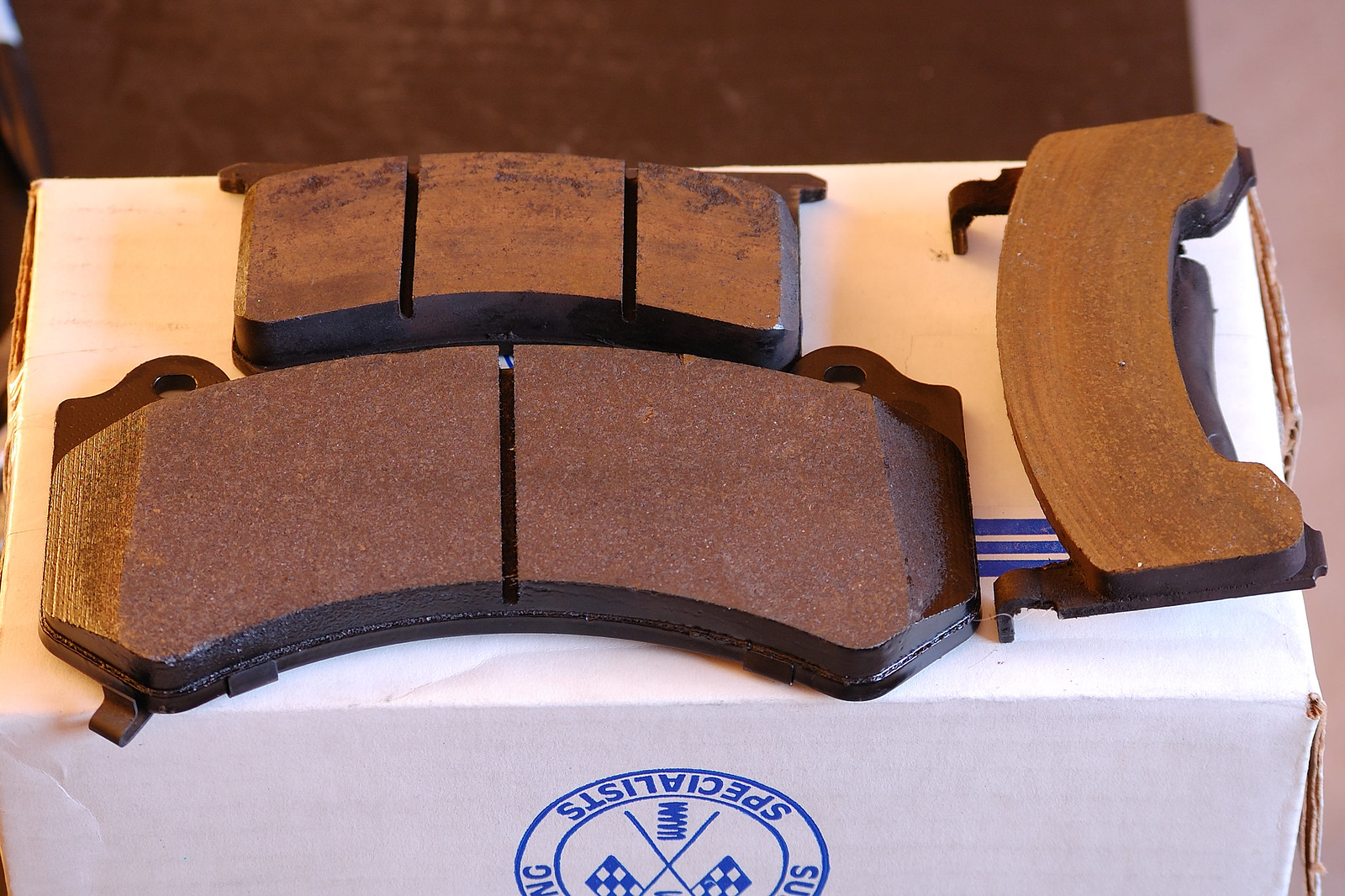
HOWEVER- you take two rotors of the same mass- lets say a 15lb 12.6" rotor solid face, and a 15lb 12.9" drilled face rotor, the drilled face rotor of the same mass will cool MUCH BETTER. It is physics. The larger rotor of the same mass has more area exposed to the atmosphere to disapate heat. Its like having two ice cubes of the same volume)a round ice cube as opposed to a long skinny one shaped more like a pencil. Sit them both on the counter and the long skinny one will melt ALOT faster it has more exposed volume to the atmosphere to beed off energy.
Modern carbon rotors are YES going back to good ol drilled rotors- why? because they vent the heat into the center vane area where it is best disapated- there is NO BETTER WAY to get ride of the heat than to route it intot he cneter vent of the rotor. The pads touch the outer side and the heat travels through to the ambient area nside the vented section where it bleeds off heat into the atmostphere. Carbon rotors can reach far beyond 1150* without cracking- so brake technology is going back to what wroks best. Larger rotors with drilled holes in them for racing use.
If you look at the bedding instructions for the ZR1, it calls for 60+ (six-zero) consecutive 5-60-5 runs. The purpose of this is to bake out the matrix material from the very surface of the rotor and pad. This will help reduce out gassing for the future. You can actually see white powder at the edge of the pad rotor interface. The carbon rotors do not wear out in the same way as iron. They do not loose thickness, instead they drop weight. When you replace pads the rotor must be weighted, and if it is under the minimum printed on the hat, it must be discarded. You are basically weighing how much matrix material has been baked out. Each rotor serial number has a specific minimum weight.
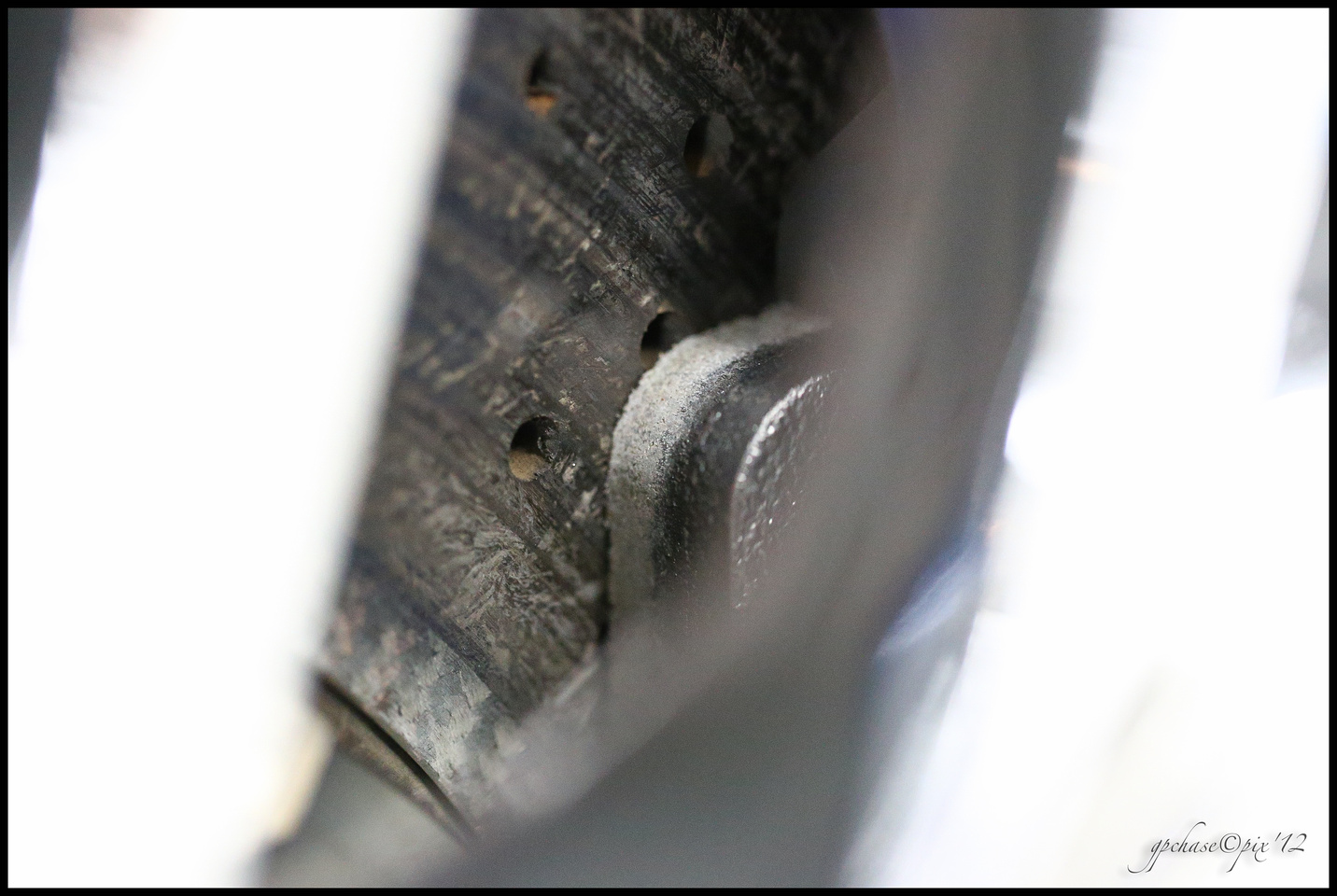
Supreme Member
iTrader: (2)
Joined: May 2002
Posts: 4,449
Likes: 8
From: Everett, WA
Car: 87' IROC
Engine: L98
Transmission: T56
Re: Suspension question
For dynamic friction in theory the pad area does not matter, the coefficient of friction and the force applied do. However a smaller pad means a smaller area for energy to transfer into the rotor and this means localized higher temperature which results in quicker pad fade. IF you have a brake system where you brake with 2 size pads in such a manner that n\neighter will result in pad fade (and the rest kept the same, so pedal force, ms size, pedal ratio, caliper & rotor size) then there should be no difference in resulting brake torque. A larger brake pad does not mean you will brake harder with less pedal (and as a result clamping) force.
Supreme Member
iTrader: (2)
Joined: May 2002
Posts: 4,449
Likes: 8
From: Everett, WA
Car: 87' IROC
Engine: L98
Transmission: T56
Re: Suspension question
As for brakes stopping only as fast as tire grip? there is not completely true either. Yes to the final pooint it IS abut tire grip, but the friction smoothness of the brakes makes a big play in how much the driver can take the manual brake system on edge without locking the tire becuas the brakes are high spoting .What do I mean? Any of you remeber riding a smaller BMX bike when you were young? When you pull the back brake lever, it the wheel had wobble to it it would lock at the spot of the circumference with the uneven wobble and the rim sidewall would develop brake pad material on it at that area. Well car brake rotors do the sdame thing over time, the do NOT warp, that feel is actually where pad material is transfered onto the rotor surface giving a uneven feel to the brakes (a sort of pusle feel to the brake pedal). Well the smaller the brakes the more suseptable the system is to this. Once this happens, the brakes are no longer smooth and the wheels will lock on one side of the rotor circumference. Now if the sytem is larger and these hotspot buldups are not as large, this is less noticible and so on. The comes a point where a ssytem is large enoguh that it is efficiantly braking with very smooth charactieristics even with high mileage. Take Pablos system new, and Pablos system used. He does a side by side comparison on the same tires and the new smooth brake setup will aloow him to stop in a shorter distance.
This really has addressed all points of topic- I would love to hear any debate?
This really has addressed all points of topic- I would love to hear any debate?

Of course the disadvantage is mainly cost and unsprung rotating inertia.
Right click - view image for a larger version

On Probation
Joined: Apr 2012
Posts: 1,435
Likes: 18
Re: Suspension question
For dynamic friction in theory the pad area does not matter, the coefficient of friction and the force applied do. However a smaller pad means a smaller area for energy to transfer into the rotor and this means localized higher temperature which results in quicker pad fade. IF you have a brake system where you brake with 2 size pads in such a manner that n\neighter will result in pad fade (and the rest kept the same, so pedal force, ms size, pedal ratio, caliper & rotor size) then there should be no difference in resulting brake torque. A larger brake pad does not mean you will brake harder with less pedal (and as a result clamping) force.
If you took a larger pad and applied the same force per square inch onto the back of it it will stop the area it is being forced upon in abrisvie friction faster. Plain and simple it has more surface area to grab. Surface area is resistance. Now if you took an object that weighed 100 lbs and moved it on 1 sq inch it would be hard to move granted, but the same 100 lbs sitting dispered across 1 sq inch would move smoother and a little easier becae it is less eight per square inches on the same friction surface...however.. you now spread that 100lb weight over 10 sq feet on surface, and the laws of physics pertaining to surface tension will make it harder to move again. There is a fine range of what is a pinpoint that bites into the surface making a blunt direct contact, or a moderated sized suport that can be pushed smoothly, or lastly a large surface support that creates drag. A larger pad area will create more smooth surface friction, too much will start to create drag. Where is the bigger pad better? Im no expert, but the trends of new performance car systems are starting to reveal this.
As for brake wheel assmebly design- I focues on the very point of what John just listed that a longer pad will disperse the heat more evenly across a rotors face- thus less likely to hotspot a rotor. I choose the Willwod SL-6 calipers for even pad pressure across the pad surface (so the pad stayed even in temp better than the 4 piston cousin) and the pad area radius from the spindle was smaller in range. SOme of the Porshce brakes where the rotor face pad contact area are braoder in radius, but shorter in length will ceate hotspots on the closer radius areas of the rotor whereas the outer portios remain fine without hotspot buiildup. A longer thinner pad is better than a wider shorter pad when its forced onto the rotor surface for eveness and longevity of smooth use as well as heat disapation.
Another point to throuw out there is brake sytems are designed for vehicle weight. What alto of people fail to think about is speed is weight- basically enertia. The more speed the more force. They put larger seytems on heavier OEN vehicle likes trucks and SUV's for weight, they put larger systems on sports cars for speed. As John has also stated, the engineers are not dumb and keep brake pad size usually in a somewhat production ratio to rotor size. Force is generally wieght of a vehicle or strength of the individuals foot, or both......with that said.... putting smaller force sytems with larger pads in proportion is ideal for that added friction when speed and control come into play- it is easier modulated and the heat stays more even.
Last edited by SlickTrackGod; Jan 31, 2013 at 12:04 PM.
On Probation
Joined: Apr 2012
Posts: 1,435
Likes: 18
Re: Suspension question
When you look at all of those options. look at the thickness of radius of each rotor face. lok at the thickness of radius coverage the Wilwood caliper hashas- it is thin and long. Most are wide and medium or wide and long. Heck, most of them do not even use part of the rotor.
Again this is what I focused on in my build. I studied systems for unsprung weight AND rotational weight Vs. power of the system. Look now at my setup. See the 12.9" SRP rotrs and the larger inner diamerter aluminum (and very lightweight) hats- this setup is the smallest weight and the thinnest rotor face radius between outer and inner circumference of the iron rotor face. It has the mass needed and the HD curved vanes- it is drilled for cooling (you talk about gas buildup, well heat is gas also)- it has a long thin pad surface for great pad to rotor heat transfer- it is fixed caliper for smooth pad use with all lightweight aluminum brackets- and it has quick change top pinned pads. The rotors where large and light rotation mass. The claiper used every bit of the rotor surface, nothing was wasted in friction surface use,so none of the mass was unused and just there for heat mass.
I will still say it is still the optimum setup for the size wheight and speed of a tird gen that would see street use as well as very moderate to heavy track use- and is lighter than OEM by 4 lbs each side.
Re: Suspension question
Now to Pablo- about your car and the point of TIRES stopping a car. You are running 315 front and 335 rear Race compound ruber on extremely wide ccw wheels that have a massive positve scrub radius--hence the word SCRUB. When you entre a corner at the AUtx and timeattack type speed tha tyou are doing with that car you pretty much do not need very much brake pedal because of the lower speeds you are going. Then when you do need to scrub off speed, you can enter a corner a little hot and just turn the wheel and those tires and wide offset will bleed off speed very quickly. Fact is you are having to burry the throttle mid corner off just to try and maintain corner speed. SO yes, your brakes are plenty for what you have been doing. Put that car on California Speedway road course and you'll burn them up in 2 laps- that Ill put a big bet on ($$$$)
I also said that heat capacity is not a concern unless you are doing road course stuff. Running california speedway qualifies as road course stuff. So I don't know why you are trying to paint a picture that I am claiming otherwise.
Regardless of all that, braking repeatedly still builds heat, and unless that heat can be expelled faster than it is being generated, things are going to keep getting hotter. Adams used to have 10 minute sessions on fridays in the dead of summer. I'd go round and round until the temp gauge was pegged. Heat in the radiator is 1/3rd of whats being burned. It got that hot because I was on the gas pedal a lot. That means I had to do a lot of slowing down too. In order to do that I had to hit the brakes a lot which equals heat. Heat with low airflow on top of hot ambient temps. No fade. Zilch. Nada. So that is why I am perfectly confident telling the original poster that for his application, stock brakes are perfectly fine. That is the only reason I am citing that example. Not for road racing or anything else. I think I made that abundantly clear so I'm not sure why you are trying to say I think they are fine for road racing. In my case I am not making any assumption either way.
Last edited by Pablo; Jan 31, 2013 at 02:11 PM.
Re: Suspension question
Pablo has also mentioned 4 channel ABS and how great that is- yes for and old lady driving in the rain- or for even a pro wanting to just stop as fast as posible in a straight line- but who hits the brakes just to stop straight? very rarely from speed unless you are in a panic situation- you generally do not stop from speed, you SLOW from speed into a fast corner entry. That 4 channel ABS which is calculating each wheelk grip is also fighting you and not letting the car rotate- yep. Not on my car. A few of you know I picked up a gig last year as an exotic car driving instructor. I also get to pilot the cars for clients that want greater experience of what the car car do. One of the cars I get to run at race speeds is an over $300K Ferrari 599 Fiorano with the massive 16" carbon brakes. This car WILL NOT rotate with the brake pedal pressed. You have to drive it completely different. You hammer the brakes striaght line and then release thenm just as you are turning. You can not use the brake pedal in that car to set the chassis atittude. I will be in it again next month and I will take footage of it with my GoPro.

As for brakes stopping only as fast as tire grip? there is not completely true either. Yes to the final pooint it IS abut tire grip, but the friction smoothness of the brakes makes a big play in how much the driver can take the manual brake system on edge without locking the tire becuas the brakes are high spoting .What do I mean? Any of you remeber riding a smaller BMX bike when you were young? When you pull the back brake lever, it the wheel had wobble to it it would lock at the spot of the circumference with the uneven wobble and the rim sidewall would develop brake pad material on it at that area. Well car brake rotors do the sdame thing over time, the do NOT warp, that feel is actually where pad material is transfered onto the rotor surface giving a uneven feel to the brakes (a sort of pusle feel to the brake pedal). Well the smaller the brakes the more suseptable the system is to this. Once this happens, the brakes are no longer smooth and the wheels will lock on one side of the rotor circumference. Now if the sytem is larger and these hotspot buldups are not as large, this is less noticible and so on. The comes a point where a ssytem is large enoguh that it is efficiantly braking with very smooth charactieristics even with high mileage. Take Pablos system new, and Pablos system used. He does a side by side comparison on the same tires and the new smooth brake setup will aloow him to stop in a shorter distance.
This really has addressed all points of topic- I would love to hear any debate?
This really has addressed all points of topic- I would love to hear any debate?
Supreme Member
iTrader: (2)
Joined: May 2002
Posts: 4,449
Likes: 8
From: Everett, WA
Car: 87' IROC
Engine: L98
Transmission: T56
Re: Suspension question
The kit I put together with the FSL caliper and C4HD rotor has all the same braking performance but with a weight penalty. I expect your kit is around 2-5lbs lighter than mine. This kit costs in the neighborhood of $1k. Likely about 1/2 the cost of yours. I argue it is the best bang for the buck brake kit out there, bar none. And it uses all premium components. That is my point.
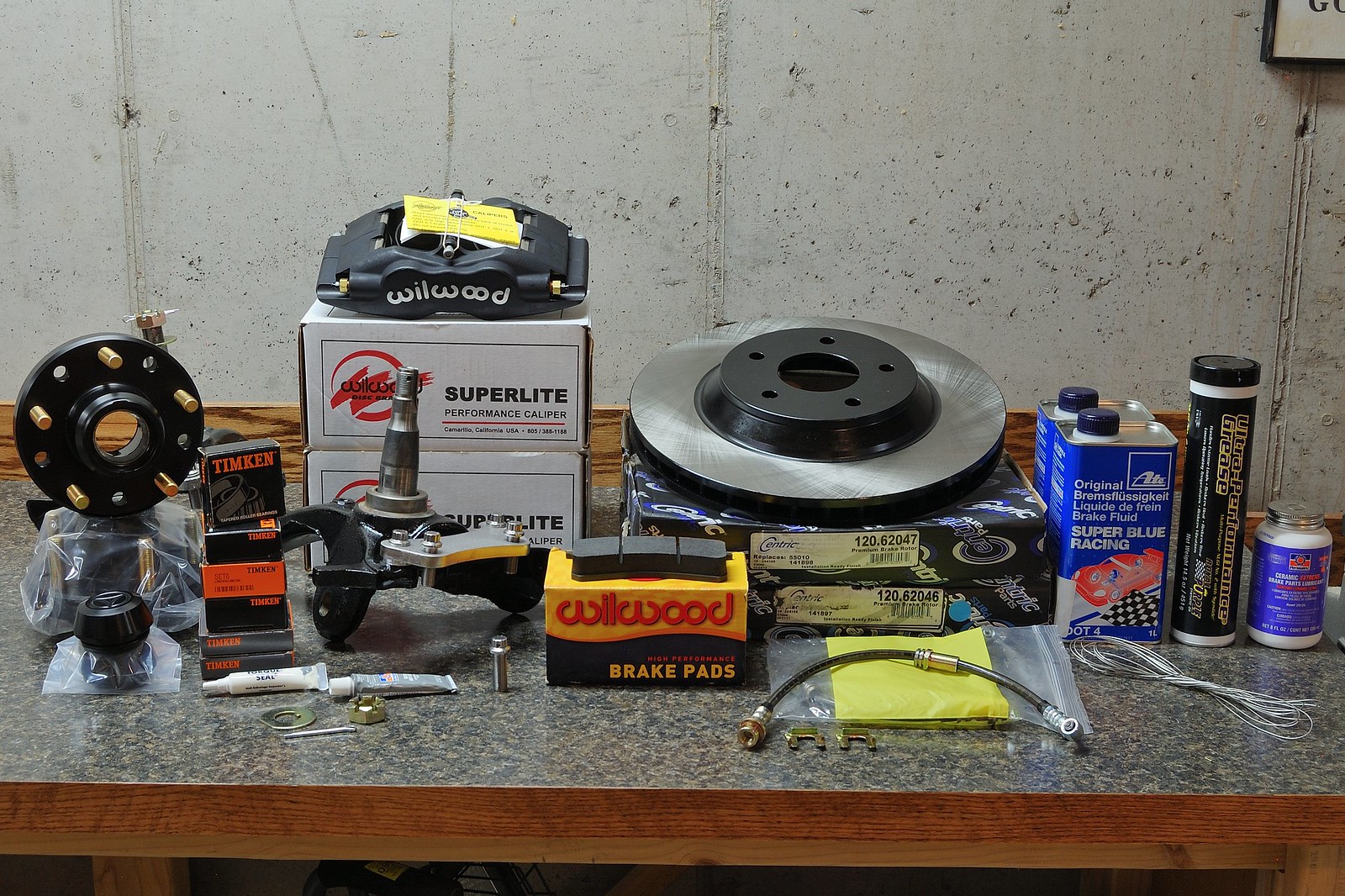
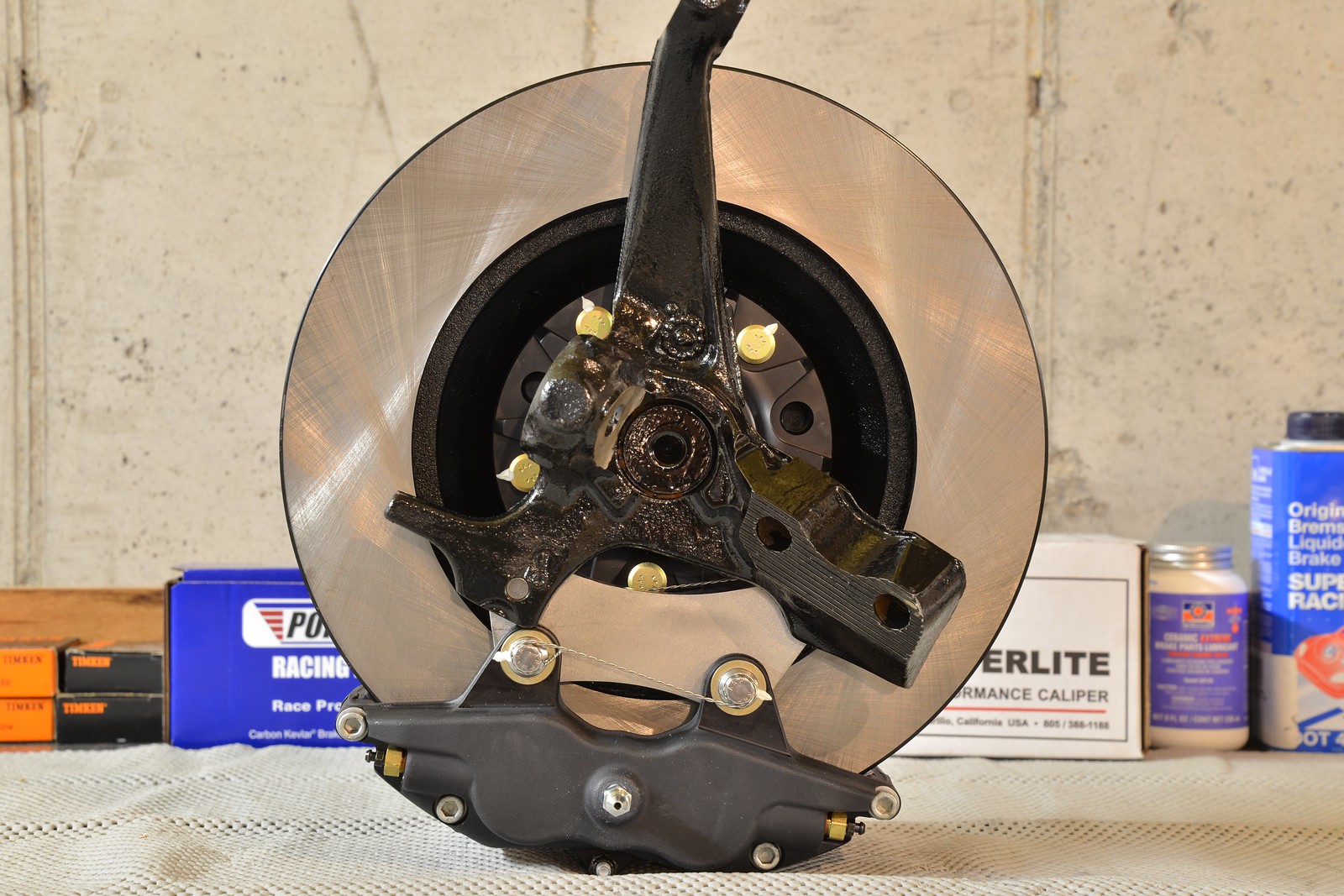
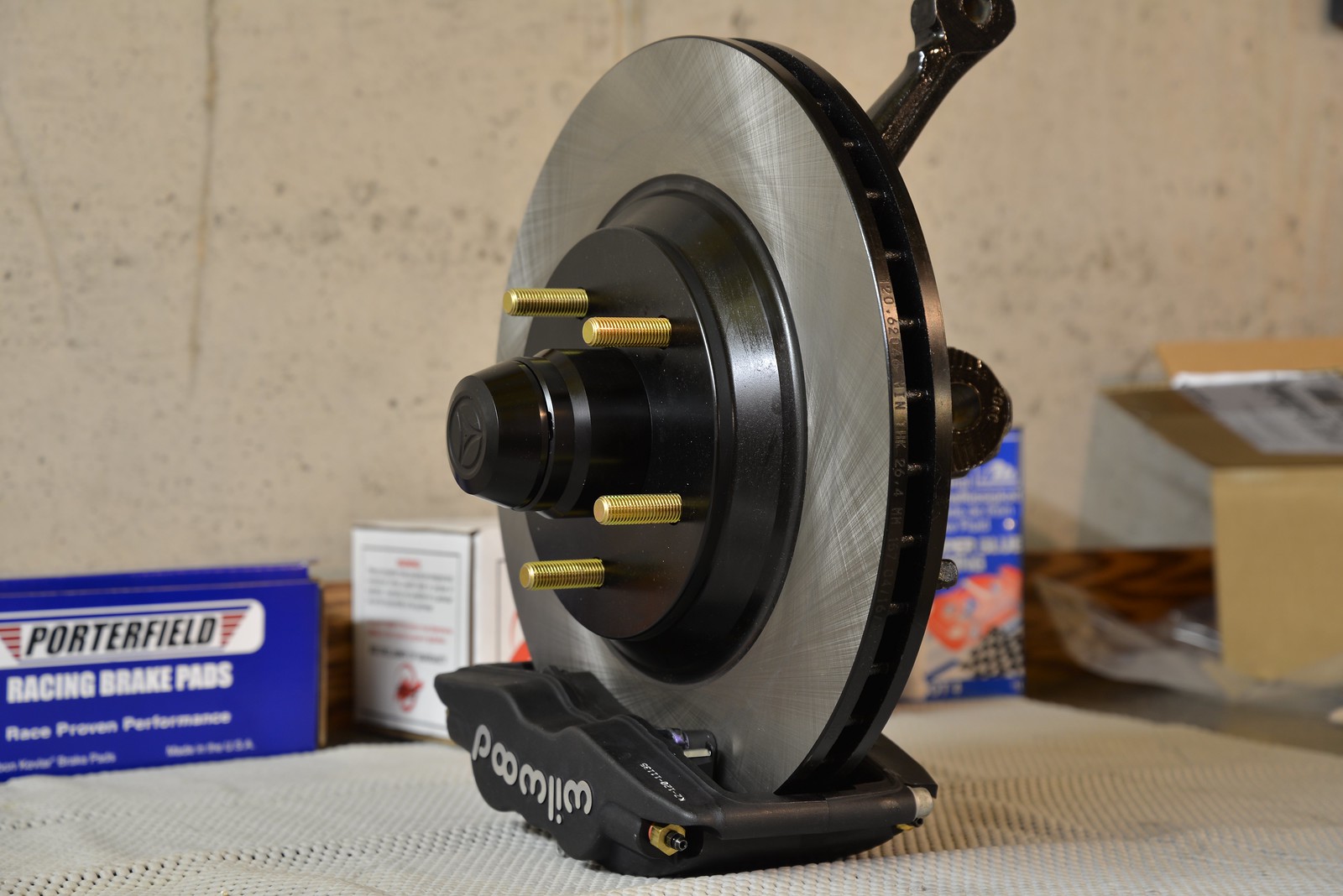
Joined: Jun 2000
Posts: 5,364
Likes: 51
From: Enschede, Netherlands
Car: 82 TA 87 IZ L98 88 IZ LB9 88 IZ L98
Engine: 5.7TBI 5,7TPI 5.0TPI, 5,7TPI
Transmission: T5, 700R4, T5, 700R4
Axle/Gears: 3.08, 3.27, 3.45, 3.27
Re: Suspension question
I see where John agreed with you on this, But I will still respectfully disagree.
If you took a larger pad and applied the same force per square inch onto the back of it it will stop the area it is being forced upon in abrisvie friction faster. Plain and simple it has more surface area to grab. Surface area is resistance. Now if you took an object that weighed 100 lbs and moved it on 1 sq inch it would be hard to move granted, but the same 100 lbs sitting dispered across 1 sq inch would move smoother and a little easier becae it is less eight per square inches on the same friction surface...however.. you now spread that 100lb weight over 10 sq feet on surface, and the laws of physics pertaining to surface tension will make it harder to move again. There is a fine range of what is a pinpoint that bites into the surface making a blunt direct contact, or a moderated sized suport that can be pushed smoothly, or lastly a large surface support that creates drag. A larger pad area will create more smooth surface friction, too much will start to create drag. Where is the bigger pad better? Im no expert, but the trends of new performance car systems are starting to reveal this.
As for brake wheel assmebly design- I focues on the very point of what John just listed that a longer pad will disperse the heat more evenly across a rotors face- thus less likely to hotspot a rotor. I choose the Willwod SL-6 calipers for even pad pressure across the pad surface (so the pad stayed even in temp better than the 4 piston cousin) and the pad area radius from the spindle was smaller in range. SOme of the Porshce brakes where the rotor face pad contact area are braoder in radius, but shorter in length will ceate hotspots on the closer radius areas of the rotor whereas the outer portios remain fine without hotspot buiildup. A longer thinner pad is better than a wider shorter pad when its forced onto the rotor surface for eveness and longevity of smooth use as well as heat disapation.
Another point to throuw out there is brake sytems are designed for vehicle weight. What alto of people fail to think about is speed is weight- basically enertia. The more speed the more force. They put larger seytems on heavier OEN vehicle likes trucks and SUV's for weight, they put larger systems on sports cars for speed. As John has also stated, the engineers are not dumb and keep brake pad size usually in a somewhat production ratio to rotor size. Force is generally wieght of a vehicle or strength of the individuals foot, or both......with that said.... putting smaller force sytems with larger pads in proportion is ideal for that added friction when speed and control come into play- it is easier modulated and the heat stays more even.
If you took a larger pad and applied the same force per square inch onto the back of it it will stop the area it is being forced upon in abrisvie friction faster. Plain and simple it has more surface area to grab. Surface area is resistance. Now if you took an object that weighed 100 lbs and moved it on 1 sq inch it would be hard to move granted, but the same 100 lbs sitting dispered across 1 sq inch would move smoother and a little easier becae it is less eight per square inches on the same friction surface...however.. you now spread that 100lb weight over 10 sq feet on surface, and the laws of physics pertaining to surface tension will make it harder to move again. There is a fine range of what is a pinpoint that bites into the surface making a blunt direct contact, or a moderated sized suport that can be pushed smoothly, or lastly a large surface support that creates drag. A larger pad area will create more smooth surface friction, too much will start to create drag. Where is the bigger pad better? Im no expert, but the trends of new performance car systems are starting to reveal this.
As for brake wheel assmebly design- I focues on the very point of what John just listed that a longer pad will disperse the heat more evenly across a rotors face- thus less likely to hotspot a rotor. I choose the Willwod SL-6 calipers for even pad pressure across the pad surface (so the pad stayed even in temp better than the 4 piston cousin) and the pad area radius from the spindle was smaller in range. SOme of the Porshce brakes where the rotor face pad contact area are braoder in radius, but shorter in length will ceate hotspots on the closer radius areas of the rotor whereas the outer portios remain fine without hotspot buiildup. A longer thinner pad is better than a wider shorter pad when its forced onto the rotor surface for eveness and longevity of smooth use as well as heat disapation.
Another point to throuw out there is brake sytems are designed for vehicle weight. What alto of people fail to think about is speed is weight- basically enertia. The more speed the more force. They put larger seytems on heavier OEN vehicle likes trucks and SUV's for weight, they put larger systems on sports cars for speed. As John has also stated, the engineers are not dumb and keep brake pad size usually in a somewhat production ratio to rotor size. Force is generally wieght of a vehicle or strength of the individuals foot, or both......with that said.... putting smaller force sytems with larger pads in proportion is ideal for that added friction when speed and control come into play- it is easier modulated and the heat stays more even.
Surface area is not a factor in any friction, static or dynamic or kinetic. Ever notice how when for instance you want to shove a book shelf it becomes easier to move when you get it to slide? You overcome static friction and go dynamic. Same reasons for the moaning sounds witha lot of automatics and the brake held on lightly. Still, both are completely independent of contact surface area. This does not take into account surface deflection where one is digging into or deforming the other and for brakes this does not apply so can be left out. The friction is only related to surface roughness and molecular adhesion, not deformation. No one is running pin point brake discs that would dig into the rotor.
On Probation
Joined: Apr 2012
Posts: 1,435
Likes: 18
Re: Suspension question
Surface area is not a factor in any friction, static or dynamic or kinetic. Ever notice how when for instance you want to shove a book shelf it becomes easier to move when you get it to slide? You overcome static friction and go dynamic. Same reasons for the moaning sounds witha lot of automatics and the brake held on lightly. Still, both are completely independent of contact surface area. This does not take into account surface deflection where one is digging into or deforming the other and for brakes this does not apply so can be left out. The friction is only related to surface roughness and molecular adhesion, not deformation. No one is running pin point brake discs that would dig into the rotor.
Speaking of opinions (nice segway)...Pablo buddy, How are things overseas? When did I ever make predictions about your car- You would have to refresh my memoriy becasue that never happened. What I do know is you and I ran on a small go-kart track raod course with both your race car and my 5000 lb Vetruck. I was on street tires with a blown brake booster that happened in the 3 hours of stop and go traffic i hit driving out there that day (hence my new hydaboost setup I have in her now) and you were a stripped down 3rd gen with a cage and 11-12 " racing rubber on all four corners. You were running 4 seconds a lap faster than I and I was on street tires with very mechanical brakes on a 2000lb heavier vehcile, yet ai could still get around the track fine without much brakes- and your tires will hold a faster corner grip as well as corner entry to scrub off speed then what my taller longer and heavier vehicle will do.
On Probation
Joined: Apr 2012
Posts: 1,435
Likes: 18
Re: Suspension question
Yes that is a very nice kit. It is also fairly costly with the radial mount SL6 and the 2pc rotors. If I was building a track only vehicle where weight was paramount and price was not critical it would likely look like pretty similar. That is a right sized brake kit from a performance point a view for the vast majority of third gens.
The kit I put together with the FSL caliper and C4HD rotor has all the same braking performance but with a weight penalty. I expect your kit is around 2-5lbs lighter than mine. This kit costs in the neighborhood of $1k. Likely about 1/2 the cost of yours. I argue it is the best bang for the buck brake kit out there, bar none. And it uses all premium components. That is my point.
The kit I put together with the FSL caliper and C4HD rotor has all the same braking performance but with a weight penalty. I expect your kit is around 2-5lbs lighter than mine. This kit costs in the neighborhood of $1k. Likely about 1/2 the cost of yours. I argue it is the best bang for the buck brake kit out there, bar none. And it uses all premium components. That is my point.
Re: Suspension question
Speaking of opinions (nice segway)...Pablo buddy, How are things overseas? When did I ever make predictions about your car- You would have to refresh my memoriy becasue that never happened. What I do know is you and I ran on a small go-kart track raod course with both your race car and my 5000 lb Vetruck. I was on street tires with a blown brake booster that happened in the 3 hours of stop and go traffic i hit driving out there that day (hence my new hydaboost setup I have in her now) and you were a stripped down 3rd gen with a cage and 11-12 " racing rubber on all four corners. You were running 4 seconds a lap faster than I and I was on street tires with very mechanical brakes on a 2000lb heavier vehcile, yet ai could still get around the track fine without much brakes- and your tires will hold a faster corner grip as well as corner entry to scrub off speed then what my taller longer and heavier vehicle will do.
About the truck, I think it was more like 5 seconds (45.3 to a 50.xx?) but who's counting. Very impressive truck. Definitely a feat to get that behemoth running similar times to something like a stock honda civic. That makes that Chevy C10 that runs in the 47s on street tires super impressive doesn't it? Google "Hickman C10" if you want to check that thing out.
And yes, I clearly have some room to improve, Mary Pozzi went back and beat my lap time. So I am fastest F body no more
 . Actually another car (first gen) also ran faster.
  Oh well, there goes my 15 minutes.
About the brakes, you are right, they are more than adequate even for me beating on the thing at adams. So yeah, if someone was just drag racing and cruising, stock brakes are more than enough.
On Probation
Joined: Apr 2012
Posts: 1,435
Likes: 18
Re: Suspension question
I just watched a short video of Hickamn and a 2nd gen running Adams and the chicane is very wide and fast on the back straight- he is going through there with a little tap on the brakes where we were having to almost stop to get through it. Look at my video and I am not going through it at more than about 15mph after doing about 60 on that back striaght. He never slows to less than about 40 (there's a second easy). He's also a short wheelbase purpose built road race truck that can not haul anything in the bed- heck I could carry him down the road seriously- and I had a bad brake booster hence why my truck sat most of that day remeber? and I ran 50.26.
That Hickman truck also has an Erod LS3 in it and as stated heas a short wheelbase.
Id love to find him on an AUtox track with my 5000lb "truck" against his 3500 wantabee sprots car that can't carry anything. Those corners at Adams are TIGHT, especially for a longbed truck with leaf springs and a Detroit locker....lol- Id run him for money on a little looser course
That Hickman truck also has an Erod LS3 in it and as stated heas a short wheelbase.
Id love to find him on an AUtox track with my 5000lb "truck" against his 3500 wantabee sprots car that can't carry anything. Those corners at Adams are TIGHT, especially for a longbed truck with leaf springs and a Detroit locker....lol- Id run him for money on a little looser course
On Probation
Joined: Apr 2012
Posts: 1,435
Likes: 18
Re: Suspension question
His runs- watch in particular the back straight where he never has to slow for the tire chicane (ie- what tire chicane?)- these guys fudge the track so it had faster times.
Then watch one of my runs on the back striaght. I practically have to come to a stop to get through the barrier that was there when we ran.
Don;t buy into the hype of laptimes at Adams TIme Attack. Every time I see someone claim a record they have fudged the track.
ps- I've also had bad luck at Adams both times I ran. This was the first event where I broke the steering box wormgear and the car would not make that tight left hairpin without the steering wheel locking on me. The second one I borke the brake booster on the way out there. Cracks me up watching that video- I let young Nick drive it the second time(Note my red helmet in the passenger seat) and the little sh*t took it off road with a little too much throttle in the front chicane. I am still having to tell people that was not me.
Here's when she's running good-
http://public.fotki.com/makofoto/201.../mvi-0195.html
Then watch one of my runs on the back striaght. I practically have to come to a stop to get through the barrier that was there when we ran.
Don;t buy into the hype of laptimes at Adams TIme Attack. Every time I see someone claim a record they have fudged the track.
ps- I've also had bad luck at Adams both times I ran. This was the first event where I broke the steering box wormgear and the car would not make that tight left hairpin without the steering wheel locking on me. The second one I borke the brake booster on the way out there. Cracks me up watching that video- I let young Nick drive it the second time(Note my red helmet in the passenger seat) and the little sh*t took it off road with a little too much throttle in the front chicane. I am still having to tell people that was not me.
Here's when she's running good-
http://public.fotki.com/makofoto/201.../mvi-0195.html
Last edited by SlickTrackGod; Feb 1, 2013 at 12:52 PM.