


GETTING CODE 25, what do i do?


Thread Starter
Member
Joined: Feb 2003
Posts: 164
Likes: 0
GETTING CODE 25, what do i do?
A week ago i was getting code 25, and 34. I replaced the MAF and they both went off, a day later while driving on highway the check engine light came on, then went off when i stopped at a stop light. then came back on once going at higher speeds. I checked the code and it read 25. What does it mean? what can i do to fix it?
Last edited by skahide; Mar 26, 2003 at 08:16 PM.

Junior Member
Joined: Mar 2003
Posts: 69
Likes: 0
From: arizona
Check all your sensor terminals make sure that they are all tight and my book says that a code 25 is aMAT sensor defective ,sensorout of range(probably high) or circuit shorted now i have no friggin idea what a MAT sensor is i am new to this dang CCC or fuel inj. stuff and jsut trying to help later

Junior Member
Joined: Mar 2003
Posts: 69
Likes: 0
From: Hollywood, FL
MAT is Manifold Absolute Temperature.
On TPI engines, I believe it's on the bottom of the plenum towards the back, around or behind the EGR. I'm not quite sure though, someone will let you know for sure.
Check the connector to it, and trace the wiring a little bit to make sure it's in good condition.
On TPI engines, I believe it's on the bottom of the plenum towards the back, around or behind the EGR. I'm not quite sure though, someone will let you know for sure.
Check the connector to it, and trace the wiring a little bit to make sure it's in good condition.

Moderator


Joined: Jan 2000
Posts: 19,691
Likes: 319
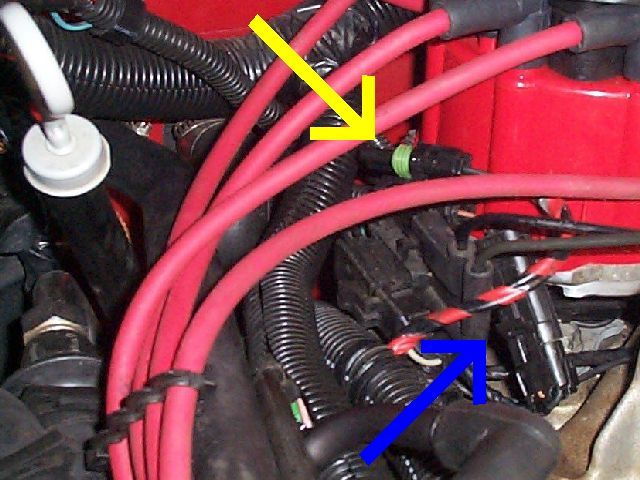
A '25' is for a MAT sensor high temperature (low resistance) fault. That most likely means the sensor or wiring is shorted. While the sensor itself is inconveniently located on the underside of the plenum, you can break into the wiring harness without removing the plenum. GM planned ahead, and installed an electrical connector near the distributor for this purpose. Look through the tangle of wires near the distributor and locate the 2-wire connector that has a dark green and a black wire in it. This is for the MAT harness (the yellow arrow):
Disconnect that connector and measure the resistance of the sensor (on the leads that route to the underside of the plenum). The resistance should be close to the readings in this chart at a known plenum temperature:
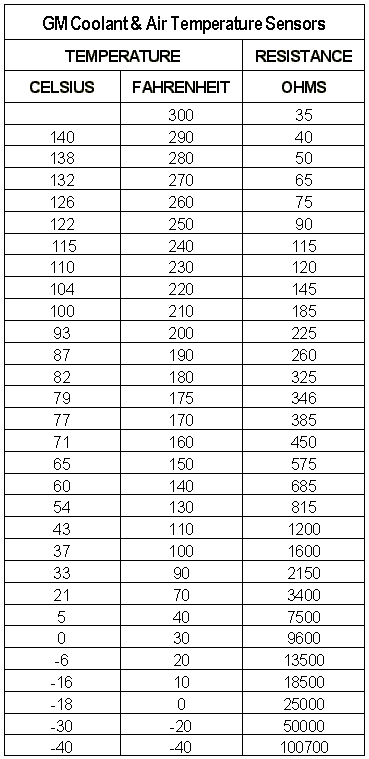
If the resistance checks good (greater than 0 ohms) the sensor wiring harness may be shorted somewhere else. Test the resistance of the harness on the other side of the connector, but ONLY use a high impedance, low current ohmmeter. You should read somewhere in the range 1,200+ ohms.
If the sensor resistance is 0 ohms or close to it, the sensor has shorted and you'll need to replace it. As an alternative, you might consider this fix:
MAT Sensor Relocation.pdf
Disconnect that connector and measure the resistance of the sensor (on the leads that route to the underside of the plenum). The resistance should be close to the readings in this chart at a known plenum temperature:
If the resistance checks good (greater than 0 ohms) the sensor wiring harness may be shorted somewhere else. Test the resistance of the harness on the other side of the connector, but ONLY use a high impedance, low current ohmmeter. You should read somewhere in the range 1,200+ ohms.
If the sensor resistance is 0 ohms or close to it, the sensor has shorted and you'll need to replace it. As an alternative, you might consider this fix:
MAT Sensor Relocation.pdf
Last edited by Vader; Mar 31, 2018 at 09:58 PM. Reason: Updated links

Thread
Thread Starter
Forum
Replies
Last Post