


What temperature should my car be at with a 160* stat?


Thread Starter
Junior Member
Joined: Sep 2000
Posts: 97
Likes: 0
From: San Jose, CA, USA
What temperature should my car be at with a 160* stat?
I just put in a 350 and replaced the air dam, got a 160* stat, and replaced all the hoses. Also, I modded the fan so that it is on always. Should my car stay at 160*? At highway speed it reaches a little over 220*.
What could it be?
Thanks
Gary Mann
What could it be?
Thanks
Gary Mann


Moderator


Joined: Jul 1999
Posts: 17,274
Likes: 171
From: 51°N 114°W, 3500'
Car: 87 IROC L98
Engine: 588 Alcohol BBC
Transmission: Powerglide
Axle/Gears: Ford 9"/31 spline spool/4.86
The thermostat is only part of the complete cooling system. It's purpose is to remain closed when the engine temp is below the thermostats setting. Once that temperature is reached the thermostat opens. If the temperature continues to increase the thermostat can't open any further than it already is. It's then up to the rest of the cooling system to remove the heat from the engine.
The engine fan is designed to pull air through the rad at speeds below 30 mph. Above those speeds the forced air is greater than what the fan can pull. Leaving it on all the time does nothing at highway speeds except put a load on the alternator.
If your car is still overheating then here is all you can check.
Make sure the thermostat is actually opening at the rated temperature.
Make sure the fan is "pulling" air from the rad.
Check for air flow to the rad. 3rd gens have little to no direct flow from the front of the vehicle and must rely on funneled air to the rad.
Make sure the rad isn't plugged with dirt, leaves, bugs, etc. Check to make sure the rad core itself isn't plugged. Lower the coolent level and look in the rad cap opening. If there's a big buildup on the cooling tubes then coolent is restricted flowing through the rad. It'll need to be flushed out.
Lastly, is the rad big enough for the engine. Pulling out a 4 or 6 cylinder engine and dropping in a performance V8 will need a bigger cooling system. a 1 or 2 core rad won't handle the extra heat produced by a bigger engine. You may need a 3 or 4 core rad or an aluminum rad to help disipate the extra heat.
------------------
Stephen's racing page
87 IROC-Z Pro ET Bracket Race Car and knocking on the SuperPro ET class
383 stroker (carbed) with double hump cast iron heads and pump gas
LS6 Big Block buildup now in progress
Best results before the engine blew up
Best ET on a time slip: 11.857
Best corrected ET: 11.163
Best MPH on a time slip: 117.87
Best corrected MPH: 126.10
Best 60 foot: 1.662
Racing at 3500 feet elevation but most race days it's over 5000 feet density altitude!
Member of the Calgary Drag Racing Association
[This message has been edited by Stephen 87 IROC (edited September 30, 2000).]
The engine fan is designed to pull air through the rad at speeds below 30 mph. Above those speeds the forced air is greater than what the fan can pull. Leaving it on all the time does nothing at highway speeds except put a load on the alternator.
If your car is still overheating then here is all you can check.
Make sure the thermostat is actually opening at the rated temperature.
Make sure the fan is "pulling" air from the rad.
Check for air flow to the rad. 3rd gens have little to no direct flow from the front of the vehicle and must rely on funneled air to the rad.
Make sure the rad isn't plugged with dirt, leaves, bugs, etc. Check to make sure the rad core itself isn't plugged. Lower the coolent level and look in the rad cap opening. If there's a big buildup on the cooling tubes then coolent is restricted flowing through the rad. It'll need to be flushed out.
Lastly, is the rad big enough for the engine. Pulling out a 4 or 6 cylinder engine and dropping in a performance V8 will need a bigger cooling system. a 1 or 2 core rad won't handle the extra heat produced by a bigger engine. You may need a 3 or 4 core rad or an aluminum rad to help disipate the extra heat.
------------------
Stephen's racing page
87 IROC-Z Pro ET Bracket Race Car and knocking on the SuperPro ET class
383 stroker (carbed) with double hump cast iron heads and pump gas
LS6 Big Block buildup now in progress
Best results before the engine blew up
Best ET on a time slip: 11.857
Best corrected ET: 11.163
Best MPH on a time slip: 117.87
Best corrected MPH: 126.10
Best 60 foot: 1.662
Racing at 3500 feet elevation but most race days it's over 5000 feet density altitude!
Member of the Calgary Drag Racing Association
[This message has been edited by Stephen 87 IROC (edited September 30, 2000).]

Moderator


Joined: Jan 2000
Posts: 19,680
Likes: 316
JS,
A thermostat temperature rating is the temperature at which the thermostat begins to open. It won't be fully open until the temperature is 12-15°F above the rated temperature. When I live, a partially open thermostat in winter can provide more than enough flow to cool the engine. Where you live, the stat probably opens fully most of the time. Assuming adequate coolant flow and air flow, your coolant should remain at or below 175-180°F under most circumstances.
Heating at highway speeds is often a symptom of poor air flow through the radiator. Stephen covered it pretty well. As he stated, having the fan on at anything above 30-40 MPH is useless. That's why the factory PROM programming kills the fan at or above 40 MPH.
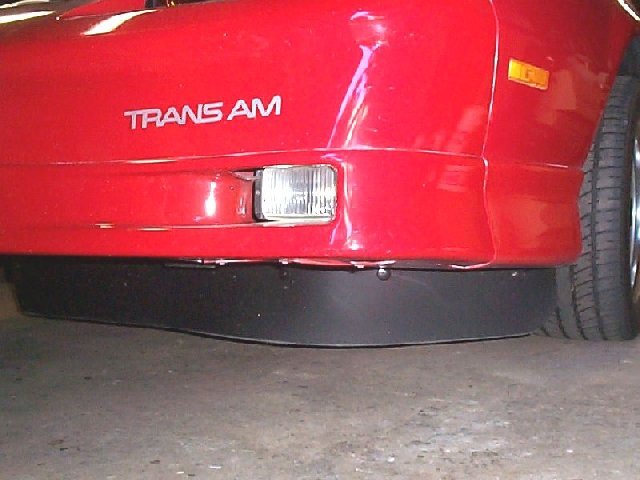
There are several baffles and deflectors mounted to the lower radiator support and around the radiator support shell to direct ram air through the radiator. Operating with any of the parts damaged or missing will hamper cooling efficiency. The most important piece is the lower air dam:
------------------
Later,
Vader
------------------
"Make Me Bad"
Adobe Acrobat Reader 4.0
A thermostat temperature rating is the temperature at which the thermostat begins to open. It won't be fully open until the temperature is 12-15°F above the rated temperature. When I live, a partially open thermostat in winter can provide more than enough flow to cool the engine. Where you live, the stat probably opens fully most of the time. Assuming adequate coolant flow and air flow, your coolant should remain at or below 175-180°F under most circumstances.
Heating at highway speeds is often a symptom of poor air flow through the radiator. Stephen covered it pretty well. As he stated, having the fan on at anything above 30-40 MPH is useless. That's why the factory PROM programming kills the fan at or above 40 MPH.
There are several baffles and deflectors mounted to the lower radiator support and around the radiator support shell to direct ram air through the radiator. Operating with any of the parts damaged or missing will hamper cooling efficiency. The most important piece is the lower air dam:
------------------
Later,
Vader
------------------
"Make Me Bad"
Adobe Acrobat Reader 4.0
Last edited by Vader; Mar 31, 2018 at 06:11 PM. Reason: Updated links

Thread
Thread Starter
Forum
Replies
Last Post
Linson
Auto Detailing and Appearance
40
Aug 21, 2015 02:12 PM
