


MSD distributor ignition advance charts inaccurate???!!


Thread Starter
Senior Member

Joined: Apr 2001
Posts: 818
Likes: 1
From: Hudson, FL USA
Car: 1988 Camaro(92 Z28 clone)
Engine: Forged 383, AFR 195 419/430@wheels
Transmission: Monster 700R4 Yank 3600 stall
Axle/Gears: 9in Detroit locker-3.90's,35 spline
MSD distributor ignition advance charts inaccurate???!!
Needless to say I am still battling this beast. Trying to get this thing to run ok at light cruise is practially killing me. Anyway, I checked my timing again today and came up with some interseting results. I used a dial back Snap on timing light. It works as a regular timing light, just point it towards the balancer and read the number. But this one also has an advance feature. It delays the flash to read at 0 on the balancer. For example, let's say that you want 36 degrees at 3000 RPM. With the engine at speed you'd let the light flash normally and it would say 36 at the pointer. Now with the advance function, you press the adv button on the timing light to 36 so when the light flashes, it should read 0 on the balancer. It is a way to check to see if the timing pointer is set in the correct location.
Ok now backto my findings. Take a look at this chart....
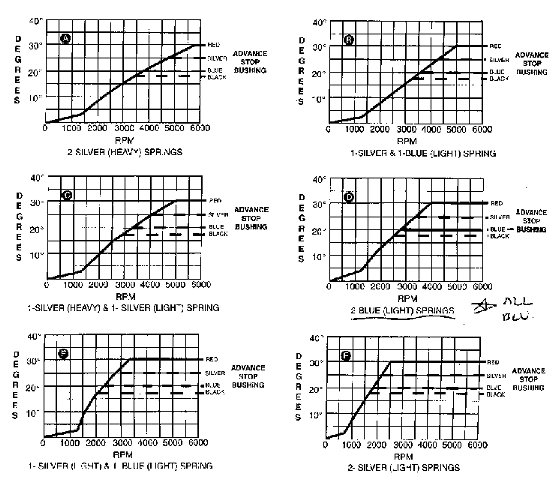
In my distributor Ihave the Heavy silver and Light silver springs with a black bushing. It is advance chart C. WIth the engine at operating temperature and idle speed of 850-900 RPM, I have a total of 13 degrees of advance. I took some notes as I revved the engine up slowly and here are the major points....
1000 RPM-14 degrees
1300 RPM-20 degrees
1500 RPM-22 degrees
2000 RPM-26 degrees
2500 RPM-32 degrees
3000 RPM-32 degrees
3000+ RPM-32 degrees(centrifugal advance limit)
Here is the problem that I have. If you look at advance chart C again, you will see that at my 900 RPM idle I have about 2 degrees of centrifugal advance acting on the timing. This makes my base initial timing(unafected by centrifugal) 11 degrees. Now, according to the chart C I should have 5 degrees of advance at 1500 RPM. Add this to my 11 degree true base timing and you get a total timing number of 16 degrees. So why is it that it reality on the car the total timing at 1500 RPM is at 22 degrees, 6 degrees MORE than waht it should be at??? Look at 2500 RPM. On chart C there should be 15 degrees of advance plus my 11 degrees of true base timing for a total of 26 but on the car I really have 32 degrees. And the second thing is the advance limit. I am hitting the advance limit at 2500 RPM which is about 500 RPM sooner than it should be. Has anyone else noticed these inconsistencies? It is making it a real pain to tune this thing because none of the numbers are where they should be. Anyone have any thoughs or suggestions on this. If so, I'd like to hear 'em. Thanks.
Ok now backto my findings. Take a look at this chart....
In my distributor Ihave the Heavy silver and Light silver springs with a black bushing. It is advance chart C. WIth the engine at operating temperature and idle speed of 850-900 RPM, I have a total of 13 degrees of advance. I took some notes as I revved the engine up slowly and here are the major points....
1000 RPM-14 degrees
1300 RPM-20 degrees
1500 RPM-22 degrees
2000 RPM-26 degrees
2500 RPM-32 degrees
3000 RPM-32 degrees
3000+ RPM-32 degrees(centrifugal advance limit)
Here is the problem that I have. If you look at advance chart C again, you will see that at my 900 RPM idle I have about 2 degrees of centrifugal advance acting on the timing. This makes my base initial timing(unafected by centrifugal) 11 degrees. Now, according to the chart C I should have 5 degrees of advance at 1500 RPM. Add this to my 11 degree true base timing and you get a total timing number of 16 degrees. So why is it that it reality on the car the total timing at 1500 RPM is at 22 degrees, 6 degrees MORE than waht it should be at??? Look at 2500 RPM. On chart C there should be 15 degrees of advance plus my 11 degrees of true base timing for a total of 26 but on the car I really have 32 degrees. And the second thing is the advance limit. I am hitting the advance limit at 2500 RPM which is about 500 RPM sooner than it should be. Has anyone else noticed these inconsistencies? It is making it a real pain to tune this thing because none of the numbers are where they should be. Anyone have any thoughs or suggestions on this. If so, I'd like to hear 'em. Thanks.

Supreme Member
Joined: Sep 1999
Posts: 7,072
Likes: 13
From: Philly, PA
Can't say I've run into that- those charts have proven reasonably close to reality for me. The "heavy" silver spring in an MSD is REALLY REALLY heavy. To have that much advance kicking in so soon using even one of them in conjunction with any other spring seems very strange. You might want to put in both heavy silver springs just to see what you get.
I also wouldn't assume your "true base" timing is 11* going by the chart, if other things from the chart aren't lining up with reality. Centrifugal advance mechanisms don't have such fine adjustability down there on the low end of the RPM range. Usually it's 0, 0, 0, 0, and then it starts kicking in quickly beyond a certain RPM threshold like 900, 1000, 1100 or whatever. That's just the nature of the mechanism that does the advancing.
I also wouldn't assume your "true base" timing is 11* going by the chart, if other things from the chart aren't lining up with reality. Centrifugal advance mechanisms don't have such fine adjustability down there on the low end of the RPM range. Usually it's 0, 0, 0, 0, and then it starts kicking in quickly beyond a certain RPM threshold like 900, 1000, 1100 or whatever. That's just the nature of the mechanism that does the advancing.
Last edited by Damon; Jan 5, 2007 at 06:54 AM.
Thread Starter
Senior Member
Joined: Apr 2001
Posts: 818
Likes: 1
From: Hudson, FL USA
Car: 1988 Camaro(92 Z28 clone)
Engine: Forged 383, AFR 195 419/430@wheels
Transmission: Monster 700R4 Yank 3600 stall
Axle/Gears: 9in Detroit locker-3.90's,35 spline
Thanks for the response. I just got off of the phone with MSD technical assistance and they told me that the charts are not an approximation, but just a general guidline of what the springs should allow the advance to be at any given rpm. So looke like it is back to the drawing board....

Supreme Member
iTrader: (1)
Joined: Jul 2004
Posts: 10,763
Likes: 4
From: Calgary, AB, Canada
Car: 1982 Trans-Am
Engine: 355 w/ ported 416s
Transmission: T10, hurst shifter
Axle/Gears: 10 bolt, true-trac, 3.73
yea, I was going to say, throw out their sheet - only trust what your timing light tells you (if you trust that light).
What MSD cooks up in their lab is going to be less trust worthy than what you see with your eyes.
Back to the point, you timing curve sounds like a good one. Full timing at 2300RPM eh? What's cruise RPM in the car ? I'd want the mechanical timing full by cruise RPM.
I'd leave the vacuum advance disconnected and plugged, if you have vacuum advance. At least until you have the car running perfectly. It's just one more factor.
So you still have a surge at cruise right? You basically know that's going to be from either timing, or being lean eh?
Have you checked all around for vacuum leaks? I forget what your plugs showed, but if some were leaner than others (say one side of motor), than that side may have a vac leak, such as intake manifold surface.
You're pretty sure you're on the rich side from your carb jetting...hmm...
Do you have a vacuum gauge in the car? If not, maybe rig one up, I dangled mine from my mirror. If you have a DEAD SMOOTH vacuum level at your cruise, while its surging, that's one thing, if your vacuum level dances, then that at least gives you a lead.
What MSD cooks up in their lab is going to be less trust worthy than what you see with your eyes.
Back to the point, you timing curve sounds like a good one. Full timing at 2300RPM eh? What's cruise RPM in the car ? I'd want the mechanical timing full by cruise RPM.
I'd leave the vacuum advance disconnected and plugged, if you have vacuum advance. At least until you have the car running perfectly. It's just one more factor.
So you still have a surge at cruise right? You basically know that's going to be from either timing, or being lean eh?
Have you checked all around for vacuum leaks? I forget what your plugs showed, but if some were leaner than others (say one side of motor), than that side may have a vac leak, such as intake manifold surface.
You're pretty sure you're on the rich side from your carb jetting...hmm...
Do you have a vacuum gauge in the car? If not, maybe rig one up, I dangled mine from my mirror. If you have a DEAD SMOOTH vacuum level at your cruise, while its surging, that's one thing, if your vacuum level dances, then that at least gives you a lead.
Thread Starter
Senior Member
Joined: Apr 2001
Posts: 818
Likes: 1
From: Hudson, FL USA
Car: 1988 Camaro(92 Z28 clone)
Engine: Forged 383, AFR 195 419/430@wheels
Transmission: Monster 700R4 Yank 3600 stall
Axle/Gears: 9in Detroit locker-3.90's,35 spline
Sonix: Seems like you always manage to post in my threads!!! At least I know someone cares, and this is good!!! But I must say that your advice has always been helpful, it is the car's lack of not fixing itself that seems to be the problem Now to anwer your questions....
Full advance is 32 degrees all in at 2500 RPM...
Cruise RPM in the car is anywhere from 1500 to 2000 RPM depending on what speed I'm at and in what gear. For example, in 4th gear at 2000 RPM I'm at about 45 MPH. In 5th gear at 2000 RPM I'm at 55-60 MPH. If I can keep the engine at 2000 RPM, it's happy for the most part. When the RPMs drop down to 1900 or below is when the problems start.
Vacuum advance has been disconnected and plugged and all of my timng and fuel adjustments were made without it.
Yes I still ahve the surge at light cruise. I have come to the conclusion (by playing with both the timing and fuel) that it is not either of them causing the surge. As stated before if it was due to too much timing, I've taken it out. If it was from running lean, I have the carb at the richest calibration possible. Now I am directing my atttention to either a slight miss(very unlikely but will check for it) or the fact that my edelbrock carb doesn't like the particular throttle angle that it is in at light cruise when the surge happens.
As far as I can tell by looking at the plugs at my new richest calibration, none of them were lean at all. All the electrodes were a dark gray color. I widened the plug gap to .050 just to see if anything chages and nothing did.
Yes I do have a permanant vacuum gauge in the car. It reads a rock solid 10 in Hg. at idle when fully warmed up. At cruise it will read anywhere from 15-20 in Hg also depending on what RPM I'm at and the load level in that gear. When the engine is surging, the vacuum needle does not move in conjunction with it so I son't think that vacuum is the issue either.
On a side note I was having as issue with running out of fuel pressure at WOT. As the RPMs climbed the pressure would drop to 2 PSI and the engine would fall flat on its face. Come to find out that I still had the factory 2.8L MPFI V6 gas cap on the car that is NON VENTED!!! The fuel pump was trying to implode my fuel tank it was sucking so hard. Removing the gas cap proved to be a wonderful thing!!! Now at WOT I still drop down to about 3 PSI, but now I have volume.
Now to anwer your questions....Full advance is 32 degrees all in at 2500 RPM...
Cruise RPM in the car is anywhere from 1500 to 2000 RPM depending on what speed I'm at and in what gear. For example, in 4th gear at 2000 RPM I'm at about 45 MPH. In 5th gear at 2000 RPM I'm at 55-60 MPH. If I can keep the engine at 2000 RPM, it's happy for the most part. When the RPMs drop down to 1900 or below is when the problems start.
Vacuum advance has been disconnected and plugged and all of my timng and fuel adjustments were made without it.
Yes I still ahve the surge at light cruise. I have come to the conclusion (by playing with both the timing and fuel) that it is not either of them causing the surge. As stated before if it was due to too much timing, I've taken it out. If it was from running lean, I have the carb at the richest calibration possible. Now I am directing my atttention to either a slight miss(very unlikely but will check for it) or the fact that my edelbrock carb doesn't like the particular throttle angle that it is in at light cruise when the surge happens.
As far as I can tell by looking at the plugs at my new richest calibration, none of them were lean at all. All the electrodes were a dark gray color. I widened the plug gap to .050 just to see if anything chages and nothing did.
Yes I do have a permanant vacuum gauge in the car. It reads a rock solid 10 in Hg. at idle when fully warmed up. At cruise it will read anywhere from 15-20 in Hg also depending on what RPM I'm at and the load level in that gear. When the engine is surging, the vacuum needle does not move in conjunction with it so I son't think that vacuum is the issue either.
On a side note I was having as issue with running out of fuel pressure at WOT. As the RPMs climbed the pressure would drop to 2 PSI and the engine would fall flat on its face. Come to find out that I still had the factory 2.8L MPFI V6 gas cap on the car that is NON VENTED!!! The fuel pump was trying to implode my fuel tank it was sucking so hard. Removing the gas cap proved to be a wonderful thing!!! Now at WOT I still drop down to about 3 PSI, but now I have volume.
Supreme Member
iTrader: (1)
Joined: Jul 2004
Posts: 10,763
Likes: 4
From: Calgary, AB, Canada
Car: 1982 Trans-Am
Engine: 355 w/ ported 416s
Transmission: T10, hurst shifter
Axle/Gears: 10 bolt, true-trac, 3.73
Yes, i'm hunting you.... 
So when you're cruising your advance will be dancing around a little bit I think. I know if your idle is into when your advance kicks in, it'll hunt for an idle speed, perhaps the same is the case with cruise? (not sure, I cruise at 3000RPM +, so i'm all in)
Is your surging at cruise a sure thing? Ie, if I told you to go take a drive, would you be able to make it happen, FOR SURE?
I'd try to narrow it down beyond the shadow of a doubt. Remove your advance springs, so that you're running full advance as soon as you fire up the car. It'll idle higher, so you may have to reset your idle speed. Leave your timing at 32* constant. (maybe use zip ties to lock it at full, but I doubt you'll need it)
Warm it up, then drive it on the highway. Your timing will be 100% static. See if that changes anything. Any changes you'll at least know are purely from timing. If there is -0- change, then you can keep your timing curve out of your thoughts for now.
You are confident you don't have any vacuum leaks? You're not burning any oil, or hearing any hissing in the engine bay? Try spraying some carb cleaner or something around, make sure there's no leaks.
You don't have an in car A/F ratio i'm guessing? That'd be nice to have...
Another test you can try, is drive the car out on the highway, then pull over, pop in one new plug in cylinder #4 say (middle). Then fire it back up and drive it 5 miles or so at a constant speed. Shut'er down and pull over and check that plug. That plug will be colored by your cruise mixture only, see what it looks like, that's your cruise mixture.
hmm, my non vented cap is still on there, I just changed the fuel line from the charcoal canister to a vent under the car. I'm guessing you're using a normal carbed fuel pump right?
So when you're cruising your advance will be dancing around a little bit I think. I know if your idle is into when your advance kicks in, it'll hunt for an idle speed, perhaps the same is the case with cruise? (not sure, I cruise at 3000RPM +, so i'm all in)
Is your surging at cruise a sure thing? Ie, if I told you to go take a drive, would you be able to make it happen, FOR SURE?
I'd try to narrow it down beyond the shadow of a doubt. Remove your advance springs, so that you're running full advance as soon as you fire up the car. It'll idle higher, so you may have to reset your idle speed. Leave your timing at 32* constant. (maybe use zip ties to lock it at full, but I doubt you'll need it)
Warm it up, then drive it on the highway. Your timing will be 100% static. See if that changes anything. Any changes you'll at least know are purely from timing. If there is -0- change, then you can keep your timing curve out of your thoughts for now.
You are confident you don't have any vacuum leaks? You're not burning any oil, or hearing any hissing in the engine bay? Try spraying some carb cleaner or something around, make sure there's no leaks.
You don't have an in car A/F ratio i'm guessing? That'd be nice to have...
Another test you can try, is drive the car out on the highway, then pull over, pop in one new plug in cylinder #4 say (middle). Then fire it back up and drive it 5 miles or so at a constant speed. Shut'er down and pull over and check that plug. That plug will be colored by your cruise mixture only, see what it looks like, that's your cruise mixture.
hmm, my non vented cap is still on there, I just changed the fuel line from the charcoal canister to a vent under the car. I'm guessing you're using a normal carbed fuel pump right?
Thread Starter
Senior Member
Joined: Apr 2001
Posts: 818
Likes: 1
From: Hudson, FL USA
Car: 1988 Camaro(92 Z28 clone)
Engine: Forged 383, AFR 195 419/430@wheels
Transmission: Monster 700R4 Yank 3600 stall
Axle/Gears: 9in Detroit locker-3.90's,35 spline
Yes, Sonix, I have noticed that you have been stalking me To answer your question, yes the stutter at cruise is a sure thing. No matter when or where I drive it is there. I even notice it in higher RPM ranges (such as 2700 RPM in 3rd gear) but at the same light throttle position. I can try some of the other check that you suggested and see what comes of them. Also, the vented gas cap thing didn't work out for me either. I took it out today and she dropped to 2 PSI and lost power again. Maybe because the engine is hot?? I'm using -10 stainless steel bradied hose all the way from the fuel tank up to the fuel pump, and then -8 stainless steel braided hose from the pump to the carb.
To answer your question, yes the stutter at cruise is a sure thing. No matter when or where I drive it is there. I even notice it in higher RPM ranges (such as 2700 RPM in 3rd gear) but at the same light throttle position. I can try some of the other check that you suggested and see what comes of them. Also, the vented gas cap thing didn't work out for me either. I took it out today and she dropped to 2 PSI and lost power again. Maybe because the engine is hot?? I'm using -10 stainless steel bradied hose all the way from the fuel tank up to the fuel pump, and then -8 stainless steel braided hose from the pump to the carb. Trending Topics
Supreme Member
iTrader: (1)
Joined: Jul 2004
Posts: 10,763
Likes: 4
From: Calgary, AB, Canada
Car: 1982 Trans-Am
Engine: 355 w/ ported 416s
Transmission: T10, hurst shifter
Axle/Gears: 10 bolt, true-trac, 3.73
return style pump?
I hope so. Otherwise, yea, it could be vapor locking I guess.
Ok, i'd fix that up first then, make sure you have 5psi at all times.
-pump?
-restrictions in line? filter?
I hope so. Otherwise, yea, it could be vapor locking I guess.
Ok, i'd fix that up first then, make sure you have 5psi at all times.
-pump?
-restrictions in line? filter?
Thread Starter
Senior Member
Joined: Apr 2001
Posts: 818
Likes: 1
From: Hudson, FL USA
Car: 1988 Camaro(92 Z28 clone)
Engine: Forged 383, AFR 195 419/430@wheels
Transmission: Monster 700R4 Yank 3600 stall
Axle/Gears: 9in Detroit locker-3.90's,35 spline
Currently I do not have any type of fuel return line going back to the tank. I was under the assumtion that I didn't need one. The instructions for the Edelbrock carb says that fuel pressure should be no more than 7 PSI and should not drop to less than 4 PSI at WOT. The instructions for my Edelbrock fuel pump says that it puts out 6 PSI of regulated pressure, and that a regulator is not required. I would have thought that I would have only needed a return line if the pressure was greater than 7 PSI, so that any residual pressure would not flood the carb. Once thing though, due to extremly tight engine clearance problems with the pump, I had to install one of Edelbrocks bottom feed kits for the fuel pump. You basically have to disassemble the whole pump and add a plate to the bottom of the pump to move the inlet/outlet from the side of the pump to the bottom. it is very possible that I might have messed up when reassembling the pump. That could cause some erratic readings and fuel pressure issues. It is one of the reasons that I am leaning towards buying a new pump. I'm looking at getting the Holley pump that flow the same 110 GPH with a fuel pressure range of 6.5-8 PSI. That should work with the Edelbrock carb just fine.
This is the bottom feed kit that I was talking about...

And here is the Holley pump that I am thinking about getting...

As you can see the base is able to be rotated. The inlet is in a much better location than the Edelbrock unit.
This is the bottom feed kit that I was talking about...
And here is the Holley pump that I am thinking about getting...
As you can see the base is able to be rotated. The inlet is in a much better location than the Edelbrock unit.
Thread Starter
Senior Member
Joined: Apr 2001
Posts: 818
Likes: 1
From: Hudson, FL USA
Car: 1988 Camaro(92 Z28 clone)
Engine: Forged 383, AFR 195 419/430@wheels
Transmission: Monster 700R4 Yank 3600 stall
Axle/Gears: 9in Detroit locker-3.90's,35 spline
Also, Sonix, I just made a new post in the tech/general forum about fuel starvation at WOT. Check out that post to see the whole layout of my fuel system if you are interested...

Supreme Member
iTrader: (3)
Joined: Sep 2005
Posts: 1,685
Likes: 3
From: MD
Car: '88 IROC-Z medium orange metallic
Engine: L98
Transmission: 700R4
Axle/Gears: 3.27
I'd blame it on an inaccurate timing pointer before the MSD charts. They've always been 100% on for me. I always calibrate the pointer when assembling an engine to eliminate any problems like this.
Thread Starter
Senior Member
Joined: Apr 2001
Posts: 818
Likes: 1
From: Hudson, FL USA
Car: 1988 Camaro(92 Z28 clone)
Engine: Forged 383, AFR 195 419/430@wheels
Transmission: Monster 700R4 Yank 3600 stall
Axle/Gears: 9in Detroit locker-3.90's,35 spline
Dialed_In- I am assuming that you are referring to the timing pointer that is installed on my engine. I can almost guarantee that it is set up properly. With the heads off, i rotated the engine clockwise to TDC and made a note on the balancer. I then rotated the engine backwards(counter clockwise) to TDC and made a second mark. Halfway in between is where the pointer was set. I can also confirm it due to the fact that I am using a Fluidampr that has the timing marks laser etched into the body. I even double checked the accuracy of the pointer with a dial back timing light and verified that it was correct.


Joined: Sep 1999
Posts: 1,496
Likes: 60
From: Danville, IN
Car: 1991 Camaro Z28
Engine: LS1
Transmission: 4L60E
Axle/Gears: Strange 12 Bolt, 3.42
Do you have the vacuum advance hooked up on your distributer? If so try unhooking it and see if that helps. I've had part throttle surging issues in the past when using the vacuum advance.
If all else fails then lock down the timing like Sonix suggested. I don't think you should have to do that though with the combination you have. Its pretty common to do that in more radical combinations but from what I've read your combo is pretty mild. I had to lock down my timing but I'm running a much more radical combination than you.
If all else fails then lock down the timing like Sonix suggested. I don't think you should have to do that though with the combination you have. Its pretty common to do that in more radical combinations but from what I've read your combo is pretty mild. I had to lock down my timing but I'm running a much more radical combination than you.
Supreme Member
Joined: Sep 1999
Posts: 7,072
Likes: 13
From: Philly, PA
The combination of a low pressure electic by the tank and a mechanical pump on the engine works very well. I've done that on 5 cars now- including my current and previous Malibu. You are correct, there is no need for a return line or a fuel pressure regulator. Originally, I did the Carter 5 PSI electric street pump with a Carter 6 PSI mechanical. Worked fine, but the Carter electrical was noisy. All installs after that have been a Holley Red with a Carter mechaincial. The Holley Red is a LOT quieter.
Also, the fact that the feed line up to the engine is now pressurized (as opposed to being under a draw if only using a mechanical pump) virtually elminimates any chance of vapor lock.
The combination of the two pumps can move a LOT of fuel. I've pushed it well past 500HP and the pressure was still rock-steady throughout the entire run.
Also, the fact that the feed line up to the engine is now pressurized (as opposed to being under a draw if only using a mechanical pump) virtually elminimates any chance of vapor lock.
The combination of the two pumps can move a LOT of fuel. I've pushed it well past 500HP and the pressure was still rock-steady throughout the entire run.
Supreme Member
iTrader: (1)
Joined: Jul 2004
Posts: 10,763
Likes: 4
From: Calgary, AB, Canada
Car: 1982 Trans-Am
Engine: 355 w/ ported 416s
Transmission: T10, hurst shifter
Axle/Gears: 10 bolt, true-trac, 3.73
oh ok,
did not know that.
None the less, dropping pressure is a bad thing. I'll check the other thread to see where that issue is.
I don't recall your combo off the top of my head, but a 500HP 383, I would think would be pretty radical. I'd fix the fueling first, then try locking it out if the fueling didn't fix it.
Also, the fact that the feed line up to the engine is now pressurized (as opposed to being under a draw if only using a mechanical pump) virtually elminimates any chance of vapor lock.
None the less, dropping pressure is a bad thing. I'll check the other thread to see where that issue is.
I don't recall your combo off the top of my head, but a 500HP 383, I would think would be pretty radical. I'd fix the fueling first, then try locking it out if the fueling didn't fix it.
Thread Starter
Senior Member
Joined: Apr 2001
Posts: 818
Likes: 1
From: Hudson, FL USA
Car: 1988 Camaro(92 Z28 clone)
Engine: Forged 383, AFR 195 419/430@wheels
Transmission: Monster 700R4 Yank 3600 stall
Axle/Gears: 9in Detroit locker-3.90's,35 spline
jbenge- At this time I do not have any type of vacuum advance hooked up to the engine. I think that the timing curve that the engine is using right now is rather conservatve. I know that it would like more, but I bumped it down for testing purposes. I'm leaving it where it is at only for testing so that my timing isn't just another variable. Hopefully I can get this figured out.

Thread
Thread Starter
Forum
Replies
Last Post
9192camaro
Engine/Drivetrain/Suspension Parts for Sale
16
Feb 3, 2019 12:21 AM
tartagliaz28
Engine/Drivetrain/Suspension Wanted
0
Aug 15, 2015 10:59 AM
