


Help with dynamic compression


Thread Starter

Joined: Mar 2002
Posts: 241
Likes: 5
From: Cincinnati, OH
Car: 1985 Z28
Engine: 350 TPI
Transmission: T56
Axle/Gears: 3.90 10 bolt eaton posi
Help with dynamic compression
I am just about done gathering parts for a build and am trying to figure out my dynamic compression. From what I am getting it seems to be to high. The calculator gave me 10.27 SCR and 8.93 DCR based on info below. At the very bottom is the calculator info I used. I had to convert from .006 to .050 for this calc.
https://www.gofastmath.com/Compressi...tio_Calculator
I dont want to add a thicker head gasket due to less quench. How can I lower this ratio, or am I calculating something wrong. Here are my stats. Any help would be greatly appreciated. Hope I gave enough info!
355 block
Standard rotating assembly w 6 cc flat top pistons
Brodix Aluminum IK180 heads 64cc
Comp Cam 08-502-8
Advertised Intake Duration:269
Advertised Exhaust Duration:276
Intake Duration at .050 Inch Lift:218
Exhaust Duration at .050 Inch Lift:224
Intake Valve Lift:0.495
Exhaust Valve Lift:0.503
Lobe Separation:112
Intake Centerline:108
Lobe Lift Intake:0.33
Lobe Lift Exhaust:0.335
Valve Timing @ 0.006 Lift:
Exhaust Close ATDC: 22
Exhaust Open BBDC: 74
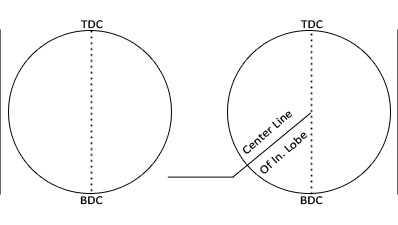
Intake Open BTDC: 26
Intake Close ABDC: 62
Calculator info
Cylinder Bore (inches): 4.030
Stroke (inches): 3.48
Cylinder Head Chamber Volume (CC's): 64
Piston Dish/Dome (CC's): 6
Head Gasket Thickness (inches): .020
Head Gasket Bore (inches): 4.1
Deck Clearance (inches): .020
IVC @ .050":37
This calculator gave me 10.27 SCR and 8.93 DCR
https://www.gofastmath.com/Compressi...tio_Calculator
I dont want to add a thicker head gasket due to less quench. How can I lower this ratio, or am I calculating something wrong. Here are my stats. Any help would be greatly appreciated. Hope I gave enough info!
355 block
Standard rotating assembly w 6 cc flat top pistons
Brodix Aluminum IK180 heads 64cc
Comp Cam 08-502-8
Advertised Intake Duration:269
Advertised Exhaust Duration:276
Intake Duration at .050 Inch Lift:218
Exhaust Duration at .050 Inch Lift:224
Intake Valve Lift:0.495
Exhaust Valve Lift:0.503
Lobe Separation:112
Intake Centerline:108
Lobe Lift Intake:0.33
Lobe Lift Exhaust:0.335
Valve Timing @ 0.006 Lift:
Exhaust Close ATDC: 22
Exhaust Open BBDC: 74
Intake Open BTDC: 26
Intake Close ABDC: 62
Calculator info
Cylinder Bore (inches): 4.030
Stroke (inches): 3.48
Cylinder Head Chamber Volume (CC's): 64
Piston Dish/Dome (CC's): 6
Head Gasket Thickness (inches): .020
Head Gasket Bore (inches): 4.1
Deck Clearance (inches): .020
Optional for Dynamic CR
Connecting Rod Length (inches): 5.7IVC @ .050":37
This calculator gave me 10.27 SCR and 8.93 DCR


Joined: Mar 2001
Posts: 10,441
Likes: 2,093
Car: '89 Firebird
Engine: 7.0L
Transmission: T56
Re: Help with dynamic compression
I agree with your 10.27 SCR.
I get 8.34 DCR using 269° advertised duration at 0.006" lift, with a 108° centerline, and 5.7" rod length.
These are calcs I do myself not using any website.
I get 8.34 DCR using 269° advertised duration at 0.006" lift, with a 108° centerline, and 5.7" rod length.
These are calcs I do myself not using any website.


Joined: Sep 2005
Posts: 28,050
Likes: 2,504
Car: Yes
Engine: Usually
Transmission: Sometimes
Axle/Gears: Behind me somewhere
Re: Help with dynamic compression
That dynamic # looks WWWWWWAAAAAAAAAAYYYYYY high. I'd expect it to give 8.4 or thereabouts.
What is your MEASURED deck clearance? (distance from top of piston to deck surface) That will also DRAMATICALLY affect the REAL compression numbers, both static and dynamic. Stock, the pistons were .025" -.000 / +.015 or so below the deck; most pistons you can buy, particularly the less expensive ones which it looks like what you have (I'm going to guess Speed Pro hypereutectic or similar), add .020" to that. Leaving that number out, or "assuming" about it, or inaccuracy, turns "calculation" into FANTASY. Garbage in, garbage out, after all. Looks like yours do in fact add the .020"; but of course the mfr has no way of knowing how low they already are sitting. That is, how accurately your block rods and crank were machined.
Assuming your decks are at the optimistic end of stock, I come up with about 9.7:1. Could be a tenth or 2 lower quite easily though; most likely, some are a good bit lower than others.
Given the extreme levels of variability in all those numbers, especially chamber volume and deck clearance (which can easily vary .015" OR MORE within the same block), I would hesitate to quote "compression" "numbers" to even a precision of 1 decimal place, let alone 2. That's about like telling somebody that you don't have a 2x4x8', you want to trade it in for a better one, because this one is only 7' 11.983" long. "Measure with micrometer, mark with chalk, cut with axe", except in reverse.
What is your MEASURED deck clearance? (distance from top of piston to deck surface) That will also DRAMATICALLY affect the REAL compression numbers, both static and dynamic. Stock, the pistons were .025" -.000 / +.015 or so below the deck; most pistons you can buy, particularly the less expensive ones which it looks like what you have (I'm going to guess Speed Pro hypereutectic or similar), add .020" to that. Leaving that number out, or "assuming" about it, or inaccuracy, turns "calculation" into FANTASY. Garbage in, garbage out, after all. Looks like yours do in fact add the .020"; but of course the mfr has no way of knowing how low they already are sitting. That is, how accurately your block rods and crank were machined.
Assuming your decks are at the optimistic end of stock, I come up with about 9.7:1. Could be a tenth or 2 lower quite easily though; most likely, some are a good bit lower than others.
Given the extreme levels of variability in all those numbers, especially chamber volume and deck clearance (which can easily vary .015" OR MORE within the same block), I would hesitate to quote "compression" "numbers" to even a precision of 1 decimal place, let alone 2. That's about like telling somebody that you don't have a 2x4x8', you want to trade it in for a better one, because this one is only 7' 11.983" long. "Measure with micrometer, mark with chalk, cut with axe", except in reverse.
Thread Starter
Joined: Mar 2002
Posts: 241
Likes: 5
From: Cincinnati, OH
Car: 1985 Z28
Engine: 350 TPI
Transmission: T56
Axle/Gears: 3.90 10 bolt eaton posi
Re: Help with dynamic compression
Thanks for the help! I'm not sure why this one calculator is showing it so high. I did another that asks for inlet close ABDC (which I'm guessing is .006 and not 050??) and my cr came back at 10.27 dcr at 8.3. should be able to run premium at that ratio...Sofakingdom, I have yet to machine the block. I was planning to either zero the deck with the new Pistons or go .20 deck and .20 gasket.
still confusing me though lol..
Also, this is all standard components, nothing crazy. Can't see how my combo wouldn't work..
still confusing me though lol..
Also, this is all standard components, nothing crazy. Can't see how my combo wouldn't work..
Joined: Mar 2001
Posts: 10,441
Likes: 2,093
Car: '89 Firebird
Engine: 7.0L
Transmission: T56
Re: Help with dynamic compression
DCR calculation is based on the remaining piston stroke after the intake valve closes (the zone where piston can actually compress the incoming air charge). That's usually done at 0.006" valve lift (advertised duration). They are incorrectly treating the valve as closed at 0.050" lift, which yields more stroke and more calculated compression.

Joined: Sep 2005
Posts: 28,050
Likes: 2,504
Car: Yes
Engine: Usually
Transmission: Sometimes
Axle/Gears: Behind me somewhere
Re: Help with dynamic compression
To get the deck clearance down to .020" with pistons that have the extra .020" that those do, you'll most likely have to take .025" - .040" off of it. (or at least, parts of it)
"Nominal" "stock" clearance is .025", -.000" / +.015" more or less. IOW if your block meets "factory tolerances" the deck clearance with ZERO DECK pistons will be between 0 and .015" down in the hole. I've seen blocks where WITHIN THE SAME BLOCK the measured values were over that ENTIRE span. It often gets worse when an engine is "rebuilt": shops tend to grind cranks "on the wear", and of course the wear is on the TDC part of the journal, which then once they re-center the journal "on the wear" (such that a more or less equal amount is taken off all the way around), means that the engine LOSES STROKE and also ADDS DECK CLEARANCE from doing that.
The "nominal" "stock" deck height of a SBC block (distance from CL of crank to deck surface) is 9.025". It's almost always more than that. The "nominal" "stock" rotating assy height of a SBC is 9.000". In the case of a 267, 305, or 350, the stroke is 3.48". The rotating assy height is half of that (1.74"), plus the rod length of 5.70" nominal, plus the piston compression height (distance between center of pin and top surface) is 1.56". 1.74" + 5.70" + 1.56" = 9.00". Your pistons have a compression height of 1.54" (that's what the .020" in the specs means), therefore are .020" lower than that. Your block is 9.025" to 9.040" tall, and your rotating assy is 8.980" OR LESS if the crank has been ground "on the wear" or if the rods have been "reconditioned" (which shortens them). And furthermore, if the decks aren't parallel to the crank, or if the 2 sides aren't the same, those heights will all be DIFFERENT on different cylinders.
Heads are about the same. Aluminum ones are better than iron about this, since the material changes less variably as it cools than iron does; but I'd be willing to bet there's at least 2cc of variation among chambers as-cast. (CNC'ed ones can be VERY close of course, and hand-worked ones by a competent hand-worker nearly as close) Unless you actually cc them (measure), you have no idea. The worst of all possible scenarios is when the biggest chamber ends up on the cyl with the greatest deck clearance, and the smallest chamber ends up on the tightest cylinder. Then, you have 1 cyl (or maybe a couple) that ping, but the motor as a whole potentially suffers from low compression. Worst of all is when the tight cylinders are 2 of the center ones on a side, because those are where the heads are the hottest and the tendency to detonation is greatest. Although usually, except if the crank has been butchered, the end cylinders (1, 2, 7, 8) tend to be the ones with the greatest variation between them. And of course, the crank throw that gets butchered the most is the one for #1 & #2, because that's the one that fails the most often, because that's the one at the far end of the oiling system.
In short, I wouldn't get too wrapped around the axle at this point about "calculating" compression of ANY kind, until you can actually MEASURE stuff. Practically anything you can guess at and enter into some "calculator" will do nothing but give you nice pretty numbers carried out to 3 decimal places or whatever that WON'T EVEN VAGUELY RESEMBLE whatever it is you're building; they'll be PRECISE to 3 decimal places, but WRONG to 4.
"Measure with micrometer, mark with chalk, cut with axe" in reverse.
Your combo of short block, heads, & cam should work just fine, no matter what "numbers" you're getting out of some "calculator". It's been built PLENTY of times, and works well. I don't think there's anything fundamentally wrong with it; I'm not saying that at all. You're not trying to scoootch your toes right up to the very edge of the possibilities; you don't need to be worried about that sort of thing. Keep in mind also, EVERY "calculator" will give you the same "numbers", if you type in the same things: you can go to the dollar store and buy a $2.99 calculator, or the university book store and buy a $150 professional financial calculator, and 2 + 2 will still always equal 4. (unless you have unusually large values of 2, in which case 2 + 2 could possibly approach 5... PRECISELY the kind of real-world approximation you're dealing with here) It's FAR more important to have THE WHOLE set of numbers ACCURATELY MEASURED - not "guessed", not "assumed", not "nominal", not "looked up in the catalog" - to enter into them, than worrying about which "calculator" you're using.
"Nominal" "stock" clearance is .025", -.000" / +.015" more or less. IOW if your block meets "factory tolerances" the deck clearance with ZERO DECK pistons will be between 0 and .015" down in the hole. I've seen blocks where WITHIN THE SAME BLOCK the measured values were over that ENTIRE span. It often gets worse when an engine is "rebuilt": shops tend to grind cranks "on the wear", and of course the wear is on the TDC part of the journal, which then once they re-center the journal "on the wear" (such that a more or less equal amount is taken off all the way around), means that the engine LOSES STROKE and also ADDS DECK CLEARANCE from doing that.
The "nominal" "stock" deck height of a SBC block (distance from CL of crank to deck surface) is 9.025". It's almost always more than that. The "nominal" "stock" rotating assy height of a SBC is 9.000". In the case of a 267, 305, or 350, the stroke is 3.48". The rotating assy height is half of that (1.74"), plus the rod length of 5.70" nominal, plus the piston compression height (distance between center of pin and top surface) is 1.56". 1.74" + 5.70" + 1.56" = 9.00". Your pistons have a compression height of 1.54" (that's what the .020" in the specs means), therefore are .020" lower than that. Your block is 9.025" to 9.040" tall, and your rotating assy is 8.980" OR LESS if the crank has been ground "on the wear" or if the rods have been "reconditioned" (which shortens them). And furthermore, if the decks aren't parallel to the crank, or if the 2 sides aren't the same, those heights will all be DIFFERENT on different cylinders.
Heads are about the same. Aluminum ones are better than iron about this, since the material changes less variably as it cools than iron does; but I'd be willing to bet there's at least 2cc of variation among chambers as-cast. (CNC'ed ones can be VERY close of course, and hand-worked ones by a competent hand-worker nearly as close) Unless you actually cc them (measure), you have no idea. The worst of all possible scenarios is when the biggest chamber ends up on the cyl with the greatest deck clearance, and the smallest chamber ends up on the tightest cylinder. Then, you have 1 cyl (or maybe a couple) that ping, but the motor as a whole potentially suffers from low compression. Worst of all is when the tight cylinders are 2 of the center ones on a side, because those are where the heads are the hottest and the tendency to detonation is greatest. Although usually, except if the crank has been butchered, the end cylinders (1, 2, 7, 8) tend to be the ones with the greatest variation between them. And of course, the crank throw that gets butchered the most is the one for #1 & #2, because that's the one that fails the most often, because that's the one at the far end of the oiling system.
In short, I wouldn't get too wrapped around the axle at this point about "calculating" compression of ANY kind, until you can actually MEASURE stuff. Practically anything you can guess at and enter into some "calculator" will do nothing but give you nice pretty numbers carried out to 3 decimal places or whatever that WON'T EVEN VAGUELY RESEMBLE whatever it is you're building; they'll be PRECISE to 3 decimal places, but WRONG to 4.
"Measure with micrometer, mark with chalk, cut with axe" in reverse.
Your combo of short block, heads, & cam should work just fine, no matter what "numbers" you're getting out of some "calculator". It's been built PLENTY of times, and works well. I don't think there's anything fundamentally wrong with it; I'm not saying that at all. You're not trying to scoootch your toes right up to the very edge of the possibilities; you don't need to be worried about that sort of thing. Keep in mind also, EVERY "calculator" will give you the same "numbers", if you type in the same things: you can go to the dollar store and buy a $2.99 calculator, or the university book store and buy a $150 professional financial calculator, and 2 + 2 will still always equal 4. (unless you have unusually large values of 2, in which case 2 + 2 could possibly approach 5... PRECISELY the kind of real-world approximation you're dealing with here) It's FAR more important to have THE WHOLE set of numbers ACCURATELY MEASURED - not "guessed", not "assumed", not "nominal", not "looked up in the catalog" - to enter into them, than worrying about which "calculator" you're using.
Last edited by sofakingdom; Oct 24, 2021 at 06:57 PM.

Thread
Thread Starter
Forum
Replies
Last Post
IROCZ28KevinZ
Tech / General Engine
2
Jul 12, 2009 01:26 PM