


capacitors...


Thread Starter
Junior Member
Joined: Nov 2005
Posts: 9
Likes: 0
From: EGF
Car: 1985 Camaro
Engine: 301 V8
Transmission: 4 speed manual
Axle/Gears: not sure, limited slip tho..
capacitors...
alright, so ive never looked into capacitors and i would like to know a little about how the work in terms of an audio system, how to hook them up, and the voltage and farad rating that is the right kind to get....anyone help out? i dont understand what they mean by 14 volt and 24 volt....or how many farad is good..

Member
iTrader: (1)
Joined: Dec 2005
Posts: 385
Likes: 0
From: Dodge City, KS/Buffalo, OK
Car: 1983 Camaro Z28/1999 Cavalier
Engine: 305
Transmission: 700R4
Basically a capacitor is there to help save your battery and alternator.
What it does, is it collects energy from the battery and stores it, and when the bass hits hard it takes the drain from the capacitor and then it re-loads itself with power from the battery. This way your alternator is not taking a direct hit from the stereo. Capacitors are really only needed for larger systems..
They are measured in 1/2 farad, 1 farad and so on.. I think they go as high as 3.
Which is basically HUGE.
1/2 farad is suitable for smaller systems, like mine for instance. I have a 800w 2 channel amp with 2 Audiobahn 10's.. it doesn't drain much, but when I turn it up loud enough it does drain some, that was with my old battery though, now I have an Optima Red Top.
What it does, is it collects energy from the battery and stores it, and when the bass hits hard it takes the drain from the capacitor and then it re-loads itself with power from the battery. This way your alternator is not taking a direct hit from the stereo. Capacitors are really only needed for larger systems..
They are measured in 1/2 farad, 1 farad and so on.. I think they go as high as 3.
Which is basically HUGE.
1/2 farad is suitable for smaller systems, like mine for instance. I have a 800w 2 channel amp with 2 Audiobahn 10's.. it doesn't drain much, but when I turn it up loud enough it does drain some, that was with my old battery though, now I have an Optima Red Top.

Supreme Member
Joined: Mar 2002
Posts: 4,812
Likes: 0
From: 62656
Car: 1991 S10 pickup 2700lbs
Engine: 4.3L Z TBI
Transmission: 700R4
Axle/Gears: 3.08 7.625"
how do you wires a capacitor in ? where at ? inwhat wire(s)
please elaborate in dummy terms
a jpg or gif would be great too
thanks!
please elaborate in dummy terms
a jpg or gif would be great too
thanks!
Member
iTrader: (1)
Joined: Dec 2005
Posts: 385
Likes: 0
From: Dodge City, KS/Buffalo, OK
Car: 1983 Camaro Z28/1999 Cavalier
Engine: 305
Transmission: 700R4
How to wire a capacitor. <-- Click me.
That should help alot, it even has a diagram for wiring in 2 capacitors for bigger setups.
Basically you directly ground the capacitor, run the power wire to the capacitor, and then another power wire out to the amplifier. Very simple to wire in.
How a capacitor works.
That link basically explains how a capacitor works, even though the capacitor shown is alot smaller than one that you would put in a car stereo setup, it is the same general idea.
I'm not entirely sure on the farad rating you should get, what kind of stereo do you have? How big? Those answers would probably help, although I am no expert on combining that kind of thing with a stereo.
EDIT: I wanted to add this to make sure you guys see this, or for anyone who plans on getting one and wiring it in themselves:
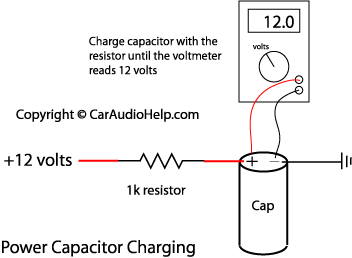
Just like that is how you charge it before hooking it up.
That should help alot, it even has a diagram for wiring in 2 capacitors for bigger setups.
Basically you directly ground the capacitor, run the power wire to the capacitor, and then another power wire out to the amplifier. Very simple to wire in.
How a capacitor works.
That link basically explains how a capacitor works, even though the capacitor shown is alot smaller than one that you would put in a car stereo setup, it is the same general idea.
I'm not entirely sure on the farad rating you should get, what kind of stereo do you have? How big? Those answers would probably help, although I am no expert on combining that kind of thing with a stereo.
EDIT: I wanted to add this to make sure you guys see this, or for anyone who plans on getting one and wiring it in themselves:
NOTE OF CAUTION: Power capacitors store a large amount of energy and they charge very quickly. You must first "charge" your power capacitor using a resistor before connecting it directly to +12 volts. This is done with the a 1k ohm resistor and a voltmeter. The exact value of the resistor is not critical but I would keep it in the 500-1k ohm range. I would recommend getting a 1 watt resistor if possible (your capacitor may have come with a resistor for charging). A lower wattage resistor will heat up too quickly. Also, do not hold the resistor with your bare hand. The current flowing through the resistor will cause the resistor to heat up and you could be burned. A good place to put the resistor is in the main power wire fuse holder. Simply substitute the resistor for the fuse. A diagram for the capacitor charging setup is shown below. You will need to place a voltmeter across the capacitor to monitor the voltage. Once the voltmeter reads 12 volts you can remove the voltmeter and replace the resistor with the power fuse.
Just like that is how you charge it before hooking it up.
Thread Starter
Junior Member
Joined: Nov 2005
Posts: 9
Likes: 0
From: EGF
Car: 1985 Camaro
Engine: 301 V8
Transmission: 4 speed manual
Axle/Gears: not sure, limited slip tho..
i have seen capacitors at least 5 farad....they go pretty high, why i dont know...but anyway. i will be running 2 1200w rms amps and 2 1000w rms subs....i read that you can go more than you need and it wont make a difference so i bought a 3 farad just to be sufficient....thanks for the wiring tips and all other info....

Supreme Member
Joined: Jun 2005
Posts: 1,800
Likes: 2
From: Bremerton, WA
Car: 1992 RS / 1989 RS
Engine: 3.1L MFI / Vortec 383 TBI
Transmission: T5 / LS-T56
Axle/Gears: 3.42 open / 3.73 Eaton posi
How to wire a capacitor. <-- Click me.
That should help alot, it even has a diagram for wiring in 2 capacitors for bigger setups.
Basically you directly ground the capacitor, run the power wire to the capacitor, and then another power wire out to the amplifier. Very simple to wire in.
How a capacitor works.
That link basically explains how a capacitor works, even though the capacitor shown is alot smaller than one that you would put in a car stereo setup, it is the same general idea.
I'm not entirely sure on the farad rating you should get, what kind of stereo do you have? How big? Those answers would probably help, although I am no expert on combining that kind of thing with a stereo.
EDIT: I wanted to add this to make sure you guys see this, or for anyone who plans on getting one and wiring it in themselves:
Just like that is how you charge it before hooking it up.
That should help alot, it even has a diagram for wiring in 2 capacitors for bigger setups.
Basically you directly ground the capacitor, run the power wire to the capacitor, and then another power wire out to the amplifier. Very simple to wire in.
How a capacitor works.
That link basically explains how a capacitor works, even though the capacitor shown is alot smaller than one that you would put in a car stereo setup, it is the same general idea.
I'm not entirely sure on the farad rating you should get, what kind of stereo do you have? How big? Those answers would probably help, although I am no expert on combining that kind of thing with a stereo.
EDIT: I wanted to add this to make sure you guys see this, or for anyone who plans on getting one and wiring it in themselves:
Just like that is how you charge it before hooking it up.

Trending Topics

On Probation
Joined: Nov 2005
Posts: 774
Likes: 0
Car: 2002 Formula
Engine: 5.7 LS1
Actually its microfarads.(MFD) They go very high, (30+) and are used for starting motors. They can stay charged and can knock the heck out of you. You can short the leads to discharge the capacitor for safe handling. Sounds like a good idea for cars if works like posted.

Supreme Member


Joined: Mar 2003
Posts: 1,617
Likes: 37
If you are having lights dimming, a cap is only going to mask the larger problem.
To properly fix headlight dimming, you need to do the big3 and then get a larger alternator.
Here are some explanations of the big3.
http://www.the12volt.com/installbay/...TID=73496&PN=1
http://forum.sounddomain.com/forum/u...=5;t=007801;p=
To properly fix headlight dimming, you need to do the big3 and then get a larger alternator.
Here are some explanations of the big3.
http://www.the12volt.com/installbay/...TID=73496&PN=1
http://forum.sounddomain.com/forum/u...=5;t=007801;p=

Supreme Member
Joined: Oct 1999
Posts: 1,734
Likes: 0
From: Westminster, MD
Car: 89 IROC-Z
Engine: 355 TPI
Transmission: 700R4
[QUOTE]Actually its microfarads. ...[QUOTE]
Actually, here they are talking Farads, not micro-farads.
And cdoyles got it right. If you have an adequate electrical system a cap will get you nothing. The FIRST thing you should do is the "BIG 3". Up grading the stock wiring more often then not takes care of it, unless you have a small alt. If thats not enough, think about big alts and go from there. Do it right and caps are a wast, do it half ... and caps can help cover up the problem. Just do it right.
Actually, here they are talking Farads, not micro-farads.
And cdoyles got it right. If you have an adequate electrical system a cap will get you nothing. The FIRST thing you should do is the "BIG 3". Up grading the stock wiring more often then not takes care of it, unless you have a small alt. If thats not enough, think about big alts and go from there. Do it right and caps are a wast, do it half ... and caps can help cover up the problem. Just do it right.

Junior Member
Joined: Dec 2006
Posts: 58
Likes: 0
I disagree to a point. Yes you need to upgrade the wiring in the engine bay. Also make sure that the correct gauge of wire is run from the battery to the electronics. Make sure the correct ground cable is used. But once that is done just adding a high powered alternator is not necessarily going fix the problem. When you are at idle or lower RPM the alternator does not put out its full rated power.
The most common symptom in need of added capacitance is headlight
dimming (and sometimes dimming of the interior/dash lights). It's
caused by a drop in system voltage associated with excessive current
draw. While there may indeed be several loads drawing substantial
amounts of current from the electrical system (eg. heat, AC, and so
forth), it's usually the transient draws that best manifest themselves
in noticeable dimming. This is partly because our visual systems are
most sensitive to detecting rapidly changing intensity levels rather
than steady absolute differences.
A commonly-used estimate for determining the appropriate size capacitor
is 1F/kW (one farad per kilowatt). For example, a system running at
300W would need a 0.3F (or 300,000uF) capacitor. However, there are
several variables at play here, including the capabilities of the
vehicle's electrical system (which generally varies from idle to higher
RPMs), the efficiency of the amplifiers, and the listening habits of
the user (ie. the tone controls and the type of music). These factors
should all be considered when making the determination.
This all being said, if you are still having a dimming
problem no amount of capactance will help as the voltage drop
at the electronics is to great. Now it is time to
look into adding a bigger alternator.
The most common symptom in need of added capacitance is headlight
dimming (and sometimes dimming of the interior/dash lights). It's
caused by a drop in system voltage associated with excessive current
draw. While there may indeed be several loads drawing substantial
amounts of current from the electrical system (eg. heat, AC, and so
forth), it's usually the transient draws that best manifest themselves
in noticeable dimming. This is partly because our visual systems are
most sensitive to detecting rapidly changing intensity levels rather
than steady absolute differences.
A commonly-used estimate for determining the appropriate size capacitor
is 1F/kW (one farad per kilowatt). For example, a system running at
300W would need a 0.3F (or 300,000uF) capacitor. However, there are
several variables at play here, including the capabilities of the
vehicle's electrical system (which generally varies from idle to higher
RPMs), the efficiency of the amplifiers, and the listening habits of
the user (ie. the tone controls and the type of music). These factors
should all be considered when making the determination.
This all being said, if you are still having a dimming
problem no amount of capactance will help as the voltage drop
at the electronics is to great. Now it is time to
look into adding a bigger alternator.

Junior Member
Joined: Sep 2003
Posts: 22
Likes: 0
From: Los Angeles
Car: 1992 Pontiac Trans Am
Engine: 305 TPI
Transmission: T5 - 5 Speed Manual
Axle/Gears: ...No Clue...
Matt is absolutely right, capacitors are a wast of time.
i've done a lot of work in a stereo shop and basically capacitors under 10 farads won't make a difference, 1-10 farads would last only about a second or two really. 10 i've seen last about 4 seconds at the longest. After it discharges its over. Even the 100 lasts only about 5 seconds on high power systems. The problem always comes that they never recharge fully at high volumes, so after a minute or so the cap just becomes a worthless box of silicone.
Upgrade your wiring (the big 3), and alternator, or its not worth it, especially not at the price of caps.
Any stereo technician that tells you anything under a 10 farad cap will FIX anything is out for the money, find a new one.
Good Luck!
By the way the largest cap i know of is 100 farads and its made by lanzar, also one by lightning audio (the brand names alone should hint that its about getting money not offering a good or useful product)
i've done a lot of work in a stereo shop and basically capacitors under 10 farads won't make a difference, 1-10 farads would last only about a second or two really. 10 i've seen last about 4 seconds at the longest. After it discharges its over. Even the 100 lasts only about 5 seconds on high power systems. The problem always comes that they never recharge fully at high volumes, so after a minute or so the cap just becomes a worthless box of silicone.
Upgrade your wiring (the big 3), and alternator, or its not worth it, especially not at the price of caps.
Any stereo technician that tells you anything under a 10 farad cap will FIX anything is out for the money, find a new one.
Good Luck!
By the way the largest cap i know of is 100 farads and its made by lanzar, also one by lightning audio (the brand names alone should hint that its about getting money not offering a good or useful product)
Last edited by xrsxj; Feb 3, 2007 at 12:56 PM.

Member

Joined: Sep 2000
Posts: 464
Likes: 0
From: Crestline,OH
Car: 1987 Formula 350
Engine: 6.0 boost and smak
Transmission: 4l80e
Axle/Gears: 9bolt 3.27
my vote would be for more effiecient amps, like Directed or similar.... less draw with the same output... you wouldn't need anymore supply, or could get away with 2batts and 2farads.... (i have seen a caviler with one solo barac comp X ($1500ea) pull a 164 off the seat with that set-up)... If you have more then that...MAN capz are the least of your worries...
windows
doors..LOL
panels
OH... if you want to see some huge caps, look at industrial junkyards, the biggest i have seen was 65,000est. F.... it was about as big as my bird....(the have smaller too...hint
windows
doors..LOL
panels
OH... if you want to see some huge caps, look at industrial junkyards, the biggest i have seen was 65,000est. F.... it was about as big as my bird....(the have smaller too...hint
Last edited by fun Pain; Feb 3, 2007 at 02:01 PM.
Supreme Member
Joined: Oct 1999
Posts: 1,734
Likes: 0
From: Westminster, MD
Car: 89 IROC-Z
Engine: 355 TPI
Transmission: 700R4
Unless you're are running the smaller stock alt (forget the size) and small/cheep/old battery you should have enough power it run some good sized amps at idle. You just need to minimize voltage drop. A cap only cover this problem up. And often the larger caps have to high an ESR to be vary useful. Save your money. Upgrade all the power distribution wires. If you need more then that, the right way to handle things is a bigger alt that will put out more current at idle.
Junior Member
Joined: Dec 2006
Posts: 58
Likes: 0
I will still stand by Capacitors. There is enough science behind them. I use Autosound 2000 tech briefs. I can't print them out here do to Copyrights and all. But Richard Clark and David Navone know their stuff. Here is a link to a reprint on caps.
http://www.monstercable.com/mpc/stab...Capacitors.pdf
----------
Whoops!!! Gave wrong link.
http://www.monstercable.com/mpc/stab...erformance.pdf
http://www.monstercable.com/mpc/stab...Capacitors.pdf
----------
Whoops!!! Gave wrong link.
http://www.monstercable.com/mpc/stab...erformance.pdf
Last edited by cub and Matt; Feb 5, 2007 at 12:20 AM. Reason: Automerged Doublepost
Supreme Member
Joined: Oct 1999
Posts: 1,734
Likes: 0
From: Westminster, MD
Car: 89 IROC-Z
Engine: 355 TPI
Transmission: 700R4
Your right, it is all science. It's late so I may need edit this tomorrow. There are a couple of things to keep in mined.
1. Monster sells caps. Not trying to say anything, just keep it in mind.
2.
To give credit quoted for the link you posted.
In the first sentence they point out that a cap would augment the power supply. If you build a good power delivery system, there is not need to augment it. May if you only had to pay $25.00 for that little extra, but not for what they go for.
In the second sentence they point out that it the impedance(resistance) of the power supply cause 'sag and drop out'. (see transient) These Resistances can be minimized for less then half the cost of car audio stiffening caps. Now remember these caps often have relatively high ESR. Run the math if you can find any that would actually post a real ESR figure and the high current drawl of the amp (higher current=higher voltage drop in the cap) and you'll see that the caps don't do as well as you my think.
Unless you buy a garbage amp it will have large enough caps right it, with a good power supply. There the third thing in line and all the amp should need. If you need more then the engineers put in the amp, you need a better power delivery system.
Remember, if you don't build up the power delivery part of thing you loosing power seen as voltage drop. The caps just trys to bust it for a sort, vary short, period of time. Doesn't it make more sense not to lost it in the first place?
Nice thread so fare. Lot of good info to both points. Don't see as Meany good threads. And it has been so time sense the last great cap debate. It was popping up every month or so.
1. Monster sells caps. Not trying to say anything, just keep it in mind.
2.
The purpose of installing Stiffening Capacitor in a 12-volt automotive sound system is to augment the alternator/battery power supply of the car. The internal impedances associated with an un-stiffened supply commonly cause the power supply to sag and drop out. The ability of a Stiffening Capacitor to deliver instant energy to the power supply of an amplifier pevents dropouts and can improve the quality of the sound system.
In the first sentence they point out that a cap would augment the power supply. If you build a good power delivery system, there is not need to augment it. May if you only had to pay $25.00 for that little extra, but not for what they go for.
In the second sentence they point out that it the impedance(resistance) of the power supply cause 'sag and drop out'. (see transient) These Resistances can be minimized for less then half the cost of car audio stiffening caps. Now remember these caps often have relatively high ESR. Run the math if you can find any that would actually post a real ESR figure and the high current drawl of the amp (higher current=higher voltage drop in the cap) and you'll see that the caps don't do as well as you my think.
Unless you buy a garbage amp it will have large enough caps right it, with a good power supply. There the third thing in line and all the amp should need. If you need more then the engineers put in the amp, you need a better power delivery system.
Remember, if you don't build up the power delivery part of thing you loosing power seen as voltage drop. The caps just trys to bust it for a sort, vary short, period of time. Doesn't it make more sense not to lost it in the first place?
Nice thread so fare. Lot of good info to both points. Don't see as Meany good threads. And it has been so time sense the last great cap debate. It was popping up every month or so.
Junior Member
Joined: Dec 2006
Posts: 58
Likes: 0
I only used the monster sight to get the tech brief. What I have been trying to explain is that even with a proper power set up consisting of a good battery, good high output alternator, correct cable gauge, and distribution a capacitor with allow a better transient response from the "power delivery set up". I have not seen a car audio competitor in the last oh say at least 15 years not use some form of capacitor to augment there power supply. Wayne Harris of Orion and I believe Fosgate fame built the Terminator Hearse back in like 85ish. He used them there. Richard Clark with the famous Grand National that retired unbeaten had them. What I am trying to say is that there is to much science behind them and to many respected people using them and getting results with them. I understand that if you have your volume at 11 with the bass on 20 and are feeding the speakers the amps maximum clipped power then you are not utilizing the Caps for what they are for. They do not produce power. They store and discharge faster than the battery can supply it to amp during a transient peak. Is it worth spending money on? I guess the next question I would ask is, are you going to compete. If no then most likely you don't NEED a cap. Your headlights and dash lights may still dim. Even after an upgraded battery alternator an a good wiring job depending on how much power you are pushing. Gettin more efficient amps help but a thousand watt amp still uses a crap oad of power. Even at 13.8 volts you are looking at a lot of amperage draw with an 80% efficient Class D amp. If you do want to compete, I would get one. Though remember in the stock form a front soundstage is first and foremost. NEEDAZ is right though, make sure you research what you get. Claims are made by these companies that stretch the very limits of what is truth and an outright lie.

Member
Joined: Jun 2006
Posts: 334
Likes: 0
From: Shangri-La
Car: 87 Iroc
Engine: 305 TPI
Transmission: 700R4
Axle/Gears: stock posi
ling427, they go ALOT higher than 3 farad. and as people dont realize, a cap does not help much, because after the bass hits and it takes from the cap, it has to re-load that, which puts just as much strain on the alternator. caps are not all that good honestly.
Supreme Member
Joined: Mar 2003
Posts: 1,617
Likes: 37
that's what people need to realize, if you have a weak electrical system. A cap is more harm then good. Just another thing that the already overloaded alt. has to charge.
A cap with an strong electrical system is helpful as mentioned above.
A cap with an strong electrical system is helpful as mentioned above.

Junior Member
Joined: Jan 2007
Posts: 12
Likes: 0
totally agree. A cap is just one more thing your electrical system has to charge.. And if your lights are dimming already, it means its already weak and a capacitor would only hinder it more
+1 to the big 3 wiring and getting an Optima Yellow top
+1 to the big 3 wiring and getting an Optima Yellow top
Supreme Member
Joined: Oct 1999
Posts: 1,734
Likes: 0
From: Westminster, MD
Car: 89 IROC-Z
Engine: 355 TPI
Transmission: 700R4
Supreme Member
Joined: Oct 1999
Posts: 1,734
Likes: 0
From: Westminster, MD
Car: 89 IROC-Z
Engine: 355 TPI
Transmission: 700R4
I wouldn't say that. At the point that the cap is getting charged the power demand of the amp would be low. There just not as useful as some people think, and cost way to much for what you get. If you could get a 'stiffing cap' for $20 I may even get one.


Junior Member
Joined: Mar 2005
Posts: 37
Likes: 0
From: Minnesota
Car: 1987 Camaro
Engine: 305 CI of SBC Goodness
Transmission: 5 speed Manual
Hey. Just putting my two cents in as a physics student (I know, I'm a dork). But let's say you have a 1 farad capacitor, the max energy that will be stored in it will be 98 Joules (1/2*C*V^2). That means, if you have a 1000W system, it will be able to provide power for less than 1/10 of a second, and after that, you're just running of your battery/alt again. And there are -a lot- of times when your subs will hit for longer than 1/10 of a second.
Just my two cents, I've never used a capacitor, but that's the physics behind it at least, and the reason why I think they're kind of pointless...so I agree with everyone else, fix the problem and don't try to cover it up.
Just my two cents, I've never used a capacitor, but that's the physics behind it at least, and the reason why I think they're kind of pointless...so I agree with everyone else, fix the problem and don't try to cover it up.

Senior Member
Joined: Nov 2006
Posts: 672
Likes: 1
From: Camden, MI
Car: 1985 IROC-Z28
Engine: LB9
Transmission: 700R4
Axle/Gears: 3.73
this may sound stupid, but a capacitor is basiclly a small battery, right?
could you have a battery in the stock location run large wires the same way you would a capacitor to a battery in the trunk? you still would need a monster of an alternator or 2 but it would hold power longer, right?
could you have a battery in the stock location run large wires the same way you would a capacitor to a battery in the trunk? you still would need a monster of an alternator or 2 but it would hold power longer, right?
