


Bogging out


Thread Starter
Member
Joined: Jul 2005
Posts: 159
Likes: 0
From: Glorietta, New Mexico
Car: 1984 Firebird V6
Bogging out
I'm not so new to the board, July. But I am kinda new to the Carb area.
In July of this year I bought a 1984 Firebird. In October I got her officially on the road.
In getting my car running we did a number of things.
1) We rebuilt the carb ( stock quadrajunk)
2) we replaced the fuel pump
3) replaced spark plugs, wires, cap and rotor.
4) Replaced O2 sensor
5) Oil change, Tranny filter and fluid change, Radiator flush.
There's only a few things I need to do, Like replace the Exhuast and the seats and carpet.
That's not really the point. My point here is. When I try to punch the car it bogs out. I am sure many of you know what bogging out means. It almost like it stalls out. If I bring the gas right back up it cures it's self and smoothes out.
Now I know this is a common problem, well at least it has been a common problem in my hubbies Trans Am and now my own Firebird.
My poor hubby has become a little too busy to help me with this and I am getting a little tired of not being able to race ( Even race my own Hubby in his 4 cyc Nissan I BARELY nosed ahead of last night. I got the edge because he had to shift, PATHETIC)
What sort of solutions to this are there are am I doomed to ease on the gas till I can get a new carb ( This is a V6, 2 barrel carb )
In July of this year I bought a 1984 Firebird. In October I got her officially on the road.
In getting my car running we did a number of things.
1) We rebuilt the carb ( stock quadrajunk)
2) we replaced the fuel pump
3) replaced spark plugs, wires, cap and rotor.
4) Replaced O2 sensor
5) Oil change, Tranny filter and fluid change, Radiator flush.
There's only a few things I need to do, Like replace the Exhuast and the seats and carpet.
That's not really the point. My point here is. When I try to punch the car it bogs out. I am sure many of you know what bogging out means. It almost like it stalls out. If I bring the gas right back up it cures it's self and smoothes out.
Now I know this is a common problem, well at least it has been a common problem in my hubbies Trans Am and now my own Firebird.
My poor hubby has become a little too busy to help me with this and I am getting a little tired of not being able to race ( Even race my own Hubby in his 4 cyc Nissan I BARELY nosed ahead of last night. I got the edge because he had to shift, PATHETIC)
What sort of solutions to this are there are am I doomed to ease on the gas till I can get a new carb ( This is a V6, 2 barrel carb )

Moderator


Joined: Jan 2000
Posts: 19,679
Likes: 316
You're only "doomed" if you give up on it.
"Bogging" (lean stumble on throttle tip-in) is not uncommon. Just as implied, it's usually due to the lack of fuel. Presuming there is adequate fuel in the tank, and the pump is able to get it to the carburetor, there is little left but the carburetor. Those presumptions are based on it running well otherwise, and only stumbles on the initial tip-in. If it continues to stumble under sustained load, the diagnosis may be different.
It would save a lot of time if you could identify the carb on the engine. I'm not sure if the '84 has the E2SE or E2ME carburetor.
"Bogging" (lean stumble on throttle tip-in) is not uncommon. Just as implied, it's usually due to the lack of fuel. Presuming there is adequate fuel in the tank, and the pump is able to get it to the carburetor, there is little left but the carburetor. Those presumptions are based on it running well otherwise, and only stumbles on the initial tip-in. If it continues to stumble under sustained load, the diagnosis may be different.
It would save a lot of time if you could identify the carb on the engine. I'm not sure if the '84 has the E2SE or E2ME carburetor.
Moderator
Joined: Jan 2000
Posts: 19,679
Likes: 316
Another presumption is that the ignition system is intact. A weak ignition can allow the spark to be blown out by compression under heavy loading. If the stumble is only occurring on initial tip-in, it may be an accelerator pump issue. If the stumbling continues as long as the throttle is held open under load, the ignition is suspect, along with improper carburetor setup. You may have a problem with either, or both.
It's easy to test spark plug wires (with an ohmeter), inspect the distributor cap and rotor, remove and inspect spark plugs, and clean /regap them if necessary. It's easy to test the ignition coil (your meter again). Since you're already replaced most of those items, it's somewhat safe to assume they are intact. If you haven't checked the timing, that would be a good step as well. Once you have verified that the ignition is sound, you can continue to the fuel system.
Since the fuel pump is new, and filter has been replaced, it is relatively safe to assume that the pump is delivering adequate fuel to the carburetor. You may want to verify this with a pump output volume test.
Chances are the carb is the E2SE. In either case, the conversion of the carburetors to electronic mixture control in the early '80s eliminated the power valve, so that is not a possibility for diagnosis. However, an improperly adjusted rich stop setting can act like a failed power valve. If the metering rod is not allowed to rise fully and admit more fuel under load conditions, you'll get the bogging you describe. Also, if the ECM is not in control of the mixture control solenoid, the system will not function as designed.
The ECM can lose control if the TPS is adjusted incorrectly, if the oxygen sensor is not functioning, if the CTS is not functioning, or if the ECM is not getting ignition reference pulses. You can perform a quick check to see if the MC solenoid is cycling with the engine idling at full temperature. If there is no solenoid activity, there is a problem. If there is solenoid activity, you may still need to adjust the lean- and rich-stops.
It's easy to test spark plug wires (with an ohmeter), inspect the distributor cap and rotor, remove and inspect spark plugs, and clean /regap them if necessary. It's easy to test the ignition coil (your meter again). Since you're already replaced most of those items, it's somewhat safe to assume they are intact. If you haven't checked the timing, that would be a good step as well. Once you have verified that the ignition is sound, you can continue to the fuel system.
Since the fuel pump is new, and filter has been replaced, it is relatively safe to assume that the pump is delivering adequate fuel to the carburetor. You may want to verify this with a pump output volume test.
Chances are the carb is the E2SE. In either case, the conversion of the carburetors to electronic mixture control in the early '80s eliminated the power valve, so that is not a possibility for diagnosis. However, an improperly adjusted rich stop setting can act like a failed power valve. If the metering rod is not allowed to rise fully and admit more fuel under load conditions, you'll get the bogging you describe. Also, if the ECM is not in control of the mixture control solenoid, the system will not function as designed.
The ECM can lose control if the TPS is adjusted incorrectly, if the oxygen sensor is not functioning, if the CTS is not functioning, or if the ECM is not getting ignition reference pulses. You can perform a quick check to see if the MC solenoid is cycling with the engine idling at full temperature. If there is no solenoid activity, there is a problem. If there is solenoid activity, you may still need to adjust the lean- and rich-stops.
Thread Starter
Member
Joined: Jul 2005
Posts: 159
Likes: 0
From: Glorietta, New Mexico
Car: 1984 Firebird V6
if the oxygen sensor is not functioning, if the CTS is not functioning, or if the ECM is not getting ignition reference pulses. You can perform a quick check to see if the MC solenoid is cycling with the engine idling at full temperature. If there is no solenoid activity, there is a problem. If there is solenoid activity, you may still need to adjust the lean- and rich-stops.
So then we changed the pump and still the same thing. So the carb was the next logical step. We rebuilt the carb, cleaned it all up, replaced all the little componets that came with the kit. Still nothing.
We just went down the path and discovered the O2 Sensor (on the right side of the car). I think it was the 02 sensor. It's either that one or the air mixture selinoid, unless they are the same, I get all confused with all these sensors, I am pretty sure it's the 02 though) We changed that and she started right up.
Those presumptions are based on it running well otherwise, and only stumbles on the initial tip-in. If it continues to stumble under sustained load, the diagnosis may be different.
She does it whether she's cold or at running temp (Which on my gauge is half way between 130 -190.. I figured about.. 155 -160)
Other then that she runs beautifully and ran absolutely marvelous today, Except I lost my power steering some how. Fluid is fine. But on futher inspection we found I was missing a bolt on the Right (Passanger side) of the power steering belt holder thingy. the Belt is like SUPER loose, almost to the point of falling off, but there's still a little tension on it.
I'm fine if I am going straight, or I am making a large turn, but into a parking spot or a similar tight turn I have to armstrong it.
The guy at Autozone said the pully was leaning forward and causing the belt to be loose and making my streering hard, Nice guys those Autozone guys.
Moderator
Joined: Jan 2000
Posts: 19,679
Likes: 316
Assuming the carb is original it should be the E2SE (VaraJet). That would look like this:
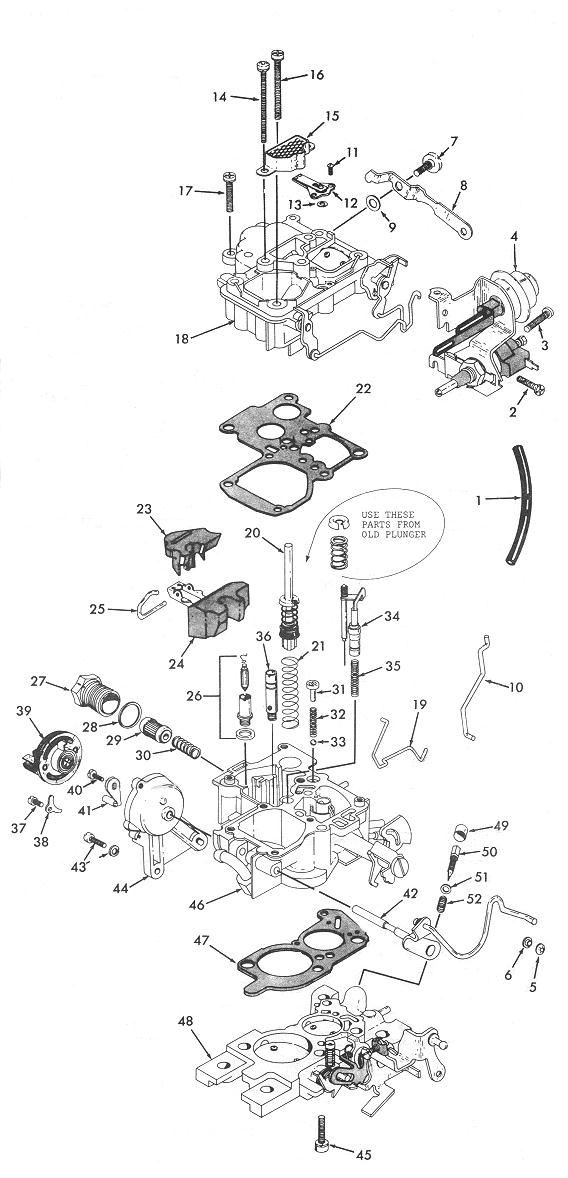
As part of the rebuild, you would have needed to adjust the float level. On the E2SE the lean and rich stops, and mixture control solenoid are not adjustable. The TPS is not adjustable other than mechanically altering the mounting or bending the accelerator pump arm.
It's all covered pretty well here:
http://www.camaro-firebird.com/phpBB...8e979ef06dd9a5
As part of the rebuild, you would have needed to adjust the float level. On the E2SE the lean and rich stops, and mixture control solenoid are not adjustable. The TPS is not adjustable other than mechanically altering the mounting or bending the accelerator pump arm.
It's all covered pretty well here:
http://www.camaro-firebird.com/phpBB...8e979ef06dd9a5
Thread Starter
Member
Joined: Jul 2005
Posts: 159
Likes: 0
From: Glorietta, New Mexico
Car: 1984 Firebird V6
It is in fact stock and we rebuilt it to the stock specs and adjusted it to the stock specs. We did the float and everything just the way it should be.
I bought the car broken down as I said so I didn't get a chance to drive it before. I'm not sure if this was a problem with it before.
We had the same problem with my Husbnads T/A but he has an Edelbrock Crab and able to adjust his easily.
Eh, maybe I should mention it's a 2 barrel.. V6. If that helps any or makes much difference.
I bought the car broken down as I said so I didn't get a chance to drive it before. I'm not sure if this was a problem with it before.
We had the same problem with my Husbnads T/A but he has an Edelbrock Crab and able to adjust his easily.
Eh, maybe I should mention it's a 2 barrel.. V6. If that helps any or makes much difference.
Moderator
Joined: Jan 2000
Posts: 19,679
Likes: 316
Originally posted by KissThis
Eh, maybe I should mention it's a 2 barrel.. V6. If that helps any or makes much difference.
Eh, maybe I should mention it's a 2 barrel.. V6. If that helps any or makes much difference.
If the float is properly adjusted, none of the bleed tubes have fallen out, the fuel pump is providing adequate output volume, and the TPS voltage is within specification, it should run. Have you measured the TPS voltage at idle? Tested the fuel pump output?

Thread
Thread Starter
Forum
Replies
Last Post
RedLeader289
Tech / General Engine
10
May 28, 2019 01:47 PM
