


Tuning Issues with manual car w/big cam


Thread Starter
Member
Joined: Jul 2000
Posts: 150
Likes: 0
From: Fort Myers,FL
Tuning Issues with manual car w/big cam
Hello
Looking for some advice. Car has 383,6 speed, 248/248 112LSA cam. ECM is 7730.
Bad fumes at idle. Wide band is showing 14.5 +-1 at idle. (Pasenger exhaust collector) BLM displaying 125-135 at idle(Stock heated O2-Drivers collector).
Car is very touchy At low RPM's1000-2300. In second gear you can feel every burp.
I even had a few backfires at low speed/high gear--Lightly touching the gas. I have to downshift to first or second gear.
Here are my current timing maps.
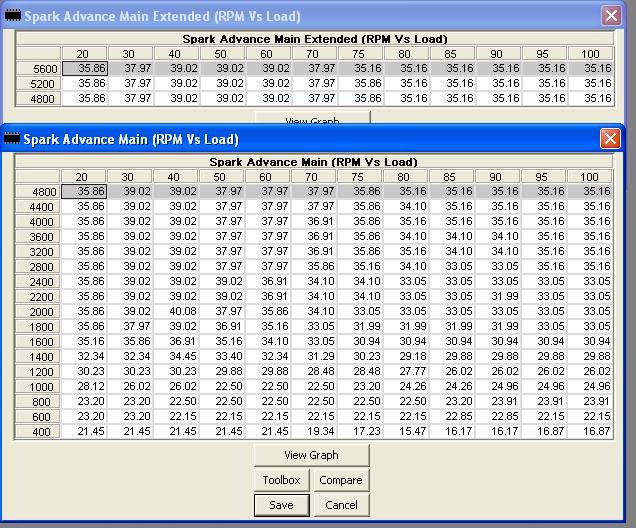
Also my latest DataMaster log.
Datamaster Log
I can upload as CSV is needed.
Also my lastest bin.
Bin
Any advice would be great.
I was running my timing a few degrees higher at idle and had some knock counts. reduced 3 degrees and most went away.
I idle around 65-70kpa 950 rpm.
Thanks
Looking for some advice. Car has 383,6 speed, 248/248 112LSA cam. ECM is 7730.
Bad fumes at idle. Wide band is showing 14.5 +-1 at idle. (Pasenger exhaust collector) BLM displaying 125-135 at idle(Stock heated O2-Drivers collector).
Car is very touchy At low RPM's1000-2300. In second gear you can feel every burp.
I even had a few backfires at low speed/high gear--Lightly touching the gas. I have to downshift to first or second gear.
Here are my current timing maps.
Also my latest DataMaster log.
Datamaster Log
I can upload as CSV is needed.
Also my lastest bin.
Bin
Any advice would be great.
I was running my timing a few degrees higher at idle and had some knock counts. reduced 3 degrees and most went away.
I idle around 65-70kpa 950 rpm.
Thanks

Supreme Member
Joined: Jun 2000
Posts: 7,554
Likes: 1
From: In reality
Car: An Ol Buick
Engine: Vsick
Transmission: Janis Tranny Yank Converter
Try dropping the light load timing values to say 36d or less. Then the 1,000->1,200 RPM jumps are kind of severe.
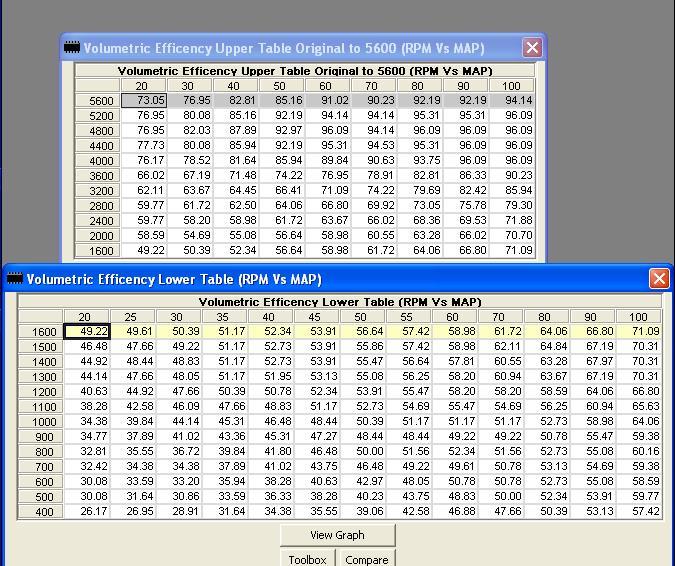
Let see a VE table.
Let see a VE table.
Thread Starter
Member
Joined: Jul 2000
Posts: 150
Likes: 0
From: Fort Myers,FL
Grumpy,
When you said Lower timing in light load. Did you mean all the way up the RPM scale?
eg. 4000rpm 40kpa lower to 36d?
here is the ve map. I should probrably even out the idle area 60-70 kpa 1000 rpm.
Thanks
When you said Lower timing in light load. Did you mean all the way up the RPM scale?
eg. 4000rpm 40kpa lower to 36d?
here is the ve map. I should probrably even out the idle area 60-70 kpa 1000 rpm.
Thanks
Supreme Member
Joined: Jun 2000
Posts: 7,554
Likes: 1
From: In reality
Car: An Ol Buick
Engine: Vsick
Transmission: Janis Tranny Yank Converter
Originally posted by BOWTYE8
Grumpy,
When you said Lower timing in light load. Did you mean all the way up the RPM scale?
eg. 4000rpm 40kpa lower to 36d?
here is the ve map. I should probrably even out the idle area 60-70 kpa 1000 rpm.
Thanks
Grumpy,
When you said Lower timing in light load. Did you mean all the way up the RPM scale?
eg. 4000rpm 40kpa lower to 36d?
here is the ve map. I should probrably even out the idle area 60-70 kpa 1000 rpm.
Thanks
I don't really see any reason table wise for your problem.
Might look at a log, and see what the IAC is doing.

Supreme Member
Joined: Jul 1999
Posts: 2,844
Likes: 4
From: Maryland
Car: 2005 Subaru STI
Engine: 153ci of Turbo Power!
Transmission: 6-Speed
Also try playing with the O2 constants. That cam might be giving you so much overlap that you are getting raw fuel out the exhaust. Basically, the overlap period allows raw O2/Fuel to come in the intake and shoot right out the exhaust. The fresh O2 goes over the O2 sensor and the ECM thinks it is lean. It adds more fuel.
My idle O2 mV constants were 200mV less than stock. Sounds like you'll also have to play with the O2 mV tables too.
Tim
My idle O2 mV constants were 200mV less than stock. Sounds like you'll also have to play with the O2 mV tables too.
Tim


Joined: Jul 1999
Posts: 12,102
Likes: 127
From: SALEM, NH
Car: '88 Formula
Engine: LC9
Transmission: 4L60E
Axle/Gears: 3.89 9"
Originally posted by TRAXION
Also try playing with the O2 constants. That cam might be giving you so much overlap that you are getting raw fuel out the exhaust. Basically, the overlap period allows raw O2/Fuel to come in the intake and shoot right out the exhaust. The fresh O2 goes over the O2 sensor and the ECM thinks it is lean. It adds more fuel.
My idle O2 mV constants were 200mV less than stock. Sounds like you'll also have to play with the O2 mV tables too.
Tim
Also try playing with the O2 constants. That cam might be giving you so much overlap that you are getting raw fuel out the exhaust. Basically, the overlap period allows raw O2/Fuel to come in the intake and shoot right out the exhaust. The fresh O2 goes over the O2 sensor and the ECM thinks it is lean. It adds more fuel.
My idle O2 mV constants were 200mV less than stock. Sounds like you'll also have to play with the O2 mV tables too.
Tim
Tightened them a hair and .. sheesh my blms plunged to 108!!!
Something to check.

But, yeah the o2 mv constants may need to be changed for your combo.
Trending Topics

Member
Joined: Jun 2004
Posts: 313
Likes: 1
From: Buffalo, NY
Car: 1987 Iroc-z
Engine: 355/Edelbrkhds/lpe219cam/MiniRam/
Transmission: 700R4/3.27 9bolt
Good idea. I havn't retorked anything and my whole motor was apart in the summer. I thought I heard some "exhaust cracking" at WOT. Sounded cool but I was suspecting an exhaust leak.

Senior Member
Joined: Oct 1999
Posts: 6,621
Likes: 2
Car: 91 Red Sled
Axle/Gears: 10bolt Richmond 3.73 Torsen
Do you have 36# injectors?
Is your base timing set at 6 degrees?
I think your problem is in the Spark Advance Temp. Correction Vs. Load Vs. Temp. table.
You have 20 degrees of added advance in some places! The peak values are in the 40's but your bias value is 20, bias is subtracted and you're left with 20. The bias is used for negative values, like in the same table you have 17 at hot temps high load, this is effectively subtracting 3 degrees from your main SA (17-20).
Put the whole table to 20's and only add like 2 or 3 degrees in the cold medium to low load areas (table values of 23), then have at the high temps have it take out 3 degrees (make the row all 17's). Try this out and see if that solves your issues, I think it will but I'm not there to test it out.
I think your VE tables look alright considering the engine/cam combo. One thing you might try doing is patching the code for the higher vol eff tables. They go to like 6400rpm which I'm sure you're able to rev into with your engine.
Is your base timing set at 6 degrees?
I think your problem is in the Spark Advance Temp. Correction Vs. Load Vs. Temp. table.
You have 20 degrees of added advance in some places! The peak values are in the 40's but your bias value is 20, bias is subtracted and you're left with 20. The bias is used for negative values, like in the same table you have 17 at hot temps high load, this is effectively subtracting 3 degrees from your main SA (17-20).
Put the whole table to 20's and only add like 2 or 3 degrees in the cold medium to low load areas (table values of 23), then have at the high temps have it take out 3 degrees (make the row all 17's). Try this out and see if that solves your issues, I think it will but I'm not there to test it out.
I think your VE tables look alright considering the engine/cam combo. One thing you might try doing is patching the code for the higher vol eff tables. They go to like 6400rpm which I'm sure you're able to rev into with your engine.
Last edited by JPrevost; Dec 6, 2004 at 02:42 PM.
Thread Starter
Member
Joined: Jul 2000
Posts: 150
Likes: 0
From: Fort Myers,FL
Thanks for the replies.
Tim- I remember reading a few post a while back on glowing headers and overlap. I tried searching O2 constants. Its dosent like only 2"O2" alpha/number for search criteria. I'll keep digging - hints would be cool too
Jprevost-
Yes 36lb injectors, Timing now a 6d.
I am in the process of adjusting the table base cool adv Corr. Vs Load Vs. Cool Temp.
Read your post a dozen times. I see you are saying its Bias it subtracts 20d. Dont understand when this table kicks in and subtracts 20+ degrees.
I want to get these issues resolved then would like to try the 6400 patch and W/B patch. I shift at 7100 right now. In PE car is nice. Mid to low 12's on the W/B. Ecm seems to handle it fine up there. I have heard the some ecm's(93 vette) shut down after 7300 RPM(with fuel cutoff set to 10k). Never went up that high. Running a MSD rev limit.
Tim- I remember reading a few post a while back on glowing headers and overlap. I tried searching O2 constants. Its dosent like only 2"O2" alpha/number for search criteria. I'll keep digging - hints would be cool too
Jprevost-
Yes 36lb injectors, Timing now a 6d.
I am in the process of adjusting the table base cool adv Corr. Vs Load Vs. Cool Temp.
Read your post a dozen times. I see you are saying its Bias it subtracts 20d. Dont understand when this table kicks in and subtracts 20+ degrees.
I want to get these issues resolved then would like to try the 6400 patch and W/B patch. I shift at 7100 right now. In PE car is nice. Mid to low 12's on the W/B. Ecm seems to handle it fine up there. I have heard the some ecm's(93 vette) shut down after 7300 RPM(with fuel cutoff set to 10k). Never went up that high. Running a MSD rev limit.
Last edited by BOWTYE8; Dec 6, 2004 at 07:13 PM.
Supreme Member
Joined: Jun 2000
Posts: 7,554
Likes: 1
From: In reality
Car: An Ol Buick
Engine: Vsick
Transmission: Janis Tranny Yank Converter
Originally posted by TRAXION
Basically, the overlap period allows raw O2/Fuel to come in the intake and shoot right out the exhaust.
Basically, the overlap period allows raw O2/Fuel to come in the intake and shoot right out the exhaust.
Other then in the case of an ignition malfunction.
Supreme Member
Joined: Jul 1999
Posts: 2,844
Likes: 4
From: Maryland
Car: 2005 Subaru STI
Engine: 153ci of Turbo Power!
Transmission: 6-Speed
Originally posted by Grumpy
Can you better detail how that happens?.
Other then in the case of an ignition malfunction.
Can you better detail how that happens?.
Other then in the case of an ignition malfunction.
EDIT: I decided to be positive and proactive and did the search for you. Here is what I had previously posted ...
I did some more research and now take back what I said. Tons of fresh air makes it into the exhaust at idle. Although what Bruce said makes sense when you are just thinking about it. It just doesn't work that way. To further lend evidence as to what I just said just run Performance Trend's Engine Analyzer Pro and use the options to view the engine at a low idle RPM. I used 900rpms (where my car idles) and MOST of the overlap period shows fresh air being sucked right into the exhaust.
Check out the following image. Look at the top which shows the valve events. The overlaping section is the overlap. Fresh air is being pulled into the exhaust starting very early in the overlap period and continues for the rest of the overlap period. The red box was what I added ... and this is important because it shows directional arrows for the direction of port flow.

Check out the following image. Look at the top which shows the valve events. The overlaping section is the overlap. Fresh air is being pulled into the exhaust starting very early in the overlap period and continues for the rest of the overlap period. The red box was what I added ... and this is important because it shows directional arrows for the direction of port flow.
Last edited by TRAXION; Dec 6, 2004 at 08:45 PM.
Senior Member
Joined: Oct 1999
Posts: 6,621
Likes: 2
Car: 91 Red Sled
Axle/Gears: 10bolt Richmond 3.73 Torsen
Here is a problem. The large table is added to your main SA table. Then the bias is subtracted. So if the lookup in the main table is 40 and the main SA lookup is 25, then you subtract the bias of 20. What you end up with is 40+25-20=45 degrees of advance!
Here are the tables that you need to edit and tone down. I'd add at max 6 at cold temps and at really hot engine temps pull out a few degrees to keep the engine from overheating too bad.
These tables are always being used. The very bottom table is what it should look like. I'd upload a modified bin but I can't attach . I wish Dirk would allow bin file attachments.
Here are the tables that you need to edit and tone down. I'd add at max 6 at cold temps and at really hot engine temps pull out a few degrees to keep the engine from overheating too bad.
These tables are always being used. The very bottom table is what it should look like. I'd upload a modified bin but I can't attach
. I wish Dirk would allow bin file attachments. Supreme Member
Joined: Jul 1999
Posts: 2,844
Likes: 4
From: Maryland
Car: 2005 Subaru STI
Engine: 153ci of Turbo Power!
Transmission: 6-Speed
Originally posted by BOWTYE8
Thanks for the replies.
Tim- I remember reading a few post a while back on glowing headers and overlap. I tried searching O2 constants. Its dosent like only 2"O2" alpha/number for search criteria. I'll keep digging - hints would be cool too
Thanks for the replies.
Tim- I remember reading a few post a while back on glowing headers and overlap. I tried searching O2 constants. Its dosent like only 2"O2" alpha/number for search criteria. I'll keep digging - hints would be cool too
Supreme Member
Joined: Jul 1999
Posts: 2,844
Likes: 4
From: Maryland
Car: 2005 Subaru STI
Engine: 153ci of Turbo Power!
Transmission: 6-Speed
Here is what I did with regard to my IDLE O2 values. I didn't get around to changing the part throttle O2 values because the car ran pretty good and there were bigger fish to fry.
Notice that the stock AUJP has idle O2 mV that are almost 250mV higher than what I was running. This is what my car wanted. I advise NOBODY to do this!! I slowly crept up to these values and they worked wonders for me. Also, please keep in mind that my AIR mV difference was set to ZERO!!!! I was no longer running AIR and I made sure that the mV difference when AIR was commanded was set to zero (and not the stock 100mV).
Notice that the stock AUJP has idle O2 mV that are almost 250mV higher than what I was running. This is what my car wanted. I advise NOBODY to do this!! I slowly crept up to these values and they worked wonders for me. Also, please keep in mind that my AIR mV difference was set to ZERO!!!! I was no longer running AIR and I made sure that the mV difference when AIR was commanded was set to zero (and not the stock 100mV).
Supreme Member
Joined: Jun 2000
Posts: 7,554
Likes: 1
From: In reality
Car: An Ol Buick
Engine: Vsick
Transmission: Janis Tranny Yank Converter
Originally posted by TRAXION
We've already been through this one before ... and I posted pics. Might want to try the search feature in the top right.
EDIT: I decided to be positive and proactive and did the search for you. Here is what I had previously posted ...
Tim
We've already been through this one before ... and I posted pics. Might want to try the search feature in the top right.
EDIT: I decided to be positive and proactive and did the search for you. Here is what I had previously posted ...
Tim
I would seem that with the piston moving up, with the exhaust valve closing, and the intake opening, up until the point that the piston dwells at TDC, there would be exhaust gases being pushed into the intake and exhaust ports.
The term 352d would seem to indicate that in your pic the piston is still moving up. If the piston is still moving up, how can there be any flow out of the intake?, since the piston is still pushing air out of the cylinder?.
Not being familiar with that software, is that 14.1, and 14.0 supposed to be manifold pressure levels?. How can the intake have less pressure in it the the exhaust, at idle (other then in a turbo application at above Cross-Over)?.
Senior Member
Joined: Oct 1999
Posts: 6,621
Likes: 2
Car: 91 Red Sled
Axle/Gears: 10bolt Richmond 3.73 Torsen
I'm not going to get dirty with this subject but I might have an explination that MIGHT explain intake charges getting sucked into the exhaust. Just like there are tune and anti-tuned engine speeds on intakes, it's on the exhaust as well! Even thought the mean pressure in the exhaust might be higher than the intake, there is still times where the exhaust is pulling the intake air charge right through the engine. An example of this is when the intake is tuned to have a high pressure at the valve opening "in-tune" and when the exhaust is also "in-tune" where it's got a very low pressure at the valve opening.
I just added this test to my "to simulate" list, .
I just added this test to my "to simulate" list,
. Supreme Member
Joined: Jul 1999
Posts: 2,844
Likes: 4
From: Maryland
Car: 2005 Subaru STI
Engine: 153ci of Turbo Power!
Transmission: 6-Speed
Originally posted by Grumpy
So engines are no longer self EGR'ing?.
I would seem that with the piston moving up, with the exhaust valve closing, and the intake opening, up until the point that the piston dwells at TDC, there would be exhaust gases being pushed into the intake and exhaust ports.
The term 352d would seem to indicate that in your pic the piston is still moving up. If the piston is still moving up, how can there be any flow out of the intake?, since the piston is still pushing air out of the cylinder?.
Not being familiar with that software, is that 14.1, and 14.0 supposed to be manifold pressure levels?. How can the intake have less pressure in it the the exhaust, at idle (other then in a turbo application at above Cross-Over)?.
So engines are no longer self EGR'ing?.
I would seem that with the piston moving up, with the exhaust valve closing, and the intake opening, up until the point that the piston dwells at TDC, there would be exhaust gases being pushed into the intake and exhaust ports.
The term 352d would seem to indicate that in your pic the piston is still moving up. If the piston is still moving up, how can there be any flow out of the intake?, since the piston is still pushing air out of the cylinder?.
Not being familiar with that software, is that 14.1, and 14.0 supposed to be manifold pressure levels?. How can the intake have less pressure in it the the exhaust, at idle (other then in a turbo application at above Cross-Over)?.
http://www.performancetrends.com/Eng...r_Pro_v3.3.htm
http://www.auto-ware.com/software/eap/eap.htm
Tim

Supreme Member
Joined: Nov 2003
Posts: 1,399
Likes: 0
From: STL area
The smell never goes away. Leaning out the car does help, as mentioned. But you'll always have that smell with a cam that is not specd for your engine combo (too big). I do have a friend that ran a lpe 214/224 in his 383 IROC. His ET was high to mid 10's. This was a carbureted car and had no problems with exhaust smell.... Not sure if a catalytic converter would help, I don't use em...
Senior Member
Joined: Oct 1999
Posts: 6,621
Likes: 2
Car: 91 Red Sled
Axle/Gears: 10bolt Richmond 3.73 Torsen
http://www.optimum-power.com/
Their simulation software is top notch. It's comparable to the "mandy" software that Ford uses only it's a commercial version. I don't know what GM uses but I'm sure they've got their own simulation software.
Though I wonder if the air/fuel that does get sucked into the exhaust, does it burn in the header or not? If it does, where does it burn and would the o2 sensor placement be critical with a large cam motor?
Their simulation software is top notch. It's comparable to the "mandy" software that Ford uses only it's a commercial version. I don't know what GM uses but I'm sure they've got their own simulation software.
Though I wonder if the air/fuel that does get sucked into the exhaust, does it burn in the header or not? If it does, where does it burn and would the o2 sensor placement be critical with a large cam motor?
Thread Starter
Member
Joined: Jul 2000
Posts: 150
Likes: 0
From: Fort Myers,FL
Tim, so you are saying I may have t oadjust my O2 constants-- Fooling the O2 in that its see raw fuel. and giving the false reading of lean and that I want to adjust in small increments to bring it in line. How can I tell when its in line. My W/B seems to be displaying 14-15 at idle. I will try to post the LM log in some kind of graph.
I have the constants in the Super8d ecu but dont see the Threshold tables.
Thanks for everybodys input.
Have t oget out for some road testing.
I have the constants in the Super8d ecu but dont see the Threshold tables.
Thanks for everybodys input.
Have t oget out for some road testing.
Supreme Member
Joined: Jun 2000
Posts: 7,554
Likes: 1
From: In reality
Car: An Ol Buick
Engine: Vsick
Transmission: Janis Tranny Yank Converter
Originally posted by TRAXION
Why not get familiar with it? I'm sure with your connections you should be able to get a copy for wholesale. I did a search for where to buy it. Ironically, I pulled up a page on EAP that shows a picture of the same thing we are discussing. Funny. It can and does happen. Be open minded and learn some new stuff. It will improve your tuning.
http://www.performancetrends.com/Eng...r_Pro_v3.3.htm
http://www.auto-ware.com/software/eap/eap.htm
Tim
Why not get familiar with it? I'm sure with your connections you should be able to get a copy for wholesale. I did a search for where to buy it. Ironically, I pulled up a page on EAP that shows a picture of the same thing we are discussing. Funny. It can and does happen. Be open minded and learn some new stuff. It will improve your tuning.
http://www.performancetrends.com/Eng...r_Pro_v3.3.htm
http://www.auto-ware.com/software/eap/eap.htm
Tim
Nice seeing you've dropped that condesending attitude.
I'm still waiting to hear from you thou, after how after sitting on ~600dF intake valve, and with the piston still raising how this claim of your's is true.
********
Originally posted by TRAXION
Basically, the overlap period allows raw O2/Fuel to come in the intake and shoot right out the exhaust.
********
Supreme Member
Joined: Jul 1999
Posts: 2,844
Likes: 4
From: Maryland
Car: 2005 Subaru STI
Engine: 153ci of Turbo Power!
Transmission: 6-Speed
Nice seeing you've dropped that condesending attitude.
I'm still waiting to hear from you thou, after how after sitting on ~600dF intake valve, and with the piston still raising how this claim of your's is true.
2) Why would you think that it wouldn't? You have 2 valves open at the same time with exhaust scavenging pulling air from somwhere in the cylinder. If the intake is open ... bam ... that is where some of it is coming from. Furthermore, the valves are right next to each other in our applications here (SBC). Distance is important. The piston is moving up pushing during the exhaust stroke. During this exhaust stroke (with big overlap cams) the intake valve opens. The piston reaches TDC and then begins it's travel downward. Please keep in mind that you have 7 other pistons working also which keeps the velocity in the exhaust!!! So, the exhaust is scavenging and the intake valve is open. EAP is on the money. I don't care if the intake valve is 600d. Gimme a break ... that means nothing with regard to the specifics of what we are talking about. It's simple air/fuel in and then air/fuel out.
Again - I SERIOUSLY recommend that you obtain a copy of EAP and run it. This program is the best program I have seen so far that will show you in real time (and allow you to start/stop/resume) what the cylinders are doing along with flow, pressures, temps, etc. EXTREMELY useful and descriptive.
Tim
Supreme Member
Joined: Jul 1999
Posts: 2,844
Likes: 4
From: Maryland
Car: 2005 Subaru STI
Engine: 153ci of Turbo Power!
Transmission: 6-Speed
Originally posted by BOWTYE8
Tim, so you are saying I may have t oadjust my O2 constants-- Fooling the O2 in that its see raw fuel. and giving the false reading of lean and that I want to adjust in small increments to bring it in line. How can I tell when its in line. My W/B seems to be displaying 14-15 at idle. I will try to post the LM log in some kind of graph.
I have the constants in the Super8d ecu but dont see the Threshold tables.
Thanks for everybodys input.
Have t oget out for some road testing.
Tim, so you are saying I may have t oadjust my O2 constants-- Fooling the O2 in that its see raw fuel. and giving the false reading of lean and that I want to adjust in small increments to bring it in line. How can I tell when its in line. My W/B seems to be displaying 14-15 at idle. I will try to post the LM log in some kind of graph.
I have the constants in the Super8d ecu but dont see the Threshold tables.
Thanks for everybodys input.
Have t oget out for some road testing.
What I have been trying to get across for awhile (with nobody listening) is that a wideband measures what passes by it. HOWEVER, this does not mean that it is measuring just the elements of combustion. It's just a sensor. If it is measuring 14.7:1 this may or many not be what your motor is running. If you have an exhaust leak the WB will often show lean because of the extra O2 entering in through the leak. This doesn't mean that your motor is running lean. Same thing applies here. IMHO, given a car with huge overlap, the wideband can't be fully trusted. My wideband showed around 16:1 at idle (or so) once the car got what it needed via the O2 constants. I went by how it felt and by how the plugs looked and by how horrible the exhaust was. Even when I was done, the exhaust was still horrible (because that smell doesn't all come from unburnt fuel).
The suggested approach basically tells that a measured leaner mixture at idle is ok. The theory is this ... if you are getting extra O2 into the exhaust that is NOT a byproduct of combustion then the ECM will still think that the combustion process is lean even though it could be absolutely perfect. Thus, we tell the ECM that lean at idle is AOK.
Tim

Junior Member
Joined: Jan 2002
Posts: 93
Likes: 0
From: GARDNERS PA
Same thing applies here. IMHO, given a car with huge overlap, the wideband can't be fully trusted. My wideband showed around 16:1 at idle (or so) once the car got what it needed via the O2 constants. I went by how it felt and by how the plugs looked and by how horrible the exhaust was. Even when I was done, the exhaust was still horrible (because that smell doesn't all come from unburnt fuel).
Steve
Senior Member
Joined: Oct 1999
Posts: 6,621
Likes: 2
Car: 91 Red Sled
Axle/Gears: 10bolt Richmond 3.73 Torsen
Originally posted by SABLT194
I see exactly the same thing on my mass air LT1. I use a PE idle and locked BLM's tune to lean the WB afr out to about 17:1 at idle. The car will start to get a lean surge at about 18:1 so I know I'm not too far off. I still get some nastys from the tailpipe. My cam isn't really all that big either. Its a 230/244 on a 112LSA. I've heard that smelly idle is a sign that my cam is not well matched to my other parts. I most certainly believe intake Air and Fuel can escape through the exhaust valve without being burnt.
Steve
I see exactly the same thing on my mass air LT1. I use a PE idle and locked BLM's tune to lean the WB afr out to about 17:1 at idle. The car will start to get a lean surge at about 18:1 so I know I'm not too far off. I still get some nastys from the tailpipe. My cam isn't really all that big either. Its a 230/244 on a 112LSA. I've heard that smelly idle is a sign that my cam is not well matched to my other parts. I most certainly believe intake Air and Fuel can escape through the exhaust valve without being burnt.
Steve
Not that I want to confuse anybody, just pointing out what might also be happening... you know, since the exhaust and intake valve are open at the same time with the piston doing it's "exhaust work"
 .
.As for the rich smell being an indicater of mismatched parts... I can believe that for a street car but if more cam makes you faster in the 1/4 mile then it obviously holding you back some OR your tuning was bad
. 
Supreme Member

Joined: Dec 2001
Posts: 1,997
Likes: 12
From: Bartlett, IL
Car: 92 ZR-1
Engine: LT-5
Transmission: ZF-6
Axle/Gears: SuperDana 44 4.10
Trax,
I am trying to follow what you are describing. I installed a cam with about 25% more overlap than my previous cam. Went from 43 to 53d overlap. I also have just started using a WB for tuning. Trying to use a NB with a scantool was not working out well. I had a constant lean surge problem at idle while the BLMs would be at 108. The more fuel I tried to take out the worse the surge got. Now the WB measures an idle AFR of 12.8-13.3, but the motor idles smoothly with very little exhaust smell. I can understand that the WB is only measuring what's coming through the exhaust and not the actual combustion mixture in the chambers. So the intake charge is leaning out since some of it is being sucked into the exhaust and yet the sensor sees a "rich" condition causing the ECM to lean it out further. It would make sense tha this would be magnified at idle due to the relatively slow engine speeds and additional time the mixture has to move through the intake and out the exhaust valve.
I am trying to follow what you are describing. I installed a cam with about 25% more overlap than my previous cam. Went from 43 to 53d overlap. I also have just started using a WB for tuning. Trying to use a NB with a scantool was not working out well. I had a constant lean surge problem at idle while the BLMs would be at 108. The more fuel I tried to take out the worse the surge got. Now the WB measures an idle AFR of 12.8-13.3, but the motor idles smoothly with very little exhaust smell. I can understand that the WB is only measuring what's coming through the exhaust and not the actual combustion mixture in the chambers. So the intake charge is leaning out since some of it is being sucked into the exhaust and yet the sensor sees a "rich" condition causing the ECM to lean it out further. It would make sense tha this would be magnified at idle due to the relatively slow engine speeds and additional time the mixture has to move through the intake and out the exhaust valve.

Joined: Mar 2000
Posts: 1,692
Likes: 1
From: Corona
Car: 92 Form, 91 Z28, 89 GTA, 86 Z28
Engine: BP383 vortech, BP383, 5.7 TPI, LG4
Transmission: 4L60e, 700R4, 700R4..
Axle/Gears: 3.27, 2.73
Exhaust gas in a cylinder charge (by itself) will not cause a lean appearing exhaust content. Take for example when the EGR turns on in normal cruise: Exhaust gas is already combusted and should have no O2. This only dilutes the intake charge, and reduces the percent of O2 available for combustion. This dilution can cause intermittent misfire when at low RPMs and low power (Idle). This misfire causes the rumpity. If there was good consistent combustion, there would be no rumpity (at all - consistent combustion MUST result in a smooth running engine no matter what RPM or load if the rotating assembly is balanced). The misfire can cause fresh O2 (and raw fuel) to exit the exhaust, thus tricking the O2.
I'm not going to make any assumptions about whether under normal combustion if any fresh charge gets sucked out the exhaust during overlap, I just want to clarify for you all that Exhaust Gas in the cylinder after the exhuast valve closes is supposed to be free of O2 and it does not (by itself) lean the mixture. The exhuast that gets sucked up the intake runner during IVO will cause the MAP reading at idle to go up, thus requiring a VE correction to obtain stoich. VE is supposed to mean how much fresh charge is trapped in the cylinder at each load and RPM, and if the load sensor is reading both fresh and diluted, some change is naturally required.
This should be clear and a little intuitive. If it's unclear, ask a question, and I'll do my best to clarify.
Edit: Assuming a stoichiometric combustion for all the above.
I'm not going to make any assumptions about whether under normal combustion if any fresh charge gets sucked out the exhaust during overlap, I just want to clarify for you all that Exhaust Gas in the cylinder after the exhuast valve closes is supposed to be free of O2 and it does not (by itself) lean the mixture. The exhuast that gets sucked up the intake runner during IVO will cause the MAP reading at idle to go up, thus requiring a VE correction to obtain stoich. VE is supposed to mean how much fresh charge is trapped in the cylinder at each load and RPM, and if the load sensor is reading both fresh and diluted, some change is naturally required.
This should be clear and a little intuitive. If it's unclear, ask a question, and I'll do my best to clarify.
Edit: Assuming a stoichiometric combustion for all the above.
Last edited by RednGold86Z; Jan 2, 2005 at 12:44 AM.
Junior Member
Joined: Jan 2002
Posts: 93
Likes: 0
From: GARDNERS PA
It seems that we have hit on three main issues that may cause foul smell at idle and wierd WB readings.
1) Misfire - This ones probably the worst culprit. Unburnt fuel and O2 go righ out the exhaust valve. This gives the lean WB reading and the nasty smell
2)Exhaust scavenging some charge prior to combustion event - Some of this probably occurs and again will show unburnt O2 in the exhaust stream
3)Intake charge contamination - Self EGR'ing - Not by itself terribly bad but if could cause misfire which makes #1 happen more frequently. Also hoses up MAP readings and makes stock VE's no where close.
This is a good discussion. Thanks to all for the input.
Steve
1) Misfire - This ones probably the worst culprit. Unburnt fuel and O2 go righ out the exhaust valve. This gives the lean WB reading and the nasty smell
2)Exhaust scavenging some charge prior to combustion event - Some of this probably occurs and again will show unburnt O2 in the exhaust stream
3)Intake charge contamination - Self EGR'ing - Not by itself terribly bad but if could cause misfire which makes #1 happen more frequently. Also hoses up MAP readings and makes stock VE's no where close.
This is a good discussion. Thanks to all for the input.
Steve

Thread
Thread Starter
Forum
Replies
Last Post
1992 Trans Am
History / Originality
27
May 10, 2023 07:19 PM
1992 Trans Am
Engine/Drivetrain/Suspension Parts for Sale
1
Aug 8, 2015 08:16 PM
