


good inline pump


Thread Starter
Member

Joined: Jul 1999
Posts: 188
Likes: 0
From: Boston , MA
Car: 89 Iroc-Z
Engine: 355
Transmission: 700R4
good inline pump
Hey guys, Im finally drivin my car again and wanted to get an inline after all I've been reading(never put one on after the p600b install cuz the used kit I got was missing it).
Here are my questions:
Whats a good inline that isnt too noisey(is there such a thing)
Even if I get an inline, will my 24# injectors be enough?
and should I go with a smaller pulley and try to get some more boost after I straighten out the fuel system(right now Im only seeing 5-6# with a 12# pulley) or should I be happy with what I have......
All the car info in sig
Here are my questions:
Whats a good inline that isnt too noisey(is there such a thing)
Even if I get an inline, will my 24# injectors be enough?
and should I go with a smaller pulley and try to get some more boost after I straighten out the fuel system(right now Im only seeing 5-6# with a 12# pulley) or should I be happy with what I have......
All the car info in sig

Supreme Member
Joined: Jul 1999
Posts: 1,827
Likes: 1
From: Indianapolis, IN
Car: 2000 Trans Am
Engine: LS1
Transmission: T56
http://www.performancedepot.com/prod...3803c24b2e978b
I used that one on recommendation from a friend who had a 4th gen with a Vortech on it. I never had a problem with dropping fuel pressure using this pump.
You might shop around and see if you can get it cheaper. It comes with a nice mounting bracket and its easy to mount and plumb too.
I used that one on recommendation from a friend who had a 4th gen with a Vortech on it. I never had a problem with dropping fuel pressure using this pump.
You might shop around and see if you can get it cheaper. It comes with a nice mounting bracket and its easy to mount and plumb too.
Thread Starter
Member
Joined: Jul 1999
Posts: 188
Likes: 0
From: Boston , MA
Car: 89 Iroc-Z
Engine: 355
Transmission: 700R4
So that will support the high pressure caused by the FMU? Im just curious cuz it doesnt say high pressure or anything.... also, and I know this sounds strange, I dont know about putting something made for a nitrous application goin on a supercharged one. Not cuz it wont work, just because it seems like it doesnt "fit" on the car.....know what I mean?
Any other recommendations?
Any other recommendations?

Joined: Jul 1999
Posts: 2,926
Likes: 5
From: Tucson, Arizona USA
Car: 1987 Z28 Convertible
Engine: 305 TPI
Transmission: 5-speed
Mike,
I read your sig. You are currently using a Walbro 340? If so, don't install an in-line. If this pump isn't sufficient, go with a Kenne Bell Boost-a-pump. Rich Krause at CamaroZ28 uses this setup in his supercharged, water-injected, 700+hp LT1....
I read your sig. You are currently using a Walbro 340? If so, don't install an in-line. If this pump isn't sufficient, go with a Kenne Bell Boost-a-pump. Rich Krause at CamaroZ28 uses this setup in his supercharged, water-injected, 700+hp LT1....


Joined: Jun 2001
Posts: 8,028
Likes: 93
From: DC Metro Area
Car: 87TA 87Form 71Mach1 93FleetWB 04Cum
There are tons of people out there that have tried upgrading their intank pump and found that even with it they still needed an inline to work with an FMU. A few people get away with it, but most don’t and many end up carrying their engine home in a bucket.
Since enrichment under boost with an FMU depends on supplying adequate pressure to the injectors, I wouldn’t mess around with it, and just run an inline and be done with it.
For that matter, even if he was running big injectors and normal fuel pressures, with what a boost a pump goes for, and with the success that people have had with twin intank pumps or even single intank (there’s a few 9 second cars with stock intank pumps) and an inline pump I really doubt that I’d waste my money on a boost a pump.
Since enrichment under boost with an FMU depends on supplying adequate pressure to the injectors, I wouldn’t mess around with it, and just run an inline and be done with it.
For that matter, even if he was running big injectors and normal fuel pressures, with what a boost a pump goes for, and with the success that people have had with twin intank pumps or even single intank (there’s a few 9 second cars with stock intank pumps) and an inline pump I really doubt that I’d waste my money on a boost a pump.
Joined: Jul 1999
Posts: 2,926
Likes: 5
From: Tucson, Arizona USA
Car: 1987 Z28 Convertible
Engine: 305 TPI
Transmission: 5-speed
It all has to do with the amount of labor one is willing to perform. If you are willing to pull the tank and fab a custom twin in-tank setup, all the power to you. If you decide to go this route, you'll have to decide how to wire the second pump. Most, if not all, actuate the second pump with a Hobbs switch, turning it on at a specific boost level. Maybe this is the preferred method because no one knows there's an alternative. My Lightning as stock twin in-tank pumps and the way Ford wired both pumps ingenius in my opinion. I won't let out the secret.... yet....
Going with an in-line is only a band-aid in my opinion. This "system" was created so one would not have to access their in-tank pump, as far as I can tell. Please correct me if I'm wrong, but from my readings, this method appears to be the least favorite. Also, most have complained about the noise associated with an in-line. This would be my last alternative.
If you want to add an in-line electrical module (BAP), it takes all but 30 minutes and you don't get your hands dirty. Mine is placed under my rear seat.
Bottom line: All three methods work to some degree or another. Cost: Adding a second pump will probably cost $100 - $200, depending on pump and with a lot of fabrication. An in-line is simple to install but I'd recommend hot-wiring both pumps. A BAP, depending on the amperage model you choose (20 or 40 amp), ranges from $180 - $220, last I recall and is extremely simple to install. It's your call.
Willie
Going with an in-line is only a band-aid in my opinion. This "system" was created so one would not have to access their in-tank pump, as far as I can tell. Please correct me if I'm wrong, but from my readings, this method appears to be the least favorite. Also, most have complained about the noise associated with an in-line. This would be my last alternative.
If you want to add an in-line electrical module (BAP), it takes all but 30 minutes and you don't get your hands dirty. Mine is placed under my rear seat.
Bottom line: All three methods work to some degree or another. Cost: Adding a second pump will probably cost $100 - $200, depending on pump and with a lot of fabrication. An in-line is simple to install but I'd recommend hot-wiring both pumps. A BAP, depending on the amperage model you choose (20 or 40 amp), ranges from $180 - $220, last I recall and is extremely simple to install. It's your call.
Willie
Last edited by Willie; Aug 23, 2004 at 08:30 AM.
Joined: Jun 2001
Posts: 8,028
Likes: 93
From: DC Metro Area
Car: 87TA 87Form 71Mach1 93FleetWB 04Cum
Willie, bottom line, you’re arguing something that he’s not asking about. I’m going to split my answer into 2 parts, 1, answering his question and 2, answering you.
1- the fact is that when it comes down to it none of the pumps that we’re discussing here are worth a damn at over about 70-80psi, and most aren’t worth anything over about 60-65psi. It doesn’t matter what voltage your run them at or anything:
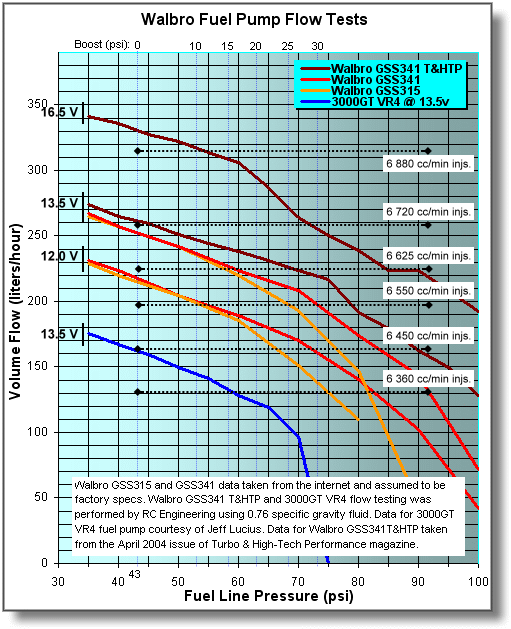
Running more voltage to it doesn’t increase the point where it stops working well, it just increases the flow somewhat at that same pressure. Walbro is pretty adamant that feeding over about 16VDC to their pumps does nothing but cause capitation (decreasing flow) and shorten their life.
There are a few OEM pumps that are capable of significant flow at higher pressures (the denso that was used in the supras, bosch used in porsches and some of the high end eurocars, and airtex that was used in some cadillacs and as a replacement part for the bosch part number that was used in the eurocars), but even these drop off badly past about 85-95psi. FWIW, these were all frame mounted and had to be quiet considering the applications that they were used in. To accomplish this they were built larger (a couple of inches longer and maybe 1.5x the diameter) of a comparable walbro pump. These were also used in a number of aftermarket setups, for example the bosch pump was used in the cartech kits and the airtex pumps are used in some supercharger and turbocharger kits.
Now when it comes down to it, with the fmu, you’ll probably be asking this thing to work at 100-maybe as high as 120psi. The only way to do that with these pumps is to put 2 of them inline. That way, assuming 2 similar pumps, at 120 psi both pumps only really have to pump a pressure differential of 60psi so they will flow what they would at 60psi (slightly simplified, in real life one will probably flow more then the other at the same pressure, but the end result is the same).
2- now ignoring the fact that you were asking specifically for high pressure use with an fmu:
There are twin pump setups that can be bought if you’re not up to fabricating, for that matter there are a bunch of ways that someone could do something like this, and it’s not that hard.
OK, so how did ford do it? I find it interesting that ford appears to have thrown in the towel with trying to supply fuel with larger parts and has gone with multiples of smaller stuff. Twin intank pumps on the lighning, cobra, GT40, twin smaller injectors… As far as all this goes, I’d probably consider running 2 pumps all the time, but just running a lower voltage to the relay under low demand conditions, it would save you a bunch of wiring and weight.
More of a band aid then not installing anything that actually flows enough and just trying to force it by running the pump at more voltage then it was designed to run at? For that matter, show me a pump that can flow a significant amount at 120psi or so and still costs something reasonable and I’ll agree that a second inline pump is not the best way to do it.
Adding a second pump, whether inline or parallel (intank) is the only solution that will absolutely supply enough fuel without pushing anything to do something that it wasn’t designed to do, and neither twin pumps in parallel or a BAP will work well at higher pressures.
1- the fact is that when it comes down to it none of the pumps that we’re discussing here are worth a damn at over about 70-80psi, and most aren’t worth anything over about 60-65psi. It doesn’t matter what voltage your run them at or anything:
Running more voltage to it doesn’t increase the point where it stops working well, it just increases the flow somewhat at that same pressure. Walbro is pretty adamant that feeding over about 16VDC to their pumps does nothing but cause capitation (decreasing flow) and shorten their life.
There are a few OEM pumps that are capable of significant flow at higher pressures (the denso that was used in the supras, bosch used in porsches and some of the high end eurocars, and airtex that was used in some cadillacs and as a replacement part for the bosch part number that was used in the eurocars), but even these drop off badly past about 85-95psi. FWIW, these were all frame mounted and had to be quiet considering the applications that they were used in. To accomplish this they were built larger (a couple of inches longer and maybe 1.5x the diameter) of a comparable walbro pump. These were also used in a number of aftermarket setups, for example the bosch pump was used in the cartech kits and the airtex pumps are used in some supercharger and turbocharger kits.
Now when it comes down to it, with the fmu, you’ll probably be asking this thing to work at 100-maybe as high as 120psi. The only way to do that with these pumps is to put 2 of them inline. That way, assuming 2 similar pumps, at 120 psi both pumps only really have to pump a pressure differential of 60psi so they will flow what they would at 60psi (slightly simplified, in real life one will probably flow more then the other at the same pressure, but the end result is the same).
2- now ignoring the fact that you were asking specifically for high pressure use with an fmu:
Originally posted by Willie
It all has to do with the amount of labor one is willing to perform. If you are willing to pull the tank and fab a custom twin in-tank setup, all the power to you.
It all has to do with the amount of labor one is willing to perform. If you are willing to pull the tank and fab a custom twin in-tank setup, all the power to you.
If you decide to go this route, you'll have to decide how to wire the second pump. Most, if not all, actuate the second pump with a Hobbs switch, turning it on at a specific boost level. Maybe this is the preferred method because no one knows there's an alternative. My Lightning as stock twin in-tank pumps and the way Ford wired both pumps ingenius in my opinion. I won't let out the secret.... yet....
Going with an in-line is only a band-aid in my opinion. This "system" was created so one would not have to access their in-tank pump, as far as I can tell
…
If you want to add an in-line electrical module (BAP), it takes all but 30 minutes and you don't get your hands dirty. Mine is placed under my rear seat.
…
If you want to add an in-line electrical module (BAP), it takes all but 30 minutes and you don't get your hands dirty. Mine is placed under my rear seat.
Bottom line: All three methods work to some degree or another. Cost: Adding a second pump will probably cost $100 - $200, depending on pump and with a lot of fabrication. An in-line is simple to install but I'd recommend hot-wiring both pumps. A BAP, depending on the amperage model you choose (20 or 40 amp), ranges from $180 - $220, last I recall and is extremely simple to install. It's your call.

Thread
Thread Starter
Forum
Replies
Last Post
NBrehm
Engine/Drivetrain/Suspension Parts for Sale
1
Aug 25, 2015 11:49 PM
