When you click on links to various merchants on this site and make a purchase, this can result in this site earning a commission. Affiliate programs and affiliations include, but are not limited to, the eBay Partner Network.
Organized Drag Racing and AutocrossDrag racing and autocross discussions and questions. Techniques, tips, suggestions, and "what will I run?" questions.
I am still using the factory fronts, curious to see how it works if you change these out. For me I am waiting and saving pennies until I get wilwoods light weight front setup.
I am still using the factory fronts, curious to see how it works if you change these out. For me I am waiting and saving pennies until I get wilwoods light weight front setup.
How far do you have to press the pedal until you start getting clamping on the fronts?
First pump, about 1/3 pedal travel, however I have a 15/16 bore cylinder. I foot brake the car and push the pedal down 1/2 way, set the line lock then push into the beams, then, while holding the line lock (biondo) I pump the brakes 2 more times.
With that I have a good pedal, and am not worried about locking them up. When I go through the beams I push half way down, then let up and start back down on the pedal.
I am sure there are better ways, but that has always worked good for me.
I ran it on my thirdgen for a little while. I have hydroboost on my other vehicles (daily drivers). For a daily driver hydroboost is great, especially if it's a blown motor. Hydroboost is consistent.
The down side to hydroboost is the hoses and space everything takes up. My firebird is more of a track-only car, and I felt that I'd rather trade a simple pulley setup and manual brakes.
Thanks! I'm looking at a procharged sbc with dry sump, I'm running 14" rotors & 6 piston calipers, but for the hp & tq this thing is going to make coupled with the top speed I'm trying to achieve. ... I want as much WOW! as possible.
Thanks! I'm looking at a procharged sbc with dry sump, I'm running 14" rotors & 6 piston calipers, but for the hp & tq this thing is going to make coupled with the top speed I'm trying to achieve. ... I want as much WOW! as possible.
My car won't stop safely. I've bleed the crap out of the calipers.
I'm going to buy the speedway non-low drag calipers and give that a try. I think the low-drag have way too much take up, so the brakes don't actually start clamping the rotor until the pedal is almost at the end of it's travel.
I'd figure out the problem before replacing more parts. Does the pedal come up if you pump it? Plug one section of the MC and see how the pedal is, this will show you what section the problem is in. If necessary plug both outlets, if pedal is low it's in the MC.
I'd figure out the problem before replacing more parts. Does the pedal come up if you pump it? Plug one section of the MC and see how the pedal is, this will show you what section the problem is in. If necessary plug both outlets, if pedal is low it's in the MC.
I'm getting full stroke of the master.
I did some more research and it seems the low-drag calipers have a lip in the seal which retracts the piston in the bore. This requires some fluid to take up the clearance before they actually start compressing the pad. It seems others have had the same problem I'm having, so I ordered the large bore calipers anyway. Will give that a try this week.
The question I have now is, are my rear PBR calipers going to have the same issue...
You guys have any issues with the rod binding in the master?
Mine seems ok when pressing on the brackets, but when releasing the pedal it binds, so the last 1/2" or so of (pedal) travel it has to be pulled by hand. I get an audible "squeak", so something is binding. thought it was the heim joint but doesn't appear to be.
I wonder if maybe rod is binding in the master itself due to the angle. ?
To get the proper angle, the rod should be attached to the brake pedal roughly 1" higher on the pedal. This will also give more mechanical leverage.
I drilled the hole 1" higher. I'm using the BMR adapter, mopar master.
I just get this slight bind when the pedal is almost all the way returned. I have to pull it back the last little bit.
I'm torn between getting rid of the heim joint and using a traditional brake push rod (that floats), or trying a pedal return spring like on manual brake corvettes.
But I was wondering if maybe the ball end of the pushrod is getting cocked in the master bore. maybe grind it a hair undersize ? On the mopar master, the rod goes in like 1" inches so it doesn't give a whole lot of leeway when it comes to angle.
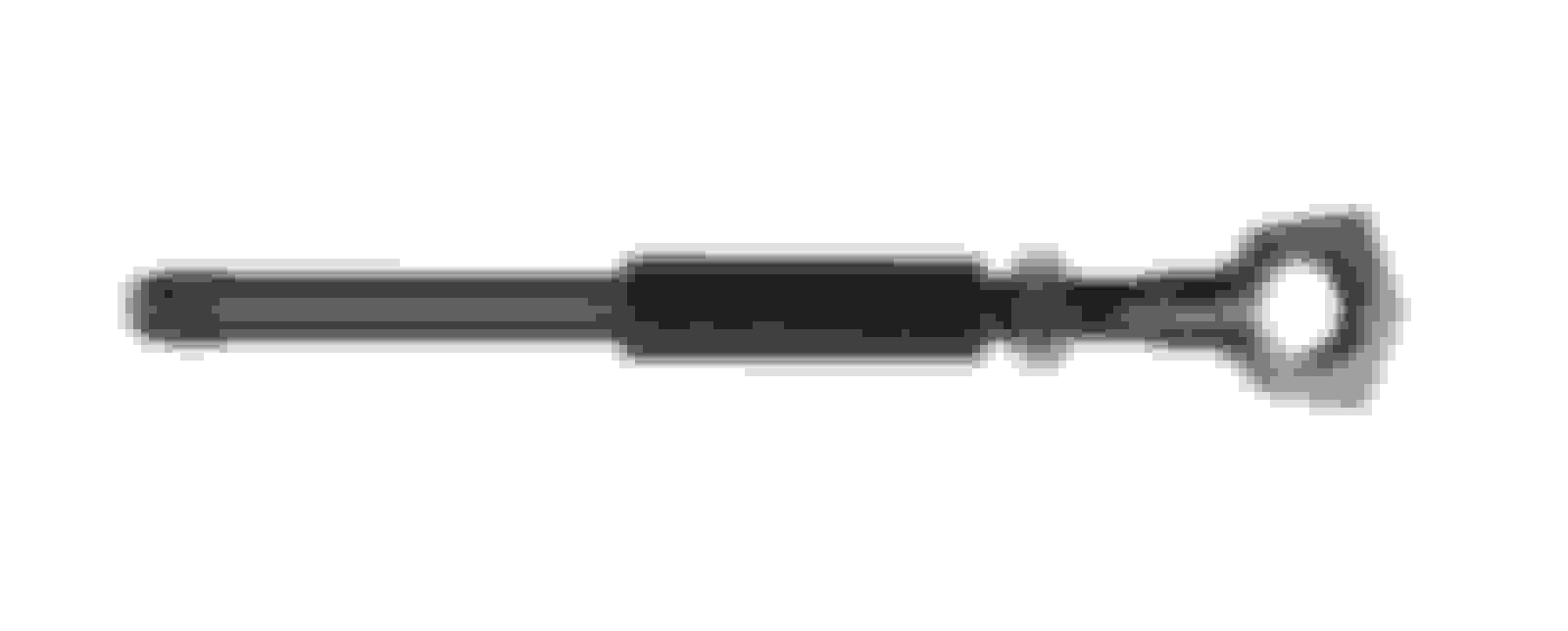
Not all heim joints are the same. Mine just uses a heim joint to attach a 3/8" rod to the brake pedal that pushes into the master cylinder. I don't think it was anything fancy. It may have even been the OEM rod. If using round stock for a rod, make sure the end that goes into the master cylinder is ground to a rounded end.
This picture might be a few pages back in the thread but here it is again. Glad it doesn't look that ugly under my dash any more.
Not all heim joints are the same. Mine just uses a heim joint to attach a 3/8" rod to the brake pedal that pushes into the master cylinder. I don't think it was anything fancy. It may have even been the OEM rod. If using round stock for a rod, make sure the end that goes into the master cylinder is ground to a rounded end.
This picture might be a few pages back in the thread but here it is again. Glad it doesn't look that ugly under my dash any more.
That's essentially how mine looks, but I'm using the rod that came with the BMR kit.
I'll play with it more tomorrow. It's got to be the ball end is too big.
I just get this slight bind when the pedal is almost all the way returned. I have to pull it back the last little bit.
Your push rod should be at a slight downward angle when the brake pedal is not pressed because of the way the geometry of the stock third gen pedal assembly is designed.
I am also guessing that the BMR push rod slides into the master cylinder piston's retention "hole" or "cup".
When your brake pedal is fully pressed in when braking, the push rod should be inline with the master cylinder piston. When it returns to the resting position, the push rod will start binding inside the master cylinder piston's retention "hole" or "cup" because it has a slight downward angle. The retention "hole" or "cup" is not much larger is diameter than the push rod itself which is causing the binding.
Best remedy is to reduce the diameter of the push rod that slides into the cup. You can keep the same diameter at the tip of the push rod that goes inside the retention "cup", but neck it down from there to just outside the retention "cup". This should give you enough clearance for it not to bind.
If the push rod is 3/8" in diameter, just neck it down to 5/16" in diameter. I don't have the exact diameters in front of me, this would be an example.
I hope what I wrote made sense. Let me know if you have additional questions.
Your push rod should be at a slight downward angle when the brake pedal is not pressed because of the way the geometry of the stock third gen pedal assembly is designed.
Ok so. the BMR pushrod is missing the little plastic bushing thing, so it allows it to be at a more severe angle then correct. To use the bottom hole (1.25" above stock) the rod binds on the master itself.
I picked up another pushrod, with the little palstic thing and stuck it inside the master. This pushrod only allows a very slight angle to drop (and prevents it from binding) I'm guessing because of that little plastic bushing:
But this requires me to run the hole 1 5/8" above the stock location. I'm not sure that I'm going to get enough piston travel. It's 2 1/8" down from the pivot.
I can grind the pushrod down and remove that little bushing, but I can't help but feel like that's against the design.
I feel like the adapter on the firewall should have been milled at a slight angle (kinda like the brake booster bracket is). I also noticed that the fluid in the resevoir is about 1/2" higher in the front than the back, meaning the front is nosing down. This seems to make sense based on my pushrod issue.
So.. I know what the problem(s) are. I'm not sure what the correct solution is.
Ok so. the BMR pushrod is missing the little plastic bushing thing, so it allows it to be at a more severe angle then correct. To use the bottom hole (1.25" above stock) the rod binds on the master itself.
I picked up another pushrod, with the little palstic thing and stuck it inside the master. This pushrod only allows a very slight angle to drop (and prevents it from binding) I'm guessing because of that little plastic bushing:
But this requires me to run the hole 1 5/8" above the stock location. I'm not sure that I'm going to get enough piston travel. It's 2 1/8" down from the pivot.
I can grind the pushrod down and remove that little bushing, but I can't help but feel like that's against the design.
I feel like the adapter on the firewall should have been milled at a slight angle (kinda like the brake booster bracket is). I also noticed that the fluid in the resevoir is about 1/2" higher in the front than the back, meaning the front is nosing down. This seems to make sense based on my pushrod issue.
So.. I know what the problem(s) are. I'm not sure what the correct solution is.
-- Joe
I know it's been awhile, but how's your brakes? I have stock disc brakes front/rear and can't decide which master will be best, 7/8, 15/16, or 1.03
Also if I should change front and rear calipers to non drag Afco or just front and if so, which master goes with that setup?
I know it's been awhile, but how's your brakes? I have stock disc brakes front/rear and can't decide which master will be best, 7/8, 15/16, or 1.03
Also if I should change front and rear calipers to non drag Afco or just front and if so, which master goes with that setup?
The front calipers are the only ones that are LOW drag and will need a step bore master cylinder to work. If you go with a strait bore master cylinder, the front calipers will need to be changed to NON low drag (normal) calipers.
From my experience, any rebuild/reman caliper should be a normal, NON drag caliper.
Depending on your rear caliper piston diameter, you will need either a 7/8" or 15/16" bore master cylinder. For stock sized calipers from and rear, the 1.03" bore is too large and will cause a hard pedal with low clamping forces at the calipers.
If you are going to use the stock size front calipers and rear calipers with a piston diameter under 2.0" (or under 3.14 square inches of piston area) go with the 7/8" bore master cylinder. Above 2.0" in diameter (or above 3.14 square inches of piston area) go with a 15/16" or 24mm bore master cylinder.
If you calipers will be the same metric calipers front and rear, you will need to go with a 15/16" or 24mm bore master cylinder.
Last edited by manualbrakes.com; Mar 10, 2017 at 08:31 AM.
The front calipers are the only ones that are LOW drag and will need a step bore master cylinder to work. If you go with a strait bore master cylinder, the front calipers will need to be changed to NON low drag (normal) calipers.
From my experience, any rebuild/reman caliper should be a normal, NON drag caliper.
Depending on your rear caliper piston diameter, you will need either a 7/8" or 15/16" bore master cylinder. For stock sized calipers from and rear, the 1.03" bore is too large and will cause a hard pedal with low clamping forces at the calipers.
If you are going to use the stock size front calipers and rear calipers with a piston diameter under 2.0" (or under 3.14 square inches of piston area) go with the 7/8" bore master cylinder. Above 2.0" in diameter (or above 3.14 square inches of piston area) go with a 15/16" or 24mm bore master cylinder.
If you calipers will be the same metric calipers front and rear, you will need to go with a 15/16" or 24mm bore master cylinder.
Great thank you. That clears it up. I think I'm just going to transfer my factory brakes onto my 9".
Also, gonna run new lines so can I eliminate proportioning valve like some have suggested? Skinnies up front.
In my opinion, With large, wide tires in the back and small, skinny tires up front, the prop valve becomes fairly useless. The bias that is built in to the stock prop is for the same size tires on all four corners. You will also NOT need an adjustable prop valve in the rear line for rear disc brakes as it will, most likely, be turned open all the way anyway.
In my opinion, With large, wide tires in the back and small, skinny tires up front, the prop valve becomes fairly useless. The bias that is built in to the stock prop is for the same size tires on all four corners. You will also NOT need an adjustable prop valve in the rear line for rear disc brakes as it will, most likely, be turned open all the way anyway.
Should I move the master up like you did? You don't sell any more kits do you? Seems most adapters keep MC in Stock location.
I guess if you are drilling a 2" higher hole, then having MC moved up is optimal for pushrod. Trying to read all your posts over this topic.
Should I move the master up like you did? You don't sell any more kits do you? Seems most adapters keep MC in Stock location.
I guess if you are drilling a 2" higher hole, then having MC moved up is optimal for pushrod. Trying to read all your posts over this topic.
I do sell the KITS. My website is going through a design change and hopefully it will be up by the end of the day. You can still purchase through my eBay account until the "new and improved" website is back up and running.
I recommend going up on the firewall and mounting the master cylinder between the upper bolt holes from the vacuum booster bracket. From this mounting location for the master cylinder, you can drill a hole in the brake pedal arm 2.0" down from the brake pedal pivot point and have the correct push rod geometry and a higher 6 to 1 pedal ratio. I would not recommend this pedal ratio with the master cylinder mounted lower than the upper two hole as it will have bad push rod geometry that will decrease master cylinder piston stroke during the last 1/2 of the brake pedal range of motion. Its easier to see what I am talking about with the brake pedal assembly mocked up on the bench and watching the geometry as the brake pedal goes through its range of motion.
If you use other manual brake kits on the market, go by their recommendation on where to drill on the pedal. Regardless of which manual brake KIT you purchased, the push rod should be level (or inline) with the master cylinder piston at the END (or bottom) of the pedal stroke to keep the geometry correct. This is how the geometry is set up on the manualbrakes.com KIT and is optimal for the 3rd gen f-body brake pedal assembly.