

I have an '86 Firebird with the LG4 still carbed by the original carb. We have it running, but it's running extremely rich. So rich that at part throttle it doesn't seem like it wants to accelerate at all, and slowly raises RPMs. We tried adjusting the fuel air mixture after we got the tool, but it doesn't change anything untill they are either all the way in or all the way out. We think we had a vacuum leak that I just took care of, and I was about to go check on adjusting the mixture again, but I figured I'd stop by here to ask you guys what you thought. I just got this back on the road after it sitting for a few months, and I wasn't sure exactly what it could be, and how I am supposed to adjust the fuel air mixture. thanks.


Those screws don't adjust anything other then idle mixture. Your carb is computer controlled, so the computer should be doing something with the mixture. The only way i know to change the mixture though is to change the metering rods.

Moderator
At idle and part-throttle the mixture should be controlled by the computer, changing the rods and jets is really only going to make a difference at WOT.
Then do I need a new ECM? I'm only getting 18 inches of vacuum at idle, but I can't seem to find any vacuum leaks. I'll check better tommorrow, but I think everything is good and plugged
Only 18", thats plenty.
BTW, the SES light is on, but I can't seem to pull a code from it. I put a paper clip into the top left two connectors, and nothing. Am I doing it right?


No. You're not quite doing it right.
The first thing to do is retrieve the error codes and solve the problems detected by the ECM. That will eliminate the SES light and possibly a few of your operational issues. To retrieve the codes, insert a jumper between the 'B' and 'A' terminals of the ALDL connector under the dash.
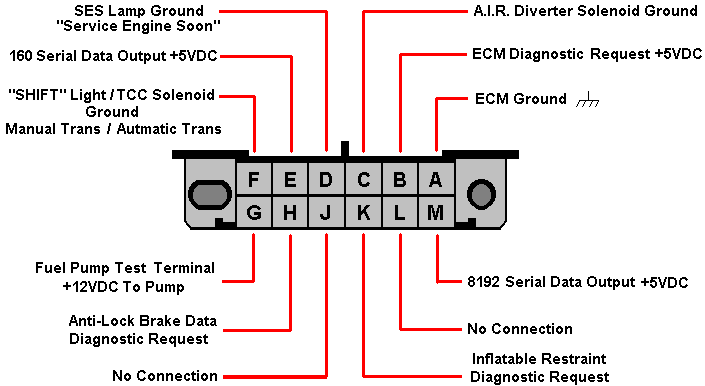
Turn on the ignition, but DO NOT start the engine. Error codes will be displayed via the flashing SES lamp. Count the flashes and pauses to decode the output. Each code will repeat three times. The first code you should get is a "12" - One flash, a pause, then two flashes. Then subsequent codes will be displayed in numerical order. Once the ECM has displayed all stored codes, it will display a "12" and start the process over. This will continue until the jumper is removed or the ignition is turned off.
When all error code numbers have been noted, turn off the ignition and remove the jumper. Decode the error numbers with this: Error Codes.pdf
Solve those problems, and I may have some more information for you to properly tune a Rochester E4ME feedback carburetor.
The first thing to do is retrieve the error codes and solve the problems detected by the ECM. That will eliminate the SES light and possibly a few of your operational issues. To retrieve the codes, insert a jumper between the 'B' and 'A' terminals of the ALDL connector under the dash.
Turn on the ignition, but DO NOT start the engine. Error codes will be displayed via the flashing SES lamp. Count the flashes and pauses to decode the output. Each code will repeat three times. The first code you should get is a "12" - One flash, a pause, then two flashes. Then subsequent codes will be displayed in numerical order. Once the ECM has displayed all stored codes, it will display a "12" and start the process over. This will continue until the jumper is removed or the ignition is turned off.
When all error code numbers have been noted, turn off the ignition and remove the jumper. Decode the error numbers with this: Error Codes.pdf
Solve those problems, and I may have some more information for you to properly tune a Rochester E4ME feedback carburetor.
Thats what I was doing. I inserted the paper clip between the A and B slots and turned the ignition on. The SES light did not flash once.
Well, after driving it to work today, the SES light went out. It never came on on my way home. I stopped and got gas, then drove to work, just down the street. All this time the light was on. After work, started the car, and it took off like a top. No light. However, it still stumbles under acceleration untill it hits about 2500 RPMs. After that it takes off, untill I floor it, then it looses power. Is this due to my father adjusting the air/fuel mixture screws on the carb? This car did sit for about 5 months, so it may just need to stretch it's legs a bit, but I was just wondering if anyone had any ideas if it was something serious. We bought a scanner today that we'll get the codes with tommorrow, and I'll post up what codes were thrown. We bought the scanner because we have a bunch of GM vehciles we can use it on, and would rather not rely on the paper clip trick. That coupled to the fact that I can't get that trick to work, we bought the scanner. :-) only 25 bucks, so we can't complain.

Junior Member
Cyfun
Junior Member
close
Aug 1, 2011
- Join DateFeb 2004
- LocationBillings, MT
- Posts:51
- iTrader Positive Feedback0
- iTrader Feedback Score(0)
- Car'83 Trans Am, Black on Red
- EngineLG4 305ci V8 w/ CCC-Qjet
- TransmissionRebuilt 700r4
- Axle/Gears4th gen 2.37 posi w/disc brakes
- Likes:0
- Liked:0 Times in 0 Posts
You say you put the paper clip between the two top left connectors, and you also say the A and B connectors. A and B are at the top right. It goes alphabetically, but from right to left on the top row and left to right on the bottom row. 
I have the same problem with my '83 and '84 'birds, and I'm pretty sure its a sneaky vacuum leak. I've gone through most all of the vacuum lines, however, and they still tend to run rich and bog. I'm starting to suspect my carb gasket or intake gaskets, though.
I have the same problem with my '83 and '84 'birds, and I'm pretty sure its a sneaky vacuum leak. I've gone through most all of the vacuum lines, however, and they still tend to run rich and bog. I'm starting to suspect my carb gasket or intake gaskets, though.
the O2 sensor is pretty much brand new, but we did backfire through the exhaust, so we may have blown it. However, would it stop sending a code once the car warmed up? I do mean the A and B connectors. I have a hard time with left and right. I'm 18 and still can't remember which is which off the top of my head. LOL. Darn mental deficincies.

Member
A backfire through the exhaust won't hurt an O2 sensor.
If you do have any exhaust leaks, it will cause the backfire since it'll suck in air and ignite unburnt fuel.
A leak will also cause the system to run rich since it sees the air coming into the pipe as a lean condition.
If you do have any exhaust leaks, it will cause the backfire since it'll suck in air and ignite unburnt fuel.
A leak will also cause the system to run rich since it sees the air coming into the pipe as a lean condition.
well, we had to take out and reinstall the exhaust manifolds, so there shouldn't be a leak there. We did not use exhaust manifold gaskets when we put this back together. Is that our problem? Should we have put those gaskets in to seal everything? I was told that unless you use headers, you don't really need gaskets. Thanks for helping me trouble shoot this system. I tried to pull the codes today, but I guess the reason behind the SES light going out was it lost it's connection. BTW, a rich condition at idle would clear itself up as you accelerated, right? It seems to be shaky and weak below 2500RPMs, but once over that it seems to rev and move fine. I pushed down hard on the accelerator from a stop last night, and the car almost died out on me, untill I backed off a bit, then it picked right up and took off.

Member
What's the timing set to? Most small blocks like a little advance. I had all kinds of problems with my 83 S/E w/rochester. When I tried to start the car one time, it shot a flame up out of the carb! I took the whole front of the engine apart, hoisted the engine up a little bit, and changed the timing chain/gears. After that, it ran pretty good, but still had a bog to it. Especially if you would stomp it. I got a rebuilt carb for a couple hundred bucks, and then problem was solved.
We put the timing as spot on as we could to keep the thing running. I'm not 100% sure if it is exactly on 0 or not. I'll talk to my father and tell him it may just want a bit of advance. Thanks for the help. We'll give it a shot.
Any luck retrieving the error codes? You should still be able to read something, since the codes are usually stored for the last 50 start/run cycles, and will remain that long unless the battery power is disconnected from the ECM.

Supreme Member
When you set the timing, did you disconenct the 4-pin connector hanging out of the back of the distributor?
I don't believe we disconnected anything from the back of the distributor.
We can't get the codes bceause the SES light is not working. It does not go on when you start the car anymore. I have to track down the wiring and see if I can fix it.
We can't get the codes bceause the SES light is not working. It does not go on when you start the car anymore. I have to track down the wiring and see if I can fix it.
Supreme Member
You may recall from working on the dist before, that there's a 4-pin plug hanging off the back of it, on a pigtail about 10" or so long. You disconnect that, then you set the timing, then you turn the car off and hook it back up. You'll find when you hook it back up that the timing goes to about 20° BTDC, which is where it's supposed to be when the ECM is properly controlling it from the point where it's supposed to properly be set. If you didn't disconnect it, your timing is now about 15° retarded from where it's supposed to be. That will surely make a car run terrible.
For that situation, try doing it right; then go from there. I'd suggest setting it to about 6° BTDC.
As far as the bulb, don't start ripping into the wiring. That's a great way to end up with a car that doesn't work. Odds are very good the problem isn't the wiring.
I'd recommend you start by changing out the bulb.
For that situation, try doing it right; then go from there. I'd suggest setting it to about 6° BTDC.
As far as the bulb, don't start ripping into the wiring. That's a great way to end up with a car that doesn't work. Odds are very good the problem isn't the wiring.
I'd recommend you start by changing out the bulb.
okay, timing is set properly, and there is definately a hugh difference in idle quality. Now we have just one problem left to figure out. Why it looses it's power at full throttle. I haven't tried to peel out as I'm trying to go easy with the car, but the full throttle bouts are funny. It just doesn't seem like the car is pulling half as hard as it should. It feels like it's pulling more at less throttle. Could is be from my dad messing with the air/fuel screws? I know that at evertyhing besides full throttle the ECM watches over the mixture, you guys told me that. Does it also do it at full throttle, or is that up to the screws my father played around with?
Also, the SES light problem is wiring, because it was fading and comming back, then going out in sync with my leg pressure on the center radio pod the other day while I was driving. I'm assuming it's nothing major though.
Also, the SES light problem is wiring, because it was fading and comming back, then going out in sync with my leg pressure on the center radio pod the other day while I was driving. I'm assuming it's nothing major though.

Junior Member
Quote:
Originally posted by RB83L69
You may recall from working on the dist before, that there's a 4-pin plug hanging off the back of it, on a pigtail about 10" or so long. You disconnect that, then you set the timing, then you turn the car off and hook it back up. You'll find when you hook it back up that the timing goes to about 20° BTDC, which is where it's supposed to be when the ECM is properly controlling it from the point where it's supposed to properly be set. If you didn't disconnect it, your timing is now about 15° retarded from where it's supposed to be. That will surely make a car run terrible.
For that situation, try doing it right; then go from there. I'd suggest setting it to about 6° BTDC.
As far as the bulb, don't start ripping into the wiring. That's a great way to end up with a car that doesn't work. Odds are very good the problem isn't the wiring.
I'd recommend you start by changing out the bulb.
Originally posted by RB83L69
You may recall from working on the dist before, that there's a 4-pin plug hanging off the back of it, on a pigtail about 10" or so long. You disconnect that, then you set the timing, then you turn the car off and hook it back up. You'll find when you hook it back up that the timing goes to about 20° BTDC, which is where it's supposed to be when the ECM is properly controlling it from the point where it's supposed to properly be set. If you didn't disconnect it, your timing is now about 15° retarded from where it's supposed to be. That will surely make a car run terrible.
For that situation, try doing it right; then go from there. I'd suggest setting it to about 6° BTDC.
As far as the bulb, don't start ripping into the wiring. That's a great way to end up with a car that doesn't work. Odds are very good the problem isn't the wiring.
I'd recommend you start by changing out the bulb.
Junior Member
Sorry sent by mistake

Junior Member
when i could no longer recieve codes, i found out i had a bad lamp driver module. look on a wiring schematic, its located on the pass side under the dash, hidden very well close to the ecm. its a printed circut board about 1" by 2" that controls the ses light. it slips into its own little wiring harness. bought mine a GM dealer for around 30 bucks, got the second one free at the local salvage yard, now that i know what to look for.it took me forever to figure this out!!