


Crankshaft


Thread Starter
Junior Member
Joined: May 2005
Posts: 96
Likes: 0
From: Florida
Car: 86 Camaro
Engine: 305
Transmission: 5 speed
Crankshaft
Hi Guys
I'am looking for a little info here, My engine spun a bearing and I was wondering what options do I here? 1st My crank now has this nice little groove on side , can I get this machined out? and if so does that mean new pistions and rods. cam ect...
Thanks
btw it's a 305 engine.
I'am looking for a little info here, My engine spun a bearing and I was wondering what options do I here? 1st My crank now has this nice little groove on side , can I get this machined out? and if so does that mean new pistions and rods. cam ect...
Thanks
btw it's a 305 engine.


Joined: Sep 2005
Posts: 27,893
Likes: 2,436
Car: Yes
Engine: Usually
Transmission: Sometimes
Axle/Gears: Behind me somewhere
Re: Crankshaft
can I get this machined out?
A better way to go would be to go to your local "real" parts store.... Car Quest, Parts Plus, NAPA, or the like... and get a "crank kit". It'll be a crank, ready to run, with the correct bearings, all in a box. Turn your smoked one in as a core and move on.
All this of course, assuming there's nothing else wrong with the motor; no metal shavings all in every oil passage dor example, which would just immediately destroy any crank you put in it, until it's torn ALL THE WAY down and cleaned up. Which would require new rings and probably pistons and therefore probably boring, and therefore would be beyond stupid to do to a 305. And assuming also, that the pistons and rings, and the cam and everything else, is good to go, and just some tragedy occurred out of the clear blue to the crank.
But, if you think you can get away with crank-kitting it, then that's the best and lowest $$ way to do it. Cheaper and higher probability of success than having that particular same crank machine-worked, and re-using it.
Avoid, AT ALL COSTS, taking the heads off and pulling the pistons out. If it doesn't NEED that, DON'T DO IT. Once you pull the pistons, you're looking at the exact same $$$ to rebuild that 305, as to rebuild a 350; so for $50 or whatever more for a 350 core block (all you have let out of your 305 that's any "good", if you even can call a 305 block "good"), you can have a 350 instead. As said, BEYOND STUPID at that point, to spend $1500 rebuilding a 305, when for the same OR LESS money, you can have a 350 instead.
Thread Starter
Junior Member
Joined: May 2005
Posts: 96
Likes: 0
From: Florida
Car: 86 Camaro
Engine: 305
Transmission: 5 speed
Re: Crankshaft
I already have pulled this motor out and all torn down, I just don't know if I have the money to buy a 350 and then spend money to rebuild it. I orginally was going to tear this motor down and freshen it up with some new bearings and a full gasket set, and heads redone.
Now if I could possiably squeeze out a 350 block what parts can I use from my 305 ?
Now if I could possiably squeeze out a 350 block what parts can I use from my 305 ?
Joined: Sep 2005
Posts: 27,893
Likes: 2,436
Car: Yes
Engine: Usually
Transmission: Sometimes
Axle/Gears: Behind me somewhere
Re: Crankshaft
Freshen up w / new bearings & gaskets = keep this motor
Have to pull the pistons out = throw this one in the trash and get another
If you've already pulled the pistons out, the die is cast; it's boring, pistons, and the whole 9 yards; you shouldn't have done that
Too simple
Whether you "think" you can "afford" it; well, you'll just have to take that up with the parts. Don't talk to us about it here, not our problem. Sometimes you gotta do what you gotta do even if it hurts. Sometimes you get lucky. I guess you'll be finding out which.
Have to pull the pistons out = throw this one in the trash and get another
If you've already pulled the pistons out, the die is cast; it's boring, pistons, and the whole 9 yards; you shouldn't have done that
Too simple
Whether you "think" you can "afford" it; well, you'll just have to take that up with the parts. Don't talk to us about it here, not our problem.
Sometimes you gotta do what you gotta do even if it hurts. Sometimes you get lucky. I guess you'll be finding out which. 
Member
Joined: Feb 2008
Posts: 219
Likes: 0
From: Antelope Valley, Ca...So.Cal.
Car: was 85 TA, 91 TA both sold
Engine: was 406, now 305 tpi
Transmission: 85 had700r4,350..91 had t5
Axle/Gears: 323,373,342
Re: Crankshaft
Take the crank to a machine shop and ask them if it's ok. If it can be saved ask how much $. Your crank,rods,piston are a balanced rotating assembly I assume you marked where everything belongs # 1 cylinder marked on piston and rod for #1 cylinder. If the crank is ok and you can put everything back where it belongs and your ok. Refresh the block by new bearings and maybe ball honing the block and reringing the pistons. If the block is bare have it cleaned. Ask the machine shop for a quote should be the best way to go if the crank is ok. Refresh the heads while your at it up grade the intake, cam and lifters then your turning lemons into lemonaide. The motor will be better than new. Don't worry if the crank needs to be turn 30 under it's still fine. Check your block it may have the 3 raised bosses to use a roller cam...maybe. If that is the case put pich a cam and and OEM lifters in it and have a great little motor.

Supreme Member
iTrader: (1)
Joined: Jul 2004
Posts: 10,763
Likes: 4
From: Calgary, AB, Canada
Car: 1982 Trans-Am
Engine: 355 w/ ported 416s
Transmission: T10, hurst shifter
Axle/Gears: 10 bolt, true-trac, 3.73
Re: Crankshaft
You need to read between the lines of what sofa said.
Unlikely. 
If you spun a bearing, chances are good that whatever the bearing spun IN (rod big end, main cap) would have gotten hot, and distorted, and needs to be replaced as well. Now you're not only in the capital city of "350 land", YOU'RE THE MAYOR!! What's your first decree?
just some tragedy occurred out of the clear blue to the crank.
If you spun a bearing, chances are good that whatever the bearing spun IN (rod big end, main cap) would have gotten hot, and distorted, and needs to be replaced as well. Now you're not only in the capital city of "350 land", YOU'RE THE MAYOR!! What's your first decree?
Member
Joined: Feb 2008
Posts: 219
Likes: 0
From: Antelope Valley, Ca...So.Cal.
Car: was 85 TA, 91 TA both sold
Engine: was 406, now 305 tpi
Transmission: 85 had700r4,350..91 had t5
Axle/Gears: 323,373,342
Re: Crankshaft
If you have spun a bearing so bad that the block has got so hot that the bearing saddle is discolored.....well that's bad. I know guys that have tried to save the block with difference ways and the same bearing will spin again when put under a load. Then you are right back here again. If the block is bad forget the rods you have bigger issues.
Trending Topics
Thread Starter
Junior Member
Joined: May 2005
Posts: 96
Likes: 0
From: Florida
Car: 86 Camaro
Engine: 305
Transmission: 5 speed
Re: Crankshaft
The Block seems to be in good shape. The cam bearings look like hell but they have to be replaced after a hot tank bath anyway, as for the crank I will take down to a machine shop and get there opinon on it, But in the mean time I'am gonna do a little search around town here for a 350 engine. and see which way I wanna go.
Are the motor mounts the same for a 350?
Are the motor mounts the same for a 350?
Supreme Member
iTrader: (1)
Joined: Jul 2004
Posts: 10,763
Likes: 4
From: Calgary, AB, Canada
Car: 1982 Trans-Am
Engine: 355 w/ ported 416s
Transmission: T10, hurst shifter
Axle/Gears: 10 bolt, true-trac, 3.73
Re: Crankshaft
Yep, everything is the same.
You'll have a two piece RMS 305, so a 2pc RMS 350 will just fall right in there and bolt up to all the 305 stuff.
Only issue will be manifolds if the dipstick is LHS.
You'll have a two piece RMS 305, so a 2pc RMS 350 will just fall right in there and bolt up to all the 305 stuff.
Only issue will be manifolds if the dipstick is LHS.
Member
Joined: Feb 2008
Posts: 219
Likes: 0
From: Antelope Valley, Ca...So.Cal.
Car: was 85 TA, 91 TA both sold
Engine: was 406, now 305 tpi
Transmission: 85 had700r4,350..91 had t5
Axle/Gears: 323,373,342
Re: Crankshaft
While looking for the block if you find a 350 crank it is the same as the 305 crank. The last 3 casting # are 442. If you where closer I have a 350 4 blt virgin bare block(has main caps) but I'm in So Cal.

Re: Crankshaft
The last 305 I was going to rebuild I stop myself . Then I checked My local Craigs list and now I have 5 350 long blocks . Every weekend I was buying one . My Wife thought I was buying every engine in IL . The most I payed for a full long block 350 4 bolt main carb to pan was $400 bucks . The cheapest one was a 1971 350 2 bolt with low miles short block with the tin $75.00 bucks . Or before you rebuild that 305 . I am sure some one here that lives near you . will give you one of there good 305s thats just sitting and that is of no use to them !
Thread Starter
Junior Member
Joined: May 2005
Posts: 96
Likes: 0
From: Florida
Car: 86 Camaro
Engine: 305
Transmission: 5 speed
Re: Crankshaft
Ok I think I found a 350. What should be the first thing I do to this motor before going back into the engine bay! I know I need to check all gaskets and replace and maybe even replace the oil pump for safe measures. But should I upgrade the cam? if so What parts do I need to replace to accomadate the new cam?
Thanks for the tip at looking on craigs list I believe I will end up getting 1 about 10 miles from my house for 300.00 complete engine, I just got to go and check it out.
Thanks for the tip at looking on craigs list I believe I will end up getting 1 about 10 miles from my house for 300.00 complete engine, I just got to go and check it out.
Joined: Sep 2005
Posts: 27,893
Likes: 2,436
Car: Yes
Engine: Usually
Transmission: Sometimes
Axle/Gears: Behind me somewhere
Re: Crankshaft
What is this 3530, exactly? What's it out of? What's the block casting # and the head casting #s?
Thread Starter
Junior Member
Joined: May 2005
Posts: 96
Likes: 0
From: Florida
Car: 86 Camaro
Engine: 305
Transmission: 5 speed
Member
Joined: Feb 2008
Posts: 219
Likes: 0
From: Antelope Valley, Ca...So.Cal.
Car: was 85 TA, 91 TA both sold
Engine: was 406, now 305 tpi
Transmission: 85 had700r4,350..91 had t5
Axle/Gears: 323,373,342
Re: Crankshaft
Be careful in regards to CL, I have purchased a few items from CL. You need to know what your looking at and what it takes to get it where you want it. Sometimes a deal is nothing more than somebodies line of b/s. If they will back up what they say with a full refund just in case you get left holding the bag. I've even returned a camaro I purchased from ebay, because after I brought the car home and looked under it is was not what the seller said it was. Just cover all your bets.
Joined: Sep 2005
Posts: 27,893
Likes: 2,436
Car: Yes
Engine: Usually
Transmission: Sometimes
Axle/Gears: Behind me somewhere
Re: Crankshaft
That's just it; the problem isn't eBay or Craigslist, it's THE SELLERS on eBay or Craigslist. And every one of them is different. Other people might have great success and luck, but I'll get shafted. Or the reverse (far less likely, if you know me....  ).
).
Good advice above though: prepare yourself before you go look at stuff, so you KNOW what you're looking at and what it's worth (what it would take to buy it from somebody else, in other words), COLD. That way you can't be fooled. You don't have to depend on some mealy-mouth "my brother-in-law's uncle's ex-girlfriend used to have a roommate that had a cousin that drove past the GM zone office on the way to work, so they were able to special-order the Vette engine in this here pickup truck with the police interceptor package added on to it and when they moved to Hawaii they didn't want it any more and they gave it to me...." yeah right. If you know what you're looking at, then the seller can run their mouth as much as they want, and you can just ignore it, and make your decision based on REALITY instead of their BS.
One other thing: don't get all excited and just buy the first one you see, unless it ACTUALLY IS exactly what you want. People do that with cars, more so than motors; but just the same, keep your head about you.
).Good advice above though: prepare yourself before you go look at stuff, so you KNOW what you're looking at and what it's worth (what it would take to buy it from somebody else, in other words), COLD. That way you can't be fooled. You don't have to depend on some mealy-mouth "my brother-in-law's uncle's ex-girlfriend used to have a roommate that had a cousin that drove past the GM zone office on the way to work, so they were able to special-order the Vette engine in this here pickup truck with the police interceptor package added on to it and when they moved to Hawaii they didn't want it any more and they gave it to me...." yeah right. If you know what you're looking at, then the seller can run their mouth as much as they want, and you can just ignore it, and make your decision based on REALITY instead of their BS.
One other thing: don't get all excited and just buy the first one you see, unless it ACTUALLY IS exactly what you want. People do that with cars, more so than motors; but just the same, keep your head about you.
Re: Crankshaft

Re: Crankshaft
If they are good 350s and the price is right buy all of them ! One time a Corvette guy just want the engines out of his garage . So I help him out .
Thread Starter
Junior Member
Joined: May 2005
Posts: 96
Likes: 0
From: Florida
Car: 86 Camaro
Engine: 305
Transmission: 5 speed
Re: Crankshaft
Came out of a 78-79 el camino
casting number on block reads 3970010
heads 333882
The block has already been bored .30 and crank has been turned .10 over
came with a new cam .470/.470, 286/296, 221/229, 108LS ,Has all new pistons & rings , lifters ,the rings are already on the pistons how do I tell if the rings have been gapped? he said they were but I wanna know myself , It was already torn apart block has been hot tanked and heads have been done with bigger valves,I asked if he would knock a 150.00 off the price if I take it as is and I put it all together ( I want the exp..) this will be my 1st rebuild ever ,I do have people I can consult with if I get into a jam but I wanted to give this a try myself. The guy was asking 600 for the engine if he assembled it , So he knocked 150.00 off for me to assemble myself. Maybe that was wrong or stupid of me,but Like I said I want the exp..
NOW TO get BUSY!
Joined: Sep 2005
Posts: 27,893
Likes: 2,436
Car: Yes
Engine: Usually
Transmission: Sometimes
Axle/Gears: Behind me somewhere
Re: Crankshaft
The 010 is not any better, or any worse, than any other 350 block. It's probably the single most common casting from the 70s.
People will tell you all about "high nickel" and "high tin", based on the numbers 010 and 020 cast into the front of it behind the timing cover. It is drivel. The people who ACTUALLY WORKED in the casting factory, tell a whole different story, about how the sand castings are made, and about the plates they used for that; and how after just a couple of months of the "different metals" experiment, they went back to using the same metal for ALL blocks, and used all the plates with the different numbers interchangeably (and in fact, lost or otherwise quit using some of them and used certain ones for ALL blocks), because it was cheaper to make them all out of the higher grade of metal than it was to try to keep them segregated somehow and deal with different batches of material. So if anyone tries to tell you that those numbers matter, nod approvingly, ignore them, and move on. They are babbling meaninglessly, like people who walk up to you in public places and try to convert you to their religion. Treat them the same way: be polite, but ignore what they have to say, because it is a total waste of your valuable bandwidth.
The main reason I asked what the casting # was, was to determine whether it's a roller (or at least roller-capable) one, and which side the dipstick is on. Obviously that's NOT a factory roller one, it's 2-pc rear main seal, and the dipstick is on the left. Be prepared for your oil pan and maybe flywheel or flex plate, to not work. The pan that comes with it (if one does) might or might not work; older truck and full-size car pans are taller in the front part, in front of the sump, and won't sit all the way down on the mounts before the pan comes to rest on the K-member, and the sump portion extends slightly farther toward the front, and won't fit the exhaust in these cars.
Other than stuff like that, it's a block. Just a plain, common, ordinary, unexceptional in any way, block. As good, or not, for a buildup as any other block with the same year-model features. If you can deal with those things, then it's OK. Now, the things that matter about it, are the original quality control, and the machine work and other thing that have happened to it over its lifetime.
As far as quality control, the US auto industry's QC in the 70s was NOTORIOUSLY crappy. It was a time of rapidly shrinking market share, rapidly escalating costs, labor problems, cash shortages, obsolete and worn-out equipment, poor maintenance, and other things that contrbuted to overall VERY poor build quality. These problems showed up in individual parts, just as much as they did in the design of cars back then, and overall assembly quality, and everything else.
Blocks have 2 holes in the bottom next to the oil pan that form a line, which establishes the reference datum for ALL OTHER measurements during the manufacture of the block. All other dimensions of the block are measured off of these holes. They are on the pass side, about ¾" in diameter or so; just 2 big holes that appear to have no purpose. One is under the fuel pump boss, the other is next to the starter pad. Here's what they look like (above and to the left of the circled "extra" starter hole, which by the way, you may need to have added to your block):
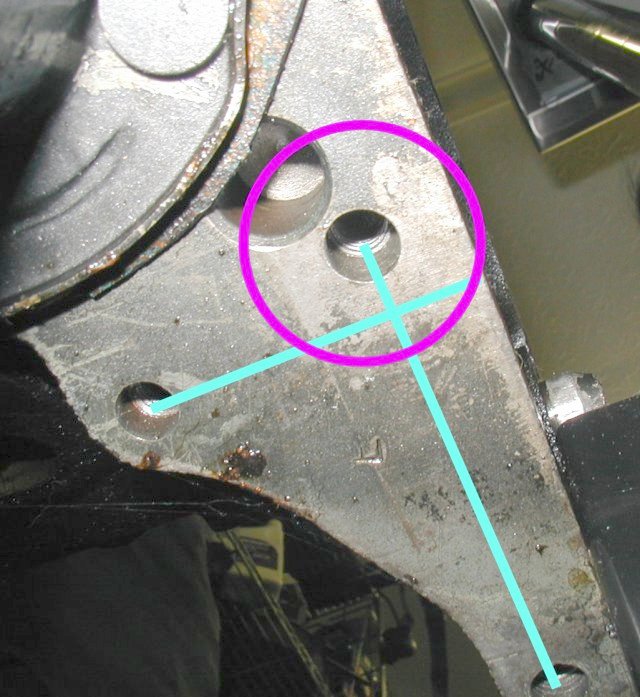
Typical things that can be, and often ARE, incorrectly produced in blocks of that era, include but are not limited to:
Crank center line parallel to datum line
Crank CL correct distance from datum line
Bell housing flange perpendicular to crank CL
BH flange centered on crank CL
Starter bolt holes correct distance from crank CL (a VERY high proportion of 010 blocks are wrong here)
Decks parallel to crank CL
Decks equidistant from crank CL
Cylinders perpendicular to crank CL (front-to-rear angle)
Cylinders centered over rod journals (front-to-rear location)
Cam parallel to crank CL
Lifter bores perpendicular to cam CL, and center on cam CL
Oil passages full bore (the 3 main front-to-rear gallereis, in particular, are drilled half from the front and half from the rear; sort of like the Chunnel; sometimes they don't exactly meet correctly)
Lifter oil passages intersect lifter bores at correct height (similar to above)
And so on.
Note that NONE of these, except deck height, can really be "repaired", if they're off. The goal of inspecting a block before building it, is to try to find one where these machine steps are within some reasonable tolerance. Not as easy as it sounds. They are one of the prime reasons, besides the builder's attention to detail, why some engine JUST RUN BETTER than others, and there's no obvious difference; or why some engine eat auto transn pump bushings, or eat cams, or make that horrible starter grinding noise, or have any of numerous other unrepairable flaws.
If your block has any of these, it is A WASTE OF MONEY to buy or to build it.
882 heads are TRASH. Throw them away and get something else. Do not be misled into thinking they are good for anything. People will post up all sorts of flow numbers from a certain web site where somebody has collected flow "data" from different sources, and magazine articles with flow numbers (which is actually where some of those on the popular web site originated), and stuff like that. There is more to a good set of heads than their stock flow numbers. 882 heads have NONE of those other things.
To check ring end gap, they have to be off the piston. Put them in the bore they go in; use the piston, upside down, to push them down about ¼" from the top, and perfectly straight; measure the end gap with a feeler gauge. For regular cast of forged pistons, you want a gap of about .0045" per inch of bore diameter ont he top ring, which for a 350, would be about .018"; and about .005" - .0055" on the 2nd ring, which would be .020" to .022". Be aware that you DO NOT want to scratch, gouge, stress, or in any way damage the rings themselves or the grooves in the piston. THIS IS CRITICAL!!!! To take them on and off safely, use a ring expander (looks kind of like big snap ring pliers); avoid chipping the end of the ring, because this will quickly produce deep vertical scratches in the bore which will lead to poor compression and blowby.
The original engine you have would have made about 180 HP, by the "ratings" methods used for new cars. Pretty sad. The heads are one of the main reasons for this. The pistons (deep dish, therefore very low compresion) are another. The factory cam (929 grind) is another, which at least you have something else. Replacement pistons MAY BE even worse than roiginal in this regard; if they have the same size dish, but are (as they nearly always are) farther "down in the hole" at TDC than stock, then you can end up building an engine with BELOW 8:1 compression. In fact, it's almost INEVITABLE that if you use those 882 heads, that's what you'll have. That's one of the main reasons why you want to throw them away.
People will tell you all about "high nickel" and "high tin", based on the numbers 010 and 020 cast into the front of it behind the timing cover. It is drivel. The people who ACTUALLY WORKED in the casting factory, tell a whole different story, about how the sand castings are made, and about the plates they used for that; and how after just a couple of months of the "different metals" experiment, they went back to using the same metal for ALL blocks, and used all the plates with the different numbers interchangeably (and in fact, lost or otherwise quit using some of them and used certain ones for ALL blocks), because it was cheaper to make them all out of the higher grade of metal than it was to try to keep them segregated somehow and deal with different batches of material. So if anyone tries to tell you that those numbers matter, nod approvingly, ignore them, and move on. They are babbling meaninglessly, like people who walk up to you in public places and try to convert you to their religion. Treat them the same way: be polite, but ignore what they have to say, because it is a total waste of your valuable bandwidth.
The main reason I asked what the casting # was, was to determine whether it's a roller (or at least roller-capable) one, and which side the dipstick is on. Obviously that's NOT a factory roller one, it's 2-pc rear main seal, and the dipstick is on the left. Be prepared for your oil pan and maybe flywheel or flex plate, to not work. The pan that comes with it (if one does) might or might not work; older truck and full-size car pans are taller in the front part, in front of the sump, and won't sit all the way down on the mounts before the pan comes to rest on the K-member, and the sump portion extends slightly farther toward the front, and won't fit the exhaust in these cars.
Other than stuff like that, it's a block. Just a plain, common, ordinary, unexceptional in any way, block. As good, or not, for a buildup as any other block with the same year-model features. If you can deal with those things, then it's OK. Now, the things that matter about it, are the original quality control, and the machine work and other thing that have happened to it over its lifetime.
As far as quality control, the US auto industry's QC in the 70s was NOTORIOUSLY crappy. It was a time of rapidly shrinking market share, rapidly escalating costs, labor problems, cash shortages, obsolete and worn-out equipment, poor maintenance, and other things that contrbuted to overall VERY poor build quality. These problems showed up in individual parts, just as much as they did in the design of cars back then, and overall assembly quality, and everything else.
Blocks have 2 holes in the bottom next to the oil pan that form a line, which establishes the reference datum for ALL OTHER measurements during the manufacture of the block. All other dimensions of the block are measured off of these holes. They are on the pass side, about ¾" in diameter or so; just 2 big holes that appear to have no purpose. One is under the fuel pump boss, the other is next to the starter pad. Here's what they look like (above and to the left of the circled "extra" starter hole, which by the way, you may need to have added to your block):
Typical things that can be, and often ARE, incorrectly produced in blocks of that era, include but are not limited to:
Crank center line parallel to datum line
Crank CL correct distance from datum line
Bell housing flange perpendicular to crank CL
BH flange centered on crank CL
Starter bolt holes correct distance from crank CL (a VERY high proportion of 010 blocks are wrong here)
Decks parallel to crank CL
Decks equidistant from crank CL
Cylinders perpendicular to crank CL (front-to-rear angle)
Cylinders centered over rod journals (front-to-rear location)
Cam parallel to crank CL
Lifter bores perpendicular to cam CL, and center on cam CL
Oil passages full bore (the 3 main front-to-rear gallereis, in particular, are drilled half from the front and half from the rear; sort of like the Chunnel; sometimes they don't exactly meet correctly)
Lifter oil passages intersect lifter bores at correct height (similar to above)
And so on.
Note that NONE of these, except deck height, can really be "repaired", if they're off. The goal of inspecting a block before building it, is to try to find one where these machine steps are within some reasonable tolerance. Not as easy as it sounds. They are one of the prime reasons, besides the builder's attention to detail, why some engine JUST RUN BETTER than others, and there's no obvious difference; or why some engine eat auto transn pump bushings, or eat cams, or make that horrible starter grinding noise, or have any of numerous other unrepairable flaws.
If your block has any of these, it is A WASTE OF MONEY to buy or to build it.
882 heads are TRASH. Throw them away and get something else. Do not be misled into thinking they are good for anything. People will post up all sorts of flow numbers from a certain web site where somebody has collected flow "data" from different sources, and magazine articles with flow numbers (which is actually where some of those on the popular web site originated), and stuff like that. There is more to a good set of heads than their stock flow numbers. 882 heads have NONE of those other things.
To check ring end gap, they have to be off the piston. Put them in the bore they go in; use the piston, upside down, to push them down about ¼" from the top, and perfectly straight; measure the end gap with a feeler gauge. For regular cast of forged pistons, you want a gap of about .0045" per inch of bore diameter ont he top ring, which for a 350, would be about .018"; and about .005" - .0055" on the 2nd ring, which would be .020" to .022". Be aware that you DO NOT want to scratch, gouge, stress, or in any way damage the rings themselves or the grooves in the piston. THIS IS CRITICAL!!!! To take them on and off safely, use a ring expander (looks kind of like big snap ring pliers); avoid chipping the end of the ring, because this will quickly produce deep vertical scratches in the bore which will lead to poor compression and blowby.
The original engine you have would have made about 180 HP, by the "ratings" methods used for new cars. Pretty sad. The heads are one of the main reasons for this. The pistons (deep dish, therefore very low compresion) are another. The factory cam (929 grind) is another, which at least you have something else. Replacement pistons MAY BE even worse than roiginal in this regard; if they have the same size dish, but are (as they nearly always are) farther "down in the hole" at TDC than stock, then you can end up building an engine with BELOW 8:1 compression. In fact, it's almost INEVITABLE that if you use those 882 heads, that's what you'll have. That's one of the main reasons why you want to throw them away.
Thread Starter
Junior Member
Joined: May 2005
Posts: 96
Likes: 0
From: Florida
Car: 86 Camaro
Engine: 305
Transmission: 5 speed
Re: Crankshaft
The 010 is not any better, or any worse, than any other 350 block. It's probably the single most common casting from the 70s.
People will tell you all about "high nickel" and "high tin", based on the numbers 010 and 020 cast into the front of it behind the timing cover. It is drivel. The people who ACTUALLY WORKED in the casting factory, tell a whole different story, about how the sand castings are made, and about the plates they used for that; and how after just a couple of months of the "different metals" experiment, they went back to using the same metal for ALL blocks, and used all the plates with the different numbers interchangeably (and in fact, lost or otherwise quit using some of them and used certain ones for ALL blocks), because it was cheaper to make them all out of the higher grade of metal than it was to try to keep them segregated somehow and deal with different batches of material. So if anyone tries to tell you that those numbers matter, nod approvingly, ignore them, and move on. They are babbling meaninglessly, like people who walk up to you in public places and try to convert you to their religion. Treat them the same way: be polite, but ignore what they have to say, because it is a total waste of your valuable bandwidth.
The main reason I asked what the casting # was, was to determine whether it's a roller (or at least roller-capable) one, and which side the dipstick is on. Obviously that's NOT a factory roller one, it's 2-pc rear main seal, and the dipstick is on the left. Be prepared for your oil pan and maybe flywheel or flex plate, to not work. The pan that comes with it (if one does) might or might not work; older truck and full-size car pans are taller in the front part, in front of the sump, and won't sit all the way down on the mounts before the pan comes to rest on the K-member, and the sump portion extends slightly farther toward the front, and won't fit the exhaust in these cars.
Other than stuff like that, it's a block. Just a plain, common, ordinary, unexceptional in any way, block. As good, or not, for a buildup as any other block with the same year-model features. If you can deal with those things, then it's OK. Now, the things that matter about it, are the original quality control, and the machine work and other thing that have happened to it over its lifetime.
As far as quality control, the US auto industry's QC in the 70s was NOTORIOUSLY crappy. It was a time of rapidly shrinking market share, rapidly escalating costs, labor problems, cash shortages, obsolete and worn-out equipment, poor maintenance, and other things that contrbuted to overall VERY poor build quality. These problems showed up in individual parts, just as much as they did in the design of cars back then, and overall assembly quality, and everything else.
Blocks have 2 holes in the bottom next to the oil pan that form a line, which establishes the reference datum for ALL OTHER measurements during the manufacture of the block. All other dimensions of the block are measured off of these holes. They are on the pass side, about ¾" in diameter or so; just 2 big holes that appear to have no purpose. One is under the fuel pump boss, the other is next to the starter pad. Here's what they look like (above and to the left of the circled "extra" starter hole, which by the way, you may need to have added to your block):
Typical things that can be, and often ARE, incorrectly produced in blocks of that era, include but are not limited to:
Crank center line parallel to datum line
Crank CL correct distance from datum line
Bell housing flange perpendicular to crank CL
BH flange centered on crank CL
Starter bolt holes correct distance from crank CL (a VERY high proportion of 010 blocks are wrong here)
Decks parallel to crank CL
Decks equidistant from crank CL
Cylinders perpendicular to crank CL (front-to-rear angle)
Cylinders centered over rod journals (front-to-rear location)
Cam parallel to crank CL
Lifter bores perpendicular to cam CL, and center on cam CL
Oil passages full bore (the 3 main front-to-rear gallereis, in particular, are drilled half from the front and half from the rear; sort of like the Chunnel; sometimes they don't exactly meet correctly)
Lifter oil passages intersect lifter bores at correct height (similar to above)
And so on.
Note that NONE of these, except deck height, can really be "repaired", if they're off. The goal of inspecting a block before building it, is to try to find one where these machine steps are within some reasonable tolerance. Not as easy as it sounds. They are one of the prime reasons, besides the builder's attention to detail, why some engine JUST RUN BETTER than others, and there's no obvious difference; or why some engine eat auto transn pump bushings, or eat cams, or make that horrible starter grinding noise, or have any of numerous other unrepairable flaws.
If your block has any of these, it is A WASTE OF MONEY to buy or to build it.
882 heads are TRASH. Throw them away and get something else. Do not be misled into thinking they are good for anything. People will post up all sorts of flow numbers from a certain web site where somebody has collected flow "data" from different sources, and magazine articles with flow numbers (which is actually where some of those on the popular web site originated), and stuff like that. There is more to a good set of heads than their stock flow numbers. 882 heads have NONE of those other things.
To check ring end gap, they have to be off the piston. Put them in the bore they go in; use the piston, upside down, to push them down about ¼" from the top, and perfectly straight; measure the end gap with a feeler gauge. For regular cast of forged pistons, you want a gap of about .0045" per inch of bore diameter ont he top ring, which for a 350, would be about .018"; and about .005" - .0055" on the 2nd ring, which would be .020" to .022". Be aware that you DO NOT want to scratch, gouge, stress, or in any way damage the rings themselves or the grooves in the piston. THIS IS CRITICAL!!!! To take them on and off safely, use a ring expander (looks kind of like big snap ring pliers); avoid chipping the end of the ring, because this will quickly produce deep vertical scratches in the bore which will lead to poor compression and blowby.
The original engine you have would have made about 180 HP, by the "ratings" methods used for new cars. Pretty sad. The heads are one of the main reasons for this. The pistons (deep dish, therefore very low compresion) are another. The factory cam (929 grind) is another, which at least you have something else. Replacement pistons MAY BE even worse than roiginal in this regard; if they have the same size dish, but are (as they nearly always are) farther "down in the hole" at TDC than stock, then you can end up building an engine with BELOW 8:1 compression. In fact, it's almost INEVITABLE that if you use those 882 heads, that's what you'll have. That's one of the main reasons why you want to throw them away.
People will tell you all about "high nickel" and "high tin", based on the numbers 010 and 020 cast into the front of it behind the timing cover. It is drivel. The people who ACTUALLY WORKED in the casting factory, tell a whole different story, about how the sand castings are made, and about the plates they used for that; and how after just a couple of months of the "different metals" experiment, they went back to using the same metal for ALL blocks, and used all the plates with the different numbers interchangeably (and in fact, lost or otherwise quit using some of them and used certain ones for ALL blocks), because it was cheaper to make them all out of the higher grade of metal than it was to try to keep them segregated somehow and deal with different batches of material. So if anyone tries to tell you that those numbers matter, nod approvingly, ignore them, and move on. They are babbling meaninglessly, like people who walk up to you in public places and try to convert you to their religion. Treat them the same way: be polite, but ignore what they have to say, because it is a total waste of your valuable bandwidth.
The main reason I asked what the casting # was, was to determine whether it's a roller (or at least roller-capable) one, and which side the dipstick is on. Obviously that's NOT a factory roller one, it's 2-pc rear main seal, and the dipstick is on the left. Be prepared for your oil pan and maybe flywheel or flex plate, to not work. The pan that comes with it (if one does) might or might not work; older truck and full-size car pans are taller in the front part, in front of the sump, and won't sit all the way down on the mounts before the pan comes to rest on the K-member, and the sump portion extends slightly farther toward the front, and won't fit the exhaust in these cars.
Other than stuff like that, it's a block. Just a plain, common, ordinary, unexceptional in any way, block. As good, or not, for a buildup as any other block with the same year-model features. If you can deal with those things, then it's OK. Now, the things that matter about it, are the original quality control, and the machine work and other thing that have happened to it over its lifetime.
As far as quality control, the US auto industry's QC in the 70s was NOTORIOUSLY crappy. It was a time of rapidly shrinking market share, rapidly escalating costs, labor problems, cash shortages, obsolete and worn-out equipment, poor maintenance, and other things that contrbuted to overall VERY poor build quality. These problems showed up in individual parts, just as much as they did in the design of cars back then, and overall assembly quality, and everything else.
Blocks have 2 holes in the bottom next to the oil pan that form a line, which establishes the reference datum for ALL OTHER measurements during the manufacture of the block. All other dimensions of the block are measured off of these holes. They are on the pass side, about ¾" in diameter or so; just 2 big holes that appear to have no purpose. One is under the fuel pump boss, the other is next to the starter pad. Here's what they look like (above and to the left of the circled "extra" starter hole, which by the way, you may need to have added to your block):
Typical things that can be, and often ARE, incorrectly produced in blocks of that era, include but are not limited to:
Crank center line parallel to datum line
Crank CL correct distance from datum line
Bell housing flange perpendicular to crank CL
BH flange centered on crank CL
Starter bolt holes correct distance from crank CL (a VERY high proportion of 010 blocks are wrong here)
Decks parallel to crank CL
Decks equidistant from crank CL
Cylinders perpendicular to crank CL (front-to-rear angle)
Cylinders centered over rod journals (front-to-rear location)
Cam parallel to crank CL
Lifter bores perpendicular to cam CL, and center on cam CL
Oil passages full bore (the 3 main front-to-rear gallereis, in particular, are drilled half from the front and half from the rear; sort of like the Chunnel; sometimes they don't exactly meet correctly)
Lifter oil passages intersect lifter bores at correct height (similar to above)
And so on.
Note that NONE of these, except deck height, can really be "repaired", if they're off. The goal of inspecting a block before building it, is to try to find one where these machine steps are within some reasonable tolerance. Not as easy as it sounds. They are one of the prime reasons, besides the builder's attention to detail, why some engine JUST RUN BETTER than others, and there's no obvious difference; or why some engine eat auto transn pump bushings, or eat cams, or make that horrible starter grinding noise, or have any of numerous other unrepairable flaws.
If your block has any of these, it is A WASTE OF MONEY to buy or to build it.
882 heads are TRASH. Throw them away and get something else. Do not be misled into thinking they are good for anything. People will post up all sorts of flow numbers from a certain web site where somebody has collected flow "data" from different sources, and magazine articles with flow numbers (which is actually where some of those on the popular web site originated), and stuff like that. There is more to a good set of heads than their stock flow numbers. 882 heads have NONE of those other things.
To check ring end gap, they have to be off the piston. Put them in the bore they go in; use the piston, upside down, to push them down about ¼" from the top, and perfectly straight; measure the end gap with a feeler gauge. For regular cast of forged pistons, you want a gap of about .0045" per inch of bore diameter ont he top ring, which for a 350, would be about .018"; and about .005" - .0055" on the 2nd ring, which would be .020" to .022". Be aware that you DO NOT want to scratch, gouge, stress, or in any way damage the rings themselves or the grooves in the piston. THIS IS CRITICAL!!!! To take them on and off safely, use a ring expander (looks kind of like big snap ring pliers); avoid chipping the end of the ring, because this will quickly produce deep vertical scratches in the bore which will lead to poor compression and blowby.
The original engine you have would have made about 180 HP, by the "ratings" methods used for new cars. Pretty sad. The heads are one of the main reasons for this. The pistons (deep dish, therefore very low compresion) are another. The factory cam (929 grind) is another, which at least you have something else. Replacement pistons MAY BE even worse than roiginal in this regard; if they have the same size dish, but are (as they nearly always are) farther "down in the hole" at TDC than stock, then you can end up building an engine with BELOW 8:1 compression. In fact, it's almost INEVITABLE that if you use those 882 heads, that's what you'll have. That's one of the main reasons why you want to throw them away.
Well I talked it over with kid I'am doing this with and he has decided just to go with what we have , he is not looking for a big performance vehicle , he just wants it back on the road, so hopefuly we can do this engine and get it to run right for him. Wish us luck!

Thread
Thread Starter
Forum
Replies
Last Post
Hotrodboba400
Firebirds for Sale
3
Dec 10, 2019 07:07 PM
Hotrodboba400
Firebirds for Sale
0
Sep 2, 2015 07:28 PM
LT1Formula
Engine/Drivetrain/Suspension Parts for Sale
7
Aug 20, 2015 09:36 PM


