

Well yesterday I was changing my oil, and when I was buying the filter at autozone, I decided I should probably put in a new PCV valve, because I had not changed the old one when I bought the car, even though it still rattled when shook.
Look what I found:
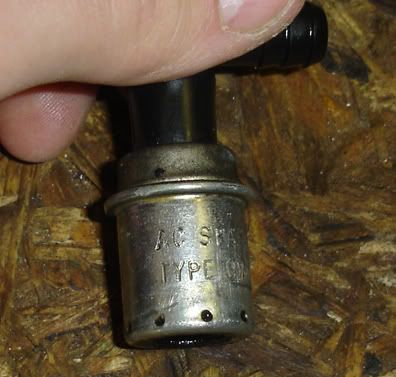
yep - thats right. AC Spark Pulg!! This thing was made probably before I was born lol.
I also changed my plugs right when I bought the car - I got rapidfires. When I got the old ones out, they had yellowish white insulators, and all they said was "AC" on them. I took it for granted that this was short for "AC Delco" but the other day I saw the movie roger and me and it talks about AC Spark plugs, and how all the workers got laid off. Good movie btw.
-------------------------
Just wondering, does the PCV valve affect gas miage at all? I know the ERG does but thats pricey.
Look what I found:
yep - thats right. AC Spark Pulg!! This thing was made probably before I was born lol.
I also changed my plugs right when I bought the car - I got rapidfires. When I got the old ones out, they had yellowish white insulators, and all they said was "AC" on them. I took it for granted that this was short for "AC Delco" but the other day I saw the movie roger and me and it talks about AC Spark plugs, and how all the workers got laid off. Good movie btw.
-------------------------
Just wondering, does the PCV valve affect gas miage at all? I know the ERG does but thats pricey.

Supreme Member
xpndbl3
Supreme Member
close
May 26, 2024
no the pcv only sucks blowby and oil vapors back into the intake, doesn't do anything for gas mileage.
Oh well maybe I shouldnt have wasted my $2 on a new one...

Supreme Member
A pcv will never be a waste of money. PCV systems will keep crankcase pressure down, making your engine seals last a lot longer. Its also better for the environment. In the olden days cars had road draft systems, where basically a tube ran to the underside of the car and the air rushing across it created an area of low pressure(vacuum). Thats why it the oil slicks going down the middle of roads used to be a lot worse.
Quote:
Yeah. And probably why there is a lot of oil spots in older parking lots too, huh?Originally Posted by ljnowell
A pcv will never be a waste of money. PCV systems will keep crankcase pressure down, making your engine seals last a lot longer. Its also better for the environment. In the olden days cars had road draft systems, where basically a tube ran to the underside of the car and the air rushing across it created an area of low pressure(vacuum). Thats why it the oil slicks going down the middle of roads used to be a lot worse. Also, well the reason I changed it is because I read that they can still go bad even when they still rattle. I was wondering, what is the milage / time interval that you are supposed to change it at? Also, how does it work? Because I dont see why you need the little rattler, you could just hook up a smaller vacuum line to the valve cover, and keep a nice steady flow of fresh air coming all the time from the breather, right?

Supreme Member
Quote:
On a carb setup a good portion of the idle air flow comes from the PCV valve. If it's plugged the engine will idle way too rich. This will foul the plugs and the resulting misfiring will cost you gas mileage. Originally Posted by slow_90firebird
...Just wondering, does the PCV valve affect gas miage at all? I know the ERG does but thats pricey. People that don't use a PCV valve have to re-adjust their idle screws to compensate for the loss of air flow.
Supreme Member
Quote:
They are actually more complicated than that. As the load on an engine increases the amount of blowby increases. Fortunately, as the load on an engine increases the vacuum also decreases and the spring in the PCV valve opens the valve more (since it is held closed by vacuum) to allow more blowby to flow into the engine to be burned. Also since it is constantly varying the opening, it is almost clog-proof.Originally Posted by slow_90firebird
...I was wondering, what is the milage / time interval that you are supposed to change it at? Also, how does it work? Because I dont see why you need the little rattler, you could just hook up a smaller vacuum line to the valve cover, and keep a nice steady flow of fresh air coming all the time from the breather, right? Change interval: Back when engines ran "dirty" and needed the oil changed every 3000 miles, the PCV valve was listed to be changed every 30,000 miles along with the air filter and A/T fluid.
All that's changed now. Engines have 195° thermostats and feedback fuel systems that run much cleaner. With better engine oils, sludge formation is almost non-existent so PCV valves don't plug up.
My step-daughter's 2001 pickup listed it to be changed at 100K miles.

Member
anybody know what pcv valve would be a good one for a built 383 with a carb? I heard that the valves and application are important. Any Ideas?
Supreme Member
i would run a stock style one. the function is the same. I do happen to have some High performance ones in my garage, ill let go of for 25 bucks a piece 