


Help figuring out how much of a bottom end is "enough"


Thread Starter
Junior Member
Joined: Apr 2008
Posts: 43
Likes: 0
From: Washington State
Car: 1988 IROC-Z
Engine: 5.7L
Transmission: 700R4
Axle/Gears: 2.77
Help figuring out how much of a bottom end is "enough"
Ok, so I'm looking to do a basic build on my 350 (this will be my first build). It has never been touched internally by myself, has 135k miles. My problem is I need advice relating to how much work to have a shop do and how much to do myself, should I order the parts or let them do it, etc.
Goal is a very reliable 400-450 hp, pump gas, no F/I or cheating with nitrous, daily driver CAPABLE (won't be) street car. I selected these parts awhile back, since then GMHTP built a motor with similar characteristics and parts and got roughly that much power out of it, I was shocked as I was hoping for 350 hp and 400 ft/lbs. From their multi-part article (yes I know it was a magazine, lay off, I had the same general idea before they did it), most of the great features of their engine involved not necessarily using high dollar parts, just good ones that were matched correctly and had alot of machine work. I think their budget was around $5000.
Parts selected so far, both for value and durability:
GM Cast Iron Vortec Style Heads (will not use aluminum for a street car, I don't trust the basic cooling arrangement of SBC's for a street car)
Overbore to 355 (is that .20 or .30 over?)
Non-stroker, prefer to use the factory crank after having it machined/hardened/anything else that can be done cheaper than buying a new one, unless the value is there to buy a new crank instead. Does everyone really need a forged crank made from 4340?
Hypereutectic pistons & strengthened rods/bearings to match
Holly Stealth Ram Intake
Full length stainless headers
Ford 30# injectors (or larger)
Aftermarket MAF
Will i need a larger radiator for a street car?
Don't know enough about valvetrains to make a decision on type of cam (roller, hydraulic, flat, etc.) I'd prefer something middle of the road for maintainence and driveability but would like to rev to 6200-6800 RPM safely if I have a choice and it doesn't cost much more when you include the lifters, better pushrods, rocker arms, etc.
I can't afford all these parts and machine work at once (I have other projects and the car needs to be painted), but I would like to freshen the engine I have. I think most of these parts function equally well as a bolt on affair as well as part of a balanced package, so I can buy them individually as I have the money and install them one at a time, with the exception of the heads as I'll need the intake at the same time. My part selection includes the consideration of one-by-one installation.
I figure once I have all the main engine parts bought and installed and the car painted, then I will rip it out, and have a shop rebuild the engine and port the heads, intake, etc. and do all their balancing stuff and in general match everything I already have better, as well as rebuild the bottom end at that time. Is that a workable plan or should I just build it at once from the beginning, or buy a crate motor, or what? I'm not afraid of doing stuff twice when it mostly involves turning alot of wrenches but minimal cost (i.e. head gaskets), the exception being removal of the tranny & engine.
Also, when it comes to the machine shop I will be having them assemble my engine, but can I save any sort of money or match parts better by ordering them myself, or just buying a whole rotating assembly package and dropping it off at the shop with the short block? Or should I just tell them what I want and let them select the brand of parts along with the individual parts? I am just being **** and don't need to pay that much attention to a little SBC street motor?
Goal is a very reliable 400-450 hp, pump gas, no F/I or cheating with nitrous, daily driver CAPABLE (won't be) street car. I selected these parts awhile back, since then GMHTP built a motor with similar characteristics and parts and got roughly that much power out of it, I was shocked as I was hoping for 350 hp and 400 ft/lbs. From their multi-part article (yes I know it was a magazine, lay off, I had the same general idea before they did it), most of the great features of their engine involved not necessarily using high dollar parts, just good ones that were matched correctly and had alot of machine work. I think their budget was around $5000.
Parts selected so far, both for value and durability:
GM Cast Iron Vortec Style Heads (will not use aluminum for a street car, I don't trust the basic cooling arrangement of SBC's for a street car)
Overbore to 355 (is that .20 or .30 over?)
Non-stroker, prefer to use the factory crank after having it machined/hardened/anything else that can be done cheaper than buying a new one, unless the value is there to buy a new crank instead. Does everyone really need a forged crank made from 4340?
Hypereutectic pistons & strengthened rods/bearings to match
Holly Stealth Ram Intake
Full length stainless headers
Ford 30# injectors (or larger)
Aftermarket MAF
Will i need a larger radiator for a street car?
Don't know enough about valvetrains to make a decision on type of cam (roller, hydraulic, flat, etc.) I'd prefer something middle of the road for maintainence and driveability but would like to rev to 6200-6800 RPM safely if I have a choice and it doesn't cost much more when you include the lifters, better pushrods, rocker arms, etc.
I can't afford all these parts and machine work at once (I have other projects and the car needs to be painted), but I would like to freshen the engine I have. I think most of these parts function equally well as a bolt on affair as well as part of a balanced package, so I can buy them individually as I have the money and install them one at a time, with the exception of the heads as I'll need the intake at the same time. My part selection includes the consideration of one-by-one installation.
I figure once I have all the main engine parts bought and installed and the car painted, then I will rip it out, and have a shop rebuild the engine and port the heads, intake, etc. and do all their balancing stuff and in general match everything I already have better, as well as rebuild the bottom end at that time. Is that a workable plan or should I just build it at once from the beginning, or buy a crate motor, or what? I'm not afraid of doing stuff twice when it mostly involves turning alot of wrenches but minimal cost (i.e. head gaskets), the exception being removal of the tranny & engine.
Also, when it comes to the machine shop I will be having them assemble my engine, but can I save any sort of money or match parts better by ordering them myself, or just buying a whole rotating assembly package and dropping it off at the shop with the short block? Or should I just tell them what I want and let them select the brand of parts along with the individual parts? I am just being **** and don't need to pay that much attention to a little SBC street motor?

Supreme Member
iTrader: (1)
Joined: Apr 2007
Posts: 1,196
Likes: 0
From: BUFFALO, NY
Car: '89 IROC-Z
Engine: 355
Transmission: 700r4 edge 3000 stall
Axle/Gears: 9-bolt 3.73
Re: Help figuring out how much of a bottom end is "enough"
No you need to be very **** about engine work! Though you can be a little less with a street engine.
400hp and a 6200 redline may be an attainable goal.
Let me say this first if you go HSR you will have to have someone dyno tune the PROM, I know this from experience, I had a custom mail order prom and could never get maximum performance out of the motor and I went to a carb'd setup and wish I had gone that route in the first place. I would strongly recommend a carburetor setup.
a 355 is a 350 .030" over. You can go .030, .040, and .060 over on a 350. Most likely your stock crank will need to be machined down or a new crank, you dont need a steel crank. You don't need aftermarket rods, have your old rods checked and reuse them if they are good. I recommend flat top hyperutectic pistons and a moly ring package.
As far as camshafts the GMPP "LT4 HOT CAM" is a great street cam and affordable priced.
No you shouldn't need a larger radiator.
If you still decide to go HSR I have the MAF sensor you need.
-Rayzor
400hp and a 6200 redline may be an attainable goal.
Let me say this first if you go HSR you will have to have someone dyno tune the PROM, I know this from experience, I had a custom mail order prom and could never get maximum performance out of the motor and I went to a carb'd setup and wish I had gone that route in the first place. I would strongly recommend a carburetor setup.
a 355 is a 350 .030" over. You can go .030, .040, and .060 over on a 350. Most likely your stock crank will need to be machined down or a new crank, you dont need a steel crank. You don't need aftermarket rods, have your old rods checked and reuse them if they are good. I recommend flat top hyperutectic pistons and a moly ring package.
As far as camshafts the GMPP "LT4 HOT CAM" is a great street cam and affordable priced.
No you shouldn't need a larger radiator.
If you still decide to go HSR I have the MAF sensor you need.
-Rayzor


Joined: Mar 2000
Posts: 43,187
Likes: 46
From: Littleton, CO USA
Car: 82 Berlinetta/57 Bel Air
Engine: L92/LQ4 (both w/4" stroke)
Transmission: 4L80E/4L80E
Axle/Gears: 12B-3.73/9"-3.89
The Hot Cam will only work if the block is a factory roller lifter type.
I'd suggest new rod bolts if you don't get new rods.
If you can trust the shop, tell them what you want and let them get the stuff and install it. It will cost you more, but things like resizing the rods after the new rod bolts and pressing on the pistons are things you can't do in your garage, anyway.
I'd suggest new rod bolts if you don't get new rods.
If you can trust the shop, tell them what you want and let them get the stuff and install it. It will cost you more, but things like resizing the rods after the new rod bolts and pressing on the pistons are things you can't do in your garage, anyway.

Senior Member
Joined: Mar 2008
Posts: 345
Likes: 0
From: moberly, Mo
Car: 91 rs
Engine: 383 290 cam aed carb
Transmission: th350
Axle/Gears: 4.10 ticking time bomb
Re: Help figuring out how much of a bottom end is "enough"
I think that a stock crank, with stock rods resized with arp bolts, and hyper flat top pistons will suffice, if you keep the compression and rpms to moderate levels. You should be able to build a 400 horse motor with 10:1 compression, and a mild cam, with only 355 cu in. if you use good heads. The vortecs are good heads, but finding good used cores is tricky at best, so new heads should be in the budget.
With that being said, vortecs are a good head, but there is nothing wrong with aluminum heads, many many small block chevys have been run with them with great results, so I would not let that be the deciding factor in cylinder head choice. If vortecs are all that you can afford or all that you think you need for your performance goals, then go for it, but do not shy away from a set of AFRs because they are aluminum, you can make so much more power with them! I am also a fan of Canfield heads, as well as RHS, and have had a set of patriots, and for roughly the same price as vortecs, you can have an aluminum head that flows better.
Your type of cam, ie flat tappet or hyd. roller, should be one of your first choices before setting any power goals, because you get what you pay for. A roller cam of equal duration and rpm range will make considerably more power than its flat tappet cousin, and you will not have to worry about a flat cam lobe.For that reason alone I would go hydraulic roller. It can also be done relatively cheaper if you get a late model block and use factory lifters, Just do not plan on reving it to the moon with factory lifters.As far as the rest of the valvetrain, a set of hardened pushrods and roller rockers should be fine. Your new heads will probably be assemble with appropriate springs, but call both the head and cam manufacturers first to be sure. You should be fine with this kind of valvetrain with a hyd. roller, it is a solid roller that you have to spend the big bucks on valvetrain, and with 600 lbs of spring pressure it is no suprise!
If you plan to balance the rotating assembly, now is the time to do it, you would not want to put it together and then have to completely remove and dissasemble the entire motor to do it later!So like you said, build a good bottom end now, and then you will be fine to add more goodies later.
And as far as saving cost on the bottom end, it is not much cheaper to reuse stock rods, if it is any cheaper, so I would just plan on buying new rods. Same story with the crank, now I do not think you will break a stock crank, but a new aftermarket cast crank is about 200 dollars, and turning your crank is near 100, so is it worth it to reuse one? I would say no, because for roughly an additional 100 dollars you can put a 383 crank in it and gain 30 cubic inches. Thats it, all you have to spend more money on for a 383 is the crank, either stock or aftermarket 5.7 rods will work, you were having it balanced anyway, and you already needed new pistons.
This is the joy of hot-rodding, the snow ball effect, well if I spend this much it is only this much more for this, and while I am at it, i will go ahead and buy this cause it is only this much more, and it just never stops!!!
With that being said, vortecs are a good head, but there is nothing wrong with aluminum heads, many many small block chevys have been run with them with great results, so I would not let that be the deciding factor in cylinder head choice. If vortecs are all that you can afford or all that you think you need for your performance goals, then go for it, but do not shy away from a set of AFRs because they are aluminum, you can make so much more power with them! I am also a fan of Canfield heads, as well as RHS, and have had a set of patriots, and for roughly the same price as vortecs, you can have an aluminum head that flows better.
Your type of cam, ie flat tappet or hyd. roller, should be one of your first choices before setting any power goals, because you get what you pay for. A roller cam of equal duration and rpm range will make considerably more power than its flat tappet cousin, and you will not have to worry about a flat cam lobe.For that reason alone I would go hydraulic roller. It can also be done relatively cheaper if you get a late model block and use factory lifters, Just do not plan on reving it to the moon with factory lifters.As far as the rest of the valvetrain, a set of hardened pushrods and roller rockers should be fine. Your new heads will probably be assemble with appropriate springs, but call both the head and cam manufacturers first to be sure. You should be fine with this kind of valvetrain with a hyd. roller, it is a solid roller that you have to spend the big bucks on valvetrain, and with 600 lbs of spring pressure it is no suprise!
If you plan to balance the rotating assembly, now is the time to do it, you would not want to put it together and then have to completely remove and dissasemble the entire motor to do it later!So like you said, build a good bottom end now, and then you will be fine to add more goodies later.
And as far as saving cost on the bottom end, it is not much cheaper to reuse stock rods, if it is any cheaper, so I would just plan on buying new rods. Same story with the crank, now I do not think you will break a stock crank, but a new aftermarket cast crank is about 200 dollars, and turning your crank is near 100, so is it worth it to reuse one? I would say no, because for roughly an additional 100 dollars you can put a 383 crank in it and gain 30 cubic inches. Thats it, all you have to spend more money on for a 383 is the crank, either stock or aftermarket 5.7 rods will work, you were having it balanced anyway, and you already needed new pistons.
This is the joy of hot-rodding, the snow ball effect, well if I spend this much it is only this much more for this, and while I am at it, i will go ahead and buy this cause it is only this much more, and it just never stops!!!
Thread Starter
Junior Member
Joined: Apr 2008
Posts: 43
Likes: 0
From: Washington State
Car: 1988 IROC-Z
Engine: 5.7L
Transmission: 700R4
Axle/Gears: 2.77
Re: Help figuring out how much of a bottom end is "enough"
Thanks for the reply's so far guys, couple new questions...
Reason for not wanting to go the aluminum head route: if I overheat on the street, I more or less will be kissing $1000-$1500 goodbye plus a lot of work. If I stick with the iron vortec's and I overheat or the ignition fails or the a/f trim goes way off I run a much lower risk of catastrophic damage, no? If the engine gets hot enough to pop the iron heads I more than likely can either still just re-machine them or replace them at a very negligible cost. I suppose part of my fear in that respect is due to the history I have with my car running very hot and my incident on the freeway where my water pump pulley came off....
Not going the 383 route: Longer stroke gives more torque yes, but gives the engine less inclination to rev, or at least revs slower, correct? I am completely against anything along that route as it is the biggest problem I have with most american automobiles - engines that are too big (for how much power they produce stock), rev too slow, with too tall of gears. I am installing lower gears as one of the next few mods to help bring the gearing inline with what I would call "proper" and don't want an engine that doesn't complement that characteristic. Or am I just being silly and don't know what I'm talking about? What good is a powerful engine if it doesn't rev quickly and max out the gear you are in so you can grab the next one? One of my best arguments for buying a lower power, lighter, properly geared DOHC import. They make best use of all 5 (or 6) gears. You stop going when you hit redline in top gear.
I guess for the valvetrain on the street, hydraulic roller would be where I want to go, I'm not too worried about the cost of the cam as it is more very important expenditure and also a fairly infrequent one unless you don't know how to use a torque wrench or obey your tach. Since I'm using the stock '88 TPI block out of my car, it already has a hydraulic roller cam and roller lifters, no?
Other than replacement due to wear, why else would I need to change my lifters unless I changed the style cam I was running? Are they made in different lengths to acommodate different length pushrods or what? Are there different types of lifters or are there just one kind of lifter dictated by the style cam you are running?
Also, I am dead set on using the vortec heads with the stealth ram, no carbs for me, I like my fuel injection. Unless things have siginifcantly changed in the last few years, I'm not aware of anything else that is better dollar for dollar. I chose the stealth ram since it seems to offer a good mix of powerband high and low and is cheap as hell but still a good name, plus there are other products designed to work with it from Holley, AND it has similar physical dimensions to the factory setup.
As far as the crank goes, it's my understanding that it is always better to use parts that are already broken in and re-machine them, rather than use new parts as they change shape and the metal settles as it heats and cools into a more natural shape, so anything new essentially *warps* the first time you fire it up, whereas the broken in part has already done that and been re-machined so it stays more true. A $200 crank would more than likely not be machined to tight enough clearances to avoid a problem such as this and should probably be checked and possibly machined before installation anyways, so why not just put that effort into the factory one? Biggest plus I am aware of for changing the crank would be weight. Aren't most aftermarket ones significantly lighter than stock?
On the rods, I'd prefer to buy new ones, they are relatively inexpensive and would prefer something that has that much of a load on it be as new with the most modern alloys as possible. Agree or disagree?
Reason for not wanting to go the aluminum head route: if I overheat on the street, I more or less will be kissing $1000-$1500 goodbye plus a lot of work. If I stick with the iron vortec's and I overheat or the ignition fails or the a/f trim goes way off I run a much lower risk of catastrophic damage, no? If the engine gets hot enough to pop the iron heads I more than likely can either still just re-machine them or replace them at a very negligible cost. I suppose part of my fear in that respect is due to the history I have with my car running very hot and my incident on the freeway where my water pump pulley came off....
Not going the 383 route: Longer stroke gives more torque yes, but gives the engine less inclination to rev, or at least revs slower, correct? I am completely against anything along that route as it is the biggest problem I have with most american automobiles - engines that are too big (for how much power they produce stock), rev too slow, with too tall of gears. I am installing lower gears as one of the next few mods to help bring the gearing inline with what I would call "proper" and don't want an engine that doesn't complement that characteristic. Or am I just being silly and don't know what I'm talking about? What good is a powerful engine if it doesn't rev quickly and max out the gear you are in so you can grab the next one? One of my best arguments for buying a lower power, lighter, properly geared DOHC import. They make best use of all 5 (or 6) gears. You stop going when you hit redline in top gear.
I guess for the valvetrain on the street, hydraulic roller would be where I want to go, I'm not too worried about the cost of the cam as it is more very important expenditure and also a fairly infrequent one unless you don't know how to use a torque wrench or obey your tach. Since I'm using the stock '88 TPI block out of my car, it already has a hydraulic roller cam and roller lifters, no?
Other than replacement due to wear, why else would I need to change my lifters unless I changed the style cam I was running? Are they made in different lengths to acommodate different length pushrods or what? Are there different types of lifters or are there just one kind of lifter dictated by the style cam you are running?
Also, I am dead set on using the vortec heads with the stealth ram, no carbs for me, I like my fuel injection. Unless things have siginifcantly changed in the last few years, I'm not aware of anything else that is better dollar for dollar. I chose the stealth ram since it seems to offer a good mix of powerband high and low and is cheap as hell but still a good name, plus there are other products designed to work with it from Holley, AND it has similar physical dimensions to the factory setup.
As far as the crank goes, it's my understanding that it is always better to use parts that are already broken in and re-machine them, rather than use new parts as they change shape and the metal settles as it heats and cools into a more natural shape, so anything new essentially *warps* the first time you fire it up, whereas the broken in part has already done that and been re-machined so it stays more true. A $200 crank would more than likely not be machined to tight enough clearances to avoid a problem such as this and should probably be checked and possibly machined before installation anyways, so why not just put that effort into the factory one? Biggest plus I am aware of for changing the crank would be weight. Aren't most aftermarket ones significantly lighter than stock?
On the rods, I'd prefer to buy new ones, they are relatively inexpensive and would prefer something that has that much of a load on it be as new with the most modern alloys as possible. Agree or disagree?

Member
Joined: May 2008
Posts: 147
Likes: 0
From: Calgary
Car: 86 Camaro IROC-Z
Engine: 305 TPI (retrofit)
Transmission: T5
Axle/Gears: Crappy stock 10-bolt gears
Re: Help figuring out how much of a bottom end is "enough"
Thanks for the reply's so far guys, couple new questions...
As far as the crank goes, it's my understanding that it is always better to use parts that are already broken in and re-machine them, rather than use new parts as they change shape and the metal settles as it heats and cools into a more natural shape, so anything new essentially *warps* the first time you fire it up, whereas the broken in part has already done that and been re-machined so it stays more true. A $200 crank would more than likely not be machined to tight enough clearances to avoid a problem such as this and should probably be checked and possibly machined before installation anyways, so why not just put that effort into the factory one? Biggest plus I am aware of for changing the crank would be weight. Aren't most aftermarket ones significantly lighter than stock?
As far as the crank goes, it's my understanding that it is always better to use parts that are already broken in and re-machine them, rather than use new parts as they change shape and the metal settles as it heats and cools into a more natural shape, so anything new essentially *warps* the first time you fire it up, whereas the broken in part has already done that and been re-machined so it stays more true. A $200 crank would more than likely not be machined to tight enough clearances to avoid a problem such as this and should probably be checked and possibly machined before installation anyways, so why not just put that effort into the factory one? Biggest plus I am aware of for changing the crank would be weight. Aren't most aftermarket ones significantly lighter than stock?
The about quote however, as it relates to the use of seasoned parts, is incorrect. I think you have confused an old myth surrounding seasoned blocks. In the case of engine blocks, given the complexity of their castings, and the wide range of different temperature zones they see when operating, they can actually distort and "settle" over time. So the use of a season block may be of some benifit. Other components however do not display the same trait, on the contrary the rotating assembly actually has a fatigue life. That is to say that, for example the crankshaft, actually has a finite lifespan. Every cycle at WOT the crankshaft deflects from the stress on it, this effectly cold forges or work hardens it and makes it more brittle. Eventually (i'm talking a long time here) the crank will become so brittle it will fail.
I guess my point here is, with the possible exception of the engine block, New components or equal of higher quality to the originals will always be more durable.
-Zander

Member
Joined: Sep 2007
Posts: 169
Likes: 0
From: Baltimore
Car: '82 Z-28
Engine: 355
Transmission: TH-400, 8" ATI MRT
Axle/Gears: Moser 9", 4.56's
Re: Help figuring out how much of a bottom end is "enough"
from a performance standpoint i think you are really limiting yourself by sticking with vortec heads, but if marginal performance is what you're after then have at it...the amount of money you'll put into them with reconditioning and porting you might as well buy some dart iron eagles. Since you inquired about switching to a larger radiator, then there is really no reason to ignore switching to aluminum heads since you are significantly upgrading your cooling system...just my 2 cents.
as far as the 383 not revving up quick statement-thats an old wives tale. If you have to buy a new crankshaft, you might as well build a 383; the price difference is negligible and the extra power it will produce will offset any "delayed throttle response" - if any. not only that, but the extra cubes open up realistic, easily achievable performance goals that are not as easily achieved by a 355. I wish I would have built a 383 instead of a 355. Just what are you planning to do with this engine, since it has to be streetable but your not going to drive it on the street?
as far as the 383 not revving up quick statement-thats an old wives tale. If you have to buy a new crankshaft, you might as well build a 383; the price difference is negligible and the extra power it will produce will offset any "delayed throttle response" - if any. not only that, but the extra cubes open up realistic, easily achievable performance goals that are not as easily achieved by a 355. I wish I would have built a 383 instead of a 355. Just what are you planning to do with this engine, since it has to be streetable but your not going to drive it on the street?
Trending Topics
Senior Member
Joined: Mar 2008
Posts: 345
Likes: 0
From: moberly, Mo
Car: 91 rs
Engine: 383 290 cam aed carb
Transmission: th350
Axle/Gears: 4.10 ticking time bomb
Re: Help figuring out how much of a bottom end is "enough"
You may hear things about bore vs. stroke and reving vs. tourqe, but in the real world, outside of nascar engines with displacement requirements, ther is NO replacement for displacement, period, a 383 will outperform a 355 with all else being equal, and in a 400 horse motor, you can expect an additional 30 hp or so. A 383 will make this power at a slightly lower rpm, but that is a very good thing when you want to save money on your bottom end and use factory roller lifters.
Your factory lifters will work with the hotcam or comparable sized comp or crane, and pushrod length will be one of the final decissions, the motor will be mostly assembled before you can check for it.
As far as iron heads vs aluminum, if you overheat an iron head and crack it it will be garbage, but an aluminum head is repairable, and less prone to crack due to an aftermarket heads better castings, so the only reason that I see to go with iron is your budget, everything else is superior on aluminum heads as far as I am concerned.
So as far as the crank goes, if you are buying new rods and having it balanced, a 383 crank is money ver well spent, 100 dollars more for a superior crank and 30 free horsepower is money very well spent, there is very few places you can gain this kind of power for so little coin in this kind of build.
If I were you I would not buy a gm cam, I think it is the right size and rpm range, but a comp extreme energy or lunati voodoo can have the same kind of rpm range, with way more agressive ramps, and more lift, which equals more power with equal driveability. More power with the same driveability is hard to come by, so I would get it wherever I could, and buy a better cam.
I agree with leaving it FI. I do not know much about it myself, but lots of people on this board have made it work very well, I am sure they can point you in the right direction as far as parts selection goes.
Your factory lifters will work with the hotcam or comparable sized comp or crane, and pushrod length will be one of the final decissions, the motor will be mostly assembled before you can check for it.
As far as iron heads vs aluminum, if you overheat an iron head and crack it it will be garbage, but an aluminum head is repairable, and less prone to crack due to an aftermarket heads better castings, so the only reason that I see to go with iron is your budget, everything else is superior on aluminum heads as far as I am concerned.
So as far as the crank goes, if you are buying new rods and having it balanced, a 383 crank is money ver well spent, 100 dollars more for a superior crank and 30 free horsepower is money very well spent, there is very few places you can gain this kind of power for so little coin in this kind of build.
If I were you I would not buy a gm cam, I think it is the right size and rpm range, but a comp extreme energy or lunati voodoo can have the same kind of rpm range, with way more agressive ramps, and more lift, which equals more power with equal driveability. More power with the same driveability is hard to come by, so I would get it wherever I could, and buy a better cam.
I agree with leaving it FI. I do not know much about it myself, but lots of people on this board have made it work very well, I am sure they can point you in the right direction as far as parts selection goes.
Thread Starter
Junior Member
Joined: Apr 2008
Posts: 43
Likes: 0
From: Washington State
Car: 1988 IROC-Z
Engine: 5.7L
Transmission: 700R4
Axle/Gears: 2.77
Re: Help figuring out how much of a bottom end is "enough"
I will more than likely just drive it 1 day a week to work and a trip to the store/drive thru/bank on my time off. So basically the idea is a weekend cruiser.
My car will never have drag slicks strapped to it, the hardest I'll ever be launching it will be putting it in drive and mashing the throttle, and doing burnouts when I need to impress some teenagers
 . All the performance I will be using/building into it will be for the street only, maybe a one-off trip to the drags with street tires, and for my personal amusement only.
 Last edited by vilespankmachin; Mar 6, 2009 at 03:23 PM.
Thread Starter
Junior Member
Joined: Apr 2008
Posts: 43
Likes: 0
From: Washington State
Car: 1988 IROC-Z
Engine: 5.7L
Transmission: 700R4
Axle/Gears: 2.77
Re: Help figuring out how much of a bottom end is "enough"
Another concern is parts selection of "equal or better quality" than stock. As there are 13,000 manufacturers of SBC parts with a wide range of prices, do you generally get what you pay for as long as you go with name brand components? (Lunati, CompCams, Crane, Keith Black)
Of a subjective inquiry is how much do I need to spend on each of these items from a reputable manufacturer before I meet/exceed the factory quality of the components, assuming the entry level items from the name brands are priced similarly (i.e. a $200 crank from Lunati is below GM quality but new, a $300 crank is equal to GM quality, above $300 exceeds GM quality). I want to make sure the $$ is spent on the correct components and that is the point of my original question, how much is "enough"?
Crank
Pistons
Rods
Cam/Lifters
Pushrods
Do I have to spend $800 to get a Lunati crank that is better than a factory one from GM, or can I spend $200 on a Eagle crank and will that still be better than factory, just not as good as the Lunati?
Is there even a comparison or do the aftermarket parts in general exceed factory (talking engine internals only) strength & durability as long as they are from a name brand?
Of a subjective inquiry is how much do I need to spend on each of these items from a reputable manufacturer before I meet/exceed the factory quality of the components, assuming the entry level items from the name brands are priced similarly (i.e. a $200 crank from Lunati is below GM quality but new, a $300 crank is equal to GM quality, above $300 exceeds GM quality). I want to make sure the $$ is spent on the correct components and that is the point of my original question, how much is "enough"?
Crank
Pistons
Rods
Cam/Lifters
Pushrods
Do I have to spend $800 to get a Lunati crank that is better than a factory one from GM, or can I spend $200 on a Eagle crank and will that still be better than factory, just not as good as the Lunati?
Is there even a comparison or do the aftermarket parts in general exceed factory (talking engine internals only) strength & durability as long as they are from a name brand?
Member
Joined: May 2008
Posts: 147
Likes: 0
From: Calgary
Car: 86 Camaro IROC-Z
Engine: 305 TPI (retrofit)
Transmission: T5
Axle/Gears: Crappy stock 10-bolt gears
Re: Help figuring out how much of a bottom end is "enough"
I would say that the quality of all after market components from reputable manufactures easily exceeds the quality of the OE pieces. That said you do get what you pay for. Given that your build it not an all out monster i would suggest a premium crank like a lunati, if you can afford it, together with scat 4340 rods, and speedpro hyper pistons.
-Zander
-Zander
Supreme Member
iTrader: (1)
Joined: Apr 2007
Posts: 1,196
Likes: 0
From: BUFFALO, NY
Car: '89 IROC-Z
Engine: 355
Transmission: 700r4 edge 3000 stall
Axle/Gears: 9-bolt 3.73
Re: Help figuring out how much of a bottom end is "enough"
Thanks for the reply's so far guys, couple new questions...
Reason for not wanting to go the aluminum head route: if I overheat on the street, I more or less will be kissing $1000-$1500 goodbye plus a lot of work. If I stick with the iron vortec's and I overheat or the ignition fails or the a/f trim goes way off I run a much lower risk of catastrophic damage, no? If the engine gets hot enough to pop the iron heads I more than likely can either still just re-machine them or replace them at a very negligible cost. I suppose part of my fear in that respect is due to the history I have with my car running very hot and my incident on the freeway where my water pump pulley came off....
Not going the 383 route: Longer stroke gives more torque yes, but gives the engine less inclination to rev, or at least revs slower, correct? I am completely against anything along that route as it is the biggest problem I have with most american automobiles - engines that are too big (for how much power they produce stock), rev too slow, with too tall of gears. I am installing lower gears as one of the next few mods to help bring the gearing inline with what I would call "proper" and don't want an engine that doesn't complement that characteristic. Or am I just being silly and don't know what I'm talking about? What good is a powerful engine if it doesn't rev quickly and max out the gear you are in so you can grab the next one? One of my best arguments for buying a lower power, lighter, properly geared DOHC import. They make best use of all 5 (or 6) gears. You stop going when you hit redline in top gear.
I guess for the valvetrain on the street, hydraulic roller would be where I want to go, I'm not too worried about the cost of the cam as it is more very important expenditure and also a fairly infrequent one unless you don't know how to use a torque wrench or obey your tach. Since I'm using the stock '88 TPI block out of my car, it already has a hydraulic roller cam and roller lifters, no?
Other than replacement due to wear, why else would I need to change my lifters unless I changed the style cam I was running? Are they made in different lengths to acommodate different length pushrods or what? Are there different types of lifters or are there just one kind of lifter dictated by the style cam you are running?
Also, I am dead set on using the vortec heads with the stealth ram, no carbs for me, I like my fuel injection. Unless things have siginifcantly changed in the last few years, I'm not aware of anything else that is better dollar for dollar. I chose the stealth ram since it seems to offer a good mix of powerband high and low and is cheap as hell but still a good name, plus there are other products designed to work with it from Holley, AND it has similar physical dimensions to the factory setup.
As far as the crank goes, it's my understanding that it is always better to use parts that are already broken in and re-machine them, rather than use new parts as they change shape and the metal settles as it heats and cools into a more natural shape, so anything new essentially *warps* the first time you fire it up, whereas the broken in part has already done that and been re-machined so it stays more true. A $200 crank would more than likely not be machined to tight enough clearances to avoid a problem such as this and should probably be checked and possibly machined before installation anyways, so why not just put that effort into the factory one? Biggest plus I am aware of for changing the crank would be weight. Aren't most aftermarket ones significantly lighter than stock?
On the rods, I'd prefer to buy new ones, they are relatively inexpensive and would prefer something that has that much of a load on it be as new with the most modern alloys as possible. Agree or disagree?
Reason for not wanting to go the aluminum head route: if I overheat on the street, I more or less will be kissing $1000-$1500 goodbye plus a lot of work. If I stick with the iron vortec's and I overheat or the ignition fails or the a/f trim goes way off I run a much lower risk of catastrophic damage, no? If the engine gets hot enough to pop the iron heads I more than likely can either still just re-machine them or replace them at a very negligible cost. I suppose part of my fear in that respect is due to the history I have with my car running very hot and my incident on the freeway where my water pump pulley came off....
Not going the 383 route: Longer stroke gives more torque yes, but gives the engine less inclination to rev, or at least revs slower, correct? I am completely against anything along that route as it is the biggest problem I have with most american automobiles - engines that are too big (for how much power they produce stock), rev too slow, with too tall of gears. I am installing lower gears as one of the next few mods to help bring the gearing inline with what I would call "proper" and don't want an engine that doesn't complement that characteristic. Or am I just being silly and don't know what I'm talking about? What good is a powerful engine if it doesn't rev quickly and max out the gear you are in so you can grab the next one? One of my best arguments for buying a lower power, lighter, properly geared DOHC import. They make best use of all 5 (or 6) gears. You stop going when you hit redline in top gear.
I guess for the valvetrain on the street, hydraulic roller would be where I want to go, I'm not too worried about the cost of the cam as it is more very important expenditure and also a fairly infrequent one unless you don't know how to use a torque wrench or obey your tach. Since I'm using the stock '88 TPI block out of my car, it already has a hydraulic roller cam and roller lifters, no?
Other than replacement due to wear, why else would I need to change my lifters unless I changed the style cam I was running? Are they made in different lengths to acommodate different length pushrods or what? Are there different types of lifters or are there just one kind of lifter dictated by the style cam you are running?
Also, I am dead set on using the vortec heads with the stealth ram, no carbs for me, I like my fuel injection. Unless things have siginifcantly changed in the last few years, I'm not aware of anything else that is better dollar for dollar. I chose the stealth ram since it seems to offer a good mix of powerband high and low and is cheap as hell but still a good name, plus there are other products designed to work with it from Holley, AND it has similar physical dimensions to the factory setup.
As far as the crank goes, it's my understanding that it is always better to use parts that are already broken in and re-machine them, rather than use new parts as they change shape and the metal settles as it heats and cools into a more natural shape, so anything new essentially *warps* the first time you fire it up, whereas the broken in part has already done that and been re-machined so it stays more true. A $200 crank would more than likely not be machined to tight enough clearances to avoid a problem such as this and should probably be checked and possibly machined before installation anyways, so why not just put that effort into the factory one? Biggest plus I am aware of for changing the crank would be weight. Aren't most aftermarket ones significantly lighter than stock?
On the rods, I'd prefer to buy new ones, they are relatively inexpensive and would prefer something that has that much of a load on it be as new with the most modern alloys as possible. Agree or disagree?
Reuse the old rods, check them with a dial bore gauge to see if they are in spec if they are not trade them in for machined ones, you don't need aftermarket rods the stock ones are more than adequate I would upgrade to ARP studs though. You can reuse roller lifters, flat tappets no.
Senior Member
Joined: Mar 2008
Posts: 345
Likes: 0
From: moberly, Mo
Car: 91 rs
Engine: 383 290 cam aed carb
Transmission: th350
Axle/Gears: 4.10 ticking time bomb
Re: Help figuring out how much of a bottom end is "enough"
A lunati crank, whith speed pro hyper pistons?????Speed pro hyper pistons are about as durable as a stock crank, or maybe an eagle or scat cast crank, but to use them with an 800 dollar crank would be outright rediculous!!That would be like buying a new bowtie block, but using stock connecting rods.
An 800 dolllar rotating assembly with hyper pistons, and scat or eagle I beam rods and cast crank, will be just fine for a 400-450 horse build, in fact, many people, including me, have built 450 horse motors with stock cranks and rods, so an 800 dollar crank seems ludicrous to me.
The reason I would reccomend a new rotating assembly is cost. although it is cheaper to reuse stock cranks and rods, it is not enough cheaper to sacrifice 30 cubic inches in my book.And if you do decide to reuse rods, remember that you need to buy new arp rod bolts,have them resized, and have them magnufluxed,this can easily be more expensive than new I beam rods.
An 800 dolllar rotating assembly with hyper pistons, and scat or eagle I beam rods and cast crank, will be just fine for a 400-450 horse build, in fact, many people, including me, have built 450 horse motors with stock cranks and rods, so an 800 dollar crank seems ludicrous to me.
The reason I would reccomend a new rotating assembly is cost. although it is cheaper to reuse stock cranks and rods, it is not enough cheaper to sacrifice 30 cubic inches in my book.And if you do decide to reuse rods, remember that you need to buy new arp rod bolts,have them resized, and have them magnufluxed,this can easily be more expensive than new I beam rods.
Senior Member
Joined: Mar 2008
Posts: 345
Likes: 0
From: moberly, Mo
Car: 91 rs
Engine: 383 290 cam aed carb
Transmission: th350
Axle/Gears: 4.10 ticking time bomb
Re: Help figuring out how much of a bottom end is "enough"
[quote=vilespankmachin;4069371]Thanks for the reply's so far guys, couple new questions...
Not going the 383 route: Longer stroke gives more torque yes, but gives the engine less inclination to rev, or at least revs slower, correct? I am completely against anything along that route as it is the biggest problem I have with most american automobiles - engines that are too big (for how much power they produce stock), rev too slow
That is just plain silly!I am glad to see you are building an american hot rod now, because there really is no replacement for displacement, and to rev to 8000 rpms is just uneccesary unless you are trying to make power with a 2 liter motor.
Not going the 383 route: Longer stroke gives more torque yes, but gives the engine less inclination to rev, or at least revs slower, correct? I am completely against anything along that route as it is the biggest problem I have with most american automobiles - engines that are too big (for how much power they produce stock), rev too slow
That is just plain silly!I am glad to see you are building an american hot rod now, because there really is no replacement for displacement, and to rev to 8000 rpms is just uneccesary unless you are trying to make power with a 2 liter motor.
Member
Joined: May 2008
Posts: 147
Likes: 0
From: Calgary
Car: 86 Camaro IROC-Z
Engine: 305 TPI (retrofit)
Transmission: T5
Axle/Gears: Crappy stock 10-bolt gears
Re: Help figuring out how much of a bottom end is "enough"
[bart91406]
While i agree that speed pro pistons are not of the same caliber as a lunati crank, they are most certainly more durable than the stock cast pieces, plus they are available in a plethora of different overbores/dishes/ftops/domes. And like i said given the modest goals for horsepower they should be more than adequate. i almost forgot, they cost about the same as stock stuff
As far as my reccomendation of a premium crank, my experience with buget rotating assemblies has always been medicore. Every aftermarket cast crank (like the ones in the $800 assemblies) i have installed always required some machine work before installation. Usually in the form of polishing to correct taper. Combined with the fact that eagle only rates its entry level assemblies to 500hp max, that doesnt leave alot of headroom for improvment in the future.
There is no reason to build this motor around a callies compustar (that would be overkill), perhapes somthing like this, 4340 forged steel, machined in the USA ...
http://ohiocrank.com/chevysb_cranks.html
-Z
While i agree that speed pro pistons are not of the same caliber as a lunati crank, they are most certainly more durable than the stock cast pieces, plus they are available in a plethora of different overbores/dishes/ftops/domes. And like i said given the modest goals for horsepower they should be more than adequate. i almost forgot, they cost about the same as stock stuff
As far as my reccomendation of a premium crank, my experience with buget rotating assemblies has always been medicore. Every aftermarket cast crank (like the ones in the $800 assemblies) i have installed always required some machine work before installation. Usually in the form of polishing to correct taper. Combined with the fact that eagle only rates its entry level assemblies to 500hp max, that doesnt leave alot of headroom for improvment in the future.
There is no reason to build this motor around a callies compustar (that would be overkill), perhapes somthing like this, 4340 forged steel, machined in the USA ...
http://ohiocrank.com/chevysb_cranks.html
-Z
Senior Member
Joined: Mar 2008
Posts: 345
Likes: 0
From: moberly, Mo
Car: 91 rs
Engine: 383 290 cam aed carb
Transmission: th350
Axle/Gears: 4.10 ticking time bomb
Re: Help figuring out how much of a bottom end is "enough"
I agree that at times the quality of scat or eagle cast cranks is not always comparible to american companies, but if you buy there cast crank for 200 dollars, and inspect and correct any abnormalities, then it will be a very durable crank, and still very far from the 550 dollar budget american crank.The material and strength will be fine for this motor, and far superior to stock parts. I do agree that it does not leave much room for improvement, but after 500 horsepower, you also need to look into splayed caps, good pistons, and a lot of other things that would justify just building another motor and selling this one. For 400-500 horsepower, I think that an 800 dollar rotating assembly will be perfect, just as long as it is assembled by someone who knows what they are doing.

Junior Member
Joined: Mar 2009
Posts: 4
Likes: 0
Re: Help figuring out how much of a bottom end is "enough"
I followed the advice from F-Bird'88 on a 400 hp 350 sbc build, and I am one happy camper. More motor than anything I have built in the past. The best part was I did not have to break the bank to get it running and on the road.
Get hold of this guy and pick his brain, he knows his stuff, honest!
Video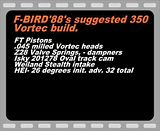
This is what I drew from his advice:
.......................F-Bird'88's 400 HP Motor..........................
a basic 350ci SBC short block with flat top pistons
906 GM vortec heads milled .040 .015 steel shim head gasket
Z28-type valves springs minus the inner damper
Stock OEM vortec retainers, seals locks and rocker arms
Isky #201278 camshaft 278-278 .450" .450" lift 234-234@.050" 106° LSA
Weiand Stealth Manifold and Holly 600cfm 4bbl carb
HEI ignition, plugs gaped. 050 static timed 26 degrees BTDC
1-5/8" headers 3" dual exhaust.
remote oil cooler
3200-3400 Stall torque converter
I love the idle! SBC MUZAK
Get hold of this guy and pick his brain, he knows his stuff, honest!
Video
This is what I drew from his advice:
.......................F-Bird'88's 400 HP Motor..........................
a basic 350ci SBC short block with flat top pistons
906 GM vortec heads milled .040 .015 steel shim head gasket
Z28-type valves springs minus the inner damper
Stock OEM vortec retainers, seals locks and rocker arms
Isky #201278 camshaft 278-278 .450" .450" lift 234-234@.050" 106° LSA
Weiand Stealth Manifold and Holly 600cfm 4bbl carb
HEI ignition, plugs gaped. 050 static timed 26 degrees BTDC
1-5/8" headers 3" dual exhaust.
remote oil cooler
3200-3400 Stall torque converter
I love the idle! SBC MUZAK
Last edited by DENCOUCH; Mar 6, 2009 at 11:15 PM.
Thread Starter
Junior Member
Joined: Apr 2008
Posts: 43
Likes: 0
From: Washington State
Car: 1988 IROC-Z
Engine: 5.7L
Transmission: 700R4
Axle/Gears: 2.77
Re: Help figuring out how much of a bottom end is "enough"
Regardless of the quality and price of the crank, should it not be getting checked by the machine shop before installation? Won't any crank I buy need to be balanced if it is purchased outside of a rotating assembly package?
If they all have to be machined anyways I see no reason not to go with a lower dollar Eagle crank or something similar and take my chances, rather than have overkill, which is the whole point of the thread. Sure it would be nice to overbuild everything, but you have to know when to stop, and I don't have enough knowledge yet to figure out where to draw the line.
Thanks for the advice so far on the quality of parts and that sort of thing, coming from the import world (I'm still there as well) I'm using to only VERY high dollar parts exceeding the factory standards, even for simple things like plug wires, so it's a bit of a change.
Based on the feedback I am warming up to the idea of possibly using a different set of heads, maybe even aluminum with an upgraded cooling system but I still have a lot of work to do before I start ordering more heavy duty engine parts, so I have plenty of time to change my mind. I also appreciate other peoples' comments about giving me the option of getting more power later by buying better parts now, I'm all about the power but I think this project will have enough with 400-450 and I would rather start another project rather than adding another 100-200 horsepower down the line, and that should be more than enough power to exceed what I'd feel comfortable doing in a 20 year old chassis with a live axle on the street anyways.
If they all have to be machined anyways I see no reason not to go with a lower dollar Eagle crank or something similar and take my chances, rather than have overkill, which is the whole point of the thread. Sure it would be nice to overbuild everything, but you have to know when to stop, and I don't have enough knowledge yet to figure out where to draw the line.
Thanks for the advice so far on the quality of parts and that sort of thing, coming from the import world (I'm still there as well) I'm using to only VERY high dollar parts exceeding the factory standards, even for simple things like plug wires, so it's a bit of a change.
Based on the feedback I am warming up to the idea of possibly using a different set of heads, maybe even aluminum with an upgraded cooling system but I still have a lot of work to do before I start ordering more heavy duty engine parts, so I have plenty of time to change my mind. I also appreciate other peoples' comments about giving me the option of getting more power later by buying better parts now, I'm all about the power but I think this project will have enough with 400-450 and I would rather start another project rather than adding another 100-200 horsepower down the line, and that should be more than enough power to exceed what I'd feel comfortable doing in a 20 year old chassis with a live axle on the street anyways.
Member
Joined: May 2008
Posts: 147
Likes: 0
From: Calgary
Car: 86 Camaro IROC-Z
Engine: 305 TPI (retrofit)
Transmission: T5
Axle/Gears: Crappy stock 10-bolt gears
Re: Help figuring out how much of a bottom end is "enough"
If you think you have enough self control to resist the urge to throw a 150hp shot of nitrous in this, or drop a blower on it when you see a sweet deal. Then i agree a basic eagle or scat rotating assembly will be alright. Personally, i've never been able to resist power adders . Check out cnc-motorsports, they have some sweet rotating assemblies with forgered KB pisons, Scat 7/16 pro-comp rods, and an scat 9000 crank for $850 and that comes fully balanced with rings/bearings. Clint at cnc will answer any/all questions you have, and their shipping is damn quick!
http://www.cnc-motorsports.com/produ...33&CtgID=25184
. Check out cnc-motorsports, they have some sweet rotating assemblies with forgered KB pisons, Scat 7/16 pro-comp rods, and an scat 9000 crank for $850 and that comes fully balanced with rings/bearings. Clint at cnc will answer any/all questions you have, and their shipping is damn quick!http://www.cnc-motorsports.com/produ...33&CtgID=25184
Senior Member
Joined: Mar 2008
Posts: 345
Likes: 0
From: moberly, Mo
Car: 91 rs
Engine: 383 290 cam aed carb
Transmission: th350
Axle/Gears: 4.10 ticking time bomb
Re: Help figuring out how much of a bottom end is "enough"
Ditto on that previous post, I believe that style of rotating assembly should fit the bill perfectly.
Thread Starter
Junior Member
Joined: Apr 2008
Posts: 43
Likes: 0
From: Washington State
Car: 1988 IROC-Z
Engine: 5.7L
Transmission: 700R4
Axle/Gears: 2.77
Re: Help figuring out how much of a bottom end is "enough"
I am liking that package from CNC except the compression. Isn't 9:1 a bit low for my power goals?
Member
Joined: Sep 2007
Posts: 169
Likes: 0
From: Baltimore
Car: '82 Z-28
Engine: 355
Transmission: TH-400, 8" ATI MRT
Axle/Gears: Moser 9", 4.56's
Re: Help figuring out how much of a bottom end is "enough"
You might be able to get them to swap out the dish pistons for some flat tops?? I dont know; I've never dealt with cnc motorsports.
Senior Member
Joined: Mar 2008
Posts: 345
Likes: 0
From: moberly, Mo
Car: 91 rs
Engine: 383 290 cam aed carb
Transmission: th350
Axle/Gears: 4.10 ticking time bomb
Re: Help figuring out how much of a bottom end is "enough"
Flat top pistons with 72cc chambers should give you 10:1-10:5.Depending on your deck height.
I just looked at the rotating assmebly in that link, it is not the one that you would want, it has a 3.48 stroke which would build a 377, make sure you get a 3.75 stroke to build a 406. This kit should suffice http://www.cnc-motorsports.com/produ...12&CtgID=20134
It has hyper pistons, which I believe will be just fine unless you plan to use nitrous, It also list 10.8 compression with 64 cc chambers, which might be a little high, but with good quench and aluminum heads should be fine.
I just looked at the rotating assmebly in that link, it is not the one that you would want, it has a 3.48 stroke which would build a 377, make sure you get a 3.75 stroke to build a 406. This kit should suffice http://www.cnc-motorsports.com/produ...12&CtgID=20134
It has hyper pistons, which I believe will be just fine unless you plan to use nitrous, It also list 10.8 compression with 64 cc chambers, which might be a little high, but with good quench and aluminum heads should be fine.

Thread
Thread Starter
Forum
Replies
Last Post
theshackle
Tech / General Engine
4
Mar 5, 2017 06:37 PM


