


To stall or not to stall


Thread Starter
Member
Joined: Jan 2011
Posts: 188
Likes: 1
From: Guelph, ON
Car: 1984 Chevrolet Camaro z28
Engine: 383 sbc
Transmission: 700r4
Axle/Gears: Stock...this is next
To stall or not to stall
Hi guys, quick question about my engine set-up. I need to know if my car requires a stall converter. I just had my engine redone, built a 383 (scat crank, 30 over flat tops, edelbrock performer rpm heads and intake, Voodoo 60103 cam (Camshaft, Hydraulic Flat Tappet, Advertised Duration 268/276, Lift .489/.504,) running the 700-r4 and 3.23 gears. I know the combination will be powerful enough for the street, I'm just wondering about the street manners it will have without a stall converter. Engine guys says it will just heat up the tranny fluid around town. Any experience with this kind of set up guys? thanks very much


Joined: Aug 2006
Posts: 1,376
Likes: 7
From: Northern California - Bay Area
Car: 1988 IROC-Z
Engine: L98 - full intake & exhaust boltons
Transmission: Bowtie 700r4, 2400 rpm stall
Axle/Gears: Borg-Warner 9bolt, 3.45 gears, posi
Re: To stall or not to stall
An aftermarket stall that is properly matched to your engine will give it a lot more performance than stock.
Stock stall for the thirdgen V8 cars is around 1,500rpm-1,600rpm. This is great for fuel economy by keeping the motor out of its power band most of the time but not for performance.
Most stalls that are properly matched to rest of the engine and drivetrain are roughly 500rpm-700rpm lower than the torque peak of the engine.
Its true that the trans will run hotter thanks to the looser converter that lets the motor get up in to the power band and stay there the entire time you are accelerating. This slipping action creates more heat then the tighter factory converter. This heat issue can be solved by installing a transmission fluid cooler. Heat is one of the main reasons that trans failure occurs so having a trans fluid cooler is a little extra insurance.
Typically though most of the mild Gen 1 small block motors that are in thirdgens will get a benefit from a stall thats in the 2,000rpm-2,500rpm range. I'm running a 2,400rpm stall with my stock head and stock cam L98 with full boltons and I like it a lot.
Once you get in to the 2,800rpm-3,000rpm stall range (depending on whats loose to you in terms of how much the converter slips and get the engine in to the power band) you may start to consider street driving issues as an imporatant factor. These higher stalls will work best with a motor has has a higher power band - around 4,500rpm-6,000rpm and up.
The 3,000rpm stall converters are a good choice for motors such as an Gen 1 small block with a miniram intake as compaired to a factory style long tube runner TPI motor or an LS-style motor. Shorter intake runners allow the motor to make make power higher in the rpm band than and engine. So to get good performance out of that kind of set up you will need a higher stall converter and some steeper axle gears.
Stock stall for the thirdgen V8 cars is around 1,500rpm-1,600rpm. This is great for fuel economy by keeping the motor out of its power band most of the time but not for performance.
Most stalls that are properly matched to rest of the engine and drivetrain are roughly 500rpm-700rpm lower than the torque peak of the engine.
Its true that the trans will run hotter thanks to the looser converter that lets the motor get up in to the power band and stay there the entire time you are accelerating. This slipping action creates more heat then the tighter factory converter. This heat issue can be solved by installing a transmission fluid cooler. Heat is one of the main reasons that trans failure occurs so having a trans fluid cooler is a little extra insurance.
Typically though most of the mild Gen 1 small block motors that are in thirdgens will get a benefit from a stall thats in the 2,000rpm-2,500rpm range. I'm running a 2,400rpm stall with my stock head and stock cam L98 with full boltons and I like it a lot.
Once you get in to the 2,800rpm-3,000rpm stall range (depending on whats loose to you in terms of how much the converter slips and get the engine in to the power band) you may start to consider street driving issues as an imporatant factor. These higher stalls will work best with a motor has has a higher power band - around 4,500rpm-6,000rpm and up.
The 3,000rpm stall converters are a good choice for motors such as an Gen 1 small block with a miniram intake as compaired to a factory style long tube runner TPI motor or an LS-style motor. Shorter intake runners allow the motor to make make power higher in the rpm band than and engine. So to get good performance out of that kind of set up you will need a higher stall converter and some steeper axle gears.
Hi guys, quick question about my engine set-up. I need to know if my car requires a stall converter. I just had my engine redone, built a 383 (scat crank, 30 over flat tops, edelbrock performer rpm heads and intake, Voodoo 60103 cam (Camshaft, Hydraulic Flat Tappet, Advertised Duration 268/276, Lift .489/.504,) running the 700-r4 and 3.23 gears. I know the combination will be powerful enough for the street, I'm just wondering about the street manners it will have without a stall converter. Engine guys says it will just heat up the tranny fluid around town. Any experience with this kind of set up guys? thanks very much
Last edited by yaj15; Nov 26, 2012 at 12:57 PM.
Thread Starter
Member
Joined: Jan 2011
Posts: 188
Likes: 1
From: Guelph, ON
Car: 1984 Chevrolet Camaro z28
Engine: 383 sbc
Transmission: 700r4
Axle/Gears: Stock...this is next
Re: To stall or not to stall
Wow, that's a lot of great information, thank you. The cam information sheet indicates that the main power band of the cam is 1800-6200 rpm. that will mean i'm stretching the the limits of the stock torque converter. Perhaps I should consider getting a 2000 rpm stall converter to help with acceleration, and a transmission oil cooler to go with. how will this affect my street driving? Also, will it be harder on my tranny kicking it gear at higher rpm? thank you
Joined: Aug 2006
Posts: 1,376
Likes: 7
From: Northern California - Bay Area
Car: 1988 IROC-Z
Engine: L98 - full intake & exhaust boltons
Transmission: Bowtie 700r4, 2400 rpm stall
Axle/Gears: Borg-Warner 9bolt, 3.45 gears, posi
Re: To stall or not to stall
Ha ha yeah I’ve learned a lot through trial and error. I asked a lot of questions when I was learning about converters and aftermarket trans so I understand what you are trying to learn. Ha ha there are a lot of things I’m still learning about here on too. At least you are asking questions though a lot of folks won’t do that then act surprised when things don’t exactly work as planned.
The trans fluid cooler is something that benefits all transmissions. With a higher stall converter that slipping action creates more heat. So even with a 100% stock car a trans fluid cooler is a good idea. It’s an even better idea with an aftermarket converter. You’ve got a nice street friendly 383. That motor has more power and produces more heat than the stock L69 or LG4 motors that were available when your car was new. So upgrading some components to take that increased power are very good ideas.
I would run a little higher stall than 2,000rpm if I had your set up. Something in the range of 2,200rpm-2,500rpm would work well too.
Also it would be a good time to upgrade your transmission with some stronger aftermarket components (i.e. shift kit, servos, etc.) or purchase an aftermarket trans that already has some upgrades made to it. The higher stall converter will put more stress on the stock trans due to the increased and more efficient torque multiplication that it has.
Also since your car is a 1984 model, you have the earlier 27 spline input shaft on your 700r4 – if you still have the original trans in your car. I think starting in 1985 GM upgraded the input spline count to 30. This gives the engine load more area to grab on to and makes it more durable.
Also the late 1986 and 1987-up 700r4’s got some upgrades that make them the more preferable transmissions to work with than the earlier 700r4’s. Even if you still have the stock 700r4 in your car it’s 28 years old and now you have put it behind a motor that has more power than the LG4 and L69 motors that came in 1984 Z28’s stock so a rebuild is good idea anyway. Stock 700r4’s have a torque capacity of around 370 pound feet.
I’m running a Bowtie Overdrives level 3 700r4 trans and 2,400rpm stall converter in my car and I’m very happy with it. I’ve got a stock head and cam L98 with full aftermarket bolt-ons for the intake components and the exhaust.
Your street driving should improve and remain very close to stock when you are driving at normal speeds. One benefit is that your car won’t pull through the brakes as much when it’s idling high while it’s warming up.
The converter really shows what it’s got when you get in to the throttle say 50% or more. The car will jump in to the power band and stay there the entire time that you are accelerating.
If I want to leave the line fast in my car I just leave at idle and jump on the throttle say 45%-50% down. My motor spins right up to 3,500rpm and stays in that rpm range the entire time I keep my foot down. When you do full throttle runs your motor will spool up faster and the rpm drops between shifts will be reduced.
Ha ha trust me once you get a high stall converter there is no way that you will want to go back to stock.
The trans fluid cooler is something that benefits all transmissions. With a higher stall converter that slipping action creates more heat. So even with a 100% stock car a trans fluid cooler is a good idea. It’s an even better idea with an aftermarket converter. You’ve got a nice street friendly 383. That motor has more power and produces more heat than the stock L69 or LG4 motors that were available when your car was new. So upgrading some components to take that increased power are very good ideas.
I would run a little higher stall than 2,000rpm if I had your set up. Something in the range of 2,200rpm-2,500rpm would work well too.
Also it would be a good time to upgrade your transmission with some stronger aftermarket components (i.e. shift kit, servos, etc.) or purchase an aftermarket trans that already has some upgrades made to it. The higher stall converter will put more stress on the stock trans due to the increased and more efficient torque multiplication that it has.
Also since your car is a 1984 model, you have the earlier 27 spline input shaft on your 700r4 – if you still have the original trans in your car. I think starting in 1985 GM upgraded the input spline count to 30. This gives the engine load more area to grab on to and makes it more durable.
Also the late 1986 and 1987-up 700r4’s got some upgrades that make them the more preferable transmissions to work with than the earlier 700r4’s. Even if you still have the stock 700r4 in your car it’s 28 years old and now you have put it behind a motor that has more power than the LG4 and L69 motors that came in 1984 Z28’s stock so a rebuild is good idea anyway. Stock 700r4’s have a torque capacity of around 370 pound feet.
I’m running a Bowtie Overdrives level 3 700r4 trans and 2,400rpm stall converter in my car and I’m very happy with it. I’ve got a stock head and cam L98 with full aftermarket bolt-ons for the intake components and the exhaust.
Your street driving should improve and remain very close to stock when you are driving at normal speeds. One benefit is that your car won’t pull through the brakes as much when it’s idling high while it’s warming up.
The converter really shows what it’s got when you get in to the throttle say 50% or more. The car will jump in to the power band and stay there the entire time that you are accelerating.
If I want to leave the line fast in my car I just leave at idle and jump on the throttle say 45%-50% down. My motor spins right up to 3,500rpm and stays in that rpm range the entire time I keep my foot down. When you do full throttle runs your motor will spool up faster and the rpm drops between shifts will be reduced.
Ha ha trust me once you get a high stall converter there is no way that you will want to go back to stock.
Wow, that's a lot of great information, thank you. The cam information sheet indicates that the main power band of the cam is 1800-6200 rpm. that will mean i'm stretching the the limits of the stock torque converter. Perhaps I should consider getting a 2000 rpm stall converter to help with acceleration, and a transmission oil cooler to go with. how will this affect my street driving? Also, will it be harder on my tranny kicking it gear at higher rpm? thank you

Moderator


Joined: Jul 1999
Posts: 17,274
Likes: 171
From: 51°N 114°W, 3500'
Car: 87 IROC L98
Engine: 588 Alcohol BBC
Transmission: Powerglide
Axle/Gears: Ford 9"/31 spline spool/4.86

Supreme Member
Joined: Feb 2006
Posts: 1,366
Likes: 1
From: St.Louis, IL
Car: 1988 Camaro
Engine: 377
Transmission: TH350; Circle D 4200 converter
Axle/Gears: Ford 9"
Re: To stall or not to stall
You should get a transmission cooler regardless of what converter you choose to go with. Heat is the number one killer for automatic transmissions.
I know this question pops up a lot, but you get what you pay for when it comes to torque converters... just like cylinder heads. A good torque converter will drive like a stock one in that RPM range (and even higher than that). Quality goes a long ways, and you'll like the results equally as much.
I seriously doubt you NEED a torque converter for your car within that RPM band (I know several people that have ran the XE268 variant with 0 problems on 350's, and you've got a 383), but it would probably help that "push you into your seat" feeling if you did.
Just my two cents. I know expensive converters aren't for everyone, but I think it's silly that people dump all their change into a motor when that's only a fraction of the whole equation. Not saying you did that, just speaking my mind.
I know this question pops up a lot, but you get what you pay for when it comes to torque converters... just like cylinder heads. A good torque converter will drive like a stock one in that RPM range (and even higher than that). Quality goes a long ways, and you'll like the results equally as much.
I seriously doubt you NEED a torque converter for your car within that RPM band (I know several people that have ran the XE268 variant with 0 problems on 350's, and you've got a 383), but it would probably help that "push you into your seat" feeling if you did.
Just my two cents. I know expensive converters aren't for everyone, but I think it's silly that people dump all their change into a motor when that's only a fraction of the whole equation. Not saying you did that, just speaking my mind.

Member
iTrader: (1)
Joined: Jan 2002
Posts: 482
Likes: 0
From: Michigan!
Engine: Vortec 4200 Inline 6 PT70 Turbo..
Transmission: 4L65E
Axle/Gears: 3.73
Re: To stall or not to stall
The best mods EVER can be summed up like this.
Sticky Tires
3000-4000 stall
100 shot.
If you dont already have sticky tires and a 3200-3600 stall I think you took a wrong turn somewhere along the "mod my camaro" trail.
The right converter even in a bone stock camaro is a HUGE performance improvement. Think of the stocker as a boat anchor.. Dragging down the performance of every part you spent money on.
Stock LT1 engines turn into a great performer with just a 2800 stall. After a cam swap, or not, it's common to jump right into a 3600 or greater stall.
I've had a 4200 Vigilante stall in front of my 700R4... Awesome, can't complain about how it drove either.. With my powerglide setup I had a 5000 stall, 3000 stall, and finally a "perfect" middleground 4500 stall. They all drove nice, they only flash up in RPM when you stab it past 50% throttle. Otherwise they motor along nicely, a little looser than stock. It's a feeling you get used to and love. Driving a 1600 rpm stall makes you really hate life.
Goodluck! Go 3500 and don't look back!
Sticky Tires
3000-4000 stall
100 shot.
If you dont already have sticky tires and a 3200-3600 stall I think you took a wrong turn somewhere along the "mod my camaro" trail.
The right converter even in a bone stock camaro is a HUGE performance improvement. Think of the stocker as a boat anchor.. Dragging down the performance of every part you spent money on.
Stock LT1 engines turn into a great performer with just a 2800 stall. After a cam swap, or not, it's common to jump right into a 3600 or greater stall.
I've had a 4200 Vigilante stall in front of my 700R4... Awesome, can't complain about how it drove either.. With my powerglide setup I had a 5000 stall, 3000 stall, and finally a "perfect" middleground 4500 stall. They all drove nice, they only flash up in RPM when you stab it past 50% throttle. Otherwise they motor along nicely, a little looser than stock. It's a feeling you get used to and love. Driving a 1600 rpm stall makes you really hate life.
Goodluck! Go 3500 and don't look back!
Last edited by AutoRoc; Nov 26, 2012 at 09:09 PM.
Trending Topics

Supreme Member
Joined: Jul 2011
Posts: 2,529
Likes: 0
Re: To stall or not to stall
A higher stall convertor without a cooler and trans upgrade is fool's gold.The one downfall of the 700R4's is the fluid doesn't flow well in lockup and then heats up.The cooler helps and the basic upgrade is a Trans-Go shift kit,Vett servo,.005 boost valve.A common failure is the sun gear where either the spines strip or the weld breaks.

TCI has a permanent fix for this in their monster sun gear.Now that I think about this more TCI has got a larger surface servo,better shift kit at different levels,bigger boost valve,clutches at different levels too.Call their tech dept and tell them what you have and they can tailor a kit for you.
www.TCIauto.com
TCI has a permanent fix for this in their monster sun gear.Now that I think about this more TCI has got a larger surface servo,better shift kit at different levels,bigger boost valve,clutches at different levels too.Call their tech dept and tell them what you have and they can tailor a kit for you.
www.TCIauto.com
Thread Starter
Member
Joined: Jan 2011
Posts: 188
Likes: 1
From: Guelph, ON
Car: 1984 Chevrolet Camaro z28
Engine: 383 sbc
Transmission: 700r4
Axle/Gears: Stock...this is next
Re: To stall or not to stall
Sorry this had taken me so long to get back to, all of you guys have put great information up here. You've all convinced me to upgrade not only the converter, but the transmission as well. There are complete kits made for the 700r4 from both TCI and B&M that upgrade everything, and there are shift kits from lots of companies (I hear trans-go makes a great one because it's more of a progressive shift?) When you say vette servo, is this direct order from GM or do the aftermarket servos that come in shift kits resemble the vette servo and serve the same function? I really appreciate the info guys. Thanks, Ian
Thread Starter
Member
Joined: Jan 2011
Posts: 188
Likes: 1
From: Guelph, ON
Car: 1984 Chevrolet Camaro z28
Engine: 383 sbc
Transmission: 700r4
Axle/Gears: Stock...this is next
Re: To stall or not to stall
Also... in my car the stock rad has an internal trans oil cooler. Did all the v8s come with this feature? And is it any good or should I switch to an external cooler?

Joined: Oct 2001
Posts: 12,231
Likes: 1,158
From: Il
Car: 1989-92 FORMULA350 305 92 Hawkclone
Engine: 4++,350 & 305 CIs
Transmission: 700R4 4800 vig 18th700R4 t56 ZF6 T5
Axle/Gears: 3.70 9"ford alum chunk,dana44,9bolt
Re: To stall or not to stall
Sorry this had taken me so long to get back to, all of you guys have put great information up here. You've all convinced me to upgrade not only the converter, but the transmission as well. There are complete kits made for the 700r4 from both TCI and B&M that upgrade everything, and there are shift kits from lots of companies (I hear trans-go makes a great one because it's more of a progressive shift?) When you say vette servo, is this direct order from GM or do the aftermarket servos that come in shift kits resemble the vette servo and serve the same function? I really appreciate the info guys. Thanks, Ian

http://www.700r4l60e.com/

Member
Joined: Dec 2012
Posts: 228
Likes: 1
Car: 1990 z28
Engine: 5.0
Transmission: t-5 wc
Axle/Gears: 4th gen 3.42 posi
Re: To stall or not to stall
not to stall T-56 6 speed conversion would be the cats butt. thats the set up I'm going with 383 / t-56 /3.42 did you go with a carb or tbi ? been looking into it they say you can get 400 h using a tbi and your computer ( with a little tuning) what do you think ? sory to step on your topic.
Supreme Member
Joined: Feb 2006
Posts: 1,366
Likes: 1
From: St.Louis, IL
Car: 1988 Camaro
Engine: 377
Transmission: TH350; Circle D 4200 converter
Axle/Gears: Ford 9"
Re: To stall or not to stall
Consider it a "vital insurance step" more than anything. It all starts to add up, but that's how it goes when you want something nice, you know?
Joined: Aug 2006
Posts: 1,376
Likes: 7
From: Northern California - Bay Area
Car: 1988 IROC-Z
Engine: L98 - full intake & exhaust boltons
Transmission: Bowtie 700r4, 2400 rpm stall
Axle/Gears: Borg-Warner 9bolt, 3.45 gears, posi
Re: To stall or not to stall
Even if you were going to keep your car 100% stock getting a cooler that was dedicated to just your transmission fluid is a good idea.
I'm not sure about the V6 cars but most of the V8 thirdgens had that internal trans fluid cooler built in to the radiator from the factory. The problem is that now the radiator is a dual fluid heat sink. Meaning that the radiator must primarily dissipate the heat from the coolant and in addition to that it has to handle to trans fluid too.
Heat is the #1 enemy for an automatic trans. An auxilary trans cooler is a good way to win that battle. It's important on a stock car but, really necessary when you start making modifications.
I'm not sure about the V6 cars but most of the V8 thirdgens had that internal trans fluid cooler built in to the radiator from the factory. The problem is that now the radiator is a dual fluid heat sink. Meaning that the radiator must primarily dissipate the heat from the coolant and in addition to that it has to handle to trans fluid too.
Heat is the #1 enemy for an automatic trans. An auxilary trans cooler is a good way to win that battle. It's important on a stock car but, really necessary when you start making modifications.
Thread Starter
Member
Joined: Jan 2011
Posts: 188
Likes: 1
From: Guelph, ON
Car: 1984 Chevrolet Camaro z28
Engine: 383 sbc
Transmission: 700r4
Axle/Gears: Stock...this is next
Re: To stall or not to stall
thanks very much for the input, I will definitely run an oil cooler. now... where do I put it? Would I put it behind the rad somewhere so that the air passes through it?
Joined: Aug 2006
Posts: 1,376
Likes: 7
From: Northern California - Bay Area
Car: 1988 IROC-Z
Engine: L98 - full intake & exhaust boltons
Transmission: Bowtie 700r4, 2400 rpm stall
Axle/Gears: Borg-Warner 9bolt, 3.45 gears, posi
Re: To stall or not to stall
Put it infront of the radiator. That way it will get maximum air flow as you drive It will allow the cooling fans to work with both the cooler and the stock radiator as well. as they pull air through both components.
Pusher style fans sit infront of the radiator.
Our cars have puller style fans - the fans sit behind the radiator. This is good because our cars get most of the air coming up from the air dam underneath the nose of the car. If our cars cooling systems were dependent upon the air coming through the grill alone they would over heat all the time. There simply isn't enough air flow coming through the grill to dissipate the heat from the radiator.
Pusher style fans sit infront of the radiator.
Our cars have puller style fans - the fans sit behind the radiator. This is good because our cars get most of the air coming up from the air dam underneath the nose of the car. If our cars cooling systems were dependent upon the air coming through the grill alone they would over heat all the time. There simply isn't enough air flow coming through the grill to dissipate the heat from the radiator.
Thread Starter
Member
Joined: Jan 2011
Posts: 188
Likes: 1
From: Guelph, ON
Car: 1984 Chevrolet Camaro z28
Engine: 383 sbc
Transmission: 700r4
Axle/Gears: Stock...this is next
Re: To stall or not to stall
Hello again, sorry for the very late reply. This has been a very educational thread for me, thanks for everyone's responses. So, I've picked up an external cooler (7"x9"x3/4" stacked plate design) that I'll be running in front of the rad (picked up a new one of those too). Now, I'm trying to determine which stall converter to go with. My local speed shop advertises the B&M stall converters, but I've read mixed reviews about them. I've decided to run a 2400 (or thereabouts) stall converter, and I was hoping for peoples input. I've looked into Bowtie Overdrives, Hughes, TCI, and B&M. These seem to fall in my price range for a good street driven set up like mine. I know about Vigilante, Edge and Yank converters, they are the best in the game, but they also run about $1000 which I can't afford and honestly don't think I need for my set up. Any recommendations and personal stories (great or terrible) would be greatly appreciated. Thank you very much guys.
Joined: Oct 2001
Posts: 12,231
Likes: 1,158
From: Il
Car: 1989-92 FORMULA350 305 92 Hawkclone
Engine: 4++,350 & 305 CIs
Transmission: 700R4 4800 vig 18th700R4 t56 ZF6 T5
Axle/Gears: 3.70 9"ford alum chunk,dana44,9bolt
Re: To stall or not to stall
Supreme Member
Joined: Feb 2006
Posts: 1,366
Likes: 1
From: St.Louis, IL
Car: 1988 Camaro
Engine: 377
Transmission: TH350; Circle D 4200 converter
Axle/Gears: Ford 9"
Re: To stall or not to stall
Hello again, sorry for the very late reply. This has been a very educational thread for me, thanks for everyone's responses. So, I've picked up an external cooler (7"x9"x3/4" stacked plate design) that I'll be running in front of the rad (picked up a new one of those too). Now, I'm trying to determine which stall converter to go with. My local speed shop advertises the B&M stall converters, but I've read mixed reviews about them. I've decided to run a 2400 (or thereabouts) stall converter, and I was hoping for peoples input. I've looked into Bowtie Overdrives, Hughes, TCI, and B&M. These seem to fall in my price range for a good street driven set up like mine. I know about Vigilante, Edge and Yank converters, they are the best in the game, but they also run about $1000 which I can't afford and honestly don't think I need for my set up. Any recommendations and personal stories (great or terrible) would be greatly appreciated. Thank you very much guys.
Just realized you have a 383. I'd still recommend a 3000 if you plan on hitting the track every now and then. Otherwise, it's not needed since the 383's torque will make things easier.

Joined: Mar 2000
Posts: 43,187
Likes: 46
From: Littleton, CO USA
Car: 82 Berlinetta/57 Bel Air
Engine: L92/LQ4 (both w/4" stroke)
Transmission: 4L80E/4L80E
Axle/Gears: 12B-3.73/9"-3.89
In all this education, I hope you've learned that even the stock converter "stalls". Not sure how you would "not stall" an automatic.
What you change is the speed at which more throttle does not increase engine RPM with the transmission output shaft not turning (as in, the brakes on hard enough to keep the driveshaft from turning). But, the same converter will stall differently behind a stock 305 than it would behind a built 454. So, take advertised stall speed with a grain of salt (you can't rate a converter for stall speed without knowing the engine it'll be behind).
I don't know your engine guy, but he doesn't appear to know diddly about what happens behind the engine. As stated, you add a transmission cooler to go along with the one built into the radiator (all 3rd gen automatic cars used a transmission cooler in the radiator). Do that, use quality ATF, and you don't have to worry about having a higher than stock stall for around town driving. The one you described sounds very small, depending upon how much "stacking" we're talking about here.
A stock converter would make that engine a dog. Don't even consider putting it behind that engine.
You didn't say what carb you're running, I'm assuming not the factory q-jet. That means you're going to have to rig up some means of locking up the TCC, and you'll need to get a "corrector bracket" for the TV cable to put on the throttle arm. If you are using the stock q-jet, you're fine.
I got my converter from Rev Max. Decent prices. The guy will build it to match your engine, car, and intended use. I've been abusing mine at the track and driving it to work for 2 years without a single problem. Very consistent 60' times (and if you ask drag racers who know what they're talking about, consistent 60' times is about traction and a good converter). I'm planning on getting one from him for my current build, stroked 6.0 with 4L80E, which will be driven to the track and run hard.
What you change is the speed at which more throttle does not increase engine RPM with the transmission output shaft not turning (as in, the brakes on hard enough to keep the driveshaft from turning). But, the same converter will stall differently behind a stock 305 than it would behind a built 454. So, take advertised stall speed with a grain of salt (you can't rate a converter for stall speed without knowing the engine it'll be behind).
I don't know your engine guy, but he doesn't appear to know diddly about what happens behind the engine. As stated, you add a transmission cooler to go along with the one built into the radiator (all 3rd gen automatic cars used a transmission cooler in the radiator). Do that, use quality ATF, and you don't have to worry about having a higher than stock stall for around town driving. The one you described sounds very small, depending upon how much "stacking" we're talking about here.
A stock converter would make that engine a dog. Don't even consider putting it behind that engine.
You didn't say what carb you're running, I'm assuming not the factory q-jet. That means you're going to have to rig up some means of locking up the TCC, and you'll need to get a "corrector bracket" for the TV cable to put on the throttle arm. If you are using the stock q-jet, you're fine.
I got my converter from Rev Max. Decent prices. The guy will build it to match your engine, car, and intended use. I've been abusing mine at the track and driving it to work for 2 years without a single problem. Very consistent 60' times (and if you ask drag racers who know what they're talking about, consistent 60' times is about traction and a good converter). I'm planning on getting one from him for my current build, stroked 6.0 with 4L80E, which will be driven to the track and run hard.

Member
iTrader: (1)
Joined: May 2010
Posts: 112
Likes: 2
From: Saskatchewan, canada
Car: 1982 Firebird T/A
Engine: 305
Re: To stall or not to stall
In all this education, I hope you've learned that even the stock converter "stalls". Not sure how you would "not stall" an automatic.
What you change is the speed at which more throttle does not increase engine RPM with the transmission output shaft not turning (as in, the brakes on hard enough to keep the driveshaft from turning). But, the same converter will stall differently behind a stock 305 than it would behind a built 454. So, take advertised stall speed with a grain of salt (you can't rate a converter for stall speed without knowing the engine it'll be behind).
I don't know your engine guy, but he doesn't appear to know diddly about what happens behind the engine. As stated, you add a transmission cooler to go along with the one built into the radiator (all 3rd gen automatic cars used a transmission cooler in the radiator). Do that, use quality ATF, and you don't have to worry about having a higher than stock stall for around town driving. The one you described sounds very small, depending upon how much "stacking" we're talking about here.
A stock converter would make that engine a dog. Don't even consider putting it behind that engine.
You didn't say what carb you're running, I'm assuming not the factory q-jet. That means you're going to have to rig up some means of locking up the TCC, and you'll need to get a "corrector bracket" for the TV cable to put on the throttle arm. If you are using the stock q-jet, you're fine.
I got my converter from Rev Max. Decent prices. The guy will build it to match your engine, car, and intended use. I've been abusing mine at the track and driving it to work for 2 years without a single problem. Very consistent 60' times (and if you ask drag racers who know what they're talking about, consistent 60' times is about traction and a good converter). I'm planning on getting one from him for my current build, stroked 6.0 with 4L80E, which will be driven to the track and run hard.
What you change is the speed at which more throttle does not increase engine RPM with the transmission output shaft not turning (as in, the brakes on hard enough to keep the driveshaft from turning). But, the same converter will stall differently behind a stock 305 than it would behind a built 454. So, take advertised stall speed with a grain of salt (you can't rate a converter for stall speed without knowing the engine it'll be behind).
I don't know your engine guy, but he doesn't appear to know diddly about what happens behind the engine. As stated, you add a transmission cooler to go along with the one built into the radiator (all 3rd gen automatic cars used a transmission cooler in the radiator). Do that, use quality ATF, and you don't have to worry about having a higher than stock stall for around town driving. The one you described sounds very small, depending upon how much "stacking" we're talking about here.
A stock converter would make that engine a dog. Don't even consider putting it behind that engine.
You didn't say what carb you're running, I'm assuming not the factory q-jet. That means you're going to have to rig up some means of locking up the TCC, and you'll need to get a "corrector bracket" for the TV cable to put on the throttle arm. If you are using the stock q-jet, you're fine.
I got my converter from Rev Max. Decent prices. The guy will build it to match your engine, car, and intended use. I've been abusing mine at the track and driving it to work for 2 years without a single problem. Very consistent 60' times (and if you ask drag racers who know what they're talking about, consistent 60' times is about traction and a good converter). I'm planning on getting one from him for my current build, stroked 6.0 with 4L80E, which will be driven to the track and run hard.
Thread Starter
Member
Joined: Jan 2011
Posts: 188
Likes: 1
From: Guelph, ON
Car: 1984 Chevrolet Camaro z28
Engine: 383 sbc
Transmission: 700r4
Axle/Gears: Stock...this is next
Re: To stall or not to stall
Hey guys, once again thanks for everything. Five-7, I'll repeat what Nicky just said, you are a boss. Every time I ask a question on here I really value your sage advice. To answer your first question, yes I know that every automatic trans has a stock torque converter that has a stock stall speed (with ours I`ve heard everything from 1500-1800, as high as 2200 for the Grand Nationals and Monte Carlo SS turbos with 200r4s). Thank you for the concise explanation of what the converter does, and how it will benefit me at the track. The engine builder I used came very highly recommended, it`s possible that I didn`t understand some of what he told me. The carb I will be using is a 750 Holley Vac Secondary. I know it will take some tuning with the jets, power valve and vac spring to have the throttle response that I want, but it can get there. Also, I recognize the need for a bracket for the throttle and TV cable. Luckily, Lokar just came out with an all in one bracket for 4150 style carbs that incorporates throttle cable, return spring, and TV cable for running 4150 style carbs on 700r4 cars (PN TCB-4150, as seen in Car Craft`s coverage of the SEMA convention in Vegas). So, I`ll definitely be running a stall converter, now the type and stall speed need to be decided. It was mentioned that some of the 2400 stall converters still have the bigger body (stock style) and therefore more rotating mass. Is it worth it for me to jump up to 2800-3000 with the smaller (10") housing? There is a local converter shop (J and K converters, in waterloo ontario) that make a 2800-3000 rpm stall converter with the smaller housing and 27 spline input. Might this be the choice for my car? Again, thanks a million for the replies

Supreme Member


Joined: Dec 2005
Posts: 9,931
Likes: 892
From: 53.0907° N, 113.4695° W
Re: To stall or not to stall
While this post is a little self-serving (I've PM'd the OP regarding a convertor I have for sale) I thought I'd add a video of how my TCI 10" (Street Fighter) convertor reacts on the dyno.
This pull was from 3000 to 6000. You can see the tach approach 3000 and just as the throttle is opened fully, it jumps to (very nearly) 4000. This is behind a Vortec headed 353 with a relatively short cam (XR276HR).
I would imagine that a 383, with it's larger amount of low engine speed torque (at least it should have more than this 353), might flash the convertor to a higher rpm.
Something to consider when you're selecting what "stall" to settle on.
For the record, TCI rates their 10" at 1500 rpm over stock (3000 to 3400 for a small block) and their 12" is 1000 rpm over stock (2200 to 2400). Expect to be at the high end of the scale with a "bigger" small block.

This pull was from 3000 to 6000. You can see the tach approach 3000 and just as the throttle is opened fully, it jumps to (very nearly) 4000. This is behind a Vortec headed 353 with a relatively short cam (XR276HR).
I would imagine that a 383, with it's larger amount of low engine speed torque (at least it should have more than this 353), might flash the convertor to a higher rpm.
Something to consider when you're selecting what "stall" to settle on.
For the record, TCI rates their 10" at 1500 rpm over stock (3000 to 3400 for a small block) and their 12" is 1000 rpm over stock (2200 to 2400). Expect to be at the high end of the scale with a "bigger" small block.
Thread Starter
Member
Joined: Jan 2011
Posts: 188
Likes: 1
From: Guelph, ON
Car: 1984 Chevrolet Camaro z28
Engine: 383 sbc
Transmission: 700r4
Axle/Gears: Stock...this is next
Re: To stall or not to stall
thanks for the reply and the video. I sorted this out with skinny, I do in fact have the 27 spline input on my 700r4 (my 84 is all original). If I can expect to be on the high side of companies advertised stall, then I might be ok going with the 12" 2200-2400 range converters. On the other hand, it sounds like if I really want the motor to hit hard when I put my foot down, a 2800-3000 10" stall converter is the way to go. Looks like I just gotta make the choice and spend the money. Thanks for everyone's help.
Supreme Member
Joined: Dec 2005
Posts: 9,931
Likes: 892
From: 53.0907° N, 113.4695° W
Re: To stall or not to stall
I will say that there's nothing quite like the difference a higher stall convertor makes short of nitrous anyway.
The only limitation I've found (from TCI anyway) is that you're somewhat limited in the amount of stall if keeping the torque convertor lockup is important to you. With their 10" convertor, 1500 rpm or so over stock is there advertised limit with a clutch version (although mine flashes past 3500).
The only limitation I've found (from TCI anyway) is that you're somewhat limited in the amount of stall if keeping the torque convertor lockup is important to you. With their 10" convertor, 1500 rpm or so over stock is there advertised limit with a clutch version (although mine flashes past 3500).
Supreme Member
Joined: Dec 2005
Posts: 9,931
Likes: 892
From: 53.0907° N, 113.4695° W
Re: To stall or not to stall
I think you were asking about your cooler installation too.
This is my set up. I went so far as to run the last foot in braided stainless. The tubing to AN adaptor gives me a convenient spot to break the transmission line during a swap.

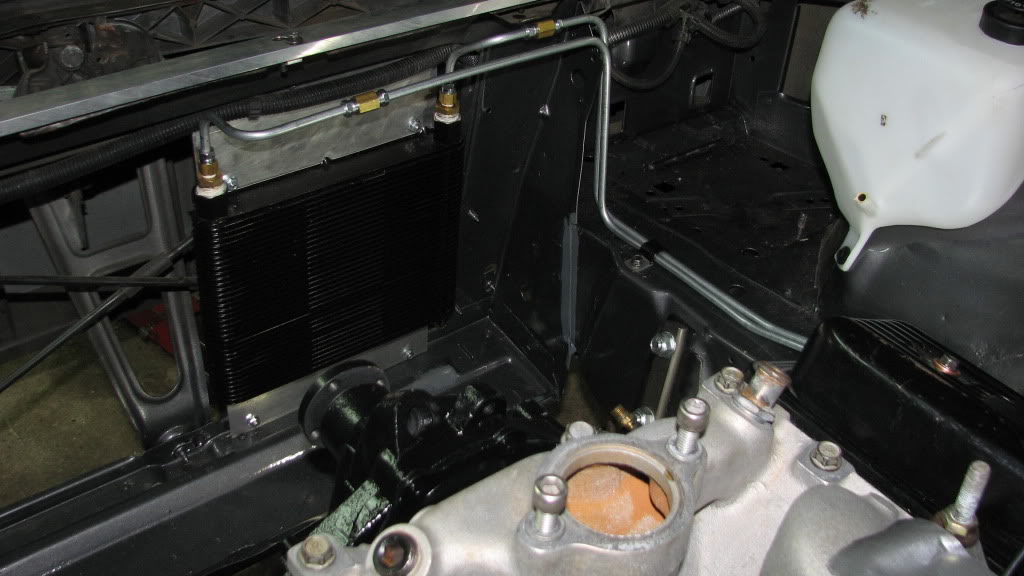
This is my set up. I went so far as to run the last foot in braided stainless. The tubing to AN adaptor gives me a convenient spot to break the transmission line during a swap.
Thread Starter
Member
Joined: Jan 2011
Posts: 188
Likes: 1
From: Guelph, ON
Car: 1984 Chevrolet Camaro z28
Engine: 383 sbc
Transmission: 700r4
Axle/Gears: Stock...this is next
Re: To stall or not to stall
wow, that's incredibly helpful, thanks skinny. I hope other people with the same questions are reading this thread, it's a good education on the basics of torque converters and external trans coolers. With all things considered, I think I'm going to go (if I can find one) for a 10" 2400 stall converter. If I can't find a smaller 2400, i'll move up to 3000 stall so I can get the smaller converter housing. As mentioned before, I should get the most out of the converter with a 383 producing a lot of torque. I'll write again after a finally buy one, and again after I run it behind the motor.

Thread
Thread Starter
Forum
Replies
Last Post
darwinprice
Organized Drag Racing and Autocross
17
Oct 11, 2015 11:51 PM
HoosierinWA
Tech / General Engine
5
Oct 7, 2015 10:15 AM
