When you click on links to various merchants on this site and make a purchase, this can result in this site earning a commission. Affiliate programs and affiliations include, but are not limited to, the eBay Partner Network.
Tech / General EngineIs your car making a strange sound or won't start? Thinking of adding power with a new combination? Need other technical information or engine specific advice? Don't see another board for your problem? Post it here!
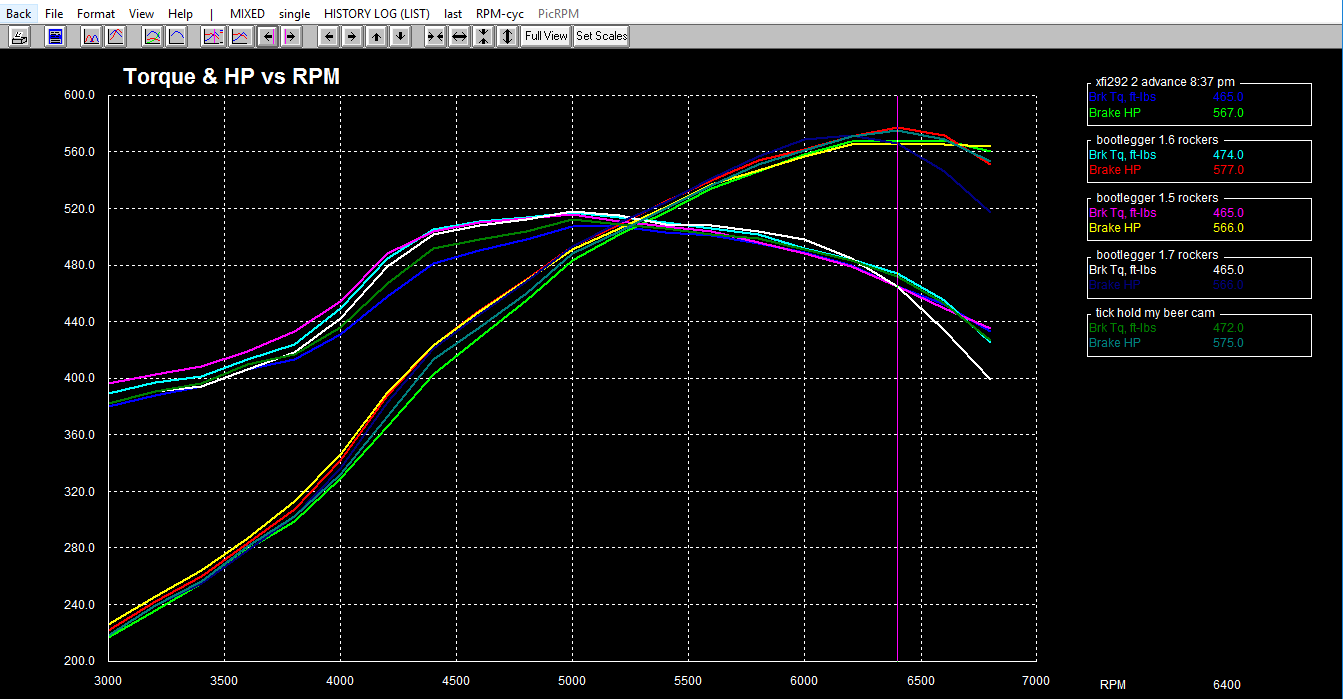
I'll run that through later tonight, in a few different iterations of lift and ICL. I plugged 1.7 rockers in on a couple of my tests, and in each one, I lost power compared to 1.6's. Maybe someone smarter then myself could answer why (smallish heads, port velocity, etc.). The only cam that made more power with over .600 lift was the tick. I also never ran a cam with that much exhaust duration, the xfi292 with 292/300 was the largest duration cam I tested. In any case, I'm curious about the results. Another thing that is important to my personal needs is a good, smooth torque curve, with hp carrying as far past the peak as possible since I autocross the car and just leave it in one gear. Rpm can range from 2500 to my 6700 rpm limiter, and a peaky torque curve can upset the balance of the car if it comes in suddenly. I don't want to get too far off the OP's topic, but at the same time, I find it interesting what does and does not work.
I don't know if you want to mess with it for comparison purposes but my setup is a traditional 383 with 6" rods and 11:1 compression. Better than factory windage control.
I don't have the port dimensions or CSA off the top of my head but I do know they are ~210cc, 2.02/1.60 valve and have the flow chart. LIFT------INTAKE-----EXHAUST .200----------138-------107 .300----------192-------138
.400----------241-------164 .500----------274-------183
.600----------291-------193
.700----------295-------199
I am running a dual plane port fuel injected intake very similar to a performer rpm vortec with a 1,200 cfm capable throttle body and induction setup.
Tri-Ys that go from 1 5/8" primaries to 2" secondaries to 2.5" collectors into a high flowing exhaust using the factory GM 3" dual piping.
I have run it on both 91 octane and E85. Seems to favor E85 and runs well with a more aggressive timing curve in the low-midrange on E85.
With the new cam I am feeding it enough fuel for ~550 hp @ 6,200 rpm on 91 octane E10 assuming a BSFC of 0.45. I am also seeing MAF readings in the 450-460 gms/sec range.
Been down and out with the flu for a week and started feeling among the living yesterday. Cleaned up the old office a bit and ran across my old notebooks of old dyno articles I used to keep. Ran across one from Jeff Smith he wrote for the October 1994 edition “Camshaft Comparo”. What caught my eye was it was a comparison of a 106 and 110 spread cam in a flat top 383 using “stock” 882 heads with 2.02/1.60 valves and Performer RPM – 1.75” long tube uncapped with torque tube. If my scanner worked I’d scan it, but here’s the meat and potatoes with a couple pictures of it.
Timing and jetting were optimized for each combination “with the only real jetting change coming from Test 4, requiring dropping 4 jet sizes, indicating a more efficient engine.”
There are a number of ways to spin this with the limited data available. Just thought you might find it interesting.
Ah makes sense now. I was gonna say that thing should go well above 6000
usually get a longer power curve after peak hp rpm with extra exhaust duration and aggressive timing curve.
I think that is why the Bootlegger feels so much stronger. My exhaust flow is only 66% of the intake. Holding it open longer is making the powerband wider. The old cam only had 10° split. This one has 12° split and 20° more exhaust duration than the old cam. Intake lobes are only 18° bigger. LSA is also 2° narrower on the new cam. Cams are installed on the same 106 ICL.
Fairly large data dump here. I'll start with some cams I ran for the OP's setup. There's a few not shown, so as not to clutter the graph too much, but as you can see, you can throw a blanket over the bunch. One notable that isn't shown is the small vizard. It was TERRIBLE! Way down on power and torque. The 'winner', IMO, is the second cam that Jones spec'd (232/236). I used the engine and cylinder head data that skinnyz provided, along with head flow data I found from a ported set of vortecs that matched his peak flow numbers to fill in the blanks on the mid range flow. I used the same 1.75 long tube headers in all the tests I've been running. I know using each of our individual setups may skew the numbers just a hair in either direction, but it's pretty time consuming and I think we can all draw our own conclusion for how our particular setups may affect the numbers.
175 headed 383
Fast355's 383
My 383. I found a pretty large error I had made on the 292 cam, somehow the .050 numbers were at 225/231. Correcting this data pushed HP up quite a bit. I was also impressed by the bootlegger cam.
I'll also add that the bootlegger pushed my dynamic compression ratio up by about .3, to 8.2, and in all the tests, power dropped off sharply after the hp peak with the 1.7 rockers.
Fairly large data dump here. I'll start with some cams I ran for the OP's setup. There's a few not shown, so as not to clutter the graph too much, but as you can see, you can throw a blanket over the bunch. One notable that isn't shown is the small vizard. It was TERRIBLE! Way down on power and torque. The 'winner', IMO, is the second cam that Jones spec'd (232/236). I used the engine and cylinder head data that skinnyz provided, along with head flow data I found from a ported set of vortecs that matched his peak flow numbers to fill in the blanks on the mid range flow. I used the same 1.75 long tube headers in all the tests I've been running. I know using each of our individual setups may skew the numbers just a hair in either direction, but it's pretty time consuming and I think we can all draw our own conclusion for how our particular setups may affect the numbers.
175 headed 383
Fast355's 383
My 383. I found a pretty large error I had made on the 292 cam, somehow the .050 numbers were at 225/231. Correcting this data pushed HP up quite a bit. I was also impressed by the bootlegger cam.
I'll also add that the bootlegger pushed my dynamic compression ratio up by about .3, to 8.2, and in all the tests, power dropped off sharply after the hp peak with the 1.7 rockers.
Thanks! Looks like the dual plane and 1.7 rockers are probably not hurting me at the 6,200 rpm I spin it to. I think its a good bit stronger at 3K than the chart reflects. The Rhoads lifters do not fully restore until around 4K based on information from talking with Rhoads. On the low-end I have about 20° @ 0.050 less duration and about 0.040" less lift.
I really like how the Bootlegger cam pulls. That ~540 ft/lbs of torque at 4,500 feel fantastic with the 5.13 gears. The 383 pulls stronger at the 2,800 rpm stall speed than the old 350 did at peak torque.
I am actually suprised how well that 175cc head runs at higher rpm but at the same time it is apparant how much power is left on the board compared to a more suitable head.
Matt I don't know if you can look at average TQ and HP numers with that setup but to me the Bootlegger with 1.6s looks like it has the highest average torque through that curve in your setup. It has alot more torque than the XFI292 in the 4,500 rpm range and looks to hold on to peak power as well as the Tick hold my beer cam.
Also I don't see how this simulation could be right about the 1.7 rockers killing top-end like that. Neither port is stalled at higher lift. When I modeled this setup with DD2000 the higher lift and 0.050" duration increase gave about 15 hp at peak and upwards of 20 at redline. DD2000 predicted more power through the whole rpm range save for sub 2,500 rpm where it cost 4-5 ft/lbs.
Wow. That's a lot of input. Thanks gentlemen. I'm going to go through this over the weekend (I hope). There's a lot to digest and Sunday mornings are best.
I haven't done any simulations myself so I've nothing to contribute in that regard (at this point anyway).
One thing to note, and this is what takes my direction somewhat off the beaten path, is the matching of the small port head (despite the flow numbers) with a larger cam and less than ideal CR. As mentioned way at the start here, is the thinking that the higher port velocity will aid cylinder filling/volumetric efficiency at lower engine speeds and isn't crippled as it would be with too large a cam that's conventional thinking says is mismatched to the CR.
So the goal here is to show that ample torque is realized down low and that carries into the higher RPMs. Which by the way will be limited to ~6200 so the spec should realize peak HP approaching 6000. It's not so much which cam will produce the most HP (but not sacrificing any either) but rather finding one that'll satisfy the CID at the specified RPM and also have the grunt down low. It's kind of been described as a good choice for a tow truck engine but still have the breath to run upstairs.
Something to note here is that of the two identical cams #'s 2 & 3, with the only difference (that I see) is the LSA, 106 vs 110, the 106 makes more HP and torque everywhere other than below 2600. It would have been interesting to see the ICL advanced as well. I bet that would bump up the torque even more.
Fairly large data dump here. I'll start with some cams I ran for the OP's setup. There's a few not shown, so as not to clutter the graph too much, but as you can see, you can throw a blanket over the bunch. One notable that isn't shown is the small vizard. It was TERRIBLE! Way down on power and torque. The 'winner', IMO, is the second cam that Jones spec'd (232/236). I used the engine and cylinder head data that skinnyz provided, along with head flow data I found from a ported set of vortecs that matched his peak flow numbers to fill in the blanks on the mid range flow. I used the same 1.75 long tube headers in all the tests I've been running. I know using each of our individual setups may skew the numbers just a hair in either direction, but it's pretty time consuming and I think we can all draw our own conclusion for how our particular setups may affect the numbers.
175 headed 383
I've been assembling all of the suggestions and at some point I'll present an entire list.
Much like your results Matt, I've finding that the differences between one cam and the next despite obvious dissimilarities, doesn't often add up to all that much. Reading the text from some of the tests and reports I've read and talk of 6-8 HP here and there but nothing really dramatic.
I'll run the same five cams as listed in your graph. And about a dozen more in total. Lunati is on the list here but what I didn't see was the line of Lunati / Vizard cams. They are the Power-Profile and Super-Profile grinds. For around my engine spec 9.8:1 CR suggests 290/290 239/239 106 102 ~.600". Bump up the CR to 10.5 and it's a 294, 251, 106, 102, .615" based on a 1.65 rocker.
EDIT: Something surprising is that none of those cams are flat at or even nearly so at 6000. All of them are well below peak by then. Is that an anomaly in the data causing that? My simulations show even the smallest have a peak at 5700 and most are nearly flat at 6000. Maybe it's the flow data for the heads. I've the test results from .100-.800". Could be something there.
Last edited by skinny z; Jan 12, 2020 at 12:04 PM.
I am actually suprised how well that 175cc head runs at higher rpm but at the same time it is apparant how much power is left on the board compared to a more suitable head.
That's an end around way of expressing of what I'm trying to get to here. The small head and how it'll change what you might normally spec for a 383 with a bigger head. Essentially the difference between yours and mine isn't it? I think the direction will be more cam than you might think to get it to run upstairs and the small head will prop up the low rpm loss you'd normally get from over-camming an engine. I'll need a better look at Matt's graph to see if there's a trend that way. I'll look for the same in my own tests.
The short list:
Some of these, GTA matt has already run through. I'll duplicate those with my data and see where we end up.
The others are suggestions and recommendations from various sources.
Last edited by skinny z; Jan 12, 2020 at 06:05 PM.
I like the DV282 and Orr's pick because both keep your DCR at nearly 8:1.
I don't care much for huge duration spreads between intake and exhaust, so I would choose the DV282, but you left out 2 values on the chart.
There is something to be said for Orr's pick because that cam gets it done with the lowest overlap.
If your exhaust port is on the weak side, then go for Orr's pick.
Please don't fall into the "bigger is better" trap.
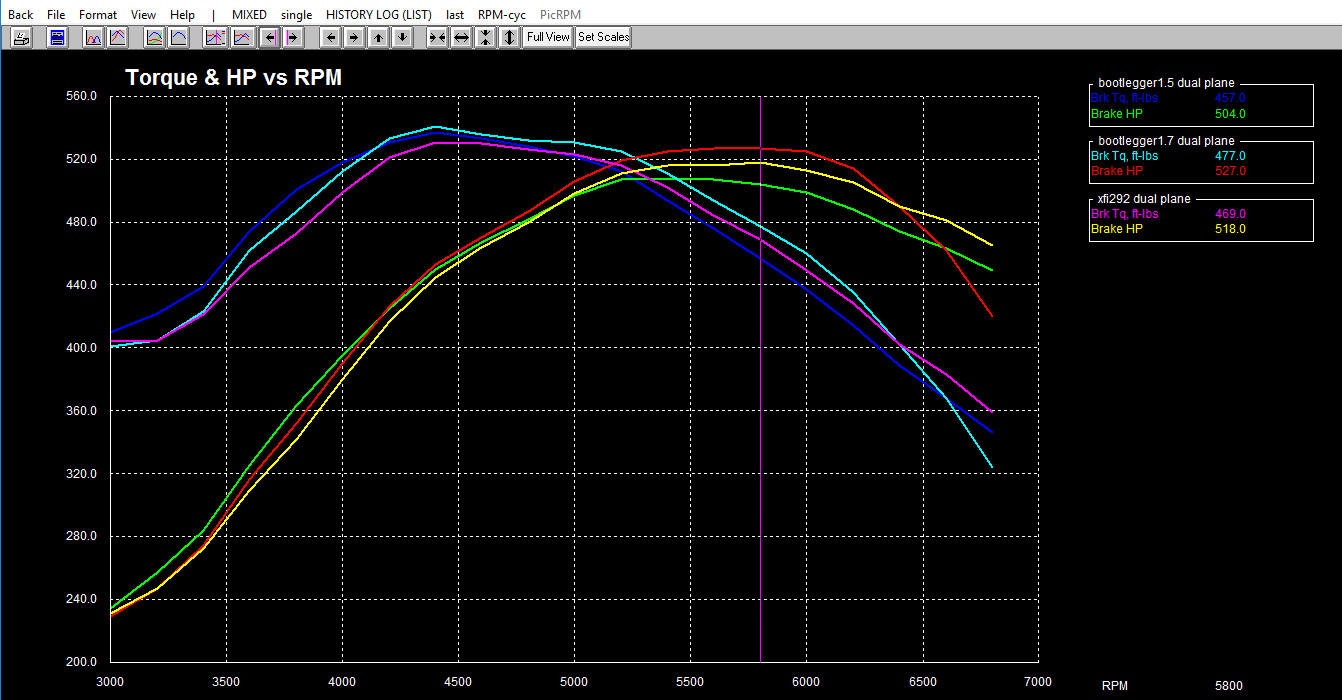
Ran a few more for you. Interested to see if our results match up. Left the Jones cam for comparison, since I felt it performed well in my previous results. The Lunati 290/290 cam seemed the best out of this bunch. While the dv294 had the most peak hp, you can see it gave up a bunch of low end torque.
I like the DV282 and Orr's pick because both keep your DCR at nearly 8:1.
I don't care much for huge duration spreads between intake and exhaust, so I would choose the DV282, but you left out 2 values on the chart.
There is something to be said for Orr's pick because that cam gets it done with the lowest overlap.
If your exhaust port is on the weak side, then go for Orr's pick.
Please don't fall into the "bigger is better" trap.
I think I can see where your thinking is going. And that's the way I'd approach a typical build with compression matched to the heads and CID. What's different here is the small port with respect to the CID and whether a "bigger is better" approach is actually "better". As I've mentioned, over-camming this engine may be of some benefit as, has been theorized, the small port low RPM VE is better than what would be expected with a more conventional head.
Ran a few more for you. Interested to see if our results match up. Left the Jones cam for comparison, since I felt it performed well in my previous results. The Lunati 290/290 cam seemed the best out of this bunch. While the dv294 had the most peak hp, you can see it gave up a bunch of low end torque.
Now THAT is interesting. The DV290 coming to the top.
Now here's something to consider with these simulations. What probably can't be compensated for is the better port velocity of the smaller head. If flow is equal, or nearly so between a large and small port, then the small port must have an increased velocity correct? This is what is supposed to compensate for using a cam larger than one would normally think is ideal. I'm not sure our simulators are able to pick up on that particular nuance although it's vital to what will work and what won't in the engine spec.
And speaking of simulations, I'm a ways out from putting anything together. By way of explanation, it's -27C here right now and my daily driver suddenly ins't. I've have had to spend more time in the cold today than I care to getting things right for the week to come.
Soon though.
PS. All still tailing off before 6000 RPM.
My cam program i use does compensate for port velocity. Based on valve area throat size and cfm flow, you can have it calculate mean port velocity. Engine analzyer should as well if it knows accurate port areas.
but im not sure if it understands where min csa is in the port which often is the pushrod pinch on a 23 deg head.
Do you know what your heads measure for throat and csa? Port volume? If its been ported it might be 180-190 cc now
My cam program i use does compensate for port velocity. Based on valve area throat size and cfm flow, you can have it calculate mean port velocity. Engine analzyer should as well if it knows accurate port areas.
but im not sure if it understands where min csa is in the port which often is the pushrod pinch on a 23 deg head.
Do you know what your heads measure for throat and csa? Port volume? If its been ported it might be 180-190 cc now
The velocity is key here and without the dimensions you're mentioning, (and I don't have the CSA and anything in that regard) might not be workable with the programs used. Engine Analyzer is more sophisticated than my old DynoSim though.
Porting was directed at cleaning up the existing valve job plus some short side stuff. I can't say what the port volume would be exactly although seeing as it started out at 170cc (advertised) I would think 180 is tops. One CC is a fair bit of material if you look at it.
I think I can see where your thinking is going. And that's the way I'd approach a typical build with compression matched to the heads and CID. What's different here is the small port with respect to the CID and whether a "bigger is better" approach is actually "better". As I've mentioned, over-camming this engine may be of some benefit as, has been theorized, the small port low RPM VE is better than what would be expected with a more conventional head.
VE graphic for reference. Your mid rpm ve is excellent. As far as port cross section goes, I kinda guesstimated, dropped the average port diameter of my 195 head down until port volume equalled 175cc's. Am I right or wrong, not sure. But it makes an interesting talking point for sure. Definitely not saying my numbers are the gospel, but there is a definitive trend going on with these cams.
Last edited by GTA matt; Jan 12, 2020 at 06:26 PM.
Those cams seem to fall off much earlier than expected in those sims
I think that has to do with the smallish port and valve allowing peak velocity increasing over 0.6 mach index.
I would experiment with altering the intake profile. You may find a later IVC than one that provides the highest DCR to alter the VE in a way that it increases peak HP substantially. IVC of 75-90°. Of course you will see a reduction in low-speed torque. I am talking keeping the duration the same by moving the IVO as well letting the LSA and ICL be what they are.
Those cams seem to fall off much earlier than expected in those sims
Not terribly surprised, but at the same time, prior to these tests, I would have estimated a peak around 57-5800. Given the small heads and dual plane, it makes sense. I tested a single plane and HP peaked at 5800 with the 294 cam, a miniram peaked at 6200. Interestingly enough, the numbers are pretty darn close to the tpi shootout article from long ago where they were using a 383 and a 288 cam.
The velocity is key here and without the dimensions you're mentioning, (and I don't have the CSA and anything in that regard) might not be workable with the programs used. Engine Analyzer is more sophisticated than my old DynoSim though.
Porting was directed at cleaning up the existing valve job plus some short side stuff. I can't say what the port volume would be exactly although seeing as it started out at 170cc (advertised) I would think 180 is tops. One CC is a fair bit of material if you look at it.
My 334 SBC is using iron World Products "305" Torquer heads that started life with 170cc intake ports. After I got in there with the grinder and sanding rolls to equalize the ports, they now measure 175.2cc. I am still using the stock size intake gasket (Felpro 1256) and the intake ports "choke" point (pushrod pinch) measures .85 x 1.90, which equals 1.805 sq in. and would allow 5903 rpm for the 334. (Wallace calculator).
I would use 175cc for your calculations. The Wallace calculator says a 383 with the same size choke point will be limited to 5155 rpm. http://wallaceracing.com/chokepoint.php
The above got me thinking ............. 305 class racers still use the heads I have, any no porting is allowed. You might want to look up what they are using for camshafts on their "spec" engines and what rpm they are turning with those limited heads.
None of my previous simulations with these heads and more than a dozen cam profiles have shown that kind of drop off past peak. Whether that's a function of my software or Matt's is something to be determined. But with 260 CFM of port flow at max lift, I can't see the heads running out of breath so abruptly and consistently as illustrated.
And although there's a CID difference, these same heads pulled like a freight train up to 7k with the XR288 and 355 cubes.
I have seen similar things with big cammed stock heads LT1 cars. They may reach peak at 5600-5800 but uusally hold power out to 6200-6500 pretty well since duration is still high enough to sustain airflow. But some of these cams are wide in duration split and wider lsa but not always
I'm going to pull back on my comment regarding the HP drop off. Having a better look at Matt's graph representing four profiles and my head data shows more like what I expected. The dashed lines are 6000 and 6500 with the purple cursor at 6200. This is roughly the results I get. No cams that I've tested prior to this thread made peak HP past 6200-6300 RPM so that looks about right. That said, this latest graph is a different test batch (except for Jones') so perhaps there still is some reckoning to be done.
Last edited by skinny z; Jan 13, 2020 at 10:20 AM.
I'm going to pull back on my comment regarding the HP drop off. Having a better look at Matt's graph representing four profiles and my head data shows more like what I expected. The dashed lines are 6000 and 6500 with the purple cursor at 6200. This is roughly the results I get. No cams that I've tested prior to this thread made peak HP past 6200-6300 RPM so that looks about right. That said, this latest graph is a different test batch (except for Jones') so perhaps there still is some reckoning to be done.
That graph there is of my miniram combo. Sorry if there was any confusion. I did run a test of your combo with a miniram and power peaked at 6200, showing the limiting factor may be your intake. I selected a street style dual plane for the tests. Even a race style single plane only peaked at 5800. A street style single plane did terrible, lost power and torque. If you know your runner length, I can plug that in, if its shorter then the preset model, it will push peak hp rpm up.
Well, that would explain that. Back to the acute drop off then.
As for the intake, no numbers handy but it's an RPM Air Gap.
When I'm inputting data into DynoSim, I use the "high flow" dual plane intake model, 750 VS carb, and open small tube headers (as opposed to the larger version I believe you've selected for your modeling). Easily changed on my end though if a trend develops and this needs addressing.
I'm going to try to run through some simulations this evening. Just really haven't had the time needed for a lengthy sit-down session.
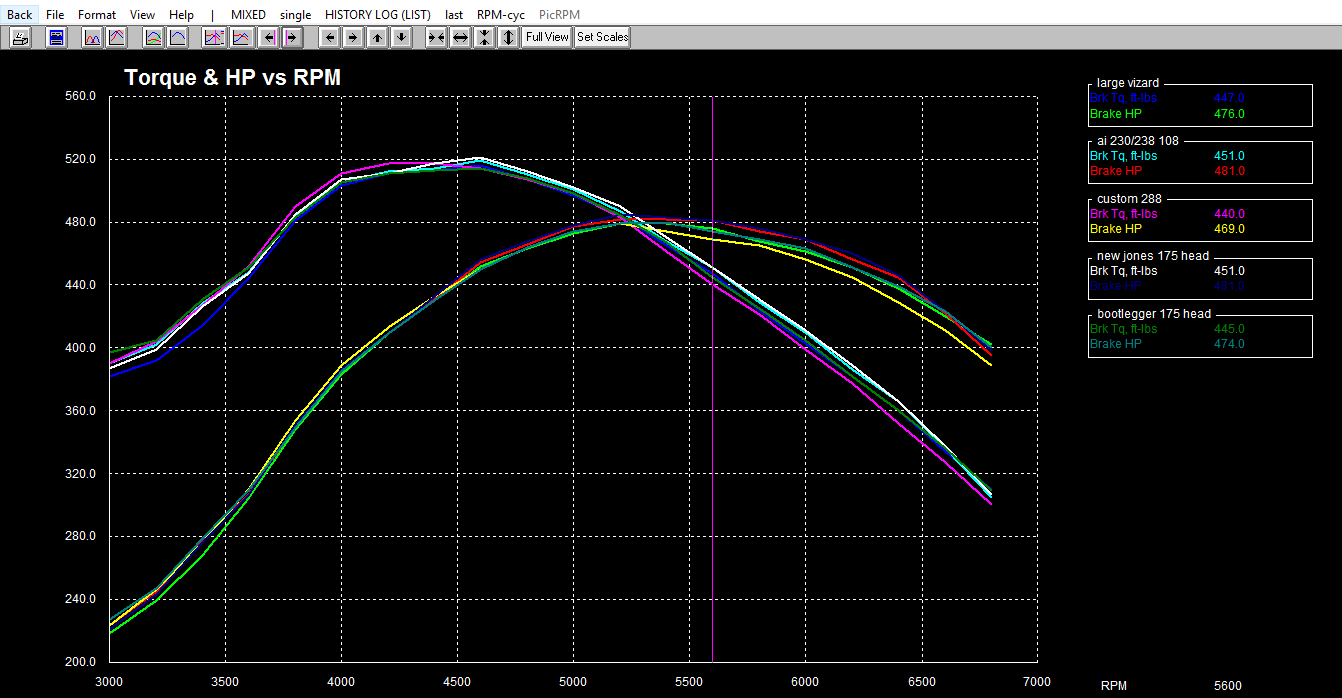
Alright. Some DynoSim graphs.
The first lot is the same test batch that Matt did. Should be Jones 2, Vizard Large, Fasts's Bootlegger and my Custom 288.
While I haven't had a thorough look at it, one things stands out and that's that the curves don't fall off as abruptly as we've discussed (except maybe for Jones 2)..
All dyno runs overlaid plus I've added a table format for each individual cam.
I've several more to test. I think what can be seen here is that all the cams are somewhat similar, with the exception of a couple of specs here and there, I think the results reflect that.
Now to the point, it's time to overcam this thing and see how it shakes out. The 290/290, 106 has some appeal. There's a 294 in there too. Just not sure how the head specs will translate into the software.
Last edited by skinny z; Jan 15, 2020 at 08:54 AM.
Interesting the differences in peak hp rpm between software. The one I'm using does NOT like your heads. I played around with runner length and different dual planes with no affect. Swapped on the 195 heads I've been using, which are only about a tenth difference in average cross section, used afr's advertised flow numbers, and peak hp rpm occurred at 6k. Time to rent a dyno lol.
I put no value whatsoever on the peak numbers regardless of the software. I think I'd be hard pressed to make 500 HP with a 175c cylinder head unless I spun it to the moon. I had a post at Speed Talk about that a few years back and that was the general consensus then.
What I do take from the simulations is how one plays against the other. I think there's something to learn from how one cam spec differs from the other and what values in that spec make the difference.
If I can get to it later today, I've a few choice profiles that were spec'd based on the small head. I'll see how that goes.
My 334 SBC is using iron World Products "305" Torquer heads that started life with 170cc intake ports. After I got in there with the grinder and sanding rolls to equalize the ports, they now measure 175.2cc. I am still using the stock size intake gasket (Felpro 1256) and the intake ports "choke" point (pushrod pinch) measures .85 x 1.90, which equals 1.805 sq in. and would allow 5903 rpm for the 334. (Wallace calculator).
I would use 175cc for your calculations. The Wallace calculator says a 383 with the same size choke point will be limited to 5155 rpm. http://wallaceracing.com/chokepoint.php
That is interesting. I'd like to have those port dimensions so I could better my estimations.
I still have the web pages and product info saved from when these heads were new. RHS Vortec Pro Torker. Maybe there's a spec in there that I've overlooked. Somewhat similar to the EQ Lightning castings (probably from the same foundry). These have 2.02/1.60 valves and are advertised as 170cc runner. Unfortunately, RHS's flow numbers are based on a 4.2" bore which really flatters the CFM. After I had these ported, I had them flowed. Those results come from a 4.03" fixture bore so they're realistic.
Last edited by skinny z; Jan 14, 2020 at 10:27 AM.
Back to the theoretical again. I've been fiddling around with Vizard's Torque Master cam selection program. It's actually very entertaining with cause and effect immediately seen when input values are changed.
At this point, I'm using the engine spec as: 383, 9.8 CR, 6" rod, max port flow 254 CFM (@ .550") with a MCA of 1.7x (calculated not measured yet).
Based on a 254 CFM minimum input value, peak HP RPM is at 5700 for a 286/286, 106 LSA, 102 ICL. DCR falls in a 7.7 with a cranking compression 190 PSI. Overlap is 74 degrees.The .050" numbers aren't provided but a look at several lobes profiles from Jones, Lunati, COMP have anywhere from 232 up to 242.
If I relax the minimum CFM to 250, peak HP RPM falls to 5570 and the cam selected is 283/283, 106/102 and 71 overlap.
Between the two, the latter loses some HP and gains a little torque which makes sense with the lower RPM but slightly higher cranking pressure with the earlier IVC.
I'll run a few simulations and see.
For the record, as there had been some discussion about the abrupt drop in output past 6000, this puts it into perspective. The heads just don't have what it takes to carry power any higher. I'm going to build to that. At the end of the day, it won't be anything new or different. but at the very least will be well thought out. If this becomes more of a track car, experimenting with the exhaust and intake tuning may pay some dividends.
Skinny, run the above again with 1.8 for MCA. You said you had your heads ported. My guess is that you are closer to 1.8.
From above: My 334 SBC is using iron World Products "305" Torquer heads that started life with 170cc intake ports. After I got in there with the grinder and sanding rolls to equalize the ports, they now measure 175.2cc. I am still using the stock size intake gasket (Felpro 1256) and the intake ports "choke" point (pushrod pinch) measures .85 x 1.90, which equals 1.805 sq in.
I'm basing the 1.7x MCA on flow and comparing that to a standard of 146 CFM per sq. in.
So, 254.CFM =.1.74.
At 1.8 pinch would be reflected as total flow of about 262 CFM. Something I don't have. But that's the math speaking there and I've never measured the pinch.
I'll run another test with a greater minimum port flow. Something I've done actually but in reverse. I pushed the peak HP RPM up to 6000 and the air flow needed and cam specs shift accordingly. Gotta get back to my PC to do that test though.
EDIT: This will come into better focus once I've got the heads off and on the bench.
Another way of evaluating port cross-sectional area comes from the (now out of print) SA-Design book DeskTop Dynos by Larry Atherton. His formula for calculating minimum port cross-sectional area offers an alternative method of estimating the minimum requirement based on cylinder volume times engine speed divided by an empirical constant of 190,000.
Minimum Port c/s Area = (bore2 x stroke x RPM) ÷ 190,000
A 350-ci engine with a 4-inch bore and a 3.48-inch stroke running at 6,000 rpm calculates as follows:
Area = (4.002 x 4.002 x 3.48 x 6,000) ÷ 190,000 = 1.758 square inches
That’s almost dead on with a Chevy 492 casting, which has a cross-sectional area of 1.76 square inches. Many performance heads have larger cross-sectional port areas because they are trying to move as much air as possible while still maintaining port velocity. It is a delicate balance to strike and some do it better than others. It would be great to know the port velocity at the choke point, but it is rarely measured outside of an engine lab and calculating it would be difficult, particularly with a plenum involved upstream of the manifold runner. Atherton’s formula provides a conservative but useful calculation of port area that lets you ballpark the minimum acceptable restriction based on engine size and RPM.
So I did a little math:
Skinny Z 383
4.030 x 4.030 x 3.75 x 6000 ÷ 190,000 = 1.923 square inches
4.030 x 4.030 x 3.75 x 5800 ÷ 190,000 = 1.860 square inches
Mike's 334
3.766 x 3.766 x 3.75 x 6000 ÷ 190,000 = 1.68 square inches
Solved for RPM gives 6448 with 1.805 square inches
I was working with that equation the other day. Results are pretty close to TM's in terms of peak HP RPM.
The difference lies in the other variables that the program assess. Even with a minimum port flow value established, the CR will change the RPM values. Keeping the flow derived from an MCA of 1.8" (264 CFM) and pushing the CR up to 10.5 (from 9.8) lowers the HP peak RPM. And cam specs really change from the lower CR.
And of course there's the whole argument of what the MCA actually does with respect to output. Chad Speier's Super Stock port has a small cross section but has a highly restructured port design. A Super Stock 358 with a 1.6in² pinch peaks at 7400.
I was having this discussion in part with Vizard and Weiss regarding the way that TM interprets the input values. Once explained, it made sense. Without enough port flow to adequately fill the cylinders (as in my case) and raising the CR, the duration values went smaller and the DCR went way up. Vizard's comment was that " If I don't have enough flow to fill the cylinders then I better squeeze the heck out of it."
The real question here, cam specs notwithstanding, is how good are these heads and what is the limit regarding peak RPM? Can't say I know for certain but it's most definitely not very high. Between your calculations and mine, it would appear to be between 5500 and 5700.
Originally Posted by NoEmissions84TA
A Super Stock 358 with a 1.6in² pinch peaks at 7400. Do you have any details, or a link for this?
Based on a 254 CFM minimum input value, peak HP RPM is at 5700 for a 286/286, 106 LSA, 102 ICL. DCR falls in a 7.7 with a cranking compression 190 PSI. Overlap is 74 degrees.The .050" numbers aren't provided but a look at several lobes profiles from Jones, Lunati, COMP have anywhere from 232 up to 242.
this whole program seems dumb. 286 advertised but no .050? No .200? How are you suppose to pick a lobe? Theres a ton of difference in how that engine will perform with a 286/230 lobe vs a 286/240 lobe
you should get controlled inductions software which I believe has been incorporated into the newest pipemax but not sure. The software was then sold to chris straub so im not sure if its still available or not. Fwiw my cam spec cam from the software
this whole program seems dumb. 286 advertised but no .050? No .200? How are you suppose to pick a lobe? Theres a ton of difference in how that engine will perform with a 286/230 lobe vs a 286/240 lobe
you should get controlled inductions software which I believe has been incorporated into the newest pipemax but not sure. The software was then sold to chris straub so im not sure if its still available or not. Fwiw my cam spec cam from the software
Originally Posted by skinny z
The .050" numbers aren't provided but a look at several lobes profiles from Jones, Lunati, COMP have anywhere from 232 up to 242..
Yeah. I'm aware of that. The thing with this program is that it appears to be all about maximum torque. Peak torque that is. As such it would be looking for maximum trapped cylinder pressure. That's the .006" value. DCR is calculated as is cranking compression (furthering the torque emphasis results) and there's little there that has to do with .050 and .200 values. I can see those numbers being more application specific. If you follow Lunati's line of DV cams, there are endurance lobes and then there are the aggressive versions. I think there's10 degrees or so difference between the two @ .050. And as you mentioned, that'll have an impact on the engine's output.
Obviously they're important but as is Vizard's approach, the first element considered in speccing a cam is the overlap. The LSA was defined empirically and is based on CID, CR and intake valve diameter. The rest falls into place. But throw in a set of mismatched heads as I have and everything gets a little wonky. But it's still targeting peak torque. Hence my experiment with the same heads and higher compression. Advertised duration went down and as it was explained by DV, "If you can't fill the cylinders (because of the small heads) then you better squeeze the heck out of it!" . That's all about maximizing torque.
I like the idea of Controlled Inductions software. I have an ancient version of PipeMax and have used it in the past but with limited results other the header calculations but I'll check into the other. Now that I'm further along into understanding the different aspects it'll be of greater benefit.
But, from what's been accomplished here, there and everywhere I've been, I think the spec is more or less sorted out. I'll undoubtedly stick with the tight LSA and ICL. Seems everyones done the same over and over. I think I'll mix it up a little. I doubt though, that at these power levels and RPMs, it'll amount to much. Then again....
Also i dont believe many sbc heads hit the 146 cfm per sq inch
That may well be. That 146 was the result of a straight pipe for analysis.
That said, then with a peak CFM of 254, the pinch in these heads could be above the 1.7x I've calculated. Which explains the discrepancy between what NoEmmisions and I have discussed. Based on his calculations a 1.7" MCA would only support a 383 to 5100 RPM whereas my measured airflow pushes that up to 5700.
, which equals 1.805 sq in. and would allow 5903 rpm for the 334. (Wallace calculator).
I would use 175cc for your calculations. The Wallace calculator says a 383 with the same size choke point will be limited to 5155 rpm.
Originally Posted by Orr89RocZ
Also i dont believe many sbc heads hit the 146 cfm per sq inch
This raises an interesting point and is a result of calculating based on data from the internet vs actually measuring. If a SBC head would never realize 146 CFM per sq. in. at the pinch, then my 254 CFM could conceivably have a MCA greater than the 1.7x I worked out. This would fall more into line with other calculated peak HP RPM.
Ultimately, I'll have to measure but the theory is better with that bit of info from Orr.
I'm all for the importance of the .050" number. Any racingengine builder I've talked to (not cam guys necessarily) want to know the 50 spec.
But for outright peak torque, and not power under the curve, it's .006".
As for overlap, yeah, lots of debate on that one. I think I've read every argument on both sides. Plenty prefer the IVC as the most important. But if you take the two cams in your example and use the overlap at .050", it tells a different story. The larger 050 cam will have significantly more overlap. Thing is, overlap comes into play as soon as the valve is off the seat. Similar to how DCR is calculated. Another spec that many don't put much stock in.
Question to you though: Of those two 050 cams, with 10 degrees between them, one will "destroy" the other and I can see average numbers in favour of the larger cam. But what about peak? When that valves snaps shuts or cracks open, the cam is out of play. Would peak TQ and HP be similar?
As I don't have a dyno, (and 2 sets of heads and 3 cams), I need more software!
I'm all for the importance of the .050" number. Any racingengine builder I've talked to (not cam guys necessarily) want to know the 50 spec.
But for outright peak torque, and not power under the curve, it's .006".
peak torque turns into power. If you make good torque you make power
cylinder fill is completely dependent on valve motion which starts off seat and ends on seat. Alot of what gets thru and how well the cylinder fills AFTER the piston hits bdc, depends on the valve motion between seats in that midrange and lift value. Thats engine VE. I know david knows this but fail to see how he derives at a meaningful cam spec by just looking at off seat. Maybe im missing something
so what overlap matters most? .006? .050? What about higher?
If a 280 xfi with 1.5 rockers faced a hot cam with 1.6-1.7’s to get lift closer to equal, and both had intakes and heads to support them, xfi wins in peak numbers. Average depends where its geared, the two may need diff gear and converter
darin morgan said engine masters making most power from 2500-6500 back in the day required valve motion out the ying yang....lol meaning fast open and close
That's part of my dilemma. Getting the duration values seems an easy exercise. I think you said mid 230's at the get go and that's kind of where I'm at. What I'm working through now, and TM isn't much help here that I can see, is to determine how fast a line I can use. A custom XFI cam I had was 274 adv and 224 @ 050. That compared to the shelf 276 grind which also had 224 @ 050. Despite the recommended springs plus tool steel retainers, I think that custom cam was partly responsible for the excessive wear. That's despite my best efforts at proper valve train geometry. It kind of spooked me a little and I have to think twice about the next profile I select. Also the application which I haven't entirely sorted out. If it's a track car mostly, I'll go for a fast lobe. Street car and cross country (yet again) I'll give up some performance for longevity.
Some of this will be determined after I find what's happened during the year down process of the current engine.






 , or confusing
  . Either way, I'm following.