


How high do your tpi's rev (dyno's welcome)


Thread Starter
Supreme Member
Joined: Sep 2001
Posts: 2,906
Likes: 0
From: Decatur, Illinois
How high do your tpi's rev (dyno's welcome)
I am getting tired of watching people argue about how high their tpi revs. From what I can tell the probably can only peak somewhere inbetween 5000 and 6000 even with modification (excluding mr/sr). I was wondering if some people that have actuall dyno runs with their setups would post them. I would like to see any combinations but I have particularly been thinking about running a highly ported/polished base and aftermarket runners with ported plenum. I am going to be running a 350 with probably a lpe 74211 or 74213 cam. If anybody has dynoed a similar setup. I will be running a set of stock heads off of my 350 factory roller motor but origionally carbed. I will have those heads thouroughly worked over(I have a friend who will do it for free). I have to have the heads magnifluxed though because I suspect that their might be something wrong with them. If so I was thinking about picking up a set of vortec heads and trying that new base from sdpc. Anyways I was just wanting to see what some of your dyno results with different setups.
Thanks
Ben
Thanks
Ben

Banned
Joined: Oct 1999
Posts: 1,147
Likes: 0
From: avondale, az
Car: 86 IROC-Z
Engine: 406
Transmission: 700R4
well i dont have the car dyno'ed yet.. heck i just got it back. im not sure what u r trying to say in your post.. u r seeing whos engine revs the highest? well im sure mines not the winner. its to new for me to rev then hell out of it, but im guessing 6200 rpms is the max.

Supreme Member
Joined: Jul 1999
Posts: 2,844
Likes: 4
From: Maryland
Car: 2005 Subaru STI
Engine: 153ci of Turbo Power!
Transmission: 6-Speed
Here we go again. Please everyone start using the correct jargon. Don't say 'rev'. I can get into a completely stock 350 TPI and 'rev' it to 6500rpms (might blow up but it will go there). That means nothing. A more appropriate question is ....
TPI powerbands: Where does yours end? AND, please post dyno graphs.
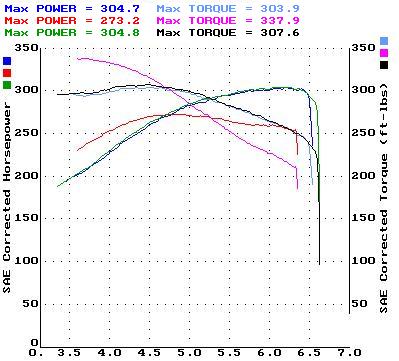
Let me start. I lent a friend my MiniRam. He did a dyno compare of a fully ported Large Tube Runner TPI setup as compared to my stock MiniRam. The FULLY PORTED LTR setup began falling off in horsepower after 4800rpms ... and this was with an LT4 HOT cam. He put the MiniRam on and the horsepower kept increasing up to 6K. Check it out.
Purple and Red are ported LTR
The others are the MiniRam
Tim
------------------
TRAXION's 1990 IROC-Z
Best Time = 12.244 @ 112.51mph (1.778 60' / 7.819@88.32mph in the 1/8)
All Natural. No Force. No Drugs. Stock Bottom End. Stock Body Panels.
Gunning for NA 11's with bigger cam, bigger stall, and bigger exhaust.
-=ICON Motorsports=-
Moderator: PROM board at thirdgen.org
TPI powerbands: Where does yours end? AND, please post dyno graphs.
Let me start. I lent a friend my MiniRam. He did a dyno compare of a fully ported Large Tube Runner TPI setup as compared to my stock MiniRam. The FULLY PORTED LTR setup began falling off in horsepower after 4800rpms ... and this was with an LT4 HOT cam. He put the MiniRam on and the horsepower kept increasing up to 6K. Check it out.
Purple and Red are ported LTR
The others are the MiniRam
Tim
------------------
TRAXION's 1990 IROC-Z
Best Time = 12.244 @ 112.51mph (1.778 60' / 7.819@88.32mph in the 1/8)
All Natural. No Force. No Drugs. Stock Bottom End. Stock Body Panels.
Gunning for NA 11's with bigger cam, bigger stall, and bigger exhaust.
-=ICON Motorsports=-
Moderator: PROM board at thirdgen.org
Thread Starter
Supreme Member
Joined: Sep 2001
Posts: 2,906
Likes: 0
From: Decatur, Illinois
Im sorry, I didnt mean rev. I did mean peak. I know that the stock tpi peaks around 4800. I was wondering if there is anyway to raise that at all without the sr/mr setups. I would love to have one but I dont really have the money right now. Traxion I heard that you ran high 12s when you had your long tube runner setup. I was just wondering how you had your car/engine setup at that time and was your peak up any from 4800 or was it still that low.
Thanks
Ben
Thanks
Ben
Guest
Posts: n/a
Theres another post on this same subject quite recently. A stock TPI intake on a stock TPI engine will peak at 42-4400 depending on which cam and stuff it had. Its not until you modify stuff that you will hit 4800, and thats about the max with a stock TPI intake no matter what you do if its naturally aspirated. TPI as it is is not a high RPM setup, never has been never will be.
Thread Starter
Supreme Member
Joined: Sep 2001
Posts: 2,906
Likes: 0
From: Decatur, Illinois
Thanks for your help madmax. I am not trying to start or continue any arguments but I am just trying to research everything so I know what is going on. I just wanted a straight answer on this because it is hard to tell what is true with everyone arguing.
Thread Starter
Supreme Member
Joined: Sep 2001
Posts: 2,906
Likes: 0
From: Decatur, Illinois
By the way madmax, I am new to these boards and just recently read through your topic on siamesing your intake. Did you ever get any before and after times with that. I just wondered how it did. I think I looked at someone elses before and after times and it looked like they actually got a little worse. Thier hp went up but the times looked like they went down. Thanks for your help.
Trending Topics

Member
Joined: Jun 2001
Posts: 410
Likes: 0
From: louisville, ky usa
I would think a 305 would peak higher than a 350 with all else being equal. Is this right guys?
------------------
************************
91 z-28 305 700R4
3.73 gears out back
T-Tops and Black all over.
------------------
************************
91 z-28 305 700R4
3.73 gears out back
T-Tops and Black all over.

Supreme Member
iTrader: (1)
Joined: Oct 2000
Posts: 1,062
Likes: 0
From: Pasadena, MD
Car: '87 Camaro IROC-Z
Engine: 385 HSR
Transmission: 700R4
Axle/Gears: 3.42 posi
Nope, not necessarily. The hp ratings GM gave for the TPI engines generally peaked at 4000 rpm for the peanut cam'd engines and 4400 rpm for the normal cam'd engines.
One thing to note about the graph Tim posted is that even though the LTR peaked at 4800 rpm, they only lost a dozen horsepower by 6000 rpm. Keep in mind that the Edelbrock manifold had been ported out (not siamesed for this dyno run) and he was running AS&M large-tube runners, all on a ZZ4 engine with a LT4 HOT cam. I have a similar combination except for stock runners (SLP's are on the way) and will be dyno'ing next Friday. Hopefully, I'll have the SLP runners on by then, but if not, I'll get before/after runs to compare how far up they move the horsepower peak, and they will be extensively ported out.
------------------
Greg Westphal
'87 IROC 355TPI/A4
One thing to note about the graph Tim posted is that even though the LTR peaked at 4800 rpm, they only lost a dozen horsepower by 6000 rpm. Keep in mind that the Edelbrock manifold had been ported out (not siamesed for this dyno run) and he was running AS&M large-tube runners, all on a ZZ4 engine with a LT4 HOT cam. I have a similar combination except for stock runners (SLP's are on the way) and will be dyno'ing next Friday. Hopefully, I'll have the SLP runners on by then, but if not, I'll get before/after runs to compare how far up they move the horsepower peak, and they will be extensively ported out.
------------------
Greg Westphal
'87 IROC 355TPI/A4

Senior Member
Joined: Sep 2001
Posts: 530
Likes: 0
Car: 1968 Camaro
Engine: 406
Transmission: Tremec TKO
Axle/Gears: 3.42
My big question is this:
How big of a part do you think cam selection played in that Dyno graph. We all know that the HOT cam was designed for a short runner, non tuned intake like the mini-ram. Would the tpi have the potential for more hp with a cam matched to take advantage of the long runners? How do they design the cam lobes to take advantage of these pulses? What is the difference of the lobe profile between say the HOT cam and the LPE 219/219? Can anyone shed a little light on this subject?
------------------
355 c.i.
Dart 180 Heads
Lunati 224/224 cam
Harland Sharp 1.5 rockers
Performer RPM Manifold
Holley 600 cfm double pumper
Hooker Super Competition Headers
Flowmaster Exhaust
Competition Engineering Sub-frame connectors
Super T-10
GM posi 3.42 rear
Hurst Roll Control
13.9@102
How big of a part do you think cam selection played in that Dyno graph. We all know that the HOT cam was designed for a short runner, non tuned intake like the mini-ram. Would the tpi have the potential for more hp with a cam matched to take advantage of the long runners? How do they design the cam lobes to take advantage of these pulses? What is the difference of the lobe profile between say the HOT cam and the LPE 219/219? Can anyone shed a little light on this subject?
------------------
355 c.i.
Dart 180 Heads
Lunati 224/224 cam
Harland Sharp 1.5 rockers
Performer RPM Manifold
Holley 600 cfm double pumper
Hooker Super Competition Headers
Flowmaster Exhaust
Competition Engineering Sub-frame connectors
Super T-10
GM posi 3.42 rear
Hurst Roll Control
13.9@102

Senior Member
Joined: Jun 2001
Posts: 829
Likes: 0
From: Vancouver, BC, Canada
So is there no way to get an LTR (aftermarket parts all the way ported and siamesed) plus the proper cam and heads to get into the 5K to 5.5K range, will it ALWAYS be stuck at 4800K????
Example
350 stock short block
AFR 190cc's
Ported and siamesed Edelbrock base
Ported and siamesed SLP runners
and ported and siamesed Plenum
Comp Cam 260AH I think it's power is 1500-5500
Will it still be peak power @ 4800 or should it in theory go higher?
------------------
1989 Trans Am GTA
Example
350 stock short block
AFR 190cc's
Ported and siamesed Edelbrock base
Ported and siamesed SLP runners
and ported and siamesed Plenum
Comp Cam 260AH I think it's power is 1500-5500
Will it still be peak power @ 4800 or should it in theory go higher?
------------------
1989 Trans Am GTA
Supreme Member
iTrader: (1)
Joined: Oct 2000
Posts: 1,062
Likes: 0
From: Pasadena, MD
Car: '87 Camaro IROC-Z
Engine: 385 HSR
Transmission: 700R4
Axle/Gears: 3.42 posi
It should peak higher than that. Mike Davis' combination (the one with the above graph) dyno'd his engine with a siamesed Edelbrock base and his horsepower peaked at 5300 rpm instead of 4600-4800.
------------------
Greg Westphal
'87 IROC 355TPI/A4
------------------
Greg Westphal
'87 IROC 355TPI/A4

Member
Joined: Nov 1999
Posts: 137
Likes: 1
From: Scottsdale, AZ USA
You need to understand the resonance effects of a tuned port motor to clearly see the rpm limitations of this type intake system. If you look at the dyno curves above you will notice the miniram has a very smooth FLAT torque curve. This is because the intake system intentionally uses no resonance effects. Actually it is referred to as an anti-tuned intake. Now look at 3500 rpm and you will see clearly the "tuned" effect coming into play. Torque has jumped from 300 ft-lbs to almost 340 ft-lbs. Now, as you go up in rpm, these exact same resonance effects which added to your torque, are now starting to SUBRTRACT from your torque. In addition, the long runners are experiencing a pressure drop due to the high velocity of the air traveling through them. (All intake components see this effect, tuned or not) That is why the TPI systems fall off so quickly above peak HP. This is a very important point to understand. If you keep the runner length the same, making everything bigger such as ported base, and large tube runners, will not overcome the negative resonance effects above torque peak. This is why people report that going to aftermarket base and large tube runners only gave them maybe 200 rpm higher HP peak and torque peak about the same. This is a relatively small change when the runner change alone went from 200cfm flow for stock runners to 260cfm for the AZS&M large tube runners. That kind of cfm change in the heads would have made a HUGE difference. If you shorten the runners, you will raise the resonance rpm and thus make more torque and HP at higher rpm, but it will still fall of quickly at higher rpms. I do not consider this to be a negative point for the long tube runner setup. If you look at the graph, you will see that below 4750 rpm, the LTR is the clear winner. When I think about how much time I spend BELOW 4800rpm versus above..... I know I made the right choice going with the long runner setup on my engine!

Supreme Member
Joined: Sep 1999
Posts: 3,197
Likes: 10
From: Manassas VA
Car: 04 GTO
Engine: LS1
Transmission: M12 T56
<font face="Verdana, Arial" size="2">Originally posted by Yelofvr:
If you look at the graph, you will see that below 4750 rpm, the LTR is the clear winner. When I think about how much time I spend BELOW 4800rpm versus above..... I know I made the right choice going with the long runner setup on my engine!</font>
If you look at the graph, you will see that below 4750 rpm, the LTR is the clear winner. When I think about how much time I spend BELOW 4800rpm versus above..... I know I made the right choice going with the long runner setup on my engine!
</font>
Yeeah, you're right, an engine does spend most of its time below 4800, when you're driving to the store to get groceries, or picking up mary jane rottencroctch to go to the movies. However, in a race, you will spend less than a second or so below 4800 rpms, meaning that sure the LTR guy jumped a length on you off the line for the first 20 feet (assuming he hooks all that torque, which is basically impossible w/ true radials on the street) and after that the MR will blow his doors clean off.
I've ridden in Trax's car which has a much more radical cam than the LT4 hot cam in it. I am sure it must make somewhat less low end than the graph he showed. Believe me, the last thing on your mind is 'damn when does the power kick in (which is how your explanation makes it sound)' It's more like 'wow, he's already shifting into 3rd and the tach seems to swing effortlessly to 7k , if only my eyes could focus on it.'
Personally, i'd rather have a little less torque when i was driving sedately (low rpms) and have the power to let it all hang out when i nail the go pedal.
Member
Joined: Nov 1999
Posts: 137
Likes: 1
From: Scottsdale, AZ USA
Ed:
How did you know I am dating mary jane rottencrotch??? She told me she likes it smooth and slow..... Actually my 383 is in a 79 Jeep CJ-7 with 35" tires so my application is surely different than most you speed demons on the board!
How did you know I am dating mary jane rottencrotch??? She told me she likes it smooth and slow.....
Actually my 383 is in a 79 Jeep CJ-7 with 35" tires so my application is surely different than most you speed demons on the board! Supreme Member
Joined: Sep 1999
Posts: 3,197
Likes: 10
From: Manassas VA
Car: 04 GTO
Engine: LS1
Transmission: M12 T56
lol @ yelo
Smartass . Yeah, in a 4x4 i would certainly shoot for as much low end as possible. No matter what you're crawling, more torque could always come in handy (unless you're mud bogging, but thats a different story.)
I reckon i jumped the gun on that one. Typically you see some hardcore LTR guy make a statement like that as it relates to street racing, thus my explanation of that fallacy.
Smartass
. Yeah, in a 4x4 i would certainly shoot for as much low end as possible. No matter what you're crawling, more torque could always come in handy (unless you're mud bogging, but thats a different story.)I reckon i jumped the gun on that one. Typically you see some hardcore LTR guy make a statement like that as it relates to street racing, thus my explanation of that fallacy.

Member
Joined: Dec 2000
Posts: 146
Likes: 0
From: tulsa, OK,USA
Car: 77 Corvette
Engine: ZZ3/nitrous
Transmission: THM 400
Ran my TPI setup, which is on a stock LO5 flat tappet motor (350 truck engine).
Pulled to a peak of 181 RWHP at 4800 rpm.
Found I had a blocked cat, but this is typical for a stock L98.
Runs were made on a dynojet. I dont have the print with me at the moment, but I will rerun it soon with a few mods, and a hi flo cat.....
Cheers
Richard
Pulled to a peak of 181 RWHP at 4800 rpm.
Found I had a blocked cat, but this is typical for a stock L98.
Runs were made on a dynojet. I dont have the print with me at the moment, but I will rerun it soon with a few mods, and a hi flo cat.....
Cheers
Richard
Member
Joined: Nov 1999
Posts: 137
Likes: 1
From: Scottsdale, AZ USA
88gta:
Do you know the cam specs on the l05 motor? I would imagine intake duration is in the range of 190 deg at 0.050" valve lift and maybe .390 or .400 peak lift??? Do you know the lobe separation angle?? Not really related to this post, but I have never seen specs on the cam used in the tbi 350 truck engines. They sure had great torque right off idle though!
Do you know the cam specs on the l05 motor? I would imagine intake duration is in the range of 190 deg at 0.050" valve lift and maybe .390 or .400 peak lift??? Do you know the lobe separation angle?? Not really related to this post, but I have never seen specs on the cam used in the tbi 350 truck engines. They sure had great torque right off idle though!
Supreme Member
Joined: Jul 1999
Posts: 2,844
Likes: 4
From: Maryland
Car: 2005 Subaru STI
Engine: 153ci of Turbo Power!
Transmission: 6-Speed
<font face="Verdana, Arial" size="2">Originally posted by Ed Maher:
I've ridden in Trax's car ... Believe me, the last thing on your mind is 'damn when does the power kick in (which is how your explanation makes it sound)' It's more like 'wow, he's already shifting into 3rd and the tach seems to swing effortlessly to 7k , if only my eyes could focus on it.'
</font>
I've ridden in Trax's car ... Believe me, the last thing on your mind is 'damn when does the power kick in (which is how your explanation makes it sound)' It's more like 'wow, he's already shifting into 3rd and the tach seems to swing effortlessly to 7k , if only my eyes could focus on it.'
</font>
 Now get down here and get your headers and driveshaft!
Tim
------------------
TRAXION's 1990 IROC-Z
Best Time = 12.244 @ 112.51mph (1.778 60' / 7.819@88.32mph in the 1/8)
All Natural. No Force. No Drugs. Stock Bottom End. Stock Body Panels.
Gunning for NA 11's with bigger cam, bigger stall, and bigger exhaust.
-=ICON Motorsports=-
Moderator: PROM board at thirdgen.org
Supreme Member
Joined: Sep 1999
Posts: 3,197
Likes: 10
From: Manassas VA
Car: 04 GTO
Engine: LS1
Transmission: M12 T56
<font face="Verdana, Arial" size="2">Originally posted by TRAXION:
That brings a tear to my eye Now get down here and get your headers and driveshaft!
Tim
</font>
That brings a tear to my eye
Now get down here and get your headers and driveshaft! Tim
</font>
Member
Joined: Dec 2000
Posts: 146
Likes: 0
From: tulsa, OK,USA
Car: 77 Corvette
Engine: ZZ3/nitrous
Transmission: THM 400
Yelofvr,
The cam specs are :
194 intake
202 exhaust
.390 intake
.410 exhaust
110 intake center angle
117 lobe separation
Identical to the 300 hp, 327 musclecar cam,
by todays standards, peanut, but really a torque monster.
Cheers
Richard.
The cam specs are :
194 intake
202 exhaust
.390 intake
.410 exhaust
110 intake center angle
117 lobe separation
Identical to the 300 hp, 327 musclecar cam,
by todays standards, peanut, but really a torque monster.
Cheers
Richard.

Senior Member
Joined: Jun 2000
Posts: 781
Likes: 0
From: Palm Bay, FL
Car: 2007 Corvette Z06
Engine: LS7
Transmission: 6 speed
How much does it cost to get a run on a dyno, no tunning, just for ****s and giggles?
Also does 220 rwhp sound high for my little 305 with headers and a chip, This is using those vehicle weight(assumed 3500lbs GTA with leather/power seats,140lbs driver, no spare tire) and a best mph of 96.4(average ~95+ mph.
I just don't want to have a ~180 rwhp car, such as the graphs i've seen or the 176 rwhp that couldn't get scanned b/c it's in a plaque LOL. My friend's 1.8L honda makes ~180 rwhp N/A, stock cams, heads, etc.
Also does 220 rwhp sound high for my little 305 with headers and a chip, This is using those vehicle weight(assumed 3500lbs GTA with leather/power seats,140lbs driver, no spare tire) and a best mph of 96.4(average ~95+ mph.
I just don't want to have a ~180 rwhp car, such as the graphs i've seen or the 176 rwhp that couldn't get scanned b/c it's in a plaque LOL. My friend's 1.8L honda makes ~180 rwhp N/A, stock cams, heads, etc.
Member
Joined: Dec 2000
Posts: 146
Likes: 0
From: tulsa, OK,USA
Car: 77 Corvette
Engine: ZZ3/nitrous
Transmission: THM 400
Typically anywhere from 50 to 100 bucks for two or three pulls on a dynojet, depending on who runs the shop. I did it as part of a group rate through a car club. Since the cat has been replaced with a hi flo, and a dynomax 3" intermediate pipe is now in, I need to rerun it to see where it is now.
220 RWHP for a 'stock' 305 is not going to happen, realistically, it should be closer to 170 to 180 for a speed density setup, a little lower for MAF.
Cheers
Richard
1988 GTA, 350, ported plenum, hi flo cat, 3" int pipe, flowmaster 80, no A.I.R, coolant bypass.
220 RWHP for a 'stock' 305 is not going to happen, realistically, it should be closer to 170 to 180 for a speed density setup, a little lower for MAF.
Cheers
Richard
1988 GTA, 350, ported plenum, hi flo cat, 3" int pipe, flowmaster 80, no A.I.R, coolant bypass.
Thread Starter
Supreme Member
Joined: Sep 2001
Posts: 2,906
Likes: 0
From: Decatur, Illinois
I was just wondering how much power you can lose by having a plugged cat. If you do not have to worry about polution control is it better to have no cat or a high flow cat?
Thanks
Ben
Thanks
Ben
Supreme Member
Joined: Sep 1999
Posts: 3,197
Likes: 10
From: Manassas VA
Car: 04 GTO
Engine: LS1
Transmission: M12 T56
You can lose a lot of power due to a clogged cat. Anything from not much, to the engine completely not running.
In terms of comapring a high flow cat vs. no cat, thats a little weird. Some people don't see any difference w/ a high flow cat and nothing, yet some people do in fact gain a couple tenths w/ no cat. And we're talking everything from stock cars that pick up a tenth, to race engines that lose 4hp (trivial)
In terms of comapring a high flow cat vs. no cat, thats a little weird. Some people don't see any difference w/ a high flow cat and nothing, yet some people do in fact gain a couple tenths w/ no cat. And we're talking everything from stock cars that pick up a tenth, to race engines that lose 4hp (trivial)

Member
Joined: Jul 1999
Posts: 109
Likes: 0
From: Sydney, Australia.
Here is the dyno of my car, with and w/o 50HP nitrous. Its a 305 TPI, ported stock heads, Crane 2031 Compucam, AS&M LTR, etc. Full mods at my site under 'Jims IROC', link below. I shifted at 5,000 RPM for the ET in my sig. To convert from KW to HP, divide by 0.746.

Picture of my car on the dyno
------------------
1987 Chevy Camaro IROC-Z. 305 TPI. 700R4
100HP nitrous.
13.05 secs @ 105 MPH.
1.92 sixty foot on street tires.
http://www.camaro-firebird.org
Camaro and Firebird pages in Sydney, Australia.
Picture of my car on the dyno
------------------
1987 Chevy Camaro IROC-Z. 305 TPI. 700R4
100HP nitrous.
13.05 secs @ 105 MPH.
1.92 sixty foot on street tires.
http://www.camaro-firebird.org
Camaro and Firebird pages in Sydney, Australia.
Member
Joined: Nov 1999
Posts: 137
Likes: 1
From: Scottsdale, AZ USA
Richard:
That is actually a little bigger than I thought it might be. Is this the cam that came in the TBI 350 trucks? I am surprised the lobe separation is so wide when the cam is such a short duration???? Dont they usually tighten the lobe sep on short duration cams to make better low and mid torque?? since the cam is not made for high rpm anyway?? I had always beleived you should use a narrower lobe separation if it does not impact your vacuum and idle, for a better overall powerband.
That is actually a little bigger than I thought it might be. Is this the cam that came in the TBI 350 trucks? I am surprised the lobe separation is so wide when the cam is such a short duration???? Dont they usually tighten the lobe sep on short duration cams to make better low and mid torque?? since the cam is not made for high rpm anyway?? I had always beleived you should use a narrower lobe separation if it does not impact your vacuum and idle, for a better overall powerband.
Member
Joined: Dec 2000
Posts: 146
Likes: 0
From: tulsa, OK,USA
Car: 77 Corvette
Engine: ZZ3/nitrous
Transmission: THM 400
Hah,
My mistake, 112 degrees, LSA, and intake is 195 degrees. The engine is exactly as it came out of the crate, and according to GM is fairly stout (torque) for street use.
I am looking forwards to putting it back on the dyno as the power drop was very visible on the plots, and could also be heard.
The fact the engine revved to 5500 rpm, proves that just because you can rev it that high, doesnt mean there is anything to be gained from doing it.
Cheers
Richard
My mistake, 112 degrees, LSA, and intake is 195 degrees. The engine is exactly as it came out of the crate, and according to GM is fairly stout (torque) for street use.
I am looking forwards to putting it back on the dyno as the power drop was very visible on the plots, and could also be heard.
The fact the engine revved to 5500 rpm, proves that just because you can rev it that high, doesnt mean there is anything to be gained from doing it.
Cheers
Richard

Junior Member
Joined: Oct 2001
Posts: 5
Likes: 0
From: Orland Park, IL, USA
I dont care what any of you guys say. I have been a member of this site for 12 hrs now and im already pissed off. Im running a stock bottom end 305 with 80,000 miles on it, a set of Vortec heads with nothing done to them except larger springs, compcam 224dur.@.050 .525 lft with 1.6 rockers, full length hooker super comp headers, with mufflex Y-pipe, dumping into 3inch flomaster cat back, Presicion Industries 9.5 inch 2800 convertor, 3.73 gears, MSD box and coil, SLP runners, Scoggin-Dickey base plate, ported plennum, STOCK throttle body, and last but not least slicks that were WAY too big for my gear(28x9x15). And a fuel pump that was giving up. I STILL ran a 13.27 at 101mph. AND YA KNOW WHAT I SPUN THAT THING UP TO 6500 RPM EVERY TIME AND IT FELT LIKE A F**KIN MILLION BUCKS. Yeah your right I have no dyno sheet but ya know what Im sick of you guys arguing amongst yourselfs. Do as Heffner says "If it feels good do it".


Supreme Member
Joined: Sep 1999
Posts: 3,197
Likes: 10
From: Manassas VA
Car: 04 GTO
Engine: LS1
Transmission: M12 T56
<font face="Verdana, Arial" size="2">Originally posted by BklimNova:
I dont care what any of you guys say. I have been a member of this site for 12 hrs now and im already pissed off. Im running a stock bottom end 305 with 80,000 miles on it, a set of Vortec heads with nothing done to them except larger springs, compcam 224dur.@.050 .525 lft with 1.6 rockers, full length hooker super comp headers, with mufflex Y-pipe, dumping into 3inch flomaster cat back, Presicion Industries 9.5 inch 2800 convertor, 3.73 gears, MSD box and coil, SLP runners, Scoggin-Dickey base plate, ported plennum, STOCK throttle body, and last but not least slicks that were WAY too big for my gear(28x9x15). And a fuel pump that was giving up. I STILL ran a 13.27 at 101mph. AND YA KNOW WHAT I SPUN THAT THING UP TO 6500 RPM EVERY TIME AND IT FELT LIKE A F**KIN MILLION BUCKS. Yeah your right I have no dyno sheet but ya know what Im sick of you guys arguing amongst yourselfs. Do as Heffner says "If it feels good do it".</font>
I dont care what any of you guys say. I have been a member of this site for 12 hrs now and im already pissed off. Im running a stock bottom end 305 with 80,000 miles on it, a set of Vortec heads with nothing done to them except larger springs, compcam 224dur.@.050 .525 lft with 1.6 rockers, full length hooker super comp headers, with mufflex Y-pipe, dumping into 3inch flomaster cat back, Presicion Industries 9.5 inch 2800 convertor, 3.73 gears, MSD box and coil, SLP runners, Scoggin-Dickey base plate, ported plennum, STOCK throttle body, and last but not least slicks that were WAY too big for my gear(28x9x15). And a fuel pump that was giving up. I STILL ran a 13.27 at 101mph. AND YA KNOW WHAT I SPUN THAT THING UP TO 6500 RPM EVERY TIME AND IT FELT LIKE A F**KIN MILLION BUCKS. Yeah your right I have no dyno sheet but ya know what Im sick of you guys arguing amongst yourselfs. Do as Heffner says "If it feels good do it".</font>
1- that cam. 224' @ 0.050 is a HUGE cam for a 305. It's powerband is significantly different than a stock cam.
2- those heads. Voretc heads outflow a stock 305 head by apporx. 25%. In other words, they will move enough air to let you make power.
3- the runners. Albeit, SLP runners are not the best out there, they are still damn good and will supoort plenty of power. Further, they are a semi-siamesed design which cuts down on the effective length of the runners, thus making them less of a high rpm/flow restriction.
These 3 things alone are what makes your car so significantly different from the case of a basically stock engine. That was the argument, in fact w/o realizing it you have proved my point. When you get into decent heads, a real cam, and a shorter runner intake, of course you'll make real power higher up.
Hell, not too long ago i drove a 305 TPI that had a solid powerband out to 6k. It had a little less cam (215/220), completely ported and matched SLP runners/base/plenum, and ported stock 305 heads. The problem was, idiots trying to tell me that their basically stock 305 could do the same thing just cuz they ported the plenum and added headers. It doesn't work that way.
Senior Member
Joined: Sep 2001
Posts: 530
Likes: 0
Car: 1968 Camaro
Engine: 406
Transmission: Tremec TKO
Axle/Gears: 3.42
Math Time:
400 cubic inch displacement = .2315 cubic feet displacement
350 cubic inches displacement = .2025 cubic feet displacement
305 cubic inches displacement = .1765 cubic feet displacement
Assuming 100% VE, the maximum airflow needs at 6000 rpm:
(Displacement (cubic feet) x RPM)/2 (2 because it is a 4 stroke engine) =
400:694 cfm
350:608 cfm
305:523 cfm
Because these flow requirements are proportional and linear by their calculation, and because we assume that a 350 is limited at 4800 rpm BY AIRFLOW, I don't think that it unreasonable to assume that the airflow requirements of a 305 will be proportional. So we can say that the intake of a 305 will limit airflow at an rpm range proportional to that of a 350:
(350/305) x 4800 rpm = 5508 rpm
Interesting how that turned out. It's almost like they took the 305 intake with a 5500 rpm redline, and put it on a 350 (sarcasm here is implied).
So the stock tpi intake of a 305 become a restriction after 5500 rpm, which gives a little weight to the claim that, concerning only the intake, 305's have a higher rpm potential than a 350.
I think the main question resides within the heads and cam. For the sake of arguement, let's restrict the stock intake flow to 200 cfm before entering the intake runner of the head.
Does anyone have flow numbers for the stock 305 heads?
Also, I'm too lazy to look up the bore/stroke combination of a 305 ... because I hate them. Is it 3.78/3.48?
Regardless, the 305 displaces .022 cubic feet per cylinder.
Somebody hime in here and help me figure this out. Let me know if my math is wrong also.
400 cubic inch displacement = .2315 cubic feet displacement
350 cubic inches displacement = .2025 cubic feet displacement
305 cubic inches displacement = .1765 cubic feet displacement
Assuming 100% VE, the maximum airflow needs at 6000 rpm:
(Displacement (cubic feet) x RPM)/2 (2 because it is a 4 stroke engine) =
400:694 cfm
350:608 cfm
305:523 cfm
Because these flow requirements are proportional and linear by their calculation, and because we assume that a 350 is limited at 4800 rpm BY AIRFLOW, I don't think that it unreasonable to assume that the airflow requirements of a 305 will be proportional. So we can say that the intake of a 305 will limit airflow at an rpm range proportional to that of a 350:
(350/305) x 4800 rpm = 5508 rpm
Interesting how that turned out. It's almost like they took the 305 intake with a 5500 rpm redline, and put it on a 350 (sarcasm here is implied).
So the stock tpi intake of a 305 become a restriction after 5500 rpm, which gives a little weight to the claim that, concerning only the intake, 305's have a higher rpm potential than a 350.
I think the main question resides within the heads and cam. For the sake of arguement, let's restrict the stock intake flow to 200 cfm before entering the intake runner of the head.
Does anyone have flow numbers for the stock 305 heads?
Also, I'm too lazy to look up the bore/stroke combination of a 305 ... because I hate them. Is it 3.78/3.48?
Regardless, the 305 displaces .022 cubic feet per cylinder.
Somebody hime in here and help me figure this out. Let me know if my math is wrong also.
Supreme Member
iTrader: (1)
Joined: Oct 2000
Posts: 1,062
Likes: 0
From: Pasadena, MD
Car: '87 Camaro IROC-Z
Engine: 385 HSR
Transmission: 700R4
Axle/Gears: 3.42 posi
Your math is right, but some of your logic is wrong. Even though the 350 peaks at 4400 or 4800 rpm or wherever, the 305 won't peak higher since the horsepower peak is determined by the cam specs and the intake runner length, among other minor variables. Given the same heads, intake, and cam, a 305 and 350 would peak within 100-200 rpm of each other. In fact, the 305 (350 cam, not the peanut cam) and 350 TPI engines both peaked at 4400 rpm, while the peanut-cam'd 305 peaked at 4000 rpm (exactly where mine peaked when it was nearly stock).
I doubt the 305 heads flow more than 150-160 cfm, so they're the biggest restriction in this whole discussion. Yes, the 305 has a 3 47/64" bore and 3 31/64" stroke, which hurts its revability compared to a 350 due to the small-bore/long-stroke configuration.
------------------
Greg Westphal
'87 IROC 355TPI/A4
Even though the 350 peaks at 4400 or 4800 rpm or wherever, the 305 won't peak higher since the horsepower peak is determined by the cam specs and the intake runner length, among other minor variables. Given the same heads, intake, and cam, a 305 and 350 would peak within 100-200 rpm of each other. In fact, the 305 (350 cam, not the peanut cam) and 350 TPI engines both peaked at 4400 rpm, while the peanut-cam'd 305 peaked at 4000 rpm (exactly where mine peaked when it was nearly stock).I doubt the 305 heads flow more than 150-160 cfm, so they're the biggest restriction in this whole discussion. Yes, the 305 has a 3 47/64" bore and 3 31/64" stroke, which hurts its revability compared to a 350 due to the small-bore/long-stroke configuration.
------------------
Greg Westphal
'87 IROC 355TPI/A4

Supreme Member
iTrader: (1)
Joined: Dec 1999
Posts: 4,335
Likes: 4
From: Mays Landing NJ
Car: 2018 Camaro SS
Engine: LT1 w/Paxton 1500SL
hehe where is bugs at on this thread? **** if a ported plenum and runners allow my 350 to make power at 6K i'll just extrude hone them so i can rev to 10K 
All that work and he STILL can't hit the 13's poor guy, i'd be pissed off too..
Well to actually add some input to this subject my bone stock L98(haven't even lifted the valve covers or plenum) drops off at around 4800-5K thats where i shift out of 1st, anything higher is just overkill, i shift at 5K out of first then shift into 3rd at around 4500(yes i shift my auto manually, and since 3rd gear takes a bit to shift, i shift at 4500 so by the time it goes into 3rd its at around 4800-5K) i've tested different shift points and this works the best for me, on my best time 13.89@99..
------------------
Check out MyGTA Nicknamed:The Big Red Machine
***AOL IM ClarkeMustGoNow***
Moderator at www.transamgta.com
"What does not kill us only makes us stronger"
Tony
[This message has been edited by fly89gta (edited October 19, 2001).]
All that work and he STILL can't hit the 13's poor guy, i'd be pissed off too..
Well to actually add some input to this subject my bone stock L98(haven't even lifted the valve covers or plenum) drops off at around 4800-5K thats where i shift out of 1st, anything higher is just overkill, i shift at 5K out of first then shift into 3rd at around 4500(yes i shift my auto manually, and since 3rd gear takes a bit to shift, i shift at 4500 so by the time it goes into 3rd its at around 4800-5K) i've tested different shift points and this works the best for me, on my best time 13.89@99..
------------------
Check out MyGTA Nicknamed:The Big Red Machine
***AOL IM ClarkeMustGoNow***
Moderator at www.transamgta.com
"What does not kill us only makes us stronger"
Tony
[This message has been edited by fly89gta (edited October 19, 2001).]
Supreme Member
Joined: Sep 1999
Posts: 3,197
Likes: 10
From: Manassas VA
Car: 04 GTO
Engine: LS1
Transmission: M12 T56
TPI guy, it is obvious you have a very good grasp of rudimentary math and physics, but an engine is a system, and thus needs to be considered as such, a couple of facts your simple treatment leaves out.
-yes, a 305 does need proportionally less air than a 350 at the same rpm given similar VE. However, a 305 also has less cylinder volume to produce vacuum on the intake stroke to pull air through the intake/head. Think of it as the 305 isn't 'trying' as hard to pull air through the intake as a 350. So to a degree, the restriction of a long runner to flow will affect the 2 the same. They don't cancel each other out entirely, but it's nowehere near a linear relationship either.
-as to the headflow, it isn't a simple case of the weakest link in the system being the determining factor. If the intake flows 200cfm, and the head flows 200cfm, bolted together they flow 180cfm. There was a good post on here on that not too long ago, related to heavily porting a MR for a serious race motor. The point of it was, ideally the intake should flow a lot more than the head if you expect to be able to use the HP potential of the head.
- and as greg pointed out the cam determines the heartbeat and powerband of the engine more than the intake anyway. It's only when you try to completely fight the intake design (high rpm cam, TPI intake) that you start to lose all around
basically the whole matter is way too complex to theorize and do math over. You'd have to be one helluva mechanical engineer before you could even begin to accurately model the effects of runner length / size vs airflow vs. air velocity vs pressure differential vs pink fuzzy bunny slippers (just seeing if anyone is still paying attention.)
In closing, best to leave the math to the MEs and ridiculously overpaid 'tuners'. To us laymen, we're better off sticking with actual results and experience. Smokey yunich never did math and sure as hell didn't have a degree yet he was wildly successful at all the racing ventures he approached.
-yes, a 305 does need proportionally less air than a 350 at the same rpm given similar VE. However, a 305 also has less cylinder volume to produce vacuum on the intake stroke to pull air through the intake/head. Think of it as the 305 isn't 'trying' as hard to pull air through the intake as a 350. So to a degree, the restriction of a long runner to flow will affect the 2 the same. They don't cancel each other out entirely, but it's nowehere near a linear relationship either.
-as to the headflow, it isn't a simple case of the weakest link in the system being the determining factor. If the intake flows 200cfm, and the head flows 200cfm, bolted together they flow 180cfm. There was a good post on here on that not too long ago, related to heavily porting a MR for a serious race motor. The point of it was, ideally the intake should flow a lot more than the head if you expect to be able to use the HP potential of the head.
- and as greg pointed out the cam determines the heartbeat and powerband of the engine more than the intake anyway. It's only when you try to completely fight the intake design (high rpm cam, TPI intake) that you start to lose all around
basically the whole matter is way too complex to theorize and do math over. You'd have to be one helluva mechanical engineer before you could even begin to accurately model the effects of runner length / size vs airflow vs. air velocity vs pressure differential vs pink fuzzy bunny slippers (just seeing if anyone is still paying attention.)
In closing, best to leave the math to the MEs and ridiculously overpaid 'tuners'. To us laymen, we're better off sticking with actual results and experience. Smokey yunich never did math and sure as hell didn't have a degree yet he was wildly successful at all the racing ventures he approached.
Senior Member
Joined: Sep 2001
Posts: 530
Likes: 0
Car: 1968 Camaro
Engine: 406
Transmission: Tremec TKO
Axle/Gears: 3.42
I think you might have missed something in my post. I limited the first part of the Discussion to the intake only. I tried to make that clear, but apparently I did not.
What I was attempting to determine was where the big cork in the system was. I am trying to determine whether, for the 305, it was the cam, the stock tpi intake, or the heads.
I agree with this "Given the same heads, intake, and cam, a 305 and 350 would peak within 100-200 rpm of each other."
I am maintaining that, for a 305, the rpm range is more a function of camshaft profile and heads than it is the stock intake UNTIL 5500 RPM. I am basing this upon the logic that a 350 is INTAKE LIMITED at 4800 rpm. There might be another variable that I am overlooking here, but with regard to intake airflow requirements on a 305, it seems that rpm could be supported up to 5500 rpm.
One of my biggest questions is in regard to camshaft profiles. Everyone maintains that "cubes tame the camshaft." Is this more a function of the torque made at idle being able to compensate for the larger duration and subsequent lower amount of manifold that a smaller displacement engine would have with the same cam?
Well, during the years of production where GM used the same camshaft in the 305 and 350, is it true that they retain nearly the same RPM OPERATING RANGE? Would it suffice to say that, if this range was 1000-4000 rpm for a 305, it would be the same for a 350, and also a 400 assuming a proportionally sized intake runner and the heads are not a restriction?
Feel free to light me up if I'm way off base
What I was attempting to determine was where the big cork in the system was. I am trying to determine whether, for the 305, it was the cam, the stock tpi intake, or the heads.
I agree with this "Given the same heads, intake, and cam, a 305 and 350 would peak within 100-200 rpm of each other."
I am maintaining that, for a 305, the rpm range is more a function of camshaft profile and heads than it is the stock intake UNTIL 5500 RPM. I am basing this upon the logic that a 350 is INTAKE LIMITED at 4800 rpm. There might be another variable that I am overlooking here, but with regard to intake airflow requirements on a 305, it seems that rpm could be supported up to 5500 rpm.
One of my biggest questions is in regard to camshaft profiles. Everyone maintains that "cubes tame the camshaft." Is this more a function of the torque made at idle being able to compensate for the larger duration and subsequent lower amount of manifold that a smaller displacement engine would have with the same cam?
Well, during the years of production where GM used the same camshaft in the 305 and 350, is it true that they retain nearly the same RPM OPERATING RANGE? Would it suffice to say that, if this range was 1000-4000 rpm for a 305, it would be the same for a 350, and also a 400 assuming a proportionally sized intake runner and the heads are not a restriction?
Feel free to light me up if I'm way off base

Member
Joined: May 2000
Posts: 157
Likes: 0
From: Daytona beach, FL
it doesn't take a 6500 rpm engine to go 10's or as fast as what you want it to be (I used 10's because I had friend running 10's shifting at 5k, his power band ended at 4900 at a nice 520hp...wasn't N/A...) I think if you gear the car right and set up a combo to make alot of power in the TPI power range you'll be ok.


Senior Member
Joined: Sep 2001
Posts: 530
Likes: 0
Car: 1968 Camaro
Engine: 406
Transmission: Tremec TKO
Axle/Gears: 3.42
Thank you for the reply Ed. You make some good points. As you may know, there really is no such thing as the engine "pull(ing) air through the intake and head." There is, however the presence of a vaccuum (or rather lack of air pressure) created by the downstroke of the cylinder. When the intake valve opens, exposing the vaccuum to the atmosphere, atmospheric pressure, in turn, attempts to fill the cylinder. Nature makes no distinction between vaccuum's. It fills a 4 inch bore with a 3.48 inch stroke the same as a 3.73 inch bore and a 3.48 inch stroke (with no valve shrouding effect, dwell time, tpi ram effect etc.. considered). It fills both volumes with a pressure of 1 atmosphere. Now, we are assuming that both of these intakes are the same, so are you trying to say that as the volume of air in the cylinder of the 305 is filled let's say it's 25% full, it allows less air to flow into it than the cylinder of a 350 that is 25% full? Does the atmosphere seek to fill an area of less pressure at a exponential rate?
-Now, if the absolute maximum flow of the head is 200 cfm, and the absolute maximum flow of the intake tract is 200 cfm, and they, together flow 180 cfm, what gives? Is there some sort of discrepancy in flow testing angles or what? Limitations in moving the column of air through the intake tract are quantified as a flow numbers, hence a cfm ratings. If you could link me that post, it would clear things up.
-The rate at which the atmosphere can fill the cylinder (i.e. the number of cubic feet per minute that can enter the cylinder) is going to be limited by the intake tract. That is an absolute maximum cfm quantity that results from the union of the head and intake etc... The amount of air that enters the cylinder is limited first by the duration of the camshaft but ultimately by the angular velocity of the camshaft. That is to say, the higher the rpm, the less time there is for the atmosphere to fill the cylinder. Consider two identical tpi engines with camshafts designed to make peak power at 5200 rpm. The intakes are identical in every way except that one intake can only support enough cfm flow to make peak power at 4800 rpm while the other can support enough cfm flow to make peak power at 5200 rpm. What I am suggesting is that, if put on a dyno, the power curves will be the same until 4800 rpm where the first one drops off while the other continues to make power until 5200 rpm.
I'd rather be embarassed than ignorant so call me out if I'm wrong.
-Now, if the absolute maximum flow of the head is 200 cfm, and the absolute maximum flow of the intake tract is 200 cfm, and they, together flow 180 cfm, what gives? Is there some sort of discrepancy in flow testing angles or what? Limitations in moving the column of air through the intake tract are quantified as a flow numbers, hence a cfm ratings. If you could link me that post, it would clear things up.
-The rate at which the atmosphere can fill the cylinder (i.e. the number of cubic feet per minute that can enter the cylinder) is going to be limited by the intake tract. That is an absolute maximum cfm quantity that results from the union of the head and intake etc... The amount of air that enters the cylinder is limited first by the duration of the camshaft but ultimately by the angular velocity of the camshaft. That is to say, the higher the rpm, the less time there is for the atmosphere to fill the cylinder. Consider two identical tpi engines with camshafts designed to make peak power at 5200 rpm. The intakes are identical in every way except that one intake can only support enough cfm flow to make peak power at 4800 rpm while the other can support enough cfm flow to make peak power at 5200 rpm. What I am suggesting is that, if put on a dyno, the power curves will be the same until 4800 rpm where the first one drops off while the other continues to make power until 5200 rpm.
I'd rather be embarassed than ignorant so call me out if I'm wrong.
Guest
Posts: n/a
I cant really address all this right now, but the idea that theres a system at work and you cant just translate the less cubes into extra rpm is quite true.
Whats happening here is you are joining 2 parts together that were tested individually. The separate tests had some sort of "ideal" entry or exit installed, that is not there when they are connected. Too many times I see poor transitions between intakes and heads, and with the deisgn of the TPI manifold and the 23 degree chevy head as it is, there are some unavoidable problems. There are also flow losses that are not directly linear that are compounded by the length of the column when the intake and head are connected. Mix everything together and you get some interesting results. I have even seen tests done where a "system" consisting of intake, head, and a makeshift bore flowed MORE with the valve in place than it did without the valve in place. There are lots of rules that air does not obey, and there are 'experts' in the field that still dont understand it completely, so I figure I know about 1% of what there is to know. That leaves alot of room for the unknown to come up and bite you in the rear.
<font face="Verdana, Arial" size="2">Originally posted by TPI Guy:
-Now, if the absolute maximum flow of the head is 200 cfm, and the absolute maximum flow of the intake tract is 200 cfm, and they, together flow 180 cfm, what gives? Is there some sort of discrepancy in flow testing angles or what? Limitations in moving the column of air through the intake tract are quantified as a flow numbers, hence a cfm ratings. If you could link me that post, it would clear things up.
</font>
-Now, if the absolute maximum flow of the head is 200 cfm, and the absolute maximum flow of the intake tract is 200 cfm, and they, together flow 180 cfm, what gives? Is there some sort of discrepancy in flow testing angles or what? Limitations in moving the column of air through the intake tract are quantified as a flow numbers, hence a cfm ratings. If you could link me that post, it would clear things up.
</font>
Supreme Member
Joined: Sep 1999
Posts: 3,197
Likes: 10
From: Manassas VA
Car: 04 GTO
Engine: LS1
Transmission: M12 T56
Well, everything you said made good sense TPI guy. I just looked over my post, and you're right, i was wrong the way i explained what i was saying in the first part of that post. The important point in that first bullet was the last part that the flow restriction of a long intake isn't necessarily linear with rpm vs flow. It's kind of hard to explain really. madmax made some good points too though.
Like i said, theory is nice, but when data exists, doing math isn't much fun.
Like i said, theory is nice, but when data exists, doing math isn't much fun.
Supreme Member
Joined: Sep 1999
Posts: 3,197
Likes: 10
From: Manassas VA
Car: 04 GTO
Engine: LS1
Transmission: M12 T56
OK, i felt guilty about that cop-out answer so i thought about it for a minute, here goes, maybe i'm off base some too...
OK, damnit, i had something typed out, but then i realized it was a long winded way of just saying this. If manifold design and runner length, etc were not very important determinants of rpm range and power output, then only the cam and total airflow would determine RPM and torque/power cuz cylinder filling would be that simple. Alas, it doesn't work that way...
OK, damnit, i had something typed out, but then i realized it was a long winded way of just saying this. If manifold design and runner length, etc were not very important determinants of rpm range and power output, then only the cam and total airflow would determine RPM and torque/power cuz cylinder filling would be that simple. Alas, it doesn't work that way...


Joined: Jul 2000
Posts: 7,386
Likes: 1
From: In a mint Third Gen!
Car: Red 87 IROC-Z28 T-Top
Engine: 5.7 Tuned Port Injection
Transmission: 700R4 Auto
Axle/Gears: BW 9-Bolt 3.27
I like lower RPM Torque and so does TPI.
------------------
89 RS
STILL Looking For:
An 87 IROC-Z28 350 TPI

------------------
89 RS
STILL Looking For:
An 87 IROC-Z28 350 TPI
Senior Member
Joined: Jun 2000
Posts: 781
Likes: 0
From: Palm Bay, FL
Car: 2007 Corvette Z06
Engine: LS7
Transmission: 6 speed
I feel sorry for that new guy that got pissed off. He could really learn alot from this site if he had some patience. I'd probably kill myself if i ran what he ran with that combo in a 3500lb car. 101mph, I run 96mph w/only a chip(SLP $70)headers, cat,2.5"intermediate pipe(is this hurting me?) and a muffler. Yeah my ET is much slower, but I have not traction or gearing for straight drag racing. Poor guy. He should give me those Hooker LTs.

Senior Member
Joined: Oct 2000
Posts: 916
Likes: 0
From: Tennessee
"There are also flow losses that are not directly linear that are compounded by the length of the column when the intake and head are connected. Mix everything together and you get some interesting results.
I have even seen tests done where a "system" consisting of intake, head, and a makeshift bore flowed MORE with the valve in place than it did without the valve in place. There are lots of rules that air does not obey, and there are 'experts' in the field that still dont understand it completely"
Madmax just about put this whole discussion in a nutshell. The fact is, fluid dynamics is one of the more complex fields of engineering study that is mostly characterized by nonlinear relationships and empirical data rather than "common sense" or simple 2+2=4 theories. Further compounding this wizardry is the fact that most fluid dynamics relationships are derived from experiments conducted under controlled conditions with very specific constants and the assumption of ideal fluid properties. Unfortunately, these assumptions often fall short of reality, and even more complex computer programs and numerical analysis are required to solve a problem with some degree of accuracy.
I'm not going to attempt to explain anything else now because it's making me want more Pabst at this point.
I have even seen tests done where a "system" consisting of intake, head, and a makeshift bore flowed MORE with the valve in place than it did without the valve in place. There are lots of rules that air does not obey, and there are 'experts' in the field that still dont understand it completely"
Madmax just about put this whole discussion in a nutshell. The fact is, fluid dynamics is one of the more complex fields of engineering study that is mostly characterized by nonlinear relationships and empirical data rather than "common sense" or simple 2+2=4 theories. Further compounding this wizardry is the fact that most fluid dynamics relationships are derived from experiments conducted under controlled conditions with very specific constants and the assumption of ideal fluid properties. Unfortunately, these assumptions often fall short of reality, and even more complex computer programs and numerical analysis are required to solve a problem with some degree of accuracy.
I'm not going to attempt to explain anything else now because it's making me want more Pabst at this point
.
Junior Member
Joined: Nov 2000
Posts: 35
Likes: 0
TPIGuy,, buy David Vizard's How to build and modify Chevrolet small block V8 camshafts and valve trains and the one on cylinder heads as well. Those should answer most of your questions and save a lot of typing time.
------------------
People who think they know it all,,, are especially annoying to those of us who do.
------------------
People who think they know it all,,, are especially annoying to those of us who do.
Senior Member
Joined: Sep 2001
Posts: 530
Likes: 0
Car: 1968 Camaro
Engine: 406
Transmission: Tremec TKO
Axle/Gears: 3.42
I'm going to ask a lot of questions more because I don't think it's fair to airflow to just exclaim "It's too hard, so let's leave it to everyone else to figure out." (As a side note, I'm on a mechanical engineering co-op, and 99.9999% of the "engineers" I have come into contact with would have given up after the word volumetric efficiency, so you guys who can respond to these questions intelligently have more than earned my respect.
Here we go:
So, if flow through the intake is nonlinear, than what is the point of stand alone flow numbers? What is the point in saying that my intake flows 208 cfm and billy bob's flows 220 cfm. Are you saying flow numbers should only be used to compare on a relative basis? So where and when, and to what parameters do cfm mater. Could this unquantifiable data be better understood by adding another dimension? Perhaps CF/M^2 so the acceleration of air through the head when the head is exposed to vaccuum can be understood.
The main point I am trying to make is that we can physically measure the total airflow into the cylinder either directly through experimentation, or indirectly through mathematical modelling (which apparently isn't very popular). Regardless,the end result is to get air into the cylider. You are making the arguement that due to the different bore/stroke combinations and the same intake, the cylinders will fill differently because of something mysterious that happens in the intake track. The CFM rating from Intake to head, whether it be intake limited, head limited, or limited by the same pink fuzzy bunny slippers mentioned above will have some total airflow number assigned to it let's call it X. Because the atmosphere is responsible for filling the cylider, the maximum rate it can accomplish this is at the rate X. Now whether the acceleration of air plays a role, I don't know.
As far as complete cylinder filling is concerned, the only arguement that I can come up with to support your claim is this:
With espect to a 4'' bore and a 3.73'' bore and a fixed amount of time with identical X rate of flow, a certain identical volume of air will enter both bores. Once inside, assume the system is once again isolated. The volumes of air in these cylinders expand to fill the cylinder volumes. There will then be resulting pressures in each cylinder as the total air volume occupies the total volume of the bore, pressures which are less than atmospheric pressure. However, the 3.73 bore will have a greater internal pressure than the 4'' bore. Pressure is a force/unit area. If the valves are once again opened, the 305 will have 14.7 psi of air pushing itself in and say 9 psi of air pushing back out while the 350 will have 14.7 pushing in and say 8 psi pushing back out. That means air will accelerate into the bore of the 305 with a force per unit area of 5.7 psi while it will accelerate back into the 350 bore with a force per unit area of 6.7 psi? Does one consider airflow like this, or more like fluid flow? Is this a valid statement? I don't really know because if you treat it like fluid flow, you have one pressurized area and one area of vaccuum. If not does air pressure resist itself when filling a volume? Does it all depend on the speed of the air moving through the bore vs. the speed of incoming air?
In order for that air to enter the cylinder, it must have a velocity. In order to have a velocity, it must accelerate. These are the only two physical quantities that should really effect the overall volumetric efficiency of a system considered as a whole. Hey, so let's clear up a little bit of this Black Magic:
"Whats happening here is you are joining 2 parts together that were tested individually. The separate tests had some sort of "ideal" entry or exit installed, that is not there when they are connected. Too many times I see poor transitions between intakes and heads, and with the deisgn of the TPI manifold and the 23 degree chevy head as it is, there are some unavoidable problems. There are also flow losses that are not directly linear that are compounded by the length of the column when the intake and head are connected.
Madmax,I did find the post that was mentioned earlier. https://www.thirdgen.org/messgboard/...ML/004062.html
I don't think that the following numbers, though, add any to your arguement. The stock tpi flow numbers are very close to those commonly accepted as flow limitations of the stock pieces, the SuperRam flows about to the capacity of the base, and the miniram flows about to the capacity of the head:
Yelofvr
posted November 02, 2000 09:07 PM
Here are the numbers I have. They come from a TPI article written by Ray Bohacz(My Hero) in GM high tech performance. All tests done on same day, same bench:
Runners
stock tpi 203 cfm
Accel large tube 242 cfm
Extrude honed Accel 275 cfm
SuperRam 289 cfm
BAse manifolds
stock 222 cfm
Accel 251 cfm
Accel extrude 276 cfm
JakeJr
posted August 26, 2001 10:16 PM "Well, here's my take on this.
I'm in the process of building a 434 SB for a friend of mine who wants a minimum of 600 HP to go in his 86 Vette.
"We sent his miniram and two sets of aluminum heads (All Pros and Brodix) to CA to be ported and flowed by a guy who use to work for Extrude Hone, but is now in business for himself.
Here's what the flow bench told us:
The miniram flow 314 after he did some some mild clean up. At that point a great deal of turbulence set in which prevented more flow.
Bob cut the miniram apart and did some extensive port work, then put it back together and the turbulence was gone, but flow only increased to 320.
The Brodix heads flowed 340 after he did some clean up and reworked the short side radius a little, but when the heads and intake were flowed together, the flow fell off to just below 300.
Bottom line: A set of heads that have extremely good flow numbers won't flow nearly what they're advertised to flow if the manifold restricts the flow."
89gta383
posted September 14, 2001 05:30 PM Flowbench numbers: All tests done at 28" water, all tests used Trick Flow Twisted Wedge stock head, all tests are on the intake valve only.
#1 Head only cfm
.100 61.1
.200 129.9
.300 189.9
.400 235.0
.500 248.6
.600 250.6
#2 head plus miniram bolted to it
.100 60.5
.200 128.3
.300 188.5
.400 231.9
.500 243.9
.600 244.0
#3 head with complete superram
.100 60.3
.200 123.5
.300 175.2
.400 209.9
.500 219.4
.600 218.6
#4 head with complete stock tpi system
.100 59.4
.200 118.9
.300 161.7
.400 187.3
.500 198.9
.600 197.8
All the intakes were flowed attached to the head, and flowed at Total Engine Airflow
http://www.totalengineairflow.com/
These numbers seem to support the "weakest link" arguement for moderate flow levels. What do you think?
------------------
355 c.i.
Dart 180 Heads
Lunati 224/224 cam
Harland Sharp 1.5 rockers
Performer RPM Manifold
Holley 600 cfm double pumper
Hooker Super Competition Headers
Flowmaster Exhaust
Competition Engineering Sub-frame connectors
Super T-10
GM posi 3.42 rear
Hurst Roll Control
13.9@102
Here we go:
So, if flow through the intake is nonlinear, than what is the point of stand alone flow numbers? What is the point in saying that my intake flows 208 cfm and billy bob's flows 220 cfm. Are you saying flow numbers should only be used to compare on a relative basis? So where and when, and to what parameters do cfm mater. Could this unquantifiable data be better understood by adding another dimension? Perhaps CF/M^2 so the acceleration of air through the head when the head is exposed to vaccuum can be understood.
The main point I am trying to make is that we can physically measure the total airflow into the cylinder either directly through experimentation, or indirectly through mathematical modelling (which apparently isn't very popular). Regardless,the end result is to get air into the cylider. You are making the arguement that due to the different bore/stroke combinations and the same intake, the cylinders will fill differently because of something mysterious that happens in the intake track. The CFM rating from Intake to head, whether it be intake limited, head limited, or limited by the same pink fuzzy bunny slippers mentioned above will have some total airflow number assigned to it let's call it X. Because the atmosphere is responsible for filling the cylider, the maximum rate it can accomplish this is at the rate X. Now whether the acceleration of air plays a role, I don't know.
As far as complete cylinder filling is concerned, the only arguement that I can come up with to support your claim is this:
With espect to a 4'' bore and a 3.73'' bore and a fixed amount of time with identical X rate of flow, a certain identical volume of air will enter both bores. Once inside, assume the system is once again isolated. The volumes of air in these cylinders expand to fill the cylinder volumes. There will then be resulting pressures in each cylinder as the total air volume occupies the total volume of the bore, pressures which are less than atmospheric pressure. However, the 3.73 bore will have a greater internal pressure than the 4'' bore. Pressure is a force/unit area. If the valves are once again opened, the 305 will have 14.7 psi of air pushing itself in and say 9 psi of air pushing back out while the 350 will have 14.7 pushing in and say 8 psi pushing back out. That means air will accelerate into the bore of the 305 with a force per unit area of 5.7 psi while it will accelerate back into the 350 bore with a force per unit area of 6.7 psi? Does one consider airflow like this, or more like fluid flow? Is this a valid statement? I don't really know because if you treat it like fluid flow, you have one pressurized area and one area of vaccuum. If not does air pressure resist itself when filling a volume? Does it all depend on the speed of the air moving through the bore vs. the speed of incoming air?
In order for that air to enter the cylinder, it must have a velocity. In order to have a velocity, it must accelerate. These are the only two physical quantities that should really effect the overall volumetric efficiency of a system considered as a whole. Hey, so let's clear up a little bit of this Black Magic:
"Whats happening here is you are joining 2 parts together that were tested individually. The separate tests had some sort of "ideal" entry or exit installed, that is not there when they are connected. Too many times I see poor transitions between intakes and heads, and with the deisgn of the TPI manifold and the 23 degree chevy head as it is, there are some unavoidable problems. There are also flow losses that are not directly linear that are compounded by the length of the column when the intake and head are connected.
Madmax,I did find the post that was mentioned earlier. https://www.thirdgen.org/messgboard/...ML/004062.html
I don't think that the following numbers, though, add any to your arguement. The stock tpi flow numbers are very close to those commonly accepted as flow limitations of the stock pieces, the SuperRam flows about to the capacity of the base, and the miniram flows about to the capacity of the head:
Yelofvr
posted November 02, 2000 09:07 PM
Here are the numbers I have. They come from a TPI article written by Ray Bohacz(My Hero) in GM high tech performance. All tests done on same day, same bench:
Runners
stock tpi 203 cfm
Accel large tube 242 cfm
Extrude honed Accel 275 cfm
SuperRam 289 cfm
BAse manifolds
stock 222 cfm
Accel 251 cfm
Accel extrude 276 cfm
JakeJr
posted August 26, 2001 10:16 PM "Well, here's my take on this.
I'm in the process of building a 434 SB for a friend of mine who wants a minimum of 600 HP to go in his 86 Vette.
"We sent his miniram and two sets of aluminum heads (All Pros and Brodix) to CA to be ported and flowed by a guy who use to work for Extrude Hone, but is now in business for himself.
Here's what the flow bench told us:
The miniram flow 314 after he did some some mild clean up. At that point a great deal of turbulence set in which prevented more flow.
Bob cut the miniram apart and did some extensive port work, then put it back together and the turbulence was gone, but flow only increased to 320.
The Brodix heads flowed 340 after he did some clean up and reworked the short side radius a little, but when the heads and intake were flowed together, the flow fell off to just below 300.
Bottom line: A set of heads that have extremely good flow numbers won't flow nearly what they're advertised to flow if the manifold restricts the flow."
89gta383
posted September 14, 2001 05:30 PM Flowbench numbers: All tests done at 28" water, all tests used Trick Flow Twisted Wedge stock head, all tests are on the intake valve only.
#1 Head only cfm
.100 61.1
.200 129.9
.300 189.9
.400 235.0
.500 248.6
.600 250.6
#2 head plus miniram bolted to it
.100 60.5
.200 128.3
.300 188.5
.400 231.9
.500 243.9
.600 244.0
#3 head with complete superram
.100 60.3
.200 123.5
.300 175.2
.400 209.9
.500 219.4
.600 218.6
#4 head with complete stock tpi system
.100 59.4
.200 118.9
.300 161.7
.400 187.3
.500 198.9
.600 197.8
All the intakes were flowed attached to the head, and flowed at Total Engine Airflow
http://www.totalengineairflow.com/
These numbers seem to support the "weakest link" arguement for moderate flow levels. What do you think?
------------------
355 c.i.
Dart 180 Heads
Lunati 224/224 cam
Harland Sharp 1.5 rockers
Performer RPM Manifold
Holley 600 cfm double pumper
Hooker Super Competition Headers
Flowmaster Exhaust
Competition Engineering Sub-frame connectors
Super T-10
GM posi 3.42 rear
Hurst Roll Control
13.9@102