


Need a little help please.....


Thread Starter
Junior Member
Joined: Sep 2006
Posts: 19
Likes: 0
From: Orange County, NY
Car: 86 Monte Carlo SS
Engine: 427 SBC
Transmission: T-56
Axle/Gears: Moser M9, 3:70
Need a little help please.....
OK, I've just read through a gazillion posts back to early 2002 and did not find the answers I need so I hope you will bear with me and help if you can.
I need to make a decision within the next few days whether to keep my HSR or ditch it for a single plane intake and 1300 CFM throttle body. anyway, here is what I've got and the issues I have.
Engine;
427 small block built with a Dart Little M Block, Eagle 4" stroke forged crank, Eagle 6" H beam rods, Lunati solid roller cam, 582/582 lift, 251/262 dur @.050. AFR 210 rr heads, F.A.S.T. XFI ecu with the F.A.S.T. dual sync distributor, 42 lb/hr injectors, MSD 6a and blaster coil. Dynatech 1 5/8 headers and Pypes 2.5" dual exhaust.
Problems:
1) The engine is not making the numbers that it should. I had the system dyno tuned at a shop in PA recommended by F.A.S.T but there are things that were revealed that casue me to not trust their opinion. They said that the main reason the engine was not making the numbers is because the Stealth Ram will not flow enough and is choking the engine. When I got the car home and ran it I found a minor problem with one plug that I corrected which resulted in a significant increase in the power. So the main question is do you think that the HSR is capable of feeding this engine enough air?
2) I know and have read about shortening the height of the HSR both by cutting the base off the plenum and milling the intake? How does this affect the performance of the setup. I would need to get about an inch more clearance to be able to fit my stock hood on the car and get rid of the cowl hood. Is it possible to take that much off of the set up?
BTW this is in a Monte SS and here is a picture:

I need to make a decision within the next few days whether to keep my HSR or ditch it for a single plane intake and 1300 CFM throttle body. anyway, here is what I've got and the issues I have.
Engine;
427 small block built with a Dart Little M Block, Eagle 4" stroke forged crank, Eagle 6" H beam rods, Lunati solid roller cam, 582/582 lift, 251/262 dur @.050. AFR 210 rr heads, F.A.S.T. XFI ecu with the F.A.S.T. dual sync distributor, 42 lb/hr injectors, MSD 6a and blaster coil. Dynatech 1 5/8 headers and Pypes 2.5" dual exhaust.
Problems:
1) The engine is not making the numbers that it should. I had the system dyno tuned at a shop in PA recommended by F.A.S.T but there are things that were revealed that casue me to not trust their opinion. They said that the main reason the engine was not making the numbers is because the Stealth Ram will not flow enough and is choking the engine. When I got the car home and ran it I found a minor problem with one plug that I corrected which resulted in a significant increase in the power. So the main question is do you think that the HSR is capable of feeding this engine enough air?
2) I know and have read about shortening the height of the HSR both by cutting the base off the plenum and milling the intake? How does this affect the performance of the setup. I would need to get about an inch more clearance to be able to fit my stock hood on the car and get rid of the cowl hood. Is it possible to take that much off of the set up?
BTW this is in a Monte SS and here is a picture:


Joined: Sep 2005
Posts: 28,050
Likes: 2,504
Car: Yes
Engine: Usually
Transmission: Sometimes
Axle/Gears: Behind me somewhere
Re: Need a little help please.....
No the HSR will not feed that much motor.
Take off the plenum and look at the size of the top of the runners. That's all you need to know.
The HSR will flow about 425-450 HP at street compression ratios. That flow will produce maybe very low 500s at racing compression and fuel. That's pretty much the end of the line for it. Of course you don't tell us enough to even guess at what your CR is, but it's pretty obvious, it's the choke point right now.
Yeah you need to get something else, for the rest of your setup.
Same for your headers.
The TPIS MiniRam might be an option to consider; it fits under a stock hood. No downdraft single-plane setup will.
Take off the plenum and look at the size of the top of the runners. That's all you need to know.
The HSR will flow about 425-450 HP at street compression ratios. That flow will produce maybe very low 500s at racing compression and fuel. That's pretty much the end of the line for it. Of course you don't tell us enough to even guess at what your CR is, but it's pretty obvious, it's the choke point right now.
Yeah you need to get something else, for the rest of your setup.
Same for your headers.
The TPIS MiniRam might be an option to consider; it fits under a stock hood. No downdraft single-plane setup will.
Thread Starter
Junior Member
Joined: Sep 2006
Posts: 19
Likes: 0
From: Orange County, NY
Car: 86 Monte Carlo SS
Engine: 427 SBC
Transmission: T-56
Axle/Gears: Moser M9, 3:70
Re: Need a little help please.....
Thank you. As much as I hate to admit it you're confirming what I was starting to believe anyway. I just hate to get rid of the HSR I really like the unit.
BTW, CR is 10.5-1
Once I can work out the details of a new intake and TB I'll probably need to put the HSR for sale to help pay for the new intake.
I knew I was going to change the exhaust as well, going to 1 3/4" headers and 3" dual exhaust.
BTW, CR is 10.5-1
Once I can work out the details of a new intake and TB I'll probably need to put the HSR for sale to help pay for the new intake.
I knew I was going to change the exhaust as well, going to 1 3/4" headers and 3" dual exhaust.
Last edited by John S; Feb 25, 2008 at 08:38 PM.

Supreme Member
Joined: Jul 1999
Posts: 2,149
Likes: 4
From: Mims, Florida
Car: '87 IROCZ
Engine: 395 ZZ4
Transmission: ProBuilt 700R4
Axle/Gears: 9 bolt 3.70s
Re: Need a little help please.....
I dont know if I'm going to help any, but the StealthRam website states that each runner flows 275 CFM (I guess at 28" of vacuum). What do the heads flow? My chart says AFR 210s flow 280 CFM at 0.60" valve lift. What kind of RWHp are you looking to make realistically?
I do not have an HSR, but I really doubt that 1.0" can be taken off. When poeple talk about this, they looking to take off 0.10"... The ports probably would not come close to lining up anymore.
You have an awesome car, I am jealous!!!! Being such an awesome car (you must have spent alot of money on it), I suggest you get a scanner & a wide band O2 sensor and tune it yourself. (please forgive me if I am too forward here)
What do you think of the FAST EFI?
I do not have an HSR, but I really doubt that 1.0" can be taken off. When poeple talk about this, they looking to take off 0.10"... The ports probably would not come close to lining up anymore.
You have an awesome car, I am jealous!!!! Being such an awesome car (you must have spent alot of money on it), I suggest you get a scanner & a wide band O2 sensor and tune it yourself. (please forgive me if I am too forward here)
What do you think of the FAST EFI?
Thread Starter
Junior Member
Joined: Sep 2006
Posts: 19
Likes: 0
From: Orange County, NY
Car: 86 Monte Carlo SS
Engine: 427 SBC
Transmission: T-56
Axle/Gears: Moser M9, 3:70
Re: Need a little help please.....
Thanks Doc, I bought the Monte new in 86 and what you see now is the result of a lot of years of planning and saving.
I do have the capability of connecting to the ecu and programming (it does have a WB 02) it but I do not have the experience to tune it effectively and there are no people in this area willing to help teach me.
Realistically, this engine should be capable of 550+hp at the wheels.
I do have the capability of connecting to the ecu and programming (it does have a WB 02) it but I do not have the experience to tune it effectively and there are no people in this area willing to help teach me.
Realistically, this engine should be capable of 550+hp at the wheels.
Joined: Sep 2005
Posts: 28,050
Likes: 2,504
Car: Yes
Engine: Usually
Transmission: Sometimes
Axle/Gears: Behind me somewhere
Re: Need a little help please.....
the StealthRam website states that each runner flows 275 CFM

The StealthRam doesn't "have" a "web site". There is however, an enthusiast for it who registered that domain name, and posts personal opinion type stuff about it on there. If that's where that "number" came from, as opposed to coming from its manufacturer or some disinterested 3rd party such as a REAL machine shop building REAL WORLD engines competitively competing in the marketplace against other REAL WORLD engines for customer dollars (this would NOT include "numbers" from a magazine for example), then I wouldn't put too much trust in it.
It's a Holley product; for OFFICIAL TRUE information, go there.
Other than that, use your eyeballs. Look visually physically at the ports. Compare the cross-sectional area at the top of the port to the cross-sectional area at the flange where it meets the head. Where's the choke point?

----------
Oh I forgot:
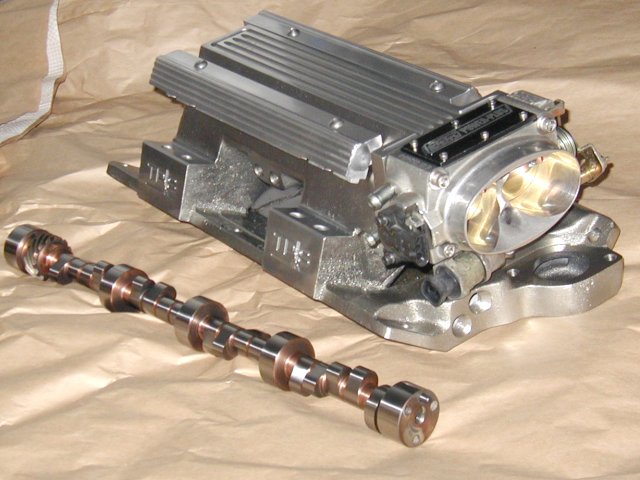
Some parts I have laying around; a MiniRam and a cam.
Last edited by sofakingdom; Feb 26, 2008 at 10:11 AM. Reason: Automerged Doublepost
Supreme Member
Joined: Jul 1999
Posts: 2,149
Likes: 4
From: Mims, Florida
Car: '87 IROCZ
Engine: 395 ZZ4
Transmission: ProBuilt 700R4
Axle/Gears: 9 bolt 3.70s
Re: Need a little help please.....
You are correct about the StealthRam website. However, I believe the flow values come from an old Hot Rod article.
John S: I struggle with air flow myself, like your question, Does the StealthRam flow enough air for my 427,, Is it a restriction?
A 427 cu.in engine with a cam that makes its peak power at 6600 RPM, will process an "ideal" 815 CFM or 102 CFM per cylinder. The equation goes like this:
ideal air = (engine size in cubic inches) / 1728 times (peak power RPM) / 2.
so we have 427/1728 * 6600/2 = 815 CFM
If each runner of the StealthRam flow 275 CFM, and each cylinder processes 102 CFM, how is the StealthRam a restriction? Personally, I think its the heads and the cam... But then I am far from an expert.
Someone please help me out here!!!! Whats wrong with this logic?
John S: I struggle with air flow myself, like your question, Does the StealthRam flow enough air for my 427,, Is it a restriction?
A 427 cu.in engine with a cam that makes its peak power at 6600 RPM, will process an "ideal" 815 CFM or 102 CFM per cylinder. The equation goes like this:
ideal air = (engine size in cubic inches) / 1728 times (peak power RPM) / 2.
so we have 427/1728 * 6600/2 = 815 CFM
If each runner of the StealthRam flow 275 CFM, and each cylinder processes 102 CFM, how is the StealthRam a restriction? Personally, I think its the heads and the cam... But then I am far from an expert.
Someone please help me out here!!!! Whats wrong with this logic?
Trending Topics
Joined: Sep 2005
Posts: 28,050
Likes: 2,504
Car: Yes
Engine: Usually
Transmission: Sometimes
Axle/Gears: Behind me somewhere
Re: Need a little help please.....
the flow values come from an old Hot Rod article
The flaw in your flow # logic is actually rather simple, and quite commonly made.
The equation you quoted produces a steady-state or long-term average number. IOW, it assumes that flow is continuous, non-varying, and uninterrupted. Does that agree with what we know about the behavior of an individual intake runner?
Or, would you suppose that the flow down ONE intake runner connected from a plenum to ONE cylinder, would ACTUALLY only be occurring about ¼ of the time (specifically, during the intake stroke)? In which case, the flow rate DURING THAT ONE FLOW EVENT, would be more like 4 x 10² CFM, or 408 CFM, if the motor had its way. That's an oversimplification, but it clearly illustrates the problem at hand.
This is the same improper reasoning that sometimes leads people to select too small of a carb. In that situation, the flow through each half of the carb, occurs in 4 discrete pulses. The smaller the plenum under the carb, the less "smoothing" or "averaging" there is for those pulses; and therefore, the higher the PEAK flow is, which is what the carb has to be sized for to avoid becoming the restriction, compared to that "steady-state" equation. Which ends up being why you need a 750 CFM carb to adequately feed a 350, which is only drawing 600-650 CFM long-term average.
Supreme Member
Joined: Jul 1999
Posts: 2,149
Likes: 4
From: Mims, Florida
Car: '87 IROCZ
Engine: 395 ZZ4
Transmission: ProBuilt 700R4
Axle/Gears: 9 bolt 3.70s
Re: Need a little help please.....
My equation is not "my equation", I simply got it from a good engine book that I have. And furthermore, it does not assume steady state flow conditions. This book also states that the actual flow is approximately 80% of the ideal. Therefore, the 815 CFM is now 652 CFM, and the book also states that it takes about 1.3 CFM to make 1.0 engine Hp. Now you must take these values with a gran of salt,,, after all, they are averages of typical engines (probably with carbs).
So, with these estimates a 427 with a cam peaking at 6600 RPM, will produce about 502 Hp. It seems to me that this 502 Hp is conservative.
So, with these estimates a 427 with a cam peaking at 6600 RPM, will produce about 502 Hp. It seems to me that this 502 Hp is conservative.
Joined: Sep 2005
Posts: 28,050
Likes: 2,504
Car: Yes
Engine: Usually
Transmission: Sometimes
Axle/Gears: Behind me somewhere
Re: Need a little help please.....
No, that equation DEFINITELY assumes "steady-state" conditions. Whether it says it or not.
It's a perfectly good and valid equation, within its limitations.
The "80%", BTW, is the individual engine's "volumetric efficiency". It varies WIDELY. What it represents, is the proportion of ACTUAL cylinder fill achieved, to the POSSIBLE cylinder fill for that CID. It is affected by restrictions in the induction system, camshaft profiles, and operating RPM. Since torque, within a given engine, is generally proprtional to cylinder fill, an engine's peak torque RPM corresponds to its VE peak RPM. A stock street motor, with typical restrictive exhaust and intake, might struggle to make 80%; a REALLY HOT street/strip one might make 90% at its peak; occasionally, by careful narrowband tuning, it's possible to get OVER 100%, by using "ram" effects in the intake tract, but this is possible only over a VERY narrow RPM band. Did I mention that the RPM range will be very narrow? Race people call this "peaky". As the engine accelerates you get nothing, nothing, nothing, WHAM it "gets up on the cam", lasts 200 RPM or something, then back to nothing. Time to shift. Better have REAL CLOSE ratios.
The equation works directly for something like a throttle body on a FI application, with small runners and a large plenum; because the air flows smoothly, constantly, and unvaryingly into it.
It DOES NOT apply to something like an individual runner, where the flow is NOT "steady-state" (constant, smooth, non-varying), but rather, occurs in a series of short, sharp pulses with long breaks in between.
Whatever book you have may not say all of this; but that doesn't keep it from being the truth. And, I am IN NO WAY disputing the accuracy or validity of the equation; only, its careless and unthinking application to the physical world.
In order for that hypothetical 427 to produce 502 HP, each cyl must be able to produce 1/8 of that, or around 63 HP. The intake flow required to produce this HP, for each individual cyl, must occur roughly during that cyl's intake stroke (duh), which is roughly ¼ of the time (since no intake flow occurs - we hope - during the compression, power, or exhaust strokes). That means that in order to produce 63 HP per cylinder, the intake tract must BE ABLE to flow 4 x 63 HP per cylinder, on a flow bench or something with constant unvarying smooth flow, by the equation; because it must flow THE ENTIRE 63 HP worth of stuff, in ¼ of the total time available to it. Meaning, to get 63 HP out of that cyl, it must flow approx 252 HP of air. 252 x 1.3 = 328 CFM, according to your own numbers. Clearly, something that flows 275 CFM per runner, won't be able to flow 328 CFM (duh). On the other hand, a runner that flows 275 CFM, will support about 275/1.3, or about 211 HP per cyl, if it was flowing constanly; or ¼ of that, if it's ONE runner feeding ONE cyl and therefore only flowing ¼ of the time. That gives 211 x .25 HP per cyl; which is about 53. 53 x 8 = 424, which agrees closely with the REAL WORLD, ACTUAL, MEASURED, REPEATABLE results that are achieved with the HSR. Which tells me, that the 275 number probably isn't too dreadfully far off. Regardless of its .... ummm, tainted .... provenance, by way of coming from a magazine.
None of this is affected in any way by whether the engine is carbed, PFI, TBI, or whether there's a mystical mythological creature in the heavens urinating fuel into it. Doesn't matter. Molecules is molecules, no matter what shape of a thing they pass through on their way.
It's a perfectly good and valid equation, within its limitations.
The "80%", BTW, is the individual engine's "volumetric efficiency". It varies WIDELY. What it represents, is the proportion of ACTUAL cylinder fill achieved, to the POSSIBLE cylinder fill for that CID. It is affected by restrictions in the induction system, camshaft profiles, and operating RPM. Since torque, within a given engine, is generally proprtional to cylinder fill, an engine's peak torque RPM corresponds to its VE peak RPM. A stock street motor, with typical restrictive exhaust and intake, might struggle to make 80%; a REALLY HOT street/strip one might make 90% at its peak; occasionally, by careful narrowband tuning, it's possible to get OVER 100%, by using "ram" effects in the intake tract, but this is possible only over a VERY narrow RPM band. Did I mention that the RPM range will be very narrow?
Race people call this "peaky". As the engine accelerates you get nothing, nothing, nothing, WHAM it "gets up on the cam", lasts 200 RPM or something, then back to nothing. Time to shift. Better have REAL CLOSE ratios.The equation works directly for something like a throttle body on a FI application, with small runners and a large plenum; because the air flows smoothly, constantly, and unvaryingly into it.
It DOES NOT apply to something like an individual runner, where the flow is NOT "steady-state" (constant, smooth, non-varying), but rather, occurs in a series of short, sharp pulses with long breaks in between.
Whatever book you have may not say all of this; but that doesn't keep it from being the truth. And, I am IN NO WAY disputing the accuracy or validity of the equation; only, its careless and unthinking application to the physical world.
In order for that hypothetical 427 to produce 502 HP, each cyl must be able to produce 1/8 of that, or around 63 HP. The intake flow required to produce this HP, for each individual cyl, must occur roughly during that cyl's intake stroke (duh), which is roughly ¼ of the time (since no intake flow occurs - we hope - during the compression, power, or exhaust strokes). That means that in order to produce 63 HP per cylinder, the intake tract must BE ABLE to flow 4 x 63 HP per cylinder, on a flow bench or something with constant unvarying smooth flow, by the equation; because it must flow THE ENTIRE 63 HP worth of stuff, in ¼ of the total time available to it. Meaning, to get 63 HP out of that cyl, it must flow approx 252 HP of air. 252 x 1.3 = 328 CFM, according to your own numbers. Clearly, something that flows 275 CFM per runner, won't be able to flow 328 CFM (duh). On the other hand, a runner that flows 275 CFM, will support about 275/1.3, or about 211 HP per cyl, if it was flowing constanly; or ¼ of that, if it's ONE runner feeding ONE cyl and therefore only flowing ¼ of the time. That gives 211 x .25 HP per cyl; which is about 53. 53 x 8 = 424, which agrees closely with the REAL WORLD, ACTUAL, MEASURED, REPEATABLE results that are achieved with the HSR. Which tells me, that the 275 number probably isn't too dreadfully far off. Regardless of its .... ummm, tainted .... provenance, by way of coming from a magazine.
None of this is affected in any way by whether the engine is carbed, PFI, TBI, or whether there's a mystical mythological creature in the heavens urinating fuel into it. Doesn't matter. Molecules is molecules, no matter what shape of a thing they pass through on their way.
Last edited by sofakingdom; Feb 26, 2008 at 09:16 PM.

Supreme Member

Joined: Jun 2005
Posts: 1,440
Likes: 2
From: huntsville, al
Car: 89 IROC
Engine: 6.8 HSR N2O
Transmission: TKO 600
Axle/Gears: 9" Moser 3.50 True trac
Re: Need a little help please.....
None of this is affected in any way by whether the engine is carbed, PFI, TBI, or whether there's a mystical mythological creature in the heavens urinating fuel into it. Doesn't matter. Molecules is molecules, no matter what shape of a thing they pass through on their way.

Supreme Member
Joined: Jul 1999
Posts: 2,149
Likes: 4
From: Mims, Florida
Car: '87 IROCZ
Engine: 395 ZZ4
Transmission: ProBuilt 700R4
Axle/Gears: 9 bolt 3.70s
Re: Need a little help please.....
I agree, the "duhs" are totally un-necessary. I think that you are ridiculing me for attempting to get at some meaningful flow numbers. Besides you have several holes in your logic. Sense the cam lobe opens the valve only on the intake stroke (per each cylinder in turn), you should not be multipling 4 times the 63 Hp, that makes no sense. Also, each runner is segregated for each cylinder. Therefore, each runner only needs to supply air for one cylinder.
John S: this is your thread and I'd like to keep it that way, so I hope you are still checking in here.
I also have an LS1 (now an LS2) '99 Camaro SS, so I am on LS1 boards. The guys with big cube LSx engines of your 427 size and even 440s, use the L92 cylinder heads which easily flow 320 CFM out of the box!!! very amazing. They run a cam about your duration, but a bit more lift, maybe 0.60"... And the most popular intake is the L76, but I do not have any flow numbers.
If the StealthRam is a restriction, so are the heads. But, you have great heads, AFR 210s, how much bigger can you go? What heads flow more than the AFR 210s? I think that heads which flow 320 CFM will really wake-up your engine.
John S: this is your thread and I'd like to keep it that way, so I hope you are still checking in here.
I also have an LS1 (now an LS2) '99 Camaro SS, so I am on LS1 boards. The guys with big cube LSx engines of your 427 size and even 440s, use the L92 cylinder heads which easily flow 320 CFM out of the box!!! very amazing. They run a cam about your duration, but a bit more lift, maybe 0.60"... And the most popular intake is the L76, but I do not have any flow numbers.
If the StealthRam is a restriction, so are the heads. But, you have great heads, AFR 210s, how much bigger can you go? What heads flow more than the AFR 210s? I think that heads which flow 320 CFM will really wake-up your engine.
Thread Starter
Junior Member
Joined: Sep 2006
Posts: 19
Likes: 0
From: Orange County, NY
Car: 86 Monte Carlo SS
Engine: 427 SBC
Transmission: T-56
Axle/Gears: Moser M9, 3:70
Re: Need a little help please.....
Doc, I am still checking this post daily and I find all the replies interesting. I have also posted the same info on several other boards that I frequent since I am the type to make decisions on consensus in topics that I am ignorant on.
There does seem to be a pretty good split about the intake although everyone feels the heads are sufficient. The other area that almost everyone feels should be addressed. I had already decided on this and finalized my plans today.
At this time I think that I am going to leave the intake alone. I've been looking at the dyno sheets and think that for the type of driving that I do the losses are negligible.
Peak HP comes in at about 4700 rpm and only drops about 25hp up to 6000 rpm. It's got peak torque at about 4000rpm and still has 400ft lbs @ 6000rpm.
Since I am not drag racing the car but instead would like to auto x and possible road race at open track events this setup may be fine for me, especially with the 6 spd in it.
So, here are my plans: first I am going to change the exhaust starting with replacing the 1-5/8" headers with 1-3/4". Then I'll dyno the car and see where it's at running through the full exhaust and then through the cutouts. If there are any significant gains through the cutouts then I'll replace the 2.5" exhaust with a 3" system. Once that is all done then I'll look and see where the power curve is and decide if I need to make any further adjustment from there.
Another test that I will perform (recommended by an HSR engineer) is to put a mech vacuum on the plenum and measure vac during the dyno pulls. If there is greater then 2" of vacuum at wide open throttle that would be a good indication as to whether the intake is choking the engine.
So, anyway that is the direction I am heading. Please continue to comment though since this is a good learning experience for me and I appreciate all the feedback.
There does seem to be a pretty good split about the intake although everyone feels the heads are sufficient. The other area that almost everyone feels should be addressed. I had already decided on this and finalized my plans today.
At this time I think that I am going to leave the intake alone. I've been looking at the dyno sheets and think that for the type of driving that I do the losses are negligible.
Peak HP comes in at about 4700 rpm and only drops about 25hp up to 6000 rpm. It's got peak torque at about 4000rpm and still has 400ft lbs @ 6000rpm.
Since I am not drag racing the car but instead would like to auto x and possible road race at open track events this setup may be fine for me, especially with the 6 spd in it.
So, here are my plans: first I am going to change the exhaust starting with replacing the 1-5/8" headers with 1-3/4". Then I'll dyno the car and see where it's at running through the full exhaust and then through the cutouts. If there are any significant gains through the cutouts then I'll replace the 2.5" exhaust with a 3" system. Once that is all done then I'll look and see where the power curve is and decide if I need to make any further adjustment from there.
Another test that I will perform (recommended by an HSR engineer) is to put a mech vacuum on the plenum and measure vac during the dyno pulls. If there is greater then 2" of vacuum at wide open throttle that would be a good indication as to whether the intake is choking the engine.
So, anyway that is the direction I am heading. Please continue to comment though since this is a good learning experience for me and I appreciate all the feedback.
Supreme Member
Joined: Jun 2005
Posts: 1,440
Likes: 2
From: huntsville, al
Car: 89 IROC
Engine: 6.8 HSR N2O
Transmission: TKO 600
Axle/Gears: 9" Moser 3.50 True trac
Re: Need a little help please.....
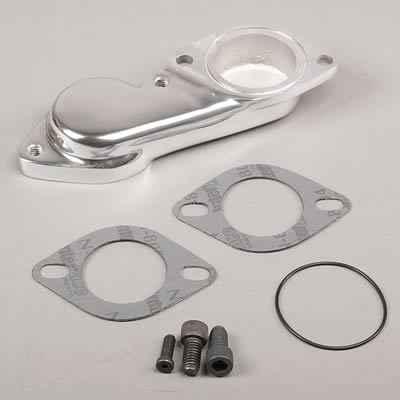
John, off the subject here but... That's an interesting thermostat housing you have there. It appears to be the same style swivel, t-stat housing I'm using, but it looks like some sort of extention to get it out from under the throttle body. Please elaborate.
Thread Starter
Junior Member
Joined: Sep 2006
Posts: 19
Likes: 0
From: Orange County, NY
Car: 86 Monte Carlo SS
Engine: 427 SBC
Transmission: T-56
Axle/Gears: Moser M9, 3:70
Re: Need a little help please.....
Joined: Sep 2005
Posts: 28,050
Likes: 2,504
Car: Yes
Engine: Usually
Transmission: Sometimes
Axle/Gears: Behind me somewhere
Re: Need a little help please.....
I'm struggling trying to understand what's so hard to understand here...
Here's a chart of the flow over a few engine cycles in an intake runner that flows 275 CFM on a flow bench, in the situation where that ONE runner feeds ONE cylinder. Again, this is an oversimplification: the flow doesn't go instantaneously from 0 to 275 at exactly the instant that the piston begins to descend on the intake stroke, hang right exactly there at 275 for exactly th eduration of the intake stroke, and return to 0 exactly the instant that the piston reaches the bottom of the stroke; so please keep in mind, this is merely a representation of the basic principle, and not an exact simulation.
Note that the PEAK flow in the runner is, exactly as the flow bench data Doc supplied says, 275 CFM, during the portion of the time WHILE IT'S FLOWING. Note that the LONG-TERM AVERAGE of the flow into the cylinder, over a complete engine cycle, is 68.75 CFM; ¼ of the flow-bench number, which is constant, steady-state flow. Take Doc's number from his book, 1.3 CFM/HP. Using that number to convert CFM flow to HP capacity, divide 68.75 CFM by 1.3. That gives you the number of HP that cylinder is producing. In this case it's 52.88 HP. Let's round it off to 53 (measure with micrometer, mark with chalk, cut with axe). This is an 8 cylinder engine, so multiply that single cylinder number by 8 to get the output of the whole engine. 53 x 8 = 424. Which, as we all know, substantially agrees with the numbers that people get from that intake. No surprise there.
This just isn't that obscure or tough or hard to "get". There's no magic here, no sleight of hand, I'm not lying, or hiding or concealing anything, not invoking any kind of unknown mystical wisdom accessible only to The Wise, it's all just NUMBERS. Numbers don't lie. Any moron can work this up, even an imbecile like me. If I can "get it", it's GOT TO BE pretty freaking simple. But, it involves engines, so automatically, I guess that invokes mystery and myth and magic, and now instead of numbers and science and engineering, it's more like religion: "My book says {xxx} and since my book says it, it's the truth, and I'm not even going to think any farther because it says so right here in my book". Without taking into account the underlying assumptions and the context of whatever "the book" says.
Take it out of the realm of engines, and put it into something that doesn't throw up that mental "engine" block. Let's say you had a garden hose that flowed 4 gallons per minute, and you were filling a bucket. You turn the hose on for one second, then off for 3 seconds; then on for one, then off for 3; and so forth. You know, for certain, because you flow-tested it, that the hose flows 4 GPM. Quick: at the end of one minute, how much water is in the bucket? Right: ¼ of how much you would have if the hose continuosuly flowed the steady-state flow rate of 4 GPM, or, 1 gallon. The engine is no different.
And, bottom line, this is why the HSR is not big enough to adequately feed the engine in question. It's a decent size for a 350, although its runners are really too long to be optimum; barely adequate for a 383 because the runners have such a small cross-section; and not enough for anything larger.
Putting a vacuum gauge in the plenum will not tell you if the intake is choking the engine. All that will tell you, is if the throttle body and air filter are choking the engine. The "choking" that the HSR will create, occurs after the plenum, in the runners. You would have to put a vacuum gauge with VERY FAST response down at the bottom of the runner someplace, like at the injector bung. Then, you'd see little pulses of vacuum, each time a cylinder tried to suck air through that little runner.
Incidentally, this has been the same situation that that intake has had for the last 25 years or so, since long before it was the "Stealth Ram". Those of us who have been in this business for a little while will probably recall that Holley introduced a product in the early 80s designed for street rodders, called, if memory serves, the "Street Ram". It was a sort of minature tunnel-ram looking thing with 2 little plenums on top, each of which was supposed to have something like a 450 CFM 4-barrel mounted on it. It looked COOL of course, but it was hard to tune, and didn't ever really run as good as a single 4-barrel on an ordinary single-plane manifold. It wasn't real popular; I don't recall how long it even lasted, as a catalog product. It simply wasn't a "go-fast" piece at all. From its initial concept, it was really only a "looks cool" piece for those guys that get into those "square inches of chrome" contests in parking lots with their engines not even running. Imagine our surprise when, just a couple of years ago, we see THE IDENTICAL SAME runner casting re-released, except with injector bungs in it, and a single plenum for a side-draft TB screwed to the top of it instead of the dual 4-bbl ones. But, believe it or not, those itty-bitty runners still impose a limitation on that thing, that injectors can't overcome.
"What has been, that will be; what has been done, that will be done. There is no new thing under the sun. Even the thing of which we say 'See, this is new!' has already existed in the ages that preceded us."
— from another book, ancient and full of great wisdom, often widely used as a reference of final recourse in discussions
Here's a chart of the flow over a few engine cycles in an intake runner that flows 275 CFM on a flow bench, in the situation where that ONE runner feeds ONE cylinder. Again, this is an oversimplification: the flow doesn't go instantaneously from 0 to 275 at exactly the instant that the piston begins to descend on the intake stroke, hang right exactly there at 275 for exactly th eduration of the intake stroke, and return to 0 exactly the instant that the piston reaches the bottom of the stroke; so please keep in mind, this is merely a representation of the basic principle, and not an exact simulation.
Note that the PEAK flow in the runner is, exactly as the flow bench data Doc supplied says, 275 CFM, during the portion of the time WHILE IT'S FLOWING. Note that the LONG-TERM AVERAGE of the flow into the cylinder, over a complete engine cycle, is 68.75 CFM; ¼ of the flow-bench number, which is constant, steady-state flow. Take Doc's number from his book, 1.3 CFM/HP. Using that number to convert CFM flow to HP capacity, divide 68.75 CFM by 1.3. That gives you the number of HP that cylinder is producing. In this case it's 52.88 HP. Let's round it off to 53 (measure with micrometer, mark with chalk, cut with axe). This is an 8 cylinder engine, so multiply that single cylinder number by 8 to get the output of the whole engine. 53 x 8 = 424. Which, as we all know, substantially agrees with the numbers that people get from that intake. No surprise there.
This just isn't that obscure or tough or hard to "get". There's no magic here, no sleight of hand, I'm not lying, or hiding or concealing anything, not invoking any kind of unknown mystical wisdom accessible only to The Wise, it's all just NUMBERS. Numbers don't lie. Any moron can work this up, even an imbecile like me. If I can "get it", it's GOT TO BE pretty freaking simple. But, it involves engines, so automatically, I guess that invokes mystery and myth and magic, and now instead of numbers and science and engineering, it's more like religion: "My book says {xxx} and since my book says it, it's the truth, and I'm not even going to think any farther because it says so right here in my book". Without taking into account the underlying assumptions and the context of whatever "the book" says.
Take it out of the realm of engines, and put it into something that doesn't throw up that mental "engine" block. Let's say you had a garden hose that flowed 4 gallons per minute, and you were filling a bucket. You turn the hose on for one second, then off for 3 seconds; then on for one, then off for 3; and so forth. You know, for certain, because you flow-tested it, that the hose flows 4 GPM. Quick: at the end of one minute, how much water is in the bucket? Right: ¼ of how much you would have if the hose continuosuly flowed the steady-state flow rate of 4 GPM, or, 1 gallon. The engine is no different.
And, bottom line, this is why the HSR is not big enough to adequately feed the engine in question. It's a decent size for a 350, although its runners are really too long to be optimum; barely adequate for a 383 because the runners have such a small cross-section; and not enough for anything larger.
Putting a vacuum gauge in the plenum will not tell you if the intake is choking the engine. All that will tell you, is if the throttle body and air filter are choking the engine. The "choking" that the HSR will create, occurs after the plenum, in the runners. You would have to put a vacuum gauge with VERY FAST response down at the bottom of the runner someplace, like at the injector bung. Then, you'd see little pulses of vacuum, each time a cylinder tried to suck air through that little runner.
Incidentally, this has been the same situation that that intake has had for the last 25 years or so, since long before it was the "Stealth Ram". Those of us who have been in this business for a little while will probably recall that Holley introduced a product in the early 80s designed for street rodders, called, if memory serves, the "Street Ram". It was a sort of minature tunnel-ram looking thing with 2 little plenums on top, each of which was supposed to have something like a 450 CFM 4-barrel mounted on it. It looked COOL of course, but it was hard to tune, and didn't ever really run as good as a single 4-barrel on an ordinary single-plane manifold. It wasn't real popular; I don't recall how long it even lasted, as a catalog product. It simply wasn't a "go-fast" piece at all. From its initial concept, it was really only a "looks cool" piece for those guys that get into those "square inches of chrome" contests in parking lots with their engines not even running. Imagine our surprise when, just a couple of years ago, we see THE IDENTICAL SAME runner casting re-released, except with injector bungs in it, and a single plenum for a side-draft TB screwed to the top of it instead of the dual 4-bbl ones. But, believe it or not, those itty-bitty runners still impose a limitation on that thing, that injectors can't overcome.
"What has been, that will be; what has been done, that will be done. There is no new thing under the sun. Even the thing of which we say 'See, this is new!' has already existed in the ages that preceded us."
— from another book, ancient and full of great wisdom, often widely used as a reference of final recourse in discussions


Joined: Jul 1999
Posts: 12,102
Likes: 127
From: SALEM, NH
Car: '88 Formula
Engine: LC9
Transmission: 4L60E
Axle/Gears: 3.89 9"
Re: Need a little help please.....
And thats where we will end this one.
You guys can attack the ideas and theories all day long, but no personal insults please.
You guys can attack the ideas and theories all day long, but no personal insults please.

Thread
Thread Starter
Forum
Replies
Last Post
Mackadoches
Tech / General Engine
14
Jun 8, 2012 09:04 PM
hemicudakidd
Exhaust
2
Sep 19, 2011 04:34 PM
