


Carb'd 383 stumbles at light cruise and a major bog on secondary opening...


Thread Starter
Senior Member

Joined: Apr 2001
Posts: 818
Likes: 1
From: Hudson, FL USA
Car: 1988 Camaro(92 Z28 clone)
Engine: Forged 383, AFR 195 419/430@wheels
Transmission: Monster 700R4 Yank 3600 stall
Axle/Gears: 9in Detroit locker-3.90's,35 spline
Carb'd 383 stumbles at light cruise and a major bog on secondary opening...
Ok, this is going to end up being a long post so I am going to get the apology out of the way now....
SORRY!!
With that being said, here is my dilemma. I have a 383 stroker AFR heads with an Edelbrock 750 CFM manual choke model 1407. I have been trying to tune this thing to get rid of some issues, but I am not well versed in carbs, and the changes I am making are not working. Due to this I figured that I would stop and ask before somthing I do may cause damage or break something. My first problem is at light throtte, especially in 4th or 5th gear. When I am cruising on the highway at anywhere from 1500-1900 RPM, there is a surge. The surging is pretty decent, and it is messing wth the drivetrain because I can feel it in the shifter specifically. The second issue is at quick WOT, or anytime the gas is pressed to where the secondaries open up. It takes a second or two, then starts going.
Now, here is what I have noted about the first condition, the surging. I have read up on it and found that the surging is likely caused by a lean condition. At light throttle cruise in my car, the engine vacuum is at 15+ in. Hg when the surge starts. Giving it more throttle gives it more gas and the vacuum drops down to like 10 or so and it goes away. Using Edelbrock's calibration reference chart, I decided to go richer in the cruise mode. This did not help. Then I tried using a stiffer step up spring(in hopes that the spring would keep the metering rod in a thinner section at higher vacuum levels to promote more fuel flow) to no avail. At that point, I took the top of the car off and went 2 stages richer on the primary jet and 1 stage richer on the secondary(more on this later) I reassembled the top of the carb, and installed the factory metering rod thinking that the bigger jet would allow enough fuel in to correct the issue.( This is calibration #13 on Edelbrocks reference chart) It didn't. I wanted to get a second opinion before I start stepping up the metering rods again, because I really don't see a 383 needing this much fuel to operate efficiently.
Now for the secondary issue. Like I stated earlier, if I go to WOT really quick, or gradually put my foot in it, I get a major bog/flat spot when the secondary plates open. When I had the carb apart, I went 1 stage richer in the secondary and it seemed to help a bit but I'm not sure if I want to go any further than that. I have the option of going 2 stages more rich but would like to get the surging problem corrected before I mess with this anymore. So far that is what I have been dealing with. I'm welcome to any and all input so give me your suggestions and opinions!! Thanks!
SORRY!!
With that being said, here is my dilemma. I have a 383 stroker AFR heads with an Edelbrock 750 CFM manual choke model 1407. I have been trying to tune this thing to get rid of some issues, but I am not well versed in carbs, and the changes I am making are not working. Due to this I figured that I would stop and ask before somthing I do may cause damage or break something. My first problem is at light throtte, especially in 4th or 5th gear. When I am cruising on the highway at anywhere from 1500-1900 RPM, there is a surge. The surging is pretty decent, and it is messing wth the drivetrain because I can feel it in the shifter specifically. The second issue is at quick WOT, or anytime the gas is pressed to where the secondaries open up. It takes a second or two, then starts going.
Now, here is what I have noted about the first condition, the surging. I have read up on it and found that the surging is likely caused by a lean condition. At light throttle cruise in my car, the engine vacuum is at 15+ in. Hg when the surge starts. Giving it more throttle gives it more gas and the vacuum drops down to like 10 or so and it goes away. Using Edelbrock's calibration reference chart, I decided to go richer in the cruise mode. This did not help. Then I tried using a stiffer step up spring(in hopes that the spring would keep the metering rod in a thinner section at higher vacuum levels to promote more fuel flow) to no avail. At that point, I took the top of the car off and went 2 stages richer on the primary jet and 1 stage richer on the secondary(more on this later) I reassembled the top of the carb, and installed the factory metering rod thinking that the bigger jet would allow enough fuel in to correct the issue.( This is calibration #13 on Edelbrocks reference chart) It didn't. I wanted to get a second opinion before I start stepping up the metering rods again, because I really don't see a 383 needing this much fuel to operate efficiently.
Now for the secondary issue. Like I stated earlier, if I go to WOT really quick, or gradually put my foot in it, I get a major bog/flat spot when the secondary plates open. When I had the carb apart, I went 1 stage richer in the secondary and it seemed to help a bit but I'm not sure if I want to go any further than that. I have the option of going 2 stages more rich but would like to get the surging problem corrected before I mess with this anymore. So far that is what I have been dealing with. I'm welcome to any and all input so give me your suggestions and opinions!! Thanks!

Junior Member
Joined: Dec 2006
Posts: 34
Likes: 0
From: Belmont N.H.
Car: 91 camaro
Engine: 383 demon 750 rpm heads 150 shot no
Transmission: bto 700r4 stage 3
Axle/Gears: currie 9" 4:10 true track
I am surprised you are having trouble,with your motor you shoul be able to run that edelbrock 750.I can tell you the stumble you are experiencing when you give it a lot of gas quick is caused by the carb feeding too much air and not enough fuel.I had that problem a few times over the years.most reacent my bg 750 speed demon gave me that same trouble.My fix was easy a set of larger squirters and a power valve that opens at lower vacume and presto the problem solved.A nimber of years ago I put a edelbrock 750 on a 383 with the same problem,not for lack of trying I ended up puting the edelbrock 600 back on.Try to adjust your butterflys to be more closed and advance your timing try 16 degrees.Have you talked to edelbrock tech?One more thing its a manual choke,is it hooked to a cable?If not your choke is probablly flopping a little bit I have seen many people wire it open to the air cleaner stud to keep it open if its not being used.Good luck


Joined: Aug 2006
Posts: 12,813
Likes: 110
From: Central NJ
Car: 86 Trans Am
Engine: 408 stroker sbc
Transmission: TKO600
Axle/Gears: Moser full floater m9, 3:70 trutrac
i had a similar problem, what i did was flatten the secondary air valve? the choke looking device that sits over the seconday bore. i adapted it so it sealed off the secondary bore a little more when closed, this way when the secondaries open it sucks a bit more fuel and a little less air past the closed air valve. it seemed to work as i have had no real problems since

Junior Member
Joined: Nov 2006
Posts: 44
Likes: 0
From: Moncton NB
Car: 84 Trans Am
Engine: 383 Stroker
Transmission: 5 Speed
Axle/Gears: Ford 9"(Moser),4:11s,locker,31splin
Ok maybe a strange question but do you have a fuel pressure regulator on the line,or did you remove the fuel pump from the tank,most carb only use 6-9PSI of pressure to operate,if the electric pump is still pumping the fuel it is flowing past and causing a flood condition.I my self am not a big fan of the ELD. carbs,just a Carter in disquise.I use a 750 Holley vacc secondary,with duel feed on my 383 and donot have a problem with fuel.
Thread Starter
Senior Member
Joined: Apr 2001
Posts: 818
Likes: 1
From: Hudson, FL USA
Car: 1988 Camaro(92 Z28 clone)
Engine: Forged 383, AFR 195 419/430@wheels
Transmission: Monster 700R4 Yank 3600 stall
Axle/Gears: 9in Detroit locker-3.90's,35 spline
1320-camaro-383: Yes it is a manual choke that I have hooked up to a cable. I really don't need it that bad here in FL but I use it everytime I start the car to get it up to operating temperature as quickly as possible.
Dels383TA: No, I don't have a fuel pressure regulator, but I am using an Edelbrock mechanical fuel pump(the electric in tank pump has been removed completly) with an Autometer electric fuel pressure gauge and it reads anywhere from 6-8 PSI and at WOT it doesn't go below 3 or 4 PSI
Whats getting me is that this particular carb was designed to be used with the Edelbrock Performer RPM package which is a 350 cubic inch 9.5:1 compression with their heads, intake, cam, lifters, etc. It makes 420 HP. Now, I would assume that the carb is calibrated to work with that package. My engine is a 500 HP 383 so I fully understand that I need more fuel but it wants alot. Everyone keeps telling me "give the engine what it wants don't give it what you think it needs" so I might cahnge the metering rods again to the #17 calibration and see what happens. Heck it only takes 3 minutes to change the rods out. On a side note, I was talking to some guys at work today and they told me that I can bend the rod of the secondary linkage to make the secondaries come in faster. Has anyone done that? I am a little unsure about doing it but I have had 2 seperate people tell me that it can be done. This thing is throwing me for a loop!!!
Dels383TA: No, I don't have a fuel pressure regulator, but I am using an Edelbrock mechanical fuel pump(the electric in tank pump has been removed completly) with an Autometer electric fuel pressure gauge and it reads anywhere from 6-8 PSI and at WOT it doesn't go below 3 or 4 PSI
Whats getting me is that this particular carb was designed to be used with the Edelbrock Performer RPM package which is a 350 cubic inch 9.5:1 compression with their heads, intake, cam, lifters, etc. It makes 420 HP. Now, I would assume that the carb is calibrated to work with that package. My engine is a 500 HP 383 so I fully understand that I need more fuel but it wants alot. Everyone keeps telling me "give the engine what it wants don't give it what you think it needs" so I might cahnge the metering rods again to the #17 calibration and see what happens. Heck it only takes 3 minutes to change the rods out. On a side note, I was talking to some guys at work today and they told me that I can bend the rod of the secondary linkage to make the secondaries come in faster. Has anyone done that? I am a little unsure about doing it but I have had 2 seperate people tell me that it can be done. This thing is throwing me for a loop!!!
Junior Member
Joined: Dec 2006
Posts: 34
Likes: 0
From: Belmont N.H.
Car: 91 camaro
Engine: 383 demon 750 rpm heads 150 shot no
Transmission: bto 700r4 stage 3
Axle/Gears: currie 9" 4:10 true track
I have done that on holley,bg carbs I assume it works the same way on a edelbrock.What were you running before the edelbrock 750?I know edelbrocks dont have power valves but they do have the squirters that give it the gas first before the downleg boosters kick in.See if you can buy larger ones.
Thread Starter
Senior Member
Joined: Apr 2001
Posts: 818
Likes: 1
From: Hudson, FL USA
Car: 1988 Camaro(92 Z28 clone)
Engine: Forged 383, AFR 195 419/430@wheels
Transmission: Monster 700R4 Yank 3600 stall
Axle/Gears: 9in Detroit locker-3.90's,35 spline
I wasn't running anything before the Edelbrock carb. I originally had a 350 with the Performer RPM package in the car and the #4 intake valve hit the piston and wrecked the motor. That's when I had the 383 bottom end built and I assembled everything else myself. I know that the Edelbrock carb uses an accelerator pump to give it an initial shot of fuel before the pressure drop starts drawing fuel out but it only gives it the fuel on the primary side. I'm almost at the point where I am wanting to pay someone to tune it but I really don't because I know that I need to learn the carb. I just wish that I would have either gotten my headers or my Y pipe with an O2 bung in it so that I could have plugged in an A/F ratio gauge. That would make my life so much easier.
Trending Topics
Joined: Aug 2006
Posts: 12,813
Likes: 110
From: Central NJ
Car: 86 Trans Am
Engine: 408 stroker sbc
Transmission: TKO600
Axle/Gears: Moser full floater m9, 3:70 trutrac
thats true, the accelerator pump deliver an xtra ammout of fuel when you open the throttle, but as you said, only for the primary side, the air valve i mentioned earlier, performs the same task as the accelerator pump, but works in conjunction with the suction of air around the secondary air valve to pull in more fuel. the larger the gap between the airvalve and the throttle bore, the less fuel you will get, thats why i modified mine to be a little more closed at rest so that the air velocity around the blades is greater, thus pulling more fuel through the secondary boosters. there is a good picture of the booster design in the edelbrock tuning manual in the front on pg, damnit, i cant find the book, anyway its in the front
and i dont think the problem is the secondaries comming in late as it is coming in to soon, and the consiquential loss of suction and lack of fuel delivery and the inrush of air
and i dont think the problem is the secondaries comming in late as it is coming in to soon, and the consiquential loss of suction and lack of fuel delivery and the inrush of air
Thread Starter
Senior Member
Joined: Apr 2001
Posts: 818
Likes: 1
From: Hudson, FL USA
Car: 1988 Camaro(92 Z28 clone)
Engine: Forged 383, AFR 195 419/430@wheels
Transmission: Monster 700R4 Yank 3600 stall
Axle/Gears: 9in Detroit locker-3.90's,35 spline
UPDATE!!
Well, I installed a different set of metering rods in the carb tonight at work. Not really too sure on if it actually did anything or not. Let me see if I can pull up the info and graph.......

OK, on this graph you can see all the numbers. #1 is stock calibration. I am currently at #17 which is...
Model #1407 & #1410
Rod/Jet Reference Chart
REF # MAIN JET METERING ROD CHANGE FROM BASE
1 1433 (.113) 1453 (071 x 047) none - stock calibration
2 1433 (.113) 1450 (070 x 042) Rod
3 1433 (.113) 1449 (070 x 037) Rod
4 1434 (.116) 1454 (073 x 037) Rod & Jet
5 1431 (.107) 1443 (063 x 047) Rod & Jet
6 1432 (.110) 1445 (065 x 047) Rod & Jet
7 1433 (.113) 1452 (070 x 052) Rod
8 1432 (.110) 1441 (062 x 052) Rod & Jet
9 1433 (.113) 1447 (068 x 047) Rod
10 1434 (.116) 1456 (073 x 047) Rod & Jet
11 1432 (.110) 1443 (063 x 047) Rod & Jet
12 1433 (.113) 1445 (065 x 047) Rod
13 1434 (.116) 1453 (071 x 047) Jet
14 1434 (.116) 1449 (070 x 037) Rod & Jet
15 1433 (.113) 1443 (063 x 047) Rod
16 1433 (.113) 1442 (063 x 037) Rod
17 1434 (.116) 1444 (065 x 037) Rod & Jet
18 1432 (.110) 1452 (070 x 052) Rod & Jet
19 1433 (.113) 1457 (073 x 052) Rod
20 1433 (.113) 1456 (073 x 047) Rod
21 1433 (.113) 1454 (073 x 037) Rod
22 1431 (.107) 1445 (065 x 047) Rod & Jet
23 1431 (.107) 1444 (065 x 037) Rod & Jet
24 1432 (.110) 1449 (070 x 037) Rod & Jet
25 1431 (.107) 1447 (068 x 047) Rod & Jet
26 1432 (.110) 1456 (073 x 047) Rod & Jet
27 1432 (.110) 1454 (073 x 037) Rod & Jet
As you can see this is the absolute richest end of the scale. I physically can't go up anymore without extensive carb modifications. Like I said in my previous post, I don't think that I should have to be at the #17 calibration. I might pull a few plugs on Sunday to see what they look like after a few days of running at that calibration but I can tell you this. When I was at calibration #13(which I thought was too rich in the first place) I pulled my plugs and the top of the electrodes were a whitish color(which to me indicates a lean condition) and the center of the base electrode was a grayish color, not the nice tan that it should be.
This problem has gotten me to thiking about my timing as well. At first I tried to set the base timing at idle and had a issue with erratic idle. So I did the whole rev it up to 3000 RPM and set the timing to 36 degrees and where it sits at idle is where she wants to be. Idled fine, had decent power. However, when I first got the distributor, I had set it up so that I had all of my advance in at 1900 RPM. Consequently, my stuttering issue is only below 2000 RPM so that may be a major factor as well. So I dropped my timing @ 3000 RPM from 36 degrees to 32, and still no changes. So, I would like to redo the centrifugal advance weight springs so that the timing comes in a little bit later and see what that does. So tell me what you guys think would be a good ramp to start with?
Well, I installed a different set of metering rods in the carb tonight at work. Not really too sure on if it actually did anything or not. Let me see if I can pull up the info and graph.......
OK, on this graph you can see all the numbers. #1 is stock calibration. I am currently at #17 which is...
Model #1407 & #1410
Rod/Jet Reference Chart
REF # MAIN JET METERING ROD CHANGE FROM BASE
1 1433 (.113) 1453 (071 x 047) none - stock calibration
2 1433 (.113) 1450 (070 x 042) Rod
3 1433 (.113) 1449 (070 x 037) Rod
4 1434 (.116) 1454 (073 x 037) Rod & Jet
5 1431 (.107) 1443 (063 x 047) Rod & Jet
6 1432 (.110) 1445 (065 x 047) Rod & Jet
7 1433 (.113) 1452 (070 x 052) Rod
8 1432 (.110) 1441 (062 x 052) Rod & Jet
9 1433 (.113) 1447 (068 x 047) Rod
10 1434 (.116) 1456 (073 x 047) Rod & Jet
11 1432 (.110) 1443 (063 x 047) Rod & Jet
12 1433 (.113) 1445 (065 x 047) Rod
13 1434 (.116) 1453 (071 x 047) Jet
14 1434 (.116) 1449 (070 x 037) Rod & Jet
15 1433 (.113) 1443 (063 x 047) Rod
16 1433 (.113) 1442 (063 x 037) Rod
17 1434 (.116) 1444 (065 x 037) Rod & Jet
18 1432 (.110) 1452 (070 x 052) Rod & Jet
19 1433 (.113) 1457 (073 x 052) Rod
20 1433 (.113) 1456 (073 x 047) Rod
21 1433 (.113) 1454 (073 x 037) Rod
22 1431 (.107) 1445 (065 x 047) Rod & Jet
23 1431 (.107) 1444 (065 x 037) Rod & Jet
24 1432 (.110) 1449 (070 x 037) Rod & Jet
25 1431 (.107) 1447 (068 x 047) Rod & Jet
26 1432 (.110) 1456 (073 x 047) Rod & Jet
27 1432 (.110) 1454 (073 x 037) Rod & Jet
As you can see this is the absolute richest end of the scale. I physically can't go up anymore without extensive carb modifications. Like I said in my previous post, I don't think that I should have to be at the #17 calibration. I might pull a few plugs on Sunday to see what they look like after a few days of running at that calibration but I can tell you this. When I was at calibration #13(which I thought was too rich in the first place) I pulled my plugs and the top of the electrodes were a whitish color(which to me indicates a lean condition) and the center of the base electrode was a grayish color, not the nice tan that it should be.
This problem has gotten me to thiking about my timing as well. At first I tried to set the base timing at idle and had a issue with erratic idle. So I did the whole rev it up to 3000 RPM and set the timing to 36 degrees and where it sits at idle is where she wants to be. Idled fine, had decent power. However, when I first got the distributor, I had set it up so that I had all of my advance in at 1900 RPM. Consequently, my stuttering issue is only below 2000 RPM so that may be a major factor as well. So I dropped my timing @ 3000 RPM from 36 degrees to 32, and still no changes. So, I would like to redo the centrifugal advance weight springs so that the timing comes in a little bit later and see what that does. So tell me what you guys think would be a good ramp to start with?

Supreme Member
iTrader: (1)
Joined: Jul 2004
Posts: 10,763
Likes: 4
From: Calgary, AB, Canada
Car: 1982 Trans-Am
Engine: 355 w/ ported 416s
Transmission: T10, hurst shifter
Axle/Gears: 10 bolt, true-trac, 3.73
whats your camshaft duration @ .050"? I imagine it's lumpy to get 500HP with a 383, but i'm curious.
Ok, with 36* at 3000RPM, what was the idle timing? Vacuum advance on ported or manifold?
This edelbrock is kinda similar to a q-jet I believe, so I might be able to help you out (my expertise... hahah, ok, my small amount of knowledge is only on q-jets).
An O2 sensor, heated stock style worked great for me. I can get a reading a lot faster than I can with plugs. $67, plus an 18mm nut. I drilled my y-pipe for it, and wired it up temporarily and read it with a multimeter. I'd highly recommend this route, if you don't mind an ugly O2 sensor in there, and drilling your exhaust.
I think you probably need more timing at idle, in fact, I think running locked out timing at 36*, with some kind of starting retard would be best.
What kind of intake are you running, dual plane or single?
I think you should get the car warmed up, then shut it down and drop in a brand new plug in #4 say. Then drive it on the primaries only, in cruise mode for about 5 miles. Put it in neutral, shut it off, coast over and view that plug. Thats your mixture at cruise, tune that as needed with the rod. Use #17-14-4, such that you aren't effecting your power area.
Too much timing at cruise could give you a surge, but I don't think thats your problem right now, but just something to keep in mind.
Since you say a gradual, or immediate punch of the gas causes the bog going into the secondaries, i'm thinking its not the pump shot being too small. (I do think that's probably the case, but not the biggest source of problem right now). Can you slow down the rate of secondary air valve opening? Not sure how that works on that edelbrock. Either that, or jack up the secondary fueling.
With that undersized carb on a 500HP motor, it'll probably have a very good signal through the boosters, so I really don't think you need to jet it up like crazy. Then again, your symptoms are showing the opposite eh?
I'd try to hammer down your timing first, that can be a thorn in your side, and mask itself as a carb problem. Then really try to do one problem at a time, cruise or power. Try to do changes that only effect one and not the other, best way to stay sane!
Hope Santa brings you some luck!
Ok, with 36* at 3000RPM, what was the idle timing? Vacuum advance on ported or manifold?
This edelbrock is kinda similar to a q-jet I believe, so I might be able to help you out (my expertise... hahah, ok, my small amount of knowledge is only on q-jets).
An O2 sensor, heated stock style worked great for me. I can get a reading a lot faster than I can with plugs. $67, plus an 18mm nut. I drilled my y-pipe for it, and wired it up temporarily and read it with a multimeter. I'd highly recommend this route, if you don't mind an ugly O2 sensor in there, and drilling your exhaust.
I think you probably need more timing at idle, in fact, I think running locked out timing at 36*, with some kind of starting retard would be best.
What kind of intake are you running, dual plane or single?
I think you should get the car warmed up, then shut it down and drop in a brand new plug in #4 say. Then drive it on the primaries only, in cruise mode for about 5 miles. Put it in neutral, shut it off, coast over and view that plug. Thats your mixture at cruise, tune that as needed with the rod. Use #17-14-4, such that you aren't effecting your power area.
Too much timing at cruise could give you a surge, but I don't think thats your problem right now, but just something to keep in mind.
Since you say a gradual, or immediate punch of the gas causes the bog going into the secondaries, i'm thinking its not the pump shot being too small. (I do think that's probably the case, but not the biggest source of problem right now). Can you slow down the rate of secondary air valve opening? Not sure how that works on that edelbrock. Either that, or jack up the secondary fueling.
With that undersized carb on a 500HP motor, it'll probably have a very good signal through the boosters, so I really don't think you need to jet it up like crazy. Then again, your symptoms are showing the opposite eh?
I'd try to hammer down your timing first, that can be a thorn in your side, and mask itself as a carb problem. Then really try to do one problem at a time, cruise or power. Try to do changes that only effect one and not the other, best way to stay sane!
Hope Santa brings you some luck!
Thread Starter
Senior Member
Joined: Apr 2001
Posts: 818
Likes: 1
From: Hudson, FL USA
Car: 1988 Camaro(92 Z28 clone)
Engine: Forged 383, AFR 195 419/430@wheels
Transmission: Monster 700R4 Yank 3600 stall
Axle/Gears: 9in Detroit locker-3.90's,35 spline
Thanks for some input there, Sonix. I was acutally thinking more about the timing issue for the last few days now and here is what I came up with...
This is the chart that MSD has for their distributor advance curves. Let's see if it will load....
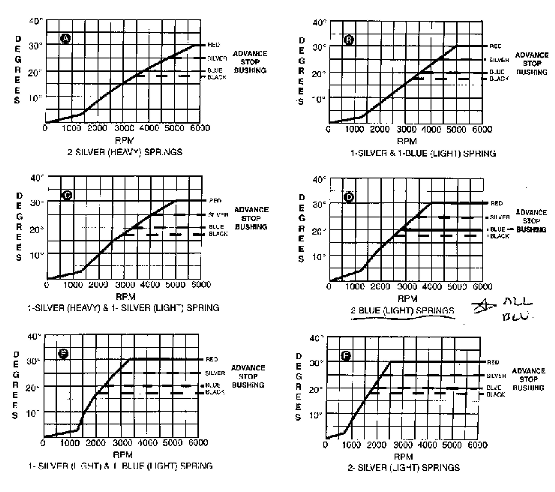
I pulled out my distributor box and checked what springs and bushings I had left over to determine what springs and bushings I had actually put in the distributor. What is in the distributor now are 2 light silver springs and a black bushing. If you look at the above chart, you can see that it is timng chart F with an advance limit of 18 degrees plus my initial. Funny thing about that is that it seems that all of my timing(36 degrees) is in at about 1700 RPM. I think that this is too much for a street engine. It does go hand in hand with the issue that I am having at cruise though seeing as how once I'm over 2000 RPM it goes away. So now I have been thinking about changing the curve to say C on the chart. Keeping the same black bushing, my full advance will hit at exactly 3000 RPM. I would like to change this first and see what it changes with the driveability. Hopefully, the stuttering at light cruise will go away. If it does, then I will put the carb back to stock calibration, and then tune the fuel mixture from there. Hopefully it will work out. Gotta love engine tuning!!! Thanks for the insight and Happy Holidays!!!!
This is the chart that MSD has for their distributor advance curves. Let's see if it will load....
I pulled out my distributor box and checked what springs and bushings I had left over to determine what springs and bushings I had actually put in the distributor. What is in the distributor now are 2 light silver springs and a black bushing. If you look at the above chart, you can see that it is timng chart F with an advance limit of 18 degrees plus my initial. Funny thing about that is that it seems that all of my timing(36 degrees) is in at about 1700 RPM. I think that this is too much for a street engine. It does go hand in hand with the issue that I am having at cruise though seeing as how once I'm over 2000 RPM it goes away. So now I have been thinking about changing the curve to say C on the chart. Keeping the same black bushing, my full advance will hit at exactly 3000 RPM. I would like to change this first and see what it changes with the driveability. Hopefully, the stuttering at light cruise will go away. If it does, then I will put the carb back to stock calibration, and then tune the fuel mixture from there. Hopefully it will work out. Gotta love engine tuning!!! Thanks for the insight and Happy Holidays!!!!


Member
iTrader: (1)
Joined: Jul 1999
Posts: 247
Likes: 1
From: Tucson, Arizona
Car: 1987 IROC Z28
Engine: 6.0L LQ9 crate engine
Transmission: Performa Built 700R4
Axle/Gears: 3.42 10 bolt, Eaton/Moser
Gauges help immensely
Three gauges on my 383 carbed motor have helped me enormously in tuning the carb, A/F gauge with an O2 sensor in each header w/ switch to see each side, a digital FP gauge sensitive to 0.1 psi, and a vacuum gauge. They immediately showed my lean condition at idle w/ car in garage and driving car as WOT is attained.
Us carb guys have no computer so these gauges are a must........I use them every time I tune and can monitor motor at all times, even at the track!
Also, I played with a 750 Edelbrock carb (1407) on my 383 till I adjusted every possible option to correct a lean condition, finally went to 750 DP Holley and have never looked back. The motor reacts to every Holley carb adjust I have made and I even went with no choke at all (Proform body). For some reason 383s need alot of fuel, and quickly too for WOT.
Just my opinion!!
Us carb guys have no computer so these gauges are a must........I use them every time I tune and can monitor motor at all times, even at the track!
Also, I played with a 750 Edelbrock carb (1407) on my 383 till I adjusted every possible option to correct a lean condition, finally went to 750 DP Holley and have never looked back. The motor reacts to every Holley carb adjust I have made and I even went with no choke at all (Proform body). For some reason 383s need alot of fuel, and quickly too for WOT.
Just my opinion!!
Last edited by Phil87IROC; Jan 7, 2007 at 11:37 AM.
Thread Starter
Senior Member
Joined: Apr 2001
Posts: 818
Likes: 1
From: Hudson, FL USA
Car: 1988 Camaro(92 Z28 clone)
Engine: Forged 383, AFR 195 419/430@wheels
Transmission: Monster 700R4 Yank 3600 stall
Axle/Gears: 9in Detroit locker-3.90's,35 spline
UPDATE!!! I think that I might have found something!!! Today I decided to double check the firing order of the plugs and wires as well as ohming out the wires to see if there were any inconsistancies. What I found was that the firing order was perfect. Ohming the wires turned out to be another story altogether. I started with cylinder 2-4-6-and 8. Now I have MSD Super Conductor 8.5mm wires, and they should have anywhere from 40-50 ohms per foot. All the plug wires were perfect EXCEPT for cylinder #5. When I first touched my voltmeter probes to the ends of the wire they were reading all over the place. First they would read OPEN then they were reading 1.9 MEGA OHMS. I didn't believe the reading so I retested it. This time I got 49-55 K OHMS. I went over and double checked all of the other wires again, and sure enough they were all reading from 90-140 ohms(depending on length). Needless to say the #5 plug wire is smoked. Here is a funny story behind it all. When I first dropped in the 383, I was having trouble getting it fired up. Once it was running, the timing was waaay out. Somewhere between the second startup to when I actually got the timing dialed in correctly, the header were kinda glowing cherry. One of the plug wires was smoking. You guessed it, #5. But the insulation of the 90* terminal is so thick that I didn't think that any voltage would leak out and cause a misfire. Personally, I think that the heat melted the wire internally and that is why it is reading erratic. So tomorrow I'm off to the parts store to buy a new set of wires just in case another one goes out. Oh by the way, here is what the plug wire 90* teminal end looked like...
Thread Starter
Senior Member
Joined: Apr 2001
Posts: 818
Likes: 1
From: Hudson, FL USA
Car: 1988 Camaro(92 Z28 clone)
Engine: Forged 383, AFR 195 419/430@wheels
Transmission: Monster 700R4 Yank 3600 stall
Axle/Gears: 9in Detroit locker-3.90's,35 spline
Well, changing out the plug wire did not change anything with the stutter. However, I did find the problem with the bog on secondary opening and the running out of fuel pressure/volume at high RPM's. I tried taking advice from some of the other memebers here about what course of action to take next. I disassembled my fuel filter that I had placed before the pump and found that condensation buildup(from sitting for a while) caused the metal cage around the paper filter element to rust and break off causing a major restriction. We took the paper element out and ran it without it so it would flow freely. Engine screams all the way up to redline at WOT without any fuel starvation issues. I am now one step closer to getting all the kinks worked out. Thanks everyone!!!

Thread
Thread Starter
Forum
Replies
Last Post
theshackle
Tech / General Engine
4
Sep 17, 2020 08:26 AM
