When you click on links to various merchants on this site and make a purchase, this can result in this site earning a commission. Affiliate programs and affiliations include, but are not limited to, the eBay Partner Network.
Guy in my neighborhood has a '70's Jeep CJ5 w/a Goodwrench "260 hp" Chev 350 in it. I've worked on it a number of times and even though the whole thing is a janky, sketchy POS... it generally runs pretty great. Related to this story, is that the cooling system is over kill; it has a 3" thick fabricated aluminum radiator, fixed fan w/a radiator shroud...and being a jeep, that radiator is standing straight up in the "wind" where it gets abundant air flow. Cooling is better than good enough.
The owner texts me yesterday, "Jeep overheated". Really? I tell him to bring it over and let's go for a ride. I'd worked on another vehicle of his that overheated that I couldn't get to overheat, so I wanted him to drive this one and SHOW ME how it overheats. He came over, picked me up last night. It was ~59° here last night so I doubted that we'd see any overheating. I jump in we head "down a mountain" from my house, about 4 miles to the next exit on I80. Get off and the engine temp is up to ~210°. Huh...that's weird. 59°, killer radiator, low load going all down hill (granted, engine's spinning ~3500 RPM at 65 mph), temp should be "down against the stat" at this point. I tell him to pull into the gas station to have a look. Pop the hood and see this:
Ahh....there is why you had an overheating issue. And now we're f'd as it's fully up to temp and we have to climb all uphill to get home. Ain't gonna happen. Should I call for a ride? Gad Damn it. I tell the owner, "Let's start heading back, run it until it gets up to 240, then we'll stop, open the hood to let it cool, and repeat." See how far we get. Well, the engine temp never made it to 240°, we drove all the way home. In fact, the coolant temp never got above about 220°. Here was the coolant temp after we'd made the ~4 mile, ~550' climb, back to my house....
My family actually has an antique car that uses this principle; it's a 4 cylinder, 1.8 liter water cooled engine....no water pump at all. Water circulates from heating/cooling and the loop. Works great. Why doesn't that work in all cars and why'd it work so good in the Jeep last night? I think it was b/c of the overkill radiator, good airflow through it, and 59° ambient temps created great temp drop through the core, combined with large temp gains in the block/heads. Coolant was moving good as a result. ~4 mile uphill climb, no water pump...200°. Pretty wicked.
__________________
'92 Corvette
'89 "Vette Kart"
Last edited by Tom 400 CFI; Jul 2, 2024 at 10:09 AM.
The jeep radiator sitting up higher than the engine helps the thermosiphon circulation effect I have a little 15hp Japanese tractor from 1976 that has thermosiphon cooling-too much antifreeze in the mix reduces circulation and engine can get hot under load.Model T Fords are one of the antique cars that are thermosiphon-water pump was an option on model Ts. No complaint about low battery volts ?
Nope. Owner is NO "Car guy". Never looks at anything, or pays attention to anything. He don't know.
Cool, about the tractor, and you're right about the Model T. Ours is a '10 Hupmobile. No water pump, no fuel pump, no oil pump, no charging system (or battery or electrical system)....Basic.
the tractor is a YM1500D,I am going to look at some at some Youtube vids of '10 Hupmobiles Car tech advanced rapidly in the '10s :my 1917 Dodge has a big starter/generator on the side of engine for full electrics-12v even!, Water pump circulation, but no thermostat and not pressurized-steams gently at the radiator cap once up to temp-just like in old silent movies of the era.
Wind powered water pump. The fan is windmilling the water pump at speed. Water pumps do not have a ton of resistance and the 40+ mph wind through a 18" fan blade can easily power one to a moderate rpm.
Interesting thread. I have a hard time believing air speed through the radiator is enough to spin the fan blade and pump enough to keep it cool. Seems like radiator would be too much obstruction. Good theory though and maybe it plays a part in the whole picture.
i'd recon an SBC would need 2500-3000 Water pump RPM to cool well at 50% or greater load,
Much less than that, my March L31 Vortec serpentine pulleys have a 33% underdrive on the water pump. The crank pulley is smaller than the water pump pulley. I can run down the road around town at ~1,200-1,500 rpm with a 383 moving a 7,000 lbs van and hold the 195F thermostat rating. It idles at 750 rpm and still stays under 210F in 115F ambients with the ac on. Depending on the PWM signal sent to the EV fan clutch on it and the engine rpm, the clutch fan runs between 400 rpm and 3,600 rpm.
A Kohler generator I work on has a L31 that runs full load at 1,800 rpm with a stright drive 22" diameter fan. It has a slight underdrive on the water pump and fan as well.
You can cool a small block under full load with a 3/4" hose worth of cooling water being admitted to the engine. My 300 hp L31 marine engine has a 3/4" hose to the thermostat housing from the raw water pump in the outdrive. The raw water enters the thermostaf housing, hot water is vented out through the exhaust manifolds and exhaust and the normal pump recirculates most of the water through the engine itself through a hose looped from the thermostat housing to the pump.
Also keep in mind many engines are cooled in racing with a little electric motor driving the factory pump at a relatively low rpm. Often has to be switched off to get the engine up to temperature for consistency in bracket racing.
At 45 mph I am at 1,200 rpm in overdrive, converter locked and the pump is spinning ~800 rpm. At idle of 750 rpm, the pump is spinning ~500 rpm and with the thermostat open, coolant circulating through the radiator at a decent rate, still has a jet of coolant flowing through the 5/8" heater outlet hose through the ~3/8" restriction in the heater outlet fitting.
I'll have a look. I'm gonna go ahead and say it didn't/doesn't turn 100 RPM. We already know, from over 100 years of "cars" that thermosiphon works, but we'll go on a fact finding mission.
Engine cooling
1937 diagram of engine cooling entirely by thermosiphon circulationSome early cars, motor vehicles, and engine-powered farm and industrial equipment used thermosiphon circulation to move cooling water between their cylinder block and radiator. This method of water circulation depends on keeping enough cool air moving past the radiator to provide a sufficient temperature differential; the air movement was accomplished by the forward motion of the vehicle and by the use of fans. As engine power increased, increased flow of water was required, so engine-driven pumps were added to assist circulation. More compact engines began to use smaller radiators and require more convoluted flow patterns, so the water circulation became entirely dependent on the pump and might even be reversed against its natural direction. An engine that circulates its cooling water only by thermosiphon is susceptible to overheating during prolonged periods of idling or very slow travel since the lack of forward motion provides too little airflow past the radiator, unless one or more fans are able to move enough air by themselves. Thermosiphon systems are also very sensitive to low coolant level, i.e. losing only a small amount of coolant stops the circulation; a pump-driven system is much more robust and can typically handle a lower coolant level.






 I have a little 15hp Japanese tractor from 1976 that has thermosiphon cooling-too much antifreeze in the mix reduces circulation and engine can get hot under load.Model T Fords are one of the antique cars that are thermosiphon-water pump was an option on model Ts. No complaint about low battery volts ?


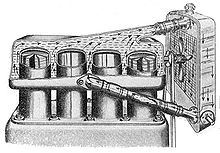 1937 diagram of engine cooling entirely by thermosiphon circulationSome early cars, motor vehicles, and engine-powered farm and industrial equipment used thermosiphon circulation to move cooling water between their cylinder block and radiator. This method of water circulation depends on keeping enough cool air moving past the radiator to provide a sufficient temperature differential; the air movement was accomplished by the forward motion of the vehicle and by the use of fans. As engine power increased, increased flow of water was required, so engine-driven pumps were added to assist circulation. More compact engines began to use smaller radiators and require more convoluted flow patterns, so the water circulation became entirely dependent on the pump and might even be reversed against its natural direction. An engine that circulates its cooling water only by thermosiphon is susceptible to overheating during prolonged periods of idling or very slow travel since the lack of forward motion provides too little airflow past the radiator, unless one or more fans are able to move enough air by themselves. Thermosiphon systems are also very sensitive to low coolant level, i.e. losing only a small amount of coolant stops the circulation; a pump-driven system is much more robust and can typically handle a lower coolant level.
 .jpg) 1937 diagram of engine cooling entirely by thermosiphon circulationSome early cars, motor vehicles, and engine-powered farm and industrial equipment used thermosiphon circulation to move cooling water between their cylinder block and radiator. This method of water circulation depends on keeping enough cool air moving past the radiator to provide a sufficient temperature differential; the air movement was accomplished by the forward motion of the vehicle and by the use of fans. As engine power increased, increased flow of water was required, so engine-driven pumps were added to assist circulation. More compact engines began to use smaller radiators and require more convoluted flow patterns, so the water circulation became entirely dependent on the pump and might even be reversed against its natural direction. An engine that circulates its cooling water only by thermosiphon is susceptible to overheating during prolonged periods of idling or very slow travel since the lack of forward motion provides too little airflow past the radiator, unless one or more fans are able to move enough air by themselves. Thermosiphon systems are also very sensitive to low coolant level, i.e. losing only a small amount of coolant stops the circulation; a pump-driven system is much more robust and can typically handle a lower coolant level.
1937 diagram of engine cooling entirely by thermosiphon circulationSome early cars, motor vehicles, and engine-powered farm and industrial equipment used thermosiphon circulation to move cooling water between their cylinder block and radiator. This method of water circulation depends on keeping enough cool air moving past the radiator to provide a sufficient temperature differential; the air movement was accomplished by the forward motion of the vehicle and by the use of fans. As engine power increased, increased flow of water was required, so engine-driven pumps were added to assist circulation. More compact engines began to use smaller radiators and require more convoluted flow patterns, so the water circulation became entirely dependent on the pump and might even be reversed against its natural direction. An engine that circulates its cooling water only by thermosiphon is susceptible to overheating during prolonged periods of idling or very slow travel since the lack of forward motion provides too little airflow past the radiator, unless one or more fans are able to move enough air by themselves. Thermosiphon systems are also very sensitive to low coolant level, i.e. losing only a small amount of coolant stops the circulation; a pump-driven system is much more robust and can typically handle a lower coolant level. 