When you click on links to various merchants on this site and make a purchase, this can result in this site earning a commission. Affiliate programs and affiliations include, but are not limited to, the eBay Partner Network.
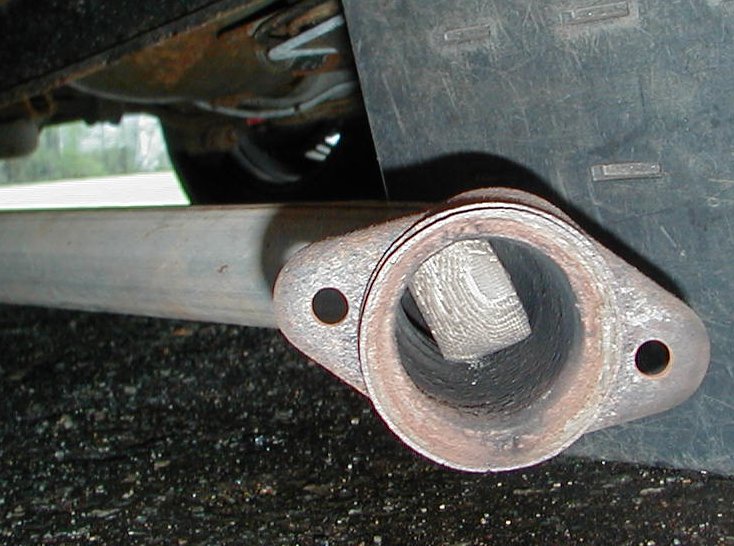
Don’t bother trying to get over on epa by deleting your catalytic converter, looks like GM did it for you, they are empty, this is in fact OE exhaust, and no sign that it has been tampered with before. Now i've got the headache of having to weld this back together.
Now is your chance to turn those into mufflers.
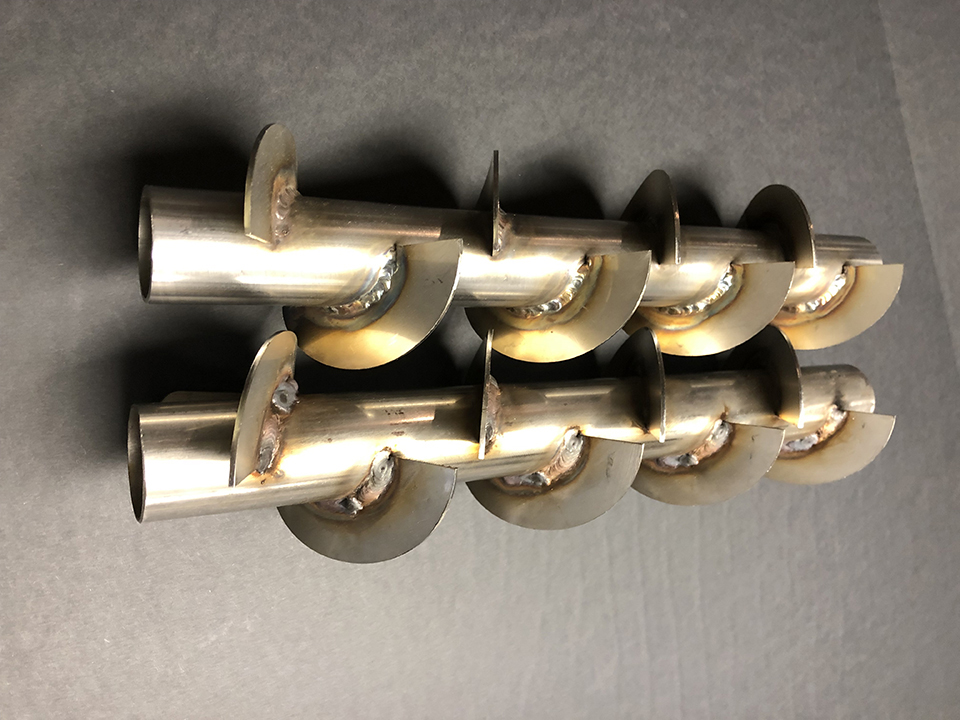
Wrap perforated metal around a spiral auger and fill the surrounding area with stainless steel scrubber pads.
Some catalytic converters, like what is on my 1984 T/A, have a plug on the bottom side that can be removed. Farmers back in the day
would have the dealer or a mechanic, remove the plug vacuum out the contents. I remember because my dad had that done to the 1976 Impala.
Remember, farmers motorized equipment use regular leaded gasoline the tetraethyll lead destroyed the cat's contents
Yup, I've had several breakup and shoot out the tail pipe.
normally rattle for quite a long time before they clean out.
The chunk that was rattling, what was left of it after the r&r. Cut on the correct welds and it comes right out. Put it back in, weld the welds and it's hard to tell its been messed with. (Has slp tri-y headers)
It'd be pretty hard to get a "broom handle" in there w/the pipe bends before and after the cats. I think that the folks who said that the cat(s) broke up on their own and flushed out the rear (or got caught up in the muffler) are correct.
From: Franklin, KY near Beech Bend Raceway, Corvette Plant and Museum.
Car: 1992 Pontiac Firebird
Engine: 5.0L L03 TBI
Transmission: 700R4
Axle/Gears: 2.73
Re: Catalytic converter delete
I don't think the convertors used in the N10 system were as reliable as the convertors used in the single cat systems. It seems that it was either the heatshields rattling on them or the guts inside rattling on them.
Then to make matters even worse for the N10 dual cat system is that it was introduced in 1989 along with the Rochester Products Multec fuel injectors. Cats don't like engine misfires or any of the other crap you're going to get from failing RP Multec injectors.
In my opinion the N10 dual cat exhaust wasn't needed for what small power gain it provided. The restriction was NOT in the cat used in the single cat H.O. exhaust system. The restriction was in the cast iron TPI H.O. exhaust manifolds and the absolutely horrible T merge before the single cat. The N10 dual cat system kept the restriction of the cast iron TPI H.O. manifolds and moved the absolutely horrible restriction of the T merge to a slightly less horrible restriction of the Y merge behind the dual cats.
Magnaflow 16450 Y-pipe
If GM would have left the entire H.O. single cat system alone and just changed the horrible T merge before it with something like Magnaflow's 16450 mandrel bent Y-pipe they would have got just as much of a power increase as the N10 dual cat system provided and saved money and weight over the N10 system.
The N10 system required multiple additional new parts to install.
Different cat convertor heat shielding on the underbody of the car.
Two cat convertors.
N10 specific transmission to cat convertor exhaust system hanger.
Different intermediate pipe.
Extra exhaust pipe for the second cat convertor.
This system is heavier, has worse under car packaging, and looks worse on cars like the Firebird Formula because you can easily see the exhaust pipe on the passenger side because the Formula doesn't have GFX to hide it. You can't service a failing cat convertor because the N10 system is a 1 piece welded assembly where with the single cat system the cat convertor can be easily removed between the Y-pipe and intermediate pipe and replaced with its slip fit and ball & socket flange connections.
The N10 dual cat exhaust system was a dumbass idea then and is now too.
One of my stock dual cat's fell apart internally, blocked the pipe after the cat for about a week and then disintegrated the rest of the way and made it's way out the tailpipe. Ran fine after that and even still passed the sniffer test. I think it was just the rear section of the monolith and the front was still intact.
Like has been already stated, there's no way to gut those cats on purpose without cutting the front or rear pipe connection and welding it back together. It probably just fell apart, like many of them do.
I stand corrected. I had no idea they could blow completely out like that.
I'm convinced my '84 cat was gutted by a P.O., as it bolts on rather than welded...
The N10 dual cat exhaust system was a dumbass idea then and is now too.
...with everything that you wrote in that post. The single cat Y was DUMB. SO dumb...and what $ did it save 'em? Not enough to justify the dumbassery of it.
From: Franklin, KY near Beech Bend Raceway, Corvette Plant and Museum.
Car: 1992 Pontiac Firebird
Engine: 5.0L L03 TBI
Transmission: 700R4
Axle/Gears: 2.73
Re: Catalytic converter delete
Yeah the T-pipe sucked. GM did the same horrible T-pipe setup on the TBI GMT400 trucks too.
Early 3rd gens had N10 with the dual exhaust at the back end and later 3rd gens had N10 with the dual exhaust at the front end.
Shame GM with the later N10 didn't go all the way with 2.25 dual exhaust with a H-pipe right before or after the cats with a passenger side dual inlet crossflow muffler with dual outlets on the driver side.
My friend has had 3 N10 dual cat cars lately and all 3 have had to have the factory cats cut out and replaced. Well the 3rd will be when the cats arrive tomorrow. All had to have the RP Multec injectors replaced too. Probably what killed the cats.
Yeah the T-pipe sucked. GM did the same horrible T-pipe setup on the TBI GMT400 trucks too.
Early 3rd gens had N10 with the dual exhaust at the back end and later 3rd gens had N10 with the dual exhaust at the front end.
Shame GM with the later N10 didn't go all the way with 2.25 dual exhaust with a H-pipe right before or after the cats with a passenger side dual inlet crossflow muffler with dual outlets on the driver side.
My friend has had 3 N10 dual cat cars lately and all 3 have had to have the factory cats cut out and replaced. Well the 3rd will be when the cats arrive tomorrow. All had to have the RP Multec injectors replaced too. Probably what killed the cats.
In that case....I guess luckily, the Multecs on my '89 went ***** up around 8 or 9 thousand miles and replaced them with new Bosch 19#-ers, that were on the '85-'88's when they were still available new from TPIS.
That stuff doesn't make for good wall art, that's for sure. IDK that Multec's had much to do w/the "shorter" life/length of N10 cats... Multecs (junk though they are), also fueled many-a-single cat system too, and they had different longevity, it seems?
That stuff doesn't make for good wall art, that's for sure. IDK that Multec's had much to do w/the "shorter" life/length of N10 cats... Multecs (junk though they are), also fueled many-a-single cat system too, and they had different longevity, it seems?
My Dad had a '92 RS 305TBI back in the mid 90's that had the cat start rattling for a while and then start falling apart. The car had somewhere around 100K miles at that point. No Multecs on that car since it was TBI and it was single cat. I think the catalytic converters GM used during that timeframe just weren't very good.
When I replaced the cat on that car, the pieces of the inside that came out all looked pretty clean, not melted/overheated and the honeycomb passages were still intact. It just looked like the fit between the ceramic monolith and the metal casing got looser over time and the ceramic started to vibrate, breaking more and more pieces off of itself.






 ...with everything that you wrote in that post. The single cat Y was DUMB. SO dumb...and what $ did it save 'em? Not enough to justify the dumbassery of it.


