When you click on links to various merchants on this site and make a purchase, this can result in this site earning a commission. Affiliate programs and affiliations include, but are not limited to, the eBay Partner Network.
LTX and LSXPutting LT1s, LS1s, and their variants into Third Gens is becoming more popular. This board is for those who are doing and have done the swaps so they can discuss all of their technical aspects including repairs, swap info, and performance upgrades.
Here is a list of torque arms I know about for 3rd gen F-bodies. Hopefully it helps people find something they like.
A basic torque arm bolts in place and that's it. But like anything, the more money you spend the more features you get. Pay attention to construction and how well the torque arm is triangulated and use of sheet metal gussets. That's where much of the strength comes from.
Adjustable pinion angle is a very desirable feature. It allows the rear axle pinion to be tilted up/down to optimize driveshaft u-joint angles for smooth operation. This feature is recommended for cars with modified suspension geometry, or when so many changes are thrown at the car that nothing is same as stock. Pay attention to the quality of the rod ends used and try to option for the stronger, higher quality rods ends if given a choice.
The style of front mount effects how freely the torque arm can move fore/aft with axle movement, and how loads are imparted to the chassis. Stock rubber bushings are a slider style mount using a 2-piece clamshell with W-shaped grooves to match the profile of the stock torque arm. Polyurethane can bind the sliding motion more than rubber, especially if not clean and well lubricated. Aftermarket torque arms are usually constructed of round tube, so the 2-piece clamshell is modified so have a round hole instead of the W-shape groove. This has added advantage of being less restrictive in movement and overall is an improved design.
Another style of front mount is the shackle style (swing plate) that is more common in drag racing. The swing plate moves in an arc, not truly fore-aft, so handling issues possibly could be exhibited during hard braking. And expect some clunking noises while driving with shackle mounts.
Torque arm length has a very strong effect on instant center. Shorter torque arms move the instant center rearward. This might help straight line acceleration but possibly harm vehicle handling and braking. A decoupled torque arm acts more like a short arm when accelerating and a long arm when braking, which better optimizes how forces are applied to chassis when in acceleration vs. braking.
Different rear axles might take different mounting bracket and bolt patterns. The torque arm mounting bracket has to be compatible with the rear axle. Consult with the axle manufacturer to understand requirements. In general, GM 10 and 12 bolt axles share the same mounting pattern, while S60 and Ford 9" axles use a different mounting pattern. Fabricated axles might be even different yet and require torque arm from that same manufacturer.
Full Length Torque Arms
Full length torque arms are same length as stock and are mounted to either the transmission tail shaft, or a custom transmission crossmember included with the kit. Using the transmission tail shaft becomes less and less desirable as engine Torque output is increased. A 2-piece clamshell bushing for round rod is the preferred style of front mount.
BMR, https://www.bmrsuspension.com/
Clamshell mount (round rod) to transmission or trans crossmember. Steel and chromoly versions. Adjustable and non-adjustable pinion angle.
Heidts, https://www.heidts.com/part/rc-587-1...orque-arm-kit/
Shackle mount to trans crossmember. Adjustable pinion angle. This is kind of a hybrid between short and full-length. The torque arm attaches to a long bar that extends from the trans crossmember. It's not clear from the description if this is compatible with 4L60 or T56 transmissions.
Midwest Chassis, https://midwestchassis.com/
Spherical rod end with shackle. Double adjustable. Made for 4th gen F-body so would have to modify the crossmember to fit 3rd gen chassis.
QA1, https://www.qa1.net/
Stock style "W" grooved bushing mounted to transmission. Adjustable and non-adjustable.
UMI, https://www.umiperformance.com/home/
Clamshell mount (round rod) mounted to trans crossmember. Also have a variant with somewhat shorter torque arm mounted with shackle to trans crossmember. Adjustable and non-adjustable.
Spohn, https://www.spohn.net/
Transmission mounted version uses clamshell mounts (round rod). "Standard Duty" and "Pro-Series" mount to trans crossmember using a shackle with choices of poly bushing, spherical rod end, or Del-Sphere rod end. All versions have adjustable pinion angle.
Short Torque Arms
Short torque arms are usually mounted to a bar that is welded to the subframe connectors. And obviously the car must have subframe connectors. The shorter torque arm moves the instant center further rearward from stock. These designs are more drag race oriented, and more chance of rear axle hop during braking.
BMR Trak Pak, https://www.bmrsuspension.com/
Mounts with shackle to a bar welded to subframe connectors. Bar has a droop for more exhaust clearance, but results in very poor ground clearance in center of vehicle. Adjustable pinion angle.
Global West, https://www.globalwest.net/
The torque arm mounts to the floorboard under the rear seat cushion. This can crack the floor or even break thru over time. I don't see this product on the Global West website today so maybe it is no longer sold.
Jegster, https://www.jegs.com/
Very short torque arm. Mounts directly to the trans tunnel. Drag race only.
S&W Performance Group, https://swracecars.com/
Mounts with shackle to a bar welded to subframe connectors. Adjustable pinion angle. Versions for stock housings and fabricated Ford 9" housings, and their own S&W Ford 9" housing.
UMI, https://www.umiperformance.com/home/
Mounts with shackle to a bar welded to subframe connectors. Choice of straight bar, or bar with droop for more exhaust clearance. Bar with droop has very poor ground clearance in center of vehicle. Adjustable pinion angle.
Decoupled torque arms act like a short arm during acceleration and a long arm during braking. It is meant to better optimize chassis dynamics for improved traction and handling.
VSE Herb Adams Suspension
A true decoupled torque arm. Front bracket mounts to sheet metal of car, requires drilling holes. This is the original decoupled torque arm from the 1980's developed by Herb Adams. The products are being offered again by Matt Adams. Catalog and pricing not available online, contact via Facebook.
Unbalanced Engineering, https://www.unbalancedengineering.com/
A true decoupled torque arm. Unfortunately it was never made for 3rd gen F-body, but there is a similar version for 4th gen F-body and some people have adapted it to the 3rd gen. Single orders are no longer made but they will build a batch if the order quantity is large enough.
Qwk: You are doing a fantastic job recently with all of these tech threads and writeups. It will be so useful for people for years to come. Thanks for doing it!
One more to add to the list is the S&W racecars torque arm. It is the one I use and I can answer any questions about it, but I will let you put it in the proper category above, and do a writeup about it that is up to your liking. Here is a link to it.
-I use mine with the S&W chassis subframe kit, which involves two front-to-back subframe connectors, an "outrigger" on each side that goes out to the rocker area, a center crossmember, and a driveshaft loop. The torque arm mounts is mounted to this whole setup, so it is not on the transmission tailshaft.
A shackle is the next step up in freedom of movement, strength, and chassis response; but expect some clunking noises while driving.
For what it's worth, I actually eliminated the clunking with my shackle torque arm. I don't know if this will always work but it's maybe worth a try if the noise bothers you.
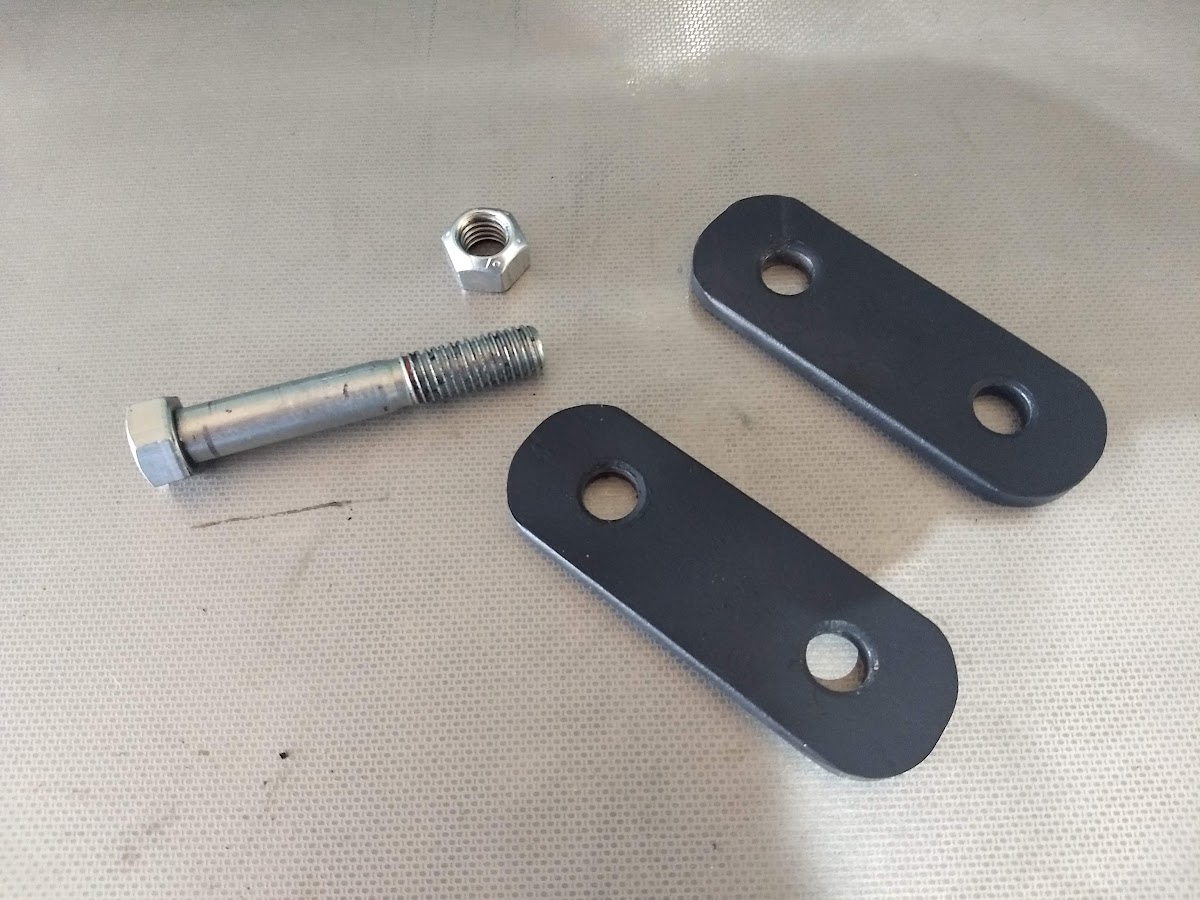
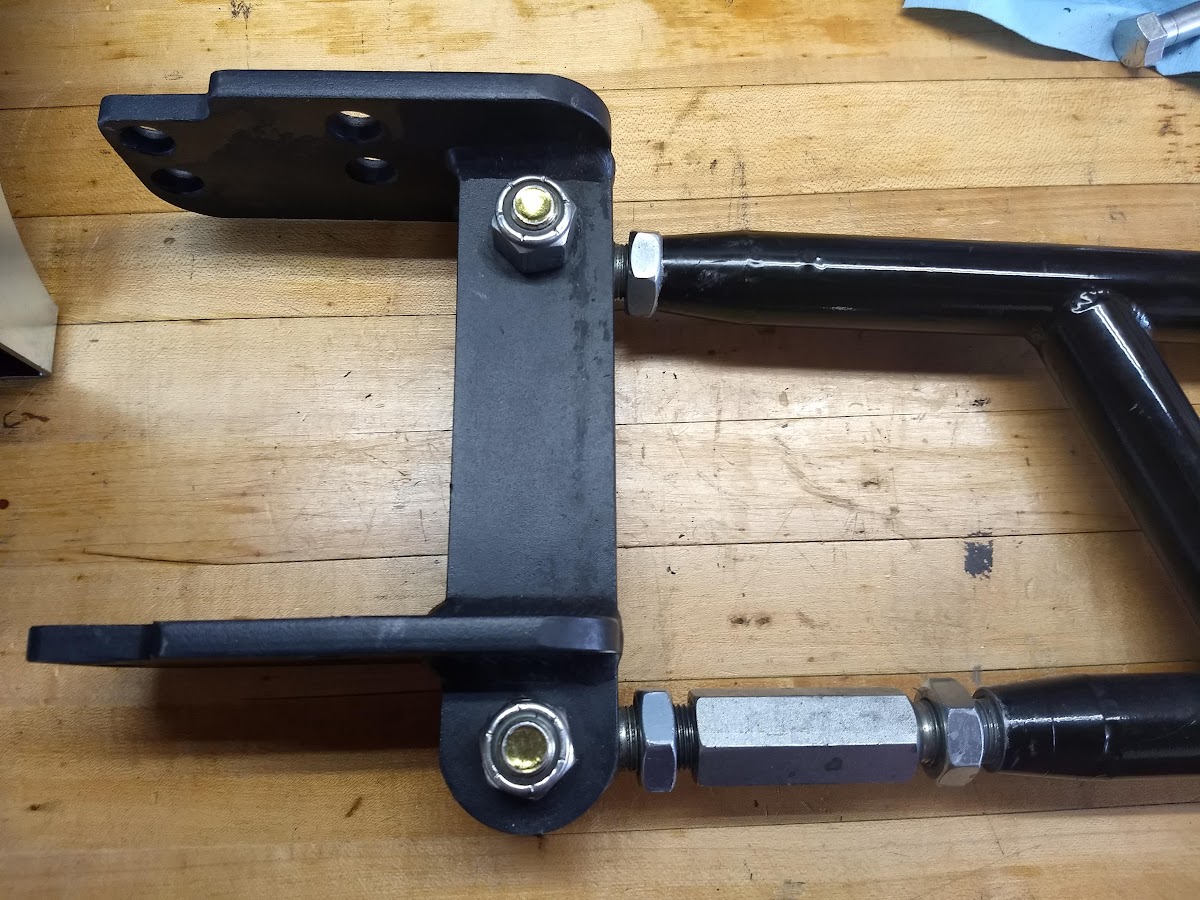
One source of noise was bolts slapping around in the thru-holes at the front bushing. Torque the bolts tight and it quiets down but binds up the pivot movement (sqeezes too hard on the bushings). Loosen the bolts and the joint will freely pivot but the bolts clunk all day. So what I did was make new shackles with holes 1/64" smaller for more precise fit to the bolts. Also added a lead-in chamfer to one side of the plates so that the bolts could be drifted through easily in the car. No more slop, still moves freely. Also made the plates shorter for more stability. My last set of plates were pretty long and didn't need to be.
These are the shackles mocked up on torque arm. I'm using a 1/2-13 bolt and metal top lock nut that won't loosen and is good for multiple uses. Caterpillar p/n 8T-8920 (bolt) and 1K-6872 (top lock nut).
I've also had a LOUD clunk sometimes when I hit the brakes. That was different from the bolts slapping. I had a hunch it had something to do with my torque arm being a bit too long, causing the swing plate to be too far over center (forward). I shortened the adjuster rods to bring the arm closer to centerline of pivot. That got rid of the intermittent loud clunk when braking.
I reached out to VSE for more info about their Herb Adams decoupled torque arm. Here is an old magazine article they sent me.
That's pretty slick.
I'd like to know more about the "slider bar" and "spring bars". There are some excellent pictures on Unbalanced Engineering's website but if those mysteries were revealed it might be a piece that one could fabricate.
The 60' time is king. Probably be a benefit on the street too.
Last edited by skinny z; Nov 12, 2023 at 11:04 AM.
This is the Midwest Chassis 3rd gen specific mid length 2 piece torque arm and crossmember. Obviously made for their fabricated 9" but has been successfully adapted to quick performance 9" rears too
Nice info! Can you add some information about torque arm relocation options?
I just received my TKX swap from American Power Train which came with a nice relocation piece.
I don't understand, Can you explain better what you mean?
The descriptions I wrote for each brand says what kind of mount it is and where it is located.
And I gave you a link to the manufacturer website where you can find their pictures and such.
Well for better or worse here I am...
Some days Mumbling and Drooling like I drank a Gallon of Vodka.
Other Days slightly functional, but not Mentally Sharp, terrible Memory (short and long term)... and a Paralyzed Left Lower-Arm/ Hand.
The Shackle System for the Torque-Arm Sucks.
The Ideal Torque-Arm would have:
-A dedicated Tubular Cross-Member between the Sub-Frame Connectors.
-This Cross-Member should be as close to the Transmission Cross-Member as possible without interfering (we want the longest Torque-Arm Possible).
-The Torque-Arm should attach to the Cross-Member by a Heavy-Duty Version of what the OEM Clam-Shell Mount was like.
-1/4 Steel should make up the Clam-Shell with Grade-8 Hardware... and use smaller Tubing to Triangulate the Clam-Shell's attachments to the Cross-Member (Very Important).
-The Bushing should have a Cylinder shaped hole for the front of the Torque-Arm Tubing to be able to slide Forwards and Backwards inside.
Example shown below:
This Torque-Arm System is in over 200 of My Customer's Third-Gens and some Fourth-Gens...
Lowest E.T. on that Suspension with Large Slicks is in the 8.100 Second range. (Well over 150 Mph).
Note: Due to the Body Design of our Cars...
There is very little down-force on the Rear-Tires at Speed and these Cars can get very "Squirrely".
Adding a Taller Spoiler is far less Ideal than just extending the OEM Spoiler Backward 12" to 18".
Example shown below:
Last edited by vorteciroc; Nov 21, 2023 at 06:27 PM.
I have been running a old school random technology tq arm for 25 yrs or so. It has the round hole poly bushing mounted in factory location on the side of the trans. Ive gone 1.5x short times with it back in the day.
I'm glad you just plain said that. I can't explain how or why, but I've been thinking for a couple years that my shackle torque arm is responsible for some odd behavior with my car, especially while braking hard.
The decoupled torque arm from Unbalanced Engineering is very similar to what Dirt Late Models run as a lift bar. Below is a link to the Earnhardt Technologies lift bar.
The biggest difference is the lift bar has a coil over shock installed on it instead of a rubber bump stop. I know these are crucial to putting big power down on dirt, so I'm assuming the same physics apply to our cars.
I'm glad you just plain said that. I can't explain how or why, but I've been thinking for a couple years that my shackle torque arm is responsible for some odd behavior with my car, especially while braking hard.
How much does the shackle move front to rear? Can't be all that much but im guessing it may have something to do with the arc the shackle travels in as it moves?
How much does the shackle move front to rear? Can't be all that much but im guessing it may have something to do with the arc the shackle travels in as it moves?
The torque arm needs move forward and back to compensate for the different arcs in it versus the lower control arms. It also needs to rotate/pivot on its axis as one side of the suspension compresses and the other side droops out. If it didn't have that ability it would cause the suspension to lock and not work.
-A dedicated Tubular Cross-Member between the Sub-Frame Connectors.
-This Cross-Member should be as close to the Transmission Cross-Member as possible without interfering (we want the longest Torque-Arm Possible).
-The Torque-Arm should attach to the Cross-Member by a Heavy-Duty Version of what the OEM Clam-Shell Mount was like.
-1/4 Steel should make up the Clam-Shell with Grade-8 Hardware... and use smaller Tubing to Triangulate the Clam-Shell's attachments to the Cross-Member (Very Important).
-The Bushing should have a Cylinder shaped hole for the front of the Torque-Arm Tubing to be able to slide Forwards and Backwards inside.
Example shown below:
Originally Posted by TTOP350
I have been running a old school random technology tq arm for 25 yrs or so. It has the round hole poly bushing mounted in factory location on the side of the trans. Ive gone 1.5x short times with it back in the day.
Originally Posted by thatsupnow
The torque arm needs move forward and back to compensate for the different arcs in it versus the lower control arms. It also needs to rotate/pivot on its axis as one side of the suspension compresses and the other side droops out. If it didn't have that ability it would cause the suspension to lock and not work.
The reference to the tubular arm end and bushing is interesting in that it would freely allow that axial rotation as one wheel tracked higher than the other. Understood.
That said, most aftermarket torque arms are mounted to the third member via heim joints. Although limited by design, how much of that rotation can they provide? My reason for asking is that I've the OEM profile "W" shaped arm end and I don't have any notion of swapping that torque arm anytime soon.
What's the difference?
A performance orientated suspension would limit that rotation about the driveline centreline for that needed cornering articulation. Less body roll to manage.
If it's drag racing only, then the significance is even less. Back and forth is what you need.
Then there's the length conundrum. I suppose that could be very application specific.
It may be a real topic of discussion in a new thread. If it isn't already.
The torque arm needs move forward and back to compensate for the different arcs in it versus the lower control arms. It also needs to rotate/pivot on its axis as one side of the suspension compresses and the other side droops out. If it didn't have that ability it would cause the suspension to lock and not work.
How much does the shackle move front to rear? Can't be all that much but im guessing it may have something to do with the arc the shackle travels in as it moves?
I have removed springs and run the axle through motions and the front link has very small movement fore/aft until the axle is in deep droop (airborne situation) at which time it pulls to the rear. Torque arms that aren't floppy don't move as much as people might imagine.
A shackle doesn't actually freely slide fore/aft in the sense that other torque arms do. The front of the torque arm rotates around a pivot and applies force along the axis of the shackle, which causes both a vertical and horizontal vector on the crossmember depending on shackle operating angle and magnitude of load. That horizontal vector is undesirable and isn't actually how a torque arm is intended to work. I don't know what that means in terms of real world handling, but I'm pretty sure it does not add to the goodness.
. The front of the torque arm rotates around a pivot and applies force along the axis of the shackle, which causes both a vertical and horizontal vector on the crossmember depending on shackle operating angle and magnitude of load. That horizontal vector is undesirable and isn't actually how a torque arm is intended to work. I don't know what that means in terms of real world handling, but I'm pretty sure it does not add to the goodness.
Originally Posted by skinny z
The reference to the tubular arm end and bushing is interesting in that it would freely allow that axial rotation as one wheel tracked higher than the other. Understood.
That said, most aftermarket torque arms are mounted to the third member via heim joints. Although limited by design, how much of that rotation can they provide?
.
My torque arm uses Heim joints on all three points for zero binding.
Originally Posted by skinny z
The reference to the tubular arm end and bushing is interesting in that it would freely allow that axial rotation as one wheel tracked higher than the other. Understood.
That said, most aftermarket torque arms are mounted to the third member via heim joints. Although limited by design, how much of that rotation can they provide?
Back to the heim joints: How much rotation do they provide relative to their design? That is 90° to the axle or bolt that they're mounted to?
Back to the heim joints: How much rotation do they provide relative to their design? That is 90° to the axle or bolt that they're mounted to?
Oh, that's all over the map. Depends on the rod end and the misalignment bushings being used. You can go to product catalogs and see the misangle specs.
The rod ends that came with my Kenny Brown control arms have ***** that can spin around 360°. What limits motion is the shape of the misalignment bushings and when it contacts the housing. You can buy misalignment bushings that are straight, angled, etc.
Without looking at my car, I would guess I have somewhere around 30° of misalignment available left and right with those particular rod ends and bushings. I have another style of rod end on my panhard "axle bracket brace" with much less angle than that - it's almost maxed out just going from bracket to axle tube.
I just installed all new UMI stuff into my T5 88 car and started test driving it. It clunks/bangs pretty hard shifting normally from 1-2 and 2-3 and clunks hard when down shifting. On top of the really poor fit to begin with, I hate my UMI setup and might just go back to stock.
I just installed all new UMI stuff into my T5 88 car and started test driving it. It clunks/bangs pretty hard shifting normally from 1-2 and 2-3 and clunks hard when down shifting. On top of the really poor fit to begin with, I hate my UMI setup and might just go back to stock.
There are things you can do to help that if you want to give it a try.
It clunks mostly because the bolts are slapping around in the holes of the plate and bushing. If you make yourself new plates with slightly smaller holes, similar to what I did in post #4, then almost all the noise will go away. I can't remember what drill bit size I used but it was probably the 33/64" based on the "close fit" sizing at this website, https://littlemachineshop.com/reference/tapdrill.php You gotta keep things clean and in tip top condition with that little clearance to bolt.
Driving habits can help too. Most clunking happens when cruising at little to no throttle and the drivetrain goes back and forth between slack and no slack. This causes the nose of the axle to teeter up and down and the front mount of the torque arm slaps up and down with it. It will stop slapping if you keep the drivetrain from going slack. Try shifting to a gear at a higher rpm. The small extra bit of throttle required to drive at higher rpm will keep tension on the torque arm.
There are things you can do to help that if you want to give it a try.
It clunks mostly because the bolts are slapping around in the holes of the plate and bushing. If you make yourself new plates with slightly smaller holes, similar to what I did in post #4, then almost all the noise will go away. I can't remember what drill bit size I used but it was probably the 33/64" based on the "close fit" sizing at this website, https://littlemachineshop.com/reference/tapdrill.php You gotta keep things clean and in tip top condition with that little clearance to bolt.
Driving habits can help too. Most clunking happens when cruising at little to no throttle and the drivetrain goes back and forth between slack and no slack. This causes the nose of the axle to teeter up and down and the front mount of the torque arm slaps up and down with it. It will stop slapping if you keep the drivetrain from going slack. Try shifting to a gear at a higher rpm. The small extra bit of throttle required to drive at higher rpm will keep tension on the torque arm.
Or just ditch it. That idea isn't too bad either.
Yeah its pretty annoying. I am also just now driving the car so I am still getting a feel for the clutch release depth and timing. When I first drove t he car last week, I was stabbing the clutch a little too deep and when pulling off the throttle and pushing clutch it was kind of like a yo-yo effect. It sucks to really have to pay super close attention to your shifting whilst also listening for other noises, smelling and watching etc. I need to get under it and see if its still contacting the trans and maybe order a taller (poly) mount.
You can contact VSE via Facebook. There is no website that I know of.
I'll be talking about it in my build thread sometime this summer. My car is not stock, so need a few things tweaked to work with my car. Possibly will be prototyping some new options.