


Code 32


Member
Joined: Jul 1999
Posts: 326
Likes: 0
From: md.
OI would check the plastic vacuum lines to make sure they arent melted or cracked.
Also make sure carbon hasnt caked up the intake port where the EGR resides.
Yeah, it would suck to miss something after taking the plenium off.
[This message has been edited by Kevin G (edited September 14, 2000).]
Also make sure carbon hasnt caked up the intake port where the EGR resides.
Yeah, it would suck to miss something after taking the plenium off.
[This message has been edited by Kevin G (edited September 14, 2000).]

Moderator


Joined: Jan 2000
Posts: 19,691
Likes: 319
JB,
It would help a great deal to know what engine/year you are talking about. Most EGR systems use a solenoid to activate the EGR pilot vacuum signal. Some EGR valves have a diagnostic temperature sensor to determine if the valve has opened when commanded to do so by the ECM.
------------------
Later,
Vader
------------------
"Make Me Bad"
Adobe Acrobat Reader 4.0
It would help a great deal to know what engine/year you are talking about. Most EGR systems use a solenoid to activate the EGR pilot vacuum signal. Some EGR valves have a diagnostic temperature sensor to determine if the valve has opened when commanded to do so by the ECM.
------------------
Later,
Vader
------------------
"Make Me Bad"
Adobe Acrobat Reader 4.0
Moderator
Joined: Jan 2000
Posts: 19,691
Likes: 319
JB,
An '86 TPI definitely has an EGR Diagnostic Temperature Sensor:
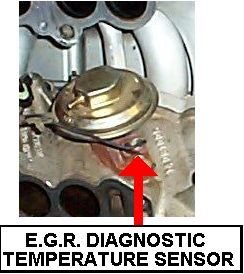
That needs to be connected and operating to avoid a DTC 32.
P.S. - While the plenum is off, are you going to "repair" the ports?
An '86 TPI definitely has an EGR Diagnostic Temperature Sensor:
That needs to be connected and operating to avoid a DTC 32.
P.S. - While the plenum is off, are you going to "repair" the ports?
Last edited by Vader; Mar 31, 2018 at 04:59 PM. Reason: Updated links
My plenum saw it's fair share of "repair" when I sent my injectors to Rich.
Okay connected I can check for, but operating? What is it supposed to be doing anyway? Thanks.
I don't suppose EGR could contribute to a hard start, when hot, could it?
Okay connected I can check for, but operating? What is it supposed to be doing anyway? Thanks.
I don't suppose EGR could contribute to a hard start, when hot, could it?
Moderator
Joined: Jan 2000
Posts: 19,691
Likes: 319
JB,
"Operating" would mean that it signals the ECM of a temperature change when the EGR opens. The sensor should have the same resistance-at-temperature scale as the MAT and CTS sensors.
An EGR that was sticking open would cause starting problems at any temperature. Your hot restart problems may have more to do with the MAT than EGR.
------------------
Later,
Vader
------------------
"Make Me Bad"
Adobe Acrobat Reader 4.0
"Operating" would mean that it signals the ECM of a temperature change when the EGR opens. The sensor should have the same resistance-at-temperature scale as the MAT and CTS sensors.
An EGR that was sticking open would cause starting problems at any temperature. Your hot restart problems may have more to do with the MAT than EGR.
------------------
Later,
Vader
------------------
"Make Me Bad"
Adobe Acrobat Reader 4.0
Trending Topics
So, checking it for resistance determines the likely hood of it being at fault? And it's resistance should coincide with that MAT? (Please correct if I'm understanding you incorrectly)
About the MAT contributing to hard starting when hot, do you recommend relocation? Or possible failure?
About the MAT contributing to hard starting when hot, do you recommend relocation? Or possible failure?
Moderator
Joined: Jan 2000
Posts: 19,691
Likes: 319
JB,
The resistance of MOST GM temperature sensors should be as follows:
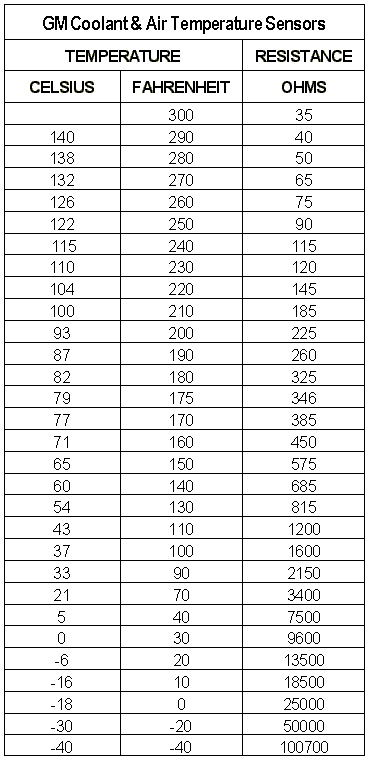
Your EGR temperature sensor should be close to the table at a given temperature.
------------------
Later,
Vader
------------------
"Make Me Bad"
Adobe Acrobat Reader 4.0
The resistance of MOST GM temperature sensors should be as follows:
Your EGR temperature sensor should be close to the table at a given temperature.
------------------
Later,
Vader
------------------
"Make Me Bad"
Adobe Acrobat Reader 4.0
Last edited by Vader; Mar 31, 2018 at 05:00 PM. Reason: Updated links

Thread
Thread Starter
Forum
Replies
Last Post