


rod legnths


Thread Starter
Member
Joined: Mar 2011
Posts: 126
Likes: 1
From: ofallon,MO
Car: 88 IROC-Z
Engine: 305 TPI
Transmission: 700R4-currently being mildly built
Axle/Gears: stock 2.73:( with limited slip
rod legnths
What are the benefits of longer rods. I am assuming higher compression.
On a 383, you can have 5.7" or 6" rods. But on this crank, http://www.lunatipower.com/Product.aspx?id=157&gid=160
It says you need a minimum of 5.7" rods. What does that mean? Lower compression for 5.7"?
What would be the better choice for the Lunati above, 5.7" or 6"?
Thanks
On a 383, you can have 5.7" or 6" rods. But on this crank, http://www.lunatipower.com/Product.aspx?id=157&gid=160
It says you need a minimum of 5.7" rods. What does that mean? Lower compression for 5.7"?
What would be the better choice for the Lunati above, 5.7" or 6"?
Thanks
Last edited by falconman; Mar 31, 2011 at 06:36 PM.

Senior Member
Joined: Oct 2009
Posts: 676
Likes: 1
From: Pacific NW
Car: 89 K3500 Fleetside
Engine: RAT *tbi* EBL
Transmission: TH400
Axle/Gears: 3.73-Dana 60
Re: rod legnths
Your question begs the study of subject.."rod ratio"
No, not a huge factor in designing static compression & only slightly more in designing dynamic.
This boils down to what you have & want to spend.
The performance advantage IMO, falls only slightly to the 6" rods.
Worth the cost if you have a good set of 5.7's you can use, NO.
If you are buying rods the decision becomes more involved. Are you willing to run smaller rings or a tighter ring package? The pistons for the 6" rod tend to be lighter & more costly.
So thar ya go, it might be a more expensive setup with a small performance advantage (all other factors being correct) using 6" rods.
If the intended use is mainly time or trophy hunting consider the 6", otherwise you won't notice any benefit, and all else being equal it might cost more given that it is a less common combo.
No, not a huge factor in designing static compression & only slightly more in designing dynamic.
This boils down to what you have & want to spend.
The performance advantage IMO, falls only slightly to the 6" rods.
Worth the cost if you have a good set of 5.7's you can use, NO.
If you are buying rods the decision becomes more involved. Are you willing to run smaller rings or a tighter ring package? The pistons for the 6" rod tend to be lighter & more costly.
So thar ya go, it might be a more expensive setup with a small performance advantage (all other factors being correct) using 6" rods.
If the intended use is mainly time or trophy hunting consider the 6", otherwise you won't notice any benefit, and all else being equal it might cost more given that it is a less common combo.

Joined: Mar 2000
Posts: 43,187
Likes: 45
From: Littleton, CO USA
Car: 82 Berlinetta/57 Bel Air
Engine: L92/LQ4 (both w/4" stroke)
Transmission: 4L80E/4L80E
Axle/Gears: 12B-3.73/9"-3.89
I don't remember if it was Yunick or Lingenfelter who said the ideal connecting rod is of infinite length.
So, in general terms, the longer the better the shorter the worser. Long reduces side loading of the piston.
It doesn't have anything to do with (static) compression ratio. You need pistons that are made for the stroke and rod length you are using. It does have some effect on valve timing, as the piston speed changes slightly at TDC and BDC with rod length, all other things being equal.
Factory SBC rod length was 5.700", except the SBC 400, which was 5.565" (kept the pin height the same for the stroke difference between the 400 & 350 engines - 3.75" - 3.48" = 0.27"; half of that is 0.135"; so 5.700" - 0.135" = 5.565" - ain't math wonderful?). While you can use 350 pistons with a 4" bore and 3.75" stroke if you use 5.565" rods, the issue with the Lunati crank is counterbalance to piston skirt clearance.
One performance factor often overlooked in all these SBC vs. BBC vs. LSx debates is stock rod length - 5.700" vs. 6.135" vs. 6.098". Even with 6" rods, the SBC comes out on the "short" end of the stick.
So, in general terms, the longer the better the shorter the worser. Long reduces side loading of the piston.
It doesn't have anything to do with (static) compression ratio. You need pistons that are made for the stroke and rod length you are using. It does have some effect on valve timing, as the piston speed changes slightly at TDC and BDC with rod length, all other things being equal.
Factory SBC rod length was 5.700", except the SBC 400, which was 5.565" (kept the pin height the same for the stroke difference between the 400 & 350 engines - 3.75" - 3.48" = 0.27"; half of that is 0.135"; so 5.700" - 0.135" = 5.565" - ain't math wonderful?). While you can use 350 pistons with a 4" bore and 3.75" stroke if you use 5.565" rods, the issue with the Lunati crank is counterbalance to piston skirt clearance.
One performance factor often overlooked in all these SBC vs. BBC vs. LSx debates is stock rod length - 5.700" vs. 6.135" vs. 6.098". Even with 6" rods, the SBC comes out on the "short" end of the stick.

Moderator


Joined: Jul 1999
Posts: 17,273
Likes: 171
From: 51°N 114°W, 3500'
Car: 87 IROC L98
Engine: 588 Alcohol BBC
Transmission: Powerglide
Axle/Gears: Ford 9"/31 spline spool/4.86
Re: rod legnths
My 540 BBC uses +0.250" longer rods. The hardest thing about using longer rods is how much higher it positions the wrist pin in the piston. My wrist pins is moved up into the oil control rings. Special rings are required to add extra support.
About the biggest benifit of using a longer rod is dwell angle. The amount of time the piston stays at TDC through crank rotation is longer with a longer rod. This will allow more fuel to be burnt while under compression to produce more power to push down on the piston. If the dwell is short because of a short rod, the piston will already be moving down into the cylinder as the fuel is still burning.
Now there's nothing saying that a short rod engine can't make power either. I had an old school 383 with a 400 crank and rods with 350 pistons and iron heads. I was able to run high 11 second 1/4 mile with it on pump gas.
About the biggest benifit of using a longer rod is dwell angle. The amount of time the piston stays at TDC through crank rotation is longer with a longer rod. This will allow more fuel to be burnt while under compression to produce more power to push down on the piston. If the dwell is short because of a short rod, the piston will already be moving down into the cylinder as the fuel is still burning.
Now there's nothing saying that a short rod engine can't make power either. I had an old school 383 with a 400 crank and rods with 350 pistons and iron heads. I was able to run high 11 second 1/4 mile with it on pump gas.


Joined: Sep 2005
Posts: 28,003
Likes: 2,486
Car: Yes
Engine: Usually
Transmission: Sometimes
Axle/Gears: Behind me somewhere
Re: rod legnths
THe primary reason you HAVE to use longer than stock rods with some specific cranks, is balancing.
THINK about a counterweight on a crank... it's opposite the rod throw on the crank, right? So where is it when the piston is at TDC? The rod throw is pointed up, and the counterweight is pointed down, right? Life is good? But where is it when the piston is at BDC? You guessed it... the rod throw is pointed away from the piston, and the CW is pointed toward the piston. There has to be enough space between the bottom of the piston and the crank CL for the counterweight to fit there at that point in th eengine's rotation. If it can't, then the counterweight can't be made large enough to properly counterbalance the rod weight, and the engine ends up having to be externally balanced.
But, if the rod is made longer to allow for enough counterweight to be internally balanced like ALL 305s and 350s, the wrist pin has to be moved upwards in the piston; which makes the rings have to be narrower, closer together, located closer to the top of the piston (makes them run hotter), or they have to actually go over the wrist pin. Any or all of which tend to make them not seal as well without special care taken to assure them a cushy life.
THe whole long-rod / short-rod debate, about the effect it has on how the motor runs, is WAY overblown. The effect is minimal. Most people build motors to so low a degree of precision, that there's more variability in the details they MISS COMPLETELY (*cough* deck clearance *cough* for example), than that one. I wouldn't get all wound up over it.
In your case, the reason you HAVE TO use longer rods, is because the crank is designed for internal balance. I.e., the STOCK 305/350 balance, instead of the stock 400 balance. If this is a 1-pc rear main seal crank, that DOES NOT mean that the flywheel will be neutral-balanced; only, that it will need the stock 305/350 internal balance weight on it. The choice of rods is, you can go with the "long-rod" monkey-spank and accept a compromised ring package (which will be fine with PROPER prep, namely boring and honing the block with a torque plate, not just the cheeeeepest "rebuilder" machine work possible), or go with the 5.7" rod and not compromise the ring package as much.
THINK about a counterweight on a crank... it's opposite the rod throw on the crank, right? So where is it when the piston is at TDC? The rod throw is pointed up, and the counterweight is pointed down, right? Life is good? But where is it when the piston is at BDC? You guessed it... the rod throw is pointed away from the piston, and the CW is pointed toward the piston. There has to be enough space between the bottom of the piston and the crank CL for the counterweight to fit there at that point in th eengine's rotation. If it can't, then the counterweight can't be made large enough to properly counterbalance the rod weight, and the engine ends up having to be externally balanced.
But, if the rod is made longer to allow for enough counterweight to be internally balanced like ALL 305s and 350s, the wrist pin has to be moved upwards in the piston; which makes the rings have to be narrower, closer together, located closer to the top of the piston (makes them run hotter), or they have to actually go over the wrist pin. Any or all of which tend to make them not seal as well without special care taken to assure them a cushy life.
THe whole long-rod / short-rod debate, about the effect it has on how the motor runs, is WAY overblown. The effect is minimal. Most people build motors to so low a degree of precision, that there's more variability in the details they MISS COMPLETELY (*cough* deck clearance *cough* for example), than that one. I wouldn't get all wound up over it.
In your case, the reason you HAVE TO use longer rods, is because the crank is designed for internal balance. I.e., the STOCK 305/350 balance, instead of the stock 400 balance. If this is a 1-pc rear main seal crank, that DOES NOT mean that the flywheel will be neutral-balanced; only, that it will need the stock 305/350 internal balance weight on it. The choice of rods is, you can go with the "long-rod" monkey-spank and accept a compromised ring package (which will be fine with PROPER prep, namely boring and honing the block with a torque plate, not just the cheeeeepest "rebuilder" machine work possible), or go with the 5.7" rod and not compromise the ring package as much.
Thread Starter
Member
Joined: Mar 2011
Posts: 126
Likes: 1
From: ofallon,MO
Car: 88 IROC-Z
Engine: 305 TPI
Transmission: 700R4-currently being mildly built
Axle/Gears: stock 2.73:( with limited slip
Re: rod legnths
In your case, the reason you HAVE TO use longer rods, is because the crank is designed for internal balance. I.e., the STOCK 305/350 balance, instead of the stock 400 balance. If this is a 1-pc rear main seal crank, that DOES NOT mean that the flywheel will be neutral-balanced; only, that it will need the stock 305/350 internal balance weight on it. The choice of rods is, you can go with the "long-rod" monkey-spank and accept a compromised ring package (which will be fine with PROPER prep, namely boring and honing the block with a torque plate, not just the cheeeeepest "rebuilder" machine work possible), or go with the 5.7" rod and not compromise the ring package as much.
So your saying that I could use 5.7" or 6" rods?
Can you explain the balancing more?
Thanks

Moderator
Joined: Jan 2000
Posts: 20,981
Likes: 11
From: Mercedes Norte, Heredia, Costa Rica
Car: 1984 Z28 Hardtop
Engine: 383 Carb
Transmission: 4L60
Axle/Gears: 3.54 Dana 44
Re: rod legnths
You can use a 5.7" rod, a 6" rod, a 6.1" rod, a 5.454" rod, or anything else you want as long as you get pistons to match and everything fits when you put it together.
What do you want to know about balancing?
What do you want to know about balancing?
Trending Topics
Thread Starter
Member
Joined: Mar 2011
Posts: 126
Likes: 1
From: ofallon,MO
Car: 88 IROC-Z
Engine: 305 TPI
Transmission: 700R4-currently being mildly built
Axle/Gears: stock 2.73:( with limited slip
Re: rod legnths
I've never worked on an engine as far as balancing, and I've never really looked into it until now. So basically, everything.(links are fine)
Moderator
Joined: Jan 2000
Posts: 20,981
Likes: 11
From: Mercedes Norte, Heredia, Costa Rica
Car: 1984 Z28 Hardtop
Engine: 383 Carb
Transmission: 4L60
Axle/Gears: 3.54 Dana 44
Re: rod legnths
Well from the simplest point of view, balancing is when you put your crankshaft, rods, rod bearings, wrist pins, wrist pin retainers, pistons, and rings in a cardboard box, take it to your machine shop and say "balance this, please".

Supreme Member
iTrader: (3)
Joined: Sep 2003
Posts: 6,859
Likes: 14
From: Cypress, California
Car: 1989 GTA
Engine: 369 TPI
Transmission: 4L60E
Axle/Gears: 3.70 Nine Bolt
Re: rod legnths
Generally speaking with the longer rod the lighter the rotating assembly. In my new motor I am running a 6.125" rod.
Thread Starter
Member
Joined: Mar 2011
Posts: 126
Likes: 1
From: ofallon,MO
Car: 88 IROC-Z
Engine: 305 TPI
Transmission: 700R4-currently being mildly built
Axle/Gears: stock 2.73:( with limited slip
Re: rod legnths
Do you need a machine shop? Do you mean they install it?
Moderator
Joined: Jan 2000
Posts: 20,981
Likes: 11
From: Mercedes Norte, Heredia, Costa Rica
Car: 1984 Z28 Hardtop
Engine: 383 Carb
Transmission: 4L60
Axle/Gears: 3.54 Dana 44
Re: rod legnths
Balancing has to be done by a machine shop, you can't do it without specialized equipment to spin the assembly and measure the imbalance.
Joined: Sep 2005
Posts: 28,003
Likes: 2,486
Car: Yes
Engine: Usually
Transmission: Sometimes
Axle/Gears: Behind me somewhere
Joined: Sep 2005
Posts: 28,003
Likes: 2,486
Car: Yes
Engine: Usually
Transmission: Sometimes
Axle/Gears: Behind me somewhere
Re: rod legnths
And by the way:
People often think that; but it's often wrong.
Consider that in operation, almost 100% of the weight difference of the longer rod, appears at the small end of the rod (right under the piston); the big end of the rod is the same and acts the same regardless of the length, but the small end gets longer or shorter.
Do the following for some typical street combos, using typical good-quality aftermarket street parts (Eagle or Scat rods, JE or Mahle or Probe or Keith Black pistons, for example):
Look up the weight of a piston for a short rod, and the weight of an otherwise identical piston for a long rod. Find the difference.
Look up the weight of a short rod, and the weight of an otherwise identical long rod. Find the difference.
Which difference is greater?
If the rod difference was greater than the piston difference, then the long-rod combo is actually heavier.
If the piston difference was greater, then you made an improvement by lengthening the rod.
Then compare the difference in price, if any. How many $$$ per gram did you just spend? How much HP do you suppose that gave you? In the $10/HP "rule of thumb" world, was that a "good deal"?
Now if you're buying rods and pistons anyway, and you're willing to go to the trouble of getting the rings right anyway (torque plate machine work), then it's usually a wash, both weight and $$$. In that case, go with the longer rod. But if you're looking at increasing your budget just to lengthen the rod, there's usually NO payoff. It's money basically down the drain.
Generally speaking with the longer rod the lighter the rotating assembly
Consider that in operation, almost 100% of the weight difference of the longer rod, appears at the small end of the rod (right under the piston); the big end of the rod is the same and acts the same regardless of the length, but the small end gets longer or shorter.
Do the following for some typical street combos, using typical good-quality aftermarket street parts (Eagle or Scat rods, JE or Mahle or Probe or Keith Black pistons, for example):
Look up the weight of a piston for a short rod, and the weight of an otherwise identical piston for a long rod. Find the difference.
Look up the weight of a short rod, and the weight of an otherwise identical long rod. Find the difference.
Which difference is greater?
If the rod difference was greater than the piston difference, then the long-rod combo is actually heavier.
If the piston difference was greater, then you made an improvement by lengthening the rod.
Then compare the difference in price, if any. How many $$$ per gram did you just spend?
How much HP do you suppose that gave you? In the $10/HP "rule of thumb" world, was that a "good deal"?Now if you're buying rods and pistons anyway, and you're willing to go to the trouble of getting the rings right anyway (torque plate machine work), then it's usually a wash, both weight and $$$. In that case, go with the longer rod. But if you're looking at increasing your budget just to lengthen the rod, there's usually NO payoff. It's money basically down the drain.

Senior Member
iTrader: (5)
Joined: May 2005
Posts: 831
Likes: 1
From: Midwest IL
Car: 1984 Z28
Engine: Alky 360
Transmission: TH400, Freakshow 9.5"
Axle/Gears: 9" 4.71
Re: rod legnths
Short rod engines tend to be "peakier", yes they achieve desired angle quicker, however their dwell, as it were, is shorter. Conversely long rod engines will produce a more broad curve. Of course this is with all things being "perfect". However real world testing can and will shoot this theory full of holes.
As with any IC engine, all things must be taken into consideration as they all must perform together in harmony to compliment each other.
As with any IC engine, all things must be taken into consideration as they all must perform together in harmony to compliment each other.
Moderator
Joined: Jul 1999
Posts: 17,273
Likes: 171
From: 51°N 114°W, 3500'
Car: 87 IROC L98
Engine: 588 Alcohol BBC
Transmission: Powerglide
Axle/Gears: Ford 9"/31 spline spool/4.86
Re: rod legnths
A machine shop has to balance the rotating assembly. It doesn't matter if you're using an internal or externally balanced crank. The way a crankshaft is balanced has nothing to do with the balance weight of the rotating assembly.
The machine shop will weigh both ends of each rod. They'll adjust the weight of each end until they all match the lightest ends, big and small. They'll weigh each piston and adjust the weight to the lightest one. They'll normally weigh a wrist pin with each piston and keep it matched to that piston. Not all wrist pins are the same weight unless you buy a matched set.
They'll then take the weight of the piston, pin, pin retainers(if required), rods, rod bolts/nuts, rings and rod bearings and a small amount of oil and set bob weights on the crank to simulate all that weight. They'll then spin up the crank to see how far out the counterweight balance is. Think of it as similar to balancing a tire when it's spun up on a tire machine. The machine will tell them where to best add or remove weight. Removing weight is easy. The just drill holes in the counterweights but if they need to add weight, they drill out a hole then fill it in with a heavy mallory metal. There may be times when they need to add or remove weight in a location where there is no counterweight. They'll then add or remove weight in different locations to simulate where it was supposed to be changed. It's a real art to balance a crankshaft properly and to get it to as close to zero as possible. It's well worth the investment.
When I had my rotating assembly balanced, it was spun up 12 times before the balance was adjusted to less than 1 gram out.
Even with an internally balanced crankshaft, take your harmonic damper and flexplate/flywheel when you get the engine balanced. My neutrally balanced flexplate was 12 grams out of balance. The crank was spun up with and without the flexplate to show me how much a neutrally balanced component can be out.
Is balancing an engine really necessary? If you're building a stock engine with stock parts and keeping the rpms below 5000 rpm then balancing isn't really required. Factory balance is far from perfect but then it also doesn't need to be.
Once you start mix and matching components such as rods, pistons etc, the balance weight can be all over the place. The engine won't run as smooth as it should and eventually it will take out the bearings. The machine shop that balanced my engine said you can really notice a car with an improperly balanced engine. Sitting at an idle, the antenna is usually vibrating.
The machine shop will weigh both ends of each rod. They'll adjust the weight of each end until they all match the lightest ends, big and small. They'll weigh each piston and adjust the weight to the lightest one. They'll normally weigh a wrist pin with each piston and keep it matched to that piston. Not all wrist pins are the same weight unless you buy a matched set.
They'll then take the weight of the piston, pin, pin retainers(if required), rods, rod bolts/nuts, rings and rod bearings and a small amount of oil and set bob weights on the crank to simulate all that weight. They'll then spin up the crank to see how far out the counterweight balance is. Think of it as similar to balancing a tire when it's spun up on a tire machine. The machine will tell them where to best add or remove weight. Removing weight is easy. The just drill holes in the counterweights but if they need to add weight, they drill out a hole then fill it in with a heavy mallory metal. There may be times when they need to add or remove weight in a location where there is no counterweight. They'll then add or remove weight in different locations to simulate where it was supposed to be changed. It's a real art to balance a crankshaft properly and to get it to as close to zero as possible. It's well worth the investment.
When I had my rotating assembly balanced, it was spun up 12 times before the balance was adjusted to less than 1 gram out.
Even with an internally balanced crankshaft, take your harmonic damper and flexplate/flywheel when you get the engine balanced. My neutrally balanced flexplate was 12 grams out of balance. The crank was spun up with and without the flexplate to show me how much a neutrally balanced component can be out.
Is balancing an engine really necessary? If you're building a stock engine with stock parts and keeping the rpms below 5000 rpm then balancing isn't really required. Factory balance is far from perfect but then it also doesn't need to be.
Once you start mix and matching components such as rods, pistons etc, the balance weight can be all over the place. The engine won't run as smooth as it should and eventually it will take out the bearings. The machine shop that balanced my engine said you can really notice a car with an improperly balanced engine. Sitting at an idle, the antenna is usually vibrating.
Thread Starter
Member
Joined: Mar 2011
Posts: 126
Likes: 1
From: ofallon,MO
Car: 88 IROC-Z
Engine: 305 TPI
Transmission: 700R4-currently being mildly built
Axle/Gears: stock 2.73:( with limited slip
Re: rod legnths
A machine shop has to balance the rotating assembly. It doesn't matter if you're using an internal or externally balanced crank. The way a crankshaft is balanced has nothing to do with the balance weight of the rotating assembly.
The machine shop will weigh both ends of each rod. They'll adjust the weight of each end until they all match the lightest ends, big and small. They'll weigh each piston and adjust the weight to the lightest one. They'll normally weigh a wrist pin with each piston and keep it matched to that piston. Not all wrist pins are the same weight unless you buy a matched set.
They'll then take the weight of the piston, pin, pin retainers(if required), rods, rod bolts/nuts, rings and rod bearings and a small amount of oil and set bob weights on the crank to simulate all that weight. They'll then spin up the crank to see how far out the counterweight balance is. Think of it as similar to balancing a tire when it's spun up on a tire machine. The machine will tell them where to best add or remove weight. Removing weight is easy. The just drill holes in the counterweights but if they need to add weight, they drill out a hole then fill it in with a heavy mallory metal. There may be times when they need to add or remove weight in a location where there is no counterweight. They'll then add or remove weight in different locations to simulate where it was supposed to be changed. It's a real art to balance a crankshaft properly and to get it to as close to zero as possible. It's well worth the investment.
When I had my rotating assembly balanced, it was spun up 12 times before the balance was adjusted to less than 1 gram out.
Even with an internally balanced crankshaft, take your harmonic damper and flexplate/flywheel when you get the engine balanced. My neutrally balanced flexplate was 12 grams out of balance. The crank was spun up with and without the flexplate to show me how much a neutrally balanced component can be out.
Is balancing an engine really necessary? If you're building a stock engine with stock parts and keeping the rpms below 5000 rpm then balancing isn't really required. Factory balance is far from perfect but then it also doesn't need to be.
Once you start mix and matching components such as rods, pistons etc, the balance weight can be all over the place. The engine won't run as smooth as it should and eventually it will take out the bearings. The machine shop that balanced my engine said you can really notice a car with an improperly balanced engine. Sitting at an idle, the antenna is usually vibrating.
The machine shop will weigh both ends of each rod. They'll adjust the weight of each end until they all match the lightest ends, big and small. They'll weigh each piston and adjust the weight to the lightest one. They'll normally weigh a wrist pin with each piston and keep it matched to that piston. Not all wrist pins are the same weight unless you buy a matched set.
They'll then take the weight of the piston, pin, pin retainers(if required), rods, rod bolts/nuts, rings and rod bearings and a small amount of oil and set bob weights on the crank to simulate all that weight. They'll then spin up the crank to see how far out the counterweight balance is. Think of it as similar to balancing a tire when it's spun up on a tire machine. The machine will tell them where to best add or remove weight. Removing weight is easy. The just drill holes in the counterweights but if they need to add weight, they drill out a hole then fill it in with a heavy mallory metal. There may be times when they need to add or remove weight in a location where there is no counterweight. They'll then add or remove weight in different locations to simulate where it was supposed to be changed. It's a real art to balance a crankshaft properly and to get it to as close to zero as possible. It's well worth the investment.
When I had my rotating assembly balanced, it was spun up 12 times before the balance was adjusted to less than 1 gram out.
Even with an internally balanced crankshaft, take your harmonic damper and flexplate/flywheel when you get the engine balanced. My neutrally balanced flexplate was 12 grams out of balance. The crank was spun up with and without the flexplate to show me how much a neutrally balanced component can be out.
Is balancing an engine really necessary? If you're building a stock engine with stock parts and keeping the rpms below 5000 rpm then balancing isn't really required. Factory balance is far from perfect but then it also doesn't need to be.
Once you start mix and matching components such as rods, pistons etc, the balance weight can be all over the place. The engine won't run as smooth as it should and eventually it will take out the bearings. The machine shop that balanced my engine said you can really notice a car with an improperly balanced engine. Sitting at an idle, the antenna is usually vibrating.
Joined: Sep 2005
Posts: 28,003
Likes: 2,486
Car: Yes
Engine: Usually
Transmission: Sometimes
Axle/Gears: Behind me somewhere
Re: rod legnths
There's not really any "usually"...
Mallory metal is several $100 per ounce. You can easily run up $500 of it just in materials in a top-line balance job trying to go where no one has gone before.
Shop time is measured in .... time. As in, hours. A good balance shop costs aound $125/hr or so. So if you want some exotic combo that doesn't exist, count on some hundreds of Mallory metal, plus some hours of $125/hr time, and guess what... the guy in the other lane (me) who knew how to get there WITHOUT spending all that, will still kick your butt. Very disconcerting I assure you.
With long rods though, there's enough volume left underneath the pistons at BDC, (you did read the link I posted for you, didn't you?) to accomplish what is required, without any effort or $$$ at all. Spend $50 more on the parts, spend $1000 less on labor.
It's all about, how to get the most for the money you have available; or, how to spend the least, to attain your stated goal. "Theoretical" kind of loses its attractiveness when those last 3 HP or whatever (which MIGHT have made a difference in a REALLY EQUAL class but are cancelled by your choice of rear-end lube or your header collector length or your extra 25 lbs of stereo eqpt) just cost you $1000.
Whatever the theoretical "advantages" of a long-rod motor might be, they are TOTALLY SWAMPED by the uncertainties and guesswork in a typical street motor. Until you get into the kind of build where $500 worth of Mallory metal doesn't make you flinch, you're not going to notice it.
You WILL however, notice the difference in parts availability and cost, between neutral- or otherwise stock-balanced parts, and "custom" ones. That's the primary advantage to people like us, of the longer rods: they allow us to build BIG motors but still not have to worry about external balance. So forget about all the rest of that, which while it looks good on paper and in magazine articles, has VERY LTTLE, if any, application to THE REAL WORLD.
Mallory metal is several $100 per ounce. You can easily run up $500 of it just in materials in a top-line balance job trying to go where no one has gone before.
Shop time is measured in .... time. As in, hours. A good balance shop costs aound $125/hr or so. So if you want some exotic combo that doesn't exist, count on some hundreds of Mallory metal, plus some hours of $125/hr time, and guess what... the guy in the other lane (me) who knew how to get there WITHOUT spending all that, will still kick your butt. Very disconcerting I assure you.
With long rods though, there's enough volume left underneath the pistons at BDC, (you did read the link I posted for you, didn't you?) to accomplish what is required, without any effort or $$$ at all. Spend $50 more on the parts, spend $1000 less on labor.
It's all about, how to get the most for the money you have available; or, how to spend the least, to attain your stated goal. "Theoretical" kind of loses its attractiveness when those last 3 HP or whatever (which MIGHT have made a difference in a REALLY EQUAL class but are cancelled by your choice of rear-end lube or your header collector length or your extra 25 lbs of stereo eqpt) just cost you $1000.
Whatever the theoretical "advantages" of a long-rod motor might be, they are TOTALLY SWAMPED by the uncertainties and guesswork in a typical street motor. Until you get into the kind of build where $500 worth of Mallory metal doesn't make you flinch, you're not going to notice it.
You WILL however, notice the difference in parts availability and cost, between neutral- or otherwise stock-balanced parts, and "custom" ones. That's the primary advantage to people like us, of the longer rods: they allow us to build BIG motors but still not have to worry about external balance. So forget about all the rest of that, which while it looks good on paper and in magazine articles, has VERY LTTLE, if any, application to THE REAL WORLD.

Joined: Dec 2005
Posts: 6,499
Likes: 31
From: Macon, GA
Car: 1992 Camaro RS
Engine: Vortec headed 355, xe262
Transmission: T56
Axle/Gears: 9-bolt 3.70
Re: rod legnths
I think my machine shop charged me somewhere around $200 to balance my rotating assembly. Somewhere between $150 and $250 I know that, I think closer to $150.
Its nice peace of mind. It's one of those REAL advantages you have of putting a motor together yourself. You're taking it from an assembly line build of off the shelf parts (Even nice off the shelf parts) to something that has a one off custom shop hand-tailored element to it. Frees up a few horsepower, saves your bearings, and gives you an advantage over guys who do heads/cam on a factory shortblock. Its an opportunity that you have when you build a motor from scratch.
Also I dont know this for sure, but I always had the impression aftermarket cranks were set up slightly on the heavy side since it's easier to take weight out than to add weight in. I dont think most people end up needing to add metal. Both the rotating assemblies I had balanced didn't need any extra metal added. And part of the job is matching all the pistons to the lightest one in the box. They're consistently cutting down weight through the whole process. Once was with an aftermarket crank, once with an L98 crank.
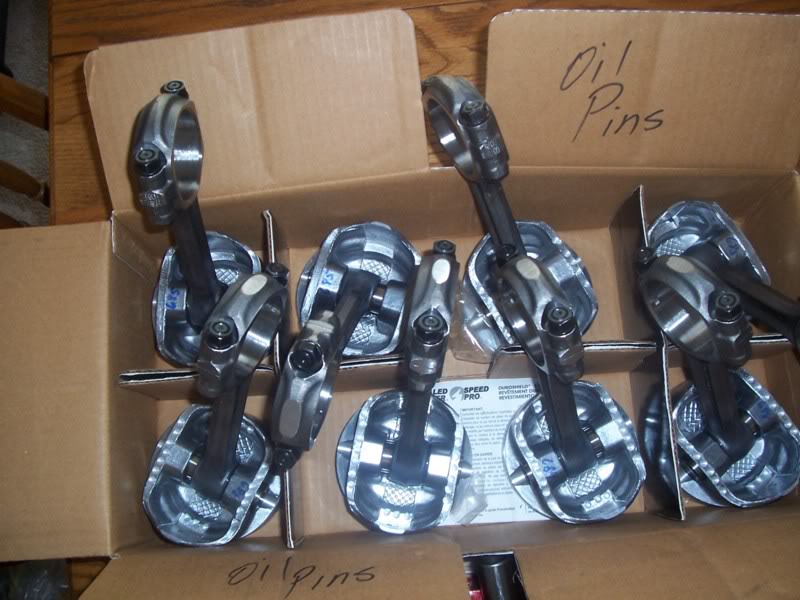
You can see here where they drilled to lighten all the pistons. I was really unimpressed with how wildly these pistons varied in weight, but you can do that yourself really if you know what you're doing. I'd do some reading first though. But if you have an accurate scale and the right tools you can go through the process of lightening/balancing rods to each other and lightening pistons, then all you do is just tell your machine shop to balance it up for you, they wont have to do nearly as much work that way. If you look closely you can see how the flat spots on the big end of the rods are varying sizes, that's the spot where they traditionally balance the rods.

You can see the nice big hole they drilled in my Eagle crank there on the rearmost counterweight.
But if you want to avoid it, many of the crankshaft companies sell balanced rotating assemblies. What Im not sure about is whether the parts are just balanced in the sense that all the pistons weigh the same and the rods weigh the same etc, or whether Scat or Eagle actually throw it all on a balance machine and balance it.
Its nice peace of mind. It's one of those REAL advantages you have of putting a motor together yourself. You're taking it from an assembly line build of off the shelf parts (Even nice off the shelf parts) to something that has a one off custom shop hand-tailored element to it. Frees up a few horsepower, saves your bearings, and gives you an advantage over guys who do heads/cam on a factory shortblock. Its an opportunity that you have when you build a motor from scratch.
Also I dont know this for sure, but I always had the impression aftermarket cranks were set up slightly on the heavy side since it's easier to take weight out than to add weight in. I dont think most people end up needing to add metal. Both the rotating assemblies I had balanced didn't need any extra metal added. And part of the job is matching all the pistons to the lightest one in the box. They're consistently cutting down weight through the whole process. Once was with an aftermarket crank, once with an L98 crank.
You can see here where they drilled to lighten all the pistons. I was really unimpressed with how wildly these pistons varied in weight, but you can do that yourself really if you know what you're doing. I'd do some reading first though. But if you have an accurate scale and the right tools you can go through the process of lightening/balancing rods to each other and lightening pistons, then all you do is just tell your machine shop to balance it up for you, they wont have to do nearly as much work that way. If you look closely you can see how the flat spots on the big end of the rods are varying sizes, that's the spot where they traditionally balance the rods.
You can see the nice big hole they drilled in my Eagle crank there on the rearmost counterweight.
But if you want to avoid it, many of the crankshaft companies sell balanced rotating assemblies. What Im not sure about is whether the parts are just balanced in the sense that all the pistons weigh the same and the rods weigh the same etc, or whether Scat or Eagle actually throw it all on a balance machine and balance it.
Last edited by InfernalVortex; Apr 1, 2011 at 10:16 PM.
Moderator
Joined: Jul 1999
Posts: 17,273
Likes: 171
From: 51°N 114°W, 3500'
Car: 87 IROC L98
Engine: 588 Alcohol BBC
Transmission: Powerglide
Axle/Gears: Ford 9"/31 spline spool/4.86
Re: rod legnths
Cost will depend on a lot of factors. If you have a matching set of rods and a matching set of pistons and wrist pins, the cost to balance should be a lot less. If they have to adjust the weights on all those items, the cost will increase as it's time consuming and you're paying a shop rate. Paying to get a basic street engine balance will also be a lot cheaper than a race engine balance. A street engine balance will probably be close to a factory balance. Not 100% perfect but close enough. With a race engine, you want it to be as close to perfect as possible. That's going to take more time as they'll spin it up more times to get that perfect balance.
It's always nice to get lightweight parts such as rods and pistons. Reducing the amount of weight being thrown around by the crankshaft is much easier on parts.
My crank needed more metal but it's also a forged internally balanced crank so the counterweights are not normal for a big BBC which is normally an externally balanced engine. I think my balance job was somewhere around $500. Since I spin my engine over 7000 rpm, I know it won't try to destroy itself over time from an imbalance.
Those complete balanced assemblies means you buy crank, rods, pistons and everything. It's all pre balanced for you. Get the block bored out for the new pistons and assemble.
It's always nice to get lightweight parts such as rods and pistons. Reducing the amount of weight being thrown around by the crankshaft is much easier on parts.
My crank needed more metal but it's also a forged internally balanced crank so the counterweights are not normal for a big BBC which is normally an externally balanced engine. I think my balance job was somewhere around $500. Since I spin my engine over 7000 rpm, I know it won't try to destroy itself over time from an imbalance.
Those complete balanced assemblies means you buy crank, rods, pistons and everything. It's all pre balanced for you. Get the block bored out for the new pistons and assemble.
Last edited by AlkyIROC; Apr 1, 2011 at 10:46 PM.
Thread Starter
Member
Joined: Mar 2011
Posts: 126
Likes: 1
From: ofallon,MO
Car: 88 IROC-Z
Engine: 305 TPI
Transmission: 700R4-currently being mildly built
Axle/Gears: stock 2.73:( with limited slip
Re: rod legnths
There's not really any "usually"...
Mallory metal is several $100 per ounce. You can easily run up $500 of it just in materials in a top-line balance job trying to go where no one has gone before.
Shop time is measured in .... time. As in, hours. A good balance shop costs aound $125/hr or so. So if you want some exotic combo that doesn't exist, count on some hundreds of Mallory metal, plus some hours of $125/hr time, and guess what... the guy in the other lane (me) who knew how to get there WITHOUT spending all that, will still kick your butt. Very disconcerting I assure you.
With long rods though, there's enough volume left underneath the pistons at BDC, (you did read the link I posted for you, didn't you?) to accomplish what is required, without any effort or $$$ at all. Spend $50 more on the parts, spend $1000 less on labor.
It's all about, how to get the most for the money you have available; or, how to spend the least, to attain your stated goal. "Theoretical" kind of loses its attractiveness when those last 3 HP or whatever (which MIGHT have made a difference in a REALLY EQUAL class but are cancelled by your choice of rear-end lube or your header collector length or your extra 25 lbs of stereo eqpt) just cost you $1000.
Whatever the theoretical "advantages" of a long-rod motor might be, they are TOTALLY SWAMPED by the uncertainties and guesswork in a typical street motor. Until you get into the kind of build where $500 worth of Mallory metal doesn't make you flinch, you're not going to notice it.
You WILL however, notice the difference in parts availability and cost, between neutral- or otherwise stock-balanced parts, and "custom" ones. That's the primary advantage to people like us, of the longer rods: they allow us to build BIG motors but still not have to worry about external balance. So forget about all the rest of that, which while it looks good on paper and in magazine articles, has VERY LTTLE, if any, application to THE REAL WORLD.
Mallory metal is several $100 per ounce. You can easily run up $500 of it just in materials in a top-line balance job trying to go where no one has gone before.
Shop time is measured in .... time. As in, hours. A good balance shop costs aound $125/hr or so. So if you want some exotic combo that doesn't exist, count on some hundreds of Mallory metal, plus some hours of $125/hr time, and guess what... the guy in the other lane (me) who knew how to get there WITHOUT spending all that, will still kick your butt. Very disconcerting I assure you.
With long rods though, there's enough volume left underneath the pistons at BDC, (you did read the link I posted for you, didn't you?) to accomplish what is required, without any effort or $$$ at all. Spend $50 more on the parts, spend $1000 less on labor.
It's all about, how to get the most for the money you have available; or, how to spend the least, to attain your stated goal. "Theoretical" kind of loses its attractiveness when those last 3 HP or whatever (which MIGHT have made a difference in a REALLY EQUAL class but are cancelled by your choice of rear-end lube or your header collector length or your extra 25 lbs of stereo eqpt) just cost you $1000.
Whatever the theoretical "advantages" of a long-rod motor might be, they are TOTALLY SWAMPED by the uncertainties and guesswork in a typical street motor. Until you get into the kind of build where $500 worth of Mallory metal doesn't make you flinch, you're not going to notice it.
You WILL however, notice the difference in parts availability and cost, between neutral- or otherwise stock-balanced parts, and "custom" ones. That's the primary advantage to people like us, of the longer rods: they allow us to build BIG motors but still not have to worry about external balance. So forget about all the rest of that, which while it looks good on paper and in magazine articles, has VERY LTTLE, if any, application to THE REAL WORLD.
I read the whole link.(Quick question: how long did it take you to type that?
)It cleared it up real nice. I have 1 question about it. here↓
This brings us around to 1-pc rear main seal motors. Recall we talked about the big funky pork-chop flange on the 305 and 350, that makes up the rearmost internal balance weight... how are you going to slip a 1-pc lip seal over that? Right: you can't. So what do you do? Easy: you move this internal weight to the flywheel. Did that suddenly make this internal weight "external"? No. Is the engine's balance accomplished any differently? No. Are the engine's internal CWs suddenly inadequate to internally balance it? No. Therefore: IS THE ENGINE "EXTERNALLY" BALANCED? NO.weight "external"? No.
Last edited by falconman; Apr 1, 2011 at 11:06 PM.

Member
Joined: Nov 2007
Posts: 119
Likes: 0
From: Waxahachie,Texas
Car: 1986 Z28
Engine: 350 Q-Jet
Transmission: 700R4
Re: rod legnths
This is all facinating stuff. I'm a novice myself and think it would be usefull for there to be a... This is what you say when going to the machine shop - type article on this site. Even, a this is generally about what you should expect to pay for this or this to be done - type post to go with it.
Joined: Sep 2005
Posts: 28,003
Likes: 2,486
Car: Yes
Engine: Usually
Transmission: Sometimes
Axle/Gears: Behind me somewhere
Re: rod legnths
you said you balance it(2 piece RMS) with the flywheel
A 2-pc RMS flywheel (except for the 400) is NEUTRAL BALANCED. It, in and of itself, can be balanced with something as simple as a lawn-mower-blade balancer type of setup. The pork-chop looking feature on the flange is the rearmost counterweight; and is part of what is needed for that as well on the 400, but isn't enough, by itself.
Joined: Sep 2005
Posts: 28,003
Likes: 2,486
Car: Yes
Engine: Usually
Transmission: Sometimes
Axle/Gears: Behind me somewhere
Re: rod legnths
BTW:
As an example of the weight comparison thing:
A nice typical street-ish rod would be the Eagle SIR I-beam unit. That rod is 565g @ 5.70", or 590g @ 6.00". A nice typical street-ish piston might be a JE 181920 ("350 standard flat-top") for 5.70" rod, which is 424g, or the same piston for a 6.00" rod, the 181911, which is 391g. 565 + 424 = 989g; and 590 + 391 = (surprise!) 981. 8g of difference, about the weight of 2½ pennies. Therefore, there is virtually NO WEIGHT SAVINGS WHATSOEVER in the rod length, in that combo. Other combos may come out a bit different, one way or the other; but bottom line, don't automatically assume that there's a weight savings in the longer rod, and if there is any difference, it's likely to be trivial, and certainly not worth any significant expense just to get that, on its own.
As an example of the weight comparison thing:
A nice typical street-ish rod would be the Eagle SIR I-beam unit. That rod is 565g @ 5.70", or 590g @ 6.00". A nice typical street-ish piston might be a JE 181920 ("350 standard flat-top") for 5.70" rod, which is 424g, or the same piston for a 6.00" rod, the 181911, which is 391g. 565 + 424 = 989g; and 590 + 391 = (surprise!) 981. 8g of difference, about the weight of 2½ pennies. Therefore, there is virtually NO WEIGHT SAVINGS WHATSOEVER in the rod length, in that combo. Other combos may come out a bit different, one way or the other; but bottom line, don't automatically assume that there's a weight savings in the longer rod, and if there is any difference, it's likely to be trivial, and certainly not worth any significant expense just to get that, on its own.
Last edited by sofakingdom; Apr 17, 2011 at 11:04 AM.

Supreme Member
Joined: Apr 2010
Posts: 4,337
Likes: 29
From: Aurora, OR
Car: 87 IROC Z28
Engine: 355 cid TPI
Transmission: Custom Built 700R4 w/3,500 stall
Axle/Gears: QP fab 9" 3.70 Truetrac
Re: rod legnths
Balancing is done at a specific speed depending on the intended use of the engine. I have my race engines balanced at 6K rpm because they will spend most of their time between 5K and 7K. At 6K the rotating assembly will be at perfect balance with minimum strain on bearings and moving parts. The harmonic damper covers the rest of the rpm range as well as harmonics caused by twisting and rate change of the crank. I use the Fluid Damper because I feel it works best at absorbing vibrations across the full rpm range.
It is accepted wisdom that the ideal rod/stroke ratio is 2:1. The closer we get to this, the better. One key advantage to the longer rod is stability of the rotating assembly due to decreased angle change between the rod, crank arm, and piston centerline. Rod to stroke ratio also affects piston velocity and TDC/BDC dwell. the longer the rod, the more time the piston spends in the power producing top half of the stroke. This is advantagious for engines that operate at higher speeds as it allows more time for the combustion process. Engines built for low end torque benefit from lower R/S ratios. This is of course an extremely over simplified explanation.
It is accepted wisdom that the ideal rod/stroke ratio is 2:1. The closer we get to this, the better. One key advantage to the longer rod is stability of the rotating assembly due to decreased angle change between the rod, crank arm, and piston centerline. Rod to stroke ratio also affects piston velocity and TDC/BDC dwell. the longer the rod, the more time the piston spends in the power producing top half of the stroke. This is advantagious for engines that operate at higher speeds as it allows more time for the combustion process. Engines built for low end torque benefit from lower R/S ratios. This is of course an extremely over simplified explanation.

Thread
Thread Starter
Forum
Replies
Last Post
LT1Formula
Engine/Drivetrain/Suspension Parts for Sale
7
Oct 8, 2015 08:34 PM
skinny z
Engine/Drivetrain/Suspension Parts for Sale
5
Oct 5, 2015 06:23 PM
