When you click on links to various merchants on this site and make a purchase, this can result in this site earning a commission. Affiliate programs and affiliations include, but are not limited to, the eBay Partner Network.
Tech / General EngineIs your car making a strange sound or won't start? Thinking of adding power with a new combination? Need other technical information or engine specific advice? Don't see another board for your problem? Post it here!
I'm preparing a set of used Vortec heads to handle 0,525" lift.
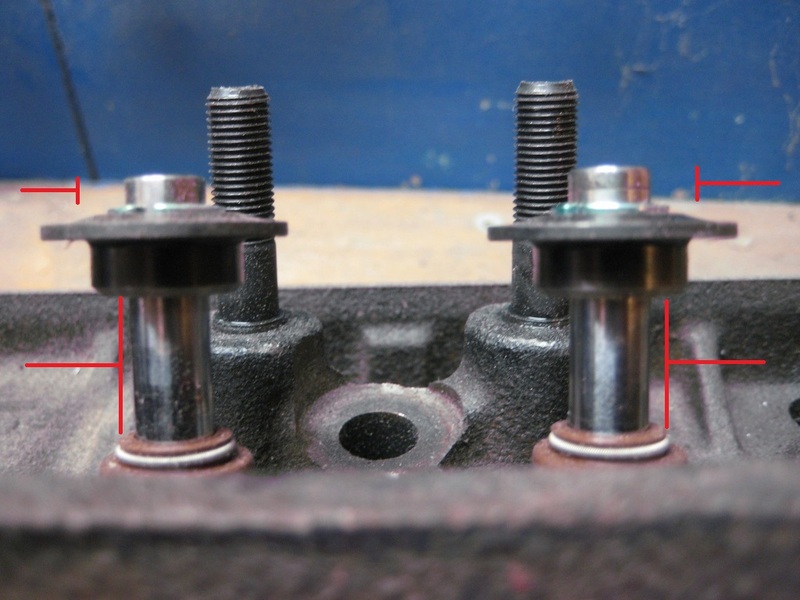
The intake valves have shorter tip length than the exhaust valves.
Why is it so? Do I have to shim up all the intake valve spring seats then?
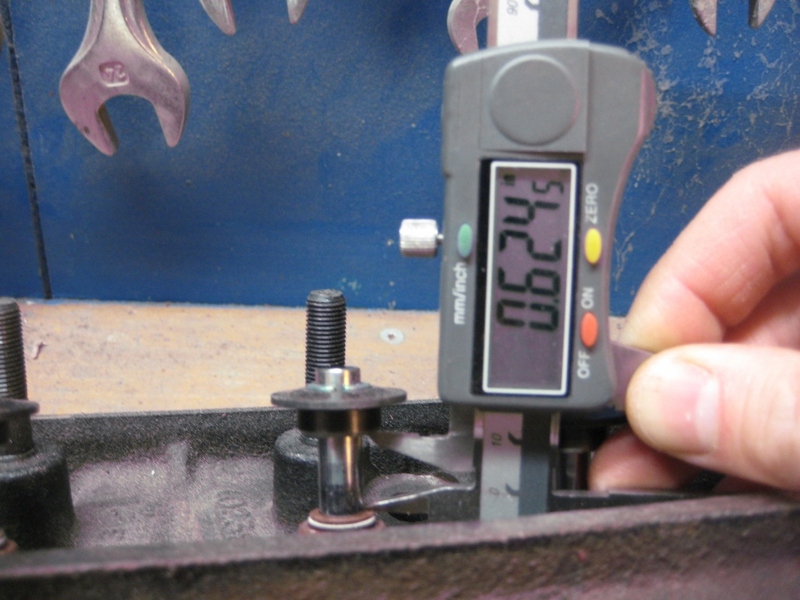
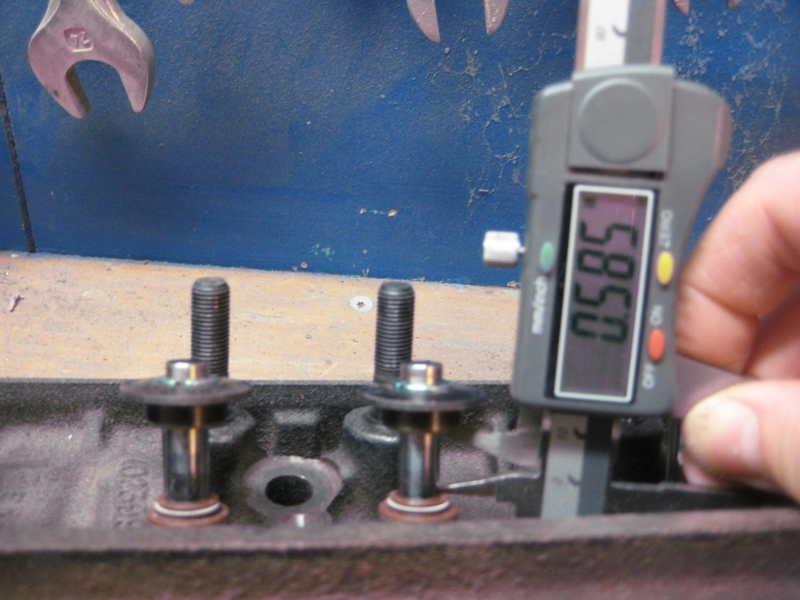
Not very good photos, but I think they show my point. Exhaust valve to the right:
Last edited by Hotrodder; Apr 12, 2016 at 12:35 PM.
The valve is longer "above" the retainer groove on the vortec valves.
.250 for non self aligining rockers.
.260 for vortec intake valves.
.289 for vortec exhaust.
I am not sure why they did this but it should have little consequence for setting up your springs due to the added length being above the groove for the retainer.
That's the way they come from the factory. Tip length of .260" for the intake and .289" for the exhaust. I can't say why there's a difference although a typical (non Vortec) SBC head has a tip length of .250" and the understanding is that the longer tip is to accommodate the self aligning rocker arm. Why the difference between the two valves on the same head remains a mystery to me. Vortecs didn't come with exhaust rotators as far as my research tells me (although that would explain the needed difference in length).
As for shimming, depending on your choice of spring, a difference of .029" may not be a deal breaker regarding installed height. When I modified my Vortecs (new from GM in 2007), in addition to screw-in studs and guide plates, I went with Comps 26918 beehive spring. That required a +.050" offset keeper to get the height to 1.8" rather than the Vortec installed spring height of 1.7". I can see that the math appears a little off but installed height worked out to 1.82" more or less.
Last edited by skinny z; Apr 12, 2016 at 12:31 PM.
These are the springs I'm going to use. Beehive springs.
Should these be shimmed to 1,75 then?
I measured up a few of the exhaust seats with a micrometer. The distance vary between 1,715 and 1,735. Is that close enough?
I'm fairly sure skinny. It has been a while since I installed my springs and CRS is slowly creeping in so everyone please measure for your self.
Hotrodder, I used comp locks and retainers that put my gm ls6 springs somewhere in the 1.75" installed height range. Plus or minus range wasn't enough to bother me but doesn't the alex parts kit come with shims to equalize installed heights?
Can you measure an intake and an exhaust valve to determine where the difference is? I'm not busting anyone's ***** here but it has my curiosity peaked. In all likelihood, Ram is probably right. The difference is not on the overall length though but rather where the keeper groove is cut.
As for the difference, 10% shorter wouldn't bother me but 10% longer, depending on the spring and the application may make a difference. Is this a stock type rebuild or at you going for something more? Too little spring pressure can make for some nasty results. My 1st go round with Vortec resulted in a couple of bent valves. Stock springs and a missed shift can do that.
I'll check out Alex's springs (again) once I'm sitting at my PC rather than trying to use my phone.
The overall valve lengths are the same.
The difference is where the keeper groove is cut and it will make for a higher installed spring pressure on the exhaust valves than on the intake valves, if no shims are added.
And it's the same for all valves on both heads.
I do have a shim kit and a micrometer, so I will make sure the installed spring pressure won't be too low on any of the valves.
Last edited by Hotrodder; Apr 13, 2016 at 01:38 AM.
I thought I had posted regarding Alex's springs. They are lighter in terms of spring rate compared to Comps 26915. You may want to double check that they're capable of handling your hydraulic roller. You'll be able to pull to 6000 (although peak hp is probably 5500 or less) and losing valve control at that rpm can be very unforgiving.
Same as my vega but I have 1.5 rockers. That thing is going to haul some a$$.
I certainly hope so!
Here's a photo of my car. 100% garage made by me during the last 15 years.
I know it's an off topic car for this forum. If the moderator want's to remove it, that's ok.
The reason I'm in here is that I have the L05 engine with an LT-1 T56 transmission, and I have noticed that the knowledge about these components are very good on this forum.
Sweet looking ride Hotrodder. You too RamIt. Sadly mine is a 40 footer for sure but I'm more into the hard parts than the fit and finish. At least for now.
As for the springs, if you're satisfied with what Alex has to say, then I'd say you're good to go. The difference between what Comp recommends for my old XR276HR and what you have from Alex is marginal. The cam specs are similar. The 276 is .530/.540, 276/282 (adv), 224/230 @ .050". Comp recommends 110 on the seat (at 1.8" installed height) and 284 open (at 1.175"). Your Alex springs spec at (according to his website) 105 @ 1.1750" and 260 @ 1.170". A little lighter but I doubt it's a deal breaker. Personally, with the pressed in studs, I'd be keeping an eye on things regardless.
Last edited by skinny z; Apr 14, 2016 at 09:21 PM.
History lesson on WHY your intake and exhaust valve stems are a little different:
The retainer lock groove is a smidge lower on the exhaust side because it's a hold-over from earlier heads that used big, fat exhaust spring rotator/retainers (Look at pretty much any pre-Vortec head from the 70s-80s-early 90s and you'll see what I mean).
If they didn't put the groove a little lower on the exhaust side the rocker arm would touch the top of the rotator/retainer.
ALSO.... the factory machined the exhaust side spring pocket deeper than the intake (on earlier heads) both because the keeper groove is a little lower and because the big, fat exhaust rotator/retainers take up a lot of room, necessitating lower exhaust-side spring pockets to keep the final installed height the same on both the intake and exhaust side (so the factory can use the same springs on both the intake and exhaust side).
Now, Vortecs never used exhaust-side rotator/retainers (except on some HD variants) so the spring pockets are only different in depth by the difference in height of those keeper grooves.
So, even though your retainer-to-guide seal distance is a little different intake vs. exhaust, your valve spring installed height should be very close to the same even without any shimming.
That's interesting. I wish I still had my Vortecs to measure that. It's been so long since I retrofitted them I don't recall how I ended up with an overall 1.820" installed height other than going to a beehive spring/retainer and a .050" offset lock.
Thanks for lots of good information and kind words!
The finish on my car is certainly not on a professional level either, but it's good enough for me, and it has worked wery well since i got it on the road 2 years ago.
The rocker arm studs on the first photos are MR Gasket collarless screw in studs, part No 1076.
Used the Comp Cam tap guide tool and threaded the stud holes.
Didn't take the chance on the pressed inn studs.
Some of them sat wery hard and would probably have worked just fine, but can't know who before you have started to pull them.
Last edited by Hotrodder; Apr 15, 2016 at 02:47 AM.
Nice rides, guys!
LOVE the Vega! Ramit, if you get it looking like the one in the pic, lock it up because I'll be trying to steal it....lol!
A comment on valve springs: Comp Cams notoriously under-specifies required seat pressure for their OWN cams! It might work for an rpm limited motor like a TPI, but to keep valvetrain stability at the rpm needed to get maximum performance from the cam, their recommendations fail more often than not.
For something like a XR276 cam with standard weight valves, I'd set up for 130 lbs on the seat. After everything beds in over the first miles, you'll be at 120. Pressed in studs are fine for that spring force.
Seems to be an odd thing for Comp to do and I'm not about to argue your point ( your result speak for themselves) but I can comment on a couple of things.
We've run Comps 26918 conical springs in several engines, mine with the 276HR( to 6500) and another with the 288HR (to 7000) to name two, with zero trouble. That brings me to my other point and that's the deal behind the conical "beehive" spring. More spring with less pressure and valve train stability another 1000 rpm +/- past where a conventional spring (of greater pressure) starts to lose control and you get component separation. When you start getting into bigger cams and more RPMs, then that particular spring spec isn't enough. Now you're into something beyond which I haven't venture personally.
yeah skinny, I am slightly biased on that thought from primarily dealing with the short runner LT1 intake manifold which pushes the operating range of the cam about 500 rpm higher than their advertised range. I have to assume they don't consider using the cams with anything other than a 2-plane manifold ?? And their "phone techs" aren't savvy enough to understand that.
I'm also done using beehive springs for high performance builds, ie. anything I plan to rev beyond 6500 rpm. I was running the baddest beehives that Manley offers with 160 lbs on the seat, and despite what was advertised they were woefully inadequate at 7000 rpm with a 228/234 .614/.614 HR cam. New LT1 build with SR cam (tight lash, street lobes, 180 lbs seat load) will be using a conventional dual spring.
If interested, here's a little teardown report from the little stock bottom 350 that poured its heart out for 6 years: http://www.impalassforum.com/vBullet...alvetrain.html
[QUOTE=86LG4Bird;
7000 rpm with a 228/234 .614/.614 HR cam.
[QUOTE]
I can see why you've stepped up to something more. That's quite the cam profile. My little custom grind is 224/230, .575" lift and it's a handful. That's partly the reason I'm moving on from that to the 288HR. Bigger cam but easier on parts.
By the way 86, I'll be posting up on my own deconstruction of the engine I was working on and having trouble with too much compression. Interesting post tear down analysis.
Last edited by skinny z; Apr 15, 2016 at 02:38 PM.
I hope Hotrodder doesn't mind but I wanted to reply to 86s post in his Impala forum. Seeing as I'm not a member there...
Regarding the stock lifters. Didn't we have a discussion a few months (years?) back about how the OEM roller lifter tends to give up past 6000 rpm?. Reports claim that the cast lifter body starts to distort at elevated RPM with a subsequent loss of hydraulic pressure. The next event is component separation, then loss of valve control and eventually contact. Now I'm not suggesting this is what happened to you but the results are suspiciously similar. Our Monte Carlo with its 6500/7000 rpm limit experienced this. Fortunately, we caught the problem before any real damage was done. A switch to a tool steel lifter of the short travel variety made every bit the difference.
And your comment on road racing vs drag racing is spot on. Drag racers can get away with a lot less ( until they too exceed the limits).
Thanks Hotrodder!
Last edited by skinny z; Apr 15, 2016 at 02:54 PM.