


Headgasket thickness for Vortec head swap?


Thread Starter
Member

Joined: Nov 2005
Posts: 181
Likes: 4
From: Norway
Car: 1934 Ford Roadster
Engine: 350 CSB
Transmission: T56
Headgasket thickness for Vortec head swap?
Hello
I'm planning on doing a Vortec head swap, but not sure of what's the most suitable head gasket thickness.
-Engine is a L05 from a 1992 Buick Roadmaster.
-Stock swirl port heads.
-Rebuilt the vortec heads accept cam lift up to .550.
-Are planning to use the GM LT4 "Hot cam".
I'm planning on doing a Vortec head swap, but not sure of what's the most suitable head gasket thickness.
-Engine is a L05 from a 1992 Buick Roadmaster.
-Stock swirl port heads.
-Rebuilt the vortec heads accept cam lift up to .550.
-Are planning to use the GM LT4 "Hot cam".

Supreme Member
iTrader: (1)
Joined: Aug 2007
Posts: 1,390
Likes: 0
From: Bright, IN
Car: '86 Bird, 96 ImpalaSS, 98 C1500XCab
Engine: LG4, LT1, L31
Transmission: 700R4, 4L60E, 4L60E
Axle/Gears: 3.73 Tors, 4.88 spool, 3.73 Eaton
Re: Headgasket thickness for Vortec head swap?
If the decks are flat and smooth, use a Felpro .015" shim gasket. Best quench clearance and the Hotcam needs compression.

Member
Joined: Aug 2010
Posts: 478
Likes: 4
From: Las Vegas
Car: Fourth Gen '94 camaro
Engine: 350 Gen II
Transmission: A4
Axle/Gears: 3.23
Re: Headgasket thickness for Vortec head swap?
It looks like FelPro #1094 for the shim head gasket. I believe that's what's on my corvette unless the part number has changed. Works great on a 350 as I overheated once already and they are still good.
I used some spray sealer I bought at NAPA but can't recall my reasoning now. I do recall calling FelPro and they confirmed there is no right or wrong side up to install them. Make sure the block deck is squeeky clean - head surface to.
Good luck.
I used some spray sealer I bought at NAPA but can't recall my reasoning now. I do recall calling FelPro and they confirmed there is no right or wrong side up to install them. Make sure the block deck is squeeky clean - head surface to.
Good luck.

Senior Member
iTrader: (4)
Joined: Jun 2014
Posts: 667
Likes: 16
From: Brainerd, MN
Car: '84 Trans Am
Engine: 357 SBC
Transmission: 700R4
Axle/Gears: 10 Bolt 3.73, Torsen Diff
Re: Headgasket thickness for Vortec head swap?
When doing research previously, I found that some of the 1094s are coated and others are not. if they are coated, do not apply anything to them. Install as is. If they're not coated, most people use the copper permatex sealant spray.


Joined: Feb 2017
Posts: 4,185
Likes: 576
From: Meriden, CT 06451
Car: 84 TA orig. 305 LG4 "H" E4ME
Engine: 334 SBC - stroked 305 M4ME Q-Jet
Transmission: upgraded 700R4 3200 stall
Axle/Gears: 10bolt 4.10 Posi w Lakewood TA Bars
Re: Headgasket thickness for Vortec head swap?
The old school head gasket coating for steel shim head gaskets was ALUMINUM (not silver) spray paint. Spray 1 coat on the gasket (both sides) and let it almost dry. Hit it with another coat and install the heads while the gaskets are still wet. It works.

Joined: Jan 2005
Posts: 10,450
Likes: 508
From: Hurst, Texas
Car: 1983 G20 Chevy
Engine: 305 TPI
Transmission: 4L60
Axle/Gears: 14 bolt with 3.07 gears
Re: Headgasket thickness for Vortec head swap?
I have had several sets of the rubber embossed steel shims and have had good luck with them sealing the way the come out of the package.
The Roadmaster should have flat top pistons with 6cc worth of valve relief and come out about 9.6:1 with the standard headgasket. The shim style gasket should put it right at 9.8:1. Should work well with the Hotcam. My buddy just put together a 350 Vortec in his 1999 4x4 Yukon with a 6" suspension lift and 3" body lift on 35s. He ended up up with a spare Lunati Bare Bones 218/228 cam he picked up from me. Stock 906 heads with a new valve job and LS6 springs on Comp 787 retainers. The truck has a 2,200 stall converter, shorty headers, 2.5" catless off-road midpipes and a flowmaster 40 dual in/single out dumped at the rear axle. Also has a Volant CAI modified for his body lift and a HP Tuners that I did. He broke the 8.5" 10-bolt in a day. Ended up putting 5.13 gears and a Yukon Duragrip differential into it. From a stop the heavy 4x4 will smoke the 35x12.5R15s all the way through first gear without powerbraking. 5.13 may seem like a deep gear but it is no lower than a 4.10 would be with the stock tires.
I actually outrun him in my Express van with a smaller cam in a 60k mile engine but have 1.6:1 full roller rockers, underdrive pulleys, better heads(2.02/1.60 valves and exhaust port work, better intake manifold, better PCM, better ignition, a 2,600 stall in the 4L85E and 4.56 gears with only 30" tall tires. I also have alot of torque management left in his tune to keep his 4L60E alive where I have almost none in my tune. Then again my engine came from a GM dealer my buddy worked at years ago and was a warranty scrap engine. It had coolant in the oil, two blown head gaskets when I got it and a cracked head. I have been into into a few times since I swapped heads and a LT4 cam into it back in 2006 but only recently noticed it has a counterweighted balancer on it. I have never measured the stroke on it but it very well could be a HT383E. I have always known it is a 4 bolt main with a forged crank. I always assumed 350 but it also ran with +10% fuel trims on the stock tune. One day I will pull the pan and find the crank casting number just for grins.
The Roadmaster should have flat top pistons with 6cc worth of valve relief and come out about 9.6:1 with the standard headgasket. The shim style gasket should put it right at 9.8:1. Should work well with the Hotcam. My buddy just put together a 350 Vortec in his 1999 4x4 Yukon with a 6" suspension lift and 3" body lift on 35s. He ended up up with a spare Lunati Bare Bones 218/228 cam he picked up from me. Stock 906 heads with a new valve job and LS6 springs on Comp 787 retainers. The truck has a 2,200 stall converter, shorty headers, 2.5" catless off-road midpipes and a flowmaster 40 dual in/single out dumped at the rear axle. Also has a Volant CAI modified for his body lift and a HP Tuners that I did. He broke the 8.5" 10-bolt in a day. Ended up putting 5.13 gears and a Yukon Duragrip differential into it. From a stop the heavy 4x4 will smoke the 35x12.5R15s all the way through first gear without powerbraking. 5.13 may seem like a deep gear but it is no lower than a 4.10 would be with the stock tires.
I actually outrun him in my Express van with a smaller cam in a 60k mile engine but have 1.6:1 full roller rockers, underdrive pulleys, better heads(2.02/1.60 valves and exhaust port work, better intake manifold, better PCM, better ignition, a 2,600 stall in the 4L85E and 4.56 gears with only 30" tall tires. I also have alot of torque management left in his tune to keep his 4L60E alive where I have almost none in my tune. Then again my engine came from a GM dealer my buddy worked at years ago and was a warranty scrap engine. It had coolant in the oil, two blown head gaskets when I got it and a cracked head. I have been into into a few times since I swapped heads and a LT4 cam into it back in 2006 but only recently noticed it has a counterweighted balancer on it. I have never measured the stroke on it but it very well could be a HT383E. I have always known it is a 4 bolt main with a forged crank. I always assumed 350 but it also ran with +10% fuel trims on the stock tune. One day I will pull the pan and find the crank casting number just for grins.
Last edited by Fast355; Aug 7, 2017 at 07:43 PM.

Supreme Member


Joined: Dec 2005
Posts: 9,920
Likes: 885
From: 53.0907° N, 113.4695° W
Re: Headgasket thickness for Vortec head swap?
Are not the shim gaskets a risky proposition when the surface of the block and heads don't have the appropriate finish? Or are truly flat? As in fresh from the machine shop?
As thin as they are and considering their construction, they're not as able to take up the irregularities or slight warpage that may exist in a used engine and/or heads (in addition to the spec'd surface finish some suggest).
My slightly used Vortecs (bought them new, installed them and had them in the shop shortly after for mods) had a .003" warp already.
As thin as they are and considering their construction, they're not as able to take up the irregularities or slight warpage that may exist in a used engine and/or heads (in addition to the spec'd surface finish some suggest).
My slightly used Vortecs (bought them new, installed them and had them in the shop shortly after for mods) had a .003" warp already.
Trending Topics
Joined: Jan 2005
Posts: 10,450
Likes: 508
From: Hurst, Texas
Car: 1983 G20 Chevy
Engine: 305 TPI
Transmission: 4L60
Axle/Gears: 14 bolt with 3.07 gears
Re: Headgasket thickness for Vortec head swap?
Are not the shim gaskets a risky proposition when the surface of the block and heads don't have the appropriate finish? Or are truly flat? As in fresh from the machine shop?
As thin as they are and considering their construction, they're not as able to take up the irregularities or slight warpage that may exist in a used engine and/or heads (in addition to the spec'd surface finish some suggest).
My slightly used Vortecs (bought them new, installed them and had them in the shop shortly after for mods) had a .003" warp already.
As thin as they are and considering their construction, they're not as able to take up the irregularities or slight warpage that may exist in a used engine and/or heads (in addition to the spec'd surface finish some suggest).
My slightly used Vortecs (bought them new, installed them and had them in the shop shortly after for mods) had a .003" warp already.
Joined: Feb 2017
Posts: 4,185
Likes: 576
From: Meriden, CT 06451
Car: 84 TA orig. 305 LG4 "H" E4ME
Engine: 334 SBC - stroked 305 M4ME Q-Jet
Transmission: upgraded 700R4 3200 stall
Axle/Gears: 10bolt 4.10 Posi w Lakewood TA Bars
Re: Headgasket thickness for Vortec head swap?
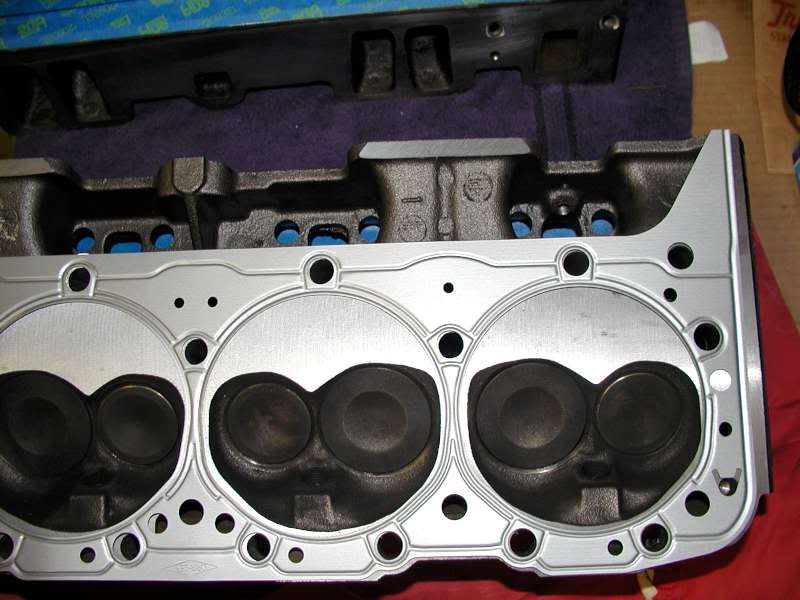
Remember, they are embossed, not dead flat like the copper gaskets.
Supreme Member
Joined: Dec 2005
Posts: 9,920
Likes: 885
From: 53.0907° N, 113.4695° W
Re: Headgasket thickness for Vortec head swap?
Copied directly from Fel-Pro's tech forum. Make of it what you will. I'm not trying to bust anyone's chops here. Just passing along Fel-Pro's words.
Hi Dave,
We do not recommend any additional spray-on coatings or other coatings to be applied to the 1094 gasket. There are uncoated steel shim gaskets which do receive a coating, but since the 1094 is already coated an additional sealer is not recommended.
These gaskets do require a very smooth surface finish, 30 Ra or less. Make sure your machine shop knows this when prepping the heads and block.
We hope this helps!
http://www.felpro-only.com/break_roo...ead.php?tid=35
The different coatings are also addressed in that forum thread. It seems the rubber coating was the old technology and the uncoated gaskets are actually clear coated with a new material.
Hi Dave,
We do not recommend any additional spray-on coatings or other coatings to be applied to the 1094 gasket. There are uncoated steel shim gaskets which do receive a coating, but since the 1094 is already coated an additional sealer is not recommended.
These gaskets do require a very smooth surface finish, 30 Ra or less. Make sure your machine shop knows this when prepping the heads and block.
We hope this helps!
http://www.felpro-only.com/break_roo...ead.php?tid=35
The different coatings are also addressed in that forum thread. It seems the rubber coating was the old technology and the uncoated gaskets are actually clear coated with a new material.
Member
Joined: Aug 2010
Posts: 478
Likes: 4
From: Las Vegas
Car: Fourth Gen '94 camaro
Engine: 350 Gen II
Transmission: A4
Axle/Gears: 3.23
Re: Headgasket thickness for Vortec head swap?
Ok skinny, I think you covered it. I do recall the Felpro's I used had a rubber like coating. And I was surprised they had a compressed height of only 0.015" with that coating.
Steel shim is what Chevy used as OEM for many lo-po small block engines but we're a little thicker at 0.026" compressed height I recall. It still provided a little quench as the stock decks were usually 0.025" above the pistons (at TDC) .
Anyways the gaskets worked well for me and are still working. I don't trust puplished factory numbers for piston volumes and head chambers. I have to measure them with liquid for myself as a 9.6 calculated c.r. often will measure 9.0 c.r. or less.
Again good luck here.
Steel shim is what Chevy used as OEM for many lo-po small block engines but we're a little thicker at 0.026" compressed height I recall. It still provided a little quench as the stock decks were usually 0.025" above the pistons (at TDC) .
Anyways the gaskets worked well for me and are still working. I don't trust puplished factory numbers for piston volumes and head chambers. I have to measure them with liquid for myself as a 9.6 calculated c.r. often will measure 9.0 c.r. or less.
Again good luck here.
Senior Member
iTrader: (4)
Joined: Jun 2014
Posts: 667
Likes: 16
From: Brainerd, MN
Car: '84 Trans Am
Engine: 357 SBC
Transmission: 700R4
Axle/Gears: 10 Bolt 3.73, Torsen Diff
Re: Headgasket thickness for Vortec head swap?
Personally, I agree with Skinny. He and I both prefer using the Victor Reinz 5746 .026 compressed height gaskets on undecked blocks (IIRC. correct me if I'm wrong, Skinny.) Sometimes even then.
Still thinner than the .040 gasket, and more reliable than the steel shim in most cases.
Still thinner than the .040 gasket, and more reliable than the steel shim in most cases.
Supreme Member
Joined: Dec 2005
Posts: 9,920
Likes: 885
From: 53.0907° N, 113.4695° W
Re: Headgasket thickness for Vortec head swap?
It seems the OP may have already made up his mind.
That said, and as evidenced here, some have success using the 1094 in a less than Fel-Pro spec'd application. But that said, Fel-Pro gives that specification for a reason. As much of a liability thing as anything perhaps.
With my current engine architecture, the Victor Reinz 5746 at .026" does the job. Fact is, the engine was built with that gasket in mind. Milled for a .014" piston deck to get .040" piston to head clearance.
That said, and as evidenced here, some have success using the 1094 in a less than Fel-Pro spec'd application. But that said, Fel-Pro gives that specification for a reason. As much of a liability thing as anything perhaps.
With my current engine architecture, the Victor Reinz 5746 at .026" does the job. Fact is, the engine was built with that gasket in mind. Milled for a .014" piston deck to get .040" piston to head clearance.
Supreme Member
iTrader: (1)
Joined: Aug 2007
Posts: 1,390
Likes: 0
From: Bright, IN
Car: '86 Bird, 96 ImpalaSS, 98 C1500XCab
Engine: LG4, LT1, L31
Transmission: 700R4, 4L60E, 4L60E
Axle/Gears: 3.73 Tors, 4.88 spool, 3.73 Eaton
Re: Headgasket thickness for Vortec head swap?
Oh heck yeah, cutting the deck to use a .026" gasket is the right way. I've just always used the .015" shim gaskets on uncut shortblocks where the piston is typically in the hole .025 or more, to get a tighter quench. Maybe I'm lucky to have dealt with nice flat uncorroded block and head deck surfaces ?? .....never had a problem with them.
Member
Joined: Aug 2010
Posts: 478
Likes: 4
From: Las Vegas
Car: Fourth Gen '94 camaro
Engine: 350 Gen II
Transmission: A4
Axle/Gears: 3.23
Re: Headgasket thickness for Vortec head swap?
Zero decking the block and using a full MLS gasket is the right way to do it. Expecting a steel shim gasket to be more effective than a full thickness composite gasket is nonsense.
Senior Member
iTrader: (4)
Joined: Jun 2014
Posts: 667
Likes: 16
From: Brainerd, MN
Car: '84 Trans Am
Engine: 357 SBC
Transmission: 700R4
Axle/Gears: 10 Bolt 3.73, Torsen Diff
Re: Headgasket thickness for Vortec head swap?
If the same force is exerted and the same material is used, I fail to see how there's any difference between a .026 and a .040 gasket.
Now, if you're arguing that a composite gasket seals better on less than perfect surfaces than a shim gasket, then I doubt anyone would argue with you.
On the flip side, it could be argued that thicker head gaskets of the same material are more prone to failure as there's more material to move and distort, which could cause any array of maladies.
As far as "the right way to do it", that all depends on the application. If it's a motor that will be living it's life at wide open throttle, then yes, these sorts of things might make or break it. Judging by the selection of his cam and heads, however, I think its safe to say that the ol' 5746 fits the bill. I certainly don't think he needs to use MLS gaskets that are 4 times the price of a composite gasket.
Now, if you're arguing that a composite gasket seals better on less than perfect surfaces than a shim gasket, then I doubt anyone would argue with you.
On the flip side, it could be argued that thicker head gaskets of the same material are more prone to failure as there's more material to move and distort, which could cause any array of maladies.
As far as "the right way to do it", that all depends on the application. If it's a motor that will be living it's life at wide open throttle, then yes, these sorts of things might make or break it. Judging by the selection of his cam and heads, however, I think its safe to say that the ol' 5746 fits the bill. I certainly don't think he needs to use MLS gaskets that are 4 times the price of a composite gasket.
Last edited by Jorlain; Aug 9, 2017 at 08:11 AM.
Supreme Member
iTrader: (1)
Joined: Aug 2007
Posts: 1,390
Likes: 0
From: Bright, IN
Car: '86 Bird, 96 ImpalaSS, 98 C1500XCab
Engine: LG4, LT1, L31
Transmission: 700R4, 4L60E, 4L60E
Axle/Gears: 3.73 Tors, 4.88 spool, 3.73 Eaton
Re: Headgasket thickness for Vortec head swap?
Bingo! I've seen that failure mechanism several times, something you will not get with a .026" or .015" embossed shim gasket.
Member
Joined: Aug 2010
Posts: 478
Likes: 4
From: Las Vegas
Car: Fourth Gen '94 camaro
Engine: 350 Gen II
Transmission: A4
Axle/Gears: 3.23
Re: Headgasket thickness for Vortec head swap?
Also the major reason to use a thinner gasket (other than price) is to provide for some amount of quench effect. And quench effect is masked/shrouded with the piston below the block deck rather than level with the deck. Leaving the piston down the hole reduces the quench effect. How much? No I don't know (and I won't start superstitions) but it does to some extent.
I'm not trying to inflame anyone as the OP should use a shim gasket for his application here but spending good money to deck the block and then use a lesser gasket is bad advice and I have to say something so others can choose reason this for themselves. Just my counter point so take it or leave it.
Senior Member
iTrader: (4)
Joined: Jun 2014
Posts: 667
Likes: 16
From: Brainerd, MN
Car: '84 Trans Am
Engine: 357 SBC
Transmission: 700R4
Axle/Gears: 10 Bolt 3.73, Torsen Diff
Re: Headgasket thickness for Vortec head swap?
I said that "it could be argued", not that I have any evidence, or even believe it. Only theory and speculation. And it's not "my" superstition. Do a google search on it. Lots of people debate it. Also note that 86LG4Bird provides information on this, stating that he's seen the effects.
Your second point is obvious and has been implied several times in this thread already.
I don't think anyone told him to deck the block and then use an inferior gasket, either. If you deck the block, use anything you like that provides adequate clearance and quench.
I'm not really sure what you're trying to get at here. You first state that you've used the shim gasket and that it worked successfully. You then quite loudly proclaim that the only right way is to deck the block and use an MLS gasket.
I think maybe you're under the impression that the Victor Reinz 5746 is a steel shim gasket. It's not. It is a "nitroseal" gasket. In other words, it's a composite graphite material. Pretty much the same thing as GMPP 10105117, but a tiny bit thinner when compressed.
Your second point is obvious and has been implied several times in this thread already.
I don't think anyone told him to deck the block and then use an inferior gasket, either. If you deck the block, use anything you like that provides adequate clearance and quench.
I'm not really sure what you're trying to get at here. You first state that you've used the shim gasket and that it worked successfully. You then quite loudly proclaim that the only right way is to deck the block and use an MLS gasket.
I think maybe you're under the impression that the Victor Reinz 5746 is a steel shim gasket. It's not. It is a "nitroseal" gasket. In other words, it's a composite graphite material. Pretty much the same thing as GMPP 10105117, but a tiny bit thinner when compressed.
Supreme Member
Joined: Dec 2005
Posts: 9,920
Likes: 885
From: 53.0907° N, 113.4695° W
Re: Headgasket thickness for Vortec head swap?
I'm not sure where this is going or why but I may as well add my two cents to the various points raised. Maybe it'll make some sense. I'm pretty sure that anyone that's contributed here has a reasonable understanding of the subject matter.
As far as gasket thickness goes, if we use extreme examples, say a gasket that's 1/8" thick, it would seem obvious that the likelihood of a failure would be greater than say, no gasket at all. (IIRC, Formula 1 engines were at one time built with no head gaskets). We can probably all agree on that. The argument could follow then that the thinner the gasket used, the better. All other things being equal.
As for the quench, I'll use .040" as a target. Whether the piston is at zero deck and a .040" gasket is used or the piston is .040" down and no gasket is used (just for illustrative purposes), I can't see how the quench is affected one way or the other. The space between the head and the piston is still .040" no matter which way you arrive at the clearance. There's nothing to shroud it (unless I'm missing something). In fact, unless the gasket's bore diameter matches that of the cylinder exactly, a thicker gasket will provide a greater crevice space. That's something that we're trying to avoid as the end gases trapped in that space will affect the mixture. Again, in this case, and probably most of what we're building here, that's to the extreme but still a valid point.
Now on to the OP and his engine.
We can all agree that Fel-Pro recommends not using the shim gasket unless a proper surface finish can be achieved. That is what I based my recommendation on.
Nothing else.
That others have done it with success didn't enter into my reply. Just theirs.
In the right application, and I can use the first 350 I stuffed into a 3rd gen, that block was "NOS". By that I mean, the engine had never been run despite being over 20 years old. (It had belonged to a high school auto shop teacher that plucked it from a donor truck and stored it in his garage until I ended up buying it). So, the deck surface would have been how GM milled it and I would think of the proper surface roughness. The Vortec heads I put on it were also new. The pistons were .026" to .036" below the deck. That would have been the place to use the shim gasket. The OP on the other hand has a used block and used cylinder heads the surfaces on which might be totally unsuitable. Enough said on that.
As for decking the block (and it wasn't suggested I don't think). Some prefer a zero deck and the appropriate head gasket to achieve enough clearance and perhaps target a certain compression ratio. The only issue I have with that is that it leaves nothing for a 2nd or 3rd go around if (and often when) the engine needs a rebuild. This is why I asked my machinist for a .014" deck. Combine that with the ultra reliable Victor Reinz composite gasket (...made from Nitroseal, a graphite facing material that is clinched to a perforated steel core...as per the Clevite catalog blurb) which at .026", gets my target clearance and C.R.
Anyway, it's been a lively discussion however I wonder what the OP makes of all this.
As far as gasket thickness goes, if we use extreme examples, say a gasket that's 1/8" thick, it would seem obvious that the likelihood of a failure would be greater than say, no gasket at all. (IIRC, Formula 1 engines were at one time built with no head gaskets). We can probably all agree on that. The argument could follow then that the thinner the gasket used, the better. All other things being equal.
As for the quench, I'll use .040" as a target. Whether the piston is at zero deck and a .040" gasket is used or the piston is .040" down and no gasket is used (just for illustrative purposes), I can't see how the quench is affected one way or the other. The space between the head and the piston is still .040" no matter which way you arrive at the clearance. There's nothing to shroud it (unless I'm missing something). In fact, unless the gasket's bore diameter matches that of the cylinder exactly, a thicker gasket will provide a greater crevice space. That's something that we're trying to avoid as the end gases trapped in that space will affect the mixture. Again, in this case, and probably most of what we're building here, that's to the extreme but still a valid point.
Now on to the OP and his engine.
We can all agree that Fel-Pro recommends not using the shim gasket unless a proper surface finish can be achieved. That is what I based my recommendation on.
Nothing else.
That others have done it with success didn't enter into my reply. Just theirs.
In the right application, and I can use the first 350 I stuffed into a 3rd gen, that block was "NOS". By that I mean, the engine had never been run despite being over 20 years old. (It had belonged to a high school auto shop teacher that plucked it from a donor truck and stored it in his garage until I ended up buying it). So, the deck surface would have been how GM milled it and I would think of the proper surface roughness. The Vortec heads I put on it were also new. The pistons were .026" to .036" below the deck. That would have been the place to use the shim gasket. The OP on the other hand has a used block and used cylinder heads the surfaces on which might be totally unsuitable. Enough said on that.
As for decking the block (and it wasn't suggested I don't think). Some prefer a zero deck and the appropriate head gasket to achieve enough clearance and perhaps target a certain compression ratio. The only issue I have with that is that it leaves nothing for a 2nd or 3rd go around if (and often when) the engine needs a rebuild. This is why I asked my machinist for a .014" deck. Combine that with the ultra reliable Victor Reinz composite gasket (...made from Nitroseal, a graphite facing material that is clinched to a perforated steel core...as per the Clevite catalog blurb) which at .026", gets my target clearance and C.R.
Anyway, it's been a lively discussion however I wonder what the OP makes of all this.
Last edited by skinny z; Aug 9, 2017 at 08:07 PM.
Member
Joined: Aug 2010
Posts: 478
Likes: 4
From: Las Vegas
Car: Fourth Gen '94 camaro
Engine: 350 Gen II
Transmission: A4
Axle/Gears: 3.23
Re: Headgasket thickness for Vortec head swap?
I said that "it could be argued", not that I have any evidence, or even believe it. Only theory and speculation. And it's not "my" superstition. Do a google search on it. Lots of people debate it. Also note that 86LG4Bird provides information on this, stating that he's seen the effects.
Your second point is obvious and has been implied several times in this thread already.
I don't think anyone told him to deck the block and then use an inferior gasket, either. If you deck the block, use anything you like that provides adequate clearance and quench.
I'm not really sure what you're trying to get at here. You first state that you've used the shim gasket and that it worked successfully. You then quite loudly proclaim that the only right way is to deck the block and use an MLS gasket.
I think maybe you're under the impression that the Victor Reinz 5746 is a steel shim gasket. It's not. It is a "nitroseal" gasket. In other words, it's a composite graphite material. Pretty much the same thing as GMPP 10105117, but a tiny bit thinner when compressed.
Your second point is obvious and has been implied several times in this thread already.
I don't think anyone told him to deck the block and then use an inferior gasket, either. If you deck the block, use anything you like that provides adequate clearance and quench.
I'm not really sure what you're trying to get at here. You first state that you've used the shim gasket and that it worked successfully. You then quite loudly proclaim that the only right way is to deck the block and use an MLS gasket.
I think maybe you're under the impression that the Victor Reinz 5746 is a steel shim gasket. It's not. It is a "nitroseal" gasket. In other words, it's a composite graphite material. Pretty much the same thing as GMPP 10105117, but a tiny bit thinner when compressed.
Your not getting my point. Does the shim gasket work? Does it work well? Yes! But is there a better gasket? Yes! Does decking the block to use a lesser gasket make sense? Not to me. If it does to you then I leave you to your own opinions and readers here need to choose for themselves.
Again take it or leave it.
Member
Joined: Aug 2010
Posts: 478
Likes: 4
From: Las Vegas
Car: Fourth Gen '94 camaro
Engine: 350 Gen II
Transmission: A4
Axle/Gears: 3.23
Re: Headgasket thickness for Vortec head swap?
..
As far as gasket thickness goes, if we use extreme examples, say a gasket that's 1/8" thick, it would seem obvious that the likelihood of a failure would be greater than say, no gasket at all. (IIRC, Formula 1 engines were at one time built with no head gaskets). We can probably all agree on that. The argument could follow then that the thinner the gasket used, the better. All other things being equal....
In fact, unless the gasket's bore diameter matches that of the cylinder exactly, a thicker gasket will provide a greater crevice space. That's something that we're trying to avoid as the end gases trapped in that space will affect the mixture.............
Some prefer a zero deck and the appropriate head gasket to achieve enough clearance and perhaps target a certain compression ratio. The only issue I have with that is that it leaves nothing for a 2nd or 3rd go around if (and often when) the engine needs a rebuild....
As far as gasket thickness goes, if we use extreme examples, say a gasket that's 1/8" thick, it would seem obvious that the likelihood of a failure would be greater than say, no gasket at all. (IIRC, Formula 1 engines were at one time built with no head gaskets). We can probably all agree on that. The argument could follow then that the thinner the gasket used, the better. All other things being equal....
In fact, unless the gasket's bore diameter matches that of the cylinder exactly, a thicker gasket will provide a greater crevice space. That's something that we're trying to avoid as the end gases trapped in that space will affect the mixture.............
Some prefer a zero deck and the appropriate head gasket to achieve enough clearance and perhaps target a certain compression ratio. The only issue I have with that is that it leaves nothing for a 2nd or 3rd go around if (and often when) the engine needs a rebuild....
As for designing gasket thickness they are developed using engineering and technology proven in a labratory. Not using assumptions and imaginations in your head. Hey VW air cooled engines don't use head gaskets either. But go ahead and try that with your sbc - good luck.
When you zero Deck the block that gasket volume is the quench volume and there is no crevice volume!. If you can't see that I can't help you.
Maybe a serious racer that competes on a regular basis will need to resurface and rebuild his same block. Or maybe you have an expensive aftermarket block. The rest of us will build only one or two street motors in our life time. Commo'n, if you can't find a good used sbc block then I can't help you with building let alone decking it either.
Enough. Good night.
Last edited by cardo0; Aug 9, 2017 at 08:44 PM. Reason: Stupid autocorrect!
Supreme Member
Joined: Dec 2005
Posts: 9,920
Likes: 885
From: 53.0907° N, 113.4695° W
Re: Headgasket thickness for Vortec head swap?
Just want to set the record straight and maybe clear up a couple of misconceptions.
There is always a crevice volume.
Whether you're talking about the clearance between the piston and the cylinder bore or the space in and around the top ring and ring land, it's there.
Additionally, the head gasket typically has a diameter larger than that of the cylinder. In most cases, such as the majority of the Fel-Pro gaskets, it's 4.100". Same with the Victor Reinz. That leaves a gap between the head and block deck that in a 4.00" bore SBC, is .050" all around. If you zero deck the block, then that gap is .040" thick. That works out to about .4 cc, a lot of dead space and an area for the end gases to be trapped.
If you measure the piston volumes and combustion chambers to get accurate values (as stated), then that .4 cc may make a difference.
Take that same engine, put the piston .014" down and use a .026" gasket, then the volume is about 35% less. Does that amount to anything? I suppose it might.
But to say it isn't there is incorrect.
Now, if you can find a head gasket that matches the bore exactly, then it doesn't matter if you zero deck the block or have the piston below deck. There'll be no gasket crevice to consider.
We're not talking about the piston to head clearance here (quench) but the gap between the block deck and the cylinder head outside of the bore.
Enough about the that.
As for zero decking the block or not, you don't have to be a "serious racer" to have the same engine block re-visit the machine shop. Taking that into consideration, and since it makes no difference ultimately if the piston is below deck or not performance-wise, why give up on having enough material remaining should something happen to deck surface (such as a blown head gasket) and there's a need for decking (or re-decking as the case may be)?
Makes sense to me anyway.
As for the gaskets I described earlier (and it was mentioned that gaskets are engineered, etc...), the thick and no gasket scenario was for illustrative purposes. It was meant to give those who don't have a thorough grasp on the subject matter (that might be reading this) an understanding of what can occur (regarding gasket thicknesses).
Anyway, that's my view on all of this. Not sure if the OP cares one way or the other.
There is always a crevice volume.
Whether you're talking about the clearance between the piston and the cylinder bore or the space in and around the top ring and ring land, it's there.
Additionally, the head gasket typically has a diameter larger than that of the cylinder. In most cases, such as the majority of the Fel-Pro gaskets, it's 4.100". Same with the Victor Reinz. That leaves a gap between the head and block deck that in a 4.00" bore SBC, is .050" all around. If you zero deck the block, then that gap is .040" thick. That works out to about .4 cc, a lot of dead space and an area for the end gases to be trapped.
If you measure the piston volumes and combustion chambers to get accurate values (as stated), then that .4 cc may make a difference.
Take that same engine, put the piston .014" down and use a .026" gasket, then the volume is about 35% less. Does that amount to anything? I suppose it might.
But to say it isn't there is incorrect.
Now, if you can find a head gasket that matches the bore exactly, then it doesn't matter if you zero deck the block or have the piston below deck. There'll be no gasket crevice to consider.
We're not talking about the piston to head clearance here (quench) but the gap between the block deck and the cylinder head outside of the bore.
Enough about the that.
As for zero decking the block or not, you don't have to be a "serious racer" to have the same engine block re-visit the machine shop. Taking that into consideration, and since it makes no difference ultimately if the piston is below deck or not performance-wise, why give up on having enough material remaining should something happen to deck surface (such as a blown head gasket) and there's a need for decking (or re-decking as the case may be)?
Makes sense to me anyway.
As for the gaskets I described earlier (and it was mentioned that gaskets are engineered, etc...), the thick and no gasket scenario was for illustrative purposes. It was meant to give those who don't have a thorough grasp on the subject matter (that might be reading this) an understanding of what can occur (regarding gasket thicknesses).
Anyway, that's my view on all of this. Not sure if the OP cares one way or the other.
Last edited by skinny z; Aug 12, 2017 at 07:44 PM.
Joined: Feb 2017
Posts: 4,185
Likes: 576
From: Meriden, CT 06451
Car: 84 TA orig. 305 LG4 "H" E4ME
Engine: 334 SBC - stroked 305 M4ME Q-Jet
Transmission: upgraded 700R4 3200 stall
Axle/Gears: 10bolt 4.10 Posi w Lakewood TA Bars
Re: Headgasket thickness for Vortec head swap?
I would never zero deck a block and then try to replace that material back with a gasket. All you have really done is make the the block's deck thinner and therefore weaker. I'm with skinny z. If my pistons were .014" in the hole, and the block's deck surface was flat, then the .026" thick gasket is perfect.
Member
Joined: Aug 2010
Posts: 478
Likes: 4
From: Las Vegas
Car: Fourth Gen '94 camaro
Engine: 350 Gen II
Transmission: A4
Axle/Gears: 3.23
Re: Headgasket thickness for Vortec head swap?
Just want to set the record straight and maybe clear up a couple of misconceptions.
There is always a crevice volume.
Whether you're talking about the clearance between the piston and the cylinder bore or the space in and around the top ring and ring land, it's there.
Additionally, the head gasket typically has a diameter larger than that of the cylinder. In most cases, such as the majority of the Fel-Pro gaskets, it's 4.100". Same with the Victor Reinz. That leaves a gap between the head and block deck that in a 4.00" bore SBC, is .050" all around. If you zero deck the block, then that gap is .040" thick. That works out to about .4 cc, a lot of dead space and an area for the end gases to be trapped.
If you measure the piston volumes and combustion chambers to get accurate values (as stated), then that .4 cc may make a difference.
Take that same engine, put the piston .014" down and use a .026" gasket, then the volume is about 35% less. Does that amount to anything? I suppose it might.
But to say it isn't there is incorrect.
Now, if you can find a head gasket that matches the bore exactly, then it doesn't matter if you zero deck the block or have the piston below deck. There'll be no gasket crevice to consider.
We're not talking about the piston to head clearance here (quench) but the gap between the block deck and the cylinder head outside of the bore.
Enough about the that.
As for zero decking the block or not, you don't have to be a "serious racer" to have the same engine block re-visit the machine shop. Taking that into consideration, and since it makes no difference ultimately if the piston is below deck or not performance-wise, why give up on having enough material remaining should something happen to deck surface (such as a blown head gasket) and there's a need for decking (or re-decking as the case may be)?
Makes sense to me anyway.
As for the gaskets I described earlier (and it was mentioned that gaskets are engineered, etc...), the thick and no gasket scenario was for illustrative purposes. It was meant to give those who don't have a thorough grasp on the subject matter (that might be reading this) an understanding of what can occur (regarding gasket thicknesses).
Anyway, that's my view on all of this. Not sure if the OP cares one way or the other.
There is always a crevice volume.
Whether you're talking about the clearance between the piston and the cylinder bore or the space in and around the top ring and ring land, it's there.
Additionally, the head gasket typically has a diameter larger than that of the cylinder. In most cases, such as the majority of the Fel-Pro gaskets, it's 4.100". Same with the Victor Reinz. That leaves a gap between the head and block deck that in a 4.00" bore SBC, is .050" all around. If you zero deck the block, then that gap is .040" thick. That works out to about .4 cc, a lot of dead space and an area for the end gases to be trapped.
If you measure the piston volumes and combustion chambers to get accurate values (as stated), then that .4 cc may make a difference.
Take that same engine, put the piston .014" down and use a .026" gasket, then the volume is about 35% less. Does that amount to anything? I suppose it might.
But to say it isn't there is incorrect.
Now, if you can find a head gasket that matches the bore exactly, then it doesn't matter if you zero deck the block or have the piston below deck. There'll be no gasket crevice to consider.
We're not talking about the piston to head clearance here (quench) but the gap between the block deck and the cylinder head outside of the bore.
Enough about the that.
As for zero decking the block or not, you don't have to be a "serious racer" to have the same engine block re-visit the machine shop. Taking that into consideration, and since it makes no difference ultimately if the piston is below deck or not performance-wise, why give up on having enough material remaining should something happen to deck surface (such as a blown head gasket) and there's a need for decking (or re-decking as the case may be)?
Makes sense to me anyway.
As for the gaskets I described earlier (and it was mentioned that gaskets are engineered, etc...), the thick and no gasket scenario was for illustrative purposes. It was meant to give those who don't have a thorough grasp on the subject matter (that might be reading this) an understanding of what can occur (regarding gasket thicknesses).
Anyway, that's my view on all of this. Not sure if the OP cares one way or the other.
You want to talk about the piston to cyl wall crevice volume now. Yes there is a piston to cyl wall crevice vol (and it won't change with decking the block) but that is not what you were referring to in post #20. Neither weas I in post #22. In your words "a thicker gasket will provide a greater crevice space".
And for some reason you can't visualize the gases above the piston becoming restricted from moving anywhere but straight up when the piston is shrouded below the deck instead omni-directional when the block is zero decked, again i can't help you. Yes shrouded and forced straight up for that distance amount the piston is below the deck instead of a hemi-spherical pattern. Yes it will be affected by the quench volume of the gasket even when zero decked but it should be optimized rather than shrouded by the cyl wall distance. I could say that a positive deck block may even create dead space above the piston but i won't because that would be guessing or superstition rather than fact.
You go on to describe the gasket volume outside the cyl bore as some thing that's avoidable. No you can't avoid that whether a 0.040" or a 0.015" gasket is used. But you say the 0.026" gasket is 35% less volume than 0.040" gasket and that may or may not account for something. A automotive research lab at GM or FelPro might know this but without hard data it becomes superstition fast. Is one thickness more prone to pre-ignition I don't know. Or does the thinner gasket make for better squish? I don't know that either.
I do know all the OEM performance crate engines use a thick gasket and mostly without correct quench height. How importance is good seal compared to good quench? Anyone can decide this for themselves.
