


Can someone confirm this is a T5 from an 8 cylinder


Re: Can someone confirm this is a T5 from an 8 cylinder
I had an 86 LG4 Trams Am that had 3.23s and a T5 from the factory, it was more than okay. I don’t have to rev it up and slip the clutch to take off at all.
 That's going to require a lot of clutch slipping to get going in 1st gear. That's a 7.39:1 total gear ratio. Should be closer to 10.
 Re: Can someone confirm this is a T5 from an 8 cylinder


Joined: Sep 2005
Posts: 28,047
Likes: 2,504
Car: Yes
Engine: Usually
Transmission: Sometimes
Axle/Gears: Behind me somewhere
Re: Can someone confirm this is a T5 from an 8 cylinder
3.73 was the stock ratio in the L69 cars, as well as lots of earlier muscle cars. It works GREAT with a T-5 if the engine can rev a bit. The LG4 can't, so with that much gear, you can easily end up with one of those deals where the car will launch like a jack rabbit from a traffic light, but can't pass a semi on a 2-lane road at 55mph unless going downhill, because all the engine will do at that RPM, is make a bunch of noise but no power. In fact one of my little brothers got the 3.73 rear out of a wrecked L69 car and put it in his 84 LG4 Z28 that came w 3.23, and it was exactly like that, so I'm familiar with it first-hand. For the one year that the L69 and 9-bolt rear were available together, the ratio in that range in that rear was 3.70 (10 & 37) rather than 3.73 like in the 10-bolt and most others (11 & 41).
You'll also find that 2.77 gears require a 2-series carrier, whereas anything above 3.08 (3.27 and higher) must be paired with a 3 series carrier. For most rears, there are ring gear spacers or special "thick" gears available in the aftermarket that can be used instead, butt AFAIK there are none such available for the 9-bolt. The only way to put in a higher gear ratio is to change out the carrier. Which is not a trivial matter in that rear; not that changing it is unusually hard or anything, it's that acquiring one (and the other parts you'll need, like seals) as well as gears themselves, is $$$$$$ and hard. The difference looks something like this; not "exactly" as these are 10-bolt carriers, butt the principle is identical. Note the location of the ring gear flange (imagine that the ring gear isn't there, on the one that has one).
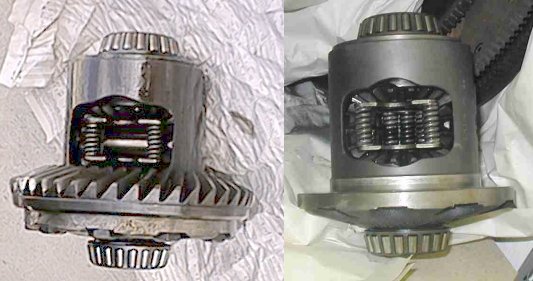
The left one is a 2 series; the right a 3 series. These are both Auburn steaming POSs for 7½" 10-bolt, not 9-bolt parts, butt the same thing happens in EVERY model of rear.
Observe the relative distance from the pinion that the flange locates the ring at. Remember that "ratio" is NOT ONLY the "ratio" of the TOOTH COUNTS on the 2 gears, BUTT ALSO the "ratio" of their DIAMETERS. Since the diameter of the ring is always the same for all ratios in any given model of rear (7.75" in the case of the 9-bolt) then it follows that as the "ratio" INCREASES, the diameter of the pinion must DECREASE. Which means then, that for higher ratios, the ring must be thicker, to mate with the pinion teeth that are moved over farther from that flange that it's mounted to (because the pinion itself is of necessity smaller). Thick gears, past some certain thickness, are more expensive to make, since heat treating tends to warp them (turn them to scrap) if not perfectly even, and that gets harder and harder to do as thickness increases. Production yield craters DRASTICALLY at some point of thickness, or, to keep the yield acceptable, the heat treatment process must be much more meticulous, and can take MUCH longer; and either a high scrap rate or a more elaborate process equals $$$$. So in EVERY model of rear from EVERY mfr, the factories use a carrier with the flange in one place (far away from the pinion) for the lowest ratios, and the ring thickness increases for each higher ratio, until it reaches the economic break-even point; then at that point in the further progression of ratios, they change to an otherwise identical carrier with the flange moved over closer to the pinion, and start over with thin ring gears again, and repeat the thickness progression as the ratio increases further. Some models of rears (Frod 9" for example) have 3 or even 4 different carrier series because the range of ratios that come in them is so great. AFAIK there are only 2 carrier series in the 9-bolt however, 2-series (3.08 and below) and 3-series (3.27 and above).
So don't get too excited about a gear ratio swap just yet, and be all flippant and just "assume" that one afternoon you'll just push a button or something and it'll magically happen, until you do the research.
You'll also find that 2.77 gears require a 2-series carrier, whereas anything above 3.08 (3.27 and higher) must be paired with a 3 series carrier. For most rears, there are ring gear spacers or special "thick" gears available in the aftermarket that can be used instead, butt AFAIK there are none such available for the 9-bolt. The only way to put in a higher gear ratio is to change out the carrier. Which is not a trivial matter in that rear; not that changing it is unusually hard or anything, it's that acquiring one (and the other parts you'll need, like seals) as well as gears themselves, is $$$$$$ and hard. The difference looks something like this; not "exactly" as these are 10-bolt carriers, butt the principle is identical. Note the location of the ring gear flange (imagine that the ring gear isn't there, on the one that has one).
The left one is a 2 series; the right a 3 series. These are both Auburn steaming POSs for 7½" 10-bolt, not 9-bolt parts, butt the same thing happens in EVERY model of rear.
Observe the relative distance from the pinion that the flange locates the ring at. Remember that "ratio" is NOT ONLY the "ratio" of the TOOTH COUNTS on the 2 gears, BUTT ALSO the "ratio" of their DIAMETERS. Since the diameter of the ring is always the same for all ratios in any given model of rear (7.75" in the case of the 9-bolt) then it follows that as the "ratio" INCREASES, the diameter of the pinion must DECREASE. Which means then, that for higher ratios, the ring must be thicker, to mate with the pinion teeth that are moved over farther from that flange that it's mounted to (because the pinion itself is of necessity smaller). Thick gears, past some certain thickness, are more expensive to make, since heat treating tends to warp them (turn them to scrap) if not perfectly even, and that gets harder and harder to do as thickness increases. Production yield craters DRASTICALLY at some point of thickness, or, to keep the yield acceptable, the heat treatment process must be much more meticulous, and can take MUCH longer; and either a high scrap rate or a more elaborate process equals $$$$. So in EVERY model of rear from EVERY mfr, the factories use a carrier with the flange in one place (far away from the pinion) for the lowest ratios, and the ring thickness increases for each higher ratio, until it reaches the economic break-even point; then at that point in the further progression of ratios, they change to an otherwise identical carrier with the flange moved over closer to the pinion, and start over with thin ring gears again, and repeat the thickness progression as the ratio increases further. Some models of rears (Frod 9" for example) have 3 or even 4 different carrier series because the range of ratios that come in them is so great. AFAIK there are only 2 carrier series in the 9-bolt however, 2-series (3.08 and below) and 3-series (3.27 and above).
So don't get too excited about a gear ratio swap just yet, and be all flippant and just "assume" that one afternoon you'll just push a button or something and it'll magically happen, until you do the research.
Last edited by sofakingdom; Feb 21, 2025 at 01:55 PM.
Re: Can someone confirm this is a T5 from an 8 cylinder
3.73 was the stock ratio in the L69 cars, as well as lots of earlier muscle cars. It works GREAT with a T-5 if the engine can rev a bit. The LG4 can't, so with that much gear, you can easily end up with one of those deals where the car will launch like a jack rabbit from a traffic light, but can't pass a semi on a 2-lane road at 55mph unless going downhill, because all the engine will do at that RPM, is make a bunch of noise but no power. In fact one of my little brothers got the 3.73 rear out of a wrecked L69 car and put it in his 84 LG4 Z28 that came w 3.23, and it was exactly like that, so I'm familiar with it first-hand. For the one year that the L69 and 9-bolt rear were available together, the ratio in that range in that rear was 3.70 (10 & 37) rather than 3.73 like in the 10-bolt and most others (11 & 41).
You'll also find that 2.77 gears require a 2-series carrier, whereas anything above 3.08 (3.27 and higher) must be paired with a 3 series carrier. For most rears, there are ring gear spacers or special "thick" gears available in the aftermarket that can be used instead, butt AFAIK there are none such available for the 9-bolt. The only way to put in a higher gear ratio is to change out the carrier. Which is not a trivial matter in that rear; not that changing it is unusually hard or anything, it's that acquiring one (and the other parts you'll need, like seals) as well as gears themselves, is $$$$$$ and hard. The difference looks something like this; not "exactly" as these are 10-bolt carriers, butt the principle is identical. Note the location of the ring gear flange (imagine that the ring gear isn't there, on the one that has one).
The left one is a 2 series; the right a 3 series. These are both Auburn steaming POSs for 7½" 10-bolt, not 9-bolt parts, butt the same thing happens in EVERY model of rear.
Observe the relative distance from the pinion that the flange locates the ring at. Remember that "ratio" is NOT ONLY the "ratio" of the TOOTH COUNTS on the 2 gears, BUTT ALSO the "ratio" of their DIAMETERS. Since the diameter of the ring is always the same for all ratios in any given model of rear (7.75" in the case of the 9-bolt) then it follows that as the "ratio" INCREASES, the diameter of the pinion must DECREASE. Which means then, that for higher ratios, the ring must be thicker, to mate with the pinion teeth that are moved over farther from that flange that it's mounted to (because the pinion itself is of necessity smaller). Thick gears, past some certain thickness, are more expensive to make, since heat treating tends to warp them (turn them to scrap) if not perfectly even, and that gets harder and harder to do as thickness increases. Production yield craters DRASTICALLY at some point of thickness, or, to keep the yield acceptable, the heat treatment process must be much more meticulous, and can take MUCH longer; and either a high scrap rate or a more elaborate process equals $$$$. So in EVERY model of rear from EVERY mfr, the factories use a carrier with the flange in one place (far away from the pinion) for the lowest ratios, and the ring thickness increases for each higher ratio, until it reaches the economic break-even point; then at that point in the further progression of ratios, they change to an otherwise identical carrier with the flange moved over closer to the pinion, and start over with thin ring gears again, and repeat the thickness progression as the ratio increases further. Some models of rears (Frod 9" for example) have 3 or even 4 different carrier series because the range of ratios that come in them is so great. AFAIK there are only 2 carrier series in the 9-bolt however, 2-series (3.08 and below) and 3-series (3.27 and above).
So don't get too excited about a gear ratio swap just yet, and be all flippant and just "assume" that one afternoon you'll just push a button or something and it'll magically happen, until you do the research.
You'll also find that 2.77 gears require a 2-series carrier, whereas anything above 3.08 (3.27 and higher) must be paired with a 3 series carrier. For most rears, there are ring gear spacers or special "thick" gears available in the aftermarket that can be used instead, butt AFAIK there are none such available for the 9-bolt. The only way to put in a higher gear ratio is to change out the carrier. Which is not a trivial matter in that rear; not that changing it is unusually hard or anything, it's that acquiring one (and the other parts you'll need, like seals) as well as gears themselves, is $$$$$$ and hard. The difference looks something like this; not "exactly" as these are 10-bolt carriers, butt the principle is identical. Note the location of the ring gear flange (imagine that the ring gear isn't there, on the one that has one).
The left one is a 2 series; the right a 3 series. These are both Auburn steaming POSs for 7½" 10-bolt, not 9-bolt parts, butt the same thing happens in EVERY model of rear.
Observe the relative distance from the pinion that the flange locates the ring at. Remember that "ratio" is NOT ONLY the "ratio" of the TOOTH COUNTS on the 2 gears, BUTT ALSO the "ratio" of their DIAMETERS. Since the diameter of the ring is always the same for all ratios in any given model of rear (7.75" in the case of the 9-bolt) then it follows that as the "ratio" INCREASES, the diameter of the pinion must DECREASE. Which means then, that for higher ratios, the ring must be thicker, to mate with the pinion teeth that are moved over farther from that flange that it's mounted to (because the pinion itself is of necessity smaller). Thick gears, past some certain thickness, are more expensive to make, since heat treating tends to warp them (turn them to scrap) if not perfectly even, and that gets harder and harder to do as thickness increases. Production yield craters DRASTICALLY at some point of thickness, or, to keep the yield acceptable, the heat treatment process must be much more meticulous, and can take MUCH longer; and either a high scrap rate or a more elaborate process equals $$$$. So in EVERY model of rear from EVERY mfr, the factories use a carrier with the flange in one place (far away from the pinion) for the lowest ratios, and the ring thickness increases for each higher ratio, until it reaches the economic break-even point; then at that point in the further progression of ratios, they change to an otherwise identical carrier with the flange moved over closer to the pinion, and start over with thin ring gears again, and repeat the thickness progression as the ratio increases further. Some models of rears (Frod 9" for example) have 3 or even 4 different carrier series because the range of ratios that come in them is so great. AFAIK there are only 2 carrier series in the 9-bolt however, 2-series (3.08 and below) and 3-series (3.27 and above).
So don't get too excited about a gear ratio swap just yet, and be all flippant and just "assume" that one afternoon you'll just push a button or something and it'll magically happen, until you do the research.
Joined: Sep 2005
Posts: 28,047
Likes: 2,504
Car: Yes
Engine: Usually
Transmission: Sometimes
Axle/Gears: Behind me somewhere
Re: Can someone confirm this is a T5 from an 8 cylinder
I’ve got a buddy that has a complete disc to disc 3.45 rear end.
 Butt hay, you clearly know more about such things than I ever will, so best o luck to ya.
Supreme Member

Joined: Aug 2021
Posts: 1,269
Likes: 359
From: CT
Car: 82 TA
Engine: Zz430 clone w a torquestorm blower
Transmission: Magnum f
Axle/Gears: Ford 9 w 4.11
Re: Can someone confirm this is a T5 from an 8 cylinder
As far as the VSS, can you use one of the Dakota digital or similar boxes? I believe you can convert a mechanical signal off the trans to a digital signal for a speedo like yours.


Joined: Jul 2000
Posts: 6,531
Likes: 94
From: Aridzona
Car: `86 SS / `87 SS
Engine: L69 w/ TPI on top / 305 4bbl
Transmission: `95 T56 \ `88 200-4R
Re: Can someone confirm this is a T5 from an 8 cylinder
Looks like post 27 has options. There is one that threads onto mechanical speedo drive and generates the right signal, maybe on one that's linked.

Thread
Thread Starter
Forum
Replies
Last Post
taguy16
Transmissions and Drivetrain
5
Dec 4, 2022 12:36 AM