


Stroking a 60*


Stroking a 60*
Let's discuss.
A 3500 crank can be offset ground to make a stroker. Up to 1/8" more.
I'll have to check specs, but on my 3.4, the pistons stay in the deck .095" and if you add the .0625" (top 1/2 of the stroke), then the pistons will stay .0885 in the block.
The 2.8 I believe has a .026" deck clearance, after stroking would make piston clearance .0365".
The 3.1 has a .0165" deck clearance, new clearance would be .1025"
A 3500 crank can be offset ground to make a stroker. Up to 1/8" more.
I'll have to check specs, but on my 3.4, the pistons stay in the deck .095" and if you add the .0625" (top 1/2 of the stroke), then the pistons will stay .0885 in the block.
The 2.8 I believe has a .026" deck clearance, after stroking would make piston clearance .0365".
The 3.1 has a .0165" deck clearance, new clearance would be .1025"
Last edited by firstfirebird; Dec 7, 2007 at 04:29 PM.

Supreme Member
iTrader: (1)
Joined: Mar 2005
Posts: 1,089
Likes: 0
From: Western PA
Car: 91 Camaro
Engine: 3.1/3100 in progress...Turbo Soon
Transmission: 700r4
Re: Stroking a 60*
Wow thats a lot of really small numbers. So will the 3500 crank accept the balancer/pulley?
Re: Stroking a 60*
Supreme Member
iTrader: (1)
Joined: Mar 2005
Posts: 1,089
Likes: 0
From: Western PA
Car: 91 Camaro
Engine: 3.1/3100 in progress...Turbo Soon
Transmission: 700r4
Re: Stroking a 60*

Re: Stroking a 60*
you would have to use 3.1 pistons, or maybe pistons from a gen2 that has a little less then the .020" protrusion of the Gen3 3100's. Do you know what year your pistons came from?
After more thought, .125" would be the biggest you could stroke it. Stroke is measured from the center of the journal. (first post edited)
The other benefit is the 3500 crank is steel, not cast. You can have a 3500 crank gound on the rod journals for a stock stroke steel crank. This would be far less expensive then a forging.
After more thought, .125" would be the biggest you could stroke it. Stroke is measured from the center of the journal. (first post edited)
The other benefit is the 3500 crank is steel, not cast. You can have a 3500 crank gound on the rod journals for a stock stroke steel crank. This would be far less expensive then a forging.
Last edited by firstfirebird; Dec 7, 2007 at 04:29 PM.
Supreme Member
iTrader: (1)
Joined: Mar 2005
Posts: 1,089
Likes: 0
From: Western PA
Car: 91 Camaro
Engine: 3.1/3100 in progress...Turbo Soon
Transmission: 700r4
Re: Stroking a 60*
I know that my pistons came from a small port Gen3 engine. But I dont have an exact year.

Moderator
Joined: Jan 2000
Posts: 20,981
Likes: 11
From: Mercedes Norte, Heredia, Costa Rica
Car: 1984 Z28 Hardtop
Engine: 383 Carb
Transmission: 4L60
Axle/Gears: 3.54 Dana 44
Trending Topics

Supreme Member
iTrader: (1)
Joined: Jul 2004
Posts: 10,763
Likes: 4
From: Calgary, AB, Canada
Car: 1982 Trans-Am
Engine: 355 w/ ported 416s
Transmission: T10, hurst shifter
Axle/Gears: 10 bolt, true-trac, 3.73
Re: Stroking a 60*
I normally don't play in the V6 boards here, so I don't know the engine measurements nearly as well. But double check your math up there, i'm a little confused.
3.4L: If you have .095" deck clearance, and you offset grind .125", your pistons will come up (and down) an extra .0625. So .095-.0625 = .033" clearance.
If your deck clearance on a 2.8L is .026" then your pistons will be OUT OF THE HOLE .04x" right?
Same deal with a 3.1L, the piston would slam into the head. Unless I missed a detail there?
And then i'd still wonder why you'd spend money on a V6, especially in order to get more cubic inches, but hey that's just me...
3.4L: If you have .095" deck clearance, and you offset grind .125", your pistons will come up (and down) an extra .0625. So .095-.0625 = .033" clearance.
If your deck clearance on a 2.8L is .026" then your pistons will be OUT OF THE HOLE .04x" right?
Same deal with a 3.1L, the piston would slam into the head. Unless I missed a detail there?
And then i'd still wonder why you'd spend money on a V6, especially in order to get more cubic inches, but hey that's just me...

Moderator
Joined: Jan 2000
Posts: 20,981
Likes: 11
From: Mercedes Norte, Heredia, Costa Rica
Car: 1984 Z28 Hardtop
Engine: 383 Carb
Transmission: 4L60
Axle/Gears: 3.54 Dana 44
Re: Stroking a 60*
It doesn't have to be a 3500 crank, you can offset grind any crankshaft.
No, they'll be .0325 in the block. Do you really have .095" deck height? That's an enormous amount of clearance.
No, piston clearance would be -.0365, minus the .157 or so from the 8mm increase in stroke before offset grinding. As in the piston would be sticking up out of the block by nearly an eighth of an inch.
No, -.046".
Assuming you get the deck height issues straightened out (which could be done with custom pistons, or by milling some off-the-shelfers down perhaps), where are you going to get smaller rods or thicker bearings for the offset-ground throw? There are reasons why offset grinding is not at all a popular option, even if the math works.
Assuming you get the deck height issues straightened out (which could be done with custom pistons, or by milling some off-the-shelfers down perhaps), where are you going to get smaller rods or thicker bearings for the offset-ground throw? There are reasons why offset grinding is not at all a popular option, even if the math works.
Last edited by Apeiron; Dec 7, 2007 at 11:48 PM.
Re: Stroking a 60*
Originally Posted by Apeiron:3558310
No, -.046".
Assuming you get the deck height issues straightened out (which could be done with custom pistons, or by milling some off-the-shelfers down perhaps), where are you going to get smaller rods or thicker bearings for the offset-ground throw? There are reasons why offset grinding is not at all a popular option, even if the math works.
Assuming you get the deck height issues straightened out (which could be done with custom pistons, or by milling some off-the-shelfers down perhaps), where are you going to get smaller rods or thicker bearings for the offset-ground throw? There are reasons why offset grinding is not at all a popular option, even if the math works.
Supreme Member
iTrader: (1)
Joined: Jul 2004
Posts: 10,763
Likes: 4
From: Calgary, AB, Canada
Car: 1982 Trans-Am
Engine: 355 w/ ported 416s
Transmission: T10, hurst shifter
Axle/Gears: 10 bolt, true-trac, 3.73
Re: Stroking a 60*
2.5" rod journal, and the earlier 60* have a 2.0" journal
I wouldn't want to have the piston above the deck, then use a super tall head gasket to compensate to have enough clearance. I think that would be a bad thing. The alternative is to mill the pistons.
If you add up all the custom machine work on this, it'd be hugely expensive i'd think. you're only gaining some cubes on a very undersized motor to begin with, putting you almost on par (well, still far from, but for arguments sake...) with a small V-8. Whereas you could just start with the small V8 and be cash ahead.
Don't get me wrong, i'm not instantly biased against V6's with no reasoning or anything. I just like to go fast cheaply. I don't see this as an economical way to go fast...
 Unless you've got your own machine shop capabilities, and really have a desire to make up oddball engine combinations for the oddball effect. (the raising others eyebrows effect).
 Re: Stroking a 60*
Yes, I have a machine shop, and I like to tinker. A 3.4 with 3400 heads all in stock form, with a stock OBD1.5 tune, headers and ECM friendly cam produced 191hp on a chassis dyno.
A 3.5l (3500) non-vvt just hit 271whp, 291tq with ported heads, big cam, and longtubes. Ran 13.7x N/A in a Cavi with a 2.x 60'.
I'm going to measure a standard 60* crank right now, the 3500 cranks are at the shop...
1.999". This is the same crank from 1991up 60*'s from 2.8 to 3500. IIRC the 3500 crank is over 2.25"
A 3.5l (3500) non-vvt just hit 271whp, 291tq with ported heads, big cam, and longtubes. Ran 13.7x N/A in a Cavi with a 2.x 60'.
I'm going to measure a standard 60* crank right now, the 3500 cranks are at the shop...
1.999". This is the same crank from 1991up 60*'s from 2.8 to 3500. IIRC the 3500 crank is over 2.25"

Member
Joined: Sep 2006
Posts: 388
Likes: 0
Car: 1992 Camaro RS
Engine: 3.1 V6
Transmission: Automatic
Re: Stroking a 60*
[quote=firstfirebird;3558381]Yes, I have a machine shop, and I like to tinker. A 3.4 with 3400 heads all in stock form, with a stock OBD1.5 tune, headers and ECM friendly cam produced 191hp on a chassis dyno.
I know you cant give an exact number but what would you think the horsepower would be on the 3.4 with the addition of ported heads, and ported intake manifold?
I know you cant give an exact number but what would you think the horsepower would be on the 3.4 with the addition of ported heads, and ported intake manifold?
Re: Stroking a 60*
HP? Can't tell you that. But if you are staying with the iron heads, you will spend over $900 on porting to get them to flow the same as the early 3x00 aluminum counterparts. My 3500 heads flow about 218CFM with the manifold attached (in stock form).
Last edited by firstfirebird; Dec 8, 2007 at 08:45 AM.
Re: Stroking a 60*
Apeiron and Sonix, thanks for making the corrections, don't know where my brain was yesterday.
The 3500 crank has a 2.249" journal and the older 60* cranks have 1.999" that's exactly .25" and can increase the stoke in that amount.
The 3500 rods are 5.6" and the pistons have the pin moved to allocate, but the big end is too large to build the motor in question wihtout adding material to the journal. This means the 3500 pistons and early rods will not work because the piston would be way too far out of the block without machining them (+.1 for the rod increase and the piston clearance of -.020).
The 2.8 pistons are flat tops and won't be as easy to machine as the 3.1-up dished pistons.
So, if we were to start with a 3.1 pistons and rods, we would need to mill .1085" from the top of the piston and have a .040" quench with stock .040" compressed height gaskets, or use FWD .060" gaskets with .0885" milled from the top - probably the better option to keep the top ring land as thick as possible (there might be a .065" gasket available).
If we start with a 3.4 block and pistons with the .0095" piston clearance, then the pistons would be at a -.1155" height, and with the .060" gaskets at a -.020" clearance, then we would only have to take .0955 off the top of the piston.
Does this sound a little better?
I happen to have a 3.4 block, 3.1 block, 2 3500 blocks, all with the rotating assemblies. Then there is a set of 3.1 FWD pistons with a deeper dish (27cc IIRC) then the 3.1's 12cc's, and two more extra pre-3500 cranks to do some testing with. It's not a metter of the "wowness" factor or to be oddball, it's about making something work with what's available.
I would like to start with the 3.4 or 3500 blocks as to get the maximum displacemant as I can with what I have, but if the 3500 block is used, it won't go into the car until a tubular k member is in the budget due to motor mounts, starter location, and oil pan configuration. The 3.1 isn't getting used for anything right now, and will be ideal for the test fitting.
The 3.4 is getting 3500 heads and almost to final assembly. With all stock GM parts, port polished and gasket matched, 11.5:1 compression, big cam and homemade headers. Since the 3.4 with 3400 top end has dynoed 191hp (3800's only produse 200bhp) with 9.6:1scr, then I belive the 3.4/3500 should produce some nice numbers since the heads are designed and flow better.
The 3500 crank has a 2.249" journal and the older 60* cranks have 1.999" that's exactly .25" and can increase the stoke in that amount.
The 3500 rods are 5.6" and the pistons have the pin moved to allocate, but the big end is too large to build the motor in question wihtout adding material to the journal. This means the 3500 pistons and early rods will not work because the piston would be way too far out of the block without machining them (+.1 for the rod increase and the piston clearance of -.020).
The 2.8 pistons are flat tops and won't be as easy to machine as the 3.1-up dished pistons.
So, if we were to start with a 3.1 pistons and rods, we would need to mill .1085" from the top of the piston and have a .040" quench with stock .040" compressed height gaskets, or use FWD .060" gaskets with .0885" milled from the top - probably the better option to keep the top ring land as thick as possible (there might be a .065" gasket available).
If we start with a 3.4 block and pistons with the .0095" piston clearance, then the pistons would be at a -.1155" height, and with the .060" gaskets at a -.020" clearance, then we would only have to take .0955 off the top of the piston.
Does this sound a little better?
I happen to have a 3.4 block, 3.1 block, 2 3500 blocks, all with the rotating assemblies. Then there is a set of 3.1 FWD pistons with a deeper dish (27cc IIRC) then the 3.1's 12cc's, and two more extra pre-3500 cranks to do some testing with. It's not a metter of the "wowness" factor or to be oddball, it's about making something work with what's available.
I would like to start with the 3.4 or 3500 blocks as to get the maximum displacemant as I can with what I have, but if the 3500 block is used, it won't go into the car until a tubular k member is in the budget due to motor mounts, starter location, and oil pan configuration. The 3.1 isn't getting used for anything right now, and will be ideal for the test fitting.
The 3.4 is getting 3500 heads and almost to final assembly. With all stock GM parts, port polished and gasket matched, 11.5:1 compression, big cam and homemade headers. Since the 3.4 with 3400 top end has dynoed 191hp (3800's only produse 200bhp) with 9.6:1scr, then I belive the 3.4/3500 should produce some nice numbers since the heads are designed and flow better.
Last edited by firstfirebird; Dec 8, 2007 at 11:25 AM.
Member
Joined: Sep 2006
Posts: 388
Likes: 0
Car: 1992 Camaro RS
Engine: 3.1 V6
Transmission: Automatic
Re: Stroking a 60*
OK so the best thing to do is to get the 3500 heads on the my 3.4? Do I need to get better pistons and I already have the pacesetter headers on my 3.1, will the headers bolt up to the 3500 heads ?

Supreme Member
iTrader: (2)
Joined: May 2007
Posts: 2,574
Likes: 0
From: right behind you
Car: '85 maro
Engine: In the works...
Transmission: TH700 R4
Axle/Gears: 3.73 posi
Re: Stroking a 60*
Would you mind sending me the 3500 crank specs firstfirebird so I can do some number crunching when I find the time, something seems off...
I'd love to throw a 3500 crank in my engine. Mmmm, forgings.
Sonix- the point of using a 3500 crank is more durability than the extra volume, although the 2.8 cranks were fairly tough to start with. As you can imagine most v6 fanatics have their sights set on either high boost or revving the snot out of it. The 'lazy litres' approach just doesn't cut it for us, although every bit counts.
Ben- the pacesetters won't bolt up, you need to cut off the stock flanges and weld 3x00 flanges inplace. Might need to do a little bending to get everything lined up correctly.
I'd love to throw a 3500 crank in my engine. Mmmm, forgings.
Sonix- the point of using a 3500 crank is more durability than the extra volume, although the 2.8 cranks were fairly tough to start with. As you can imagine most v6 fanatics have their sights set on either high boost or revving the snot out of it. The 'lazy litres' approach just doesn't cut it for us, although every bit counts.
Ben- the pacesetters won't bolt up, you need to cut off the stock flanges and weld 3x00 flanges inplace. Might need to do a little bending to get everything lined up correctly.
Moderator
Joined: Jan 2000
Posts: 20,981
Likes: 11
From: Mercedes Norte, Heredia, Costa Rica
Car: 1984 Z28 Hardtop
Engine: 383 Carb
Transmission: 4L60
Axle/Gears: 3.54 Dana 44
Re: Stroking a 60*
How thick are the piston faces. Are you going to be able to remove enough material safely?
Re: Stroking a 60*
Ben- the pacesetters won't bolt up, you need to cut off the stock flanges and weld 3x00 flanges inplace. Might need to do a little bending to get everything lined up correctly.
Would you mind sending me the 3500 crank specs firstfirebird so I can do some number crunching when I find the time, something seems off...
I'd love to throw a 3500 crank in my engine. Mmmm, forgings.
OK so the best thing to do is to get the 3500 heads on the my 3.4? Do I need to get better pistons and I already have the pacesetter headers on my 3.1, will the headers bolt up to the 3500 heads ?

Re: Stroking a 60*
The 3500 rod is 5.9"
So the 3500 block will probably be the best donor for this combination due to the other blocks not being able to be bored that big (92mm vs 94mm). Using 3500 pistons that have a -.020" height minus the .2" rod difference, then adding the .125" to the stroke will give a .055 deck clearance.
I plan on still checking clearances in the Gen1 blocks, but the 3500 that eventually gets in the Firebird will probably be stroked. This will yield a 229.6ci engine (3.762) or essetially a 3.8l 60*.
So the 3500 block will probably be the best donor for this combination due to the other blocks not being able to be bored that big (92mm vs 94mm). Using 3500 pistons that have a -.020" height minus the .2" rod difference, then adding the .125" to the stroke will give a .055 deck clearance.
I plan on still checking clearances in the Gen1 blocks, but the 3500 that eventually gets in the Firebird will probably be stroked. This will yield a 229.6ci engine (3.762) or essetially a 3.8l 60*.
Re: Stroking a 60*
I put a 3500 crank in my 3.4, but didn't take the time to press out the wristpins on the 3500 pistons. Instead I bolted the rod on the crank with the piston sticking out the bottom, lol. Since the rod cap and the heads of the bolts measured almost the same distance from the bearing, then I felt it was a productive test (actually the nut side of the bolt was a little further).
The idea is to check clearances for stroking a Gen1 block. Since the 3500 and Gen 1 rods have the same thickness caps, I feel that if a 3500 rod made it around, then a stroked 3.4 rod would also clear. There was only one spot that the rod bolt hit the block, and that was only if I turned the rod on the crank in such a way that would never happen with a piston in the bore.
Since we know the 3500 has plenty of clearance, and that's the next motor going in my car, stroking is a serious consideration. I know for the average person, this might get out of budget really fast, but having a machine shop makes it feasable for me to try. The only part I think I will have to sub out is the final grind on the rod journals.
Also I was going to measure the rod pins on both the 3.4 and 3500, but didn't have a caliper handy that was thin enough to get between the rod and piston (also was wanting to get the crank and bearings installed today on my block), but I have plenty of extar rods with pistons on to measure later.
Here's pics...
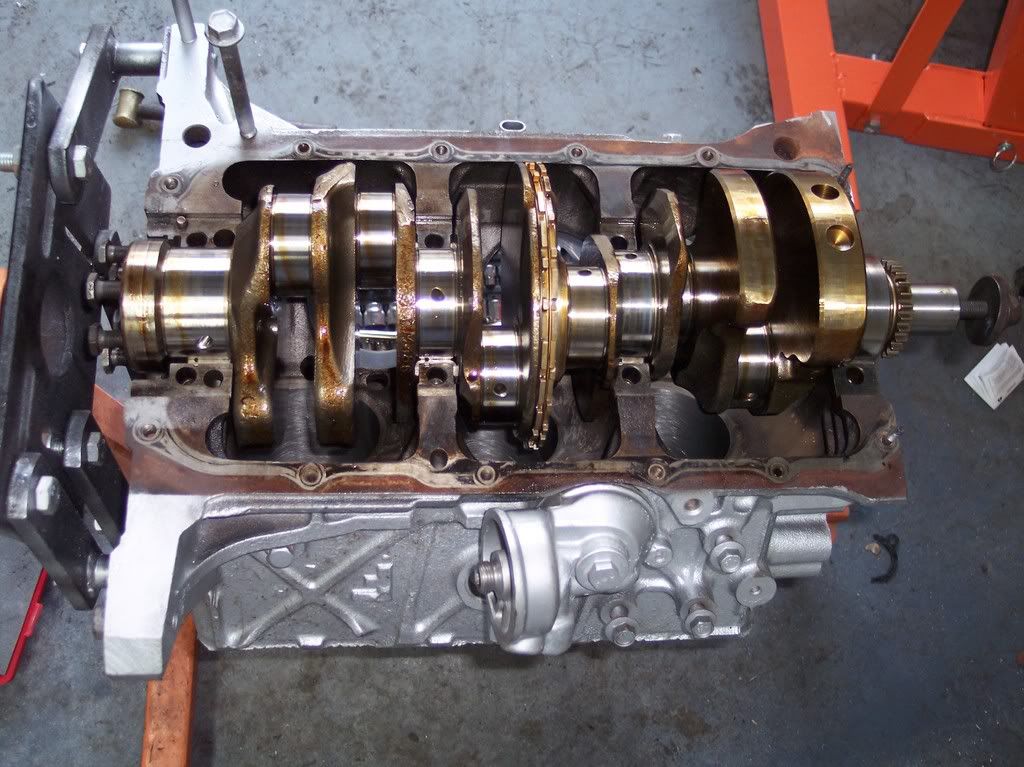
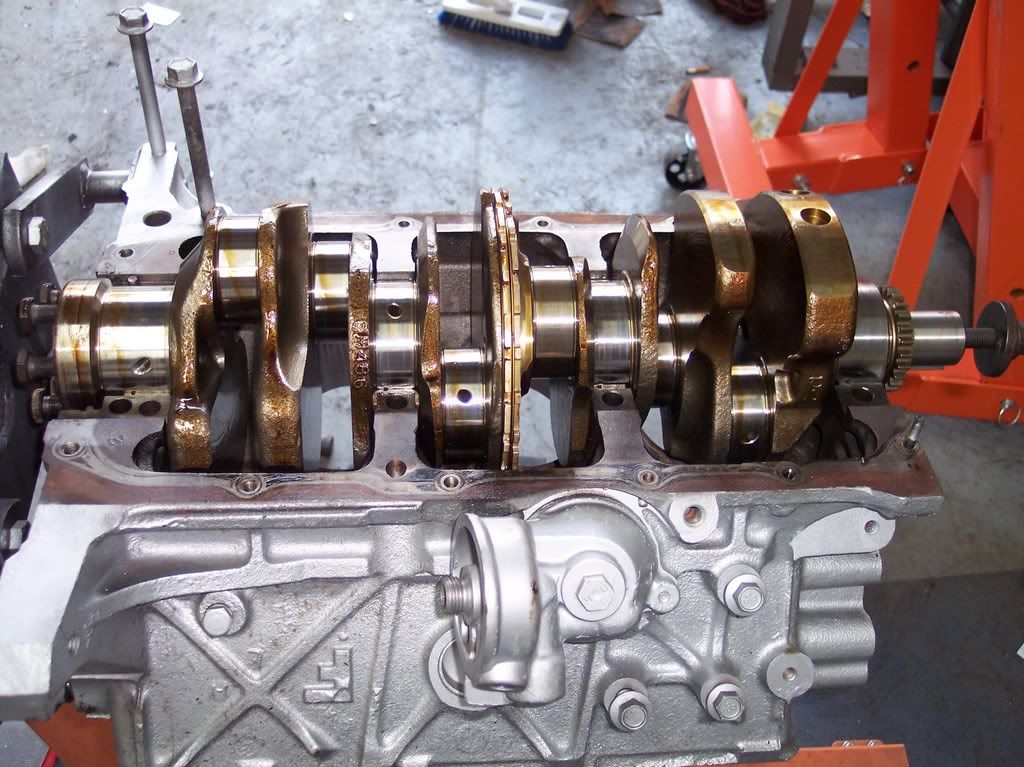
The idea is to check clearances for stroking a Gen1 block. Since the 3500 and Gen 1 rods have the same thickness caps, I feel that if a 3500 rod made it around, then a stroked 3.4 rod would also clear. There was only one spot that the rod bolt hit the block, and that was only if I turned the rod on the crank in such a way that would never happen with a piston in the bore.
Since we know the 3500 has plenty of clearance, and that's the next motor going in my car, stroking is a serious consideration. I know for the average person, this might get out of budget really fast, but having a machine shop makes it feasable for me to try. The only part I think I will have to sub out is the final grind on the rod journals.
Also I was going to measure the rod pins on both the 3.4 and 3500, but didn't have a caliper handy that was thin enough to get between the rod and piston (also was wanting to get the crank and bearings installed today on my block), but I have plenty of extar rods with pistons on to measure later.
Here's pics...

Joined: Mar 2006
Posts: 4,370
Likes: 19
Car: 1973 Datsun 240Z/ 1985 S-15 Jimmy
Engine: Turbo LX9/To be decided
Transmission: 5-speed/T-5
Axle/Gears: R200 3.90/7.5" 3.73
Re: Stroking a 60*
My only concern with offset grinding the 3500 crank is the weakening that will happen. The extra diameter of the rod journals helps keep the 3500 crank strong, by having more material or diameter, on the sides of the journal ajacent to the throws and other rod journals.
Re: Stroking a 60*
My only concern with offset grinding the 3500 crank is the weakening that will happen. The extra diameter of the rod journals helps keep the 3500 crank strong, by having more material or diameter, on the sides of the journal ajacent to the throws and other rod journals.
Joined: Mar 2006
Posts: 4,370
Likes: 19
Car: 1973 Datsun 240Z/ 1985 S-15 Jimmy
Engine: Turbo LX9/To be decided
Transmission: 5-speed/T-5
Axle/Gears: R200 3.90/7.5" 3.73
Re: Stroking a 60*
 You are still removing material.
Even if after the offset grinding the thickness in these common areas is the same I would still be very leary of it, due to torque. Torque is afterall why you would want to stroke an engine. With the increased distance between the center of the crank (center of the main bearings) and the center point of the rods (I use this point assuming it as an easy point where one could assume that a high, possible highest amount of force could be measured), the same force as a shorter stroke would put more stress on these common areas, due to more leverage.
I'm just speaking in generalities here, from research on other engines. Most engine builders don't go for maximum offset grind just becaue of the weakening effect that can happen. There may be room to offset grind the 3500 crank, just maybe not completly on one side, for maximum stroke. I think a 3.6 or 3.7L would be plenty.

Junior Member
Joined: Jan 2008
Posts: 23
Likes: 0
Car: 87 camaro
Engine: 2.8 stroked to 3.1 fully built
Transmission: t-5 5spd manual
Re: Stroking a 60*
i put the 3.1 crank and rod and pistons in my 2.8 block and i also did ALOT of of modifications and machine work, and im LOVEING it!!!! my 2.8 v6 is running almost 300hp all motor.
Supreme Member
iTrader: (1)
Joined: Mar 2005
Posts: 1,089
Likes: 0
From: Western PA
Car: 91 Camaro
Engine: 3.1/3100 in progress...Turbo Soon
Transmission: 700r4
Re: Stroking a 60*
So what all did you do to the motor? Ive never heard of a 3.1 getting anywhere near 300hp N/A. Im not saying you havent got the hp...Im just curious.

Junior Member
Joined: Aug 2004
Posts: 50
Likes: 0
From: So IN.
Re: Stroking a 60*
I'm expecting ~300hp at the crank with a fully built 3.4/3500 hybrid with ~12:1 compression and big cam.


Supreme Member
iTrader: (4)
Joined: Apr 2005
Posts: 1,124
Likes: 0
From: Cleveland, Ohio
Car: 1992 Firebird
Engine: 3.1L V6
Transmission: 5 Speed Manual
Axle/Gears: 3.42 Peg Leg
Re: Stroking a 60*
Yes, I'd be interested in details on a 3.1L running 300hp N/a as well 

Senior Member
iTrader: (5)
Joined: Nov 2006
Posts: 1,517
Likes: 0
From: Tallahassee, FL
Car: 89 V6 Camaro
Engine: 2.8
Transmission: 700R4
Axle/Gears: 3.42 open diff
Re: Stroking a 60*
 I could see 200, and that quite an achievement. 300 is just unbelievable on iron heads.

Joined: Mar 2006
Posts: 4,370
Likes: 19
Car: 1973 Datsun 240Z/ 1985 S-15 Jimmy
Engine: Turbo LX9/To be decided
Transmission: 5-speed/T-5
Axle/Gears: R200 3.90/7.5" 3.73
Re: Stroking a 60*
LOL, mixing forms of measurment. Let's throw Leagues in there as well.

Re: Stroking a 60*
3.1 has a 3.504" bore (89mm) and the chambers on the 3500 heads are 3.591" (91.21mm).
For future referance mm to 0.000" is easy. To convert from mm to inches, just divide mm by 25.4 and to convert from 0.000 inches to mm multiply by 25.4.
example:
Bore on a 3.4 is 3.622" x 25.4 = 91.9988mm (92mm). 92mm/25.4 = 3.62205

This stuff is becoming second nature working in the machine shop, not everybody knows the conversions.

Thread
Thread Starter
Forum
Replies
Last Post
C409
Engine/Drivetrain/Suspension Parts for Sale
5
Sep 23, 2015 04:30 PM
