


Oil pressure guage at 0,builds up from 10 seconds of cranking...what's normal?


Thread Starter
Junior Member
Joined: Oct 2001
Posts: 54
Likes: 0
From: Ocean City,MD
Oil pressure guage at 0,builds up from 10 seconds of cranking...what's normal?
89' IROC with a 305 TPI/700r4. Very hard starting and doesn't have oil pressure until it cranks for a good 10 seconds. Just did an oil and filter change but didn't help... sending unit or oil pump gone bad?I believe I should show pressure when the key is at accessory even before cranking it over.
Any thoughts and help appreciated,what should the car show at accessory and when turning it over?
------------------
*1989 IROC Z(White)
>305 TPI/700R4
>Flowmaster 3" Catback
>K&N Filters
>50k miles
Any thoughts and help appreciated,what should the car show at accessory and when turning it over?
------------------
*1989 IROC Z(White)
>305 TPI/700R4
>Flowmaster 3" Catback
>K&N Filters
>50k miles

Supreme Member
Joined: Jul 1999
Posts: 2,767
Likes: 2
From: Vereinigten Staaten
Car: Take
Engine: Your
Transmission: Pick
Your oil pump is driven by the distributer, which is driven by the camshaft. So you will not see any pressure untill the engine is turning over.
Its the fuel pump that gives pressure during key on, and thats only momentary.
------------------
If you live in Southeastern US, check us out!
South East Thirdgen
1987 Trans Am 305
14.88 @ 92.81
Its the fuel pump that gives pressure during key on, and thats only momentary.
------------------
If you live in Southeastern US, check us out!
South East Thirdgen
1987 Trans Am 305
14.88 @ 92.81
Thread Starter
Junior Member
Joined: Oct 2001
Posts: 54
Likes: 0
From: Ocean City,MD
Thanks for the info. Since the oil pump is driven by the distributor-I guess it's safe to say that a car out of time would not circulate oil properly throughout the engine and cause knocking amoung other things.
One other question how could a car go from running fine one day to not even start the next,when you know the distributor was not bumped or changed?
------------------
*1989 IROC Z(White)
>305 TPI/700R4
>Flowmaster 3" Catback
>K&N Filters
>50k miles
One other question how could a car go from running fine one day to not even start the next,when you know the distributor was not bumped or changed?
------------------
*1989 IROC Z(White)
>305 TPI/700R4
>Flowmaster 3" Catback
>K&N Filters
>50k miles

Moderator


Joined: Jan 2000
Posts: 19,655
Likes: 309
Niko,
The distributor being out of time will not affect the oil pressure. As long as the distributor is turning, the oil pump is turning, and should be moving oil. The oil pump doesn't care about timing to a particular cam or crank orientation, only that it is turning. Just like a water pump, as long as it is turning it will create flow (and pressure).
As for your initial problem, the oil pressure gauge on the dash is not very accurate, and developing oil pressure after protracted cranking is normal. The ECM should operate the fuel pump for two seconds when the ignition is first turned on, as GM Tech stated. Your problem is not likely the lack of oil pressure.
You need to verify that you have all the elements necessary for combustion - spark, fuel, compression, and timing.
Since you have a TPI engine, you can test for fuel pressure in a couple of ways. If the ignition has been off for twenty seconds or more, turning the ignition to the "RUN" position should operate the electric fuel pump for two seconds to prime the system. You can listen carefully for the sound of the pump running in the fuel tank. If you hear the pump running, half of the problem is solved. The pump is generally not very noisy, so unless you are in a quiet area, you might not be able to hear it operate.
If you cannot hear the pump running, you can test for fuel pressure at the Schrader valve on the right fuel rail. Remove the cap, and slightly depress the core pin on the valve (like a tire valve):
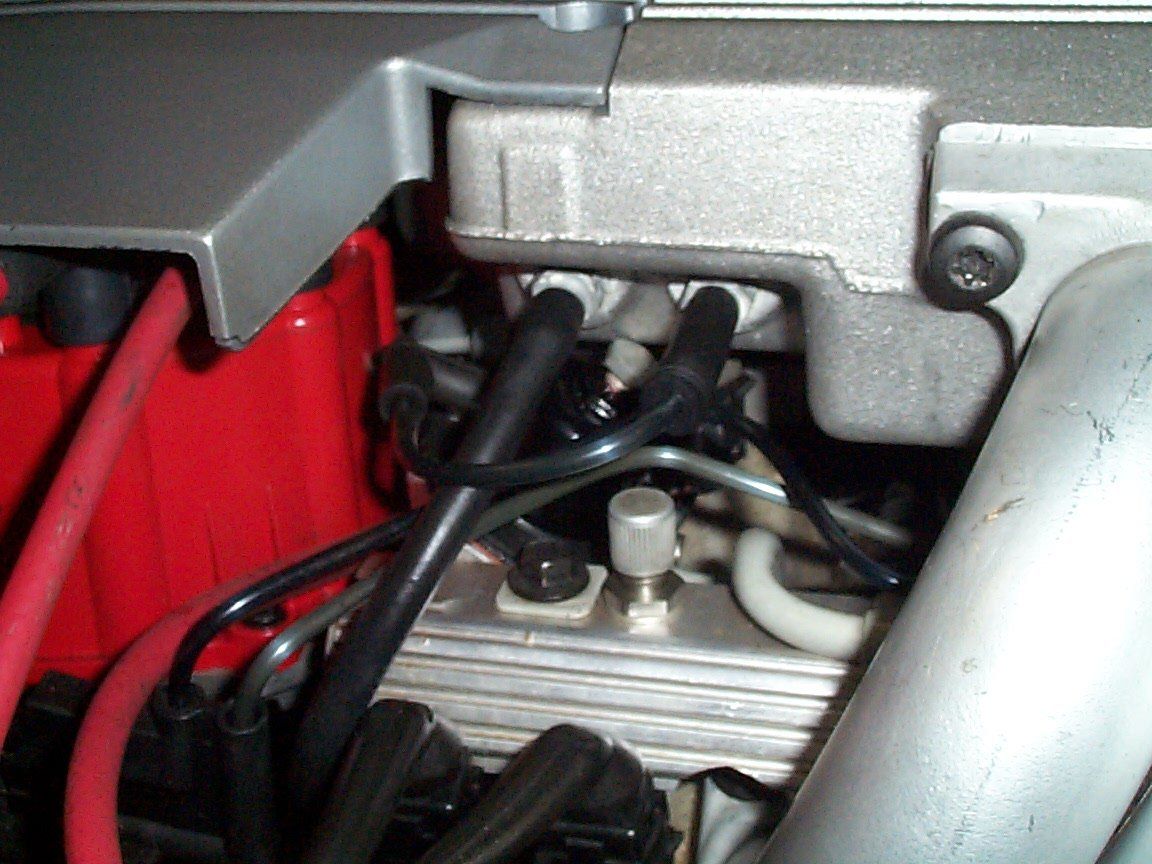
Depressing the valve core should cause a spurt of fuel to be released. If not, you may have a fuel pump or filter problem.
Assuming you have fuel pressure, the next thing to verify is the spark. The easiest way is to remove a spark plug wire at an easily accessible plug, and hold the wire within ¼" of an engine ground while the engine is cranked. Be careful not to become part of the circuit - you may find out that you have good spark the hard way. Another method is to use a spare or removed spark plug and ground it while connected to the wire. Observe the plug gap while cranking. A good spark should be apparent.
If the spark is healthy, the next step is to verify timing. You can do this with a timing light or static timing check. Follow the instructions included with your timing light, or remove the distributor cap and crank the engine to the TDC position of the #1 cylinder, as indicated by the timing marks at the front of the engine timing chain cover. If the engine is at TDC on the compression stroke of the #1 cylinder, the distributor rotor should be pointing almost directly at the #1 cylinder. This is the position on the distributor cap occupied by the #1 spark plug wire.
Loss of compression is generally caused by mechanical engine damage or wear. Unless you have had other indications of poor performance in the recent past, this is not likely a problem. A slipped timing chain can also cause no compression due to incorrect valve timing, but will also be evident in the ignition timing check, since the distributor is driven by the cam and timing chain as well.
One of these should get you closer to your problem. Please report back with results.
------------------
Later,
Vader
------------------
If you want to beat the World, it might reach up and pull you down...
Adobe Acrobat Reader
The distributor being out of time will not affect the oil pressure. As long as the distributor is turning, the oil pump is turning, and should be moving oil. The oil pump doesn't care about timing to a particular cam or crank orientation, only that it is turning. Just like a water pump, as long as it is turning it will create flow (and pressure).
As for your initial problem, the oil pressure gauge on the dash is not very accurate, and developing oil pressure after protracted cranking is normal. The ECM should operate the fuel pump for two seconds when the ignition is first turned on, as GM Tech stated. Your problem is not likely the lack of oil pressure.
You need to verify that you have all the elements necessary for combustion - spark, fuel, compression, and timing.
Since you have a TPI engine, you can test for fuel pressure in a couple of ways. If the ignition has been off for twenty seconds or more, turning the ignition to the "RUN" position should operate the electric fuel pump for two seconds to prime the system. You can listen carefully for the sound of the pump running in the fuel tank. If you hear the pump running, half of the problem is solved. The pump is generally not very noisy, so unless you are in a quiet area, you might not be able to hear it operate.
If you cannot hear the pump running, you can test for fuel pressure at the Schrader valve on the right fuel rail. Remove the cap, and slightly depress the core pin on the valve (like a tire valve):
Depressing the valve core should cause a spurt of fuel to be released. If not, you may have a fuel pump or filter problem.
Assuming you have fuel pressure, the next thing to verify is the spark. The easiest way is to remove a spark plug wire at an easily accessible plug, and hold the wire within ¼" of an engine ground while the engine is cranked. Be careful not to become part of the circuit - you may find out that you have good spark the hard way. Another method is to use a spare or removed spark plug and ground it while connected to the wire. Observe the plug gap while cranking. A good spark should be apparent.
If the spark is healthy, the next step is to verify timing. You can do this with a timing light or static timing check. Follow the instructions included with your timing light, or remove the distributor cap and crank the engine to the TDC position of the #1 cylinder, as indicated by the timing marks at the front of the engine timing chain cover. If the engine is at TDC on the compression stroke of the #1 cylinder, the distributor rotor should be pointing almost directly at the #1 cylinder. This is the position on the distributor cap occupied by the #1 spark plug wire.
Loss of compression is generally caused by mechanical engine damage or wear. Unless you have had other indications of poor performance in the recent past, this is not likely a problem. A slipped timing chain can also cause no compression due to incorrect valve timing, but will also be evident in the ignition timing check, since the distributor is driven by the cam and timing chain as well.
One of these should get you closer to your problem. Please report back with results.
------------------
Later,
Vader
------------------
If you want to beat the World, it might reach up and pull you down...
Adobe Acrobat Reader
Last edited by Vader; Mar 31, 2018 at 10:30 PM. Reason: Updated links
Thread Starter
Junior Member
Joined: Oct 2001
Posts: 54
Likes: 0
From: Ocean City,MD
Good info,I understand the system now.I'm getting spark and fuel,don't know about compression or timing. I'll try the timing first,unfortunately I can't get it running long enough to adjust by ear. Can you rely on setting tdc by removing #1 plug,lightly stuffing with a piece of cloth,and manually turning crankshaft until cloth pops out?Is this a reliable way of determining tdc?
Thanks GMTech and Vader-wish I knew about the forum earlier...could have saved alot of time and money!
Thanks GMTech and Vader-wish I knew about the forum earlier...could have saved alot of time and money!
Moderator
Joined: Jan 2000
Posts: 19,655
Likes: 309
Niko,
Better late than never.
In any case, you can use the "Kleenex test" to help find the compression stroke of a cylinder as a relative indicator. By the time you notice the tissure blown out of the plug hole, the crank may have coasted beyond the TDC mark of the cylinder. You may have to realign the timing marks to the TCD point by manually rotating the crank either forward or backward slightly.
It is evident that you are able to get the engine to at least fire, albeit briefly. This would indicate that the engine is not completely out of time. This also indicates at least the presence of fuel and spark, and compression.
Another factor that can affect timing on your engine is the Electronic Spark Timing (EST) control. You can bypass that for troubleshooting and diagnosis by unplugging a single wire connector in a tan/black wire near the right rear of the engine compartment:
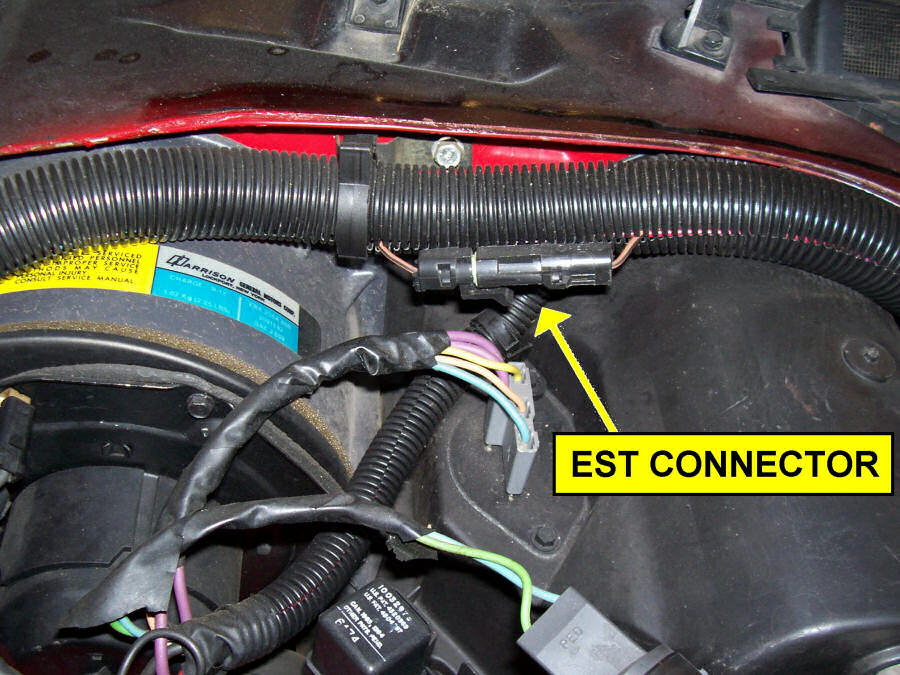
Disconnecting this wire will cause the ignition system to ignore any EST input and revert to the base timing settings. You'll need to disconnect this wire to set the base timing anyway, so trying it to get running isn't a problem.
------------------
Later,
Vader
------------------
If you want to beat the World, it might reach up and pull you down...
Adobe Acrobat Reader
Better late than never.
In any case, you can use the "Kleenex test" to help find the compression stroke of a cylinder as a relative indicator. By the time you notice the tissure blown out of the plug hole, the crank may have coasted beyond the TDC mark of the cylinder. You may have to realign the timing marks to the TCD point by manually rotating the crank either forward or backward slightly.
It is evident that you are able to get the engine to at least fire, albeit briefly. This would indicate that the engine is not completely out of time. This also indicates at least the presence of fuel and spark, and compression.
Another factor that can affect timing on your engine is the Electronic Spark Timing (EST) control. You can bypass that for troubleshooting and diagnosis by unplugging a single wire connector in a tan/black wire near the right rear of the engine compartment:
Disconnecting this wire will cause the ignition system to ignore any EST input and revert to the base timing settings. You'll need to disconnect this wire to set the base timing anyway, so trying it to get running isn't a problem.
------------------
Later,
Vader
------------------
If you want to beat the World, it might reach up and pull you down...
Adobe Acrobat Reader
Last edited by Vader; Mar 31, 2018 at 10:31 PM. Reason: Updated links
Thread Starter
Junior Member
Joined: Oct 2001
Posts: 54
Likes: 0
From: Ocean City,MD
Excellent info and pics,I'll try that and post results. Just bought this car and am new to the whole tpi setup. I understand the basics and priciples behind them-just an amazing difference in power between this iroc and my older camaro 305/4brl!
Getting close to selling it,and have only had it for 3 weeks!
Niko
Getting close to selling it,and have only had it for 3 weeks!
Niko
Trending Topics
Thread Starter
Junior Member
Joined: Oct 2001
Posts: 54
Likes: 0
From: Ocean City,MD
Reset the timing and re-checked the plugs ect.I'm getting spark,fuel and seemingly compression.Don't know what gives...I'm under the impression the iac and tps would not affect the startup.Does the est wire have to be connected for outputting timing info,or can you drive the car on a daily basis without re-connecting it?
Not sure where to go from here?
Not sure where to go from here?

Supreme Member
Joined: Jul 1999
Posts: 18,457
Likes: 16
From: Loveland, OH, US
Car: 4
Engine: 6
Transmission: 5
Try the simple... put a NEW set of plugs in it, even if you did that yesterday; then give it a shot of starting fluid. Either it will start, or it won't, 50% chance. Whichever it does, go from there.
Don't outsmart yourself by over-analyzing the situation. If you're like me, then the simpler and clearer the evidence is, the easier it is to come to the correct conclusion the first time.
------------------
"So many Mustangs, so little time..."
ICON Motorsports
Don't outsmart yourself by over-analyzing the situation. If you're like me, then the simpler and clearer the evidence is, the easier it is to come to the correct conclusion the first time.
------------------
"So many Mustangs, so little time..."
ICON Motorsports
Thread Starter
Junior Member
Joined: Oct 2001
Posts: 54
Likes: 0
From: Ocean City,MD
I agree but it's hard not to outsmart yourself when the problem seems like it should be so simple.Plugs have 500 miles on them max but I think I'll try a new set,I've seen plugs fail with less mileage.
Thanks to all for advice,I'll post results.Sucks to buy a new,low mileage car-feel like it's more or less flawless...and 2 weeks later you can't start it! Seems cars that sit sometimes end up costing you.
Niko
------------------
*1989 IROC Z(White)
>305 TPI/700R4
>Flowmaster 3" Catback
>K&N Filters
>50k miles
Thanks to all for advice,I'll post results.Sucks to buy a new,low mileage car-feel like it's more or less flawless...and 2 weeks later you can't start it! Seems cars that sit sometimes end up costing you.
Niko
------------------
*1989 IROC Z(White)
>305 TPI/700R4
>Flowmaster 3" Catback
>K&N Filters
>50k miles

Senior Member
Joined: Jun 2000
Posts: 781
Likes: 0
From: Palm Bay, FL
Car: 2007 Corvette Z06
Engine: LS7
Transmission: 6 speed
are all the spark plugs going to the right cylinders? all the connections going to the back of dist. in place? dist. cap and rotor in good condition?(cheap to replace less than $20 for both), I'd recommend a timing light instead of your ear for setting the timing, the computer can fool you if you haven't disconnected that brown wire.
Make sure you didn't run out of fuel. I know someone who had fuel pressure when he checked the first time, then later had none and realized after lots of fun(same stuff you're doing) that he had no gas. I say drain all the pressure out, then turn the key and see if it comes back assuming you don't have a gauge to just "hook up".
I know these are the dumb obvious things, but hey, I drove around with a spark plug wire that fell off, wondering why my car ran so ****ty and kept making this ticking noise. I thought it was a colapsed lifter until one night when I saw the pretty lightning bolts running down the side of the block from a plug wire that fell off. Nice loud ticking noise it made close to the valve cover with every spark.
------------------
14.62@96mph headers, muffler, chip, ghetto stuff, duct tape
89 GTA 305 TPI 5 speed 3.42 gears
Make sure you didn't run out of fuel. I know someone who had fuel pressure when he checked the first time, then later had none and realized after lots of fun(same stuff you're doing) that he had no gas. I say drain all the pressure out, then turn the key and see if it comes back assuming you don't have a gauge to just "hook up".
I know these are the dumb obvious things, but hey, I drove around with a spark plug wire that fell off, wondering why my car ran so ****ty and kept making this ticking noise. I thought it was a colapsed lifter until one night when I saw the pretty lightning bolts running down the side of the block from a plug wire that fell off. Nice loud ticking noise it made close to the valve cover with every spark.
------------------
14.62@96mph headers, muffler, chip, ghetto stuff, duct tape
89 GTA 305 TPI 5 speed 3.42 gears
Thread Starter
Junior Member
Joined: Oct 2001
Posts: 54
Likes: 0
From: Ocean City,MD
Just installed a new set of plugs and tried them...no luck. I also picked up a rotor,cap,and timing light.Hopefully they will cure the problem tomorrow. Looks like I need to start back at the beginning and recheck everything(for the third time)...This car is killing me!
Thread Starter
Junior Member
Joined: Oct 2001
Posts: 54
Likes: 0
From: Ocean City,MD
Here's an update of what I've done and the results. I have installed a new cap,rotor,plugs,oil and filter,and the timing looks to be 6* btdc. I have no wire problems and all have been verified to the correct plugs and cap. No computer codes and it seems to be working properly(unplug the est wire and I get the code immediately).
It will start with the est disconnected,but barely and runs terribly.If the est is reconnected the car won't start.If I hold the pedal down it will catch if I stay on the gas,but is very rich and knocks.
Here are the 2 things I'm wondering...(1)Is there a fuel relay or regulator which is malfunctioning and dumping too much fuel? (2)Why will the car start relatively easily with the est disconnected(although it barely runs),yet only crank over when reconnected?Thanks for all the info guys-any other ideas are greatly appreciated.
It's very frustrating not beeing able to solve something which should be obvious!I'm not a big fan of taking my car to mechanics.The last time I did(exhaust work)I'm sitting outside having a smoke and I hear what sounds like my car.I look around the back of the building and sure enough,I see the back end of a white IROC squatting down and taking off on the highway.Guys said they wanted to check the system out,I was HIGHLY upset.
Thanks again-Niko
------------------
*1989 IROC Z(White)
>305 TPI/700R4
>Flowmaster 3" Catback
>K&N Filters
>50k miles
It will start with the est disconnected,but barely and runs terribly.If the est is reconnected the car won't start.If I hold the pedal down it will catch if I stay on the gas,but is very rich and knocks.
Here are the 2 things I'm wondering...(1)Is there a fuel relay or regulator which is malfunctioning and dumping too much fuel? (2)Why will the car start relatively easily with the est disconnected(although it barely runs),yet only crank over when reconnected?Thanks for all the info guys-any other ideas are greatly appreciated.
It's very frustrating not beeing able to solve something which should be obvious!I'm not a big fan of taking my car to mechanics.The last time I did(exhaust work)I'm sitting outside having a smoke and I hear what sounds like my car.I look around the back of the building and sure enough,I see the back end of a white IROC squatting down and taking off on the highway.Guys said they wanted to check the system out,I was HIGHLY upset.
Thanks again-Niko
------------------
*1989 IROC Z(White)
>305 TPI/700R4
>Flowmaster 3" Catback
>K&N Filters
>50k miles
Moderator
Joined: Jan 2000
Posts: 19,655
Likes: 309
Niko,
Disconnecting the EST removes all ECM and ESC control of the spark timing. This will typically retard the timing at least 8-10°. If the engine starts with the EST disconnected, there is a chance that the ESC module is fragged. It is also possible that the base timing is way too far advanced, either because the timing marks on the damper are not correct, or the wrong spark plug was used to time the engine, or there was plug cross-firing occurring when the timing was set. Your new wires, cap, and rotor should have eliminated any cross-firing.
The timing marks at the damper may also have moved, either because the outer ring on the damper has slipped (not uncommon) or because the timing chain has slipped.
The harmonic damper outer ring timing mark should be compared to the keyway in the crankshaft snout. If the mark is about in line with the crank keyway, or slightly retarded depending on your timing tab. You'll probably have to remove the center crank bolt to get a good look:
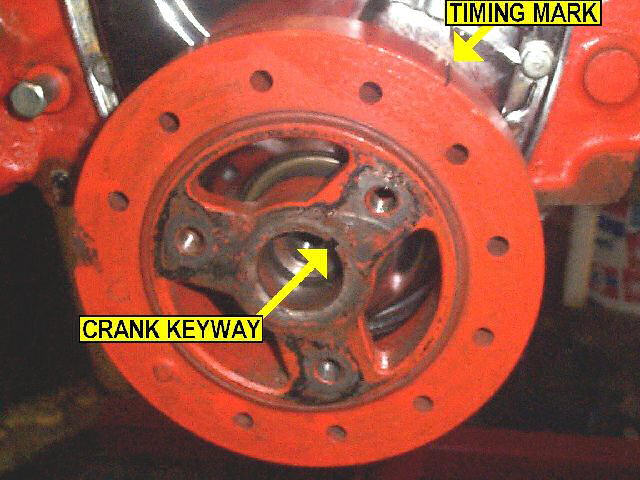
If the timing mark is not correct, your setting of the timing may have to be altered by the amount the marks are off. It is very easy to clean the outer ring and paint a new reference mark on it for timing purposes.
If the engine has a lot of miles, slippage of the timing chain is possible.
One way to verify the timing chain is with a dial indicator on the rockers to determine cam position for comparison to the crankshaft. This is usually a little less labor than removing the timing cover for a visual inspection. If the timing chain has slipped, not only would the ignition timing be off, but the valve timing would be off as well, really affecting performance and idle.
I'd verify the base timing first. Remember to disconnect the EST connector to set the base timing to 6° BTDC, then reconnect when finished. Make sure you are using the #1 plug wire for the timing reference (I know that you know better, but I had to mention that). And make sure the timing tab on the chain cover is not damaged or bent.
------------------
Later,
Vader
------------------
If you want to beat the World, it might reach up and pull you down...
Adobe Acrobat Reader
Disconnecting the EST removes all ECM and ESC control of the spark timing. This will typically retard the timing at least 8-10°. If the engine starts with the EST disconnected, there is a chance that the ESC module is fragged. It is also possible that the base timing is way too far advanced, either because the timing marks on the damper are not correct, or the wrong spark plug was used to time the engine, or there was plug cross-firing occurring when the timing was set. Your new wires, cap, and rotor should have eliminated any cross-firing.
The timing marks at the damper may also have moved, either because the outer ring on the damper has slipped (not uncommon) or because the timing chain has slipped.
The harmonic damper outer ring timing mark should be compared to the keyway in the crankshaft snout. If the mark is about in line with the crank keyway, or slightly retarded depending on your timing tab. You'll probably have to remove the center crank bolt to get a good look:
If the timing mark is not correct, your setting of the timing may have to be altered by the amount the marks are off. It is very easy to clean the outer ring and paint a new reference mark on it for timing purposes.
If the engine has a lot of miles, slippage of the timing chain is possible.
One way to verify the timing chain is with a dial indicator on the rockers to determine cam position for comparison to the crankshaft. This is usually a little less labor than removing the timing cover for a visual inspection. If the timing chain has slipped, not only would the ignition timing be off, but the valve timing would be off as well, really affecting performance and idle.
I'd verify the base timing first. Remember to disconnect the EST connector to set the base timing to 6° BTDC, then reconnect when finished. Make sure you are using the #1 plug wire for the timing reference (I know that you know better, but I had to mention that). And make sure the timing tab on the chain cover is not damaged or bent.
------------------
Later,
Vader
------------------
If you want to beat the World, it might reach up and pull you down...
Adobe Acrobat Reader
Last edited by Vader; Mar 31, 2018 at 10:31 PM.

Thread
Thread Starter
Forum
Replies
Last Post
