


mv to a/f calc


Thread Starter
Supreme Member
Joined: Nov 2003
Posts: 1,399
Likes: 0
From: STL area
mv to a/f calc
I'm wondering how to calculate the a/f ratio based on mv. This is just on paper for my project. For example, .450mv=14.7 a/f . So then what would, lets say 650mv=?
Thanks
Tim
Thanks
Tim

Supreme Member
Joined: Jun 2000
Posts: 7,554
Likes: 1
From: In reality
Car: An Ol Buick
Engine: Vsick
Transmission: Janis Tranny Yank Converter
It doesn't work that way. The NB is a switching type sensor, if you were to compare to a WB you'd see how meaningless they really are for other then being rich or lean of Stoich. I've seen 810 mv be 11.8: and then 12.5:1 in runs done within minutes.

Member
Joined: Jan 2003
Posts: 363
Likes: 0
From: Sydney
>>Not talkng about the sensor, just the calculation........
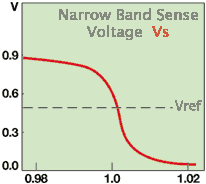
There is no "calculation" like in the DIY-WB kit, where a box of electronics converts the voltage in the sensor to a read-out voltage that you do a calculation on to get AFR. Like Grumpy says, the ECM just treats the O2S like a "rich/lean switch" by increasing and decreasing PW to toggle either side of the stoich (lambda) voltage.
The voltage vs lambda for the NB sensor looks like this:
While the output from a DIY-WB kit looks more straight line:
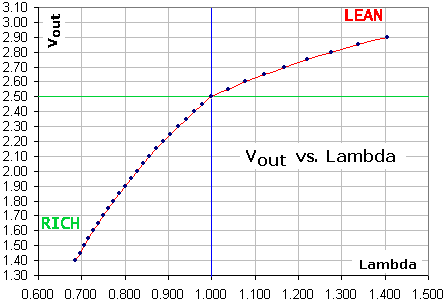
These pics are from the Techedge site.
John
There is no "calculation" like in the DIY-WB kit, where a box of electronics converts the voltage in the sensor to a read-out voltage that you do a calculation on to get AFR. Like Grumpy says, the ECM just treats the O2S like a "rich/lean switch" by increasing and decreasing PW to toggle either side of the stoich (lambda) voltage.
The voltage vs lambda for the NB sensor looks like this:
While the output from a DIY-WB kit looks more straight line:
These pics are from the Techedge site.
John
Supreme Member
Joined: Jun 2000
Posts: 7,554
Likes: 1
From: In reality
Car: An Ol Buick
Engine: Vsick
Transmission: Janis Tranny Yank Converter
Originally posted by 11sORbust
Not talkng about the sensor, just the calculation........
Not talkng about the sensor, just the calculation........
If you want to play with commanded AVERAGE AFR, ie Stoich., then you have to play with the cross over points to get that commanded AVERAGE. Closed loop averages an AFR it doesn't maintain a specific AFR. There's a small but dritical difference in averaging an AFR, and maintianing a specific one. The ECM swings rich and lean, so as to keep the converters happy. That's why a switching sensor works out best.
Thread Starter
Supreme Member
Joined: Nov 2003
Posts: 1,399
Likes: 0
From: STL area
Like I said, this is for a project on paper. No disrespect but I'm quite clear on o2 sensor funtion. I was just needing help calculating the dfference between a/f ratio based on mv........... So on paper, .450=14.7 so what does lets say .300 mean? Just the calculation. I know it would mean little in the real world................

Member
Joined: Nov 2003
Posts: 462
Likes: 1
From: Ft. Leavenworth, KS
Car: 83 TA, 89 TTA, others
Engine: ZZ4 TPI, LC2 turbo v6
Transmission: several, mostly broken
How good are you at calculus?
And for whatever project this is, can you assume constant EGT and pressure?
The problem is, the output curve changes drastically with temperature -- IC Engine Fundamentals (Heywood) has a couple of charts, of F/A ratio vs. O2 partial pressure, and F/A ratio vs. mV...but there are different curves depending on what the EGT is. And as temp changes, the change to output mV is much more drastic on the rich end of the curve than the lean end. And even under the best of conditions, the center part of the curve is still a vertical line.
The graphs were taken from SAE paper 770401. Perhaps with a copy of that, you might be able to come up with an equation, or a lookup table, that sorta approximates the curve.
To me, it's noteable that the books I have don't provide any mathematical equation for output mV vs. AFR, when they talk about lambda O2 sensors. I'm sorta inclined to believe that if there was a useful one, it would have been mentioned.
Good luck,
And for whatever project this is, can you assume constant EGT and pressure?
The problem is, the output curve changes drastically with temperature -- IC Engine Fundamentals (Heywood) has a couple of charts, of F/A ratio vs. O2 partial pressure, and F/A ratio vs. mV...but there are different curves depending on what the EGT is. And as temp changes, the change to output mV is much more drastic on the rich end of the curve than the lean end. And even under the best of conditions, the center part of the curve is still a vertical line.
The graphs were taken from SAE paper 770401. Perhaps with a copy of that, you might be able to come up with an equation, or a lookup table, that sorta approximates the curve.
To me, it's noteable that the books I have don't provide any mathematical equation for output mV vs. AFR, when they talk about lambda O2 sensors. I'm sorta inclined to believe that if there was a useful one, it would have been mentioned.
Good luck,
Last edited by Dave_Jones; Mar 22, 2004 at 10:37 AM.
Trending Topics
Supreme Member
Joined: Jun 2000
Posts: 7,554
Likes: 1
From: In reality
Car: An Ol Buick
Engine: Vsick
Transmission: Janis Tranny Yank Converter
Originally posted by 11sORbust
Like I said, this is for a project on paper. No disrespect but I'm quite clear on o2 sensor funtion. I was just needing help calculating the dfference between a/f ratio based on mv........... So on paper, .450=14.7 so what does lets say .300 mean? Just the calculation. I know it would mean little in the real world................
Like I said, this is for a project on paper. No disrespect but I'm quite clear on o2 sensor funtion. I was just needing help calculating the dfference between a/f ratio based on mv........... So on paper, .450=14.7 so what does lets say .300 mean? Just the calculation. I know it would mean little in the real world................
We'll go to an extreme example.
50% of the time at .900v, and the remainder at 0.v
That happens to average to .45v, in that case, the average AFR is 14.7.
Using gas analyse, and reading POST cat, they can figure on what gives the best tail pipe emissions. And it might not be at Stoich..
If you look at the cals, there's a range of what's used for the rich lean limtis O2 voltage wise, and that's all set in the emissions lab, and is about tailpipe emissions. Not AFR.
Since we're doing off highway use stuff, we look at AFR, and in a way so does the ecm, but from different views for different purposes.
And even with all the best of computer modeling, and engine simulation done on the most state of the art dynos, with some brillant folks thinking this stuff thru, there's often tweaks needed to get a new car past the sniffers.
Thread Starter
Supreme Member
Joined: Nov 2003
Posts: 1,399
Likes: 0
From: STL area
How good are you at calculus?
The problem is, the output curve changes drastically with temperature -- IC Engine Fundamentals (Heywood) has a couple of charts, of F/A ratio vs. O2 partial pressure, and F/A ratio vs. mV...but there are different curves depending on what the EGT is. And as temp changes, the change to output mV is much more drastic on the rich end of the curve than the lean end. And even under the best of conditions, the center part of the curve is still a vertical line.
The graphs were taken from SAE paper 770401. Perhaps with a copy of that, you might be able to come up with an equation, or a lookup table, that sorta approximates the curve.
To me, it's noteable that the books I have don't provide any mathematical equation for output mV vs. AFR, when they talk about lambda O2 sensors. I'm sorta inclined to believe that if there was a useful one, it would have been mentioned.
The graphs were taken from SAE paper 770401. Perhaps with a copy of that, you might be able to come up with an equation, or a lookup table, that sorta approximates the curve.
To me, it's noteable that the books I have don't provide any mathematical equation for output mV vs. AFR, when they talk about lambda O2 sensors. I'm sorta inclined to believe that if there was a useful one, it would have been mentioned.
Thanks!
Thread Starter
Supreme Member
Joined: Nov 2003
Posts: 1,399
Likes: 0
From: STL area
On a sidenote..........
I think that might be what the o2 mv vs map table compensates for,yes?.
the output curve changes drastically with temperature -- IC Engine Fundamentals (Heywood) has a couple of charts, of F/A ratio vs. O2 partial pressure, and F/A ratio vs. mV...

Senior Member
Joined: Nov 2003
Posts: 647
Likes: 0
From: Rockport, TX
Car: 1980 Jeep CJ7
Engine: AMC 360 with GM TBI
Transmission: TF727 set for kill...let's get it on!!!
Calculus? I know a fair amount of calc. How would one go about using calc to convert O2 mV to an AFR value? You have piqued my interest here.
Member
Joined: Nov 2003
Posts: 462
Likes: 1
From: Ft. Leavenworth, KS
Car: 83 TA, 89 TTA, others
Engine: ZZ4 TPI, LC2 turbo v6
Transmission: several, mostly broken
Originally posted by jeepguy553
Calculus? I know a fair amount of calc. How would one go about using calc to convert O2 mV to an AFR value? You have piqued my interest here.
Calculus? I know a fair amount of calc. How would one go about using calc to convert O2 mV to an AFR value? You have piqued my interest here.
But the idea crossed my mind, that you might be able to SWAG something that would approximately describe the curve enough to suit 11sORbust's purposes for an academic project only.
Don't even think about trying to apply that to a real world application, because you could only get it close by assuming EGT and backpressure to be constant, otherwise the curve changes on you.
(I liked calc so much, I took some of those classes more than once
 )
) Thread Starter
Supreme Member
Joined: Nov 2003
Posts: 1,399
Likes: 0
From: STL area
Don't even think about trying to apply that to a real world application, because you could only get it close by assuming EGT and backpressure to be constant, otherwise the curve changes on you.
Thread Starter
Supreme Member
Joined: Nov 2003
Posts: 1,399
Likes: 0
From: STL area
I just realized that my LM-1 simulates the voltage curve of a NB. I can just look at that.
I want control over the a/f ratios. Running in open loop is not an option. The block learn memory,IAC and general closed loop is a great thing,IMO. My car runs great with the fixed 14.7 ratio for part throttle,etc. In fact I'm gettng 20+mph out of my 406 with a 242/250 duraton cam. It idles like a dream......
I don't have any emissions equipment. So 14.7 means nothing to me.This little project should be done in a couple of weeks. If it works out then I'll be running different a/f ratios at idle, on the highway, in city traffic or whatever condition. Fairly sure how to do it, so.
Thanks for the responses!
I want control over the a/f ratios. Running in open loop is not an option. The block learn memory,IAC and general closed loop is a great thing,IMO. My car runs great with the fixed 14.7 ratio for part throttle,etc. In fact I'm gettng 20+mph out of my 406 with a 242/250 duraton cam. It idles like a dream......
I don't have any emissions equipment. So 14.7 means nothing to me.This little project should be done in a couple of weeks. If it works out then I'll be running different a/f ratios at idle, on the highway, in city traffic or whatever condition. Fairly sure how to do it, so.
Thanks for the responses!

Supreme Member

Joined: Jan 2002
Posts: 1,162
Likes: 1
From: California
Car: Z28
Engine: L98
Transmission: T56
What everyone is trying to say, is that whatever equation you come up with, is not going to be accurate.
800mV could be 14:1. or 13:1. or 12:1. or 11:1. or ... you get the idea. _there_is_little_to_no repeatable, reliable correlation of narrow band o2 mV to AFR. This is why they made NB's.
So, you can pick any values you want. They will be no more right (or wrong) than values anyone else picks.
based on this principle, I suggest you pick whatever values are easiest to work with, or maybe just your favorite numbers. it doesn't matter. You could probably just as easily get away with using 900mV for ANYTHING richer than 14.7:1, and 100mV for ANYTHING leaner than 14.7:1. That would make the ECM's AFR averaging less accurate (as hinted at by grumpy above), but would probably work for some/most purposes.
judging AFR with a NB is like judging the temperature of water by looking at it. Sure, if you watch the water freeze (or melt) you know its 32*F (or 14.7:1 AFR) at that moment, but if it's already melted or frozen...you know that it's either warmer or colder (richer or leaner) than 32*F (14.7:1 AFR) ... but how much? who knows.
800mV could be 14:1. or 13:1. or 12:1. or 11:1. or ... you get the idea. _there_is_little_to_no repeatable, reliable correlation of narrow band o2 mV to AFR. This is why they made NB's.
So, you can pick any values you want. They will be no more right (or wrong) than values anyone else picks.
based on this principle, I suggest you pick whatever values are easiest to work with, or maybe just your favorite numbers. it doesn't matter. You could probably just as easily get away with using 900mV for ANYTHING richer than 14.7:1, and 100mV for ANYTHING leaner than 14.7:1. That would make the ECM's AFR averaging less accurate (as hinted at by grumpy above), but would probably work for some/most purposes.
judging AFR with a NB is like judging the temperature of water by looking at it. Sure, if you watch the water freeze (or melt) you know its 32*F (or 14.7:1 AFR) at that moment, but if it's already melted or frozen...you know that it's either warmer or colder (richer or leaner) than 32*F (14.7:1 AFR) ... but how much? who knows.
Supreme Member
Joined: Jan 2002
Posts: 1,162
Likes: 1
From: California
Car: Z28
Engine: L98
Transmission: T56
I don't remember if I ever posted this before or not, but it's certainly interesting. it is a chart of NB O2 mV values plotted against the WBo2 specified AFR value, for a wide range of conditions (including decel enleanment, AE enrich, etc.), as measured by me in my car with my DIY WBO2 installed in the same pipe as the NBo2 about four inches further downstream (NBo2 in stock location). Yes I know the AE is a bit rich. ignore the tune for purposes of the conversation.  this log was done over a year ago now.
I think about the only conclusion you can draw is the following:
(1) if NB mV is < 100mV, then about 50/50 odds you are leaner than 15:1.
(2) if NB mV is > 900mV, then pretty good odds you are richer than 14:1.
It's also interesting to note the "grouping" of values around 100mV - 300mV and then again 650mV - 900mV. there is not (as) much time spent in the center, which is what theory predicts (that since the NBo2 is a "switch" it will not be in a halfway condition very much - either saying "yes there is o2 here" or "nope no o2 here". I would guess that, if I had a brand new fresh NBo2 when I did that run, it would spend even less time in the center and more at the extreme ends.
I'll have to run another one of these comparisons some day now that I do have a fresh NBo2 and see how it looks.
this log was done over a year ago now.I think about the only conclusion you can draw is the following:
(1) if NB mV is < 100mV, then about 50/50 odds you are leaner than 15:1.
(2) if NB mV is > 900mV, then pretty good odds you are richer than 14:1.
It's also interesting to note the "grouping" of values around 100mV - 300mV and then again 650mV - 900mV. there is not (as) much time spent in the center, which is what theory predicts (that since the NBo2 is a "switch" it will not be in a halfway condition very much - either saying "yes there is o2 here" or "nope no o2 here". I would guess that, if I had a brand new fresh NBo2 when I did that run, it would spend even less time in the center and more at the extreme ends.
I'll have to run another one of these comparisons some day now that I do have a fresh NBo2 and see how it looks.
Last edited by 91L98Z28; Mar 24, 2004 at 12:37 AM.

Supreme Member
Joined: Jan 2002
Posts: 1,162
Likes: 1
From: California
Car: Z28
Engine: L98
Transmission: T56
the tune isn't that important for the chart - it simply correlates nbo2 mv to wbo2 afr. my comments about the ve being off is due to the excessively rich blob down around 11:1. it's actually useful for purposes of this chart, it better demonstrates a nbo2's behavior in this region.
I generated the chart in excel, it's just an X-Y scatter plot with o2 mV forming the x coordinate and WBo2 AFR forming the Y cordinate. I got my wbo2 afr into excel using information elsewhere on this forum (it's wired into my ECM and I log the raw wbo2 output in the fuel pump volts spot in the data stream, and conver it to AFR using an appropriate equation). I think I posted this elsewhere a few months ago here.
the nbo2 really should be thought of as a switch, and then it's ability to maintain 14.7:1 makes more sense. if you take a switch that controls a light bulb, and flip that switch at a steady 60hz (60 times a second), you'll find that the average brightness of the light is "dim" regardless of the actual position of the switch at any instant.
as long as you are rapidly generating crosscounts (crossing from high nbo2 mv to low nbo2 mv and back), you are going to average 14.7:1 regardless of any single instaneous value of the nbo2. It's only when you get "stuck" high or low (where the particular nbo2 i tested above settles into > 850mV or < 100mV) that you no longer generate crosscounts, and you no longer have an averaging going on, and you lose the 14.7:1.
I generated the chart in excel, it's just an X-Y scatter plot with o2 mV forming the x coordinate and WBo2 AFR forming the Y cordinate. I got my wbo2 afr into excel using information elsewhere on this forum (it's wired into my ECM and I log the raw wbo2 output in the fuel pump volts spot in the data stream, and conver it to AFR using an appropriate equation). I think I posted this elsewhere a few months ago here.
the nbo2 really should be thought of as a switch, and then it's ability to maintain 14.7:1 makes more sense. if you take a switch that controls a light bulb, and flip that switch at a steady 60hz (60 times a second), you'll find that the average brightness of the light is "dim" regardless of the actual position of the switch at any instant.
as long as you are rapidly generating crosscounts (crossing from high nbo2 mv to low nbo2 mv and back), you are going to average 14.7:1 regardless of any single instaneous value of the nbo2. It's only when you get "stuck" high or low (where the particular nbo2 i tested above settles into > 850mV or < 100mV) that you no longer generate crosscounts, and you no longer have an averaging going on, and you lose the 14.7:1.

Thread
Thread Starter
Forum
Replies
Last Post
formula5
Electronics
1
Nov 27, 2001 08:49 PM
147, af, afr, air, calculate, calculator, conversion, convert, fuel, lambda, millivolt, millivolts, mv, o2, sensor
