


checking for small battery draw


Thread Starter
Supreme Member
Joined: Mar 2002
Posts: 4,812
Likes: 0
From: 62656
Car: 1991 S10 pickup 2700lbs
Engine: 4.3L Z TBI
Transmission: 700R4
Axle/Gears: 3.08 7.625"
checking for small battery draw
how do you guys go about checking for a small battery draw by checking it between a battery cable and battery post ?
test light ? or is a small draw even enough current to light up a test light bulb ?
if i were to use a digital multimeter then what setting should i use ?
im thinking it may be the sterio i installed recentl,y but who knows, it may be glovebox light or trunk light or something else('84 impala)
never had this problem until recently after i cut the cumputer out(so that i could swap a non CCC carb on)
and put in a cassette sterio
i dont know if i need to look for amps or volts in the draw between cable and post
thanks for anything
test light ? or is a small draw even enough current to light up a test light bulb ?
if i were to use a digital multimeter then what setting should i use ?
im thinking it may be the sterio i installed recentl,y but who knows, it may be glovebox light or trunk light or something else('84 impala)
never had this problem until recently after i cut the cumputer out(so that i could swap a non CCC carb on)
and put in a cassette sterio
i dont know if i need to look for amps or volts in the draw between cable and post
thanks for anything

Moderator


Joined: Jan 2000
Posts: 19,683
Likes: 316
Typically, an ammeter is used in series. Disconnect a battery cable, connect in the ammeter to complete the circuit (noting polarity), and read the current. Start with the meter on the highest current scale just to be safe, then lower the scale as necessary for best resolution.
Thread Starter
Supreme Member
Joined: Mar 2002
Posts: 4,812
Likes: 0
From: 62656
Car: 1991 S10 pickup 2700lbs
Engine: 4.3L Z TBI
Transmission: 700R4
Axle/Gears: 3.08 7.625"
what setting would this be on a digital multimeter tester ?
theres ohms(resistance) and volts and continuity, i dont see anything else, no way to measure amperage flow with a multimeter afaik ?
thanks
theres ohms(resistance) and volts and continuity, i dont see anything else, no way to measure amperage flow with a multimeter afaik ?
thanks


Member
Joined: Oct 2004
Posts: 491
Likes: 1
From: Lapeer, MI
Car: 86 IROC, 89 GTA
Engine: 350 blocks, both of em
Transmission: 700r4s
Axle/Gears: 10 bolt and 9 bolt, 3.73, 3.23
Any meter will work fine as long as it actually reads amperes. Put the meter on its highest setting so you dont blow the fuse!
Last edited by shawnc16; Jan 19, 2006 at 03:09 AM.
Trending Topics


Most meters do not read current without an amp clamp adapter, only voltage.
Take a volt-ohm meter and connect one lead to the negative battery post and one to the ground cable. Note if there is a volt draw. If no voltage, no short or nothing is drawing voltage. Keep in mind that minor things like the radio may draw minute amounts of current for the pre-set memory. Your system is only 12 volts so that setting if selectable is fine.
Take a volt-ohm meter and connect one lead to the negative battery post and one to the ground cable. Note if there is a volt draw. If no voltage, no short or nothing is drawing voltage. Keep in mind that minor things like the radio may draw minute amounts of current for the pre-set memory. Your system is only 12 volts so that setting if selectable is fine.

Supreme Member
iTrader: (1)
Joined: Oct 2004
Posts: 3,361
Likes: 2
From: Worcester, MA
Car: 86 T/A
Engine: HSR 355
Transmission: 700R4
Axle/Gears: 2.77 posi
Originally posted by 2kflhr
Take a volt-ohm meter and connect one lead to the negative battery post and one to the ground cable. Note if there is a volt draw. If no voltage, no short or nothing is drawing voltage. Keep in mind that minor things like the radio may draw minute amounts of current for the pre-set memory. Your system is only 12 volts so that setting if selectable is fine.
Take a volt-ohm meter and connect one lead to the negative battery post and one to the ground cable. Note if there is a volt draw. If no voltage, no short or nothing is drawing voltage. Keep in mind that minor things like the radio may draw minute amounts of current for the pre-set memory. Your system is only 12 volts so that setting if selectable is fine.

Supreme Member
Joined: Feb 2005
Posts: 1,034
Likes: 0
From: Fort Lauderdale, FL
Car: 91 Camaro RS
Engine: 305 TBI
Transmission: 700R4
Axle/Gears: 2.73 Posi w/Disc
You can put a giant resistor in-line with the battery + terminal and measure the voltage drop across it. The only problem with this setup (and all 12VDC in-car current measurements) is that even with eveything off, if you're getting a load anough to actually notice, it's probably going to be in the 30+W range. Resistors that large can be expensive. Not necessarily are, but can be.

Supreme Member
Joined: Oct 1999
Posts: 1,734
Likes: 0
From: Westminster, MD
Car: 89 IROC-Z
Engine: 355 TPI
Transmission: 700R4
Originally posted by 2kflhr
Most meters do not read current without an amp clamp adapter, only voltage.
Take a volt-ohm meter and connect one lead to the negative battery post and one to the ground cable. Note if there is a volt draw. If no voltage, no short or nothing is drawing voltage. Keep in mind that minor things like the radio may draw minute amounts of current for the pre-set memory. Your system is only 12 volts so that setting if selectable is fine.
Most meters do not read current without an amp clamp adapter, only voltage.
Take a volt-ohm meter and connect one lead to the negative battery post and one to the ground cable. Note if there is a volt draw. If no voltage, no short or nothing is drawing voltage. Keep in mind that minor things like the radio may draw minute amounts of current for the pre-set memory. Your system is only 12 volts so that setting if selectable is fine.
And if using a resistor as a shunt you would need a vary low value/high wattage PRECISION resistor (and an accurate mV meter), or just get one sold as a shunt.
But it would be cheaper to just buy a DMM that will read current directly. And YES they are easy to find without clamp-ons.
Originally posted by 2kflhr
Most meters do not read current without an amp clamp adapter, only voltage.
Take a volt-ohm meter and connect one lead to the negative battery post and one to the ground cable. Note if there is a volt draw. If no voltage, no short or nothing is drawing voltage. Keep in mind that minor things like the radio may draw minute amounts of current for the pre-set memory. Your system is only 12 volts so that setting if selectable is fine.
Most meters do not read current without an amp clamp adapter, only voltage.
Take a volt-ohm meter and connect one lead to the negative battery post and one to the ground cable. Note if there is a volt draw. If no voltage, no short or nothing is drawing voltage. Keep in mind that minor things like the radio may draw minute amounts of current for the pre-set memory. Your system is only 12 volts so that setting if selectable is fine.
Supreme Member
iTrader: (1)
Joined: Oct 2004
Posts: 3,361
Likes: 2
From: Worcester, MA
Car: 86 T/A
Engine: HSR 355
Transmission: 700R4
Axle/Gears: 2.77 posi
Originally posted by 2kflhr
Ok, Ignore my previous post. But if I remember correctly you can connect a 12v test light between the negative post and negative cable and if the light glows something is pulling current. Is this not correct and will a Volt-Ohm meter not work the same way?
Ok, Ignore my previous post. But if I remember correctly you can connect a 12v test light between the negative post and negative cable and if the light glows something is pulling current. Is this not correct and will a Volt-Ohm meter not work the same way?

Supreme Member
Joined: Jan 2004
Posts: 1,206
Likes: 4
From: Western Ky
Car: Z/28..39 Plymouth truck in progress
Engine: S/B
Transmission: Manual
Since this seems to be a question asked often and since this was way to much info to type and explain it in a way people would understand I dug out my books (I am retired so don't need to have my books handy anymore  ) This info is a little dated (1990 or so) but the basics never change....lets see if this works
Edit: lol excuse any underlining or notes this was a book I used in my GM electronics certification class
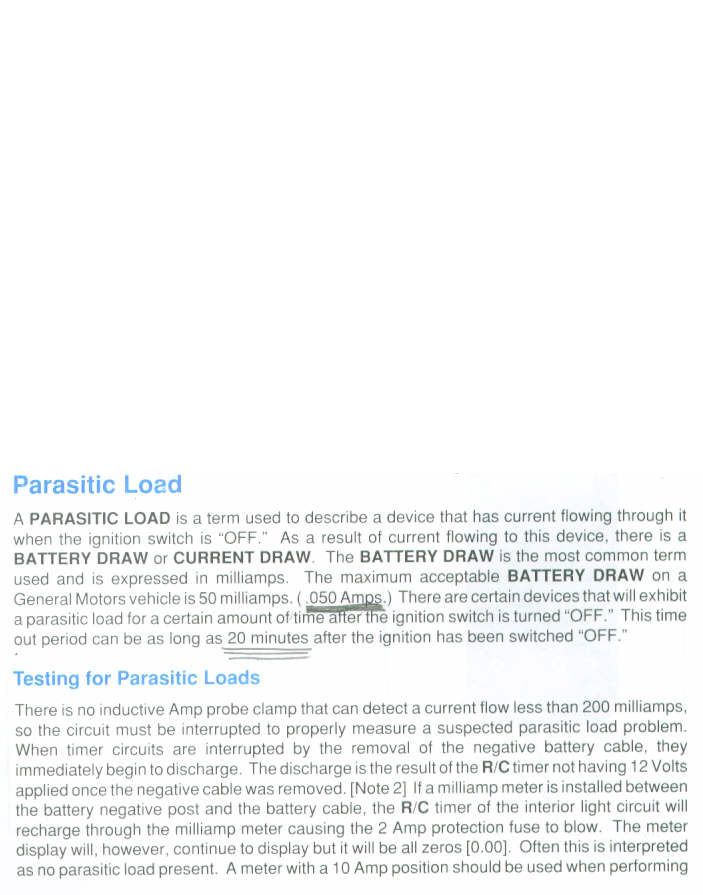
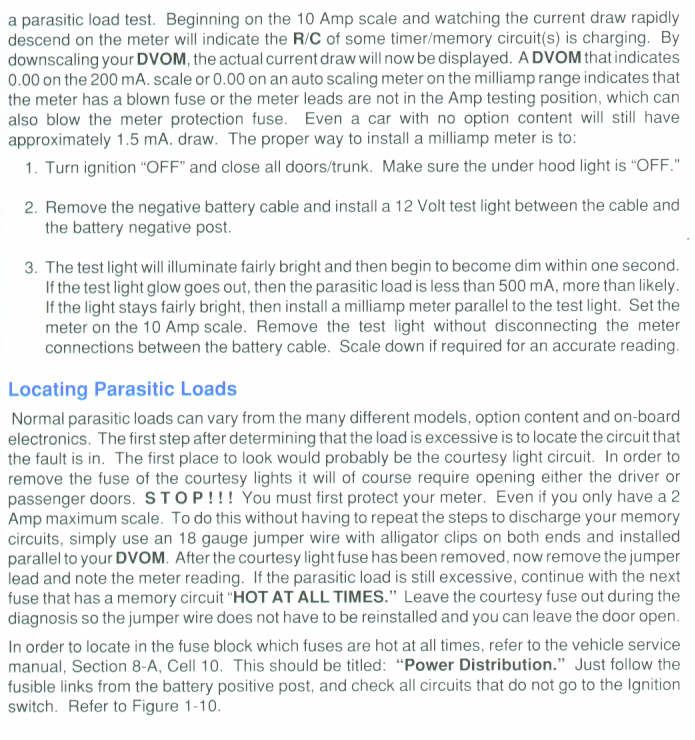
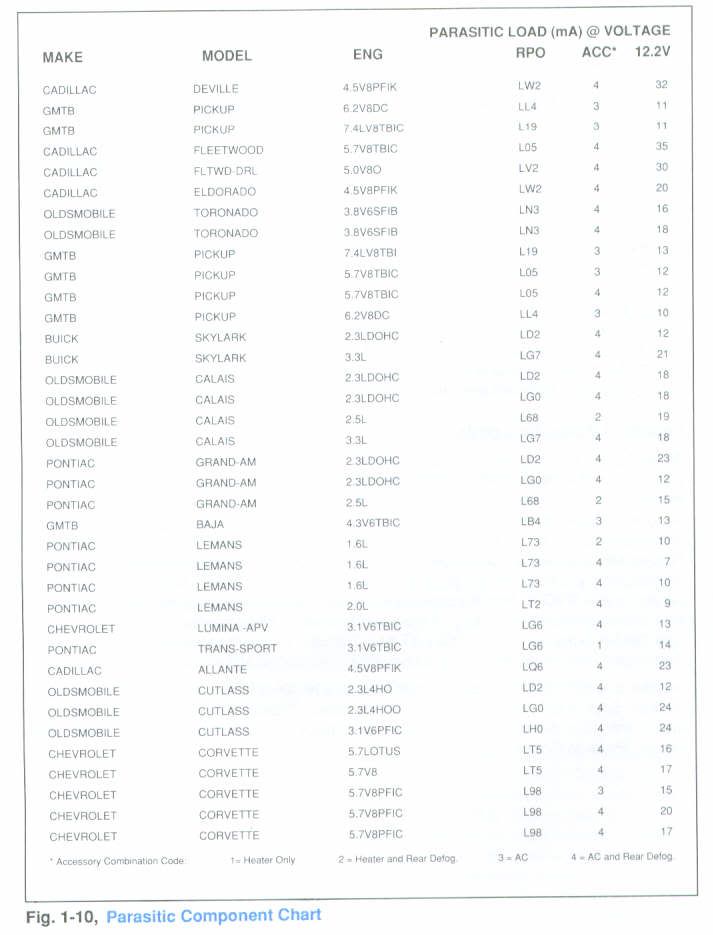
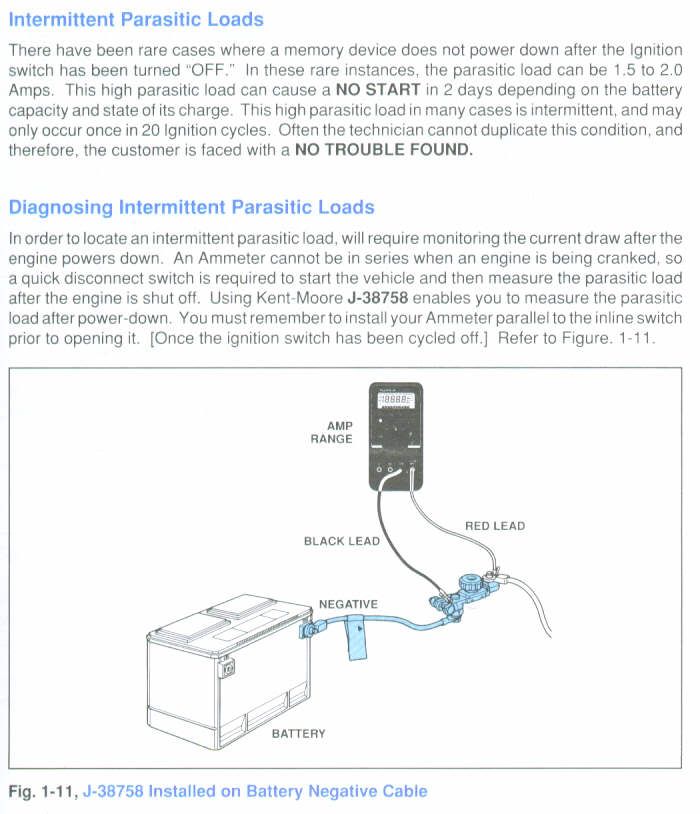
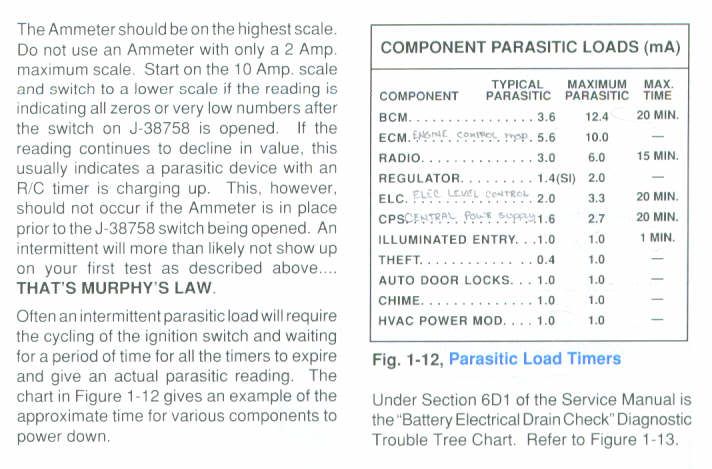
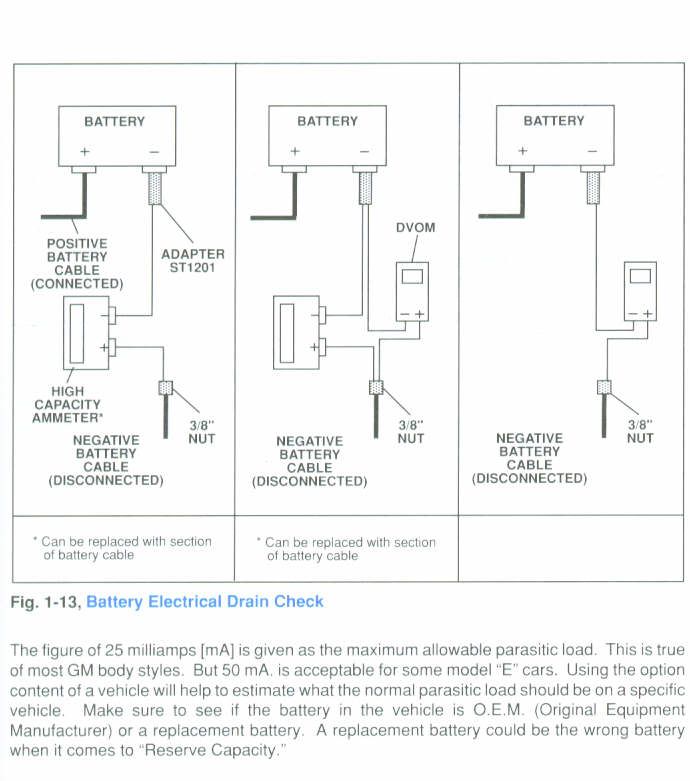
) This info is a little dated (1990 or so) but the basics never change....lets see if this worksEdit: lol excuse any underlining or notes this was a book I used in my GM electronics certification class
Last edited by flrtin1; Feb 2, 2006 at 11:14 AM.
Supreme Member
Joined: Oct 1999
Posts: 1,734
Likes: 0
From: Westminster, MD
Car: 89 IROC-Z
Engine: 355 TPI
Transmission: 700R4
Originally posted by 2kflhr
Ok, Ignore my previous post. But if I remember correctly you can connect a 12v test light between the negative post and negative cable and if the light glows something is pulling current. Is this not correct and will a Volt-Ohm meter not work the same way?
Ok, Ignore my previous post. But if I remember correctly you can connect a 12v test light between the negative post and negative cable and if the light glows something is pulling current. Is this not correct and will a Volt-Ohm meter not work the same way?
I don’t like the test light method because it assumes too much. The amount of current to get the light to light up will depend on the light bulb. Different light bulbs will light different amounts for the same current. Way to hit-and-miss. I like the post above (other then the test light part).
Get a DMM that will read current and go at it.

Thread
Thread Starter
Forum
Replies
Last Post
Mickeyruder
Engine/Drivetrain/Suspension Parts for Sale
3
Sep 2, 2015 02:45 PM
db057
TBI
10
Aug 11, 2015 10:11 PM


