


Poor cold start... Look for what?


Thread Starter
Junior Member
Joined: Apr 2000
Posts: 97
Likes: 0
From: Marietta, Georgia, USA
Poor cold start... Look for what?
Recently, my car has been having poor cold starts. Normally on cold starts, my car wil roar to life up to 1,500 and settle down to 1,000 after a brief while. Now, it doesn't shoot up... it goes straight to 500-600 RPMs and since the engine is cold, it tries to stall. The only changes that happened is that the air temperature around here is somewhat warmer now... It ran great when it was 30 degrees. But now that it's around 45-50 degrees outside, the car just doesn't like to start as well as it did... Not sure if it's temperature related, but it's the only change that has occurred.
Now the question is... what is causing this to happen. It happen almost suddenly. What sensor, if there is one, that tells the ECU that the engine is dead cold? Or is there something else that I should look for? Does anyone else have this type of problem or solution? Help!!!
Thanks,
Humvee
------------------
1989 IROC-Z Convertible
305 TPI automatic
White with black top
Mods:
K&N Filter
Modded air box
My webpage: http://mindspring.com/~humvee
Now the question is... what is causing this to happen. It happen almost suddenly. What sensor, if there is one, that tells the ECU that the engine is dead cold? Or is there something else that I should look for? Does anyone else have this type of problem or solution? Help!!!
Thanks,
Humvee
------------------
1989 IROC-Z Convertible
305 TPI automatic
White with black top
Mods:
K&N Filter
Modded air box
My webpage: http://mindspring.com/~humvee

Junior Member
Joined: Dec 2000
Posts: 16
Likes: 0
From: Toledo, IL U.S.
I think your problem is the maf, if you have one. During startup the engine will reley on info from the MAF until the engine is warm enough to run off of the O2 sensor. If the maf was telling your engine it was 30 degrees outside and it was really 50, the ecm will flood the car with excess gas.
Thread Starter
Junior Member
Joined: Apr 2000
Posts: 97
Likes: 0
From: Marietta, Georgia, USA
I see... is there any way to test the MAF? Please let me know. Thanks.
------------------
1989 IROC-Z Convertible
305 TPI automatic
White with black top
Mods:
K&N Filter
Modded air box
My webpage: http://mindspring.com/~humvee
------------------
1989 IROC-Z Convertible
305 TPI automatic
White with black top
Mods:
K&N Filter
Modded air box
My webpage: http://mindspring.com/~humvee

Member
Joined: Jul 1999
Posts: 496
Likes: 0
From: Chicago, IL
Car: 89 IROC-Z
Engine: LB9
Transmission: 700-R4
I don't think the maf tells the computer anything about temp - just airflow. The coolant temp sensor in the front of your manifold costs 8 bucks and if it's bad then what he said would apply. It might be the IAC sticking when it's cold or something...how are the plugs?
------------------
Base: 89 Iroc-Z LB9 auto 2.73 posi
Exh: 3" Dynomax muffler, 3" Pipe in place of cat
Ign: Accel 300+ wires, cap&rotor
Fuel: Cleaned and flow-matched injectors, afpr, !air pump&diverter valve
Sound: Clarion deck, Kicker speakers and amps
Suspension: KYB Shocks, BMR Strut Tower Brace
Misc: TB Bypass, Synthetic Oil, Flexlite Transmission cooler,
free mods, hopefully engine swap and 4th gen seats in the works...
------------------
Base: 89 Iroc-Z LB9 auto 2.73 posi
Exh: 3" Dynomax muffler, 3" Pipe in place of cat
Ign: Accel 300+ wires, cap&rotor
Fuel: Cleaned and flow-matched injectors, afpr, !air pump&diverter valve
Sound: Clarion deck, Kicker speakers and amps
Suspension: KYB Shocks, BMR Strut Tower Brace
Misc: TB Bypass, Synthetic Oil, Flexlite Transmission cooler,
free mods, hopefully engine swap and 4th gen seats in the works...
Thread Starter
Junior Member
Joined: Apr 2000
Posts: 97
Likes: 0
From: Marietta, Georgia, USA
I had the plugs replaced 3,000 miles ago. I'm sure they're in good shape. I should check just to be sure though. About the IAC, how do you get that out? It looks like it's screwed into the TB. I'd like to take a look at the IAC.
------------------
1989 IROC-Z Convertible
305 TPI automatic
White with black top
Mods:
K&N Filter
Modded air box
My webpage: http://mindspring.com/~humvee
------------------
1989 IROC-Z Convertible
305 TPI automatic
White with black top
Mods:
K&N Filter
Modded air box
My webpage: http://mindspring.com/~humvee

Supreme Member
Joined: Jul 1999
Posts: 5,183
Likes: 42
From: Oakdale, Ca
Car: 89 IrocZ
Engine: L98-ish
Transmission: 700R4
Disconnect the MAF, and see if she fires right up.
The CTS (mentioned above) is the temp control parameter for the ECM, and very well may be an issue. This can be measured with an OHM meter when cold, and compared to spec's...I could dig them out if you need them (spec's.
The IAC is one thing that I don't think can be checked with a meter/test light etc., but you'll need a scan tool to monitor it, although you can look through the Tech Section on the main page for the reset sequence.
Probably the best place to start is see if any codes are set in the ECM, follow the procedure in the Tech section.
The CTS (mentioned above) is the temp control parameter for the ECM, and very well may be an issue. This can be measured with an OHM meter when cold, and compared to spec's...I could dig them out if you need them (spec's.
The IAC is one thing that I don't think can be checked with a meter/test light etc., but you'll need a scan tool to monitor it, although you can look through the Tech Section on the main page for the reset sequence.
Probably the best place to start is see if any codes are set in the ECM, follow the procedure in the Tech section.

Moderator


Joined: Jan 2000
Posts: 19,684
Likes: 317
Hum,
Throttle Minimum Air Position
Tools needed:
1. Torx driver # T-20
2. Paper Clip
3. Small Punch
4. Tachometer
GENERAL NOTE: The engine should be at normal operating temperature before performing any adjustments. Never rely on the dash mounted instruments for diagnostics and adjustments. The oil pressure and temperature gauges and the voltmeter and tachometer just aren't calibrated accurately enough for diagnosis, but are a relative indication for monitoring the vehicle while driving.
For this adjustment, the transmission will be in DRIVE while you're under the hood. You will need to securely set the parking brake and block the drive wheels. It would also be a good idea to have an assistant hold the service brake while you perform the adjustments.
In order to successfully complete the adjustment, the IAC air passages and pintle need to be clean. The throttle plates and bores need to be clean as well. If this is not the case, you'll need to remove the air cleaner from TBI engines or the intake air bellows from TPI engines to gain access to the area to be cleaned. A spray-type carburetor cleaner works well for this. Cleaning the IAC passages on a TPI/MAF engine will set a DTC, but we'll be clearing that later. With the engine idling, direct the spray cleaner in to the IAC air passages and around the throttle plates. Shut off the engine and continue cleaning the throttle plates by opening the throttle manually. Once everything is satisfactorily cleaned, replace the air bellows on TPI engines. Many times, this alone can solve IAC/idle speed problems.
If this doesn't solve the problem, you may need to remove and clean the IAC stepper motor. If the IAC appears to be clean and functioning properly, continue with the adjustment procedure.
- - - - - - - - - - - - - - - - - - - - - - - - - - - - - - - - - - - - - - - -
Idle Air Control Cleaning
You can remove the IAC and service it. Remove the electrical connector from the IAC. Unscrew the IAC unit from the throttle body.
DON'T do what I did the first time! I removed the IAC, plugged it back in to watch operation, then turned on the ignition. The IAC stepped the pintle out to full extended position until the spring took over and launched the pintle across the garage. A while later, after moving a couple of other cars and several pieces of equipment, I found all the parts I neeeded to reassemble the unit.
You can gently rock the pintle back and forth and allow the spring to extend it until it comes apart in your hands. Clean everything with lint-free cloths and a mild solvent. Harsh solvents can affect the insulation of the stepper motor coils. It's generally the dirt and buildup on this worm shaft that causes sluggish IAC operation.
When the worm gear on the pintle shaft is clean and dry, apply one drop of clean light oil to the shaft and work the pintle back into the rack gears of the motor by the same rocking motion. It takes a while to get the pintle back into the worm gears, but you'll get it. It is important to get the pintle fully retracted into the housing so that the pintle is not forced against the gears when reinstalling the IAC unit in the throttle body.
While the IAC is out, clean the air passages in the throttle body. The oriface in the TB where the IAC resides is the seat that the IAC valve closes against, and it can accumulate a lot of carbon, dirt, and debris. The easy way to do this is with carburetor cleaner and a small stiff brush. Another "DON'T" - don't use your sister's toothbrush.
When everything is clean and dry, replace the gasket if it is damaged, apply a little anti-seize to the threads, and torque the IAC to the proper specs. (13 ft/lb for '85-'89 , 30 in/lb for 1990-on.) Proceed with setting the TPS and minimum air position.
- - - - - - - - - - - - - - - - - - - - - - - - - - - - - - - - - - - - - - - -
Cut and form a paper clip into a "U" shape. Insert the clip ends into the ALDL in the 'A' and 'B' sockets. Turn on the ignition, but don't start the engine. This will force the ECM into its diagnostic mode. Wait 30 seconds to allow the IAC pintle to fully extend. Under the hood, remove the electrical connector from the IAC, then turn off the ignition and remove the paper clip jumper from the ALDL. With the IAC pintle fully extended (closed) all idle air will be controlled by the position of the throttle plates.
Locate the Torx screw on the left side of the throttle body. It may be equipped with a protective metal cap from the factory. This was intended to discourage adjustment. If the cap is present, use a small punch to knock it out. Once the screw is accessible, start the engine and place the transmission in DRIVE. Adjust the throttle stop to obtain 450-500 RPM with the transmission in "DRIVE", rotating the Torx screw clockwise to raise speed and counter-clockwise to lower speed. Once the idle RPM is set, place the transmission in PARK and turn off the engine.
Re-connect the electrical connector onto the IAC. Start engine. Idle speed should be governed by the ECM at approximately 650 rpm in "DRIVE" (for unmodified cars). Idle speed in NEUTRAL or PARK is less significant, and will be higher.
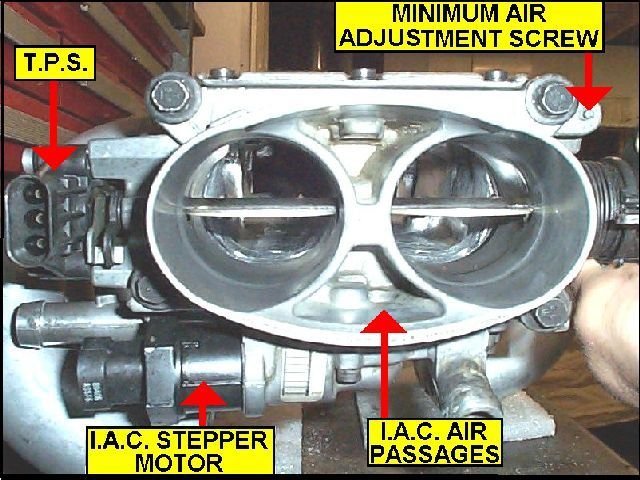
Throttle Position Sensor (TPS)
Tools needed:
1. Digital Volt-Ohm-Meter (VOM)
2. Breakout jumper wires or probes (make your own)
3. AutoXray, Diacom, or similar scanner will replace the VOM and jumper wires.
Turn on ignition, but don't start the engine.
With a diagnostic scanner: plug in the scanner and read the TPS voltage. It should be 0.54Volts +/- 0.07 VDC.
Connect the VOM to the TPS electrical connector terminals ‘A' and ‘B'.
With a breakout jumper: Disconnect the electrical connector from the TPS. Install the breakout in-line, between the TPS and wiring harness connector. Connect the meter probes to terminals 'A' and 'B' on the connector. (‘B' is the positive connection, ‘A' the signal ground, or negative.)
With probes: If you have very slender probes on your VOM, you can back-probe the TPS connector while it is attached to the TPS. If you have made probes of large dressmakers pins or a similar item, you can back-probe the connector as well. Connect the meter probes to terminals 'A' and 'B' on the connector.
Turn on the ignition to read the TPS output voltage at the idle position. The reading should be 0.54VDC +/- 0.07VDC. The ideal is the center of the range, 0.54VDC for a stock engine. To adjust the output voltage, loosen the two Torx screws holding the TPS to the throttle body, and slightly rotate the TPS up or down, reading the voltage until it comes into specification. Tighten screws. Using the throttle lever, rotate the throttle to WOT (wide open throttle). The TPS voltage should be over 4.0 volts. Close the throttle again, and then slowly open it to WOT, observing the voltage reading. It should increase progressively and in a linear fashion. If it sticks or jumps or falls off at all while doing this check, the TPS sensor may be failing and could be a cause of stumbling and driveability problems.
After achieving the desired setting, turn off the ignition switch. Remove all jumpers or the scanner and reconnect the TPS connector as required.
Reinitializing the ECM
If you set a DTC during the procedure, the SES light should be illuminated on the dash. This ECM retains DTC data for the previous 50 engine starts, so the codes will eventually be cleared. If you want more immediate results, after shutting down the engine disconnect the negative battery terminal for five minutes. This will clear the ECM of all diagnostic trouble codes. Clearing the ECM also clears any data learned about your engine, and clears the radio presets. If you have a Delco-Loc or Theft Loc II radio, make sure you follow the procedure to unlock the radio protection before disconnecting the battery. This five minutes is also just about long enough to clean both battery cables. Reconnect the battery. When you first start the engine after clearing the ECM, the engine will operate with base parameters programmed into the ECM PROM. These parameters may not be optimum for your engine, but the ECM will enter a Block Learn Mode soon after the engine is warm and enters Closed Loop Mode. The ECM will write new data tables specific to your engine and will eventually rely on those tables instead of the base tables of the factory program. You can expedite this process by driving the car for 20 minutes under varying conditions to allow the ECM to initialize. Or you can wait and drive the car normally at your convenience. The BLM tables are constantly being updated as sensor input ranges change, but the greatest change will occur within the first twenty minutes of Closed Loop operation.
------------------
Later,
Vader
------------------
"Make Me Bad..."
Adobe Acrobat Reader 4.0
Throttle Minimum Air Position
Tools needed:
1. Torx driver # T-20
2. Paper Clip
3. Small Punch
4. Tachometer
GENERAL NOTE: The engine should be at normal operating temperature before performing any adjustments. Never rely on the dash mounted instruments for diagnostics and adjustments. The oil pressure and temperature gauges and the voltmeter and tachometer just aren't calibrated accurately enough for diagnosis, but are a relative indication for monitoring the vehicle while driving.
For this adjustment, the transmission will be in DRIVE while you're under the hood. You will need to securely set the parking brake and block the drive wheels. It would also be a good idea to have an assistant hold the service brake while you perform the adjustments.
In order to successfully complete the adjustment, the IAC air passages and pintle need to be clean. The throttle plates and bores need to be clean as well. If this is not the case, you'll need to remove the air cleaner from TBI engines or the intake air bellows from TPI engines to gain access to the area to be cleaned. A spray-type carburetor cleaner works well for this. Cleaning the IAC passages on a TPI/MAF engine will set a DTC, but we'll be clearing that later. With the engine idling, direct the spray cleaner in to the IAC air passages and around the throttle plates. Shut off the engine and continue cleaning the throttle plates by opening the throttle manually. Once everything is satisfactorily cleaned, replace the air bellows on TPI engines. Many times, this alone can solve IAC/idle speed problems.
If this doesn't solve the problem, you may need to remove and clean the IAC stepper motor. If the IAC appears to be clean and functioning properly, continue with the adjustment procedure.
- - - - - - - - - - - - - - - - - - - - - - - - - - - - - - - - - - - - - - - -
Idle Air Control Cleaning
You can remove the IAC and service it. Remove the electrical connector from the IAC. Unscrew the IAC unit from the throttle body.
DON'T do what I did the first time! I removed the IAC, plugged it back in to watch operation, then turned on the ignition. The IAC stepped the pintle out to full extended position until the spring took over and launched the pintle across the garage. A while later, after moving a couple of other cars and several pieces of equipment, I found all the parts I neeeded to reassemble the unit.
You can gently rock the pintle back and forth and allow the spring to extend it until it comes apart in your hands. Clean everything with lint-free cloths and a mild solvent. Harsh solvents can affect the insulation of the stepper motor coils. It's generally the dirt and buildup on this worm shaft that causes sluggish IAC operation.
When the worm gear on the pintle shaft is clean and dry, apply one drop of clean light oil to the shaft and work the pintle back into the rack gears of the motor by the same rocking motion. It takes a while to get the pintle back into the worm gears, but you'll get it. It is important to get the pintle fully retracted into the housing so that the pintle is not forced against the gears when reinstalling the IAC unit in the throttle body.
While the IAC is out, clean the air passages in the throttle body. The oriface in the TB where the IAC resides is the seat that the IAC valve closes against, and it can accumulate a lot of carbon, dirt, and debris. The easy way to do this is with carburetor cleaner and a small stiff brush. Another "DON'T" - don't use your sister's toothbrush.
When everything is clean and dry, replace the gasket if it is damaged, apply a little anti-seize to the threads, and torque the IAC to the proper specs. (13 ft/lb for '85-'89 , 30 in/lb for 1990-on.) Proceed with setting the TPS and minimum air position.
- - - - - - - - - - - - - - - - - - - - - - - - - - - - - - - - - - - - - - - -
Cut and form a paper clip into a "U" shape. Insert the clip ends into the ALDL in the 'A' and 'B' sockets. Turn on the ignition, but don't start the engine. This will force the ECM into its diagnostic mode. Wait 30 seconds to allow the IAC pintle to fully extend. Under the hood, remove the electrical connector from the IAC, then turn off the ignition and remove the paper clip jumper from the ALDL. With the IAC pintle fully extended (closed) all idle air will be controlled by the position of the throttle plates.
Locate the Torx screw on the left side of the throttle body. It may be equipped with a protective metal cap from the factory. This was intended to discourage adjustment. If the cap is present, use a small punch to knock it out. Once the screw is accessible, start the engine and place the transmission in DRIVE. Adjust the throttle stop to obtain 450-500 RPM with the transmission in "DRIVE", rotating the Torx screw clockwise to raise speed and counter-clockwise to lower speed. Once the idle RPM is set, place the transmission in PARK and turn off the engine.
Re-connect the electrical connector onto the IAC. Start engine. Idle speed should be governed by the ECM at approximately 650 rpm in "DRIVE" (for unmodified cars). Idle speed in NEUTRAL or PARK is less significant, and will be higher.
Throttle Position Sensor (TPS)
Tools needed:
1. Digital Volt-Ohm-Meter (VOM)
2. Breakout jumper wires or probes (make your own)
3. AutoXray, Diacom, or similar scanner will replace the VOM and jumper wires.
Turn on ignition, but don't start the engine.
With a diagnostic scanner: plug in the scanner and read the TPS voltage. It should be 0.54Volts +/- 0.07 VDC.
Connect the VOM to the TPS electrical connector terminals ‘A' and ‘B'.
With a breakout jumper: Disconnect the electrical connector from the TPS. Install the breakout in-line, between the TPS and wiring harness connector. Connect the meter probes to terminals 'A' and 'B' on the connector. (‘B' is the positive connection, ‘A' the signal ground, or negative.)
With probes: If you have very slender probes on your VOM, you can back-probe the TPS connector while it is attached to the TPS. If you have made probes of large dressmakers pins or a similar item, you can back-probe the connector as well. Connect the meter probes to terminals 'A' and 'B' on the connector.
Turn on the ignition to read the TPS output voltage at the idle position. The reading should be 0.54VDC +/- 0.07VDC. The ideal is the center of the range, 0.54VDC for a stock engine. To adjust the output voltage, loosen the two Torx screws holding the TPS to the throttle body, and slightly rotate the TPS up or down, reading the voltage until it comes into specification. Tighten screws. Using the throttle lever, rotate the throttle to WOT (wide open throttle). The TPS voltage should be over 4.0 volts. Close the throttle again, and then slowly open it to WOT, observing the voltage reading. It should increase progressively and in a linear fashion. If it sticks or jumps or falls off at all while doing this check, the TPS sensor may be failing and could be a cause of stumbling and driveability problems.
After achieving the desired setting, turn off the ignition switch. Remove all jumpers or the scanner and reconnect the TPS connector as required.
Reinitializing the ECM
If you set a DTC during the procedure, the SES light should be illuminated on the dash. This ECM retains DTC data for the previous 50 engine starts, so the codes will eventually be cleared. If you want more immediate results, after shutting down the engine disconnect the negative battery terminal for five minutes. This will clear the ECM of all diagnostic trouble codes. Clearing the ECM also clears any data learned about your engine, and clears the radio presets. If you have a Delco-Loc or Theft Loc II radio, make sure you follow the procedure to unlock the radio protection before disconnecting the battery. This five minutes is also just about long enough to clean both battery cables. Reconnect the battery. When you first start the engine after clearing the ECM, the engine will operate with base parameters programmed into the ECM PROM. These parameters may not be optimum for your engine, but the ECM will enter a Block Learn Mode soon after the engine is warm and enters Closed Loop Mode. The ECM will write new data tables specific to your engine and will eventually rely on those tables instead of the base tables of the factory program. You can expedite this process by driving the car for 20 minutes under varying conditions to allow the ECM to initialize. Or you can wait and drive the car normally at your convenience. The BLM tables are constantly being updated as sensor input ranges change, but the greatest change will occur within the first twenty minutes of Closed Loop operation.
------------------
Later,
Vader
------------------
"Make Me Bad..."
Adobe Acrobat Reader 4.0
Last edited by Vader; Mar 31, 2018 at 09:58 AM. Reason: Updated links

Thread
Thread Starter
Forum
Replies
Last Post
