


IAC question


Thread Starter
Supreme Member
iTrader: (1)
Joined: Apr 2001
Posts: 2,031
Likes: 0
From: Southwest Chicago 'burbs
IAC question
Hey guys, I think I'm having an issue with my IAC, but want to make sure before I buy a new one.
My IAC counts are 160 all the time, indicating it is completely closed. I took the IAC housing off the TB, started the car, and watched the pintle. It didn't move at all from it's closed position. I then put my hand over the IAC opening on the TB itself, choking the motor to the point where it was almost dying. At this point, shouldn't the IAC pintle have gone to 0 counts, or all the way open?
Anyone have a wiring diagram of what the 4 wires are for? I'm guessing one is ground, one is reference voltage, one is signal voltage, but what's the 4th? Is that a ground for the actual IAC solonoid?
Oh, it's a TB and wiring original to the 87 TPI setup.
Thanks
EDIT: am I thinking backwards with my IAC counts? Should 160 be all the way open?
My IAC counts are 160 all the time, indicating it is completely closed. I took the IAC housing off the TB, started the car, and watched the pintle. It didn't move at all from it's closed position. I then put my hand over the IAC opening on the TB itself, choking the motor to the point where it was almost dying. At this point, shouldn't the IAC pintle have gone to 0 counts, or all the way open?
Anyone have a wiring diagram of what the 4 wires are for? I'm guessing one is ground, one is reference voltage, one is signal voltage, but what's the 4th? Is that a ground for the actual IAC solonoid?
Oh, it's a TB and wiring original to the 87 TPI setup.
Thanks
EDIT: am I thinking backwards with my IAC counts? Should 160 be all the way open?

Moderator


Joined: Jan 2000
Posts: 19,684
Likes: 317
No ground. No signal. No reference voltage. The IAC is not a sensor. It is a stepper motor. The ECM controls the IAC not based on any feedback directly from it (as in a the newer IACs and EGR valves) but based on engine RPM and TPS voltage.
Two of the connections are one stepper coil, the other two are the opposite stepper coil. There is an "A" phase and a "B" phase. The biasing voltage and sequence of output pulses applied to these coils determines the direction and rate of travel of the pintle. If the pintle fails to move or the engine RPM does not react, the ECM will continue to try to step the IAC to admit more of less air as required.
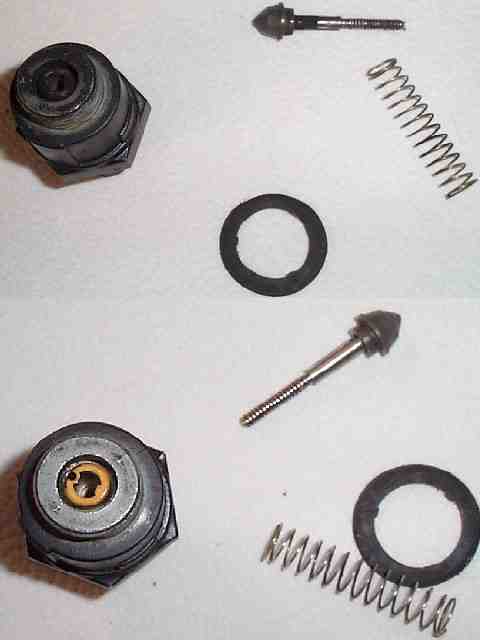
What typically occurs is the pintle becomes dirty, gummed, and varnished, and doesn't move easily. You can manually disassemble the IAC and clean the pintle shaft and rack gears. Carburetor cleaner spray works well for this, but be conservative on teh IAC itself, since some cleaners can dissolve the insulation on the stepper motor windings. Just a quick shot of cleaner to an inverted IAC body and plenty of time to air dry. Clean the pintle shaft with as much cleaner as you like, and a small brush. Apply a single drop of clean engine oil to the pintle shaft, then reassemble the IAC. It might act a lot better after that. If not, you may have an electrical problem with the IAC coils, harness, or ECM.
The difference between a "dead" IAC and fully functional IAC can be only a little dirt and lack of lubrication:
As mentioned, the IAC is only a stepper drive:
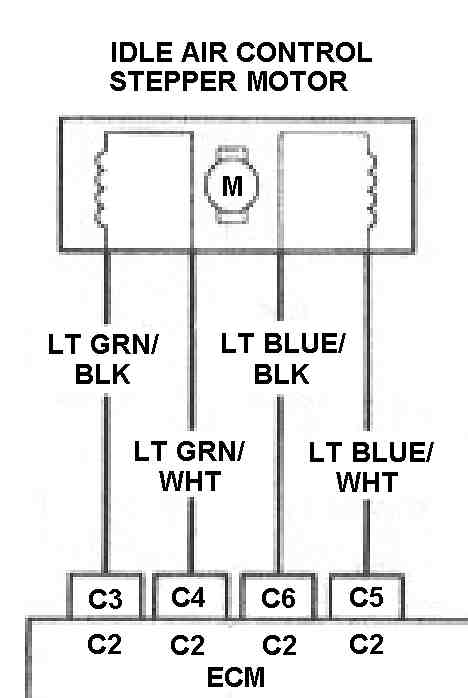
Two of the connections are one stepper coil, the other two are the opposite stepper coil. There is an "A" phase and a "B" phase. The biasing voltage and sequence of output pulses applied to these coils determines the direction and rate of travel of the pintle. If the pintle fails to move or the engine RPM does not react, the ECM will continue to try to step the IAC to admit more of less air as required.
What typically occurs is the pintle becomes dirty, gummed, and varnished, and doesn't move easily. You can manually disassemble the IAC and clean the pintle shaft and rack gears. Carburetor cleaner spray works well for this, but be conservative on teh IAC itself, since some cleaners can dissolve the insulation on the stepper motor windings. Just a quick shot of cleaner to an inverted IAC body and plenty of time to air dry. Clean the pintle shaft with as much cleaner as you like, and a small brush. Apply a single drop of clean engine oil to the pintle shaft, then reassemble the IAC. It might act a lot better after that. If not, you may have an electrical problem with the IAC coils, harness, or ECM.
The difference between a "dead" IAC and fully functional IAC can be only a little dirt and lack of lubrication:
As mentioned, the IAC is only a stepper drive:
Last edited by Vader; Mar 31, 2018 at 10:15 PM. Reason: Updated links
Thread Starter
Supreme Member
iTrader: (1)
Joined: Apr 2001
Posts: 2,031
Likes: 0
From: Southwest Chicago 'burbs
I cleaned it up this afternoon and got rid of all the carbon buildup on the entire housing and IAC, but it was still no go. I went out and bought a new one ($40 bucks!), and it works like it should.
When I has the TB off, it was on my workbench and fell on the ground. I think it broke the worm gears, because when I twisted the pintle, it would not move in or out of the housing. It would only spin. I checked the resistance on both coils and they were something like 24milli ohms each.
Another quick question though: If there is no potentiometer or anything in the IAC, how does the ECM know exactly what position the pintle is at? Does it reset itself at all the way open or closed and then monitor it from there? How would it calculate weakening over time from wear?
When I has the TB off, it was on my workbench and fell on the ground. I think it broke the worm gears, because when I twisted the pintle, it would not move in or out of the housing. It would only spin. I checked the resistance on both coils and they were something like 24milli ohms each.
Another quick question though: If there is no potentiometer or anything in the IAC, how does the ECM know exactly what position the pintle is at? Does it reset itself at all the way open or closed and then monitor it from there? How would it calculate weakening over time from wear?
Moderator
Joined: Jan 2000
Posts: 19,684
Likes: 317
The ECM doesn't have a clue about pintle position. It only outputs to the IAC to achieve the desired engine RPM. If the IAC is at a given position and the RPM is correct, there is no IAC output. If RPM is too low, the ECM will try to step the IAC open, and vice-versa.
Thread Starter
Supreme Member
iTrader: (1)
Joined: Apr 2001
Posts: 2,031
Likes: 0
From: Southwest Chicago 'burbs
So what are the counts? Is that the number of "open" or "closed" pulses the ECM sends to the IAC?
Like this?
160=160 open counts, 0 closed counts
0=0 open counts, 160 closed counts
50=50 open counts, and 80 closed counts
etc, etc, etc, etc, etc, etc, etc, etc, etc.................
If so, that would explain the really strange alternating voltage readings I was seeing on the wires.
Thanks for all your help vader
Like this?
160=160 open counts, 0 closed counts
0=0 open counts, 160 closed counts
50=50 open counts, and 80 closed counts
etc, etc, etc, etc, etc, etc, etc, etc, etc.................
If so, that would explain the really strange alternating voltage readings I was seeing on the wires.
Thanks for all your help vader

Thread
Thread Starter
Forum
Replies
Last Post
