When you click on links to various merchants on this site and make a purchase, this can result in this site earning a commission. Affiliate programs and affiliations include, but are not limited to, the eBay Partner Network.
Tech / General EngineIs your car making a strange sound or won't start? Thinking of adding power with a new combination? Need other technical information or engine specific advice? Don't see another board for your problem? Post it here!
4 of the roller rockers on my Vortec heads don't hit the center of the valve tip. Has been driving with this for a couple of seasons. Engine works great. The reason is probably that the rocker arm bolts leans app 1/32" against the valve on these. I have checked.
-Will it help to use a slightly shorter push rod to move the hitting point towards the centre of the tip? -Will changing to a cam with slightly higher lift make this worse? Am planning to increase lift from .500" and up to .525"
Or am I overthinking and making problems out of nothing?
As long as it is not riding on the edge of the tip, off center is fine. The goal with different length pushrods is to make the sweep pattern as narrow as possible.
Changing the cam normally does not change the pushrod length requirement. The increased valve height is not achieved by a higher lobe height but by a lower base circle height. It never hurts to check valve train geometry after a cam swap anyway.
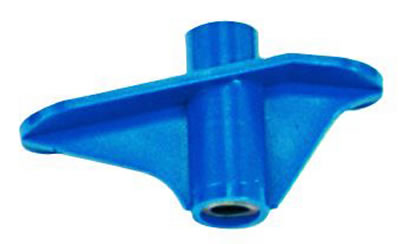
Buy one of these to see if your pushrods are the proper length
Last edited by AlkyIROC; Oct 24, 2022 at 01:02 PM.
Thanks for your answer.
The other alternative is to change to 1.6 rocker arms.
that will increase lift to .533», and a .038» Safety clearance margin.
Is that margin risky?
A 1.6 rocker only moves the pushrod hole slightly closer to the rocker stud to get the increased ratio. Technically a 1.6 rocker swap is just a poor mans cam swap. Although it still increases light slightly, it will not change duration, LSA etc which a cam swap can do to help increase power.
As for how much lift can you get, it's hard to tell. The first is if there is enough room between the piston and the valve. This distance is measured as the piston is going down and the intake valve is opening while chasing the piston and as the piston is coming up chasing the exhaust valve as it is closing. There's a specific number for clearance for each valve and you need to have at least the minimum allowable space. Something as simple as advancing or retarding the cam can change that value.
If piston to valve clearance is enough, the valve springs need to allow more lift. Too much lift and the springs can make contact with each coil and will fail. There's also spring retainer clearance. That's the gap between the bottom of the retainer and the top of valve guide/seal. If the retainer makes contact, it will fail.
There's a big difference between assembling an engine and building an engine. Anybody can throw a bunch of parts together and say they built an engine but anyone properly building an engine will tear it down multiple time to make sure everything is correct.
I know that a cam change and and a rocker ratio change isn't quite the same.
All parts and factors was checked during the head upgrade so I know the .533" lift is not a problem.
Except from the mentioned security margin from seal to retainer that is only .038" when lift is .533"
The total distance is .571".
.533" lift makes for a safety margin on .038" only.
And isn't that small?
Or is it ok for a non racing engine with a max rpm's around 6000?
... Technically a 1.6 rocker swap is just a poor mans cam swap. Although it still increases light slightly, it will not change duration, LSA etc which a cam swap can do to help increase power.
Technically, the duration is ground into the cam, and cannot be changed by the valvetrain. However, changing effective duration (usually measured at 0.050" valve lifts) will occur with a changed rocker ratio. The change is very minor, and practically irrelevant, but is there nonetheless.
Your suggestion of a cam change to alter those parameters is certainly the practical approach, and may or may not resolve any geometry issues which exist. The fact that the rocker tip is staying on the valve is good. My suspicion is that the rocker stud may not be straight relative to the head/boss, and if that is not due to a bent stud, it may indicate that the layout for head machining might have been done with a 9" torpedo level, a carpenters' square, and a chalk line.
Recommended specification, minimum clearance between the bottom of the spring retainer and the top of the valve seal should be no less than 0.060". That's for all engines regardless of rpm range.
Thanks for all your inputs.
After some thinking, I have decided to keep it as it is.
The uneven rocker arm bolts is my own responsibility.
Existing cam have .500" lift. The plan was to change to a .525" lift cam.
Taking off the rockers showed me that the parts seems to work well with toadys set up, with my amateur rocker arm replacement.
Don't want to push the limits any more.
Will have a good time driving the car instead!