When you click on links to various merchants on this site and make a purchase, this can result in this site earning a commission. Affiliate programs and affiliations include, but are not limited to, the eBay Partner Network.
So, I got my fuel rail lifted up with all 8 injectors, and lines all intact. Put small cups under each pair of injectors, and pressurized the system. I'm looking for leaking injectors of course, since my pressure goes down quicker than it should. I did not see any obvious "drippers", but most all injector tips were wet, and a little bit of fuel in the cups. Pressure goes down from 40-10 in about 10 mins. Quicker drop at the higher pressure, with permanent gage on the rail. Original stock multec injectors. Would these "wet" tips be enough to cause the pressure to drop like i see? Also, all injector electrical connections are pulled, would that matter? Obviously not starting the engine, just going to run and energize the pump.
Next test i did, was the same thing with the return line pinched off. Same results as above. Pressure still goes down, and tips are wet. Where else can the fuel go? Should i try pinching off the supply line?
And yes, since you will ask, i have new injectors waiting to go in, Bosch III 24 lbers............
Pressure up the system, pinch off the supply hose and see if it holds. Wet injector tips won't be enough to drop 30 psi IMO. I think it's probably the check valve on the pump leaking off. You already did the test with the return side so it's not the regulator.
Pressure up the system, pinch off the supply hose and see if it holds. Wet injector tips won't be enough to drop 30 psi IMO. I think it's probably the check valve on the pump leaking off. You already did the test with the return side so it's not the regulator.
Well, i did this after my post above. Pinched off the supply line and achieved the same results. So, i sort of did follow the flowchart, just not in the order it listed. I only have 1 hose pincher tool, so i could not pinch both lines at the same time. I did several pressure tests, pretty much 7 of 8 injectors have wet tips, just did not witness an actual "drip", but fuel was coming out of them for sure. Like i said, it takes several minutes for the pressure to get down to 10 or so. These injectors are 32+ years old, and beat up. Its just time to ditch them. B-IIIs going in tomorrow......
Who else but me can spot the kinda big mistake in this chart ?
It doesn't take into account the elapsed time between key on - prime cycle - pump off and you running back under the hood to pinch off the lines. The lines need to be pinched off during the prime cycle. It doesn't matter what the pressure is, you're just seeing if it holds pressure or not.
You can have a helper operate the key or momentarily jumper the fuel pump relay (avoid dead heading the pump more than necessary).
Last edited by paulo57509; Apr 16, 2020 at 03:45 PM.
Well....problem solved. New B-3s in, and locked down. Pressurized the system, with 4 key-on/off flips, and she holds good now! Like real good, not going down at all!
So, for the bad news, i gotta lift the rail back up, to get the left side runner weaseled in. No other way to get it under the rail. And, i didnt get the 9/16" bolt that holds fuel line bracket, down to the front of the engine. That one is a pain, as i left all fuel lines connected. I think i might just shorten the bolt, so i can get it started. Dont need to be so long, just to hold that plate down.
And, take a look at my #2 injector.......doesnt look too good on the inlet end, yes? I found one small piece of it, on the intake.....but not all of it!
It doesn't take into account the elapsed time between key on - prime cycle - pump off and you running back under the hood to pinch off the lines. The lines need to be pinched off during the prime cycle. It doesn't matter what the pressure is, you're just seeing if it holds pressure or not.
You can have a helper operate the key or momentarily jumper the fuel pump relay (avoid dead heading the pump more than necessary).
Hi Paulo , The mistake I saw is that in the first set of "Holds" and "Not Holding" results they have the blocks reversed . As the chart is presently written , it has you declare the in tank components faulty when it holds pressure with the pressure line clamped . This is of course wrong , and I will post a corrected chart here ;
Hi Paulo , The mistake I saw is that in the first set of "Holds" and "Not Holding" results they have the blocks reversed . As the chart is presently written , it has you declare the in tank components faulty when it holds pressure with the pressure line clamped . This is of course wrong , and I will post a corrected chart here ;
Not so fast here.....does it matter which line you block off first, as to where you go in the flowchart? Blocking both of my fuel lines, separately, still resulted in "Not Holding". And it was leaking injectors which was the source of the leak. My FP gage, is on the rail at the schrader port. If you block the supply line off, and have leaking injectors, i would think the pressure on the rail would still go down....just saying.
If I think (that's laughable) through the chart, the chart as written makes sense to me.
Originally Posted by MikeT 88IROC350
Not so fast here.....does it matter which line you block off first, as to where you go in the flowchart? Blocking both of my fuel lines, separately, still resulted in "Not Holding". And it was leaking injectors which was the source of the leak. My FP gage, is on the rail at the schrader port. If you block the supply line off, and have leaking injectors, i would think the pressure on the rail would still go down....just saying.
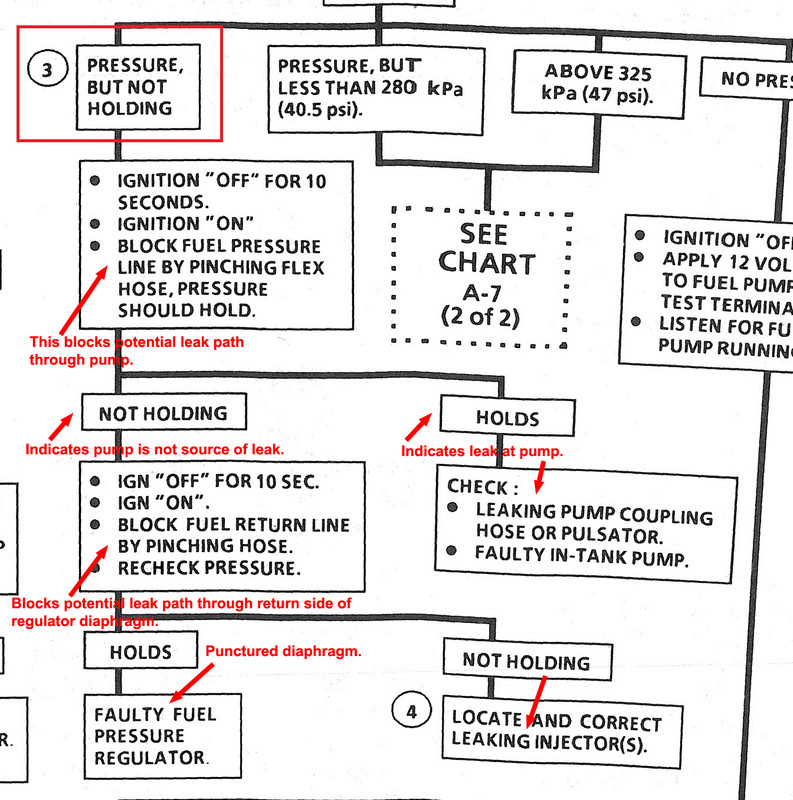
Assuming the block is affected by pinching off the rubber hoses to the fuel rail:
Order of operations : If you first block only the return and the pressure holds, that means that the leak cannot be at the regulator, injectors or the pump This is the same as if there was no leakage, yes?
If you first block off the return, the leak can still be at the regulator, injectors or the pump. So yes, I believe it does matter which line you block off first because you have to first determine if the pump is at fault.
Last edited by paulo57509; Apr 17, 2020 at 03:53 AM.
If I think (that's laughable) through the chart, the chart as written makes sense to me.
Assuming the block is affected by pinching off the rubber hoses to the fuel rail:
Order of operations : If you first block only the return and the pressure holds, that means that the leak cannot be at the regulator, injectors or the pump This is the same as if there was no leakage, yes?
If you first block off the return, the leak can still be at the regulator, injectors or the pump. So yes, I believe it does matter which line you block off first because you have to first determine if the pump is at fault.
I agree. But I started at blocking the return line, and as the gage is on the rail, if the injectors leak, the pressure will drop. That is where I started, as i did not have my FSM open to the flowchart. I used a hose pincher tool, to squeeze the flex hoses going to the hard lines. So what i am saying, is that it doesnt matter which fuel lines you pinch, if you have leaking injectors, they will cause pressure drop both ways. (injectors are what i was focusing on, as i had the new ones sitting on my workbench)
Starting at the return line, would not rule out the pump.......just regulator or injectors. Why would this be the same as no leaking? No leaking would be normal, without pinching any lines, thus you wouldnt be looking at the flowchart at all. The order of operations does make sense, as written.
As far as your red notes on the chart, spot on!
If I think (that's laughable) through the chart, the chart as written makes sense to me.
Assuming the block is affected by pinching off the rubber hoses to the fuel rail:
Order of operations : If you first block only the return and the pressure holds, that means that the leak cannot be at the regulator, injectors or the pump This is the same as if there was no leakage, yes?
If you first block off the return, the leak can still be at the regulator, injectors or the pump. So yes, I believe it does matter which line you block off first because you have to first determine if the pump is at fault.
Thank you for explaining that Paulo , it took me a while to finally see where I was wrong , and it was that my mind was stuck on thoughts of cars without a test port on the rail , where to take a pressure reading it required putting a T fitting on the pressure line leading from the tank . It just seemed wrong to me till I remembered the test port is on the rail and not plumbed in at the union of the metal to flexible line , and I appreciate your insight .
Thank you for explaining that Paulo , it took me a while to finally see where I was wrong , and it was that my mind was stuck on thoughts of cars without a test port on the rail , where to take a pressure reading it required putting a T fitting on the pressure line leading from the tank . It just seemed wrong to me till I remembered the test port is on the rail and not plumbed in at the union of the metal to flexible line , and I appreciate your insight .
For me, these flow charts are often confusing because you need to read between the lines to interpret the meaning and results and of each test. And I've seen errors in some service manuals enough times to not take their word at face value.




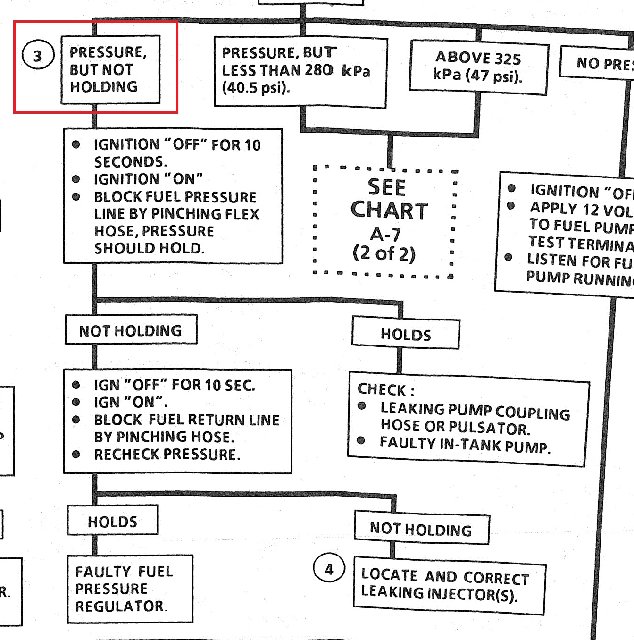


 Who else but me can spot the kinda big mistake in this chart ?


 Hi Paulo , The mistake I saw is that in the first set of "Holds" and "Not Holding" results they have the blocks reversed . As the chart is presently written , it has you declare the in tank components faulty when it holds pressure with the pressure line clamped . This is of course wrong , and I will post a corrected chart here ;
 : If you first block only the return and the pressure holds, that means that the leak cannot be at the regulator, injectors or the pump This is the same as if there was no leakage, yes?
