


Putting 5th Gen Brembos On a 3rd Gen?


Thread Starter
Member
Joined: Mar 2010
Posts: 284
Likes: 0
From: charlotte
Car: 1986 Camaro
Transmission: T5
Axle/Gears: 411
Putting 5th Gen Brembos On a 3rd Gen?
Has anyone here put 5th Gens SS Brembos On their 3rd gen Camaro? What needs to be done?
I have 4th gen brakes on the rear but my fronts are stock, I figured why not just put the 5th Gen brakes all around instead.
I have 4th gen brakes on the rear but my fronts are stock, I figured why not just put the 5th Gen brakes all around instead.


Joined: Aug 2011
Posts: 2,381
Likes: 10
From: San Diego, California For Now
Car: 88 Formula, 90 Iroc RIP, 92 RS Sold
Engine: 305 to 350
Transmission: 700r4
Axle/Gears: 10 Bolt
Re: Putting 5th Gen Brembos On a 3rd Gen?
Camaro ss and CTS v are the same caliper 4 piston Brembo
For the rear you have to figure sum thing out for parking brake as there disc rotors with drum parking brake all in one you would need a bracket also but remember you have a 10 bolt so if you want to upgrade to a stronger rear end then you have to start from scratch
You would be fine with just front 4 piston less hassle until you gather parts for rear


Member
Joined: Nov 2009
Posts: 415
Likes: 0
From: Pasco, WA
Car: 88 Iroc Z, 00 SS
Engine: 5.7 HSR, 5.7 LS1
Transmission: 700r4, T56
Axle/Gears: 3.23, 3.42

Supreme Member
iTrader: (2)
Joined: May 2002
Posts: 4,449
Likes: 8
From: Everett, WA
Car: 87' IROC
Engine: L98
Transmission: T56
Re: Putting 5th Gen Brembos On a 3rd Gen?
5th gen Camaro SS / 1st gen CTS-V front brakes. You really have to want to run these. They do not mount very nice and require 1LE offset hubs.
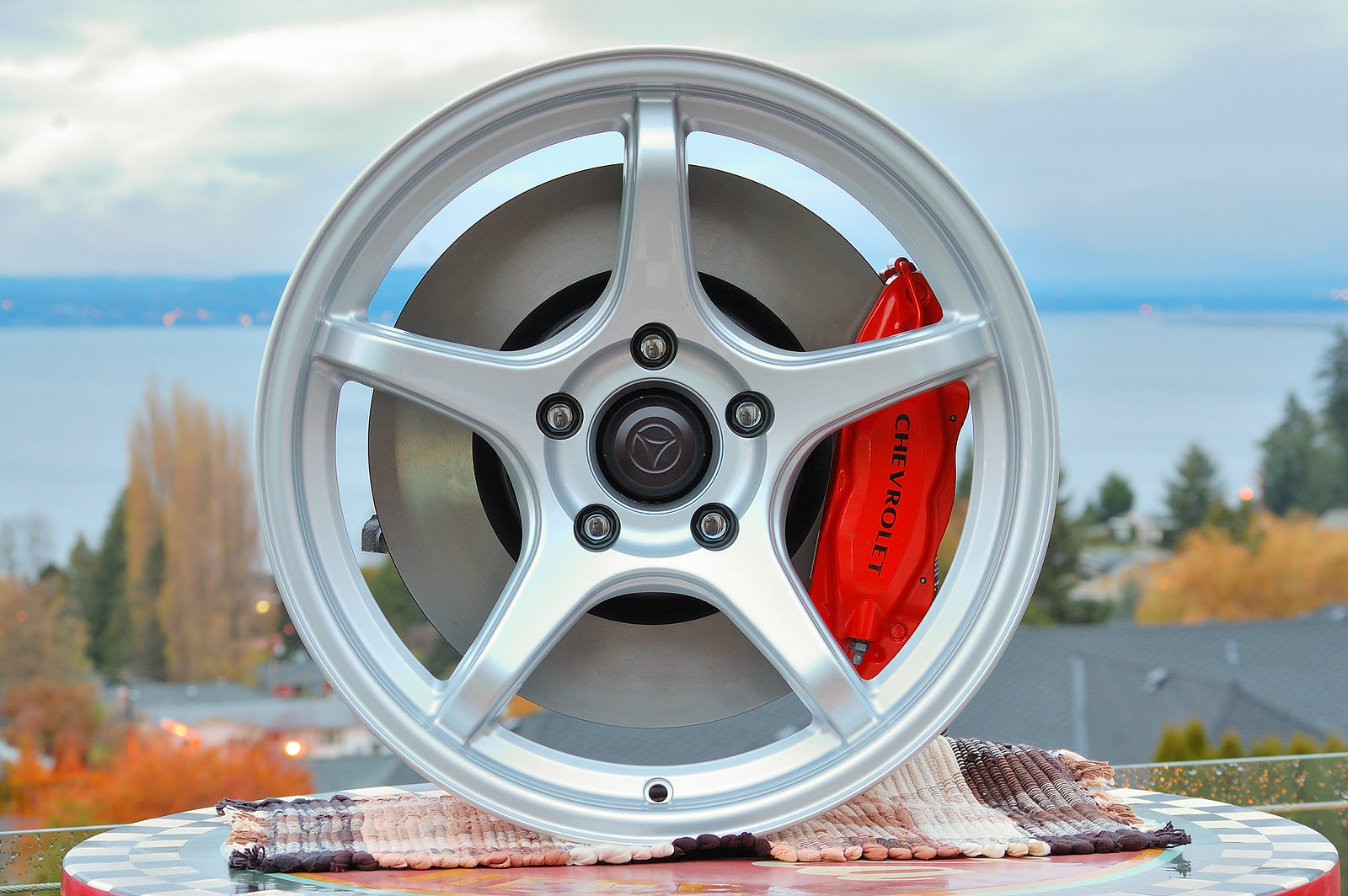
5th gen Camaro SS / 1-2 gen CTS-V rear brakes. You also really have to want these if you want to retain a working e-brake. No e-brake, then the fitment is a piece of cake.


5th gen Camaro SS / 1-2 gen CTS-V rear brakes. You also really have to want these if you want to retain a working e-brake. No e-brake, then the fitment is a piece of cake.

Junior Member
iTrader: (1)
Joined: Jun 2003
Posts: 55
Likes: 0
From: Austin, Texas
Car: 1990 IROC Convertible
Engine: 5.7 TPI, L98 Heads w/roller rockers
Transmission: T-5
Re: Putting 5th Gen Brembos On a 3rd Gen?
Just got my setup in, Scott at bigbrakeupgrade.com has the kits, and he is currently designing the rear fitment for my 4th gen rear end. Looking forward to the finished product!

Trending Topics

Supreme Member
Joined: Jun 2005
Posts: 1,440
Likes: 2
From: huntsville, al
Car: 89 IROC
Engine: 6.8 HSR N2O
Transmission: TKO 600
Axle/Gears: 9" Moser 3.50 True trac
Re: Putting 5th Gen Brembos On a 3rd Gen?
Yep, he's got it all. Just a click or email away! If you've done the LS upgrade you'll only need a pair of calipers and discs. Not sure about the lines but he can tell you.

Junior Member
Joined: Sep 2013
Posts: 88
Likes: 0
From: Random Hostile Territories
Car: 1992 RS Heritage Edition
Engine: LS6 Mut
Transmission: 4L60E
Axle/Gears: Stock
Re: Putting 5th Gen Brembos On a 3rd Gen?
I've got 5th gen rotors and calipers on the front of my 92 and they work like a champ from scott at bigbrakeupgrade.com Waiting on him to finish designing the rear bracket so I can get it and matching rotors to mount the calipers that came with the front.
Junior Member
Joined: Sep 2013
Posts: 88
Likes: 0
From: Random Hostile Territories
Car: 1992 RS Heritage Edition
Engine: LS6 Mut
Transmission: 4L60E
Axle/Gears: Stock


Joined: Jun 2003
Posts: 5,028
Likes: 78
From: Desert
Car: 1991 Z28 Vert
Engine: 383 single plane efi
Transmission: T-56
Axle/Gears: 8.8 with 3.73s
Re: Putting 5th Gen Brembos On a 3rd Gen?
5th gen Camaro SS / 1st gen CTS-V front brakes. You really have to want to run these. They do not mount very nice and require 1LE offset hubs.
5th gen Camaro SS / 1-2 gen CTS-V rear brakes. You also really have to want these if you want to retain a working e-brake. No e-brake, then the fitment is a piece of cake.
5th gen Camaro SS / 1-2 gen CTS-V rear brakes. You also really have to want these if you want to retain a working e-brake. No e-brake, then the fitment is a piece of cake.
Supreme Member
iTrader: (2)
Joined: May 2002
Posts: 4,449
Likes: 8
From: Everett, WA
Car: 87' IROC
Engine: L98
Transmission: T56
Re: Putting 5th Gen Brembos On a 3rd Gen?
I would like to know your opinion ( aside from pedal feel and or travel ) about how well a fixed caliper would last or perform on our rear ends. Our axles have much more play in them then a fixed hub of an independent suspension. I have always heard that is a big reason for staying with a floating caliper on the rear end. That and our cars can be up to 1000# lighter and have more of the weight in the front of the car which would allow a floating to be absolutely efficient.
I and others have done track days on the baby 10.5" rear iron brakes with no issues at all, on street pads. Granted, my car has modest power and modest grip. People seem to have endless trouble with the 10.5" rear brakes, but I am not one of them. I have no complaints at all. The best thing you can do to make these brakes work well is to gut the stock prop valve and use an adjustable prop valve and dial in a bias for your car. The e-brake is also no issue as long as it is adjusted.
If you find you are fading your pads, and are unwilling to run a more aggressive pad, then I would suggest upgrading to the later year pbr rear brakes. I would be shocked if anyone could fade these with a suitable pad on the track.
Beyond that you can always use a larger rotor.
The other big reason to use fixed calipers is for the better feel. However on cars like ours, they can be more of a detriment than a help. Most of our cars came with a 10 bolt with c-clip axles. There is quite a bit of inherent play in the c-clip retention. You can actually feel some in and out play if you shake an installed axle. I don't know about the 10 bolt specifically, but max end play for differentials is usually in the neighborhood of 0.030" or about 1/32". This means that when you go around a corner, the axle and therefore the rotor on the inboard tire is going to want to go outboard by half the axle end play and the outboard tire/axle/rotor is going to want to go inboard by half the axle end play.
When this happens, if you have floating calipers, and the calipers are in proper working order, the caliper will slide with the moving axle, reducing or eliminating any movement in the caliper piston. So you pads stay tight with the rotor. If you have fixed calipers, the caliper body cannot move, so any movement in the axle is taken up by displacing the caliper pistons. Now after you exit the turn, your pads are further away from the rotor. This is called pad knock back. So the next time you hit the brakes, you will get a soft pedal because the pads need to be brought back out to the rotor before they begin doing their job. For this reason I never recommend using fixed calipers with un-modified c-clip axles. You can try new c-clips to see if they reduce the end play, or you could make shims to really dial it in. I am not a c-clip expert, so please do your research before trying this. Also, you can purchase c-clip eliminators that basically convert a c-clip axle to a bolt in axle like discussed below. Just make sure to use eliminators with tapered roller bearings and not ball bearings.
Not all differentials use c-clip retention. If you are lucky and own a 9 bolt, you have bolt in axles. In this design, the axles are retained by a plate that is bolted to the axle tube flange that is out by the wheel. The plate holds the tapered wheel bearing into the axle housing. I don’t know about the 9 bolt specifically, but typical maximum axle end play for bolt in axles is about 0.010”. The third gen Dana 44 also uses this design. You still have all the downsides of a c-clip axle mentioned above but they are much reduced due to the tighter axle end play. You can shim the plates to reduce end play. This is never a bad idea, especially when running fixed calipers.
It is also important to note that the larger the rotor, the more pronounced the pad knock back will be. So keep that in mind.
Another possible solution to pad knockback may be the use of a residual pressure valve on your rear brake line. The valve keeps a constant minimum fluid pressure (typically 2psi) on the brake fluid downstream of the valve. This may be enough to push the caliper pistons back out after a turn.
Now to compare to an IRS or full floater, you are probably looking at about a max end play of about 0.005” for those.
John

Thread
Thread Starter
Forum
Replies
Last Post
eightsixseven
Tech / General Engine
2
Dec 16, 2024 01:50 PM
xbmx89
South Central Region
4
Oct 31, 2015 10:59 AM
